
- Home
- »
- Next Generation Technologies
- »
-
Cognitive Computing Market Size, Share Report, 2026 - 2033GVR Report cover
![Cognitive Computing Market (2026 - 2033)Report]()
Cognitive Computing Market (2026 - 2033)
Size, Share & Trends Analysis Report By Technology (Natural Language Processing, Machine Learning, Automated Reasoning), By Deployment (On-premises, Cloud), By Application (Healthcare, Retail), By Region, And Segment Forecasts
Market Size, 2025
$64.5BMarket Estimate, 2026
$82.8BMarket Forecast, 2023
$462.9BCAGR, 2026–2023
27.9%Cognitive Computing Market Summary
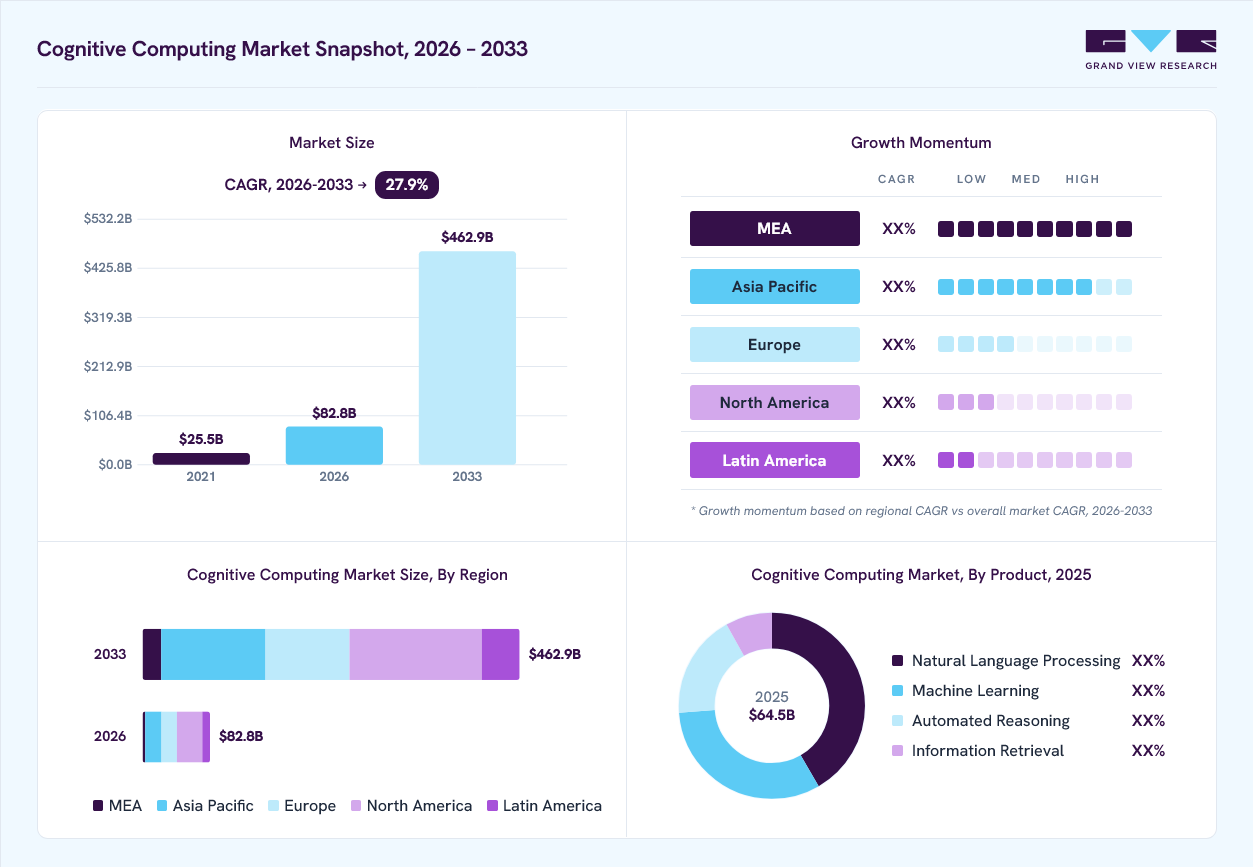
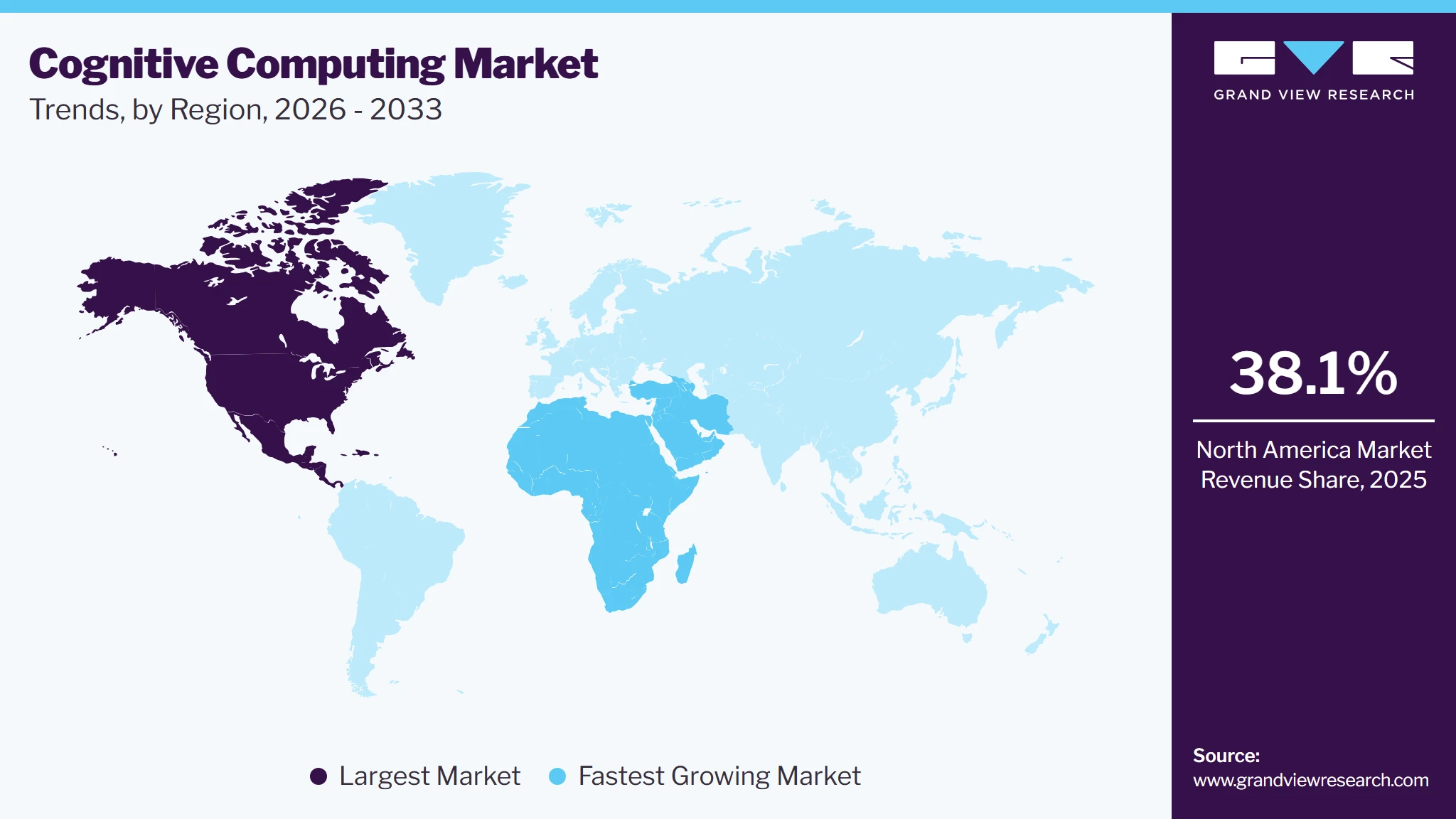
The global cognitive computing market size was valued at USD 64.5 billion in 2025 and is projected to grow from USD 82.8 billion in 2026 to USD 462.9 billion by 2033, growing at a CAGR of 27.9% from 2026 to 2033. North America dominated the global market with the largest revenue share of 38.1% in 2025. The market is driven by the organizations that are increasingly integrating generative AI and multimodal cognitive capabilities into enterprise platforms to enhance contextual understanding, reasoning, and human-like interactions.
Key Market Trends & Insights
- By technology: Natural language processing segment dominated the market, with a revenue share of 41.6% in 2025.
- By deployment: Cloud segment held the largest market share of 71.7% in 2025.
- By application: BFSI segment held the largest market share of 26.1% in 2025.
Regional Highlights
- Largest regional market: North America (38.1% revenue share, 2025)
- Fastest-growing regional market: MEA (highest CAGR, 2026-2033)
- By country: The U.S. held the largest market share in 2025
Market Size & Forecast
- Market size in 2025: USD 64.5 Billion
- Estimated market size in 2026: USD 82.8 Billion
- Projected market size by 2033: USD 462.9 Billion
- CAGR (2026-2033): 27.9%
Companies across industries are recognizing the potential of cognitive technologies, such as natural language processing and machine learning, to enhance decision-making and improve efficiency. The rise in demand for personalized experiences has also fueled the growth of these systems, particularly in sectors such as healthcare, finance, and retail. Cognitive computing solutions are being integrated into various business processes, from customer service to supply chain management.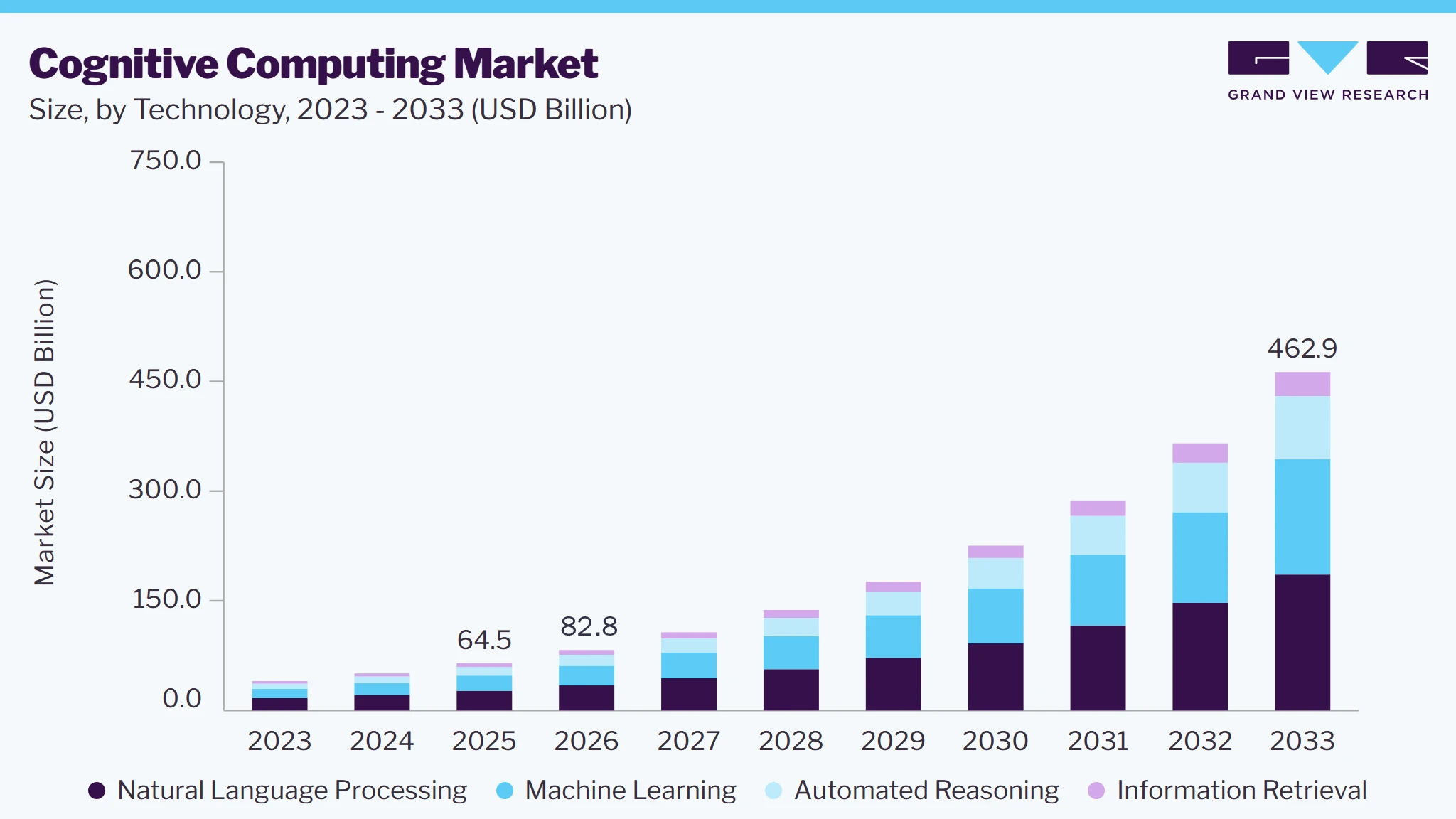
The increasing volume of unstructured data propels the market forward as traditional systems struggle to process it efficiently. Cognitive computing, with its ability to understand and derive insights from such data, offers a valuable solution. Moreover, organizations are focusing on automating repetitive tasks and enhancing productivity, further boosting the demand for cognitive solutions. Governments and public sector organizations are also investing in cognitive technologies to improve services and decision-making. These systems can analyze large datasets, predict trends, and offer actionable insights, helping organizations make informed decisions. Moreover, the integration of cognitive computing with cloud platforms has made these technologies more accessible to businesses of all sizes. As a result, the market has witnessed significant investments from both private and public sectors.
The growing demand for automation is a significant trend driving the market growth. Businesses are increasingly looking for ways to streamline operations and enhance efficiency. Automation allows organizations to reduce human error and improve the accuracy of routine tasks. Cognitive computing technologies, with their advanced data processing capabilities, enable more intelligent automation solutions. This improves productivity and also helps in making faster, data-driven decisions. As automation continues to evolve, more industries are expected to adopt cognitive systems to stay competitive. Furthermore, automation powered by cognitive computing enables businesses to optimize resource allocation and reduce operational costs. As cognitive technologies advance, they are expected to drive even greater innovation across various sectors, transforming the way companies operate and compete in the marketplace.
Market Dynamics
The cognitive computing market is primarily driven by the increasing need for intelligent systems that can analyze unstructured data, automate complex decision-making, and deliver real-time insights across industries. Growing enterprise investments in artificial intelligence, machine learning, and natural language processing are accelerating the adoption of cognitive platforms for improving operational efficiency and customer engagement. The rapid expansion of digital transformation initiatives, combined with rising data volumes from connected devices and business applications, is further strengthening market demand.
Enterprises are increasingly adopting AI-driven decision intelligence to improve the speed, accuracy, and consistency of business decisions across complex operations. Cognitive computing platforms combine artificial intelligence, machine learning, natural language processing, and knowledge graphs to analyze structured and unstructured data, enabling organizations to generate contextual insights and predictive recommendations. This capability is becoming essential as businesses manage growing data volumes and require faster responses to changing market conditions.
Organizations across sectors such as healthcare, banking, manufacturing, retail, and telecommunications are integrating cognitive computing into workflows for risk assessment, customer engagement, supply chain optimization, fraud detection, and operational planning. The increasing focus on digital transformation and intelligent automation is encouraging investments in cognitive technologies that support data-driven decision-making while reducing manual intervention.
The adoption of cognitive computing solutions often requires substantial investments in advanced computing infrastructure, AI software platforms, cloud resources, and data management capabilities, making implementation expensive for many organizations. In addition to initial deployment costs, businesses must invest in system customization, employee training, and ongoing maintenance to ensure effective performance and long-term scalability. These financial commitments can delay adoption, particularly among small and medium-sized enterprises with limited technology budgets.
Integration presents another significant challenge, as cognitive computing platforms must work seamlessly with existing enterprise applications, legacy systems, and diverse data sources. Differences in data formats, outdated IT infrastructure, and interoperability issues increase deployment complexity and extend implementation timelines. As a result, organizations may experience slower returns on investment, limiting the pace of cognitive computing adoption across several industries.
The integration of cognitive computing with edge AI and internet of things (IoT) ecosystems is creating significant growth opportunities by enabling intelligent data processing closer to the source of data generation. Instead of relying solely on centralized cloud infrastructure, organizations can analyze sensor data in real time, reduce latency, and improve decision-making across connected environments. This capability is becoming increasingly valuable in applications where immediate responses are essential, such as industrial automation, smart cities, autonomous systems, and connected healthcare.
As IoT deployments continue to expand globally, the volume of data generated by connected devices is rising rapidly, increasing the need for cognitive systems that can interpret complex information and learn from changing conditions. The combination of edge intelligence and cognitive computing also enhances data privacy, optimizes network bandwidth, and improves operational efficiency by minimizing unnecessary data transfers. These advantages are expected to accelerate enterprise investments and open new opportunities for cognitive computing solution providers across multiple industry verticals.
Market Concentration & Characteristics
The impact of regulations is moderate as governments introduce frameworks for AI governance, data privacy, transparency, and responsible AI deployment. Organizations must ensure compliance with evolving regulations related to data protection, algorithm accountability, and ethical AI practices. Although compliance increases implementation complexity, it also encourages the development of more secure, trustworthy, and explainable cognitive computing solutions.
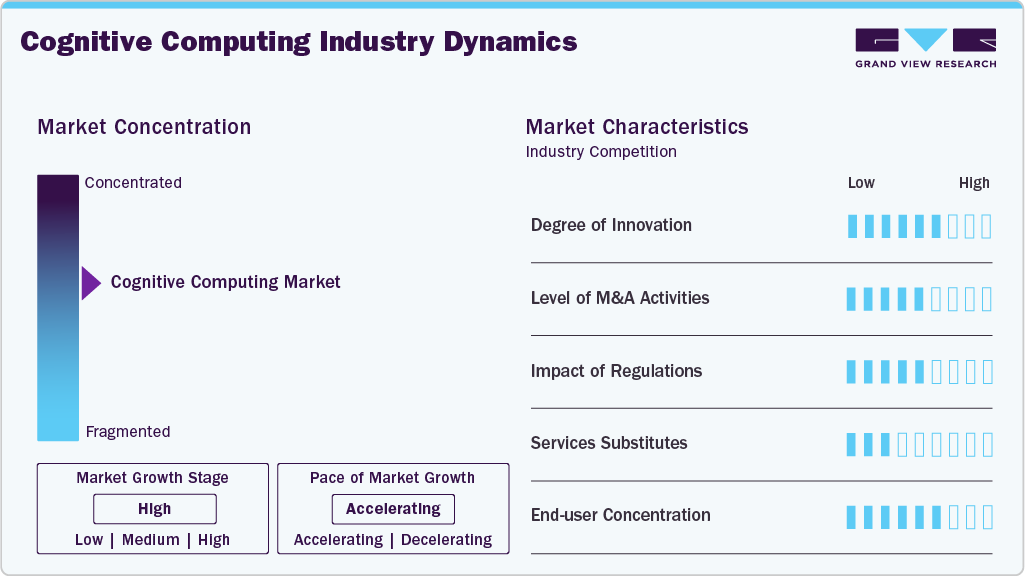
End-user concentration is relatively high, with demand primarily driven by large enterprises and data-intensive industries such as healthcare, banking and financial services, manufacturing, retail, telecommunications, and government. These organizations possess the data infrastructure and investment capacity required for large-scale cognitive computing deployments. However, increasing availability of cloud-based AI services is gradually expanding adoption among small and medium-sized enterprises, broadening the market over time.
Analyst Perspective
The cognitive computing market is entering a phase where competitive advantage is shifting from standalone AI capabilities to enterprise-wide cognitive platforms that integrate reasoning, contextual understanding, predictive analytics, and generative AI into a unified decision-support ecosystem. As organizations continue to digitize operations and manage rapidly expanding volumes of structured and unstructured data, demand is shifting from automation to systems capable of learning, adapting, and delivering actionable insights in real time. The ability to deliver explainable, industry-focused cognitive solutions while integrating seamlessly with existing enterprise workflows is expected to define sustainable differentiation and support long-term revenue expansion.
Technology Insights
Based on technology, the natural language processing segment led the market with the largest revenue share of 41.6% in 2025 and is expected to grow at a significant CAGR over the forecast period, due to its ability to understand and interpret human language. This technology facilitates improved communication between machines and users, enhancing user experiences across various applications. Businesses increasingly rely on NLP for tasks such as sentiment analysis, chatbots, and voice recognition systems. The growing need for efficient customer service solutions further contributes to NLP's prominence in the market. As organizations strive for better engagement and personalized interactions, NLP continues to play a critical role in cognitive computing advancements.
The machine learning (ML) segment is anticipated to grow at a significant CAGR during the forecast period, as organizations seek to leverage data for better insights. This technology enables systems to learn from data patterns, improving their performance over time without human intervention. Businesses are increasingly adopting ML to automate decision-making processes and enhance predictive analytics capabilities. The rise of big data analytics has further fueled the demand for machine learning solutions, allowing organizations to process and analyze vast datasets effectively. As ML algorithms become more sophisticated, their applications across various industries are expanding, driving continued market growth.
Deployment Insights
Based on deployment, the cloud segment led the market with the largest revenue share of 71.7% in 2025, due to its scalability and cost-effectiveness. Organizations benefit from the flexibility of accessing advanced cognitive technologies without significant upfront capital expenditures. This model allows businesses to quickly adapt to changing demands and scale their resources as needed. The cloud environment also promotes collaboration by enabling teams to share insights and data seamlessly. As the demand for agile and innovative solutions rises, the cloud segment continues to lead in the cognitive computing landscape.
The on-premises segment is benefiting within the market as businesses seek enhanced data control and security. Many organizations are adopting on-premises solutions to comply with stringent data privacy regulations and ensure that sensitive information remains protected. This approach allows companies to customize their cognitive systems according to specific operational requirements. On-premises deployments often provide faster data processing capabilities, reducing latency for critical applications. As the importance of data governance increases, more organizations are investing in on-premises cognitive computing solutions.
Application Insights
Based on application, the BFSI segment led the market with the largest revenue share of 26.1% in 2025 and is expected to grow at the fastest CAGR over the forecast period, due to its significant reliance on data analysis and risk management. Organizations within this sector utilize cognitive technologies to enhance fraud detection and streamline compliance processes. The ability to process large volumes of unstructured data allows BFSI companies to gain valuable insights into customer behavior and preferences. Moreover, cognitive computing supports personalized financial services, improving customer satisfaction and loyalty. As financial institutions increasingly adopt innovative technologies, the BFSI segment remains at the forefront of cognitive computing advancements.
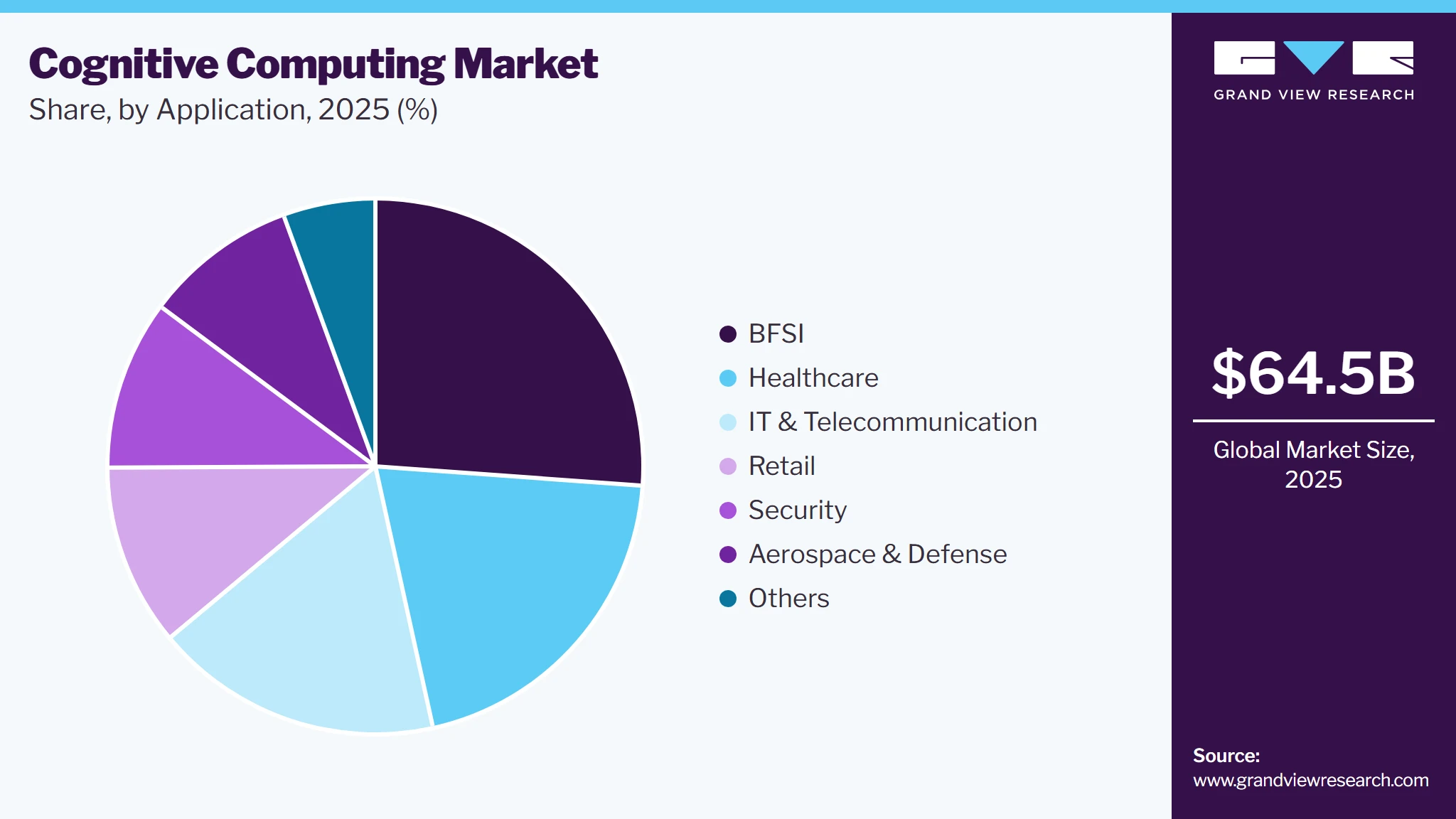
The IT and telecommunications segment is anticipated to experience significant CAGR during the forecast period, as organizations seek to improve operational efficiency and customer engagement. Companies in this sector are implementing cognitive solutions to analyze vast amounts of data generated by network traffic and user interactions. This enables them to optimize service delivery and enhance predictive maintenance strategies. The demand for smarter customer support solutions is driving the adoption of chatbots and virtual assistants in the telecommunications industry. As technology continues to evolve, the IT and telecommunications sector is expected to increasingly leverage cognitive computing to remain competitive and innovative.
Regional Insights
North America dominated the cognitive computing market with the largest revenue share of 38.1% in 2025. The market is growing rapidly in North America, driven by the region's advanced technological infrastructure. Organizations are increasingly adopting artificial intelligence and machine learning to enhance operations, particularly in sectors such as finance and healthcare. The presence of major tech firms and a dynamic startup ecosystem fosters innovation and competition, leading to continuous advancements in cognitive technologies. Moreover, the emphasis on data analytics and personalized customer experiences is further propelling the demand for cognitive computing solutions across various industries.
U.S. Cognitive Computing Market Trends
The cognitive computing market in the U.S. held the largest share in the North America region in 2025. The cognitive computing market in the U.S. is experiencing significant growth due to the presence of leading technology companies that are pioneering advancements in artificial intelligence. The increasing focus on automation and data analytics drives organizations to adopt cognitive technologies for improved efficiency and decision-making. A highly skilled workforce in tech and engineering fields further supports the growth of cognitive computing by enabling organizations to utilize these advanced technologies effectively.
Europe Cognitive Computing Market Trends
The cognitive computing market in Europe is expanding as businesses increasingly recognize the importance of these technologies for improving productivity and compliance. Strict data protection regulations prompt organizations to adopt cognitive solutions that ensure security while driving innovation. European companies are utilizing cognitive computing for applications such as smart manufacturing and enhanced customer service.
Asia Pacific Cognitive Computing Market Trends
The cognitive computing market in Asia Pacific is witnessing rapid growth, driven by the region's increasing digitalization and substantial government initiatives to advance AI technologies. Countries such as China and India are leading this growth, investing heavily in cognitive solutions to enhance various industries, including finance, healthcare, and logistics. The rising adoption of mobile technologies and e-commerce is fueling demand for cognitive applications, enabling businesses to optimize operations and improve customer experience.
Key Cognitive Computing Company Insights
Some of the key companies in the global market include Google LLC, IBM Corporation, Oracle Corporation, Microsoft, Nuance Communications Inc., and others. Organizations are focusing on increasing customer base to gain a competitive edge in the industry. Therefore, key players are taking several strategic initiatives, such as mergers and acquisitions and partnerships with other major companies.
-
Microsoft has made significant progress in cognitive computing with its Azure cloud platform, which provides a range of AI and machine learning services. The company has developed tools such as Azure Cognitive Services, enabling developers to integrate capabilities such as natural language processing, computer vision, and speech recognition into their applications. Moreover, Microsoft’s investments in research and partnerships with academic institutions accelerate advancements in AI technologies
-
Nuance Communications Inc. has made significant advancements in cognitive computing, particularly in conversational AI and natural language processing. The company's Dragon software suite utilizes advanced speech recognition technology to provide accurate transcription and voice commands, greatly enhancing productivity, especially in healthcare. Moreover, Nuance's AI-driven solutions improve customer engagement by automating interactions and gathering insights from conversations. Their developments in voice biometrics further enhance security and simplify authentication processes
Key Cognitive Computing Companies
The following key companies have been profiled for this study on the cognitive computing market.
- CognitiveScale
- Enterra Solutions
- HP Development Company, L.P.
- IBM Corporation
- Microsoft
- Muance Communications Inc.
- Numenta
- Oracle Corporation
- Palantir
- PTC
- Saffron Technology
- SAP
- Statistical Analysis System (SAS)
- Tibco Software
- Vicarious
Competitive Benchmarking
Category
Operating Strategies
Competitive Edge
Weakness
Established Players (Google; HP Development Company, L.P.; IBM Corporation; Microsoft; Oracle Corporation; Palantir)
- Focus on integrating cognitive computing into cloud, analytics, and enterprise software ecosystems.
- Expand capabilities through strategic acquisitions, AI model development, and industry-specific solution portfolios.
- Extensive enterprise customer base supported by global delivery and partner networks.
- Strong investments in AI research, scalable cloud infrastructure, and comprehensive product portfolios.
- Large product ecosystems can increase deployment complexity and implementation timelines.
- Premium pricing and legacy infrastructure may slow adoption among cost-sensitive organizations.
Emerging Players (CognitiveScale; Enterra Solutions; Muance Communications Inc.; Numenta; Saffron Technology; Vicarious)
- Concentrate on niche cognitive AI applications and domain-specific enterprise solutions.
- Emphasize innovation through specialized platforms, partnerships, and flexible deployment models.
- Agile development enables rapid feature enhancements and faster response to evolving customer needs.
- Specialized expertise delivers highly customized cognitive solutions for targeted industry use cases.
- Limited global presence and smaller customer base compared with established technology vendors.
- Lower financial resources can restrict large-scale expansion, marketing, and research investments.
Recent Developments
-
In May 2024, Wipro, an IT company in India, partnered with Microsoft to launch a suite of generative AI-powered cognitive assistants for financial services to enhance market intelligence, accelerate onboarding, and streamline loan origination. These solutions will utilize Microsoft Azure OpenAI and Document Intelligence to provide timely information, reduce paperwork, and improve the overall user experience for financial professionals and their clients
-
In May 2024, IBM Corporation and SAP announced an expanded collaboration focused on generative AI capabilities and industry-specific cloud solutions to help clients enhance business value and accelerate digital transformation. The collaboration aims to integrate AI into various SAP business processes, enabling innovation across sectors while utilizing IBM's expertise in hybrid cloud and AI technologies
-
In February 2024, Microsoft collaborated with Mistral AI, a French artificial intelligence company, to boost AI innovation over several years. This collaboration will use Azure's advanced infrastructure to develop and deploy Mistral's large language models, including the new Mistral Large. This collaboration aims to provide commercial opportunities, enhance AI research and development, and make Mistral AI's models accessible to customers through Azure's Models as a Service (MaaS)
-
In March 2023, Nuance Communications launched Dragon Ambient eXperience (DAX) Express. This innovative voice-enabled medical scribe application integrates OpenAI's GPT-4 to automate clinical documentation by capturing physician-patient interactions and generating draft notes in seconds. This advancement aims to reduce administrative burdens for healthcare providers, enhance documentation accuracy, and ultimately alleviate physician burnout
Cognitive Computing Market Report Scope
Report Attribute
Details
Market size value in 2025
USD 64.5 billion
Market size value in 2026
USD 82.8 billion
Revenue forecast in 2033
USD 462.9 billion
Growth rate
CAGR of 27.9% from 2026 to 2033
Base year for estimation
2025
Historical data
2021 - 2024
Forecast period
2026 - 2033
Quantitative units
Revenue in USD billion/million and CAGR from 2026 to 2033
Report coverage
Revenue forecast, company ranking, competitive landscape, growth factors, and trends
Segments covered
Technology, deployment, application, region
Regional scope
North America, Asia Pacific; Europe; MEA; Latin America
Country scope
U.S.; Canada; Mexico; Germany; UK; France; China; Japan; India; South Korea; Australia; Brazil; Saudi Arabia; South Africa; UAE
Key companies profiled
CognitiveScale; Enterra Solutions; Google; HP Development Company; L.P.; IBM Corporation; Microsoft; Nuance Communications, Inc.; Numenta; Oracle Corporation; Palantir; PTC; Saffron Technology; SAP; Statistical Analysis System (SAS); Tibco Software; Vicarious
Customization scope
Free report customization (equivalent up to 8 analysts' working days) with purchase. Addition or alteration to country, regional & segment scope.
Pricing and purchase options
Avail customized purchase options to meet your exact research needs. Explore purchase options
Global Cognitive Computing Market Report Segmentation
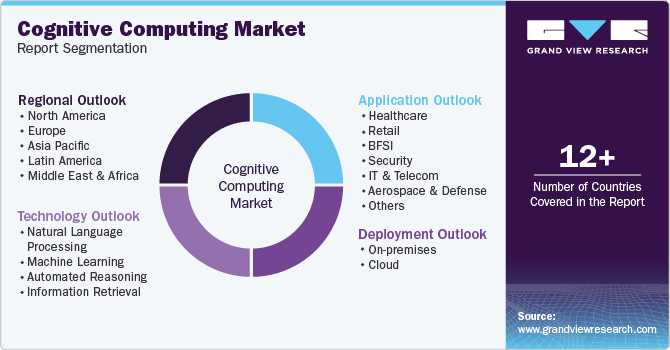
This report offers revenue growth forecasts at the global, regional, and country levels and provides an analysis of the latest industry trends in each of the sub-segments from 2021 to 2033. For this study, Grand View Research has segmented the global cognitive computing market report based on technology, deployment, application, and region:
-
Technology Outlook (Revenue, USD Billion, 2021 - 2033)
-
Natural Language Processing
-
Machine Learning
-
Automated Reasoning
-
Information Retrieval
-
-
Deployment Outlook (Revenue, USD Billion, 2021 - 2033)
-
On-premises
-
Cloud
-
-
Application (Revenue, USD Billion, 2021 - 2033)
-
Healthcare
-
Retail
-
BFSI
-
Security
-
IT & Telecom
-
Aerospace & Defense
-
Others
-
-
Regional Outlook (Revenue, USD Billion, 2021 - 2033)
-
North America
-
U.S.
-
Canada
-
Mexico
-
-
Europe
-
UK
-
Germany
-
France
-
-
Asia Pacific
-
China
-
Japan
-
India
-
South Korea
-
Australia
-
-
Latin America
-
Brazil
-
-
Middle East & Africa (MEA)
-
KSA
-
UAE
-
South Africa
-
-
Research Methodology
The cognitive computing market figures in this report are based on a proven research process that combines executive interviews with secondary research from proprietary databases, company filings, and recognized regulatory and institutional sources. Market size is built through value-chain sizing - reconciling supply-side and demand-side estimates - and triangulated with bottom-up and top-down approaches. Every estimate passes multiple levels of expert validation before publication, with each cognitive computing segment quantified using the revenue-capture definitions in the table below.
Segment Definition
Segment - Technology
Revenue capture definition
Natural Language Processing
This segment captures revenue from cognitive computing platforms that interpret, analyze, and generate human language through text and speech processing. It includes solutions used for chatbots, virtual assistants, sentiment analysis, document processing, and language translation.
Machine Learning
Revenue in this segment is generated from platforms that identify patterns, learn from data, and improve prediction accuracy without explicit programming. It covers supervised, unsupervised, and reinforcement learning solutions deployed across enterprise applications.
Automated Reasoning
This segment includes revenue from cognitive systems that apply logical inference, knowledge representation, and rule-based reasoning to support complex decision-making. Its adoption spans fraud detection, compliance management, diagnostics, and intelligent recommendation systems.
Information Retrieval
Revenue is derived from technologies that organize, search, and retrieve relevant information from structured and unstructured data sources. The segment covers enterprise search, semantic search, knowledge discovery, and content management solutions.
Segment - Deployment
Revenue capture definition
Cloud
Cloud deployment captures revenue generated from subscription-based cognitive computing platforms, AI services, and cloud-hosted analytics delivered through public, private, or hybrid cloud environments. Revenue includes platform licensing, managed services, API usage, storage, and computing resources supporting scalable AI workloads.
On-Premise
On-premise deployment captures revenue from cognitive computing software installed and managed within an organization's own IT infrastructure. It includes perpetual software licenses, implementation services, infrastructure integration, maintenance, upgrades, and technical support for enterprise-owned environments.
Segment - Application
Revenue capture definition
Healthcare
Revenue includes cognitive computing platforms used for clinical decision support, medical imaging analysis, patient monitoring, personalized treatment planning, and healthcare data management. It also covers AI-enabled virtual assistants and predictive analytics solutions deployed across healthcare providers and life sciences organizations.
IT & Telecommunication
Revenue covers cognitive computing solutions used for network optimization, IT operations, customer service automation, predictive maintenance, and cybersecurity analytics. It also includes intelligent resource management and AI-driven service assurance platforms adopted by telecom operators and IT enterprises.
BFSI
Revenue comprises cognitive computing applications for fraud detection, risk assessment, regulatory compliance, customer engagement, credit analysis, and financial advisory services. The segment also includes AI-based automation supporting banking operations and insurance claims processing.
Security
Revenue includes cognitive computing solutions deployed for threat detection, security monitoring, identity verification, fraud prevention, and incident response. The segment also covers AI-powered analytics that improve real-time risk identification across enterprise security environments.
Retail
Revenue is generated from cognitive computing platforms used for customer behavior analysis, personalized recommendations, demand forecasting, inventory optimization, and pricing analytics. It also includes intelligent shopping assistants and AI-based retail operations management solutions.
Aerospace & Defense
Revenue covers cognitive computing technologies applied in mission planning, predictive maintenance, surveillance intelligence, autonomous systems, and operational analytics. It also includes AI-enabled decision support solutions used across defense and aerospace operations.
Others
Revenue includes cognitive computing deployments across manufacturing, education, energy, logistics, government, and media sectors for process optimization, intelligent automation, and advanced data analytics. The segment also captures emerging industry-specific cognitive applications beyond the primary end-use categories.
Estimation Model
Layer Name
Key Questions
Description
Enterprise Adoption Layer
Who adopts cognitive computing solutions?
Identify enterprises across industries with digital infrastructure and AI adoption readiness to estimate the addressable customer base for cognitive computing deployments. This establishes the potential enterprise population across healthcare, BFSI, retail, manufacturing, IT & telecom, government, and other sectors.
Deployment Layer
How many enterprises deploy cognitive computing?
Apply enterprise AI adoption rates and cognitive computing implementation levels to estimate the number of organizations actively deploying cognitive platforms. This converts the addressable enterprise base into active market demand across cloud, on-premises, and hybrid environments.
Application Layer
Where is cognitive computing implemented?
Measure the distribution of deployments across key applications such as clinical decision support, fraud detection, intelligent automation, customer experience, predictive maintenance, cybersecurity, and business analytics. This reflects technology penetration across major industry use cases.
Monetization Layer
How much revenue is generated?
Apply the average annual spending per deployment, including software licensing, cloud subscriptions, implementation, integration, consulting, and support services, to estimate total market revenue. This aggregates recurring and one-time revenues generated from cognitive computing solutions across industries.
Delivered Customizations
This report has been delivered with the following In-depth customizations
Client Request
Customization Delivered
Value Adds
Market Entry & Expansion Assessment
Regional demand sizing and forecasting
Customer segmentation and buying behavior analysis
Competitive landscape benchmarking
Regulatory and distribution channel assessment
Identified high-growth market opportunities
Supported go-to-market strategy development
Highlighted investment priorities and risks
Enabled data-driven expansion planning
Technology & Innovation Assessment
Emerging technology trend analysis
Innovation pipeline
Technology adoption readiness assessment
Ecosystem and partnership mapping
Identified future growth areas
Supported roadmap planning innovation
Evaluated commercialization potential
Strengthened strategic partnership decisions
Customer & End-User Insights Study
Consumer awareness and adoption analysis
Purchase decision journey mapping
Satisfaction and loyalty assessment
Usage pattern and pain-point evaluation
Revealed key adoption drivers and barriers
Supported customer-centric product development
Improved targeting and engagement strategy
Identified opportunities for retention and upselling
Frequently Asked Questions About This Report
The global cognitive computing market size was estimated at USD 64.5 billion in 2025 and is expected to reach USD 82.8 billion in 2026.
The global cognitive computing market is expected to grow at a compound annual growth rate of 27.9% from 2026 to 2033 to reach USD 462.9 billion by 2033.
North America dominated the cognitive computing market with a share of 38.1% in 2025. This is attributable to its early adoption of advanced technologies, a robust innovation ecosystem, and significant government and private sector support.
Some key players operating in the cognitive computing market include CognitiveScale, Enterra Solutions, Google, HP Development Company, L.P., IBM Corporation, Microsoft, Nuance Communications Inc., Numenta, Oracle Corporation, Palantir, PTC, Saffron Technology, SAP, Statistical Analysis System (SAS), Tibco Software, and Vicarious
Key factors that are driving the cognitive computing market growth include increasing demand for intelligent business solutions, advancements in machine learning and AI technologies, rising adoption of cloud-based services, and expanding applications across various industries.
About the Author(s)
Next Generation Technologies Research Team
Technology · Next Generation TechnologiesThis report was authored by the next generation technologies research team at Grand View Research - comprising two research analysts, one senior research analyst, and one industry expert - with specialized expertise in the next generation technologies segment of the technology industry. All findings are based on proprietary technology databases, executive interviews, and regulatory analysis, subject to internal peer review prior to publication.
Last Updated:
Speak to Analyst


Need a Tailored Report?
Customize this report to your needs — add regions, segments, or data points, with 20% free customization.
Or view our licence options:


ISO 9001:2015 & 27001:2022 Certified
We are GDPR and CCPA compliant! Your transaction & personal information is safe and secure. For more details, please read our privacy policy.












