
- Home
- »
- Biotechnology
- »
-
AAV Capsid Content Analysis Market Size Report 2026-2033GVR Report cover

AAV Capsid Content Analysis Market (2026 - 2033)
Size, Share & Trends Analysis Report By Product & Service (Instruments, Consumables & Reagents), By Technology, By Application, By Development Stage, By End Use, By Region, And Segment Forecasts
Market Size, 2025
$182.0MMarket Estimate, 2026
$201.1MMarket Forecast, 2033
$427.1MCAGR, 2026–2033
11.4%AAV Capsid Content Analysis Market Summary
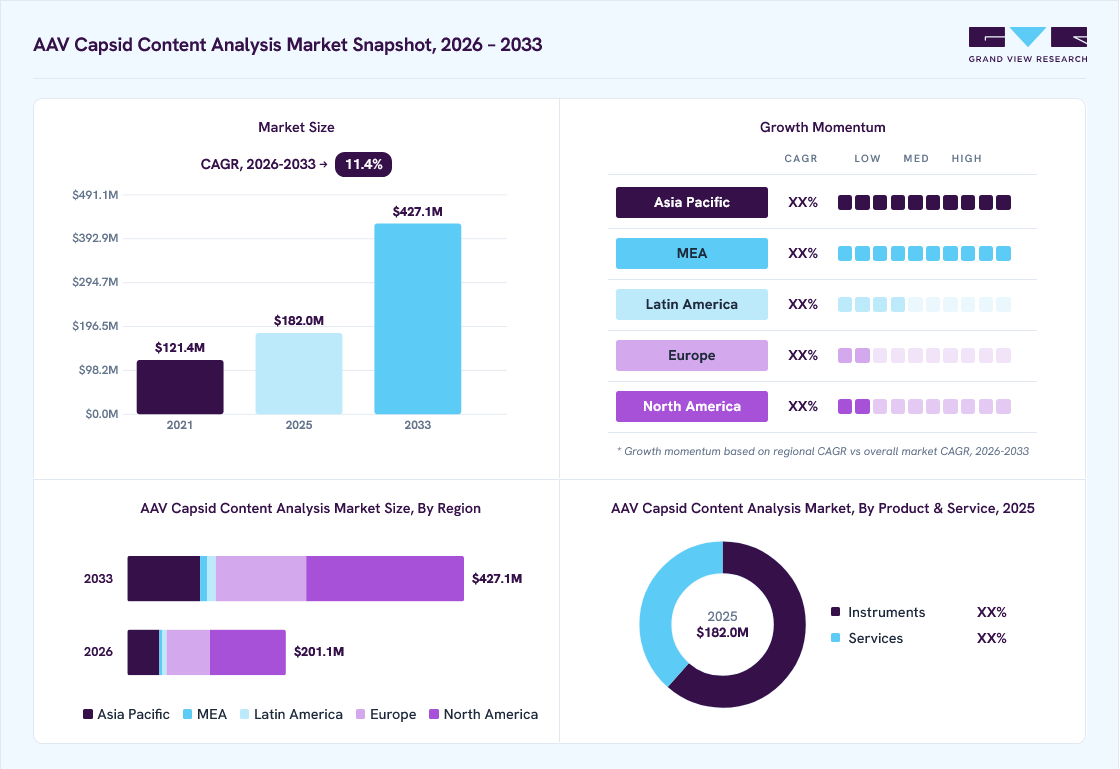
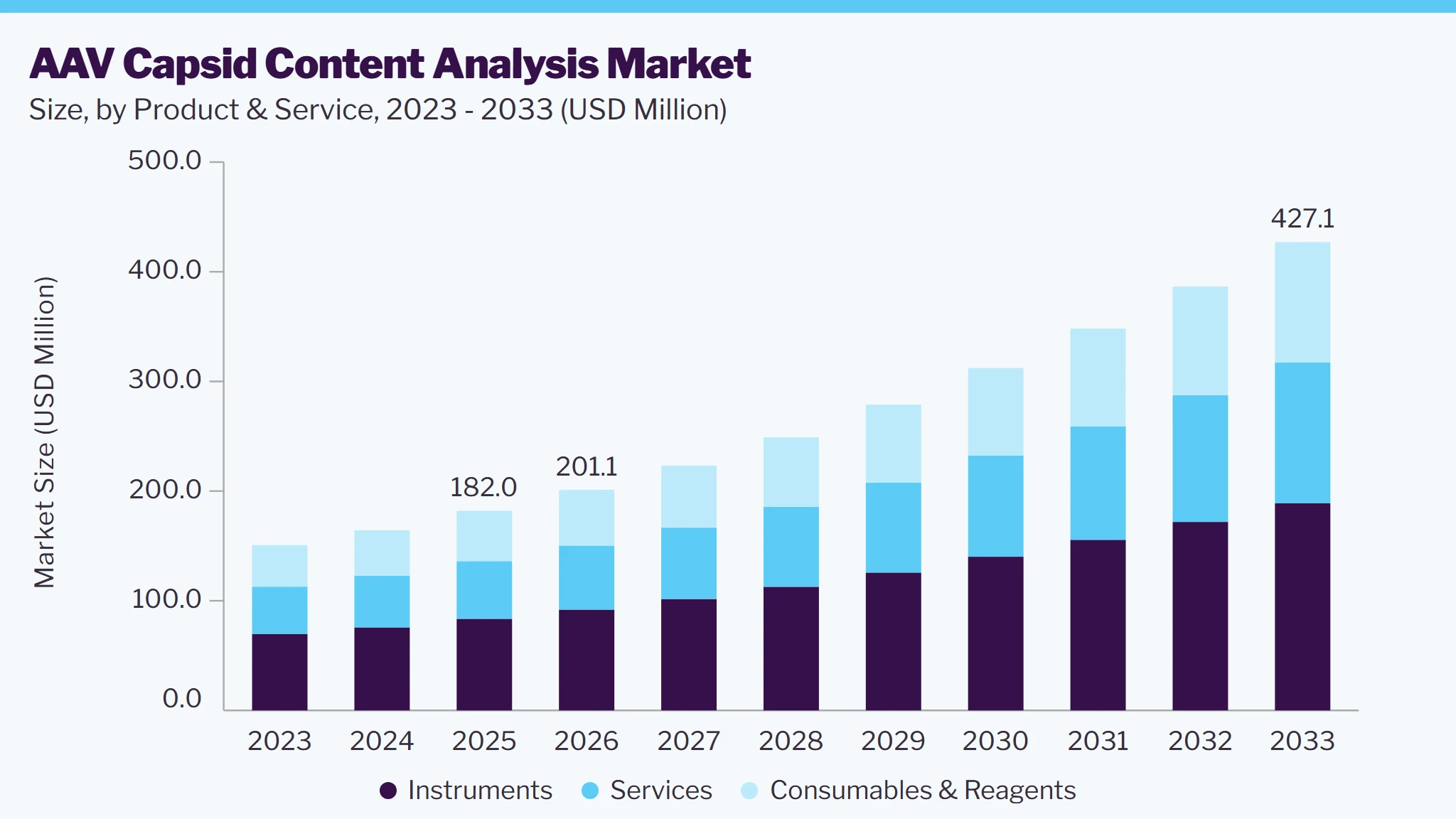
The global AAV capsid content analysis market size was valued at USD 182.0 million in 2025 and is projected to grow from USD 201.1 million in 2026 to USD 427.1 million by 2033, at a CAGR of 11.4% from 2026 to 2033. The market in North America dominated with a revenue share of 48.0% in 2025. The industry is driven by increasing adoption of gene therapy and viral vector technologies, growing demand for precise AAV characterization, and expanding applications of capsid analysis in gene therapy development, vector quality assessment, and biopharmaceutical manufacturing.
 Source: Grand View Research, IR Documents, Primary Interviews, Paid DatabasesTo learn more about this report,
 Download Free Sample Report
Key Market Trends & Insights
- By product & service: Instruments segment held the largest market share of 45.9% in 2025.
- By technology: Chromatography (AEX-HPLC, SEC-MALS) segment held the largest market share of 25.5% in 2025.
- By application: Process development & optimization segment held the largest market share of 40.7% in 2025.
- By development stage: Clinical segment held the largest market share of 52.5% in 2025.
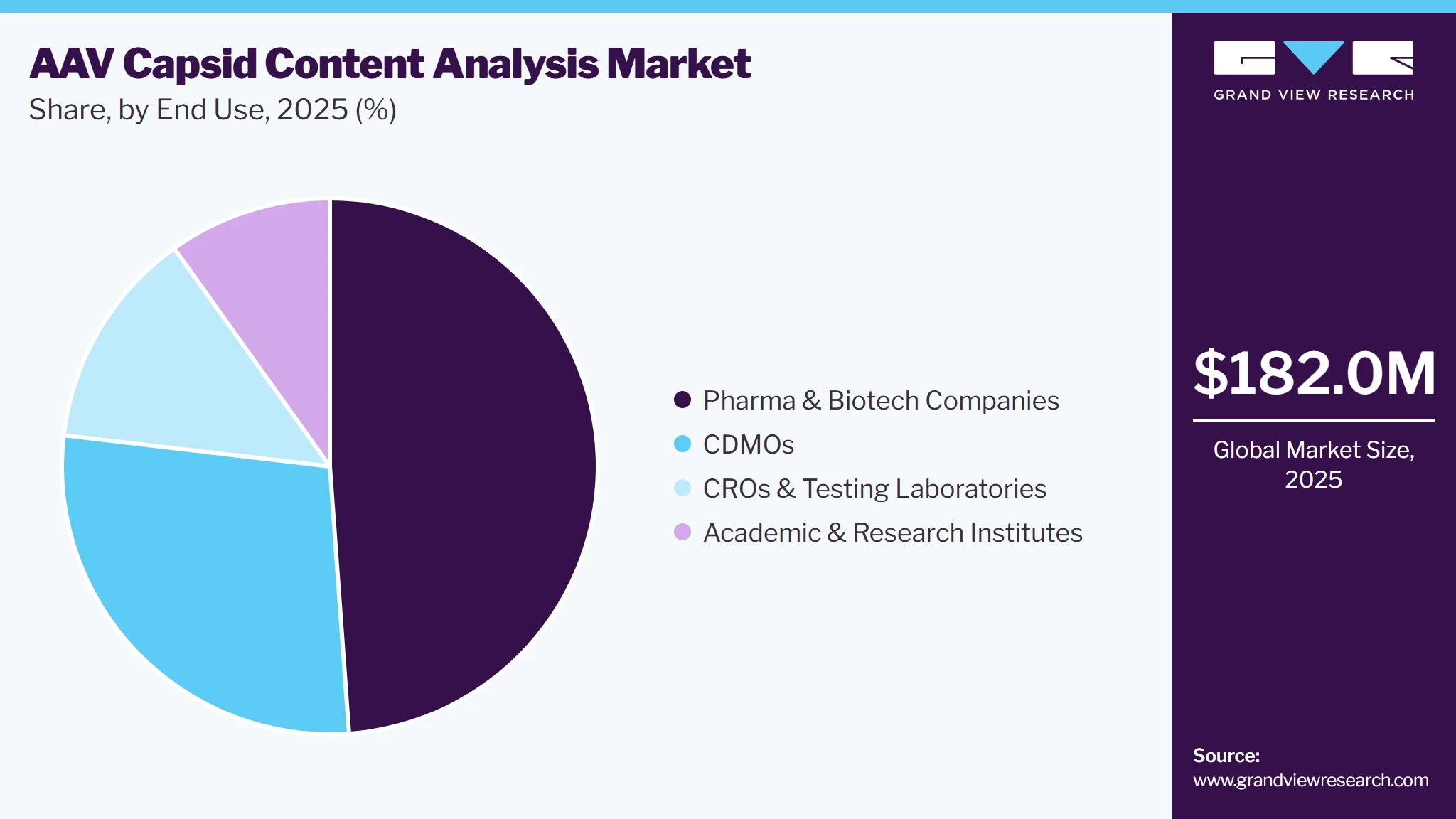
- By end use: Pharmaceutical & biotechnology companies segment held the largest market share of 48.9% in 2025.
Regional Highlights
- Largest regional market: North America (48.0% revenue share, 2025)
- Fastest-growing regional market: Asia Pacific (highest CAGR, 2026-2033)
- By country: The U.S. held the largest market share in 2025
Market Size & Forecast
- Market size in 2025: USD 182.0 Million
- Estimated market size in 2026: USD 201.1 Million
- Projected market size by 2033: USD 427.1 Million
- CAGR (2026-2033): 11.4%
Three ways to get this report
Buy it, customize it, or ask a question.Ask an Analyst
Analyst response in 1 business day
- AccessReport author, directly
- Reply timeWithin 1 working day
- No sales callDirect answer only
- FormatEmail reply
- CostFree, no cost
Get the Full Report
What the study covers
- FormatsPDF · Excel · Dashboard
- Timeline2026–2033 annual, 2025 base
- Coverage20+ countries, 5 regions
- Companies10+ key players profiled
Customize the Report
20% free customization
- IncludeCountries, segments, points
- TailorTo your product definition
- ExtendDeeper competitor detail
- OrA fully bespoke study
- Turnaround5–10 working days
 To learn more about this report, Download Free Sample Report
Market Dynamics
The industry is witnessing significant growth, driven by the expanding development and manufacturing of AAV-based gene therapies and increasing demand for accurate characterization of viral-vector quality. Growing adoption of analytical techniques for quantifying full, empty, and partially filled capsids is enabling improved assessment of product purity, potency, safety, and manufacturing consistency. In addition, increasing regulatory requirements for comprehensive AAV characterization, along with advances in analytical ultracentrifugation, chromatography, mass photometry, electron microscopy, and charge-detection mass spectrometry, are supporting market growth.
Increasing development of AAV-based gene therapies is driving demand for capsid content analysis to assess full, empty, and partially filled capsids during product development and manufacturing. According to an article published in the Journal of the American Society for Mass Spectrometry in June 2024, the growing use of AAV vectors has increased the need for analytical methods to characterize capsid content and monitor product quality. Accurate assessment of genome packaging is important for evaluating AAV product quality and optimizing manufacturing processes, supporting demand for specialized capsid content analysis solutions. The expanding clinical development of AAV-based gene therapies across multiple disease indications further highlights the importance of analytical characterization and is illustrated by the clinical development activity summarized in the table below.
Clinical Development of AAV-Based Gene Therapies Across Indications
Indication
AAV-Based Gene Therapy Clinical Development
Age-related macular degeneration (AMD)
GT005 and RGX-314 are being investigated as AAV-based gene therapy candidates for AMD.
Tay-Sachs disease
AAV-based gene therapy approaches are being explored for the treatment of Tay-Sachs disease.
Duchenne muscular dystrophy (DMD)
AAV-based gene therapy has been developed to address DMD, with delandistrogene moxeparvovec receiving FDA approval in 2023.
Other disease indications
rAAV-based gene therapies are being developed for ocular, neurological, metabolic, hematological, neuromuscular, cardiovascular, and oncologic diseases.
Overall clinical development
A total of 238 clinical trials of rAAV-based gene therapies are summarized, demonstrating clinical development across a broad range of disease indications.
Source: Nature, Secondary Research, Primary Interviews, Grand View Research Analysis
Limitations in accurately assessing DNA content in rAAV preparations can restrain the market by increasing the complexity of quality control and characterization. According to an article published in Gene Therapy in June 2026, empty, partial, and over-filled capsids commonly contaminate purified rAAV preparations, while accurate assessment of capsid DNA content remains a persistent manufacturing and quality-control challenge. The study also noted limitations in existing analytical approaches and introduced high-resolution ES-DMA to rapidly identify and relatively quantify empty, full, and partial or over-filled capsids. These challenges increase the need for specialized analytical methods and comprehensive characterization during rAAV development and manufacturing.
Development of rapid and potentially real-time technologies for AAV capsid content analysis presents an opportunity for the market. According to an article published in Analytical and Bioanalytical Chemistry in March 2026, researchers demonstrated the use of infrared attenuated total reflection spectroscopy combined with multivariate analysis to classify and quantify full and empty AAV2 capsids. This method enabled automated analysis using small-volume samples and showed potential for at-line or online monitoring during AAV manufacturing. The development of such rapid and non-destructive analytical approaches can support broader adoption of real-time capsid content monitoring for process development and quality control.
Market Concentration & Characteristics
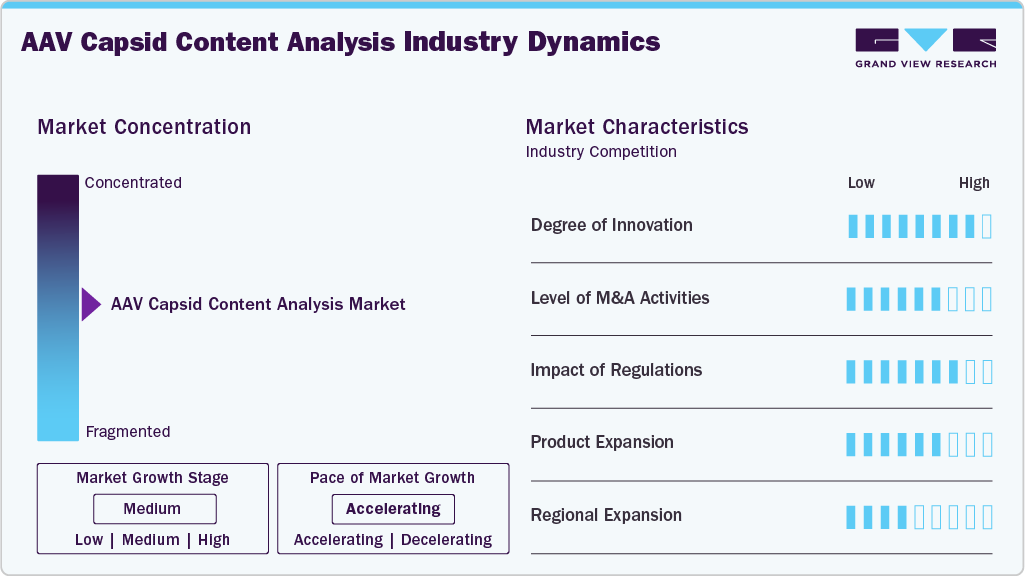
The degree of innovation in the industry is high, driven by advances in multiplexed analysis, high-throughput characterization, and simultaneous assessment of capsid and transgene content. For instance, in March 2024, NanoMosaic launched AAV bioprocessing and manufacturing QC assays on its Tessie platform, enabling simultaneous characterization of AAV capsids and therapeutic transgenes. The platform quantifies full, empty, and partial capsids from crude extracts in a single workflow, improving analytical efficiency and supporting AAV process development and manufacturing.
"NanoMosaic is excited to offer a unique solution to a challenging and fast-growing gene therapy market. In addition to AAV characterization applications, we remain committed to empowering the scientific community with high-plex and multi-omic solutions for biomarker research and diagnostics.
-Qimin Quan, PhD, co-founder and Chief Scientific Officer, NanoMosaic
 To learn more about this report, Download Free Sample Report
The industry is witnessing moderate M&A activity, supported by acquisitions that expand specialized AAV analytical and development capabilities. For instance, in April 2024, Ascend Advanced Therapies completed the acquisition of Beacon Therapeutics’ CMC team and GMP site in Alachua, Florida, adding process and analytical development capabilities for AAV products. The acquisition strengthens Ascend’s analytical services and CDMO capabilities, supporting AAV characterization, quality assessment, and process development activities.
“This acquisition allows us to now support customers from research through to commercialization and adds to one of the most experienced gene therapy teams in the market. Every day we are working together to grow the company with a long-term mindset of quality first to appropriately balance quality and yield for the life of each product."
- Mike Stella, CEO at Ascend
The impact of regulations on the industry is high, as regulatory requirements emphasize the characterization, quality, purity, and consistency of gene therapy products. These requirements increase the need for reliable analytical methods to evaluate AAV capsid content and related product attributes. Consequently, regulatory expectations support the adoption of specialized instruments, consumables, and analytical services for capsid characterization across process development, quality control, and lot release applications.
The industry is witnessing product expansion through the introduction of specialized reference materials for capsid characterization. For instance, in May 2024, Charles River Laboratories launched six AAV reference material serotypes with defined empty and full capsid ratios and high vector genome concentrations. These reference materials support analytical method development, assay calibration, and quality control for AAV capsid content analysis, supporting process development and lot release applications.
The industry is witnessing regional expansion as analytical testing providers expand specialized capabilities for AAV gene therapies. For instance, in May 2024, Solvias announced the development of a 50,000-square-foot analytical testing center in Research Triangle Park, North Carolina, to support characterization and release testing of AAV gene therapies. The facility expanded Solvias’ U.S. analytical services and strengthened regional access to testing capabilities supporting AAV development and quality control.
“Our new center strongly complements our biologics and CGT sites in Europe and expands our world-class testing capabilities in the U.S. Our team is thrilled to bring our newest center of excellence to Research Triangle Park, a leading research and development center and burgeoning hub for the life science industry. We will continue to invest in expanding our capabilities to support our customers with their critical work of developing and maintaining life-changing therapies.”
- Archie Cullen, CEO of Solvias
Analyst Perspective
The industry is supported by the expanding development of AAV-based gene therapies and increasing emphasis on viral vector quality assessment. As manufacturers seek to improve product consistency and process efficiency, demand is expected to rise for analytical solutions that accurately quantify full, empty, and partially filled capsids. The need for reliable characterization across process development, quality control, and lot release is also shaping technology adoption. Market participants are focusing on advancing chromatography, mass photometry, and mass spectrometry platforms, while developing faster, more precise, and workflow-compatible solutions to support AAV characterization and manufacturing requirements.
Product & Service Insights
The instruments segment accounted for the largest revenue share of 45.9% in 2025, supported by increasing demand for accurate and efficient characterization of AAV capsid content. For instance, according to an article published in Analytical Chemistry in October 2024, researchers demonstrated the use of Orbitrap-based charge detection mass spectrometry (CDMS) to characterize AAV vectors by evaluating empty-to-full capsid ratios, encapsidated genome mass, and viral protein stoichiometry. The technique enabled the analysis of multiple critical quality attributes using a single analytical approach, highlighting the role of advanced mass spectrometry instruments.
The services segment is expected to register the fastest CAGR during 2026-2033, driven by the complexity of AAV-based gene therapies and the need for specialized analytical expertise. Service providers offer testing and characterization solutions to assess capsid composition, including the distribution of empty, partial, and full capsids. Outsourcing these analyses enables biopharmaceutical companies to access advanced analytical technologies and technical expertise without substantial investments in specialized equipment, while supporting quality control and consistency throughout AAV development and manufacturing.
Technology Insights
The chromatography (AEX-HPLC, SEC-MALS) segment dominated the market with a share of 25.5% in 2025, supported by the need for reliable methods to characterize AAV capsid content and product quality. AEX-HPLC enables the separation of empty and full capsids, while SEC-MALS supports the assessment of capsid content, aggregation, and genome titer. According to a research article published in Molecular Therapy Methods & Clinical Development in November 2024, researchers developed a size-exclusion chromatography-based multi-attribute monitoring method using UV, fluorescence, multi-angle light scattering, and refractive index detectors to assess AAV genome and capsid titers, purity, aggregation, and full-to-empty capsid ratios within a single assay. The method produced results comparable to established analytical techniques, highlighting the potential of advanced chromatography for comprehensive AAV quality assessment.
The mass photometry segment is expected to register the fastest CAGR during 2026-2033, driven by increasing demand for rapid, sensitive, and low-sample-volume techniques for AAV capsid characterization. Mass photometry enables the quantification of empty, partially filled, and full capsid populations, supporting the assessment of genome packaging and product quality. For instance, according to an article published in Molecular Therapy Nucleic Acids in June 2025, researchers demonstrated that mass photometry could quantify empty, partially filled, and full AAV capsids across samples with varying genome-loading levels, with results comparable to analytical ultracentrifugation. The study highlighted the technique's accuracy, reproducibility, rapid analysis, and low sample consumption for AAV characterization.
Application Insights
The process development & optimization segment accounted for 40.7% of the revenue in 2025, mainly due to the increasing need to improve AAV production efficiency, purification performance, and product quality. The growing emphasis on improving full-capsid recovery, reducing impurities, and ensuring consistent product quality is expected to drive the adoption of analytical techniques throughout process development and scale-up activities.
The quality control & lot release segment is projected to register the fastest CAGR during 2026-2033, driven by stringent quality requirements for gene therapy products and the need to ensure batch-to-batch consistency. AAV capsid content analyses provide critical information for evaluating product quality against predefined specifications before release. The growing focus on analytical reliability, regulatory compliance, and consistent manufacturing outcomes is expected to increase the adoption of capsid characterization techniques in quality control and lot release testing.
Development Stage Insights
The clinical segment accounted for 52.5% of the global revenue, supported by increasing development of AAV-based gene therapies and the need to evaluate vector quality, safety, and therapeutic potency before and during clinical development. According to a research article published in Gene Therapy in February 2024, researchers evaluated the impact of full, intermediate, and empty AAV capsids on vector potency using in vitro and in vivo assays. The research found that intermediate capsids contributed to measured vector genome titers but did not contribute to product potency, highlighting the importance of capsid content characterization in evaluating AAV candidates for clinical development.
The commercial segment is projected to register the fastest CAGR during 2026-2033, driven by increasing need for standardized analytical methods and reliable quality assessment of AAV-based gene therapies. Accurate characterization of empty, partial, and full capsids helps manufacturers establish consistent quality specifications, validate analytical methods, and support batch quality assessment. Continued advancements in reference materials and analytical characterization techniques are expected to strengthen quality control practices and support the transition of AAV therapies toward commercial manufacturing.
End Use Insights
The pharmaceutical & biotechnology companies segment accounted for a 48.9% share in 2025, making it the leading end use segment. Growth is driven by increasing investments in AAV-based gene therapies and the need for effective analytical methods to ensure product quality. The growing focus on optimizing manufacturing processes, improving vector purity, and meeting stringent quality requirements is expected to increase the adoption of advanced capsid characterization techniques across pharmaceutical and biotechnology development programs.
 To learn more about this report, Download Free Sample Report
The CDMOs segment is projected to witness the fastest CAGR during 2026-2033, supported by increasing outsourcing of AAV vector development, manufacturing, and analytical testing by pharmaceutical and biotechnology companies. CDMOs utilize AAV capsid content analysis to assess purification efficiency and monitor product quality throughout manufacturing. The growing demand for specialized analytical expertise, scalable production processes, and consistent batch quality is expected to encourage the adoption of advanced capsid characterization techniques among CDMOs supporting gene therapy developers.
Regional Insights
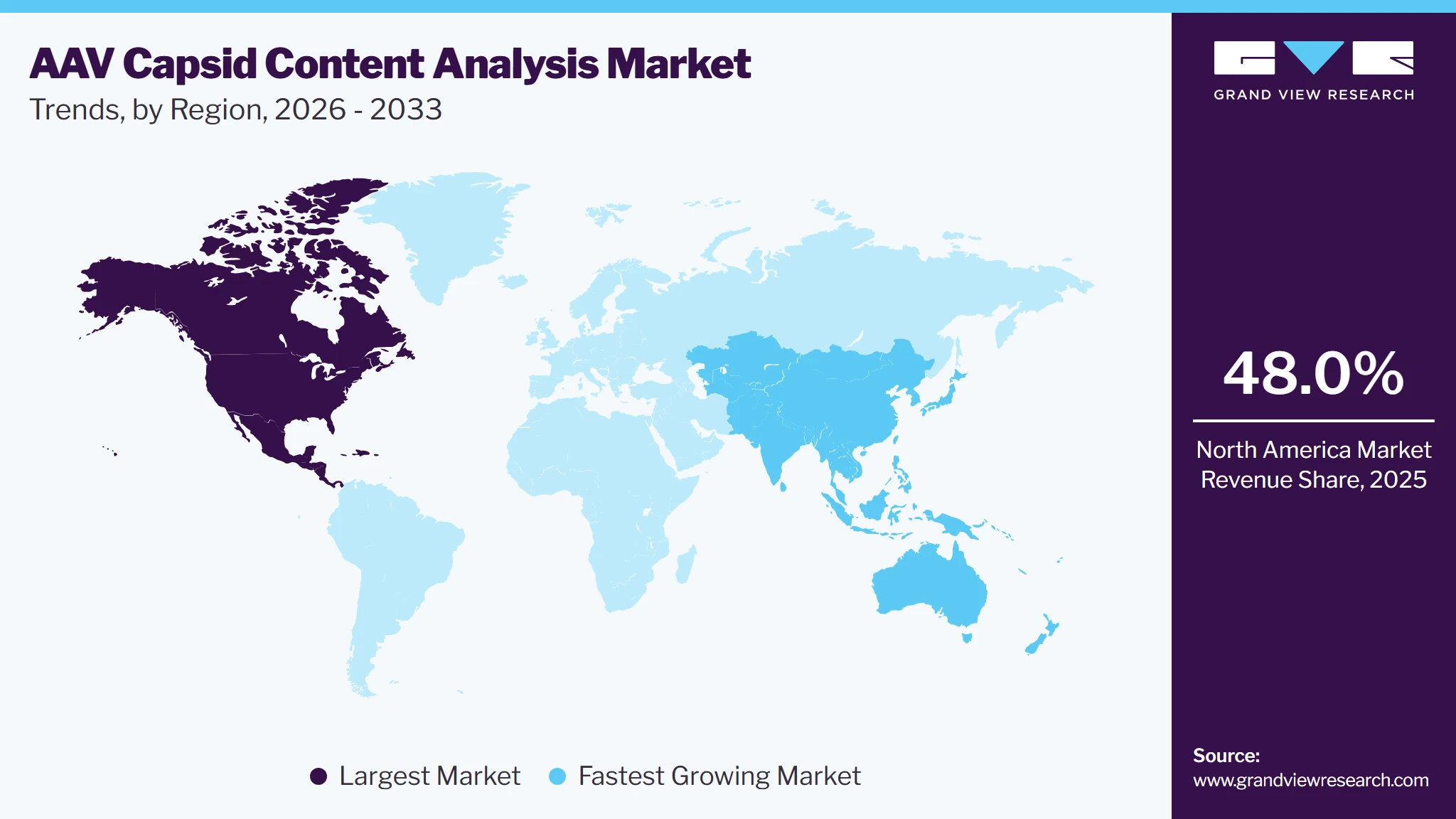
The North America AAV capsid content analysis market dominated, accounting for the largest revenue share of 48.0% in 2025. The regional industry is driven by the expanding development of AAV-based gene therapies and increasing emphasis on accurate assessment of capsid quality attributes. Growing demand to evaluate empty, full, and partially filled capsids, along with capsid purity and genome content, is driving adoption of advanced analytical technologies across AAV development and manufacturing in the region.
 To learn more about this report, Download Free Sample Report
U.S. AAV Capsid Content Analysis Market Trends
The AAV capsid content analysis market in the U.S. is expected to grow over the forecast period, supported by increasing emphasis on standardized measurement of critical capsid attributes for AAV-based gene therapies. For instance, in December 2024, the U.S. National Institute of Standards and Technology (NIST) published an interlaboratory study evaluating methods for quantifying full and empty AAV capsids and measuring the full-to-total capsid ratio. The study supports analytical standardization and comparability of AAV measurements, strengthening the adoption of reliable capsid analysis methods for gene therapy development and quality assessment
Europe AAV Capsid Content Analysis Market Trends
The AAV capsid content analysis market in Europe is anticipated to grow significantly over the forecast period, supported by increasing demand for rapid and reliable assessment of genome-containing and genome-lacking AAV particles during gene therapy development and manufacturing. According to an article published in Analytical and Bioanalytical Chemistry in March 2026, researchers from the University of Ulm and Hahn-Schickard in Germany demonstrated the feasibility of infrared attenuated total reflection spectroscopy combined with multivariate data analysis for classifying and quantifying full and empty AAV2 capsids. The approach supports rapid capsid content assessment and potential process monitoring in AAV production.
The UK AAV capsid content analysis industry is expected to grow significantly over the forecast period. In June 2025, Oxford-based Refeyn announced that its mass photometry technology was recognized by the U.S. Pharmacopeia as an orthogonal method for characterizing empty and full AAV capsids in its new AAV reference standards. This development supports greater standardization of capsid content analysis and adoption of advanced analytical technologies for AAV quality assessment.
“We are thrilled that mass photometry has been recognized by the USP for the characterization of empty, full, and—critically—partially filled AAV capsids, and that it is specifically referenced in the new USP general chapter <1067> as a recommended orthogonal method. Along with prior recognition by the British Pharmacopeia, this demonstrates that mass photometry is being accepted as a valuable part of the AAV analytics toolbox. And it has a lot to offer because it is a simple, easy-to-use method for measuring a significant CQA while ensuring consistent and reliable analytics.”
- Gabriella Kiss, Market Development Director at Refeyn.
The AAV capsid content analysis market in Germany is anticipated to grow significantly over the forecast period. The growing emphasis on analytical quality control and process optimization is driving adoption of chromatography, mass spectrometry, and other advanced technologies for capsid content assessment. In addition, the expansion of commercial AAV analytical testing and process-development capabilities is supporting broader use of capsid content analysis solutions.
Asia Pacific AAV Capsid Content Analysis Market Trends
The AAV capsid content analysis market in Asia Pacific is expected to grow at the fastest CAGR of 12.4% during the forecast period, supported by advancement of AAV-based gene therapy development and increasing emphasis on product quality assessment across regional biopharmaceutical markets. Efforts to strengthen regulatory alignment and manufacturing quality standards across countries such as China, Japan, India, and South Korea are increasing the importance of reliable analytical methods.
The China AAV capsid content analysis industry is expected to grow over the forecast period, supported by the expansion of AAV-based gene therapy development and increasing emphasis on quality control of viral vector products. As the country advances its gene therapy pipeline and strengthens regulatory oversight of innovative biologics, demand for reliable measurement of full, empty, and partially filled capsids is expected to increase.
The AAV capsid content analysis market in Japan is witnessing rapid growth supported by increasing demand for specialized analytical testing and GMP-compliant quality assessment of AAV-based gene therapies. For instance, in August 2025, Japan-based U-Medico opened a new GMP-compliant analytical center in Minoh, Osaka, to expand quality testing services for biopharmaceuticals and gene therapy vectors. Its analytical portfolio includes measurement of full-to-empty AAV particle ratios using analytical ultracentrifugation and mass photometry, supporting reliable capsid content assessment and quality control during AAV development and manufacturing.
Latin America AAV Capsid Content Analysis Market Trends
The AAV capsid content analysis industry in Latin America is expected to grow steadily over the forecast period, supported by the gradual expansion of gene therapy research and increasing emphasis on quality assessment of viral vectors. As regional biotechnology and biopharmaceutical capabilities develop, reliable capsid content analysis is expected to become increasingly important for AAV vector development and quality control.
MEA AAV Capsid Content Analysis Market Trends
The AAV capsid content analysis market in the Middle East & Africa is growing steadily. Governments across the region, most notably Saudi Arabia, the UAE, and South Africa, are heavily funding specialized biotechnology and genomic initiatives. As these nations pivot toward precision medicine and localized pharmaceutical manufacturing, they are building advanced bio-analytical labs. This infrastructure development creates a footprint for high-end analytical equipment capable of viral vector characterization.
Key AAV Capsid Content Analysis Company Insights
The AAV capsid content analysis industry is characterized by strong competition among companies offering mass photometry, charge detection mass spectrometry, digital PCR, chromatography, biolayer interferometry, analytical ultracentrifugation, and other capsid characterization technologies. Market participants are enhancing their competitive position through new analytical platforms, assay and service introductions, technology enhancements, partnerships, and broader AAV testing capabilities. Competitive differentiation is influenced by analytical sensitivity, measurement speed, workflow compatibility, technology breadth, geographic reach, customer relationships, and use across AAV development, process optimization, quality assessment, and gene therapy manufacturing.
Key AAV Capsid Content Analysis Companies
Some prominent players in the AAV capsid content analysis market include:
-
Beckman Coulter Life Sciences (Danaher Corporation)
-
Waters Corporation
-
Thermo Fisher Scientific Inc.
-
Refeyn Ltd.
-
Unchained Labs
-
Bio-Rad Laboratories, Inc.
-
Sartorius AG
-
Agilent Technologies, Inc.
-
Charles River Laboratories
-
Eurofins
Competitive Benchmarking
Category
Operating Strategies
Competitive Edge
Weakness
Established Players (Beckman Coulter Life Sciences (Danaher Corporation); Waters Corporation; Thermo Fisher Scientific Inc.; Bio-Rad Laboratories, Inc.; Sartorius AG; Agilent Technologies, Inc.)
Advancing AAV empty, full, and partial capsid characterization through mass spectrometry, chromatography, digital PCR, BLI, and analytical platforms.
Extensive analytical capabilities, global distribution networks, strong customer relationships, and established biopharma expertise.
Premium instrument costs, technical complexity, specialized infrastructure, and lengthy method development.
Emerging Players (Refeyn Ltd.; Unchained Labs; Charles River Laboratories; Eurofins)
Targeting AAV characterization needs with mass photometry, rapid analytical testing, reference materials, and specialized testing services.
Rapid innovation, focused AAV applications, flexible analytical offerings, and specialized characterization expertise.
Smaller commercial footprint, limited product breadth, technology adoption barriers, and dependence on specialized applications.
Recent Developments:
-
In October 2025, Waters Corporation launched the Xevo Charge Detection Mass Spectrometry (CDMS) system, enabling direct mass-based characterization of viral-vector capsids. The technology distinguishes empty, partial, full, and overfull capsids and supports relative quantification of these capsid types in less than 10 minutes per sample, strengthening applications in capsid content analysis.
Waters continues to make strategic investments in large molecules, recognizing that advanced tools for bioanalytical characterization play a critical role in driving therapeutic breakthroughs. Today, we are proud to introduce the first-of-its-kind Xevo Charge Detection Mass Spectrometer, enabling the precise analysis of previously unmeasurable molecules. We believe the Xevo CDMS will accelerate the global development of genetic medicines and other advanced modalities by providing a greater understanding of the characteristics of large molecules earlier in development, which is crucial for making life-changing therapies more accessible to patients.
-Udit Batra, Ph.D., President and Chief Executive Officer, Waters Corporation.
-
In October 2024, Bio-Rad Laboratories launched the Vericheck ddPCR Empty-Full Capsid Kit, a high-precision analytical solution for AAV vector characterization. The kit simultaneously quantifies AAV capsid and genome titers to determine the percentage of full capsids and assess empty-to-full capsid ratios, strengthening applications in AAV capsid content analysis and gene therapy vector development.
"AAV vectors are a powerful gene therapy tool, but their production can result in the generation of product-related impurities, such as partial or empty capsids, which impact effectiveness and can elicit unwanted immunotoxicity. Determining the ratio of full, partial, and empty capsids is a recurring challenge throughout AAV gene therapy manufacturing, from early-stage development to quality control and release testing. Our new Vericheck ddPCR Empty-Full Capsid Kit delivers unmatched precision and specificity, along with ease of use and high-throughput capabilities, to provide our customers with a comprehensive solution for AAV vector characterization and to help drive the advancement of safe and effective gene therapies."
-Stephen Kulisch, Vice President of Marketing for Bio-Rad’s Digital Biology Group.
-
In February 2023, Refeyn Ltd. launched the SamuxMP Auto mass photometer for automated AAV capsid analysis. The system enables determination of AAV sample purity, aggregation, and empty-to-full capsid ratios, supporting rapid and reproducible analysis of AAV capsid content during development and manufacturing.
“We are excited to continue the momentum of our new product introductions with the SamuxMP Auto mass photometer. The system builds on the already successful SamuxMP, adding automated liquid handling to increase the efficiency and reliability of AAV characterization for our customers, all while remaining a benchtop instrument. We are committed to innovating and delivering unique and cost-effective solutions to the challenges faced by our customers and anticipate the SamuxMP Auto having a significant impact in the field, helping speed up crucial steps in AAV development and manufacturing pipelines.”
- Matthias Langhorst, CPO, Refeyn
AAV Capsid Content Analysis Market Report Scope
Report Attribute
Details
Market size in 2025
USD 182.0 million
Estimated market size in 2026
USD 201.1 million
Projected market size by 2033
USD 427.1 million
Growth rate
CAGR of 11.4% from 2026 to 2033
Historical data
2021 - 2025
Forecast period
2026 - 2033
Quantitative units
Revenue in USD million, and CAGR from 2026 to 2033
Report coverage
Revenue forecast, company ranking, competitive landscape, growth factors, and trends
Segments covered
Product & service, technology, application, development stage, end use, region
Regional scope
North America; Europe; Asia Pacific; Latin America; MEA
Country scope
U.S.; Canada; Mexico; UK; Germany; France; Italy; Spain; Norway; Denmark; Sweden; China; Japan; India; South Korea; Australia; Thailand; Brazil; Argentina; Saudi Arabia; South Africa; UAE; Kuwait
Key companies profiled
Beckman Coulter Life Sciences (Danaher Corporation); Waters Corporation; Thermo Fisher Scientific Inc.; Refeyn Ltd.; Unchained Labs; Bio-Rad Laboratories, Inc.; Sartorius AG; Agilent Technologies, Inc.; Charles River Laboratories; Eurofins
Customization scope
Free report customization (equivalent up to 8 analysts' working days) with purchase. Addition or alteration to country, regional & segment scope.
Pricing and purchase options
Avail customized purchase options to meet your exact research needs. Explore purchase options
Global AAV Capsid Content Analysis Market Report Segmentation
This report forecasts revenue growth at the global, regional, and country levels and provides an analysis of the latest trends in each of the sub-segments from 2021 to 2033. For this study, Grand View Research has segmented the global AAV capsid content analysis market report based on product & service, technology, application, development stage, end use, and region:
-
Product & Service Outlook (Revenue, USD Million, 2021 - 2033)
-
Instruments
-
Services
-
Consumables & Reagents
-
-
Technology Outlook (Revenue, USD Million, 2021 - 2033)
-
Chromatography (AEX-HPLC, SEC-MALS)
-
Analytical Ultracentrifugation (AUC)
-
Mass Photometry
-
PCR & ELISA-based Titer Ratio
-
UV/Vis & Light Scattering Spectroscopy
-
Charge Detection Mass Spectrometry (CDMS)
-
Electron Microscopy (TEM, Cryo-EM)
-
Others (CE, cIEF)
-
-
Application Outlook (Revenue, USD Million, 2021 - 2033)
-
Process Development & Optimization
-
Quality Control & Lot Release
-
Research & Capsid Engineering
-
-
Development Stage Outlook (Revenue, USD Million, 2021 - 2033)
-
Clinical
-
Preclinical
-
Commercial
-
-
End Use Outlook (Revenue, USD Million, 2021 - 2033)
-
Pharmaceutical & Biotechnology Companies
-
CDMOs
-
CROs & Testing Laboratories
-
Academic & Research Institutes
-
-
Regional Outlook (Revenue, USD Million, 2021 - 2033)
-
North America
-
U.S.
-
Canada
-
Mexico
-
-
Europe
-
UK
-
Germany
-
France
-
Italy
-
Spain
-
Denmark
-
Sweden
-
Norway
-
-
Asia Pacific
-
Japan
-
China
-
India
-
Australia
-
Thailand
-
South Korea
-
-
Latin America
-
Brazil
-
Argentina
-
-
Middle East and Africa (MEA)
-
South Africa
-
Saudi Arabia
-
UAE
-
Kuwait
-
-
Research Methodology
The AAV capsid content analysis market figures in this report are based on a proven research process that combines executive interviews with secondary research from proprietary databases, company filings, and recognized regulatory and institutional sources. Market size is built through value-chain sizing—reconciling supply-side and demand-side estimates—and triangulated with bottom-up and top-down approaches. Every estimate passes multiple levels of expert validation before publication, with each AAV capsid content analysis segment quantified using the revenue-capture definitions in the table below.
Segment Definition
Product & Service
Revenue Capture Definition
Instruments
Revenue generated from the sale of analytical instruments used to measure empty, partial and full AAV capsids, such as analytical ultracentrifuges, mass photometers, CDMS systems, UV/Vis and light scattering systems, SEC-MALS and AEX-HPLC systems, ddPCR systems and electron microscopes, counting only the share of sales used for this analysis.
Services
This segment captures income from outsourced capsid content testing, including method development and validation, characterization studies and GMP release and stability testing performed by CROs, testing laboratories, CDMOs and core facilities for external clients.
Consumables & Reagents
Market value in this category stems from consumables and reagents for capsid content analysis, such as AEX columns, AUC cells and centerpieces, mass photometry slides and plates, ddPCR empty-full kits, capsid ELISA kits, AAV reference standards and related software licenses.
Technology
Revenue Capture Definition
Chromatography (AEX-HPLC, SEC-MALS)
Revenue generated from instruments, consumables and services for chromatography-based capsid content analysis, mainly anion-exchange HPLC (AEX-HPLC), which separates capsids by charge, and size-exclusion chromatography with multi-angle light scattering (SEC-MALS).
Analytical Ultracentrifugation (AUC)
This segment captures income from sale of instruments, consumables and services for analytical ultracentrifugation (AUC), which separates capsids by sedimentation and is the reference method for measuring empty, partial and full capsids.
Mass Photometry
Market value in this category stems from sale of instruments, consumables and services for mass photometry, which measures the mass of single capsids in solution to determine empty, partial and full populations.
PCR & ELISA-based Titer Ratio
Revenue generated from sale of instruments, kits and services for titer ratio methods, in which the genome titer measured by qPCR or ddPCR is compared with the capsid titer measured by ELISA, including ddPCR-based empty-full kits.
UV/Vis & Light Scattering Spectroscopy
This segment captures income from revenues generated by the sale of instruments, consumables and services for UV/Vis spectroscopy (A260/A280 ratio) and light scattering (DLS/SLS) methods that estimate empty/full ratio together with capsid and genome titer.
Charge Detection Mass Spectrometry (CDMS)
This segment includes revenues generated by the sale of instruments, consumables and services for charge detection mass spectrometry (CDMS), which measures the mass and charge of individual capsids at high resolution.
Electron Microscopy (TEM, Cryo-EM)
Revenue generated from sale of electron microscopy services, instruments and consumables (transmission electron microscopy and cryo-electron microscopy) used to image and count empty and full capsids.
Others (CE, cIEF)
Market value in this category stems from sale of instruments, consumables and services for other methods, such as capillary electrophoresis, capillary isoelectric focusing and microfluidic electrophoresis.
Application
Revenue Capture Definition
Process Development & Optimization
This segment includes revenues generated by the sale of instruments, consumables and services used to develop and optimize upstream and downstream AAV processes, including screening of purification conditions to remove empty and partial capsids.
Quality Control & Lot Release
This segment captures income from sale of instruments, consumables and services used for in-process control, drug substance and drug product release testing, and stability and comparability studies under GMP.
Research & Capsid Engineering
Market value in this category stems from sale of instruments, consumables and services used in AAV research, capsid engineering and serotype screening before process development begins.
Development Stage
Revenue Capture Definition
Clinical
Revenue generated from sale of instruments, consumables and services used for AAV programs in Phase I to Phase III clinical trials and for clinical trial material.
Preclinical
This segment captures income from sales of instruments, consumables and services used for AAV programs in discovery and preclinical development, including toxicology lots.
Commercial
Market value in this category stems from sale of instruments, consumables and services used for approved AAV gene therapies, including commercial lot release and post-approval process changes.
End Use
Revenue Capture Definition
Pharmaceutical & Biotechnology Companies
Revenue generated from capsid content analysis instruments, consumables and services to pharmaceutical and biotechnology companies developing AAV gene therapies.
CDMOs
This segment captures income from capsid content analysis instruments and consumables to contract development and manufacturing organizations that produce AAV vectors for clients.
CROs & Testing Laboratories
Market value in this category stems from capsid content analysis instruments and consumables to contract research organizations and independent testing laboratories that provide AAV testing services.
Academic & Research Institutes
Revenue generated from capsid content analysis instruments, consumables and services to universities, research institutes, government laboratories and academic vector cores.
Estimation Model
Stage
Description
Top-Down
Commodity Flow Analysis: Market value was estimated by assessing revenues from AAV capsid analysis instruments, analytical services, consumables, reagents, and testing solutions. Company financials, product portfolios, pricing, testing volumes, and commercial offerings were analyzed to quantify market revenue across major applications and technologies. Revenue contributions from specialized capsid characterization products and services were further evaluated to capture the overall market value.
Parent Market
Parent Market & Penetration-Based Analysis: The AAV capsid content analysis market was assessed within the broader viral vector and plasmid DNA manufacturing market, focusing on capsid characterization in gene therapy development, manufacturing, and quality control. Adoption of analytical technologies was evaluated to establish market opportunities across AAV capsid quantification, purity assessment, and empty-to-full capsid ratio analysis.
Segmentation
Country-Level Segment Share Modeling: Country-level shares were estimated using AAV research activity, capsid analysis capacity, analytical testing infrastructure, laboratory networks, pharmaceutical R&D, and clinical and commercial adoption. Differences in gene therapy development, testing volumes, technology availability, laboratory capacity, manufacturing infrastructure, and research activity were incorporated to determine country and regional distributions across product & service, technology, application, development stage, and end use segments.
Validation
Data Triangulation & Validation Model: Market estimates were reconciled using company revenues, capsid testing volumes, analytical service pricing, instrument capacity, laboratory activity, gene therapy applications, and scientific evidence. The resulting estimates were cross-checked across product & service, technology, application, development stage, end use, country, and region to ensure consistency between volume-based and revenue-based calculations.
Forecasting
Forecasting & CAGR Modeling: Future demand was projected using observed expansion of AAV gene therapy, capsid analysis, viral vector manufacturing, analytical testing, and clinical research. Increasing demand for capsid characterization, broader analytical applications, technological improvements, and growing clinical and commercial use of AAV-based therapies were incorporated into segment-level growth assumptions.
Customization Table
Client Request
Customization Delivered
Value Adds
AAV Capsid Ratio & Composition Assessment
Assessment of full, empty, and partially filled capsid populations across selected AAV products and analytical methods.
Help clients to understand capsid composition, identify product-quality differences, and evaluate factors affecting analytical outcomes.
AAV Capsid Quantification Method Selection Assessment
Comparative assessment of analytical approaches used for capsid quantification, including ELISA, analytical ultracentrifugation, mass photometry, and related methods.
Help clients identify suitable methods based on accuracy, throughput, sensitivity, and intended testing applications.
AAV Capsid Analysis Data & Reporting Assessment
Assessment of data interpretation, reporting parameters, acceptance criteria, and result comparability across selected capsid content assays.
Help clients to improve analytical interpretation, establish consistent reporting practices, and support data-driven quality decisions.
About the Author(s)
Biotechnology Research Team
Healthcare · BiotechnologyThis report was authored by the biotechnology research team at Grand View Research - comprising two research analysts, one senior research analyst, and one industry expert - with specialized expertise in the biotechnology segment of the healthcare industry. All findings are based on proprietary healthcare databases, executive interviews, and regulatory analysis, subject to internal peer review prior to publication.
Last Updated:
Speak to Analyst

Customize this report to your needs - add regions, segments, or data points, with 20% free customization.
Or view our licence options:


ISO 9001:2015 & 27001:2022 Certified
We are GDPR and CCPA compliant! Your transaction & personal information is safe and secure. For more details, please read our privacy policy.


