
- Home
- »
- Specialty Glass, Ceramic & Fiber
- »
-
Abaca Fiber Market Size, Share & Trends Report, 2026-2033GVR Report cover
![Abaca Fiber Market (2026 - 2033)Report]()
Abaca Fiber Market (2026 - 2033)
Size, Share & Trends Analysis Report By Product (Pulp & Paper, Fiber Craft, Cordage, Textile), By Region (North America, Asia Pacific, Europe, Central & South America, MEA), And Segment Forecasts
Market Size, 2025
$1.1BMarket Estimate, 2026
$1.3BMarket Forecast, 2033
$3.6BCAGR, 2026–2033
15.5%Abaca Fiber Market Summary
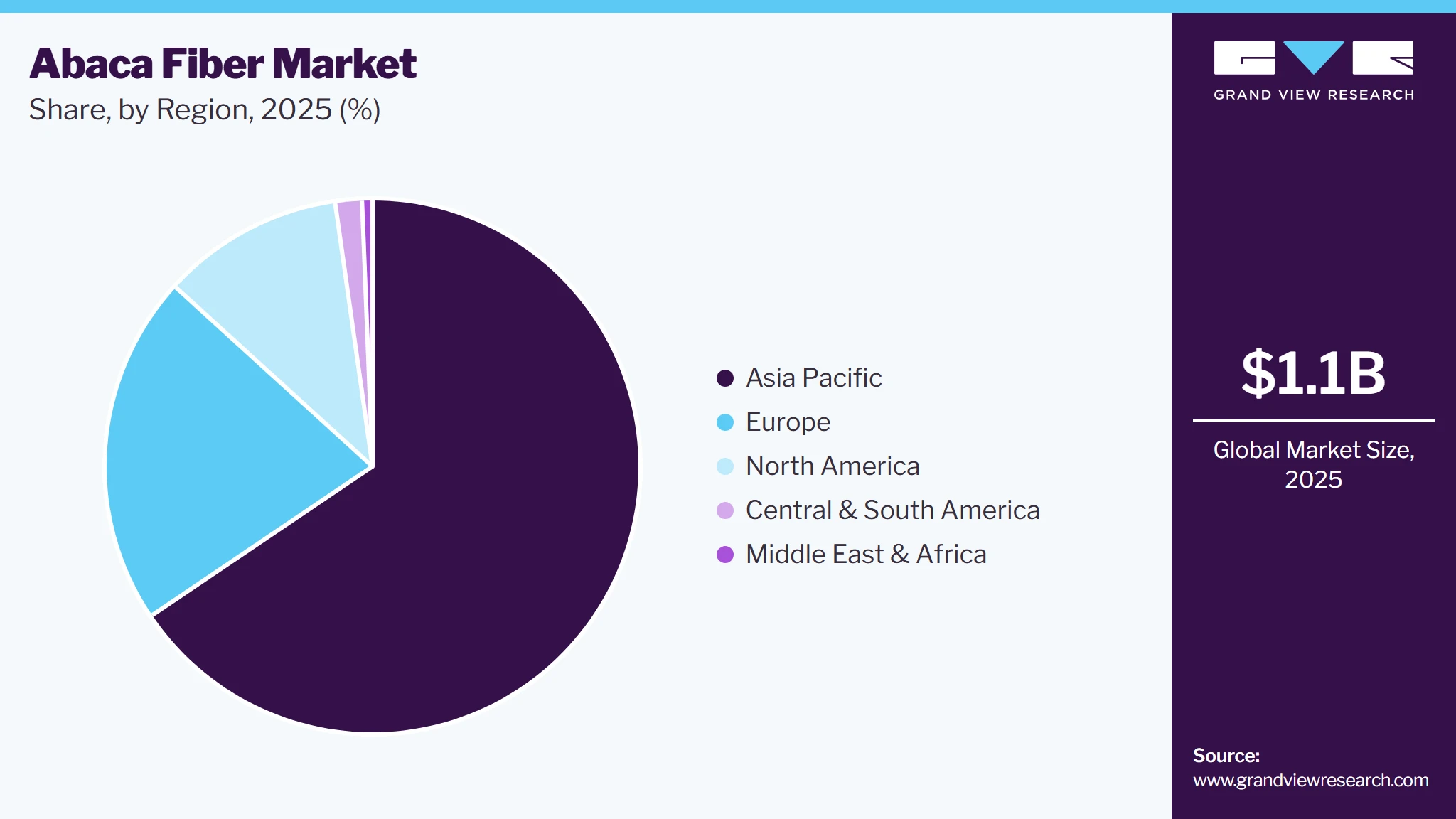
The global abaca fiber market size was valued at USD 1.1 billion in 2025 and is projected to grow from USD 1.3 billion in 2026 to USD 3.6 billion by 2033, at a CAGR of 15.5% from 2026 to 2033. Asia Pacific dominated the global market with the largest revenue share of 65.5% in 2025. Rapidly rising usage of abaca fiber in the growing pulp and paper industry for applications such as cigarette filter papers, tea and coffee bags, and disposable medical and food papers is expected to drive the market.

Key Market Trends & Insights
- By product: Pulp & paper segment led the market with the largest revenue share of 84.5% in 2025.
Regional Highlights
- Largest regional market: Asia Pacific (65.5% revenue share, 2025)
- By country: The abaca fiber market in the Philippines held the largest share in the Asia Pacific region in 2025.
Market Size & Forecast
- Market Size in 2025: USD 1.1 Billion
- Estimated Market Size in 2026: USD 1.3 Billion
- Projected Market Size by 2033: USD 3.6 Billion
- CAGR (2026-2033): 15.5%
European and North American countries such as the UK, Germany, the U.S., Canada, and France are among the largest importers of abaca fibers for applications across various industries such as currency notes, tea/coffee bags, automotive, and textile. The lockdown regulations in these countries also led to transport restrictions, thus disrupting the market supply chain.
Over the past few years, there has been high demand for the product in the manufacture of clothing, curtains, paper making, screens, and furnishings owing to its properties such as superior high mechanical strength and long fiber length resistance to salt-water damage. This is expected to drive market growth. In addition, the market is also expected to grow on account of increasing product adoption across the globe.
The usage of abaca fibers is also rising in the automotive industry with the growing adoption of natural fibers in car manufacturing. These fibers are utilized in several applications in the automotive industry, such as filling products for bolsters, interior trip parts, and exterior semi-structure components as a substitute for glass fiber in reinforced plastic components.
The demand for abaca fibers has grown internationally over the past few years owing to its growing adoption within several industries, including paper, automotive, medical fabric, and handicraft. However, the market has witnessed low productivity, which has not been enough to fulfill the demand. For instance, the demand-supply gap was about 25,000 metric tons in 2019.
Market Dynamics
The Abaca Fiber Market is experiencing steady growth due to increasing demand from specialty paper, tea bags, coffee filters, currency paper, industrial filtration products, cordage, handicrafts, and sustainable packaging applications. Abaca fiber offers advantages such as high tensile strength, durability, biodegradability, saltwater resistance, and excellent fiber quality, making it suitable for both industrial and specialty applications. The growing focus on sustainable and renewable raw materials, increasing adoption of eco-friendly packaging solutions, and rising demand for specialty paper products are further supporting market growth. Additionally, technological advancements in fiber processing, pulp manufacturing, and bio-based composite applications are contributing to wider industry adoption.
The increasing use of abaca fiber in specialty paper and sustainable packaging applications is a major factor driving the abaca fiber market. Growing environmental awareness and regulatory pressure to reduce plastic consumption have encouraged manufacturers to adopt renewable and biodegradable materials. Abaca fiber is widely utilized in tea bags, coffee filters, currency paper, cigarette papers, food packaging materials, and other specialty paper products due to its exceptional strength, porosity, and durability. The shift toward sustainable packaging solutions across food & beverage, consumer goods, and industrial sectors continues to support demand for abaca-based products.
Furthermore, governments and corporations worldwide are implementing sustainability initiatives and circular economy strategies that promote the use of natural fibers. The increasing preference for biodegradable packaging materials and eco-friendly paper products is encouraging investments in abaca cultivation and processing. As industries continue to prioritize sustainability and reduce dependence on synthetic materials, the demand for abaca fiber across specialty paper and packaging applications is expected to remain strong, supporting long-term market expansion.
The abaca fiber market faces challenges due to its heavy reliance on cultivation in a limited number of geographic regions, particularly the Philippines, which accounts for the majority of global production. Weather-related disruptions, typhoons, plant diseases, and climate variability can significantly affect crop yields and fiber availability. Such supply fluctuations often result in raw material shortages and price volatility, creating uncertainty for manufacturers dependent on consistent fiber supplies.
The growing adoption of sustainable materials across automotive, construction, consumer goods, and industrial sectors is creating significant growth opportunities for the abaca fiber market. Manufacturers are increasingly incorporating abaca fiber into bio-based composites due to its lightweight characteristics, high strength-to-weight ratio, and renewable nature. The material is gaining traction as an alternative reinforcement fiber in automotive interior components, construction materials, furniture products, and consumer goods aimed at reducing environmental impact.
In addition, advancements in fiber treatment technologies and composite manufacturing processes are enhancing the performance, durability, and application range of abaca-based materials. Governments and industries are actively promoting the use of renewable resources and low-carbon materials as part of broader sustainability and carbon reduction initiatives. As demand for eco-friendly industrial materials continues to grow, the adoption of abaca fiber in advanced composite and engineered material applications is expected to create substantial growth opportunities across multiple end-use industries.
Market Concentration & Characteristics
The market growth stage is high, and the pace of growth is accelerating. The market is fragmented, with numerous small and medium enterprises operating with a limited geographical reach. Thus, these players witness various challenges, such as a lack of investment from global players for strategic expansion. In addition, they exhibit an insufficient financial backup to conduct research and development activities for advancements in the material.
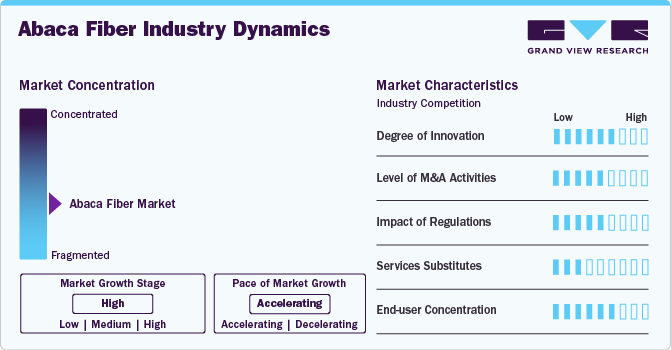
The market faces substitution threats from synthetic fibers like polypropylene and polyester, which are cheaper, widely available, and offer consistent quality for large-scale applications. Natural fibers such as jute, hemp, and sisal also compete due to similar properties and greater availability. These alternatives are preferred in cost-sensitive industries like packaging and construction, limiting market share. In addition, the restricted geographical production of abaca further hampers its competitiveness.
Analyst Perspective
The abaca fiber market is gradually transitioning from traditional applications such as cordage and specialty paper toward higher-value, sustainability-driven applications, with stronger growth opportunities in bio-composites, eco-friendly packaging materials, technical textiles, filtration media, and advanced specialty papers. The key differentiator for companies will not be fiber production capacity alone, but their ability to ensure consistent fiber quality, develop value-added processing capabilities, maintain sustainable and traceable supply chains, and meet evolving environmental and performance requirements across end-use industries. Players with integrated sourcing networks, advanced fiber processing expertise, strong relationships with specialty paper manufacturers and industrial customers, and diversified application portfolios are likely to capture premium margins, while smaller and less diversified suppliers may remain vulnerable to climate-related supply disruptions, raw material availability constraints, price volatility, and competition from alternative natural and synthetic fibers.
Product Insights
Based on product, the pulp & paper segment led the market with the largest revenue share of 84.5% in 2025 and is expected to grow at a CAGR of 16.0% over the forecast period. This is attributed to the rising demand for non-wood fibers as raw Materials for specialty paper applications. Specialty paper made using abaca fiber exhibits a superior strength-to-weight ratio, thus offering high functionality in manufacturing tea bags, currency, and security papers.
Active research and development activities are in progress to properly understand the pulping characteristics, pulp yield, and quality of abaca fibers. The outcomes of the studies can offer a good idea of the possibilities and potential uses of abaca fibers for pulp and paper production.
The textile product segment is also expected to witness a notable revenue-based CAGR of 11.7% over the forecast period on account of the rising demand for advanced biomaterials in fashion textiles. In addition, the latest trend in interior designing practices for both residential and commercial spaces is also expected to drive the demand for abaca fiber for textile manufacturing.
In the past few years, environmental concerns have compelled various industry leaders to focus on the development of ‘green’ products. In order to attain their sustainability goals, manufacturers have started employing biomaterials in their production technologies. Increasing demand for sustainable fibers having advanced properties is anticipated to offer expansion opportunities for abaca fibers in the textile industry.
Regional Insights
The abaca fiber market in North America is growing, focusing on sustainable and biodegradable materials in packaging, textiles, and industrial applications drives the demand for abaca fiber. With increasing environmental awareness, manufacturers are shifting toward natural fibers as alternatives to synthetic options. Moreover, the rise of eco-friendly products in industries like automotive and construction supports the demand for abaca fiber.
U.S. Abaca Fiber Market Trends
The abaca fiber market in the U.S. demand is propelled by its use in specialty papers, such as currency and tea bags, due to its durability and eco-friendly nature. The country's increasing regulations on single-use plastics and a shift to biodegradable materials in consumer goods have further boosted the adoption of abaca-based products. Furthermore, government initiatives promoting sustainability are encouraging industries to adopt natural fibers.
Asia Pacific Abaca Fiber Market Trends
Asia Pacific dominated the abaca fiber market with the largest revenue share of 65.5% in 2025, owing to the growth in adoption of these fibers in several end-use industries, including healthcare, specialty paper, handicraft, automotive, and textile, due to their high mechanical strength, durability, long length, and sustainability.
The abaca fiber market in the philippines held the largest share in the Asia Pacific region in 2025. In addition, public investments in the Philippines and Japan to promote abaca cultivation practices and increase the fibers' production capacity are expected to positively influence market growth in the future.
Europe Abaca Fiber Market Trends
The abaca fiber market in Europe is expected to witness a notable revenue-based CAGR of 14.8% from 2025 to 2033, owing to the growing adoption of the fibers in several application industries, including food and beverages, automotive, and specialty papers, owing to their high mechanical strength, durability, flexibility, and long length.
In addition, favorable trade policies by European countries for importing abaca and other natural fibers are expected to benefit the growth of fiber markets. Key German automotive manufacturing companies are adopting abaca fibers for automotive parts such as headliners, rear cargo shelves, trunk components, and thermal insulation to reduce the overall vehicle weight and increase fuel efficiency.
Germany abaca market strongly emphasizes sustainability, and innovation in material science drives the demand for abaca fiber. The country is a leader in the automotive and paper industries, both of which are incorporating natural fibers to meet environmental standards. Abaca's strength and eco-friendliness make it an ideal material for Germany's advanced manufacturing sectors, including composites and filtration systems.
Central & South America Abaca Fiber Market Trends
The abaca fiber market in CSA is rising, and the rising agricultural and packaging industries are fostering the demand. The region's efforts to adopt sustainable practices in response to global environmental concerns have led to increased use of biodegradable materials. In addition, the fiber's ability to withstand harsh conditions makes it suitable for industrial applications in tropical climates prevalent in the region.
Middle East & Africa Abaca Fiber Market Trends
The abaca fiber market in the Middle East & Africa is increasing in demand due to the region's growing construction and packaging sectors. As countries in the region aim to diversify their economies and adopt eco-friendly materials, abaca fiber is becoming a preferred choice. Its durability and resistance to moisture make it ideal for use in ropes, bags, and industrial products in these arid climates.
Key Abaca Fiber Company Insights
Some key players operating in the market include Specialty Pulp Manufacturing, Inc (SPMI) and Ching Bee Trading Corporation.
-
Specialty Pulp Manufacturing, Inc. (SPMI) was established in 1949 and is headquartered in Quezon City, the Philippines. The company is primarily involved in the manufacturing of high-quality specialty pulps by using Manila hemp, otherwise known as abaca fiber. SPMI belongs to the Chinese Bee Group of Companies and has substantial trading experience in producing and manufacturing abaca fibers. It sells both food-grade and non-food-grade, bleached, and unbleached specialty pulps made from abaca, sisal, kenaf, and jute.
-
Ching Bee Trading Corporation was established in 1940 and is headquartered in Manila, the Philippines. The company has had a substantial market position from the beginning of its operation. It exports abaca, especially to the U.S., Japan, and European countries. The company has a strong market position both domestically and internationally. Ching Bee Trading Corporation ties up with other companies involved in manufacturing vegetable oils and desiccated coconuts.
M.A.P Enterprises and YZEN HANDICRAFT EXPORT TRADING are some emerging market participants.
-
M.A.P Enterprises, headquartered in Manila, Philippines, was established in 2008. It is primarily engaged in the production of abaca fibers, abaca gift envelopes, abaca flowers, and floral scrunched wraps. The company has strong trade networks, and its main marketing areas include Southeast Asia, Western Europe, Oceania, and South Asia.
-
YZEN HANDICRAFT EXPORT TRADING, headquartered in Central Visayas, Philippines, was established in 2008. It primarily manufactures sinamay, abaca fibers, raffia fibers, coco fibers, and coco coir. The company's products are chiefly used for applications such as hat making, flowers, gift wrapping, floral decorations, and Christmas decorations.
Key Abaca Fiber Companies
The following key companies have been profiled for this study on the abaca fiber market.
-
M.A.P. Enterprises
-
Yzen Handicraft Export Trading
-
Specialty Pulp Manufacturing, Inc. (SPMI)
-
Ching Bee Trading Corporation
-
Peral Enterprises
-
Sellinrail International Trading Company
-
DGL Global Ventures LLC
-
Terranova Papers
Competitive Benchmarking
Category
Operating Strategies
Competitive Edge
Weakness
Established Players (Specialty Pulp Manufacturing, Inc. (SPMI), Ching Bee Trading Corporation, Terranova Papers, M.A.P. Enterprises)
- Maintain vertically integrated operations covering cultivation, fiber processing, pulp production, and exports.
- Focus on long-term supply agreements with specialty paper, filtration, and industrial customers.
- Invest in fiber quality enhancement, sustainable sourcing, and production efficiency improvements.
- Strong access to raw material supply and established grower networks.
- Extensive export capabilities and long-standing relationships with global buyers.
- Ability to provide consistent fiber quality and large-volume supply for industrial applications.
- High dependence on abaca-growing regions exposed to climatic risks and supply disruptions.
- Limited diversification beyond traditional pulp, paper, and cordage applications.
- Higher operational costs associated with labor-intensive cultivation and processing activities.
Emerging Players (Yzen Handicraft Export Trading, Peral Enterprises, Sellinrail International Trading Company, DGL Global Ventures LLC)
- Target niche markets such as eco-friendly crafts, sustainable textiles, bio-composites, and specialty fiber products.
- Expand through partnerships with international distributors and sustainable product manufacturers.
- Focus on customized products and value-added processing for higher-margin applications.
- Greater flexibility in addressing emerging end-use applications and customer requirements.
- Strong positioning in sustainable and environmentally friendly product segments.
- Ability to rapidly adopt innovative processing techniques and product development initiatives.
- Limited production capacity and restricted access to large-scale fiber supply networks.
- Lower brand recognition and weaker global distribution capabilities compared to established players.
- Greater vulnerability to raw material price fluctuations and supply chain disruptions.
Abaca Fiber Market Report Scope
Report Attribute
Details
Market size in 2025
USD 1.1 billion
Estimated market size in 2026
USD 1.3 billion
Projected market size by 2033
USD 3.6 billion
Growth rate
CAGR of 15.5% from 2026 to 2033
Base year for estimation
2025
Historical data
2021 - 2024
Forecast period
2026 - 2033
Quantitative units
Volume in tons and Revenue in USD million/billion and CAGR from 2026 to 2033
Report coverage
Revenue forecast, company ranking, competitive landscape, growth factors, and trends
Segments covered
Product, region
Regional scope
North America; Europe; Asia Pacific; Latin America; MEA
Country scope
U.S.; Canada; Mexico; UK; Germany; France; Italy; Spain; China; India; Japan; Philippines
Key companies profiled
M.A.P. Enterprises; Yzen Handicraft Export Trading; Specialty Pulp Manufacturing, Inc. (SPMI); Ching Bee Trading Corporation; Peral Enterprises; Sellinrail International Trading Company; DGL Global Ventures LLC; Terranova Papers
Customization scope
Free report customization (equivalent up to 8 analysts' working days) with purchase. Addition or alteration to country, regional & segment scope.
Pricing and purchase options
Avail customized purchase options to meet your exact research needs. Explore purchase options
Global Abaca Fiber Market Report Segmentation
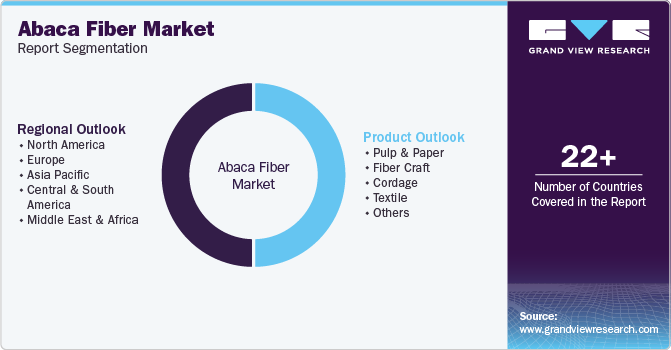
This report forecasts revenue growth at global, regional, and country levels and provides an analysis of the latest industry trends in each of the sub-segments from 2021 to 2033. For this study, Grand View Research has segmented the global abaca fiber market report based on product and region.
-
Product Outlook (Volume, Tons; Revenue, USD Million, 2021 - 2033)
-
Pulp & paper
-
Fiber Craft
-
Cordage
-
Textile
-
Others
-
-
Regional Outlook (Volume, Tons; Revenue, USD Million, 2021 - 2033)
-
North America
-
U.S.
-
Canada
-
Mexico
-
-
Europe
-
Germany
-
UK
-
France
-
Italy
-
Spain
-
-
Asia Pacific
-
China
-
Japan
-
India
-
Philippines
-
-
Central & South America
-
Middle East & Africa
-
Research Methodology
Segment Definition
Segment - Product
Revenue capture definition
Pulp & Paper
Revenue generated from the sale of abaca fiber used in the production of specialty pulp and paper products, including tea bags, coffee filters, currency paper, cigarette paper, security paper, filtration paper, and industrial-grade paper materials. This segment captures revenues from abaca fiber supplied to paper manufacturers requiring high-strength, durable, porous, and lightweight fibers for specialty paper applications across packaging, banking, food & beverage, and industrial sectors.
Fiber Craft
Revenue generated from the sale of abaca fiber used in handcrafted products, decorative items, artisanal goods, and specialty fiber-based crafts, including woven baskets, wall décor, handmade paper products, gift items, fashion accessories, and home furnishings. This segment captures revenues from abaca fiber supplied to artisans, cottage industries, and craft manufacturers utilizing natural fibers for sustainable and aesthetically appealing consumer products.
Cordage
Revenue generated from the sale of abaca fiber used in the manufacture of ropes, twines, marine cordage, fishing nets, cables, and industrial binding materials. This segment captures revenues from abaca fiber supplied for applications requiring high tensile strength, flexibility, durability, and resistance to saltwater degradation across marine, agricultural, shipping, construction, and industrial sectors.
Textile
Revenue generated from the sale of abaca fiber used in textile and fabric production, including apparel fabrics, blended yarns, nonwoven textiles, fashion accessories, upholstery materials, carpets, and technical textiles. This segment captures revenues from abaca fiber supplied to textile manufacturers seeking sustainable, durable, and biodegradable fiber alternatives for use in clothing, home furnishings, and industrial textile applications.
Others
Revenue generated from the sale of abaca fiber used in applications beyond pulp & paper, fiber crafts, cordage, and textiles, including bio-composites, automotive components, construction materials, filtration systems, horticultural products, geotextiles, packaging reinforcements, and specialty industrial applications. This segment captures revenues from abaca fiber supplied to manufacturers utilizing its lightweight, renewable, and high-strength characteristics across diverse end-use industries.
Estimation Model
Layer Name
Key Question
Description
Abaca Fiber Production Base Layer
What forms the supply and demand base?
Identify global production and consumption volumes of abaca fiber across major producing and consuming regions. Analyze cultivated area, fiber yield, harvesting volumes, and utilization across key end-use industries including pulp & paper, cordage, fiber crafts, textiles, bio-composites, filtration materials, and industrial applications. This layer establishes the total addressable demand and supply base that drives the abaca fiber market.
End-Use Penetration Layer
Where is abaca fiber utilized?
Estimate the penetration of abaca fiber across various application segments relative to alternative natural and synthetic fibers. Assess adoption levels in specialty paper products, ropes and cordage, handicrafts, textiles, packaging materials, automotive composites, construction materials, and filtration applications across developed and emerging markets.
Application Intensity Layer
How much abaca fiber is consumed?
Analyze average fiber consumption intensity across major applications, including pulp manufacturing requirements, cordage production volumes, textile blending ratios, composite reinforcement content, and craft product utilization. Consumption intensity is influenced by product specifications, performance requirements, sustainability preferences, technological advancements, and industry-specific demand patterns.
Revenue Layer
How is market revenue generated?
Market revenue is quantified through the sale of raw, processed, and semi-processed abaca fiber supplied to pulp & paper manufacturers, cordage producers, textile manufacturers, craft industries, composite material producers, and industrial users. Revenue is generated from recurring demand for specialty paper products, marine and industrial ropes, sustainable textiles, handicrafts, bio-based composites, filtration materials, and other value-added applications across diverse end-use industries.
Delivered Customizations
This report has been delivered with the following In-depth customizations
CLIENT REQUEST
CUSTOMIZATION DELIVERED
VALUE ADDS
Sustainable Packaging & Specialty Paper Opportunity Assessment
Evaluated abaca fiber consumption trends across specialty paper, tea bags, coffee filters, food packaging, filtration media, and other sustainable packaging applications driven by increasing environmental regulations and consumer preference for biodegradable materials.
Supports investment decisions by identifying high-growth application segments, emerging sustainability-driven demand centers, and opportunities for value-added abaca fiber products in specialty paper and packaging markets.
Abaca Fiber Supply Chain & Raw Material Risk Assessment
Analyzed abaca cultivation patterns, fiber production capacity, harvesting trends, export dynamics, pricing fluctuations, climate-related risks, and supply chain vulnerabilities affecting global abaca fiber availability.
Enables manufacturers and investors to strengthen sourcing strategies, mitigate supply risks, improve procurement planning, and enhance operational resilience amid production disruptions and raw material price volatility.
Regional Demand & Regulatory Landscape Benchmarking
Conducted country-level analysis of abaca fiber demand, sustainability regulations, natural fiber promotion initiatives, agricultural support programs, and industry adoption trends across major producing and consuming regions.
Supports market entry and expansion strategies by identifying favorable regulatory environments, high-growth regions, emerging application opportunities, and competitive positioning across the global abaca fiber value chain.
Frequently Asked Questions About This Report
The global abaca fiber market size was estimated at USD 1.1 billion in 2025 and is expected to reach USD 1.3 billion in 2026.
Some of the key players operating in the abaca fiber market include M.A.P. Enterprises, YZEN HANDICRAFT EXPORT TRADING, Specialty Pulp Manufacturing, Inc (SPMI), Ching Bee Trading Corporation, PERAL ENTERPRISES, SELLINRAIL INTERNATIONAL TRADING, COMPANY, DGL GLOBAL VENTURES LLC, TERRANOVAPAPERS.
The key factors that are driving the abaca fiber market include rising government emphasis on the usage of biodegradable material including fibers to replace hazardous synthetic materials, the rising application scope of abaca fiber across various end-use industries especially automotive and textile.
Asia Pacific accounted for the largest revenue share of 65.5% in 2025.
The global abaca fiber market is expected to grow at a compound annual growth rate of 15.5% from 2026 to 2033 to reach USD 3.6 billion by 2033.
Pulp & paper segment led the market with the largest revenue share of 84.5% in 2025.
Philippines is the fastest-growing country in the abaca fiber market.
About the Author(s)
Specialty Glass, Ceramic & Fiber Research Team
Advanced Materials · Specialty Glass, Ceramic & FiberThis report was authored by the specialty glass, ceramic & fiber research team at Grand View Research - comprising two research analysts, one senior research analyst, and one industry expert - with specialized expertise in the specialty glass, ceramic & fiber segment of the advanced materials industry. All findings are based on proprietary advanced materials databases, executive interviews, and regulatory analysis, subject to internal peer review prior to publication.
Last Updated:
Speak to Analyst

Need a Tailored Report?
Customize this report to your needs — add regions, segments, or data points, with 20% free customization.
Or view our licence options:


ISO 9001:2015 & 27001:2022 Certified
We are GDPR and CCPA compliant! Your transaction & personal information is safe and secure. For more details, please read our privacy policy.












