
- Home
- »
- Next Generation Technologies
- »
-
Active Network Management Market Size Report, 2026-2033GVR Report cover

Active Network Management Market (2026 - 2033)
Size, Share & Trends Analysis Report By Type (Solution & Service), By Enterprise Size (SMEs, Large Enterprise), By Application (Transportation, Energy & Utilities), By Region, And Segment Forecasts
Market Size, 2025
$1.5BMarket Estimate, 2026
$1.7BMarket Forecast, 2033
$4.7BCAGR, 2026–2033
15.8%Active Network Management Market Trends
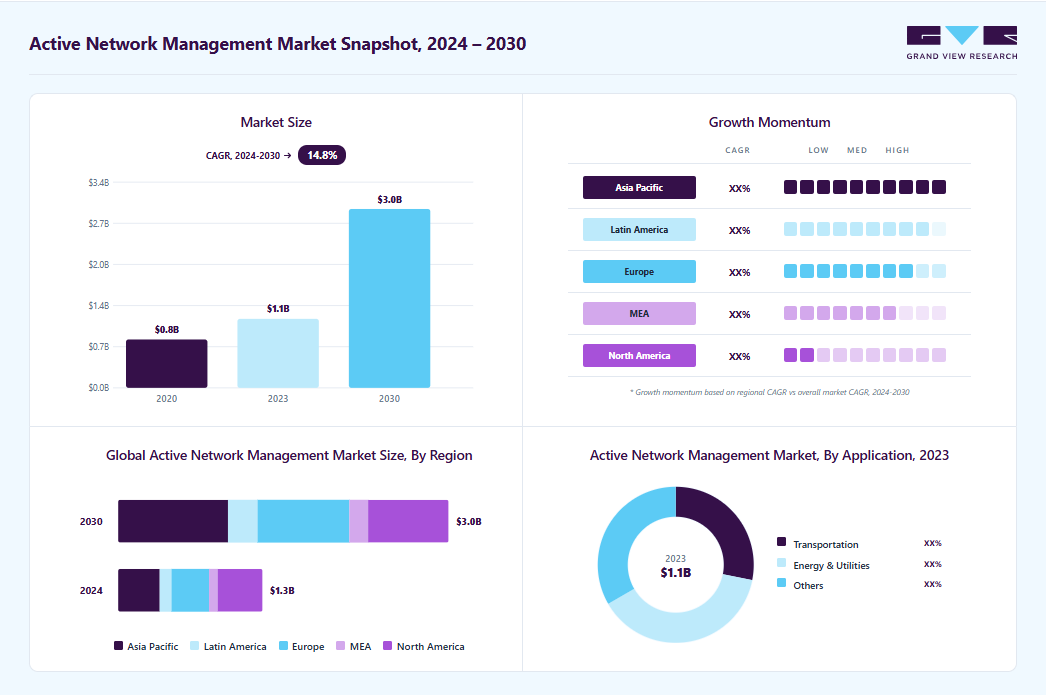
The global active network management market size was valued at USD 1.5 billion in 2025 and is projected to grow from USD 1.7 billion in 2026 to USD 4.7 billion by 2033, at a CAGR of 15.8% from 2026 to 2033. North America dominated the market, accounting for a revenue share of 30.0% in 2025. The market growth is attributed to the increasing complexity of modern networks and the growing demand for highly efficient and reliable network operations. With the rise of cloud services, IoT devices, and edge computing, effective network management is crucial for seamless connectivity and performance.
 Source: Grand View Research, IR Documents, Primary Interviews, Paid DatabasesTo learn more about this report,
 Download Free Sample Report
 Key Market Trends & Insights
- By type: Solution segment dominated the market, with a revenue share of 61.0% in 2025.
- By enterprise size: Large enterprise segment held the largest market share of 55.9% in 2025.
- By application: Energy & utilities segment held the largest revenue share in 2025.
Regional Highlights
- Largest regional market: North America (30.0% revenue share, 2025)
- Fastest-growing regional market: Asia Pacific (highest CAGR, 2026-2033)
- By country: The U.S. held the largest revenue share in the North America.
Market Size & Forecast
- Market size in 2025: USD 1.5 Billion
- Estimated market size in 2026: USD 1.7 Billion
- Projected market size by 2033: USD 4.7 Billion
- CAGR (2026-2033): 15.8%
Three ways to get this report
Buy it, customize it, or ask a question.Ask an Analyst
A direct answer, usually in 1 working day
- AccessReport author, directly
- Reply timeWithin 1 working day
- No sales callDirect answer only
- FormatEmail reply
- CostFree, no cost
Get the Full Report
What the study covers
- FormatsPDF · Excel · Dashboard
- Timeline2026–2033 annual, 2025 base
- Coverage20+ countries, 5 regions
- Companies10+ key players profiled
Customize the Report
20% free customization
- IncludeCountries, segments, points
- TailorTo your product definition
- ExtendDeeper competitor detail
- OrA fully bespoke study
- Turnaround5–10 working days
As a result, organizations across several industries are increasingly investing in advanced active network management solutions for proactively monitoring, analyzing, and optimizing their networks. Active network management plays a pivotal role in the effective management of smart grids, serving as a connective framework that links various components integral to the operation of a smart grid. This includes renewable energy generation sources, energy storage devices, and smaller-scale energy generators. By doing so, it establishes a highly intelligent energy infrastructure capable of autonomous control over these diverse components within the energy network. This intricate system not only streamlines operations but also provides essential information necessary for ensuring that all elements within the smart grid are meticulously governed in the most efficient and optimal manner possible.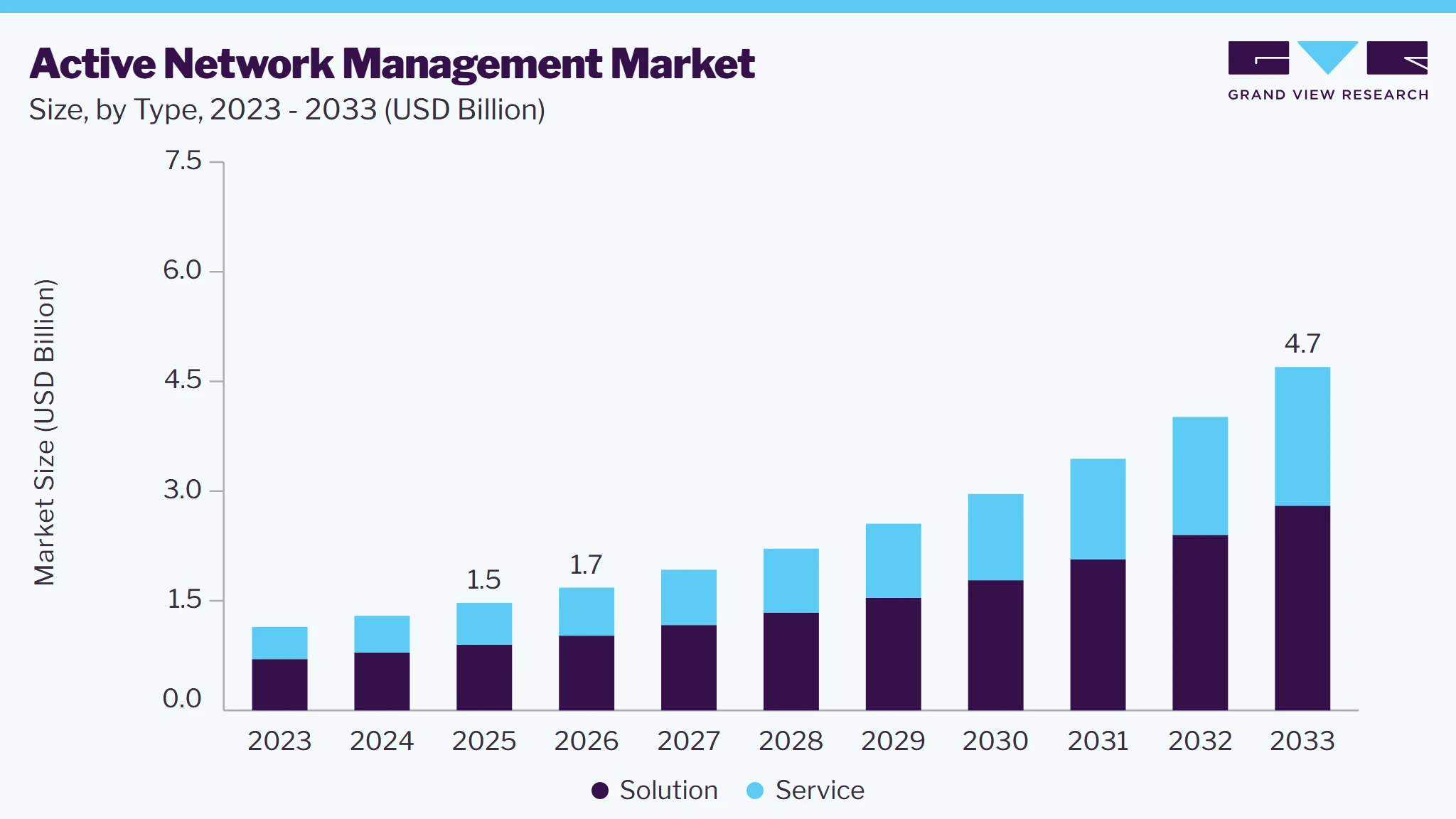 To learn more about this report, Download Free Sample Report
 Another factor fueling the growth of the market is the increasing focus on sustainability and energy efficiency. As energy costs continue to rise, businesses are actively seeking ways to reduce their carbon footprint and energy consumption. Active network management solutions help organizations optimize their energy usage by intelligently managing power distribution and reducing energy wastage. By minimizing energy costs and enhancing sustainability, these solutions have garnered the attention of environmentally conscious businesses, contributing to the market's growth. Thus, the market is thriving as it meets the evolving needs of organizations looking to maintain efficient, resilient, and eco-friendly network infrastructures in a digital-first world.
Moreover, the growing adoption of 5G technology is creating new opportunities for the active network management market. The rollout of 5G networks brings unprecedented speeds and low latency, but it also introduces greater complexity in network management. 5G networks require more dynamic and flexible management solutions to handle the increased data traffic and diverse array of connected devices. Active network management systems are evolving to meet these challenges. Type tools for managing network slicing, orchestrating virtualized network functions, and ensuring quality of service across various 5G use cases. As 5G continues to expand globally, the demand for sophisticated active network management solutions is expected to surge, further propelling market growth in the coming years.
Despite its potential for significant growth, the market encounters several challenges. A major hurdle is the substantial initial investment needed for advanced network management solutions, which can deter small and medium-sized enterprises with limited budgets. Furthermore, integrating these systems with existing legacy infrastructure presents technical challenges and may necessitate extensive staff training or hiring specialized personnel. Additionally, there are concerns about data security and privacy, as active network management systems frequently handle sensitive information, making them potential targets for cyberattacks.
Market Dynamics
The active network management market is witnessing substantial growth as utilities increasingly modernize electricity networks to accommodate rising renewable energy penetration, distributed energy resources (DERs), and evolving grid reliability requirements. Advances in smart grid technologies, IoT-enabled monitoring systems, artificial intelligence, and real-time analytics are enabling utilities to optimize power flows, improve grid visibility, and enhance operational efficiency. Growing investments in grid digitalization, decarbonization initiatives, and energy transition programs are further accelerating market adoption.
The global transition toward clean energy has significantly increased the deployment of renewable energy generation assets such as solar farms, wind parks, and distributed energy resources. While renewable energy supports decarbonization objectives, its intermittent nature introduces operational challenges for grid operators. Traditional electricity networks were originally designed for centralized power generation and often struggle to accommodate fluctuating renewable energy output, voltage instability, reverse power flows, and network congestion. These challenges are becoming more pronounced as renewable penetration continues to rise across both developed and emerging energy markets.
Active network management solutions address these challenges by providing real-time visibility, automated control mechanisms, and intelligent grid optimization capabilities. ANM platforms enable utilities to manage network constraints dynamically, optimize renewable energy integration, and improve grid flexibility without requiring extensive infrastructure expansion. Through advanced forecasting, demand response coordination, and automated power flow management, these systems help maximize renewable energy utilization while maintaining grid reliability.
The complexity associated with integrating active network management platforms into existing utility infrastructure is restraining the growth of the market. Many electricity networks operate with legacy systems that were not designed to support modern digital grid management technologies. Integrating active network management solutions often requires significant upgrades to communication networks, control systems, monitoring infrastructure, and operational processes. The resulting implementation costs, project complexity, and lengthy deployment timelines can create barriers for utilities considering adoption.
The impact of this restraint is particularly significant for smaller utilities and organizations operating in regions with aging grid infrastructure. Developing economies may face additional challenges due to limited funding availability, lower digital maturity, and constrained technical expertise. These factors can delay modernization initiatives and reduce the pace of Active Network Management adoption.
The rapid growth of distributed energy resources, including rooftop solar systems, battery energy storage systems, electric vehicles, and microgrids, presents a significant opportunity for the active network management market. Utilities are increasingly seeking advanced solutions to manage decentralized energy assets while maintaining network stability and operational efficiency. The proliferation of distributed resources is creating new requirements for real-time visibility, dynamic control, and coordinated energy management across increasingly complex grid environments.
Active network management platforms are well-positioned to capitalize on this opportunity by enabling utilities to integrate and optimize distributed energy resources at scale. Advanced analytics, artificial intelligence, and automated control capabilities allow network operators to manage power flows, improve grid resilience, and unlock additional network capacity. Vendors offering integrated DER management, smart grid optimization, and cloud-based network management solutions are expected to benefit significantly. The convergence of distributed energy resources and digital grid technologies is expected to drive growth of the market over the forecast period.
Analyst Perspective
The active network management market is becoming a cornerstone of modern grid modernization strategies as utilities increasingly transition toward decentralized and renewable-based energy systems. Growing investments in smart grids, distributed energy resource management, and network automation are creating sustained demand for intelligent grid management platforms. Technological advancements in artificial intelligence, cloud computing, advanced analytics, and real-time network control are significantly enhancing the capabilities of Active Network Management solutions. Competitive activity is increasingly centered on integrated grid orchestration platforms that combine forecasting, optimization, DER management, and network automation functionalities.
Type Insights
Based on type, the solution segment led the market with the largest revenue share of 61.0% in 2025. Based on the type, the market is segmented into solution and service. The segmental growth can be attributed to the rising demand for effective power distribution management systems and load-balancing modules in power grids. Furthermore, multiple European nations, such as the UK, Germany, the Netherlands, and Belgium, are in the process of implementing intelligent energy distribution systems to enhance power allocation efficiency. Active network management software solutions encompass a range of management suites and platforms, which encompass advanced metering infrastructure (AMI), distribution automation, geographic information systems, outage management, and telecommunications network management.
The service segment is expected to grow rapidly during the forecast period. The increasing complexity of network infrastructures, coupled with a prevalent skill gap in organizations, is driving demand for professional services, managed services, and consulting. In addition, cloud adoption is creating opportunities for migration and integration services, while customization needs are fueling tailored solutions across industries. Continuous innovation in network technologies necessitates regular updates, creating a consistent demand for maintenance services.
Enterprise Size Insights
Based on enterprise size, the large enterprises segment led the market with the largest revenue share of 55.9% in 2025. Based on the enterprise size, the market is segmented into small & medium enterprises and large enterprises. The growth of the large enterprises segment can be attributed to the growing adoption of advanced active network management systems owing to the increasing need for enhanced operational efficiency, improved network performance, and robust security measures in large-scale operations. Furthermore, a shift towards cloud-based and hybrid network architectures is being witnessed among large enterprises, necessitating more advanced network management capabilities.
The small & medium enterprises (SMEs) segment is anticipated to be the fastest-growing segment throughout the projection period. The growth can be attributed to the growing number of SMEs worldwide. Additionally, government initiatives in many countries are actively promoting entrepreneurship and SME growth, contributing to an increase in the number of SMEs. As SMEs grow and their network needs become more complex, they are increasingly turning to active network management solutions to ensure reliability, security, and scalability. Moreover, as digital transformation initiatives become increasingly critical for businesses of all sizes, SMEs are recognizing the importance of efficient network management.
Application Insights
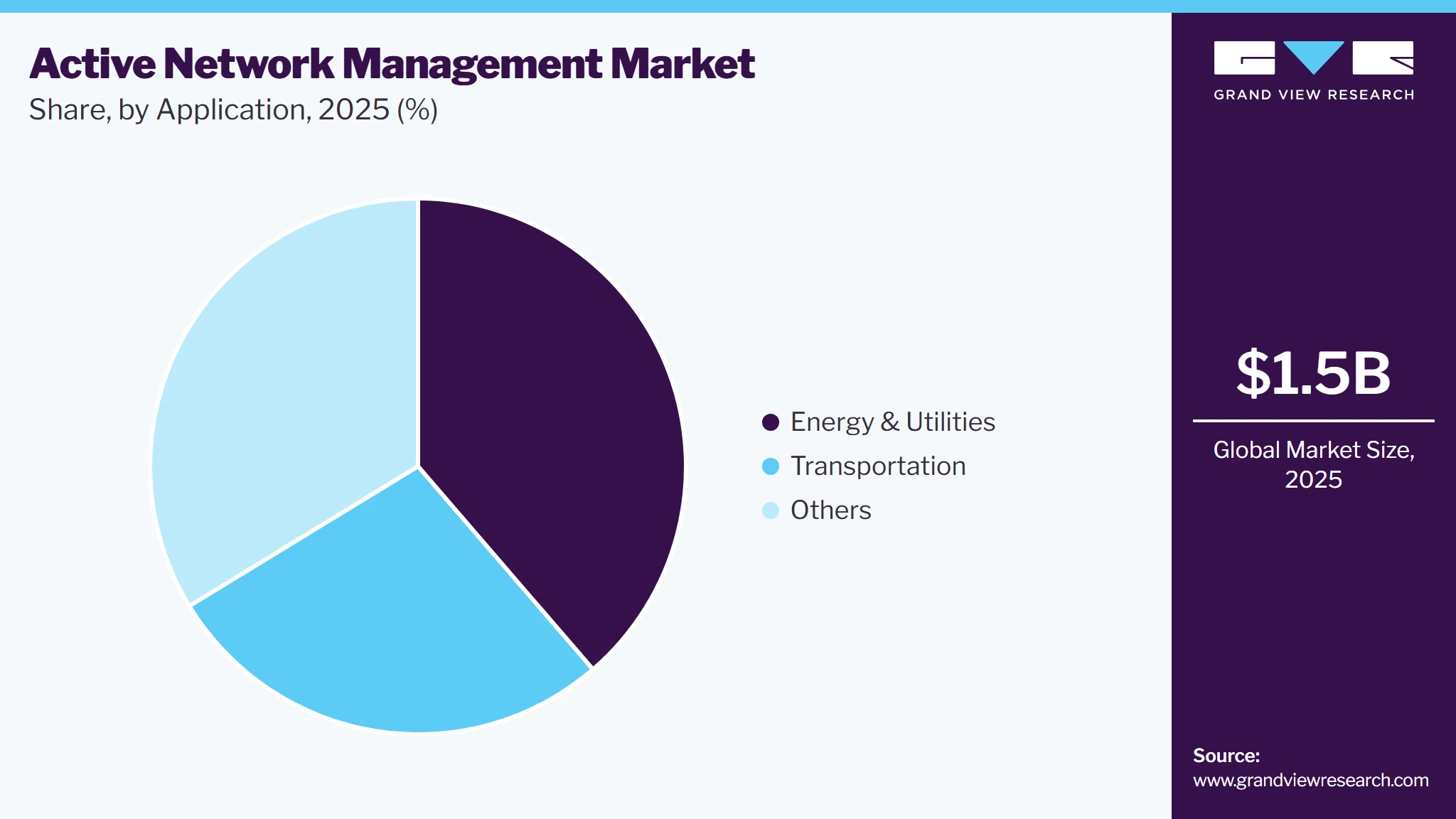
Based on application, the energy & utilities led the market with the largest revenue share of 38.7% in 2025. The integration of renewable energy sources, such as solar and wind power, has prompted energy and utility companies to embrace active network management solutions to manage the influx of intermittent energy efficiently. Moreover, the advent of smart grids, featuring advanced metering infrastructure, distribution automation, and real-time monitoring, has further accentuated the demand for active network management. These systems empower utilities to monitor and control energy distribution with precision, mitigate losses, and enhance grid reliability.
 To learn more about this report, Download Free Sample Report
 The transportation segment is expected to grow substantially during the forecast period. This segment encompasses a wide range of applications, from intelligent traffic management systems to connected vehicle networks and smart public transportation solutions. One of the primary drivers of growth in this segment is the rapid development of smart city initiatives worldwide. As urban areas seek to improve mobility and reduce congestion, they are increasingly turning to active network management solutions to optimize traffic flow, manage public transportation systems, and enhance overall transportation efficiency.
Regional Insights
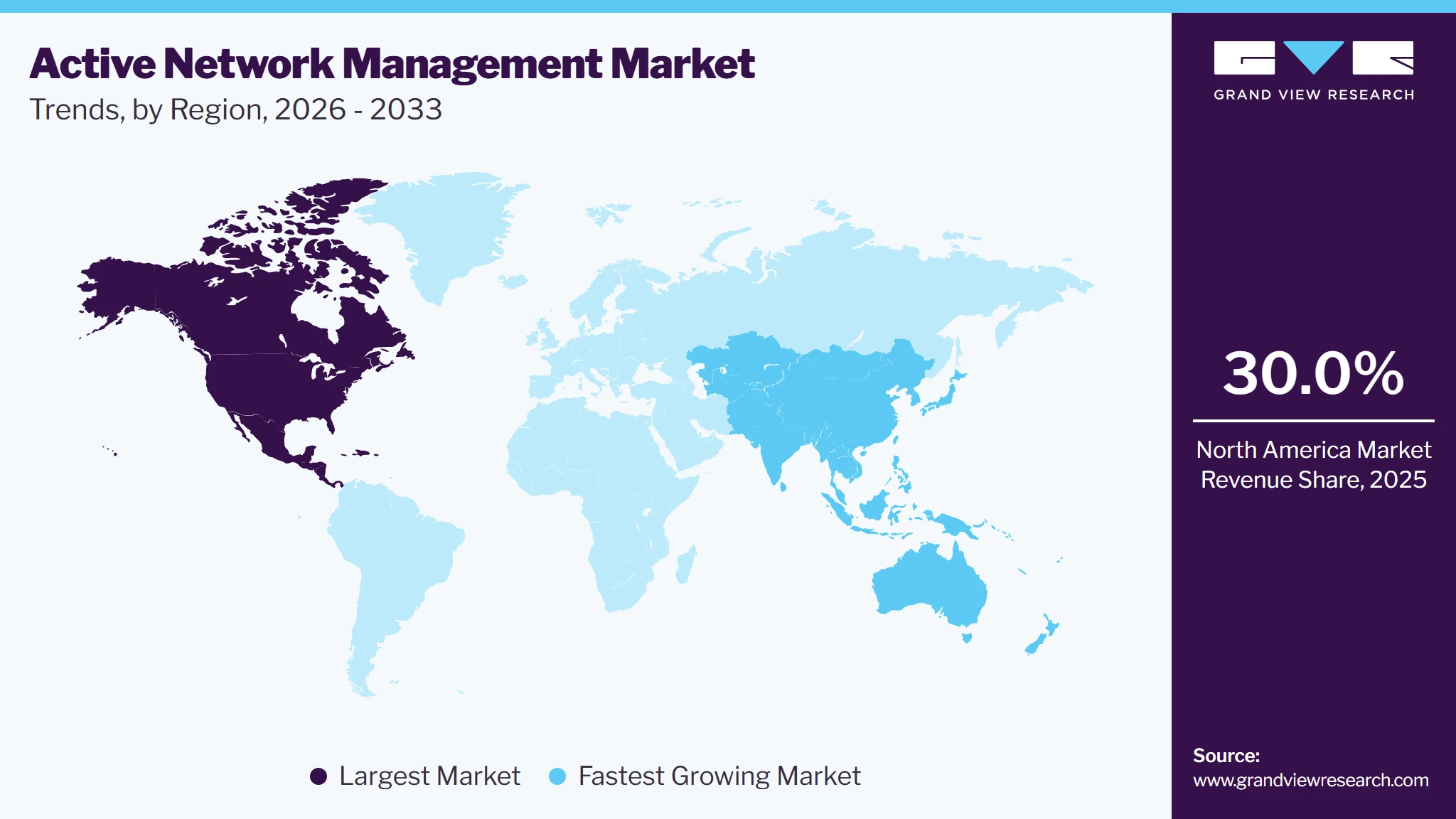
North America dominated the global active network management market with the largest revenue share of 30.0% in 2025. The segmental growth can be attributed to the region's increasing focus on renewable energy integration, smart grid development, and grid modernization initiatives has accelerated the adoption of active network management solutions. Furthermore, the growing demand for electric vehicles has also played a role in driving market’s growth, with active network management being essential for managing EV charging infrastructure. Regulatory compliance and the increasing reliance on data centers in the region have contributed to the ongoing expansion of the active network management market.
 To learn more about this report, Download Free Sample Report
 U.S. Active Network Management Market Trends
U.S. active network management held the largest revenue share in the North America. The U.S. active network management market is experiencing significant growth, driven by the rapid adoption of smart grid technologies and the increasing emphasis on grid resilience. A major trend is the modernization of aging infrastructure to handle the growing demand for electricity and improve reliability.
Europe Active Network Management Market Trends
Theactive network management market of Europe is characterized by its strong commitment to sustainability and renewable energy integration. The European Union's stringent environmental regulations and ambitious carbon reduction targets are driving the adoption of advanced network management solutions.
Asia Pacific Active Network Management Market Trends
Asia Pacific active network management market is marked by its dynamic and diverse landscape, driven by rapid urbanization and industrialization. A key trend in this region is the substantial investment in smart city initiatives, where advanced network management plays a crucial role in ensuring efficient energy distribution and management.
Key Active Network Management Company Insights
Key players operating in the market include Abb Ltd.; Chemtrols Industries Pvt. Ltd.; Cisco Systems Inc.; General Electric Company; IBM Corporation; Landis+Gyr AG; Oracle Corporation; Schneider Electric S.E.; Siemens Ag; And Itron, Inc.; among others. The key market players are focusing on various strategic initiatives, including partnerships & collaborations, new product development, and geographic expansion to gain a competitive advantage over their rivals.
Key Active Network Management Companies
The following key companies have been profiled for this study on the active network management market.
-
Abb Ltd.
-
Chemtrols Industries Pvt. Ltd.
-
Cisco Systems Inc.
-
General Electric Company
-
IBM Corporation
-
Landis+Gyr AG
-
Oracle Corporation
-
Schneider Electric S.E.
-
Siemens Ag
-
Itron, Inc.
Competitive Benchmarking
Operating Strategies
Competitive Edge
Weaknesses
Established Players (ABB Ltd., Cisco Systems Inc., General Electric Company)
- Focus on smart grid modernization, utility digitalization, DER integration, advanced analytics, grid automation, cloud-based energy management platforms, and strategic partnerships with utilities and grid operators.
- These companies emphasize end-to-end grid management ecosystems and large-scale infrastructure deployments.
- Strong global presence, extensive product portfolios, advanced technology capabilities, large installed customer bases, significant R&D investments, and deep expertise in utility operations and energy management systems.
- Longer sales cycles, complex implementation requirements, higher deployment costs, and dependence on utility capital expenditure programs and regulatory approvals.
Emerging Players (Chemtrols Industries Pvt. Ltd.)
- Focus on utility automation, industrial control systems, customized energy management solutions, and regional infrastructure projects.
- The company emphasizes localized implementation capabilities and customer-specific engineering solutions.
- Strong regional expertise, customization capabilities, flexible project execution, and specialized knowledge of industrial automation and energy infrastructure environments.
- Limited global footprint, smaller technology portfolio, lower brand visibility, and fewer financial resources compared to multinational market leaders.
Recent Developments
-
In February 2023, Siemens AG announced a strategic partnership with EnergyHub to develop an advanced Distributed Energy Resources (DER) management system. This collaboration aims to integrate Siemens' software solutions with EnergyHub's grid capabilities, enhancing network planning, operation, and maintenance for utilities. By leveraging Siemens' expertise in network management and EnergyHub's technological strengths, the partnership aims to offer a comprehensive DER management solution. This initiative supports utilities in achieving net-zero emissions by maximizing the use of distributed energy resources as cost-effective alternatives to traditional infrastructure investments.
Active Network Management Market Report Scope
Report Attribute
Details
Market size in 2025
USD 1.5 billion
Estimated market size in 2026
USD 1.7 billion
Projected market size by 2033
USD 4.7 billion
Growth rate
CAGR of 15.8% from 2026 to 2033
Base year for estimation
2025
Historical data
2021 - 2024
Forecast period
2026 - 2033
Quantitative units
Revenue in USD million/billion and CAGR from 2026 to 2033
Report coverage
Revenue forecast, company ranking, competitive landscape, growth factors, and trends
Segments covered
Type, enterprise size, application, region
Regional scope
North America; Europe; Asia Pacific; Latin America; MEA
Country scope
U.S.; Canada; Mexico; U.K.; Germany; France; China; Japan; India; Australia; South Korea; Brazil; Saudi Arabia; UAE; South Africa
Key companies profiled
Abb Ltd.; Chemtrols Industries Pvt. Ltd.; Cisco Systems Inc.; General Electric Company; IBM Corporation; Landis+Gyr AG; Oracle Corporation; Schneider Electric S.E.; Siemens Ag; Itron, Inc.
Customization scope
Free report customization (equivalent up to 8 analysts' working days) with purchase. Addition or alteration to country, regional & segment scope.
Pricing and purchase options
Avail customized purchase options to meet your exact research needs. Explore purchase options
Global Active Network Management Market Report Segmentation
The report forecasts revenue growth at global, regional, and country levels and provides an analysis of the latest industry trends in each of the sub-segments from 2021 to 2033. For this study, Grand View Research has segmented the global active network management market based on type, enterprise size, application, and region.
-
Type Outlook (Revenue, USD Million, 2021 - 2033)
-
Solution
-
Service
-
-
Enterprise Size Outlook (Revenue, USD Million, 2021 - 2033)
-
Small & Medium Enterprises (SMEs)
-
Large Enterprises
-
-
Application Outlook (Revenue, USD Million, 2021 - 2033)
-
Transportation
-
Energy & Utilities
-
Others
-
-
Regional Outlook (Revenue, USD Million, 2021 - 2033)
-
North America
-
U.S.
-
Canada
-
Mexico
-
-
Europe
-
Germany
-
UK
-
France
-
-
Asia Pacific
-
China
-
India
-
Japan
-
South Korea
-
Australia
-
-
Latin America
-
Brazil
-
-
Middle East & Africa (MEA)
-
UAE
-
Kingdom of Saudi Arabia (KSA)
-
South Africa
-
-
Research Methodology
The active network management market figures in this report are based on a proven research process that combines executive interviews with secondary research from proprietary databases, company filings, and recognized regulatory and institutional sources. Market size is built through value-chain sizing-reconciling supply-side and demand-side estimates-and triangulated with bottom-up and top-down approaches. Every estimate passes multiple levels of expert validation before publication, with each active network management segment quantified using the revenue-capture definitions in the table below.
Segment Definition
Segment – Type
Revenue capture definition
Solution
Revenue generated from active network management software platforms, grid optimization applications, DER management systems, network monitoring solutions, analytics platforms, control systems, forecasting engines, software licensing fees, SaaS subscriptions, platform upgrades, and associated software modules used for network automation and grid management.
Service
Revenue generated from consulting, implementation, integration, deployment, customization, system engineering, technical support, maintenance, managed services, training programs, software upgrades, performance optimization services, and ongoing operational support associated with active network management deployments.
Segment – Enterprise Size
Revenue capture definition
SME
Small and medium-sized enterprises utilizing active network management solutions to improve energy network visibility, optimize operational performance, manage distributed energy assets, and support efficient network operations with scalable and cost-effective solutions.
Large Enterprise
Large enterprises and utility operators deploying comprehensive active network management platforms across extensive electricity networks to manage complex grid operations, renewable energy integration, distributed energy resources, and large-scale infrastructure assets.
Segment – Application
Revenue capture definition
Transportation
Utilization of active network management solutions within transportation infrastructure, including rail networks, electric vehicle charging systems, airports, and intelligent transportation energy systems, to optimize energy distribution and maintain operational reliability.
Energy & Utilities
Deployment of active network management platforms by electricity utilities, grid operators, renewable energy providers, and distribution network operators to manage power flows, integrate renewable energy, optimize grid performance, and enhance network reliability.
Others
The others segment includes industrial facilities, commercial buildings, campuses, microgrids, smart cities, public infrastructure projects, and other applications where dynamic energy network management and optimization capabilities are required.
Estimation Model
Layer Name
Key Question
Description
Electricity Network & Grid Infrastructure Layer
What is the total addressable market for active network management?
This layer evaluates the global electricity network ecosystem, including transmission infrastructure, distribution networks, renewable energy installations, distributed energy resources, and utility modernization programs. It assesses investments in grid expansion, digitalization, and energy transition initiatives. These factors establish the foundational demand environment for active network management solutions.
Smart Grid & ANM Adoption Layer
What proportion of network operators are deploying Active Network Management solutions?
This layer measures adoption rates of smart grid technologies, network automation systems, DER management platforms, and active network management solutions across utilities and energy operators. It evaluates utility digital transformation initiatives, regulatory support, and technology deployment trends. Adoption patterns are analyzed across regions and utility sizes.
Application & End-User Demand Layer
Which applications generate demand for active network management?
This layer evaluates demand across energy & utilities, transportation, smart cities, microgrids, renewable energy projects, and industrial energy management applications. It analyzes operational requirements related to renewable integration, grid flexibility, network optimization, and energy efficiency. Industry-specific deployment patterns and investment priorities are assessed.
Revenue Monetization Layer
How is market value generated?
This layer estimates revenue generated from software platforms, grid management solutions, analytics tools, consulting services, implementation projects, managed services, support contracts, and recurring software subscriptions. Revenue contributions from solution providers, technology vendors, and service providers are aggregated.
Delivered Customizations
This report has been delivered with the following In-depth customizations
Client Request
Customization Delivered
Value Adds
Cross-Segmentation Analysis for the Active Network Management Market
Criss-cross market analysis by type, enterprise size, application
Demand and adoption assessment across key segments
Segment attractiveness and growth potential benchmarking
Identified high-potential market segments
Supported targeted product positioning and marketing strategy
Improved customer and segment prioritization
Competitive Benchmarking and Strategic Positioning in the Active Network Management Market
Benchmarking of key competitors across products, pricing, partnerships, and innovation
Comparative assessment of market share, capabilities, and strategies
Analysis of competitive strengths, gaps, and differentiation areas
Identified competitive white spaces and growth gaps
Supported strategic positioning and differentiation
Enabled data-driven competitive strategy development
Regional Active Network Management Market Opportunity Assessment
Country/region-wise market sizing and forecasts
Analysis of demand, adoption trends, and regulatory landscape
Identification of high-growth regions and investment hotspots
Identified region-specific growth opportunities
Supported expansion and go-to-market strategy
Enabled informed regional investment decisions
Frequently Asked Questions About This Report
Asia Pacific is the fastest growing region over the forecast period.
The solutions segment lead with the 61.0% revenue share in 2025, while services segment is expected to grow at the fastest CAGR over the forecast period.
The large enterprises segment held the largest revenue share in 2025, while SME represents the fastest growing area.
The energy & utilities held the largest revenue share in 2025, while transportation segment is expected to grow at a significant CAGR over the forecast period.
The global active network management market size was estimated at USD 1.5 billion in 2025 and is expected to reach USD 1.7 billion in 2026.
The global active network management market is expected to grow at a compound annual growth rate of 15.8% from 2026 to 2033 to reach USD 4.7 billion by 2033.
Increasing integration of renewable energy sources is driving growth of the active network management market.
Some key players operating in the active network management market include Abb Ltd.; Chemtrols Industries Pvt. Ltd.; Cisco Systems Inc.; General Electric Company; IBM Corporation; Landis+Gyr AG; Oracle Corporation; Schneider Electric S.E.; Siemens Ag; Itron, Inc.
North America dominant with a 30.0% market share in 2025.
About the Author(s)
Next Generation Technologies Research Team
Technology · Next Generation TechnologiesThis report was authored by the next generation technologies research team at Grand View Research - comprising two research analysts, one senior research analyst, and one industry expert - with specialized expertise in the next generation technologies segment of the technology industry. All findings are based on proprietary technology databases, executive interviews, and regulatory analysis, subject to internal peer review prior to publication.
Last Updated:
Speak to Analyst

Customize this report to your needs - add regions, segments, or data points, with 20% free customization.
Or view our licence options:


ISO 9001:2015 & 27001:2022 Certified
We are GDPR and CCPA compliant! Your transaction & personal information is safe and secure. For more details, please read our privacy policy.


