
- Home
- »
- Next Generation Technologies
- »
-
Active Optical Cable Market Size & Share Report, 2026-2033GVR Report cover
![Active Optical Cable Market (2026 - 2033)Report]()
Active Optical Cable Market (2026 - 2033)
Size, Share & Trends Analysis Report By Form Factor (QSFR, SFP), By Application (High-performance Computing (HPC), Consumer Electronics, Telecommunications), By Protocol (InfiniBand, Ethernet), By Region, And Segment Forecasts
Market Size, 2025
$5.0BMarket Estimate, 2026
$5.6BMarket Forecast, 2033
$13.4BCAGR, 2026–2033
13.2%Active Optical Cable Market Summary
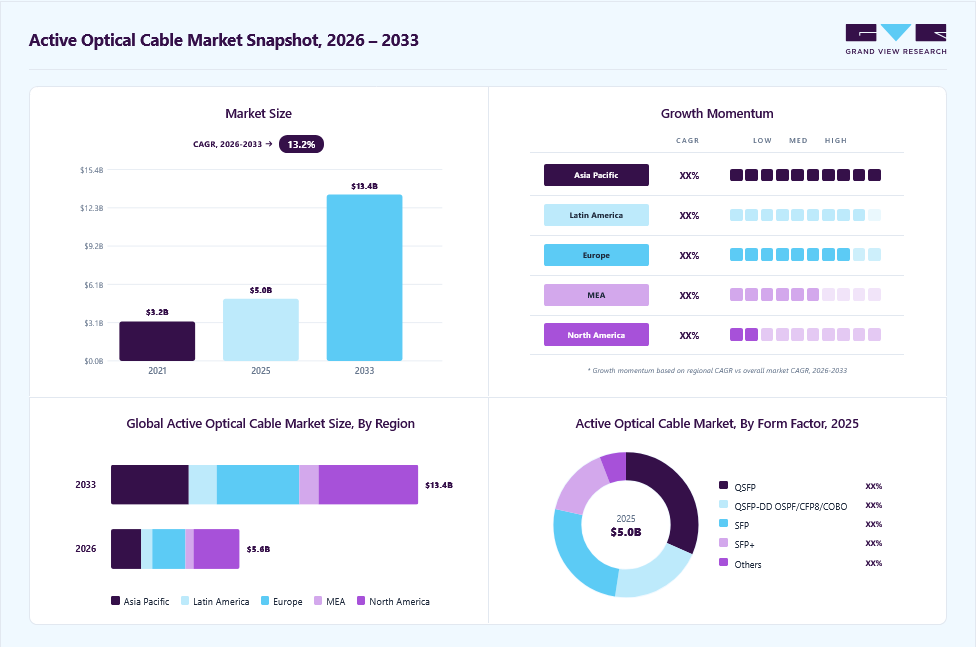
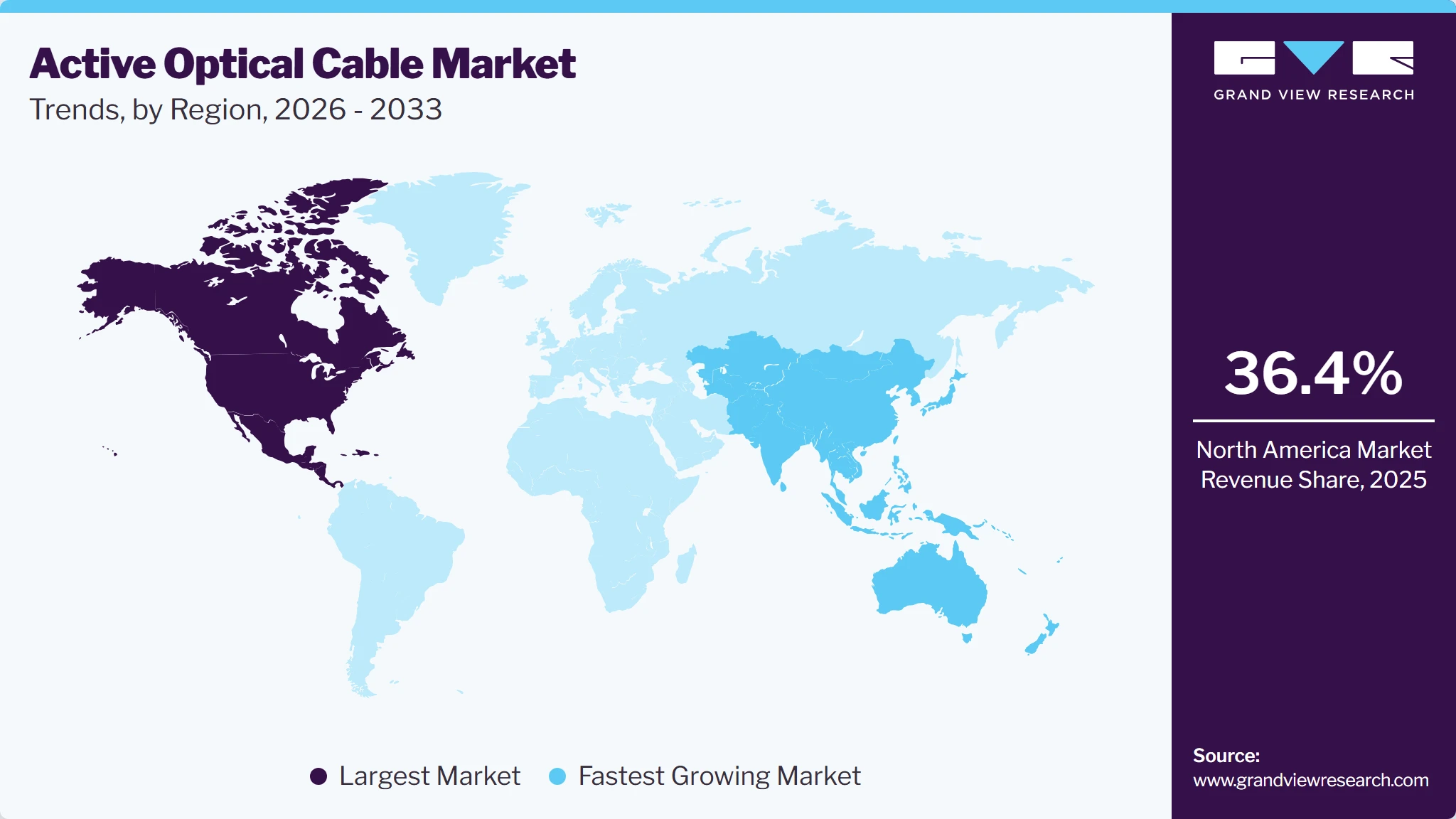
The global active optical cable market size was valued at USD 5.0 billion in 2025 and is projected to grow from USD 5.6 billion in 2026 to USD 13.4 billion by 2033, at a CAGR of 13.2% from 2026 to 2033. North America dominated the market, accounting for a revenue share of 36.4% in 2025. The region's leadership is attributed to the strong presence of hyperscale data centers, cloud service providers, and high-performance computing infrastructure across the U.S. and Canada.
Key Market Trends & Insights
- By Form Factor: QSFP segment led the Market and held the largest revenue share of over 23.7% in 2025.
- By Application: Data Centers segment led the Market and held the largest revenue share of over 35.8% in 2025.
- By Protocol: PCI Express (PCIe) segment is expected to grow at the fastest CAGR of over 15.2% from 2026 to 2033.
Regional Highlights
- Largest regional market: North America (36.4% revenue share, 2025)
- Fastest growing regional market: Asia Pacific (highest CAGR, 2026-2033)
- By country: U.S. held the largest market share in 2025.
Market Size & Forecast
- 2025 Market Size: USD 5.0 Billion
- 2026 Market Size: USD 5.6 Billion
- 2033 Projected Market Size: USD 13.4 Billion
- CAGR (2026-2033): 13.2%
Three ways to get this report
Buy it, customize it, or ask a question.Ask an Analyst
A direct answer, usually in 1 working day
- AccessReport author, directly
- Reply timeWithin 1 working day
- No sales callDirect answer only
- FormatEmail reply
- CostFree, no cost
Get the Full Report
What the study covers
- FormatsPDF · Excel · Dashboard
- Timeline2026–2033 annual, 2025 base
- Coverage20+ countries, 5 regions
- Companies10+ key players profiled
Customize the Report
20% free customization
- IncludeCountries, segments, points
- TailorTo your product definition
- ExtendDeeper competitor detail
- OrA fully bespoke study
- Turnaround5–10 working days
Moreover, rising investments in artificial intelligence, machine learning, and 400G/800G network upgrades are driving demand for high-speed, low-latency optical interconnect solutions. In addition, factors such as digitalization and the rollout of 5G networks present significant growth opportunities for the market. The superior reliability of active optical cables over traditional copper cables, combined with the extensive adoption of cloud-based services, is propelling market growth during the forecast period.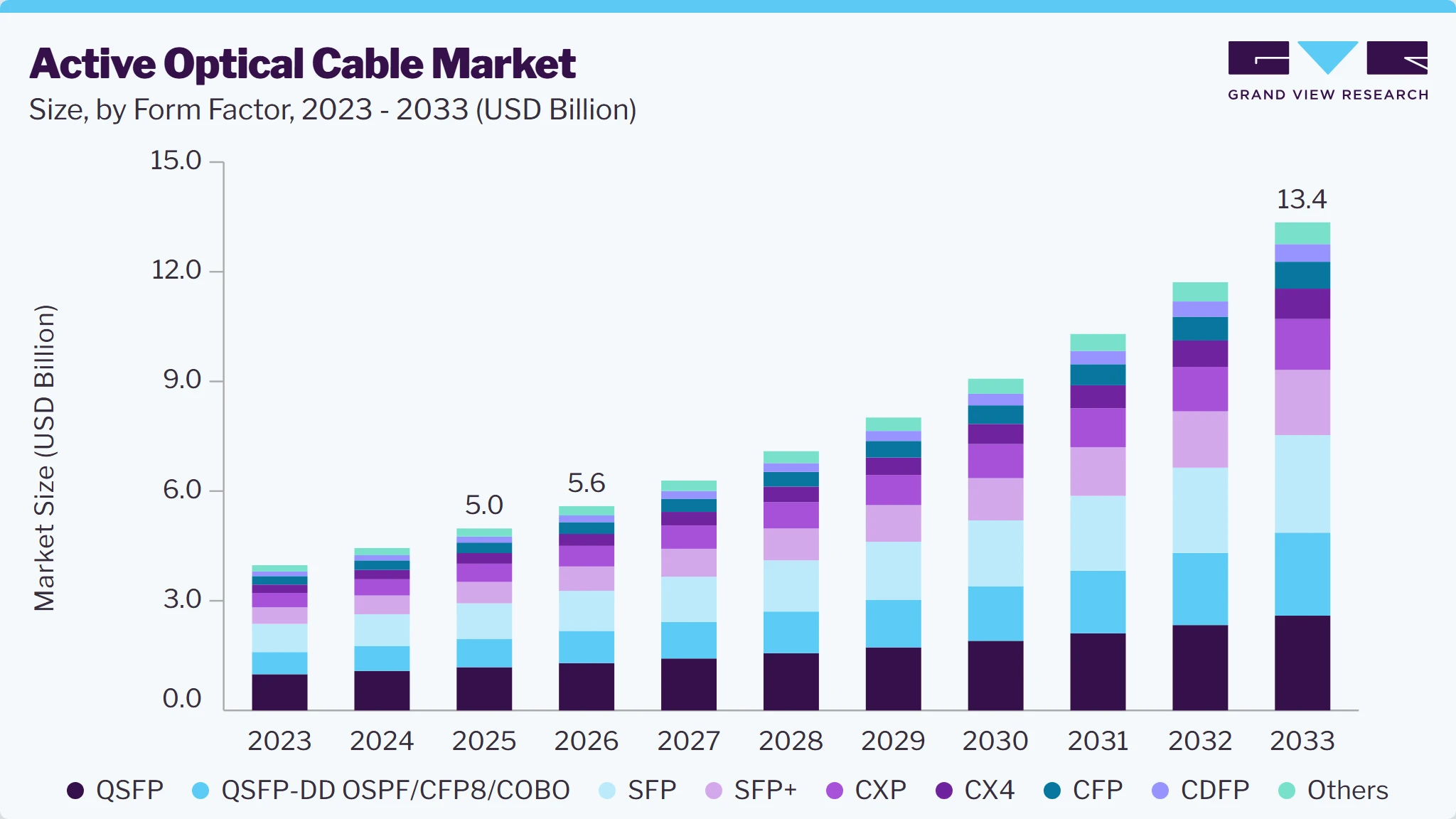
Furthermore, digitalization and the rollout of 5G networks offer significant growth opportunities for the market. Moreover, the widespread adoption of 4K and 8K Video Technologies is fueling the market growth. 4K and 8K video technologies have become prevalent in industries like medical imaging, gaming, broadcasting, and digital signage, leading to a substantial rise in the demand for high data rates and extended transmission distances. To meet these needs, Active optical cables have become essential solutions. These progressed optical interconnects offer seamless and reliable transmission of high-resolution video signals over long distances, ensuring the quality and integrity of the video content.
Market Dynamics
The Active Optical Cable Market is experiencing substantial growth, driven by the increasing demand for high-speed, low-latency data transmission and the rapid expansion of hyperscale data centers and cloud computing infrastructure. Active optical cables enable reliable, high-bandwidth connectivity while reducing power consumption and electromagnetic interference, making them essential for modern networking environments. Rising adoption of artificial intelligence, machine learning, and high-performance computing applications, coupled with the ongoing transition to 400G and 800G Ethernet technologies, is further supporting market growth. Additionally, the expansion of 5G networks, edge computing infrastructure, and advancements in optical interconnect technologies are accelerating the demand for active optical cables across telecommunications, enterprise, and consumer electronics applications.
The Active Optical Cable Market is experiencing robust growth driven by the increasing need for high-bandwidth, low-latency connectivity across data centers, telecommunications networks, and high-performance computing environments. The rapid proliferation of cloud computing, artificial intelligence workloads, and big data analytics has significantly increased demand for high-speed interconnect solutions. Active optical cables offer superior signal integrity, lower power consumption, and longer transmission distances compared to traditional copper cables, making them essential for next-generation networking infrastructure. Additionally, the ongoing transition toward 400G and 800G Ethernet networks is further accelerating market adoption.
Despite strong growth prospects, the Active Optical Cable Market faces challenges associated with the relatively high cost of optical components and ongoing supply chain disruptions. The manufacturing of active optical cables requires specialized materials, semiconductor chips, and optical transceivers, which can increase overall production costs. Fluctuations in the availability and pricing of optical modules and electronic components, coupled with geopolitical uncertainties and logistics bottlenecks, may impact product availability and delivery timelines. Furthermore, compatibility issues with legacy networking systems and the higher upfront investment compared to copper cables may limit adoption among cost-sensitive users.
The increasing deployment of artificial intelligence clusters, hyperscale data centers, and advanced telecommunications infrastructure presents significant opportunities for the active optical cable market. AI training and inference applications require ultra-high-speed connectivity with minimal latency, driving demand for 400G, 800G, and emerging 1.6T active optical cable solutions. The expansion of 5G networks, edge computing, and high-performance computing environments is further creating opportunities for advanced optical interconnect technologies. Moreover, innovations in silicon photonics, co-packaged optics, and energy-efficient optical modules are expected to enhance performance and support long-term market growth throughout the forecast period.Top of Form
Market Concentration & Characteristics
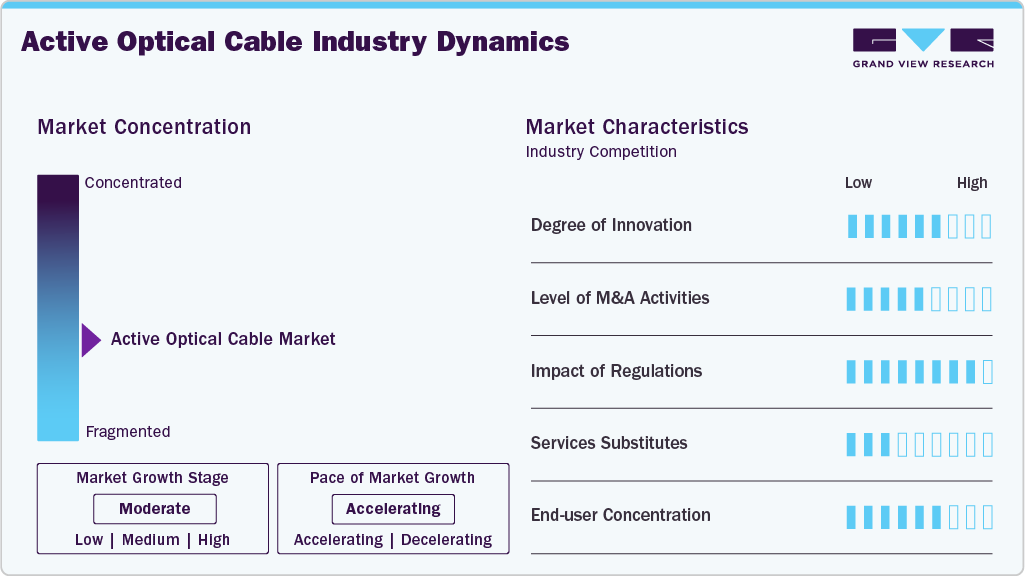
The Active Optical Cable Market is moderately consolidated, characterized by the presence of several established connectivity and optical component manufacturers competing based on product performance, bandwidth capabilities, signal integrity, power efficiency, and technological innovation. Market participants are increasingly focusing on expanding their high-speed connectivity portfolios, strengthening manufacturing capabilities, and developing advanced optical interconnect solutions to address the growing requirements of hyperscale data centers, artificial intelligence workloads, high-performance computing, and telecommunications networks. The ongoing transition to 400G and 800G networking technologies is further encouraging companies to enhance their offerings through innovation, strategic partnerships, and investments in next-generation optical technologies.
Key market participants include 3M, Amphenol Communications Solutions, Broadcom, Corning Incorporated, Dell Inc., Eaton, EverPro Technology Co. Ltd., Molex, Sumitomo Electric Industries Ltd., and TE Connectivity. These companies are emphasizing product innovation, capacity expansion, strategic collaborations, and investments in high-speed optical connectivity solutions to strengthen their market presence and maintain competitiveness in the global active optical cable market.
Analyst Perspective
The active optical cable market is emerging as a critical enabler of next-generation digital infrastructure, driven by increasing demand for high-speed, low-latency, and energy-efficient connectivity across data centers, telecommunications networks, and high-performance computing environments. Active optical cables ensure reliable data transmission and signal integrity for bandwidth-intensive applications, including cloud computing, artificial intelligence, machine learning, and big data analytics. The market is benefiting from advancements in optical communication technologies, silicon photonics, and higher-speed network architectures supporting 400G, 800G, and future 1.6T deployments. Growing investments in hyperscale data centers, AI clusters, 5G infrastructure, and edge computing are driving market growth.
Form Factor Insights
Based on form factor, QSFP segment led the market with the largest revenue share of 23.7% in 2025. This growth is driven by several factors, including the use of QSFP modules, which are high-density transceivers employed in networking and data communication applications. They provide a compact and efficient solution for high-speed data transmission, typically over fiber optic cables. Commonly used in data centers, telecommunications, and high-performance computing environments, these modules feature four independent transmit and receive channels, enabling data rates of up to 40 Gbps (Gigabits per second). Their escalated ability makes QSFP modules especially valuable for bandwidth-intensive tasks such as large-scale data transfers, high-definition video streaming, and cloud computing. Moreover, the rapid adoption of cloud services, the rollout of 5G networks, and ongoing digital transformation across industries further boost the demand for QSFP-based Active optical cables. These factors ensure that QSFP modules continue to play a significant role in the development of high-speed data communication.
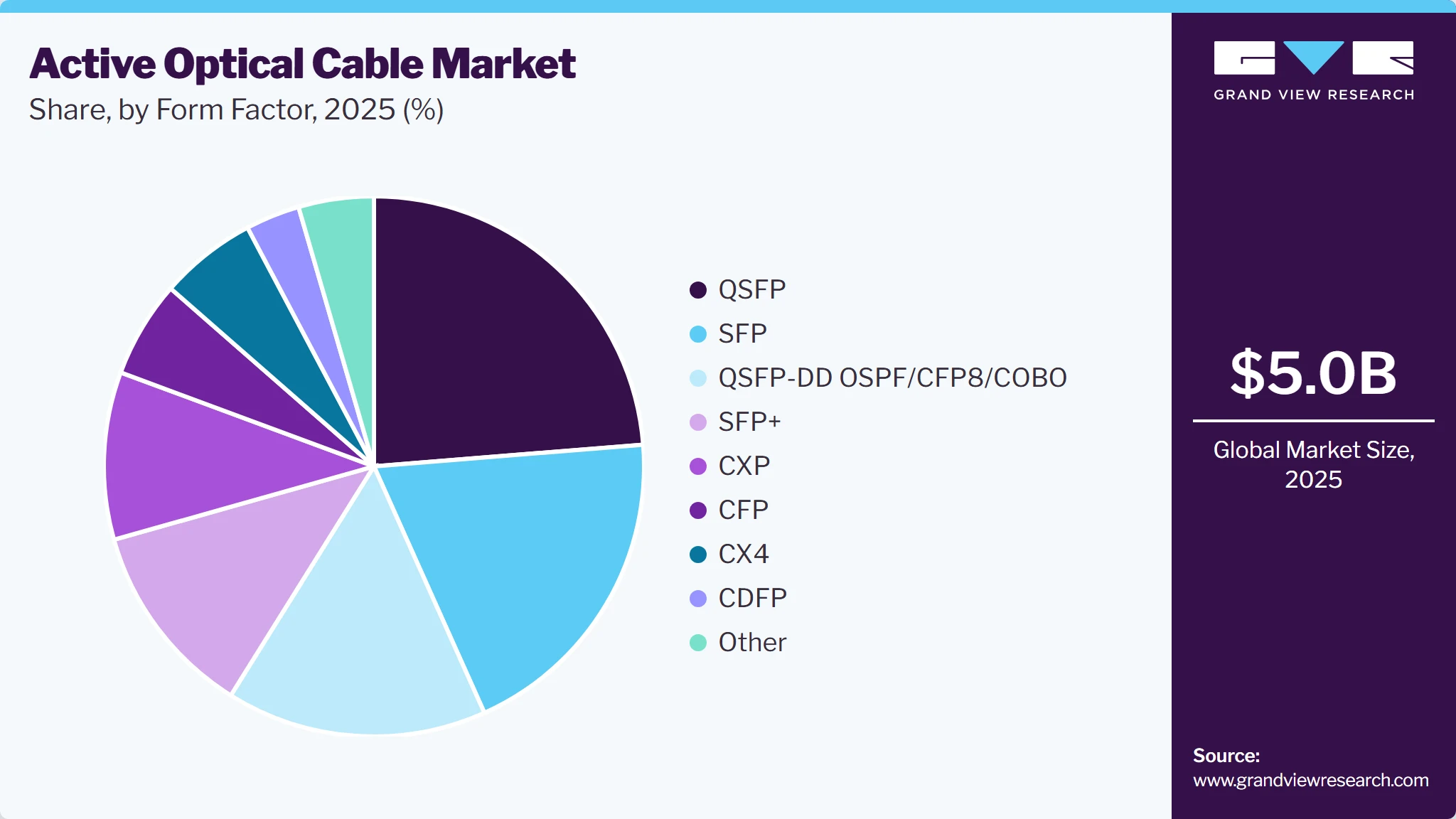
The SFP+ segment is estimated to grow significantly over the forecast period. The adoption of SFP+ (Small Form-factor Pluggable Plus) technology in Active Optical Cables (AOC) is showing significant growth and popularity in high-speed networking applications. This growth is attributed to expanding traction to their ability to provide high-speed 10Gbps connectivity over longer distances compared to traditional copper cables. This makes them ideal for data center and enterprise network applications requiring high bandwidth and low latency. Moreover, the growth of SFP+ in Active Optical Cables reflects the increasing demand for high-speed, reliable, and cost-effective connectivity solutions in modern data centers and enterprise networks. As data rates continue to increase and network architectures evolve, the adoption of SFP+ Active optical cables will likely continue its upward trend.
Protocol Insights
Based on protocol, InfiniBand segment led the market with the largest revenue share of 19.5% in 2025. The growth of InfiniBand in active optical cables is driven by the increasing demand for high-speed, low-latency connectivity in data centers, cloud computing, and supercomputing environments. InfiniBand Active optical cables are now supporting data rates up to 200Gbps HDR (High Data Rate), enabling high-speed data transfer for high-performance computing applications. These cables offer superior performance compared to traditional copper cables, including higher speeds, lower latency, and improved signal integrity over longer distances. InfiniBand Active optical cables are designed to work seamlessly with major networking equipment, facilitating easy integration into existing infrastructure. InfiniBand Active optical cables are particularly valuable in data center environments, enabling high-speed connections between switches, servers, and storage systems, and allowing for more flexible and scalable network designs. As the demand for high-performance computing and data-intensive applications continues to rise, the growth potential for InfiniBand Active optical cables remains strong, particularly in sectors requiring cutting-edge connectivity solutions.
The HDMI segment is predicted to foresee significant growth in the forecast period. Significant market share is driven by the increasing demand for high-definition video and audio streaming services, gaming activities, and immersive virtual reality experiences, all requiring high-speed data transfer and connectivity. HDMI connectors are particularly popular because they transmit audio and video signals through a single cable, simplifying connections for consumer electronics like HDTVs, gaming consoles, Blu-ray players, and home theater systems. The HDMI segment is expected to continue its strong growth trajectory, with a projected CAGR of 18.65% during the forecast period. This growth is fueled by the rising adoption of 4K and 8K TV sets, the increasing popularity of online gaming and streaming services, and the growing demand for VR/AR applications.
Application Insights
Based on application, Data Centers segment led the market with the largest revenue share of 35.8% in 2025. The increasing adoption of cloud-based services fuels this growth, reliance on high-performance computing (HPC) and AI architectures, and the need for high-speed data transfer and low latency. Active optical cables offer superior reliability compared to traditional copper cables, providing higher-speed data communication, lightweight design, and resistance to electromagnetic interference (EMI). They support data transmission speeds of 100 Gbps or more, meeting the growing demands for fast data transfers in data centers. In addition, Active optical cables are designed to be compatible with widely available sockets, allowing for easy integration into existing infrastructure. They also contribute to improved energy efficiency, critical for reducing power consumption and operational costs.
Military/aerospace is projected to grow significantly over the forecast period. The military and aerospace sectors are witnessing substantial growth in adopting AOC, driven by the increasing demand for high-speed, reliable, and secure communication systems. This trend is part of a broader expansion in the use of fiber optic cables in these industries, with the global market for military and aerospace applications projected to grow significantly from 2024 to 2030. The growth is fueled by several factors, including increased data transmission needs for real-time processing and advanced sensor systems, the superior performance of Active optical cables compared to traditional copper cables, weight reduction benefits crucial for aerospace applications, improved reliability in harsh environments, and enhanced security against signal interception.
Regional Insights
North America dominated the active optical cable market with the largest revenue share of 36.4% in 2025. This is driven by the increasing demand for high-speed data transmission and connectivity solutions across various applications. Data centers are a major driver of AOC adoption in the region, as these cables enable high-speed connections between servers, switches, and storage systems. This region is at the forefront of adopting new technologies like 4K/8K video, cloud computing, and 5G networks, all of which require the high-bandwidth capabilities of Active optical cables. Major technology companies and network equipment manufacturers in North America are key players in the AOC market, both as suppliers and consumers of these products.
U.S. Active Optical Cable Market Trends
The Active Optical Cable Market in the U.S. held the largest share in the North America region in 2025. The active optical cable market in the U.S. is experiencing significant growth, driven by the increasing adoption of cloud computing and the need for high-speed data transmission in data centers, which are major drivers of AOC growth in the country. The rise of 4K/8K video, online gaming, streaming services, and virtual reality applications also fuel the demand for active optical cables in consumer electronics in the U.S.
Europe Active Optical Cable Market Trends
The active optical cable market in Europe is poised for significant growth, driven by several key factors. The increasing demand for high-speed data transmission in various sectors, such as data centers, high-performance computing, and consumer electronics, is a major driver of this growth. In addition, the growing adoption of cloud-based services and applications is fueling the demand for high-speed connectivity solutions, which in turn is driving the growth of the market.
Asia Pacific Active Optical Cable Market Trends
The active optical cable market in Asia Pacific is experiencing significant growth driven by several key factors. Countries like China, India, and Japan invest heavily in 5G infrastructure, driving the demand for high-speed, low-latency connectivity solutions provided by Active optical cables. The growing number of internet users in APAC is fueling the demand for reliable and efficient communication networks, which Active optical cables are well-suited to provide.
Key Active Optical Cable Company Insights
Prominent firms have used product launches and developments, expansions, mergers and acquisitions, contracts, agreements, partnerships, and collaborations as their primary business strategy to increase their market share. The companies have used various techniques to enhance market penetration and boost their position in the competitive industry. For instance, in March 2023, Broadcom (US) unveiled BCM85812, a transceiver optimized for 800G DR8, 2x400G FR4, and 800G AOC module applications. It enables high-performance and efficient active optical cable solutions for hyper-scale data centers.
Key Active Optical Cable Companies
The following key companies have been profiled for this study on the active optical cable market.
-
3M
-
Amphenol Communications Solutions
-
Broadcom
-
Corning Incorporated
-
Dell Inc.
-
Eaton
-
EverPro Technology Co. Ltd.
-
Molex
-
Sumitomo Electric Industries Ltd.
-
TE Connectivity
Competitive Benchmarking
Category
Operating Strategies
Competitive Edge
Weakness
Established Players: Broadcom; Corning Incorporated; Molex; Sumitomo Electric Industries Ltd.; TE Connectivity
- Focus on expanding high-speed connectivity portfolios across active optical cables, optical transceivers, connectors, and interconnect solutions.
- Emphasize product innovation, investments in 400G/800G technologies, strategic partnerships, manufacturing expansion, and integration with AI, cloud computing, and hyperscale data center ecosystems to strengthen market leadership.
- Strong global brand recognition, extensive R&D capabilities, diversified product portfolios, established relationships with OEMs and hyperscale operators, broad distribution networks, and advanced expertise in optical communication technologies.
- High manufacturing and operational costs, dependence on semiconductor and optical component supply chains, exposure to pricing pressures, complex product qualification requirements, and the need for continuous investment to keep pace with evolving networking standards.
Emerging Players: 3M; Amphenol Communications Solutions; Dell Inc.; Eaton; EverPro Technology Co. Ltd.
- Focus on specialized connectivity solutions, strategic collaborations, regional expansion, and development of high-bandwidth interconnect products for enterprise networks, telecommunications, and data center applications.
- Strong flexibility, focused product expertise, ability to rapidly address evolving customer requirements, and specialization in specific networking and connectivity applications.
- Limited presence across certain end-use markets, narrower product portfolios compared to larger competitors, lower economies of scale, and resource constraints in expanding manufacturing capabilities and global distribution networks.
Recent Developments
-
In February 2024, Dell Technologies and Nokia announced their strategic partnership expansion. This collaboration utilizes Dell's infrastructure solutions and Nokia's private wireless connectivity to advance open network architectures in the telecom ecosystem and improve private 5G use cases for businesses.
-
In March 2024, MaxLinear, Inc. announced the demonstration of 800G half re-timed linear receive optics (LRO) optical modules and active optical cables (Active optical cables), utilizing Optomind’s patented optical assembly capabilities and MaxLinear’s Keystone Multimode 5nm 800G Tx-ONLY DSP with integrated VCSEL drivers.
Active Optical Cable Market Report Scope
Report Attribute
Details
Market size in 2025
USD 5.0 billion
Estimated market size in 2026
USD 5.6 billion
Projected market size by 2033
USD 13.4 billion
Growth rate
CAGR of 13.2% from 2026 to 2033
Base year for estimation
2025
Historical data
2021 - 2024
Forecast period
2026 - 2033
Quantitative units
Revenue in USD billion/billion and CAGR from 2026 to 2033
Report coverage
Revenue forecast, company ranking, competitive landscape, growth factors, and trends
Segments covered
Form factor, application, protocol, region
Regional scope
North America; Europe; Asia Pacific; Latin America; MEA
Country scope
U.S.; Canada; Mexico; UK; Germany; France; China; Japan; India; South Korea; Australia; Brazil; KSA; UAE; South Africa
Key companies profiled
3M; Amphenol Communications Solutions; Broadcom; Corning Incorporated; Dell Inc.; Eaton; EverPro Technology Co. Ltd.; Molex; Sumitomo Electric Industries Ltd.; TE Connectivity.
Customization scope
Free report customization (equivalent up to 8 analysts' working days) with purchase. Addition or alteration to country, regional & segment scope.
Pricing and purchase options
Avail customized purchase options to meet your exact research needs. Explore purchase options
Global Active Optical Cable Market Report Segmentation
This report forecasts revenue growth at global, regional, and country levels and provides an analysis of the latest industry trends in each of the sub-segments from 2021 to 2033. For this study, Grand View Research has segmented the global active optical cable market report based on form factor, application, protocol, and region:
-
Form Factor Outlook (Revenue, USD Million, 2021 - 2033)
-
QSFP
-
QSFP-DD OSPF/CFP8/COBO
-
SFP
-
SFP+
-
PCIE
-
CXP
-
CX4
-
CFP
-
CDFP
-
Other
-
-
Application Outlook (Revenue, USD Million, 2021 - 2033)
-
Data Centers
-
High-performance Computing (HPC)
-
Consumer Electronics
-
Telecommunications
-
Industrial
-
Energy
-
Oil & Gas
-
Medical
-
Military/Aerospace
-
Other Applications
-
-
Protocol Outlook (Revenue, USD Million, 2021 - 2033)
-
InfiniBand
-
Ethernet
-
Serial Attached SCSI (SAS)
-
DisplayPort
-
PCI Express (PCIe)
-
HDMI
-
Thunderbolt
-
USB
-
MIPI
-
Fiber Channel
-
Other Protocols
-
-
Regional Outlook (Revenue, USD Million, 2021 - 2033)
-
North America
-
U.S.
-
Canada
-
Mexico
-
-
Europe
-
Germany
-
UK
-
France
-
-
Asia Pacific
-
China
-
Japan
-
India
-
South Korea
-
Australia
-
-
Latin America
-
Brazil
-
-
Middle East and Africa (MEA)
-
Kingdom of Saudi Arabia
-
UAE
-
South Africa
-
-
Research Methodology
The active optical cable market figures in this report are based on a proven research process that combines executive interviews with secondary research from proprietary databases, company filings, and recognized regulatory and institutional sources. Market size is built through value-chain sizing - reconciling supply-side and demand-side estimates - and triangulated with bottom-up and top-down approaches. Every estimate passes multiple levels of expert validation before publication, with each active optical cable segment quantified using the revenue-capture definitions in the table below.
Segment Definition
Segment - Form Factor
Revenue capture definition
QSFP
Revenue in this segment is generated through the deployment and sale of Quad Small Form-factor. Pluggable (QSFP)-based Active Optical Cables (AOCs) are used in high-speed data transmission across hyperscale data centers, cloud computing environments, telecommunications networks, and high-performance computing applications.
QSFP-DD OSPF/CFP8/COBO
Revenue in this segment is generated through the deployment and sale of OSFP (Octal Small Form-factor Pluggable), CFP8 (C Form-factor Pluggable 8), and COBO (Consortium for On-Board Optics)-based Optical Cables used in ultra-high-speed networking applications across data centers, telecommunications infrastructure, and high-performance computing systems.
SFP
Revenue in this segment is generated from the integration and commercialization of Small Form-factor Pluggable (SFP)-based active optical cable solutions utilized across enterprise networks, telecommunications infrastructure, industrial automation systems, and data center applications.
SFP+
Revenue in this segment is derived from the adoption of SFP+ (Small Form-factor Pluggable Plus) optical cables that enable high-speed connectivity across enterprise networks, telecom infrastructure, storage area networks, and data centers.
CXP
Revenue in this segment is generated from the commercialization of CXP-based Active Optical Cable solutions deployed in high-performance computing systems, data centers, and telecommunications infrastructure.
CX4
Revenue in this segment is derived from the adoption of CX4-based Active Optical Cable solutions that facilitate high-speed connectivity across data centers, enterprise networks, telecommunications infrastructure, and high-performance computing environments
CFP
Revenue in this segment is derived from the adoption of C Form-factor Pluggable (CFP)-based active optical cable solutions that enable high-speed connectivity across telecommunications networks, data centers, and carrier-grade infrastructure.
CDFP
Revenue in this segment is derived from the adoption of C Form-factor Dense Pluggable (CDFP)-based Active Optical Cable solutions that support ultra-high-speed connectivity across hyperscale data centers, high-performance computing environments, and telecommunications networks
Others
These products include OSFP, CFP8, COBO, Mini-SAS, PCIe, HDMI, USB, and custom optical cable assemblies designed to provide high-speed, low-latency, and reliable data transmission.
Segment - Application
Revenue capture definition
Data Centers
Revenue in this segment is attributed to the integration of technologies within hyperscale, enterprise, edge, and colocation data center environments requiring low-latency, high-bandwidth connectivity.
High-performance Computing (HPC)
Revenue in this segment is generated through the deployment of active optical cable solutions that provide ultra-high-speed, low-latency connectivity for high-performance computing clusters, supercomputers, and AI training infrastructures.
Consumer Electronics
Revenue in this segment is generated through the adoption of solutions that enable high-speed data transmission and audiovisual connectivity across a wide range of consumer electronic devices. These products include HDMI, USB, DisplayPort, and Thunderbolt active optical cables used in televisions, gaming consoles, personal computers, virtual reality devices, and home entertainment systems.
Telecommunications
Revenue in this segment is generated through the deployment of active optical cable solutions that facilitate high-speed, low-latency connectivity across telecommunications networks and communication infrastructure.
Industrial
Revenue in this segment is generated through the adoption of Cable solutions that enable reliable, high-speed connectivity across industrial automation systems, manufacturing facilities, and process control environments
Energy
Revenue in this segment is generated through the utilization of Active Optical Cable solutions that support high-speed, interference-resistant connectivity across energy generation, transmission, and distribution infrastructures.
Oil & Gas
Revenue in this segment is derived from the adoption of high-speed optical interconnect technologies that provide robust, low-latency, and interference-resistant connectivity across upstream, midstream, and downstream oil and gas infrastructure.
Medical
Revenue in this segment is derived from the adoption of high-speed optical interconnect technologies that enable reliable, low-latency data transmission across medical devices, diagnostic equipment, and healthcare information systems.
Military/Aerospace
Revenue in this segment is derived from the adoption of high-speed optical interconnect technologies that provide secure, low-latency, and interference-resistant connectivity across military and aerospace platforms
Others
Revenue in this segment is derived from the adoption of high-speed optical interconnect technologies across applications such as transportation, education, media and entertainment, smart buildings, research laboratories, financial services, and government infrastructure.
Segment - Protocol
Revenue capture definition
InfiniBand
Revenue in this segment is derived from the deployment of high-speed optical interconnect technologies supporting InfiniBand protocols across high-performance computing clusters, AI infrastructures, and hyperscale data centers
Ethernet
Revenue in this segment is derived from the deployment of high-speed optical interconnect technologies supporting Ethernet protocols across data centers, enterprise networks, telecommunications infrastructure, and cloud computing environments.
Serial Attached SCSI (SAS)
Revenue in this segment is derived from the deployment of high-speed optical interconnect technologies supporting Serial Attached SCSI (SAS) protocols across enterprise storage systems, servers, and data center infrastructures.
DisplayPort
Revenue in this segment is derived from the deployment of high-speed optical interconnect technologies supporting DisplayPort interfaces across consumer electronics, professional displays, gaming systems, and audiovisual equipment
PCI Express (PCIe)
Revenue in this segment is derived from the deployment of high-speed optical interconnect technologies supporting PCI Express (PCIe) protocols across data centers, high-performance computing systems, AI clusters, and enterprise servers.
HDMI
Revenue in this segment is derived from the deployment of high-speed optical interconnect technologies supporting HDMI interfaces across consumer electronics, home entertainment systems, gaming consoles, professional audiovisual equipment, and digital signage applications.
Thunderbolt
Revenue in this segment is derived from the deployment of high-speed optical interconnect technologies supporting Thunderbolt interfaces across personal computers, workstations, storage devices, professional audiovisual equipment, and consumer electronics.
USB
Revenue in this segment is derived from the deployment of high-speed optical interconnect technologies supporting USB interfaces across consumer electronics, computing devices, industrial systems, and professional audiovisual equipment.
MIPI
Revenue in this segment is derived from the deployment of high-speed optical interconnect technologies supporting MIPI interfaces across mobile devices, cameras, automotive electronics, industrial systems, and embedded computing platforms.
Fiber Channel
Revenue in this segment is derived from the deployment of high-speed optical interconnect technologies supporting Fibre Channel protocols across enterprise storage networks, data centers, and mission-critical computing environments
Others
Revenue in this segment is derived from the deployment of high-speed optical interconnect technologies that includes proprietary communication standards, DVI, SDI, Serial RapidIO, and other specialized interfaces used across industrial automation, aerospace, defense, medical imaging, telecommunications, and research applications.
Estimation Model
Layer Name
Key Question
Description
Addressable Network Infrastructure Layer
Which infrastructure and applications generate demand for active optical cables?
Identify the global addressable installed base of networking infrastructure requiring high-speed optical interconnects. Include hyperscale and enterprise data centers, cloud computing facilities, AI clusters, high-performance computing systems, telecommunications networks, industrial automation systems, medical equipment, consumer electronics, and aerospace and defense platforms. Consider Ethernet, InfiniBand, Fibre Channel, PCIe, HDMI, and other interface standards driving connectivity requirements.
Bandwidth & Connectivity Requirement Layer
Which systems and interfaces require active optical connectivity?
Apply bandwidth requirements and interconnect densities across servers, switches, storage systems, GPUs, accelerators, base stations, routers, and audiovisual equipment. Consider transmission speeds ranging from 10G to 800G and above, communication protocols, latency requirements, signal integrity needs, power efficiency, and migration toward next-generation network architectures influencing active optical cable demand.
Cable Deployment & Consumption Layer
How extensively are active optical cables utilized?
Estimate cable consumption based on the number of optical interconnects required per rack, server, switch, storage array, AI cluster, telecom node, and consumer device annually. Consider deployment intensity across hyperscale data centers, cloud environments, high-performance computing systems, 5G infrastructure, industrial networks, and multimedia applications, along with replacement cycles and technology upgrade frequencies.
Revenue Generation Layer
How much revenue is generated?
Calculate market revenue by multiplying the volume of active optical cables deployed across various applications by their respective average selling prices (ASPs). Revenue is generated through the sale of SFP, SFP+, QSFP, QSFP-DD, CXP, CFP, OSFP, and other optical interconnect products, along with associated customization, integration, and value-added connectivity solutions.
Delivered Customizations
This report has been delivered with the following In-depth customizations
Client Request
Customization Delivered
Value Adds
Competitive Intelligence & Market Positioning Assessment
Performed an in-depth evaluation of major Active Optical Cable manufacturers, connectivity solution providers, and optical component suppliers. Assessed market positioning, product portfolios, bandwidth capabilities, protocol support, strategic partnerships, acquisitions, regional presence, and recent developments across the active optical cable market ecosystem.
Enables stakeholders to identify key market players, assess competitive landscapes, compare technological strengths, explore strategic partnership and acquisition opportunities, and gain valuable insights into the evolving competitive environment of the active optical cable market.
Application Demand Patterns & End-Use Analysis
Analyzed demand trends across key applications including data centers, high-performance computing, telecommunications, consumer electronics, industrial automation, energy, healthcare, and military/aerospace sectors. Evaluated bandwidth requirements, deployment intensity, technology migration trends, and growth drivers across various interface and protocol segments.
Provides actionable insights into application-specific demand patterns, emerging opportunities, and high-growth end-use sectors, supporting informed decision-making for market entry, business expansion, product development, and commercialization strategies.
Technology Advancements & Future Growth Potential Evaluation
Assessed the impact of AI infrastructure, cloud computing, 400G/800G network migration, silicon photonics, co-packaged optics, and next-generation optical interconnect technologies on market development.
Identified emerging innovation areas, untapped growth opportunities, and high-potential applications across the active optical cable value chain.
Supports long-term strategic planning by highlighting attractive investment opportunities, prioritizing technology innovation initiatives, identifying future revenue streams, and understanding the key trends shaping the evolution of the active optical cable market.
Frequently Asked Questions About This Report
The global active optical cable market is expected to grow at a compound annual growth rate of 13.2% from 2026 to 2033 to reach USD 13.4 billion by 2033.
The global active optical cable market size was valued at USD 5.0 billion in 2025 and is expected to reach USD 5.6 billion in 2026
Some key players operating in the active optical cable market include 3M, Amphenol Communications Solutions, Broadcom, Corning Incorporated, Dell Inc., Eaton, EverPro Technology Co. Ltd., Molex, Sumitomo Electric Industries Ltd., TE Connectivity.
Key factors that are driving the market growth include the superior reliability of AOCs over traditional copper cables, combined with the extensive adoption of cloud-based services, is propelling market growth during the forecast period. Furthermore, digitalization and the rollout of 5G networks offer significant growth opportunities for the active optical cable market.
North America dominated the active optical cable market with a share of 36.4% in 2025. The Active Optical Cable (AOC) market in North America is experiencing significant growth, driven by the increasing demand for high-speed data transmission and connectivity solutions across various applications.
QSFP leads the market with revenue share of 23.7% in 2025, while SFP+ is the fastest growing segment in the market.
Data Centers leads the market with revenue share of 35.8% in 2025, While telecommunication is the fastest growing segment in the market
InfiniBand leads the market with revenue share of 19.5% in 2025, While PCI Express (PCIe) is the fastest growing segment in the market
Asia Pacific is growing with CAGR 14.5% and is the fastest growing region in the active optical cable market.
About the Author(s)
Next Generation Technologies Research Team
Technology · Next Generation TechnologiesThis report was authored by the next generation technologies research team at Grand View Research - comprising two research analysts, one senior research analyst, and one industry expert - with specialized expertise in the next generation technologies segment of the technology industry. All findings are based on proprietary technology databases, executive interviews, and regulatory analysis, subject to internal peer review prior to publication.
Last Updated:
Speak to Analyst


Customize this report to your needs - add regions, segments, or data points, with 20% free customization.
Or view our licence options:


ISO 9001:2015 & 27001:2022 Certified
We are GDPR and CCPA compliant! Your transaction & personal information is safe and secure. For more details, please read our privacy policy.


