
- Home
- »
- Organic Chemicals
- »
-
Adipic Acid Market Size, Share & Growth Report, 2026-2033GVR Report cover
![Adipic Acid Market (2026 - 2033)Report]()
Adipic Acid Market (2026 - 2033)
Size, Share & Trends Analysis Report By Application (Nylon 6, 6 Resin, Nylon 6, 6 Fiber, Polyurethane) By Region (North America, Europe, Asia Pacific, Middle East & Africa, Central & South America), And Segment Forecasts
Market Size, 2025
$5.4BMarket Estimate, 2026
$5.6BMarket Forecast, 2033
$7.3BCAGR, 2026–2033
3.8%Adipic Acid Market Summary
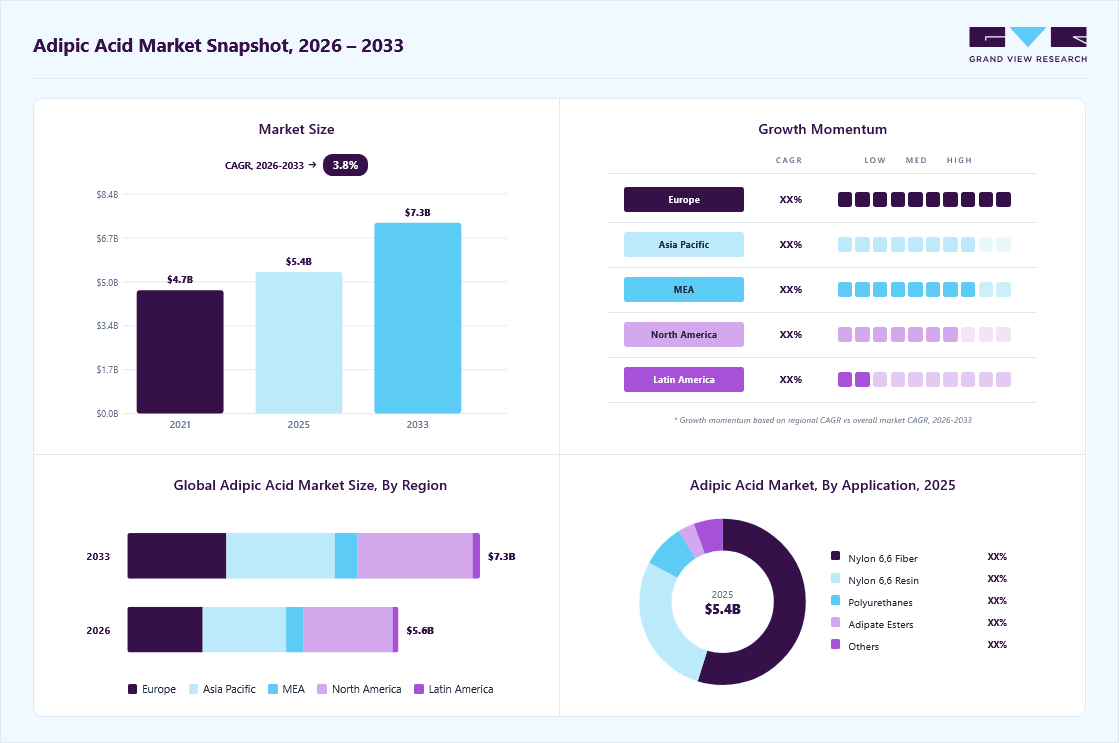
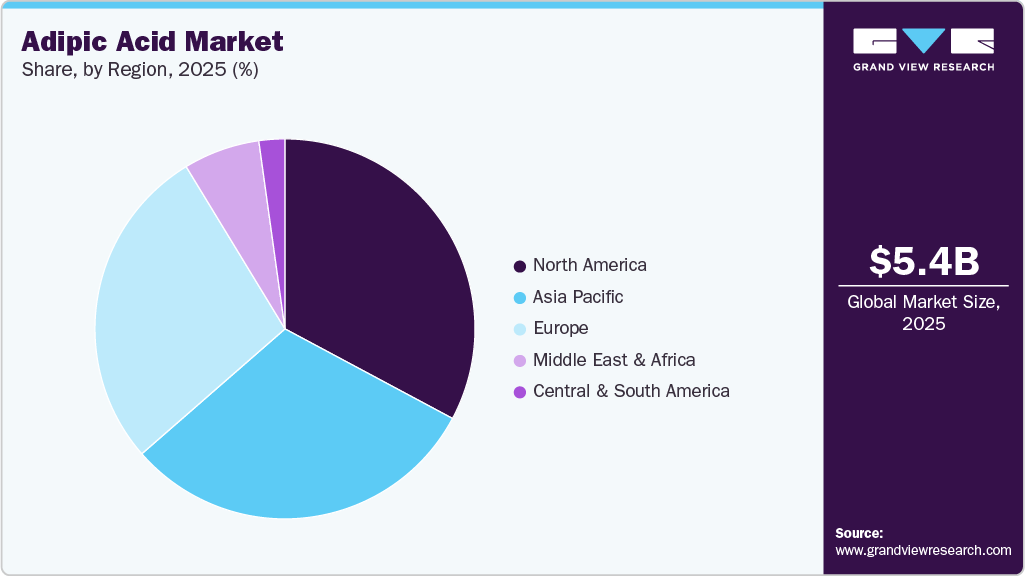
he global adipic acid market size was valued at USD 5.4 billion in 2025 and is projected to grow from USD 5.6 billion in 2026 to USD 7.3 billion by 2033, at a CAGR of 3.8% from 2026 to 2033. The North America market held the largest share of 32.8% of the global market in 2025. The market is primarily driven by robust demand from the nylon 6,6 value chain, particularly in engineering plastics and fibers used across automotive, electrical & electronics, and textile industries.
Key Market Trends & Insights
- By application: The Nylon 6,6 fiber dominated the global adipic acid market, accounting for the largest revenue share of 52.8% in 2025.
Regional Highlights
- Largest regional market: North America (32.8% revenue share, 2025)
- By country: The U.S. held the largest market share in 2025.
Market Size & Forecast
- Market size in 2025: USD 5.4 Billion
- Estimated market size in 2026: USD 5.6 Billion
- Projected market size by 2033: USD 7.3 Billion
- CAGR (2026-2033): 3.8%
The ongoing shift toward lightweight materials in vehicles, especially with the rise of electric mobility, is significantly boosting the consumption of nylon 6,6 resin. The growth in the construction and furniture sectors is supporting demand for polyurethane applications, further underpinning adipic acid consumption. Rapid industrialization and urbanization in emerging economies, particularly in the Asia Pacific, continue to reinforce volume growth across multiple end-use segments.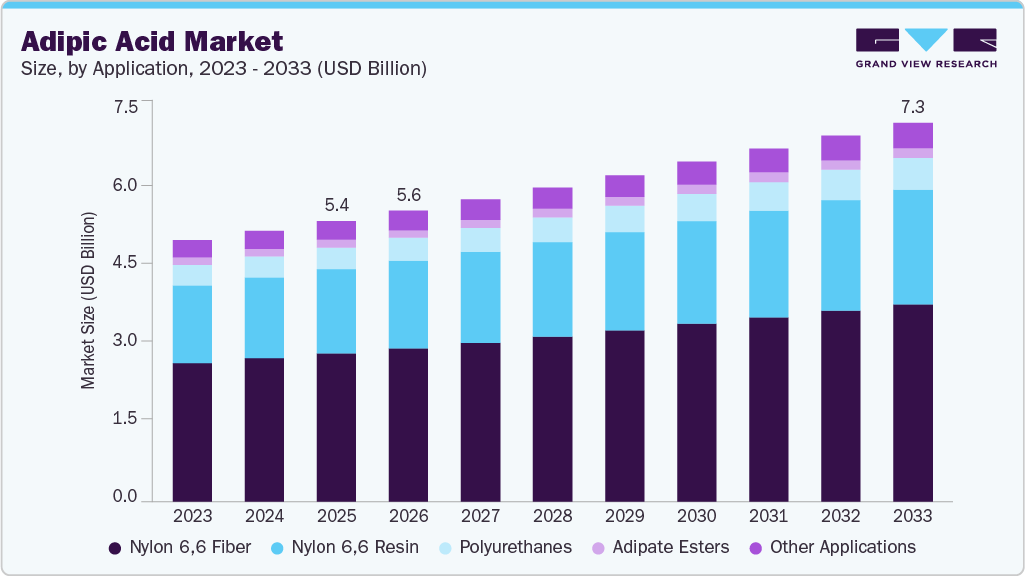
Emerging opportunities in the adipic acid market center on the development and commercialization of bio-based production routes, driven by growing regulatory and consumer emphasis on sustainability. Advancements in green chemistry and carbon abatement technologies offer manufacturers avenues to differentiate and align with evolving environmental standards. Furthermore, expanding applications in high-performance engineering plastics, particularly in electric vehicles and advanced electronics, are expected to create new demand pockets. Growth in emerging markets such as India and Southeast Asia, coupled with increasing investments in downstream nylon production, also offers significant long-term expansion potential.
The market faces notable challenges, primarily due to environmental concerns stemming from conventional production processes that emit nitrous oxide, a potent greenhouse gas. Regulatory pressures to reduce industrial emissions are increasing compliance costs and necessitating capital-intensive technological upgrades. In addition, volatility in raw material prices, particularly benzene and cyclohexane, can impact profit margins across the value chain. The market also experiences competitive pressure from regional producers, especially in China, leading to pricing fluctuations and margin compression. Furthermore, the slow commercialization of bio-based alternatives presents uncertainty regarding long-term structural shifts in the industry.
Market Concentration & Characteristics
The global adipic acid market exhibits a moderately consolidated structure, dominated by a group of vertically integrated chemical manufacturers, including BASF SE, INVISTA, and Ascend Performance Materials, which collectively command a substantial share of global capacity. Competition is primarily driven by integration across the nylon 6,6 value chain, operational efficiency, and the ability to ensure consistent supply to downstream industries such as automotive and textiles. These players benefit from established global manufacturing footprints and long-term customer relationships, enabling them to maintain pricing power in value-added segments, while commodity-grade adipic acid remains more price-sensitive.
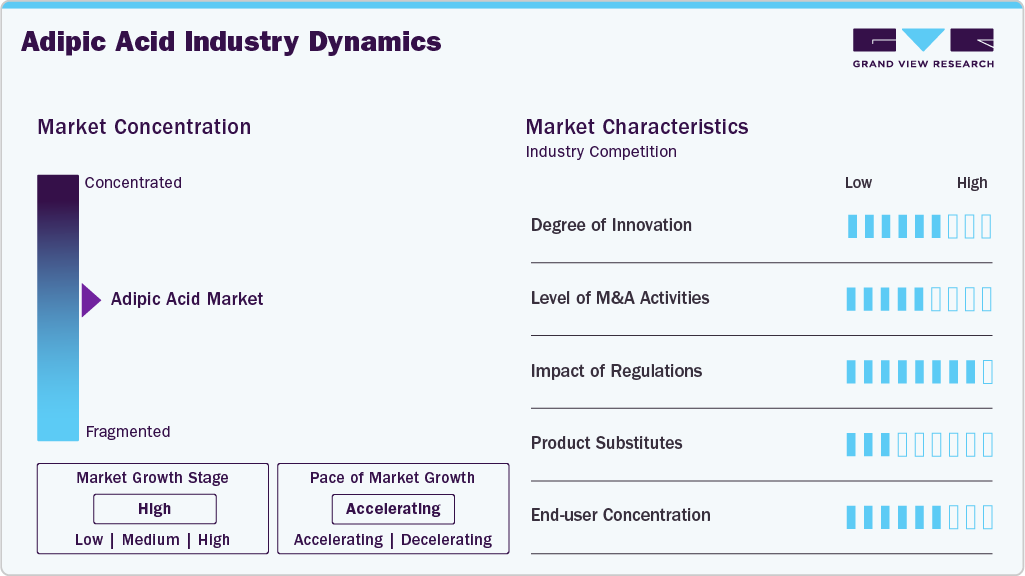
The market is witnessing increasing competitive intensity from regional producers, particularly in the Asia Pacific, including companies such as Liaoyang Tianhua Chemical Co., Ltd, which compete on the basis of cost advantages and localized supply. The competitive landscape is further evolving as companies prioritize sustainability and technological innovation, with investments in emission-reduction technologies and the development of bio-based alternatives. Strategic initiatives such as capacity expansions, partnerships, and downstream integration continue to shape market positioning, as participants seek to balance cost competitiveness with regulatory compliance and long-term differentiation.
Application Insights
Nylon 6,6 fiber dominated the global adipic acid market, accounting for the largest revenue share of 52.8% in 2025, primarily driven by its extensive utilization in textiles, carpets, and industrial fibers. The segment benefits from strong, consistent demand across apparel and home furnishings applications, particularly in the Asia Pacific, where large-scale manufacturing and consumption continue to support volume growth. The durability, elasticity, and wear resistance of nylon 6,6 fiber make it a preferred material in high-performance textile applications, further reinforcing its leading position. While the segment remains relatively mature in developed regions, steady demand from emerging economies continues to sustain its dominance over the forecast period.
Nylon 6,6 resin represents a high-growth segment, supported by increasing adoption in engineering plastics for automotive and electrical & electronics applications, where lightweighting and performance optimization are critical.
The polyurethane segment also holds a significant share, driven by its use in foams, coatings, and insulation materials, particularly in the construction and furniture industries. Adipate esters, though comparatively smaller in volume, contribute higher margins due to their application in plasticizers and specialty lubricants. Meanwhile, other applications, including food additives and pharmaceuticals, represent niche demand segments.
Regional Insights
The adipic acid industry in North America accounted for 32.8% share of the global market in 2025, driven by strong integration across the nylon 6,6 value chain and the presence of key manufacturers such as Ascend Performance Materials and INVISTA. The region benefits from advanced manufacturing infrastructure, stable demand from automotive and electrical & electronics sectors, and a well-established supply chain. The increasing investments in sustainable production technologies and emission reduction initiatives are further shaping market dynamics, positioning North America as a mature yet innovation-driven market.
U.S. Adipic Acid Market Trends
The U.S. adipic acid industry represented the largest market in North America, supported by robust demand for nylon 6,6 resin in automotive lightweighting and high-performance engineering applications. Strong domestic production capacity, coupled with the presence of vertically integrated players, ensures supply reliability and cost efficiency. Furthermore, ongoing advancements in specialty materials and increasing focus on sustainability are expected to drive gradual market evolution, with emphasis on high-value applications and technological differentiation.
Asia Pacific Adipic Acid Market Trends
Theadipic acid industry in the Asia Pacific held a 30.8% share of the global market in 2025, underpinned by rapid industrialization, expanding manufacturing base, and strong demand from textiles, automotive, and construction sectors. The region serves as both a major production hub and a consumption center, supported by cost-competitive manufacturing and increasing downstream integration. Rising urbanization and infrastructure development across emerging economies are further accelerating demand, positioning the Asia Pacific as the fastest-growing regional market over the forecast period.
The China adipic acid industry hasdominated the Asia Pacific region, driven by its extensive chemical manufacturing capacity and strong presence across the nylon and polyester value chains. The country benefits from large-scale production, cost advantages, and proximity to key end-use industries, enabling it to influence global pricing trends. Besides, rising domestic demand from the automotive, textile, and construction sectors, along with ongoing capacity expansions by local manufacturers, continues to strengthen China’s position as a critical market for adipic acid.
Europe Adipic Acid Market Trends
Theadipic acid industry in Europe accounted for 27.7% share in 2025, characterized by a strong focus on sustainability, regulatory compliance, and high-performance materials. The presence of established players such as BASF SE and LANXESS supports technological innovation and product development. Demand in the region is primarily driven by automotive and industrial applications, with an increasing emphasis on low-emission production processes and circular economy initiatives shaping the competitive landscape.
The Germany adipic acid industry is a key market in Europe, supported by its advanced automotive and engineering sectors, which drive demand for nylon 6,6 resin and specialty materials. The country’s strong industrial base, coupled with leadership in sustainable manufacturing practices, positions it as a hub for innovation in adipic acid production. Additionally, stringent environmental regulations are encouraging investments in cleaner technologies and bio-based alternatives, influencing long-term market trends.
Middle East & Africa Adipic Acid Market Trends
Theadipic acid industry in the Middle East & Africa is at a developmental stage, with growth driven by increased investments in petrochemical infrastructure and the diversification of industrial economies. Rising demand from construction, automotive, and consumer goods sectors is supporting adipic acid consumption, particularly in polyurethane applications. The region’s access to low-cost feedstock provides potential for future capacity expansion, although market growth remains constrained by limited downstream integration and a relatively smaller manufacturing base compared to other regions.
Central & South America Adipic Acid Market Trends
Theadipic acid industry in the Central & South America market is characterized by moderate growth, supported by expanding industrial activities and increasing demand from the automotive and construction sectors. While the region relies partially on imports to meet domestic demand, gradual development of local manufacturing capabilities and improving economic conditions are expected to support market expansion. Brazil, in particular, plays a key role due to its relatively large industrial base and growing consumption of engineering plastics and polyurethane products.
Key Adipic Acid Company Insights
Key players, such as Ascend Performance Materials, Asahi Kasei Corporation, BASF SE, INVISTA, LANXESS, and Liaoyang Tianhua Chemical Co., Ltd, are dominating the market.
-
BASF SE is one of the leading players in the global market, leveraging its strong backward integration, extensive product portfolio, and global manufacturing footprint to maintain a competitive edge. The company operates through a highly integrated “Verbund” system, enabling cost efficiencies and optimized resource utilization across the value chain, including intermediates used in nylon 6,6 production. BASF’s adipic acid offerings are primarily aligned with high-performance applications in automotive, textiles, and industrial sectors, supported by long-standing customer relationships and technical expertise. The company is actively investing in sustainable production processes and emission reduction technologies to address regulatory pressures and strengthen its position in environmentally responsible chemical manufacturing.
Key Adipic Acid Companies:
The following key companies have been profiled for this study on the adipic acid market.
- Ascend Performance Materials
- Asahi Kasei Corporation
- BASF SE
- INVISTA
- LANXESS
- Liaoyang Tianhua Chemical Co., Ltd
- Radici Partecipazioni S.p.A.
- Solvay
- Sumitomo Chemical Co., Ltd.
- JPM Pharma & Chemicals Pvt. Ltd.
Global Adipic Acid Market Report Scope
Report Attribute
Details
Market size in 2025
USD 5.4 billion
Estimated market size in 2026
USD 5.6 billion
Projected market size by 2033
USD 7.3 billion
Growth rate
CAGR of 3.8% from 2026 to 2033
Base year for estimation
2025
Historical data
2021 - 2024
Forecast period
2026 - 2033
Quantitative units
Revenue in USD million/billion, Volume in Kilotons, and CAGR from 2026 to 2033
Report coverage
Revenue forecast, company ranking, competitive landscape, growth factors, and trends
Segments covered
Application, region
Regional scope
North America; Europe; Asia Pacific; Middle East & Africa; Central & South America
Country scope
U.S.; Canada; Mexico; Germany; UK; France; Italy; China; India; Japan; Brazil; Argentina; South Africa; Saudi Arabia
Key companies profiled
Ascend Performance Materials; Asahi Kasei Corporation; BASF SE; INVISTA; LANXESS; Liaoyang Tianhua Chemical Co., Ltd; Radici Partecipazioni S.p.A.; Solvay; Sumitomo Chemical Co., Ltd.; JPM Pharma & Chemicals Pvt. Ltd.
Customization scope
Free report customization (equivalent up to 8 analysts’ working days) with purchase. Addition or alteration to country, regional & segment scope.
Pricing and purchase options
Avail customized purchase options to meet your exact research needs. Explore purchase options
Global Adipic Acid Market Report Segmentation
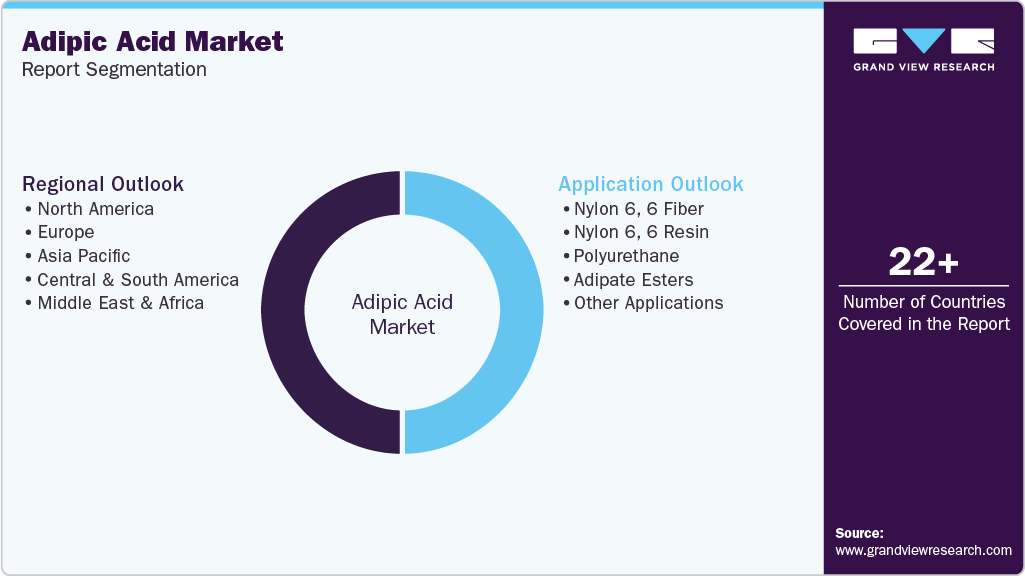
This report forecasts revenue growth at global, regional, and country levels and provides an analysis of the latest industry trends in each of the sub-segments from 2021 to 2033. For this study, Grand View Research has segmented the global adipic acid market report based on application, and region.
-
Application Outlook (Volume, Kilotons; Revenue, USD Million, 2021 - 2033)
-
Nylon 6, 6 Fiber
-
Nylon 6, 6 Resin
-
Polyurethane
-
Adipate Esters
-
Other Applications
-
-
Regional Outlook (Volume, Kilotons; Revenue, USD Million, 2021 - 2033)
-
North America
-
U.S.
-
Canada
-
Mexico
-
-
Europe
-
Germany
-
UK
-
France
-
Italy
-
-
Asia Pacific
-
China
-
India
-
Japan
-
-
Middle East & Africa
-
Saudi Arabia
-
South Africa
-
-
Central & South America
-
Brazil
-
Argentina
-
-
Frequently Asked Questions About This Report
The global adipic acid market size was estimated at USD 5.4 billion in 2025 and is expected to reach 5.6 billion in 2026.
The adipic acid market is expected to grow at a compound annual growth rate of 3.8% from 2026 to 2033 to reach USD 7.3 billion by 2033.
Nylon 6,6 fiber dominated the market with a 52.8% revenue share in 2025 due to its extensive use in high-volume applications such as textiles, carpets, and industrial fibers, which ensure consistent and large-scale consumption of adipic acid. Its superior durability, strength, and wear resistance further reinforce its preference across both consumer and industrial end-use sectors, sustaining its leading position.
Some of the key players operating in the adipic acid market include Ascend Performance Materials, Asahi Kasei Corporation, BASF SE, INVISTA, LANXESS, Liaoyang Tianhua Chemical Co., Ltd, Radici Partecipazioni S.p.A., Solvay, Sumitomo Chemical Co., Ltd., and JPM Pharma & Chemicals Pvt. Ltd.
The adipic acid market is driven by strong demand from the nylon 6,6 value chain, particularly in automotive, textiles, and electrical & electronics sectors, where performance materials are essential. The increasing adoption of lightweight engineering plastics and growth in construction-related polyurethane applications are further supporting market expansion.
About the Author(s)
Organic Chemicals Research Team
Bulk Chemicals · Organic ChemicalsThis report was authored by the organic chemicals research team at Grand View Research - comprising two research analysts, one senior research analyst, and one industry expert - with specialized expertise in the organic chemicals segment of the bulk chemicals industry. All findings are based on proprietary bulk chemicals databases, executive interviews, and regulatory analysis, subject to internal peer review prior to publication.
Last Updated:
Speak to Analyst

Need a Tailored Report?
Customize this report to your needs — add regions, segments, or data points, with 20% free customization.
Or view our licence options:


ISO 9001:2015 & 27001:2022 Certified
We are GDPR and CCPA compliant! Your transaction & personal information is safe and secure. For more details, please read our privacy policy.












