
- Home
- »
- Advanced Interior Materials
- »
-
Aerogel Textile Insulation Market Size & Share Report, 2033GVR Report cover
![Aerogel Textile Insulation Market (2026 - 2033)Report]()
Aerogel Textile Insulation Market (2026 - 2033)
Size, Share & Trends Analysis Report By Material (Silica Aerogel, Polymer Aerogel, Carbon Aerogel), By Textile Form (Aerogel-infused Fabrics, Aerogel-coated Textile), By End-user (Oil & Gas, Construction), By Region, And Segment Forecasts
Market Size, 2025
$223.6MMarket Estimate, 2026
$252.2MMarket Forecast, 2033
$603.6MCAGR, 2026–2033
13.3%Aerogel Textile Insulation Market Summary
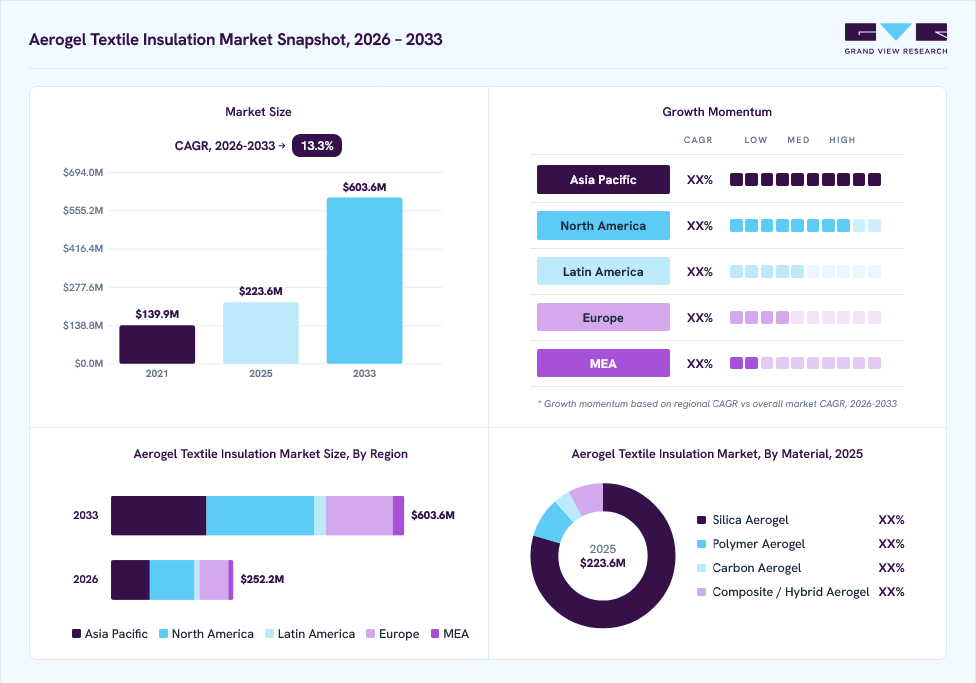
The global aerogel textile insulation market size was valued at USD 223.6 million in 2025 and is projected to grow from USD 252.2 million in 2026 to USD 603.6 million in 2033, at a CAGR of 13.3% from 2026 to 2033. North America dominated the market, accounting for the largest revenue share of 36.5% in 2025. The market is primarily driven by the increasing demand for lightweight, high-performance thermal insulation solutions across aerospace, automotive, industrial, energy, and protective applications, where aerogel-integrated textiles provide low thermal conductivity, reduced weight, flexibility, and effective thermal protection in space-constrained environments.
Key Market Trends & Insights
- By material: The silica aerogel segment dominated the market, accounting for 79.4% of revenue in 2025.
- By end-user: The aerospace & defense segment is forecast to grow at the fastest CAGR of 14.1% from 2026 to 2033.
- By textile form: The aerogel blanket / textile blanket segment led the market with the largest revenue share of 35.9% in 2025.
Regional Highlights
- Largest regional market: North America (36.5% revenue share, 2025)
- Fastest-growing regional market: Asia Pacific (highest CAGR, 2026-2033)
- By country: The U.S. held the largest market share in 2025.
Market Size & Forecast
- Market size in 2025: USD 223.6 Million
- Estimated market size in 2026: USD 252.2 Million
- Projected market size by 2033: USD 603.6 Million
- CAGR (2026-2033): 13.3%
Three ways to get this report
Buy it, customize it, or ask a question.Get the Full Report
What the study covers
- FormatsPDF · Excel · Dashboard
- Timeline2026–2033 annual, 2025 base
- Coverage20+ countries, 5 regions
- Companies10+ key players profiled
Customize the Report
20% free customization
- IncludeCountries, segments, points
- TailorTo your product definition
- ExtendDeeper competitor detail
- OrA fully bespoke study
- Turnaround5–10 working days
Ask an Analyst
A direct answer, usually in 1 working day
- AccessReport author, directly
- Reply timeWithin 1 working day
- No sales callDirect answer only
- FormatEmail reply
- CostFree, no cost
The market is driven by the growing demand for lightweight, high-performance thermal insulation across aerospace, automotive, industrial, energy, and protective applications. As industries increasingly seek insulation materials that provide high thermal resistance while minimizing weight, thickness, and space requirements, aerogel-integrated textile solutions are gaining adoption in applications where conventional insulation materials can be bulky, rigid, or less effective. Silica aerogel remains the dominant material segment, accounting for 79.4% of the market in 2025, supported by its extremely low thermal conductivity, lightweight structure, and established use in high-performance insulation systems. At the same time, the development of polymer, carbon, and composite/hybrid aerogels is expanding the range of textile-compatible insulation solutions for demanding applications.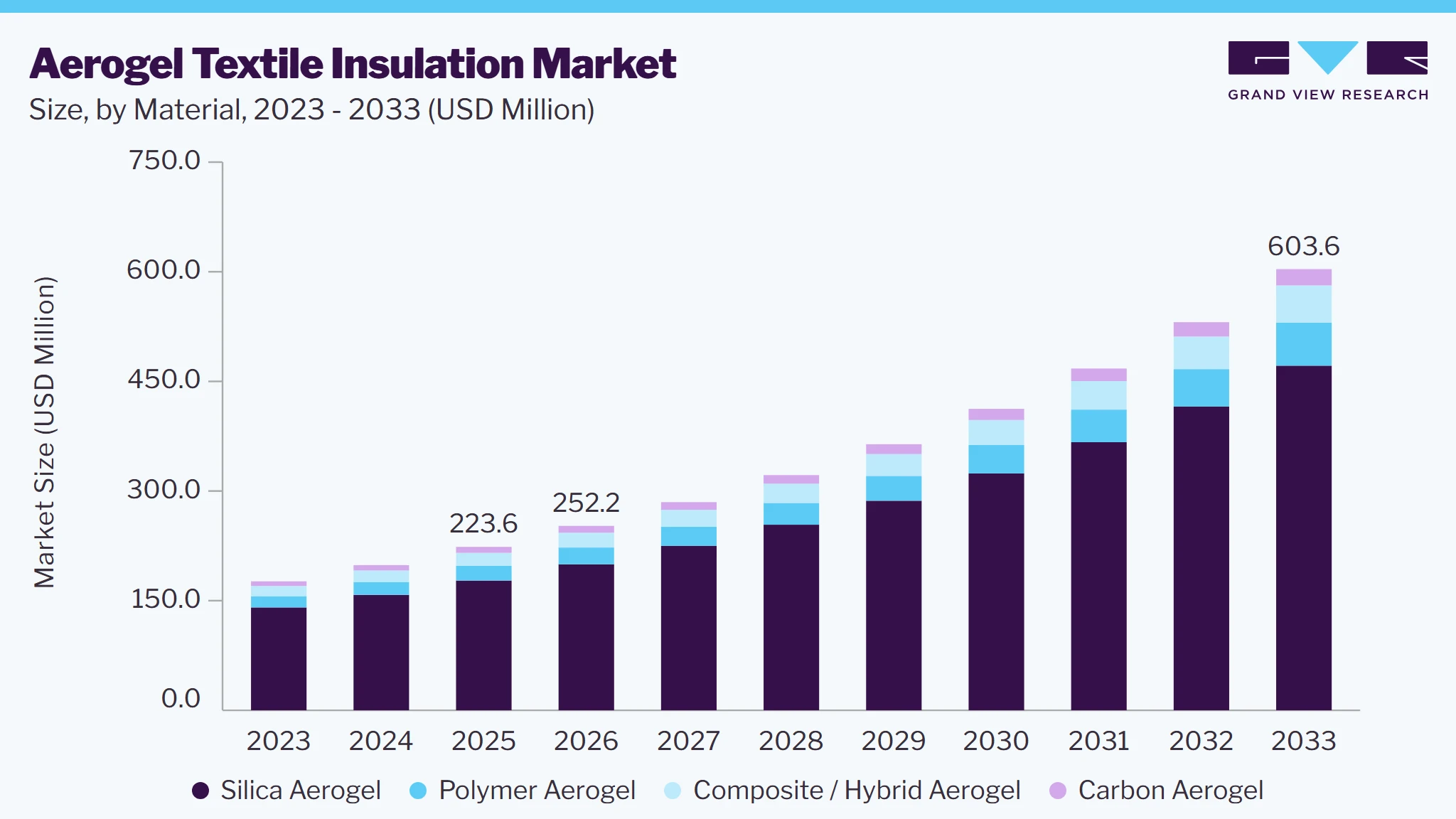
An increasing focus on energy efficiency, thermal management, and compact insulation systems across industrial and transportation applications is expected to boost market growth in the coming years. Aerogel textile insulation enables manufacturers to achieve effective thermal protection with relatively thin and flexible formats, making it suitable for pipes and equipment, high-temperature industrial systems, automotive components, aerospace systems, protective clothing, and other space-constrained applications. The material's combination of low thermal conductivity, flexibility, lightweight construction, and thermal stability supports its use where conventional fiberglass, mineral wool, or foam-based insulation may face limitations related to thickness, weight, or installation flexibility. The growing deployment of energy-intensive industrial equipment and advanced thermal management systems is therefore creating additional opportunities for aerogel-based textile insulation.
Technological advancements and the transition toward higher-performance and application-specific insulation materials are also significantly contributing to market growth. A defining trend in the aerogel textile insulation industry is the development of polymer and composite/hybrid aerogel systems that can address flexibility, mechanical durability, and application-specific performance requirements. While silica aerogel represented the largest material segment with USD 177.5 million in 2025, polymer aerogel is projected to record the fastest growth at a 14.4% CAGR from 2026 to 2033, followed by composite/hybrid aerogel at 14.1%. These higher-growth material categories are expected to gradually expand their market presence as manufacturers develop aerogel textiles with improved flexibility, handling characteristics, durability, and compatibility with specialized thermal insulation applications.
Market Dynamics
The market is witnessing strong growth, driven by increasing demand for lightweight, flexible, and high-performance thermal insulation solutions across aerospace, automotive, industrial, energy, and protective applications. Manufacturers are increasingly focusing on aerogel-based textile systems that combine extremely low thermal conductivity with reduced thickness, flexibility, and weight, enabling effective insulation in space-constrained and performance-critical environments. In addition, advancements in aerogel processing, textile integration, and composite insulation technologies are driving market expansion, while the need for improved thermal efficiency and energy conservation continues to spur adoption of advanced insulation materials.
The growing demand for lightweight, high-performance insulation materials in industrial and transportation applications is a key market driver. Industries such as aerospace, automotive, oil & gas, power generation, and advanced manufacturing are increasingly seeking insulation solutions that can deliver high thermal resistance without adding significant weight or occupying excessive installation space. Aerogel textiles offer a combination of low thermal conductivity, flexibility, and lightweight construction, making them suitable for applications involving complex geometries, high-temperature environments, and restricted installation areas.
As manufacturers and end users continue to improve thermal management and energy efficiency, demand for advanced aerogel textile insulation is increasing. Silica aerogel, which accounted for 79.4% of the market in 2025, remains the dominant material owing to its established thermal insulation performance and broad applicability. Growing investments in energy-intensive industrial facilities, aerospace systems, and thermal management infrastructure are further supporting the adoption of aerogel textile insulation solutions.
A significant market restraint is the relatively high cost of aerogel production and textile integration compared with conventional insulation materials. Aerogel manufacturing can involve specialized processing, controlled drying, reinforcement, and handling requirements, while integrating aerogel materials into flexible textile structures requires additional manufacturing capabilities. These factors can increase the final cost of aerogel textile insulation and limit adoption in price-sensitive applications where conventional fiberglass, mineral wool, foams, or other established insulation materials provide adequate thermal performance. In addition, limited production capacity and the specialized technical expertise required for aerogel-based materials can create barriers to large-scale commercialization.
A major market opportunity lies in the increasing development of advanced aerogel materials and their integration into flexible textile-based insulation systems. Growing demand for thinner, lighter, and more adaptable thermal insulation is encouraging manufacturers to explore polymer, carbon, and composite/hybrid aerogels alongside conventional silica aerogels. These materials can provide improved flexibility, mechanical strength, durability, and application-specific performance, supporting their use in aerospace, automotive, industrial equipment, energy infrastructure, and thermal protective applications. Continued advancements in aerogel processing and textile integration are expected to reduce performance limitations, expand the range of end-use applications, and create new opportunities for manufacturers offering customized high-performance insulation solutions.
Market Concentration & Characteristics
The aerogel textile insulation industry is characterized by its high-performance, application-specific nature, driven by demand for lightweight, flexible, and highly efficient thermal insulation solutions. The industry relies on advanced material processing and textile integration technologies to combine aerogel’s extremely low thermal conductivity with the flexibility, conformability, and handling properties of textile substrates. Manufacturers prioritize material performance, thermal resistance, mechanical durability, and thickness reduction, particularly for aerospace, automotive, energy, industrial equipment, and thermal protection applications. Unlike conventional rigid insulation materials, aerogel textile systems are designed for space-constrained and complex geometries, where lightweight, flexible insulation can provide performance advantages. Leading players such as Aspen Aerogels, Cabot Corporation, Armacell, and Svenska Aerogel have developed specialized aerogel materials, blankets, and flexible insulation solutions for demanding thermal management applications.
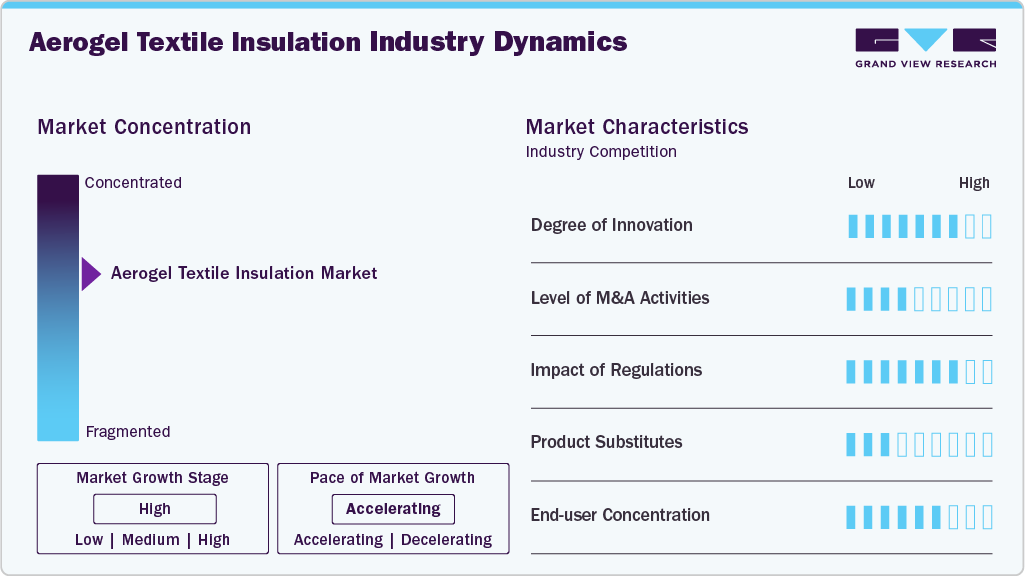
A defining feature of the industry is its strong dependence on silica aerogel, due to its very low thermal conductivity, lightweight structure, and established performance across high-temperature and industrial insulation applications. At the same time, the industry is evolving toward polymer, carbon, and composite/hybrid aerogels, which are being developed to address limitations related to flexibility, mechanical strength, durability, and application-specific performance. Manufacturing remains technically complex because aerogel production involves controlled processing, drying, reinforcement, and integration with textile substrates. Consequently, the market is shifting toward scalable production methods, improved aerogel-textile bonding, thinner insulation structures, and customized flexible insulation systems to expand adoption across aerospace, automotive, industrial, energy, and protective applications.
Analyst Perspective
From an analyst perspective, the market has evolved from a niche, technically intensive insulation solution into a high-performance material platform supporting demanding thermal-management applications. Earlier adoption was concentrated in oil & gas and industrial insulation, while the market is now expanding toward aerospace & defense, construction, automotive, and specialized thermal protection due to demand for lightweight, flexible, thin, and energy-efficient insulation. Going forward, advancements in aerogel-textile integration, polymer and hybrid aerogels, manufacturing scalability, and material durability are expected to broaden applications and improve commercial viability, supporting strong market growth as industries increasingly prioritize thermal efficiency, weight reduction, space optimization, and high-performance insulation.
Material Insights
The silica aerogel segment dominated the market, accounting for 79.4% of revenue in 2025. Its superior thermal insulation, lightweight nature, and heat resistance make it widely used in blankets, fabrics, and flexible insulation systems across aerospace, automotive, industrial, and energy applications. Its established performance and compatibility with textile reinforcement further support its market dominance.
The polymer aerogel segment is projected to register the fastest CAGR of 14.4% during the forecast period. Its high flexibility, mechanical strength, and lightweight properties make it suitable for textile-based insulation requiring bending and conformability. The growing development of polymer-aerogel composites for aerospace, automotive, and advanced thermal protection applications is expected to accelerate adoption.
Textile Form Insights
The aerogel blanket/textile blanket segment led the market with the largest revenue share of 35.9% in 2025. These blankets provide lightweight, flexible, and highly efficient thermal insulation and are widely used across industrial, energy, aerospace, and automotive applications. Their ability to conform to complex surfaces while maintaining strong thermal performance supports continued adoption.
The aerogel-reinforced nonwoven segment is expected to grow at the fastest CAGR of 14.1% during the forecast period. Its combination of flexibility, low weight, and thermal insulation performance makes it suitable for aerospace, automotive, industrial, and protective applications. The growing demand for thin, adaptable insulation solutions is driving segment growth.
End-user Insights
Oil & gas led the market with the largest revenue share of 29.4% in 2025. Aerogel textile insulation is widely used for pipelines, equipment, and thermal management systems due to its lightweight, flexible, and high-thermal-resistance properties. Its ability to provide efficient insulation in demanding operating environments supports continued adoption in the oil and gas industry.
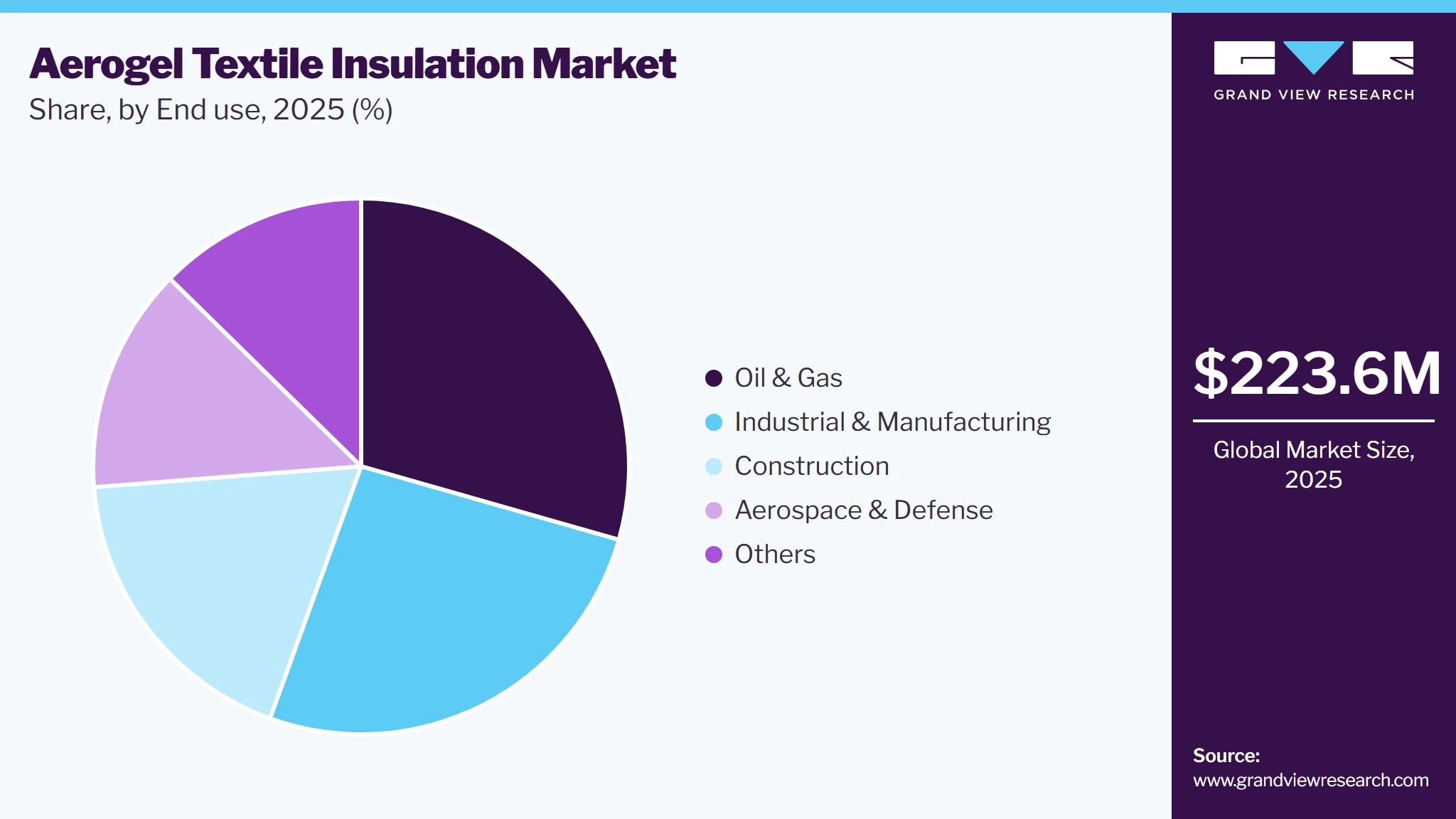
The aerospace & defense segment is expected to grow at the fastest CAGR of 14.1% during the forecast period. Growing demand for lightweight, compact, and high-performance thermal insulation is driving the use of aerogel textiles in aircraft, spacecraft, and defense systems. Their flexibility and superior thermal protection make them suitable for space-constrained and performance-critical applications.
Regional Insights
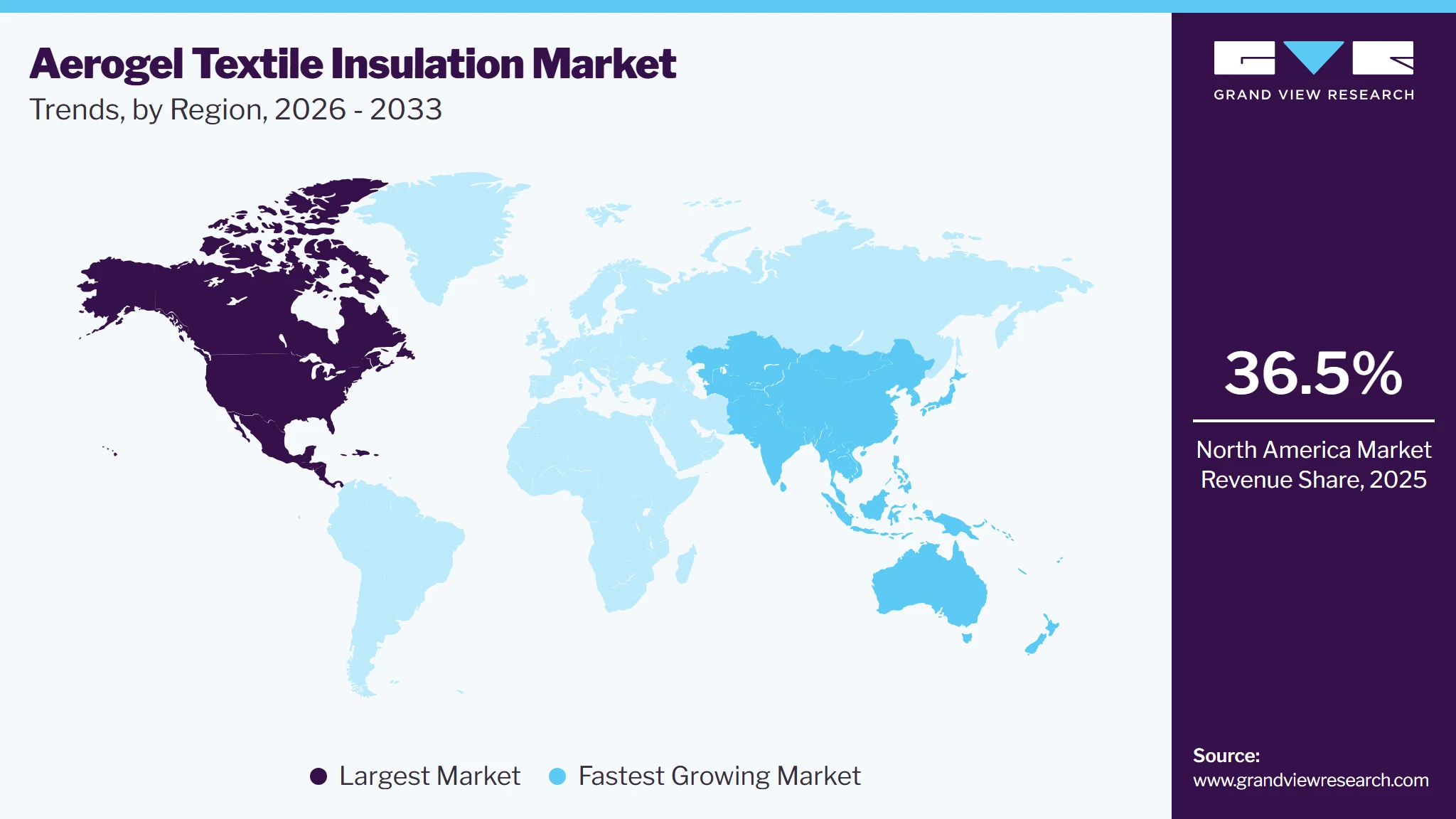
North America held the largest market share at 36.5% in 2025, supported by demand for lightweight and high-performance insulation across oil & gas, industrial, aerospace, and energy applications. Established advanced-materials manufacturing capabilities and an increasing focus on energy efficiency are supporting the adoption of flexible aerogel insulation solutions.
U.S. Aerogel Textile Insulation Market Trends
The aerogel textile insulation market in the U.S. is expected to expand steadily, driven by applications in industrial equipment, pipelines, aerospace systems, and energy infrastructure. Growing demand for compact thermal insulation, coupled with technological development in aerogel blankets, reinforced textiles, and flexible insulation systems, is creating favorable market conditions.
Europe Aerogel Textile Insulation Market Trends
The aerogel textile insulation market in Europe is projected to grow at a moderate pace, supported by increasing emphasis on energy conservation, industrial thermal management, and lightweight insulation technologies. Demand from aerospace, construction, manufacturing, and energy applications is driving the adoption of thin, flexible aerogel-based insulation systems.
Germany aerogel textile insulation marketrepresents a significant European market, supported by its strong industrial and automotive manufacturing base. The increasing adoption of advanced thermal management materials in industrial equipment, automotive systems, and energy-efficient infrastructure is expected to support market growth.
The aerogel textile insulation market in the UK is expected to witness steady expansion, driven by demand for advanced insulation in aerospace, construction, energy, and industrial applications. Increasing focus on energy efficiency and lightweight materials is encouraging the adoption of flexible aerogel textile solutions.
Asia Pacific Aerogel Textile Insulation Market Trends
The aerogel textile insulation market in the Asia Pacific is projected to register the fastest CAGR of 13.7% during the forecast period. Rapid industrialization, expanding energy infrastructure, growing manufacturing activity, and increasing investments in aerospace and automotive industries are driving demand. The region's developing advanced-materials ecosystem and focus on efficient thermal management are further supporting adoption.
China aerogel textile insulation market is expanding with growth in industrial manufacturing, energy infrastructure, automotive production, and aerospace activities. Increasing investment in advanced insulation materials and in domestic aerogel production is driving the adoption of flexible thermal insulation solutions in demanding industrial applications.
The aerogel textile insulation market in India is expected to grow strongly, supported by expanding industrialization, infrastructure development, energy projects, and manufacturing capacity. Rising awareness of lightweight, energy-efficient insulation, along with the increasing adoption of advanced materials, is creating opportunities for aerogel textile insulation.
Latin America Aerogel Textile Insulation Market Trends
The aerogel textile insulation market in Latin America is projected to grow steadily, supported by oil & gas activities, industrial development, construction, and energy infrastructure investments. Increasing demand for efficient thermal management in industrial environments is creating opportunities for flexible aerogel-based insulation.
Brazil aerogel textile insulation market represents an important regional market, supported by its oil & gas, industrial, construction, and energy sectors. Growing investment in infrastructure and demand for high-performance thermal insulation are expected to encourage market adoption.
The aerogel textile insulation market in Argentina is expected to grow gradually, driven by industrial applications, energy infrastructure, and construction activity. Growing interest in lightweight, efficient insulation technologies is creating opportunities for aerogel textile-based solutions.
Middle East & Africa Aerogel Textile Insulation Market Trends
The aerogel textile insulation market in MEA is expected to grow steadily, supported by investments in oil & gas, industrial infrastructure, construction, and energy projects. The need for efficient thermal management in harsh operating environments is increasing interest in lightweight and flexible aerogel insulation technologies.
Key Aerogel Textile Insulation Company Insights
Some key companies in the market include Zhejiang Runfeng New Material Co., Ltd., Shenzhen Aerogel Technology Co., Ltd., Zhongning Technology (Hubei) Co., Ltd., Ningbo Surnano Aerogel Co., Ltd., NANO TECH CO., LTD., Guangzhou Anchor Technology Co., Ltd., Aspen Aerogels, Inc., Cabot Corporation, Luoyang Langchao Fire Technology Co., Ltd., and DashamLabs. The market is characterized by advanced aerogel material development, textile integration, flexible insulation technologies, thermal protection, and application-specific insulation solutions. Key participants are focusing on developing lightweight, low-thermal-conductivity, flexible, durable, and high-performance aerogel insulation materials for demanding industrial, aerospace, energy, construction, and protective applications.
-
Zhejiang Runfeng New Material Co., Ltd. is an aerogel materials manufacturer focused on the development and production of advanced aerogel insulation materials. Its solutions are designed to provide low thermal conductivity, lightweight construction, and effective thermal protection, creating opportunities for flexible, textile-integrated insulation applications across the industrial and energy sectors.
-
Shenzhen Aerogel Technology Co., Ltd. develops aerogel-based thermal insulation materials with an emphasis on lightweight and high-efficiency thermal management. Its aerogel solutions can be incorporated into flexible insulation structures and textile-based systems where compact thickness, thermal resistance, and reduced weight are important performance requirements.
Key Aerogel Textile Insulation Companies:
The following key companies have been profiled for this study on the aerogel textile insulation market:
-
Zhejiang Runfew New Material Co., Ltd.
-
Shenzhen Aerogel Technology Co., Ltd.
-
Ningbo Surnano Aerogel Co., Ltd.
-
NANO TECH CO., LTD.
-
Guangzhou Anchor Technology Co., Ltd.
-
Aspen Aerogels, Inc.
-
Cabot Corporation
-
Luoyang Langchao Fire Technology Co., Ltd.
-
DashamLabs
Company Categorization
Category
Operating Strategies
Competitive Edge
Weakness
Established Players (Aspen Aerogels, Inc.; Cabot Corporation; Ningbo Surnano Aerogel Co., Ltd.)
Focus on aerogel R&D, flexible insulation, textile integration, and thermal management solutions for industrial, energy, aerospace, and construction applications.
Strong aerogel technology, manufacturing capabilities, low thermal conductivity, lightweight insulation, and an established customer base.
High production costs, complex aerogel processing, and higher prices than conventional insulation materials.
Emerging Players (Zhejiang Runfeng; Shenzhen Aerogel Technology; Zhongning Technology; NANO TECH; Guangzhou Anchor Technology; Luoyang Langchao Fire Technology; DashamLabs)
Focus on silica aerogel materials, flexible insulation, thermal protection, and customized aerogel-textile solutions while expanding regional applications.
Specialized aerogel expertise, product customization, flexible insulation development, and application-specific thermal protection capabilities.
Limited production scale, global distribution, brand recognition, and resources compared with established aerogel manufacturers.
Recent Development:
-
In May 2026, Ningbo Surnano Aerogel Co., Ltd. showcased a water-based, environmentally friendly aerogel production process at the 2026 Aerogel Products New Technology and New Application Exchange Conference. The process aims to reduce production costs and improve the environmental profile of aerogel manufacturing, thereby supporting the development of lower-cost, more sustainable aerogel insulation materials.
-
In May 2026, Aspen Aerogels, Inc. reported continued business development in its advanced aerogel technology portfolio, with its products supporting thermal management, electric-vehicle battery protection, and energy-efficiency applications. The company continues to expand the use of ultrathin aerogel-based thermal barriers, thereby reinforcing opportunities for lightweight, high-performance insulation technologies.
Aerogel Textile Insulation Market Report Scope
Report Attribute
Details
Market size in 2025
USD 223.6 million
Estimated market size in 2026
USD 252.2 million
Projected market size by 2033
USD 603.6 million
Growth rate
CAGR of 13.3% from 2026 to 2033
Historical data
2021 - 2025
Forecast period
2026 - 2033
Quantitative units
Revenue in USD million and CAGR from 2026 to 2033
Report coverage
Revenue forecast, company ranking, competitive landscape, growth factors, and trends
Segments covered
Material, textile form, end-user, region
Regional scope
North America; Europe; Asia Pacific; Latin America; MEA
Country scope
U.S.; Canada; Mexico; Germany; France; UK; Italy; Spain; China; India; Japan; South Korea; Australia; Brazil; Argentina; Saudi Arabia; UAE; South Africa
Key companies profiled
Zhejiang Runfew New Material Co., Ltd.; Shenzhen Aerogel Technology Co., Ltd.; Ningbo Surnano Aerogel Co., Ltd.; NANO TECH CO., LTD.; Guangzhou Anchor Technology Co., Ltd.; Aspen Aerogels, Inc.; Cabot Corporation; Luoyang Langchao Fire Technology Co., Ltd.; DashamLabs
Customization scope
Free report customization (equivalent up to 8 analysts working days) with purchase. Addition or alteration to country, regional & segment scope.
Pricing and purchase options
Avail of customized purchase options to meet your exact research needs. Explore purchase options
Global Aerogel Textile Insulation Market Report Segmentation
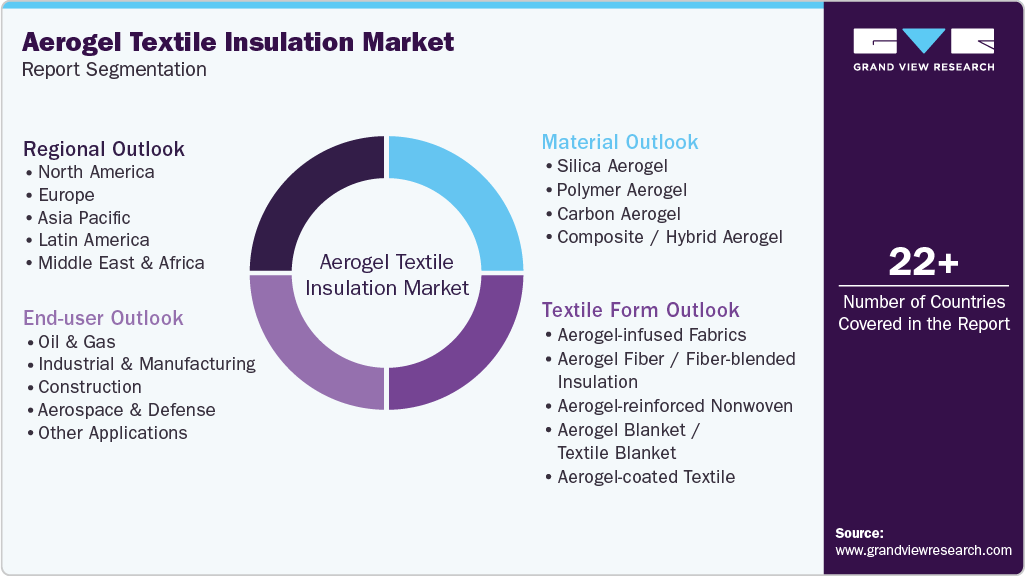
This report forecasts revenue growth at the regional and country levels and provides an analysis of the latest industry trends and opportunities in each of the sub-segments from 2021 to 2033. For this study, Grand View Research has segmented the global aerogel textile insulation market report based on material, textile form, end-user, and region:
-
Material Outlook (Revenue, USD Million, 2021 - 2033)
-
Silica Aerogel
-
Polymer Aerogel
-
Carbon Aerogel
-
Composite / Hybrid Aerogel
-
-
Textile Form Outlook (Revenue, USD Million, 2021 - 2033)
-
Aerogel-infused Fabrics
-
Aerogel Fiber / Fiber-blended Insulation
-
Aerogel-reinforced Nonwoven
-
Aerogel Blanket / Textile Blanket
-
Aerogel-coated Textile
-
-
End-user Outlook (Revenue, USD Million, 2021 - 2033)
-
Oil & Gas
-
Industrial & Manufacturing
-
Construction
-
Aerospace & Defense
-
Other Applications
-
-
Regional Outlook (Revenue, USD Million, 2021 - 2033)
-
North America
-
U.S.
-
Canada
-
Mexico
-
-
Europe
-
Germany
-
France
-
UK
-
Italy
-
Spain
-
-
Asia Pacific
-
China
-
India
-
Japan
-
South Korea
-
Australia
-
-
Latin America
-
Brazil
-
Argentina
-
-
Middle East & Africa
-
Saudi Arabia
-
UAE
-
South Africa
-
-
Research Methodology
The aerogel textile insulation market figures in this report are based on a proven research process that combines executive interviews with secondary research from proprietary databases, company filings, and recognized regulatory and institutional sources. Market size is built through value-chain sizing—reconciling supply-side and demand-side estimates—and triangulated with bottom-up and top-down approaches. Every estimate passes multiple levels of expert validation before publication, with each aerogel textile insulation segment quantified using the revenue-capture definitions in the table below.
Segment Definition
Segment - Material Type
Revenue capture definition
Silica Aerogel
Revenue generated from the sale of silica aerogel-based textile insulation products, including aerogel blankets, fabrics, nonwovens, fibers, and coated textiles used for high-performance thermal insulation, heat protection, and energy efficiency across industrial, oil & gas, aerospace, construction, and other applications.
Polymer Aerogel
Revenue generated from polymer aerogel-based textile insulation products offering lightweight construction, flexibility, mechanical strength, and low thermal conductivity. Includes polymer aerogel materials integrated into fabrics, fibers, nonwovens, blankets, and flexible insulation systems.
Carbon Aerogel
Revenue generated from carbon aerogel-based textile insulation materials used in applications requiring lightweight thermal protection, heat resistance, and advanced thermal management. Includes carbon aerogel integrated into textile-based insulation structures for aerospace, industrial, energy, and specialized applications.
Composite / Hybrid Aerogel
Revenue generated from composite or hybrid aerogel-based textile insulation products combining aerogel with other materials to improve thermal performance, flexibility, mechanical durability, fire resistance, or application-specific functionality. Includes hybrid aerogel blankets, reinforced textiles, nonwovens, and flexible insulation systems.
Segment - Textile Form
Revenue capture definition
Aerogel-infused Fabrics
Revenue generated from aerogel-infused textile fabrics designed to provide lightweight thermal insulation, heat resistance, and thermal protection in aerospace, industrial, automotive, and protective applications.
Aerogel Fiber / Fiber-blended Insulation
Revenue generated from aerogel fibers and fiber-blended insulation materials is used to enhance thermal resistance, flexibility, and lightweight performance in textile-based insulation systems and protective applications.
Aerogel-reinforced Nonwoven
Revenue generated from aerogel-reinforced nonwoven insulation materials combining aerogel with nonwoven substrates to provide low thermal conductivity, flexibility, lightweight construction, and thermal protection.
Aerogel Blanket / Textile Blanket
Revenue generated from aerogel blanket and textile blanket insulation products used for flexible thermal insulation of pipelines, equipment, industrial systems, buildings, and high-temperature applications.
Aerogel-coated Textile
Revenue generated from aerogel-coated textile products where aerogel is applied to textile substrates to improve thermal insulation, heat resistance, and surface protection for industrial, aerospace, construction, and specialized applications.
Segment - End User
Revenue capture definition
Oil & Gas
Revenue generated from aerogel textile insulation products used for thermal insulation of pipelines, valves, vessels, tanks, process equipment, and offshore systems, providing lightweight and high-performance insulation in demanding operating environments.
Industrial & Manufacturing
Revenue generated from aerogel-based textile insulation used for industrial equipment, process piping, furnaces, machinery, tanks, and thermal management systems requiring efficient heat retention, reduced energy loss, and flexible insulation.
Construction
Revenue generated from aerogel textile insulation products used in walls, roofs, facades, HVAC systems, ducts, and other building applications requiring thin, lightweight, and energy-efficient thermal insulation solutions.
Aerospace & Defense
Revenue generated from aerogel textile insulation used in aircraft, spacecraft, defense equipment, thermal barriers, and protective systems requiring lightweight construction, extreme-temperature resistance, and high-performance thermal protection.
Others
Revenue generated from aerogel textile insulation used in automotive, marine, electronics, protective equipment, and other specialized applications requiring lightweight, flexible, and advanced thermal insulation performance.
Estimation Model
Layer No.
Layer Name
Key Question
Description
01
End-use Industry Layer
What drives demand?
Estimate demand from key end-use industries including oil & gas, industrial & manufacturing, construction, aerospace & defense, and other specialized sectors that utilize aerogel-integrated textile insulation for thermal management and protection.
02
Application Adoption Layer
Where is aerogel textile insulation used?
Assess adoption of aerogel textile insulation across major applications based on requirements such as low thermal conductivity, lightweight construction, flexibility, heat resistance, energy efficiency, and space-constrained insulation.
03
Product Consumption Layer
Which products generate demand?
Evaluate consumption of aerogel-infused fabrics, aerogel fiber/fiber-blended insulation, aerogel-reinforced nonwovens, aerogel blankets/textile blankets, and aerogel-coated textiles across industrial and specialized applications.
04
Revenue Layer
How is revenue generated?
Revenue is generated through the sale of aerogel-based textile insulation products and flexible thermal insulation systems, including blankets, fabrics, fibers, nonwovens, and coated textiles used for thermal protection, energy efficiency, and high-performance insulation.
Delivered Customizations
This report has been delivered with the following In-depth customizations
Client Request
Customization Delivered
Value Adds
Regional Segmentation Analysis
Detailed assessment of the aerogel textile insulation industry across North America, Europe, Asia Pacific, Latin America, and the Middle East & Africa, covering regional demand patterns, aerogel material preferences, textile form adoption, end-use industries, thermal insulation requirements, manufacturing capabilities, and regulatory trends.
Enables identification of high-growth regions, regional demand variations, technology adoption patterns, and strategic expansion opportunities across key markets.
Cross-Segmentation Analysis
Comprehensive analysis of market opportunities across combinations of Material Type (Silica Aerogel, Polymer Aerogel, Carbon Aerogel, Composite/Hybrid Aerogel), Textile Form (Aerogel-infused Fabrics, Fiber/Fiber-blended Insulation, Reinforced Nonwoven, Textile Blankets, Coated Textiles), End User (Oil & Gas, Industrial & Manufacturing, Construction, Aerospace & Defense, Others), and regional markets.
Helps identify high-value segment combinations, application demand pockets, material preferences, and emerging growth opportunities to support targeted business strategies.
Competitive Benchmarking
Comparative benchmarking of leading Aerogel Textile Insulation companies based on product portfolio, aerogel technology, textile integration capabilities, thermal performance, product customization, manufacturing capacity, application coverage, regional presence, innovation, sustainability initiatives, and strategic developments.
Provides insights into competitor positioning, technology differentiation, product gaps, market opportunities, and strategic competitive advantages across key segments.
About the Author(s)
Advanced Interior Materials Research Team
Advanced Materials · Advanced Interior MaterialsThis report was authored by the advanced interior materials research team at Grand View Research - comprising two research analysts, one senior research analyst, and one industry expert - with specialized expertise in the advanced interior materials segment of the advanced materials industry. All findings are based on proprietary advanced materials databases, executive interviews, and regulatory analysis, subject to internal peer review prior to publication.
Last Updated:
Speak to Analyst


Customize this report to your needs - add regions, segments, or data points, with 20% free customization.
Or view our licence options:


ISO 9001:2015 & 27001:2022 Certified
We are GDPR and CCPA compliant! Your transaction & personal information is safe and secure. For more details, please read our privacy policy.


