
- Home
- »
- Next Generation Technologies
- »
-
Agentic AI Governance & Policy Management Market Report 2033GVR Report cover

Agentic AI Governance And Policy Management Market (2026 - 2033)
Size, Share & Trends Analysis Report By Component (Software, Services), By Governance Function, By Deployment Mode (Cloud-based, On-premises, Hybrid), By End-use, By Region, And Segment Forecasts
Market Size, 2025
$11.5BMarket Estimate, 2026
$15.8BMarket Forecast, 2033
$153.4BCAGR, 2026–2033
38.3%Agentic AI Governance And Policy Management Market Summary
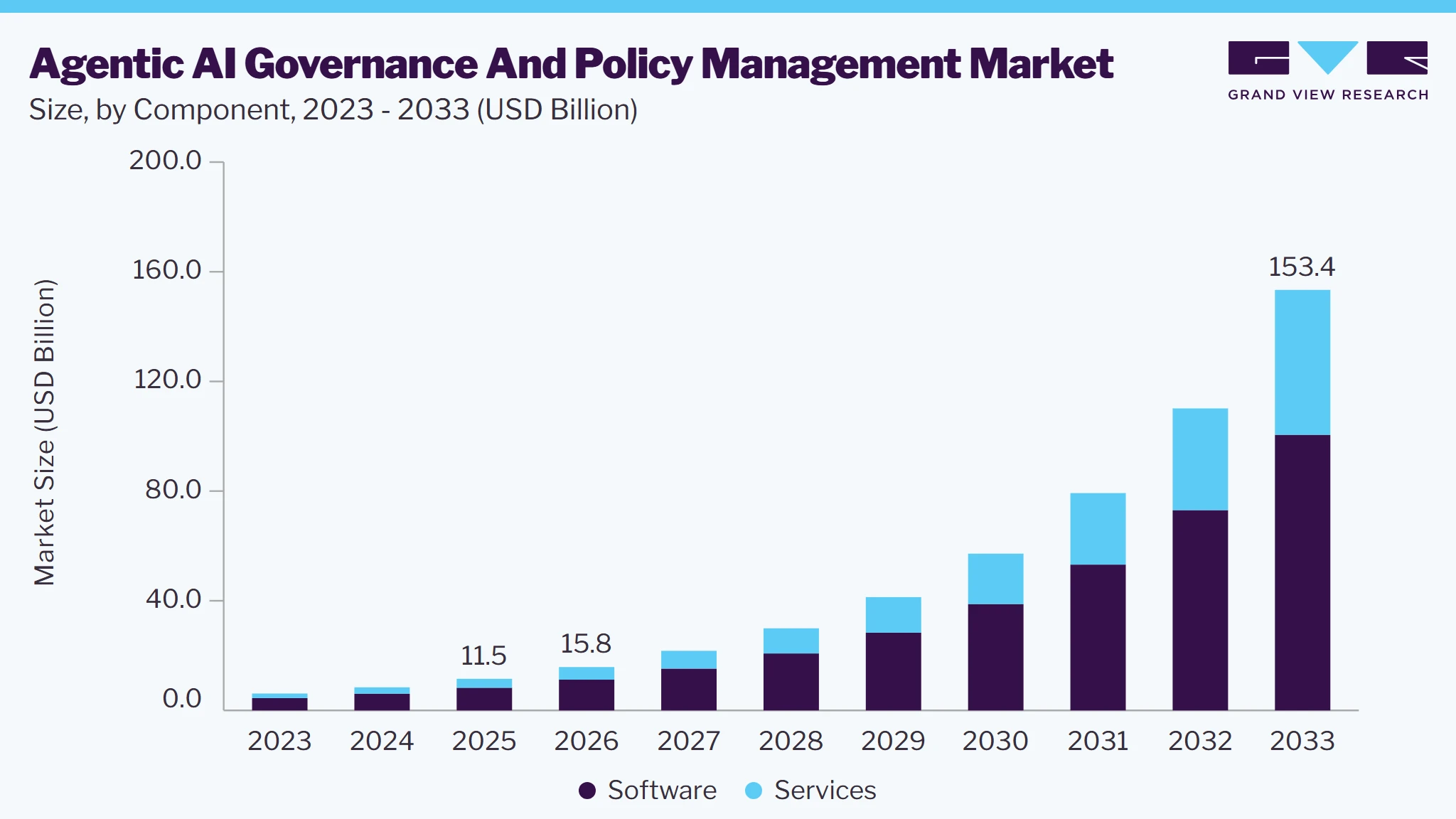
The global agentic AI governance and policy management market size was valued at USD 11.5 billion in 2025 and is projected to grow from USD 15.8 billion in 2026 to USD 153.4 billion by 2033, at a CAGR of 38.3% from 2026 to 2033. North America dominated the market, accounting for the largest revenue share of 38.2% in 2025. The global agentic AI governance and policy management market is growing as enterprises increasingly adopt autonomous AI agents.
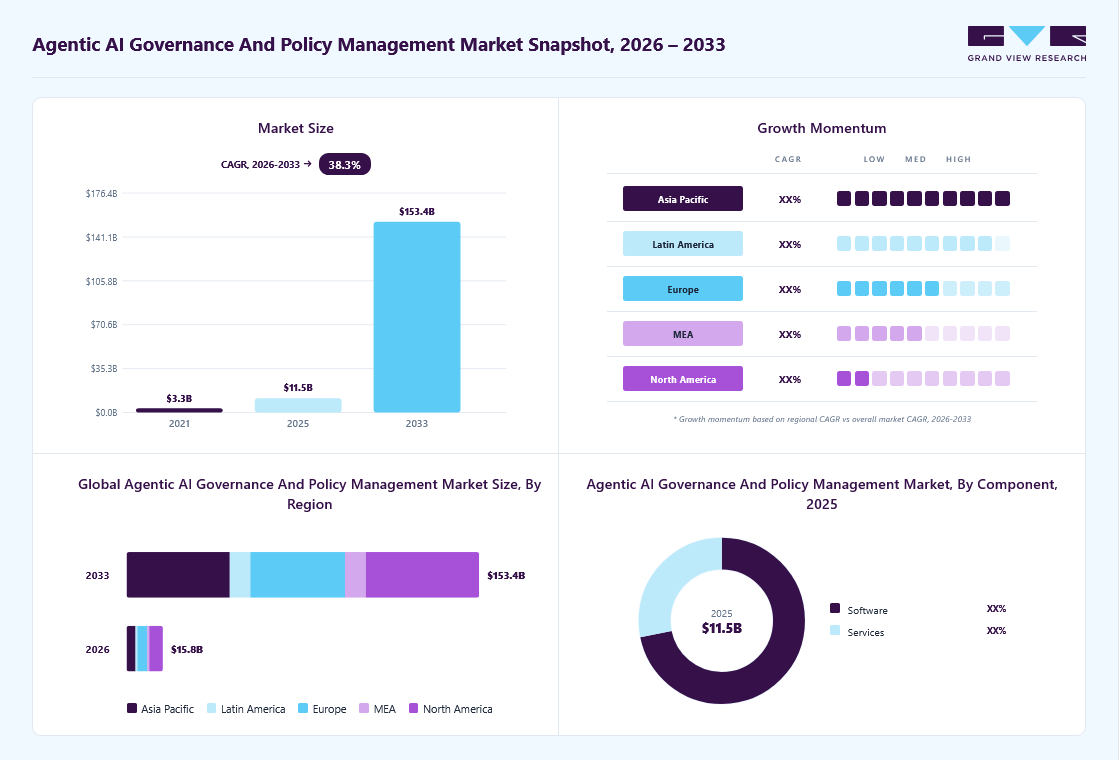 Source: Grand View Research, IR Documents, Primary Interviews, Paid DatabasesTo learn more about this report,
 Download Free Sample Report
Key Market Trends & Insights
- By component: Software segment held the largest market share of around 71.7% in 2025.
- By governance function: Policy management and compliance segment held the largest market revenue share in 2025.
- By deployment mode: Cloud-based segment led the market with the largest revenue share in 2025.
- By end use: BFSI segment held the largest market revenue share in 2025.
Regional Highlights
- Largest regional market: North America (38.2% revenue share, 2025)
- Fastest-growing regional market: Asia Pacific (highest CAGR, 2026-2033)
- By country: U.S. held the largest share in 2025
Market Size & Forecasts
- Market size in 2025: USD 11.5 Billion
- Estimated market size in 2026: USD 15.8 Billion
- Projected market size by 2033: USD 153.4 Billion
- CAGR (2026-2033): 38.3%
Three ways to get this report
Buy it, customize it, or ask a question.Ask an Analyst
Analyst response in 1 business day
- AccessReport author, directly
- Reply timeWithin 1 working day
- No sales callDirect answer only
- FormatEmail reply
- CostFree, no cost
Get the Full Report
What the study covers
- FormatsPDF · Excel · Dashboard
- Timeline2026–2033 annual, 2025 base
- Coverage20+ countries, 5 regions
- Companies10+ key players profiled
Customize the Report
20% free customization
- IncludeCountries, segments, points
- TailorTo your product definition
- ExtendDeeper competitor detail
- OrA fully bespoke study
- Turnaround5–10 working days
Rising concerns about security, regulatory compliance, data privacy and operational risks are driving demand for governance platforms and runtime controls. Growing investment in responsible AI and risk management is expected to create significant market opportunities.The rising demand for runtime security and continuous monitoring of AI agents is driving market growth as businesses seek to protect AI workflows from cyber threats, data leakage and unauthorized actions. This is increasing demand for real-time threat detection, continuous monitoring and automated policy enforcement. As enterprise adoption of autonomous AI agents expands, investment in security and governance solutions is expected to grow. Companies are developing advanced solutions to strengthen AI agent security, monitor runtime behavior and enforce governance policies continuously. For instance, in August 2026, Zenity, an AI security and governance company, launched AI Total, a free threat intelligence service that dynamically analyzes AI agent skills in a secure sandbox to detect malicious behavior, malware delivery and data exfiltration. The launch strengthens AI agent security by identifying runtime threats that traditional static analysis may miss, helping organizations improve governance and protect autonomous AI workflows.
 To learn more about this report, Download Free Sample Report
The growing adoption of autonomous AI agents is increasing demand for AI agent identity and access management, as organizations need to control agent permissions, credentials and access to sensitive enterprise systems. This is driving demand for solutions that verify agent identities, prevent unauthorized actions and enforce access policies. As AI agents become more integrated into business operations, organizations require stronger identity security, credential management and continuous access monitoring. These capabilities help reduce security risks, protect sensitive data and support the safe deployment of AI agents across enterprise environments. For instance, in May 2025, Microsoft announced Microsoft Entra Agent ID to help organizations secure and manage AI agent identities. The solution supports identity governance and access control, helping businesses reduce risks associated with autonomous AI agents.
The increasing need for regulatory compliance and responsible AI adoption is driving demand for automated governance and policy management solutions. Organizations must ensure that AI agents operate within established policies, industry regulations and ethical standards. This is encouraging investment in tools that automate compliance checks, document decisions and maintain audit trails. Growing regulatory scrutiny is also increasing the need for transparency and accountability in AI-driven operations. Businesses are adopting centralized governance platforms to manage risks across multiple AI agents. These platforms help organizations identify compliance gaps and standardize policies across departments. As regulatory requirements evolve, demand for adaptable governance solutions is expected to increase. Integration with existing enterprise systems is further supporting the adoption of AI governance technologies. The need for responsible and compliant AI deployment is creating new growth opportunities in the market.
Market Dynamics
The agentic AI governance and policy management market is growing as organizations increasingly integrate autonomous AI agents into business operations. Rising concerns about security, transparency and regulatory compliance are encouraging investment in governance solutions. Businesses are seeking effective ways to monitor AI activities, manage risks and ensure responsible deployment. Technological advancements and expanding enterprise adoption are creating new opportunities for market participants. However, implementation costs, integration challenges and evolving regulatory requirements may influence market growth.
Organizations are increasingly adopting autonomous AI agents to automate workflows and improve business efficiency. However, the growing autonomy of these systems creates concerns regarding data security, unauthorized actions, accountability, and regulatory compliance. Businesses are therefore investing in governance and policy management solutions to establish operational boundaries, monitor agent activities, and enforce security requirements. These solutions help organizations manage AI-related risks while maintaining oversight of automated operations. The increasing need for secure and responsible AI deployment is driving demand for agentic AI governance solutions.
As AI agents become integrated into enterprise applications and business processes, organizations require consistent governance policies across different systems. Centralized platforms enable businesses to monitor agent behavior, manage permissions, document activities, and identify policy violations. Growing awareness of AI-related risks is further encouraging enterprises to strengthen their governance frameworks. This increasing emphasis on security, accountability, and compliance is supporting market expansion.
The absence of widely adopted standards for governing autonomous AI agents creates challenges for market growth. Organizations may face uncertainty when establishing policies for agent behavior, decision-making, permissions, and accountability. Differences in regulatory requirements across regions and industries can further complicate governance implementation. Businesses may also struggle to determine appropriate risk thresholds and monitoring requirements for different types of AI agents. These challenges can slow the adoption of governance solutions.
Additionally, rapidly evolving AI technologies require organizations to regularly update governance policies and security controls. Companies may find it difficult to establish consistent practices across agents developed using different platforms and technologies. Uncertainty regarding compliance responsibilities and governance effectiveness can also delay investment decisions. Consequently, the lack of standardized frameworks may increase implementation complexity and limit market adoption.
The growing deployment of autonomous AI agents is creating opportunities for solutions that provide continuous monitoring and runtime control. Unlike conventional AI applications, autonomous agents can perform actions, interact with enterprise systems, and access business data with limited human intervention. This increases the need to detect unusual behavior, prevent unauthorized activities, and enforce policies while agents are operating. Vendors can address this demand by developing solutions that combine real-time monitoring, threat detection, audit logging, and automated policy enforcement.
Organizations are also seeking greater visibility into how AI agents operate and interact with enterprise resources. Governance platforms that provide centralized oversight can help businesses identify risks, investigate incidents, and maintain accountability. As enterprises deploy larger numbers of agents, managing their activities manually may become increasingly difficult. This creates opportunities for scalable governance solutions that automate monitoring and policy enforcement across enterprise environments, supporting further growth in the market.
Market Concentration & Characteristics
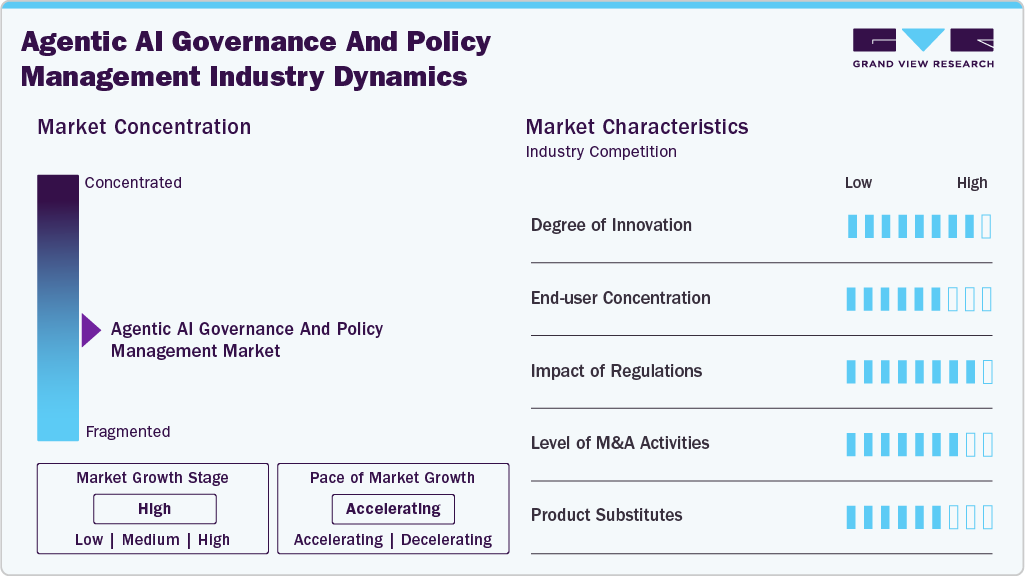
The global agentic AI governance and policy management market is moderately fragmented, with numerous companies offering solutions across AI governance, cybersecurity, identity management, and compliance. The market includes established technology providers and specialized vendors developing tools for autonomous AI agent oversight. Major companies leverage their existing enterprise platforms to integrate governance and security capabilities. Meanwhile, specialized providers compete through agent-specific monitoring, runtime protection, and policy enforcement solutions. The diversity of technologies and service offerings creates competition across multiple market segments. As adoption expands, competition is expected to intensify as companies strengthen their capabilities and expand their product portfolios.
 To learn more about this report, Download Free Sample Report
Market fragmentation is also influenced by the evolving nature of agentic AI technologies and the absence of a single, universally adopted governance framework. Organizations have varying requirements for agent security, access control, compliance, and operational monitoring. This creates opportunities for both large technology companies and smaller specialized providers to address specific business needs. Strategic partnerships, product launches, and acquisitions may help companies expand their market presence. Established vendors may benefit from their existing customer relationships and integrated enterprise solutions. However, specialized providers can remain competitive by offering targeted capabilities and adapting quickly to emerging governance requirements.
Analyst Perspective
The agentic AI governance and policy management market is evolving as organizations increasingly adopt autonomous AI agents. Rising concerns about security, compliance, and operational risks are driving demand for governance solutions. Companies are developing advanced platforms to improve agent monitoring, access control, and policy enforcement. Growing enterprise adoption and technological advancements are creating new market opportunities. The market is expected to expand as businesses prioritize the safe and responsible deployment of AI agents.
Component Insights
The software segment dominated the agentic AI governance and policy management in 2025, accounting for a 71.7% revenue share. This dominance is driven by the increasing adoption of governance platforms to manage autonomous AI agents across enterprise environments. These solutions enable organizations to monitor agent activities, enforce policies, manage access permissions, and identify potential risks. The growing need for centralized oversight and automated compliance is further supporting software adoption. Businesses are increasingly integrating governance tools into their existing IT and security infrastructure. As enterprise deployment of AI agents expands, demand for scalable and automated governance software is expected to increase.
The services segment is also gaining traction as organizations require professional support to implement and manage AI governance frameworks. Businesses often need assistance with risk assessments, policy development, system integration, and regulatory compliance. Service providers help organizations align governance solutions with their operational requirements and existing technology infrastructure. The complexity of deploying autonomous AI agents is increasing demand for consulting, implementation, and ongoing support services. Organizations may also require employee training and periodic governance assessments to maintain effective oversight. Consequently, growing implementation needs and the expansion of enterprise AI adoption are expected to support the services segment.
Governance Function Insights
The policy management and compliance segment dominated the agentic AI governance and policy management market in 2025, due to the growing need for organizations to establish clear rules for autonomous AI agents. Businesses are adopting governance solutions to align agent activities with internal policies, security standards, and regulatory requirements. These solutions help define operational boundaries, standardize AI usage, and maintain compliance records. Increasing regulatory scrutiny and concerns about responsible AI deployment are further supporting segment growth. Organizations also require centralized policy management to maintain consistent oversight across departments and enterprise systems.
The agent identity and access management segment is growing as organizations deploy more autonomous AI agents across enterprise applications and workflows. These agents require secure identities, controlled permissions, and managed credentials to access business systems and sensitive information. Identity and access management solutions help verify agent identities, restrict unauthorized activities, and enforce access policies. The growing number of AI agents is increasing the need for continuous identity verification and permission management. Integration with existing enterprise security systems is also supporting adoption. As agentic AI becomes more widespread, demand for secure agent identity and access management solutions is expected to increase.
Deployment Mode Insights
The cloud-based segment dominated the agentic AI governance and policy management market in 2025, due to its scalability, flexibility, and ease of deployment. Cloud-based solutions enable organizations to monitor and govern AI agents across distributed enterprise environments. These platforms offer centralized policy management, real-time monitoring, and regular software updates without requiring extensive on-premises infrastructure. Their ability to integrate with cloud applications and existing enterprise systems further supports adoption. Cloud deployment also allows businesses to scale governance capabilities as the number of AI agents increases. These advantages continue to support demand for cloud-based governance solutions.
The hybrid segment is growing as organizations seek to balance cloud scalability with greater control over sensitive data and critical operations. Hybrid deployment allows businesses to manage AI governance across cloud-based and on-premises environments. This approach is particularly useful for organizations with strict data security, privacy, and regulatory requirements. It also supports integration with legacy infrastructure while enabling access to modern AI governance capabilities. As enterprises adopt AI agents across diverse IT environments, demand for flexible deployment models is increasing. Consequently, hybrid solutions are gaining traction among organizations requiring both operational flexibility and greater control over their data.
End Use Insights
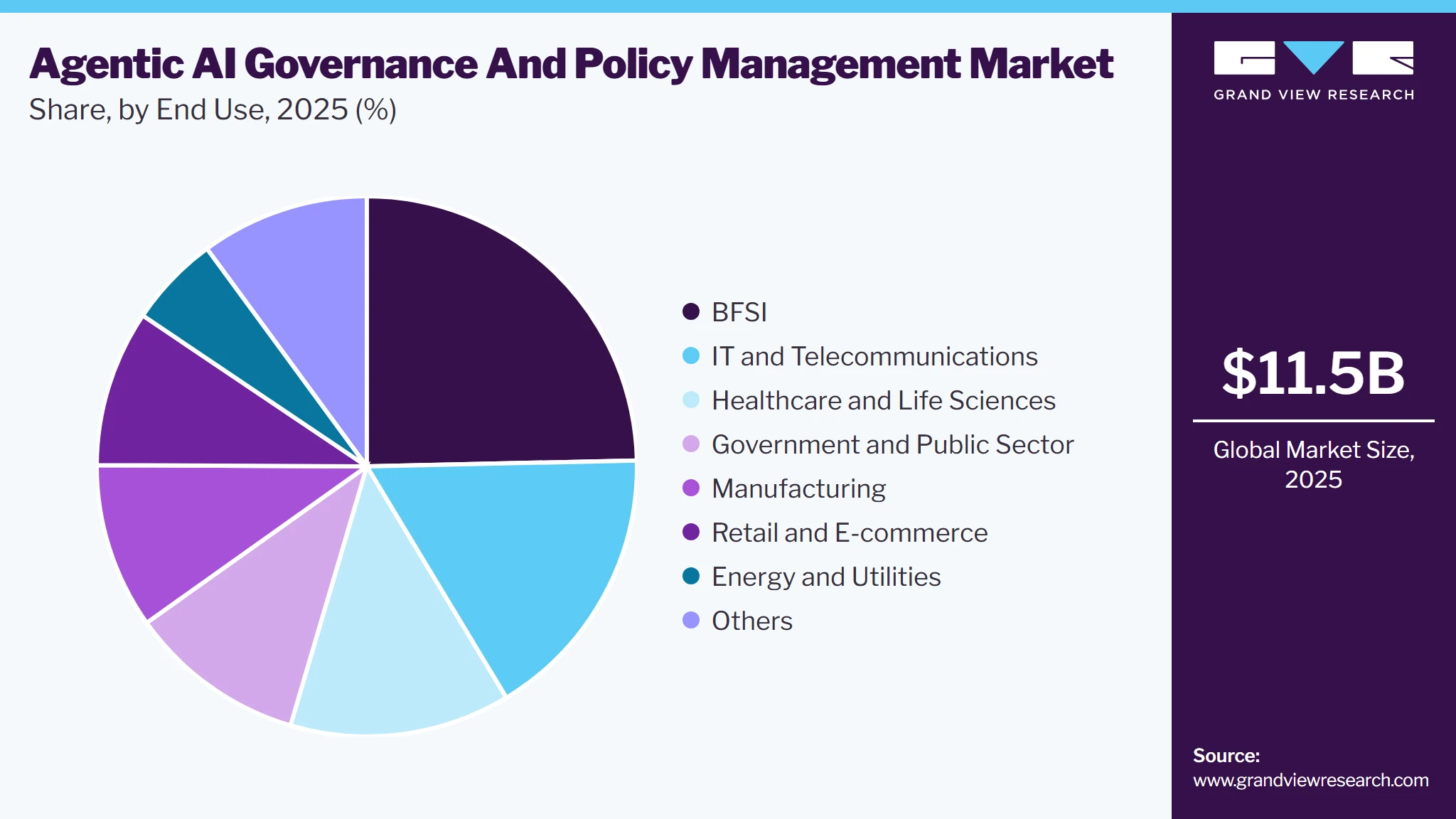
The BFSI segment dominated the agentic AI governance and policy management market due to the extensive use of AI across banking, financial services, and insurance operations. Financial institutions operate under strict regulatory requirements and must maintain strong controls over data security, privacy, and operational risks. The adoption of AI agents for fraud detection, customer service, risk assessment, and financial operations increases the need for effective governance. Governance solutions help institutions monitor agent activities, enforce policies, and maintain audit trails. The sensitive nature of financial data further strengthens demand for secure and compliant AI deployments. These requirements support the adoption of agentic AI governance solutions across the BFSI sector.
 To learn more about this report, Download Free Sample Report
The healthcare and life sciences segment is growing as healthcare providers, pharmaceutical companies, and research institutions increasingly adopt AI agents. These agents can support clinical workflows, administrative tasks, research activities, and healthcare data management. Their use requires careful oversight to protect sensitive patient information and maintain compliance with applicable regulations. Governance solutions help organizations manage access permissions, monitor agent behavior, and establish accountability. The increasing use of AI in clinical research and healthcare operations is creating additional demand for risk management and policy enforcement. As adoption expands, the need for secure and responsible AI agent deployment is expected to support segment growth.
Regional Insights
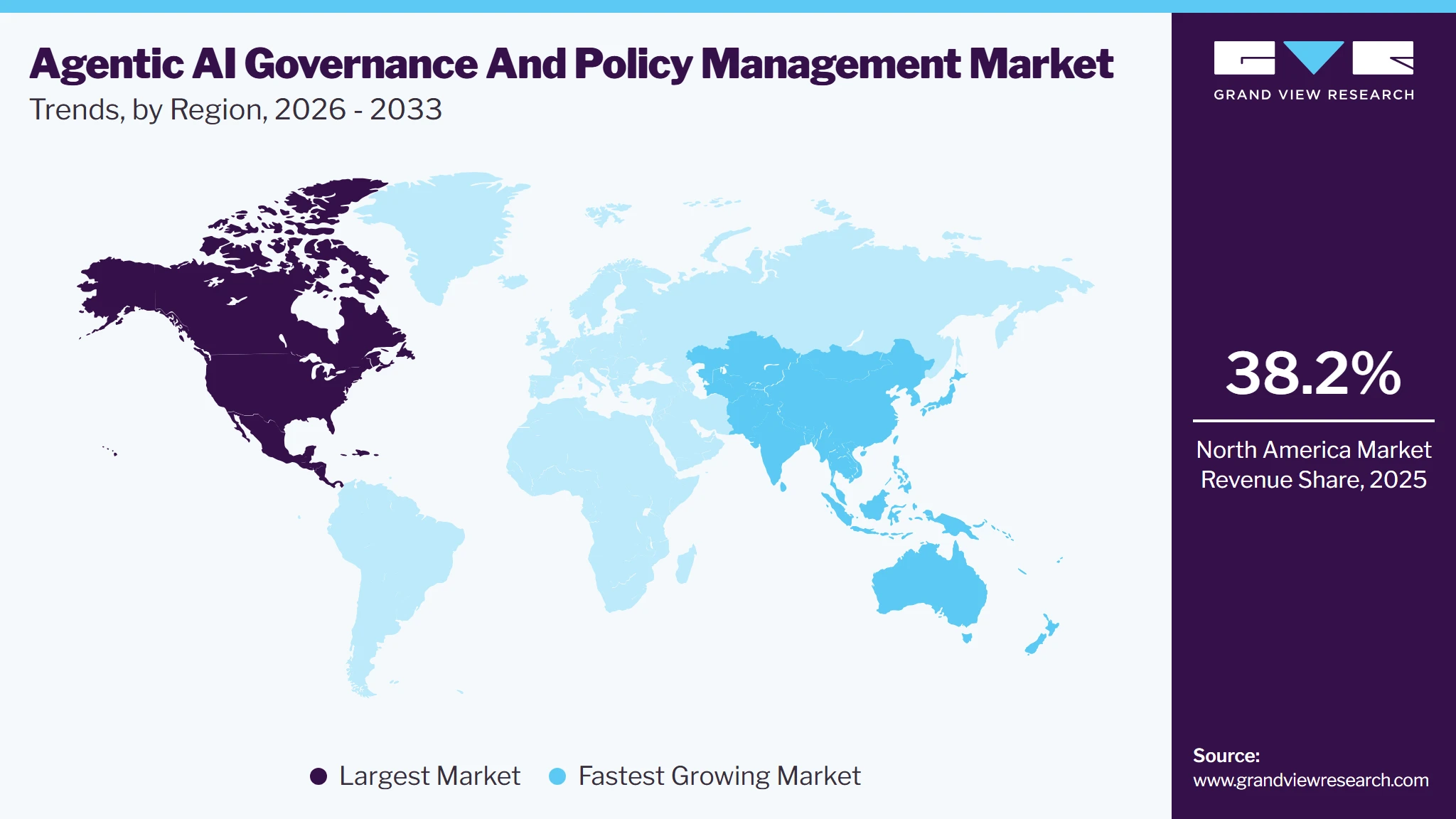
North America held the largest share of the agentic AI governance and policy management market in 2025, accounting for 38.2% of revenue. The region benefits from widespread enterprise AI adoption and a well-established technology ecosystem. Growing emphasis on cybersecurity, regulatory compliance, and responsible AI deployment supports market demand. The presence of major technology providers and specialized AI governance companies further strengthens the regional market. Increasing investment in enterprise AI infrastructure is expected to support continued market growth.
 To learn more about this report, Download Free Sample Report
U.S. Agentic AI Governance And Policy Management Market Trends
The U.S. is a major market for agentic AI governance and policy management, supported by widespread enterprise AI adoption. Organizations are increasingly deploying autonomous AI agents, creating demand for effective oversight and security. The country benefits from a strong technology ecosystem and leading AI and cybersecurity providers. Businesses are integrating governance tools into existing security and compliance frameworks. The market is expected to grow as enterprises prioritize secure AI deployment.
Europe Agentic AI Governance And Policy Management Market Trends
Europe is experiencing growing demand for agentic AI governance and policy management as enterprises expand their use of autonomous AI systems. Organizations are prioritizing AI oversight, data protection, and regulatory compliance. The region has an established ecosystem of cybersecurity and data governance providers. Businesses are increasingly integrating AI monitoring and policy controls into existing technology frameworks. The market is expected to grow as AI adoption and governance requirements increase.
Asia Pacific Agentic AI Governance And Policy Management Market Trends
Asia Pacific is expected to be the fastest-growing region in the agentic AI governance and policy management market. Enterprises across the region are rapidly adopting AI applications across business functions. The expanding use of AI is increasing the need for visibility, security, and governance of AI activities. The region is also seeing wider adoption of cloud platforms and cybersecurity technologies. Increasing regulatory focus on AI accountability and data protection is further encouraging organizations to implement governance frameworks and policy management solutions.
Key Agentic AI Governance And Policy Management Company Insights
Key players operating in the Agentic AI governance and policy management market include Amazon Web Services, Inc.; Credo.AI Corp.; Google LLC; Holistic AI; IBM Corporation; Microsoft; OneTrust; Palantir Technologies Inc.; Palo Alto Networks.; ServiceNow.
-
Amazon Web Services offers AI governance and security capabilities to support the responsible deployment of AI applications. Its tools help organizations manage risks and apply security controls across cloud-based AI environments. AWS enables businesses to monitor AI workloads and integrate governance into their existing infrastructure. Its capabilities support access management, data protection, and operational oversight. The company continues to expand its cloud-based AI services to meet enterprise governance needs. These offerings strengthen its presence in the Agentic AI Governance and Policy Management Market.
-
IBM provides AI governance and security solutions through its watsonx.governance and Guardium AI Security offerings. These solutions help organizations assess AI risks, monitor AI systems, and establish governance controls. Its capabilities support policy enforcement, compliance management, and oversight throughout the AI lifecycle. IBM also helps enterprises improve visibility into AI activities and address potential security issues. Its integrated governance and security offerings support organizations deploying AI agents across business environments. These capabilities strengthen IBM’s position in the Agentic AI Governance and Policy Management Market.
Key Agentic AI Governance And Policy Management Companies
The following key companies have been profiled for this study on the agentic AI governance and policy management market.
-
Amazon Web Services, Inc.
-
Credo.AI Corp.
-
Google LLC
-
Holistic AI
-
IBM Corporation
-
Microsoft
-
OneTrust
-
Palantir Technologies Inc.
-
Palo Alto Networks
-
ServiceNow
Competitive Benchmarking
Operating Strategies
Competitive Edge
Weaknesses
Mature Players: Amazon Web Services, Inc., Google LLC, IBM Corporation
- Expand AI governance through product development, strategic partnerships, acquisitions, and integration with existing enterprise platforms.
- Established customer relationships, broad technology portfolios, strong distribution networks, and enterprise integration capabilities.
- Complex product ecosystems, potentially higher implementation costs, and challenges adapting existing platforms to rapidly evolving agentic AI requirements.
Emerging Players: Credo.AI Corp., Holistic AI
- Develop specialized solutions for AI governance, policy management, risk assessment, compliance, and agent security.
- Focused expertise, specialized features, flexibility, and the ability to respond quickly to emerging AI governance needs.
- Comparatively limited market reach, smaller distribution networks, and potential dependence on integrations with larger enterprise platforms.
Recent Developments
-
In March 2026, Palo Alto Networks launched Prisma AIRS 3.0 to secure the entire agentic AI lifecycle through agent discovery, continuous risk assessment, and runtime protection. The platform provides AI agent inventory, vulnerability scanning, AI red teaming, and governance and identity controls to help enterprises deploy autonomous AI agents securely at scale.
-
In October 2025, IBM Corporation announced enhancements to watsonx.governance introducing agent monitoring and insights to track AI agent behavior, decisions, and performance in production. The updates also integrate Guardium AI Security metrics into the governance console, providing visibility into vulnerabilities, threat detections, and security risks to support responsible AI deployment.
-
In July 2025, Amazon Web Services (AWS) introduced Amazon Bedrock AgentCore in preview, a suite of services designed to securely deploy, manage, and scale AI agents. The platform provides identity management, runtime security, monitoring, and access controls to help enterprises operate AI agents securely and efficiently.
Agentic AI Governance And Policy Management Market Report Scope
Report Attribute
Details
Market size in 2025
USD 11.5 billion
Estimated market size in 2026
USD 15.8 billion
Projected market size by 2033
USD 153.4 billion
Growth rate
CAGR of 38.3% from 2026 to 2033
Actual data
2021 - 2025
Forecast period
2026 - 2033
Quantitative units
Revenue in USD billion and CAGR from 2026 to 2033
Report coverage
Revenue forecast, company share, competitive landscape, growth factors, and trends
Segments covered
Component, governance function, deployment mode, end use, and region
Regional scope
North America; Europe; Asia Pacific; Latin America; Middle East & Africa
Country scope
U.S.; Canada; Mexico; U.K.; Germany; France; China; Japan; India; South Korea; Australia; Brazil; UAE; KSA; South Africa
Key companies profiled
Amazon Web Services, Inc.; Credo.AI Corp.; Google LLC; Holistic AI; IBM Corporation; Microsoft; OneTrust; Palantir Technologies Inc.; Palo Alto Networks.; ServiceNow
Customization scope
Free report customization (equivalent to up to 8 analyst working days) with purchase. Addition or alteration to country, regional & segment scope.
Pricing and purchase options
Avail customized purchase options to meet your exact research needs. Explore purchase options
Global Agentic AI Governance And Policy Management Market Report Segmentation
This report forecasts revenue growth at global, regional, and country levels and provides an analysis of the latest industry trends in each of the sub-segments from 2021 to 2033. For this study, Grand View Research has segmented the global agentic AI governance and policy management market report based on component, governance function, deployment mode, end use, and region.
-
Component Outlook (Revenue, USD Billion, 2021 - 2033)
-
Software
-
Services
-
-
Governance Function Outlook (Revenue, USD Billion, 2021 - 2033)
-
Policy Management & Compliance
-
Agent Identity & Access Management
-
Runtime Guardrails & Security
-
Monitoring, Risk Management & Audit
-
Others
-
-
Deployment Mode Outlook (Revenue, USD Billion, 2021 - 2033)
-
Cloud-based
-
On-premises
-
Hybrid
-
-
End Use Outlook (Revenue, USD Billion, 2021 - 2033)
-
BFSI
-
IT & Telecommunications
-
Healthcare & Life Sciences
-
Government & Public Sector
-
Manufacturing
-
Retail & E-commerce
-
Energy & Utilities
-
Others
-
-
Regional Outlook (Revenue, USD Billion, 2021 - 2033)
-
North America
-
U.S.
-
Canada
-
Mexico
-
-
Europe
-
U.K.
-
Germany
-
France
-
-
Asia Pacific
-
China
-
Japan
-
India
-
South Korea
-
Australia
-
-
Latin America
-
Brazil
-
-
Middle East and Africa
-
UAE
-
KSA
-
South Africa
-
-
Research Methodology
The agentic AI governance and policy management market figures in this report are based on a proven research process that combines executive interviews with secondary research from proprietary databases, company filings, and recognized regulatory and institutional sources. Market size is built through value-chain sizing-reconciling supply-side and demand-side estimates-and triangulated with bottom-up and top-down approaches. Every estimate passes multiple levels of expert validation before publication, with each agentic AI governance and policy management segment quantified using the revenue-capture definitions in the table below.
Segment Definition
Component
Revenue Capture Definition
Software
Includes revenue from software licenses, subscriptions, and embedded tools that provide AI agent policy enforcement, access management, security, monitoring, and compliance capabilities.
Services
Covers income from consulting, implementation, system integration, governance assessments, training, managed services, and compliance advisory for agentic AI systems.
Governance Function
Revenue Capture Definition
Policy Management and Compliance
Captures revenue from solutions that establish governance policies, automate compliance checks, enforce organizational standards, and support regulatory adherence.
Agent Identity and Access Management
Encompasses earnings from technologies that authenticate AI agents, manage credentials, assign permissions, and control access to enterprise systems, tools, and data.
Runtime Guardrails and Security
Includes revenue from solutions that prevent unauthorized agent actions, detect threats during execution, block malicious inputs, and enforce real-time security controls.
Monitoring, Risk Management and Audit
Accounts for income generated by platforms that track agent activities, assess operational risks, issue alerts, maintain audit trails, and produce governance reports.
Others
Represents revenue from additional governance capabilities, including agent lifecycle oversight, workflow automation, specialized reporting, and other governance functions not listed above.
Deployment Mode
Revenue Capture Definition
Cloud-based
Measures revenue from governance solutions hosted on cloud infrastructure and delivered through subscription-based or usage-based service models.
On-premises
Covers licensing and related income from governance software installed and operated within an organization's internal infrastructure or data centers.
Hybrid
Encompasses earnings from solutions that combine cloud and on-premises environments to manage agent governance across distributed IT infrastructures.
End Use
Revenue Capture Definition
BFSI
Reflects revenue from financial institutions using governance solutions to manage AI-driven transactions, protect sensitive data, meet regulatory obligations, and mitigate operational risks.
IT and Telecommunications
Includes spending by technology companies and telecom operators on tools that govern AI agents across digital platforms, networks, customer services, and enterprise applications.
Healthcare and Life Sciences
Accounts for revenue from healthcare providers, pharmaceutical companies, biotechnology firms, and research institutions seeking to protect sensitive information and govern AI-driven workflows.
Government and Public Sector
Covers income from governance solutions procured by public agencies to enforce AI policies, protect government data, strengthen accountability, and oversee automated decisions.
Manufacturing
Represents investment by industrial companies in technologies that supervise AI agents used in production planning, robotics, predictive maintenance, and supply chain operations.
Retail and E-commerce
Captures revenue from retailers and online merchants adopting governance platforms to regulate AI-powered customer service, recommendations, pricing, inventory, and transactions.
Energy and Utilities
Includes earnings from solutions used by energy producers and utility providers to govern AI agents supporting grid management, infrastructure monitoring, maintenance, and resource allocation.
Others
Encompasses revenue from agentic AI governance deployments in other industries, such as education, transportation, logistics, media, hospitality, and professional services.
Estimation Model
Layer Name
Key Question
Description
End-user Industry Layer
Which industries generate demand for agentic AI governance and policy management solutions?
Identifies the organizations creating market demand across BFSI, healthcare and life sciences, IT and telecommunications, government and public sector, manufacturing, retail and e-commerce, energy and utilities, and other industries adopting AI agents.
Adoption / Usage Layer
Which organizations are adopting AI agents and requiring governance controls?
Evaluates the addressable market based on enterprise AI agent adoption, autonomous workflow deployment, integration with business applications, regulatory exposure, and the need for secure and responsible agent operations.
Technology and Infrastructure Layer
Which technologies enable the governance, security, and oversight of AI agents?
Assesses the deployment of policy management and compliance platforms, agent identity and access management, runtime guardrails and security, monitoring, risk management, and audit technologies.
Revenue Capture Layer
How is revenue generated across the agentic AI governance ecosystem?
Measures revenue from software licenses, subscriptions, embedded governance capabilities, cloud-based and on-premises solutions, hybrid deployments, and services such as consulting, implementation, implementation, integration, compliance assessment, and managed governance.
Delivered Customizations
This report has been delivered with the following in-depth customizations
Client Objective
Custom Research Modules Delivered
Strategic Value / Business Impact
Technology & Accessibility Capability Assessment
Governance, agent security, identity, and monitoring technology assessment.
Deployment model and partner ecosystem analysis.
Identified technology gaps and opportunities.
Supported adoption and partnership decisions.
Product Positioning & Competitive Intelligence
Product and vendor capability benchmarking.
Pricing, deployment, and differentiation analysis.
Improved product positioning.
Supported pricing and competitive strategy.
Market Entry & Growth Assessment
Regional sizing, forecasting, and segmentation.
Adoption trends, regulations, and competitive analysis.
Identified growth opportunities.
Supported market entry and expansion planning.
About the Author(s)
Next Generation Technologies Research Team
Technology · Next Generation TechnologiesThis report was authored by the next generation technologies research team at Grand View Research - comprising two research analysts, one senior research analyst, and one industry expert - with specialized expertise in the next generation technologies segment of the technology industry. All findings are based on proprietary technology databases, executive interviews, and regulatory analysis, subject to internal peer review prior to publication.
Last Updated:
Speak to Analyst

Customize this report to your needs - add regions, segments, or data points, with 20% free customization.
Or view our licence options:


ISO 9001:2015 & 27001:2022 Certified
We are GDPR and CCPA compliant! Your transaction & personal information is safe and secure. For more details, please read our privacy policy.


