
- Home
- »
- IT Services & Applications
- »
-
Agentic Analytics Market Size & Share Report, 2026-2033GVR Report cover

Agentic Analytics Market (2026 - 2033)
Size, Share & Trends Analysis Report By Component, By Deployment Mode (Cloud, On-Premises), By Organization Size, By Application, By End-use, By Region, And Segment Forecasts
Market Size, 2025
$581.2MMarket Estimate, 2026
$754.4MMarket Forecast, 2033
$6,012.9MCAGR, 2026–2033
34.5%Agentic Analytics Market Summary
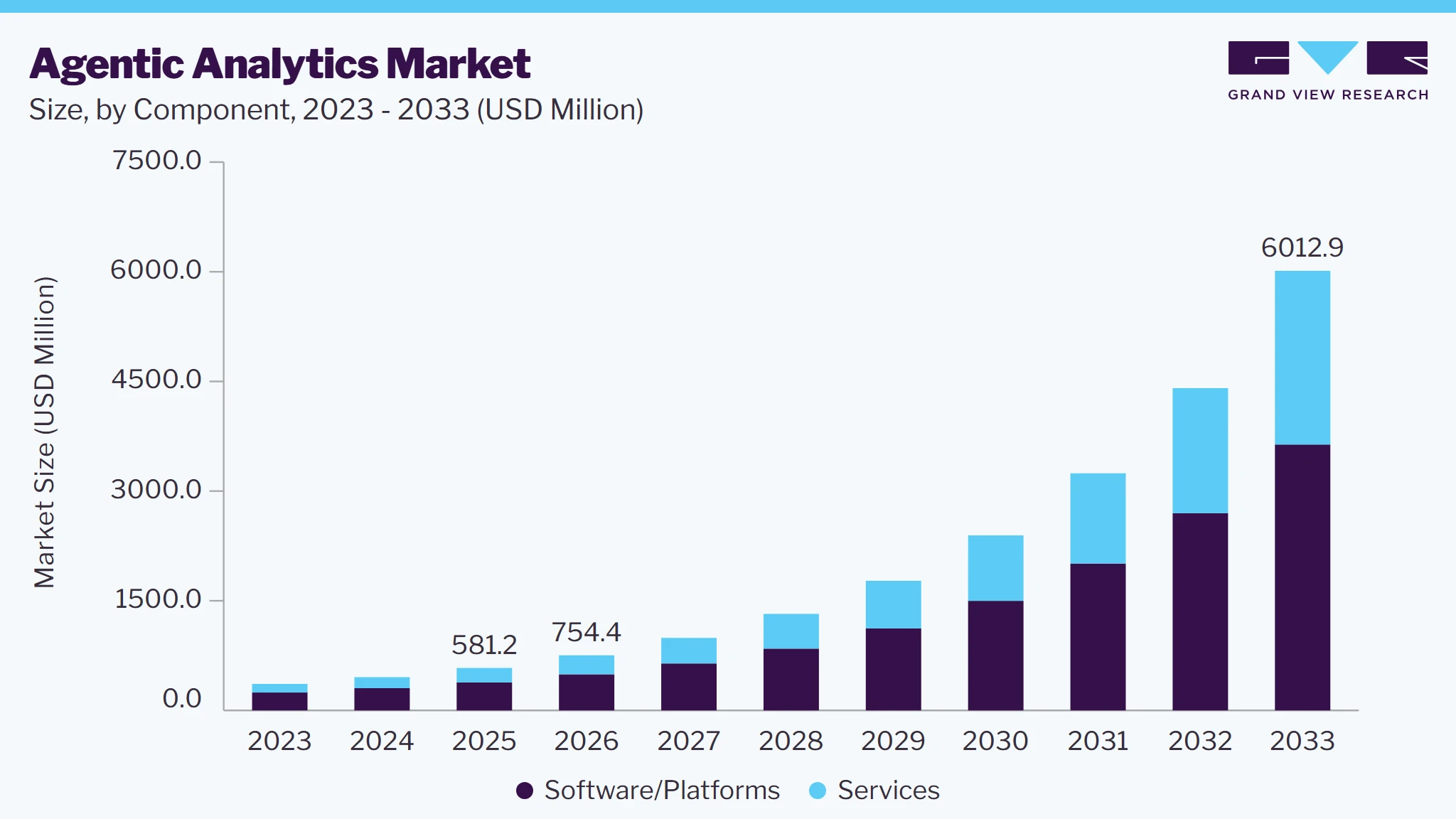
The global agentic analytics market size was valued at USD 581.2 million in 2025 and is projected to grow from USD 754.4 million in 2026 to USD 6,012.9 million by 2033, at a CAGR of 34.5% from 2026 to 2033. North America dominated the market, accounting for a revenue share of 39.0% in 2025. The global market is emerging as enterprises transition from traditional business intelligence (BI) and dashboard-based reporting toward autonomous, insight-driven decision-making.
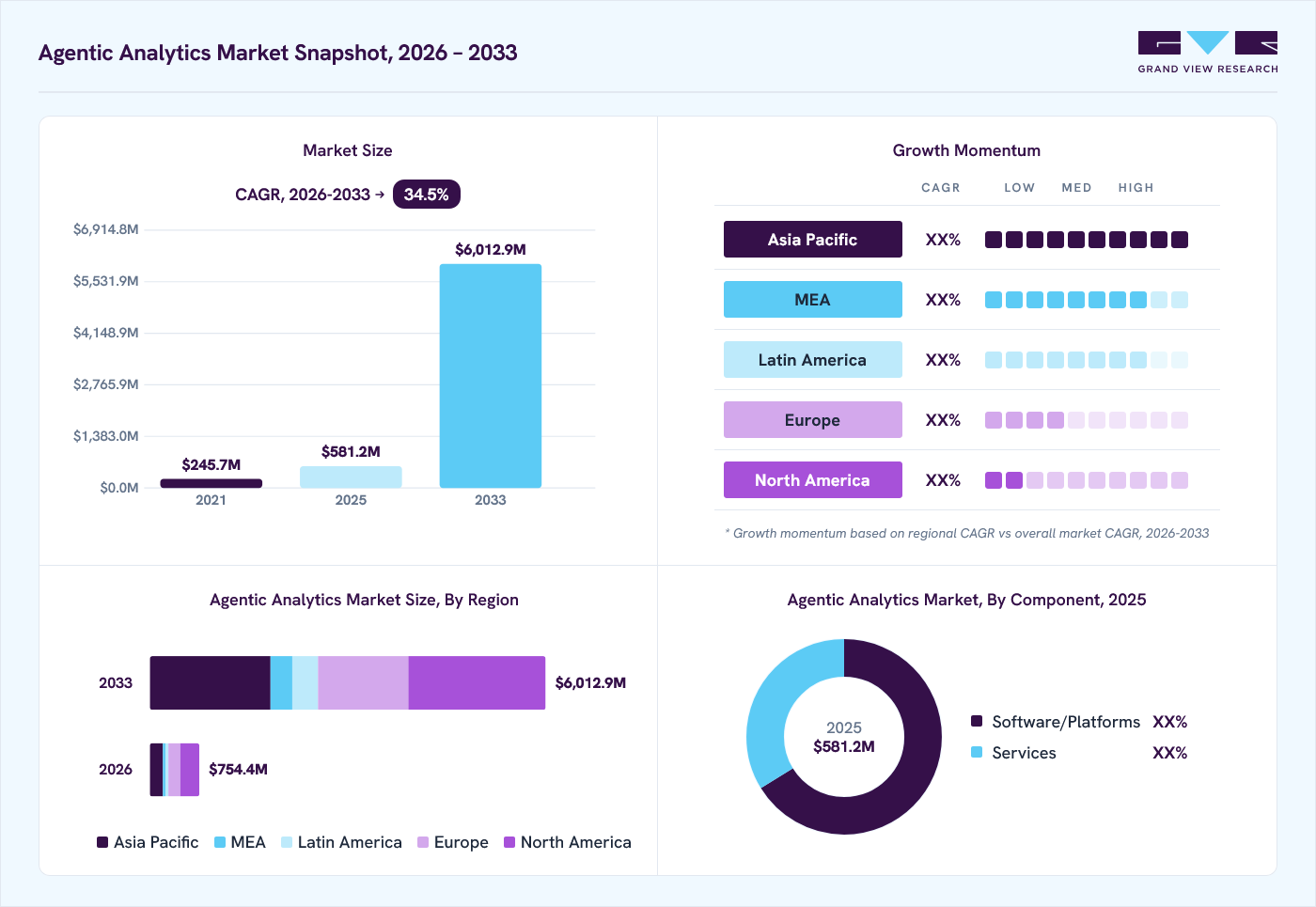 Source: Grand View Research, IR Documents, Primary Interviews, Paid DatabasesTo learn more about this report,
 Download Free Sample Report
Key Market Trends & Insights
- By component: Software/platforms segment held the largest market share of around 66.2% in 2025.
- By deployment mode: Cloud segment held the largest market revenue share in 2025.
- By organization size: Large enterprises segment led the market with the largest revenue share in 2025.
- By application: Customer and sales analytics segment held the largest market revenue share in 2025.
- By end use: BFSI segment led the market with the largest revenue share in 2025.
Regional Highlights
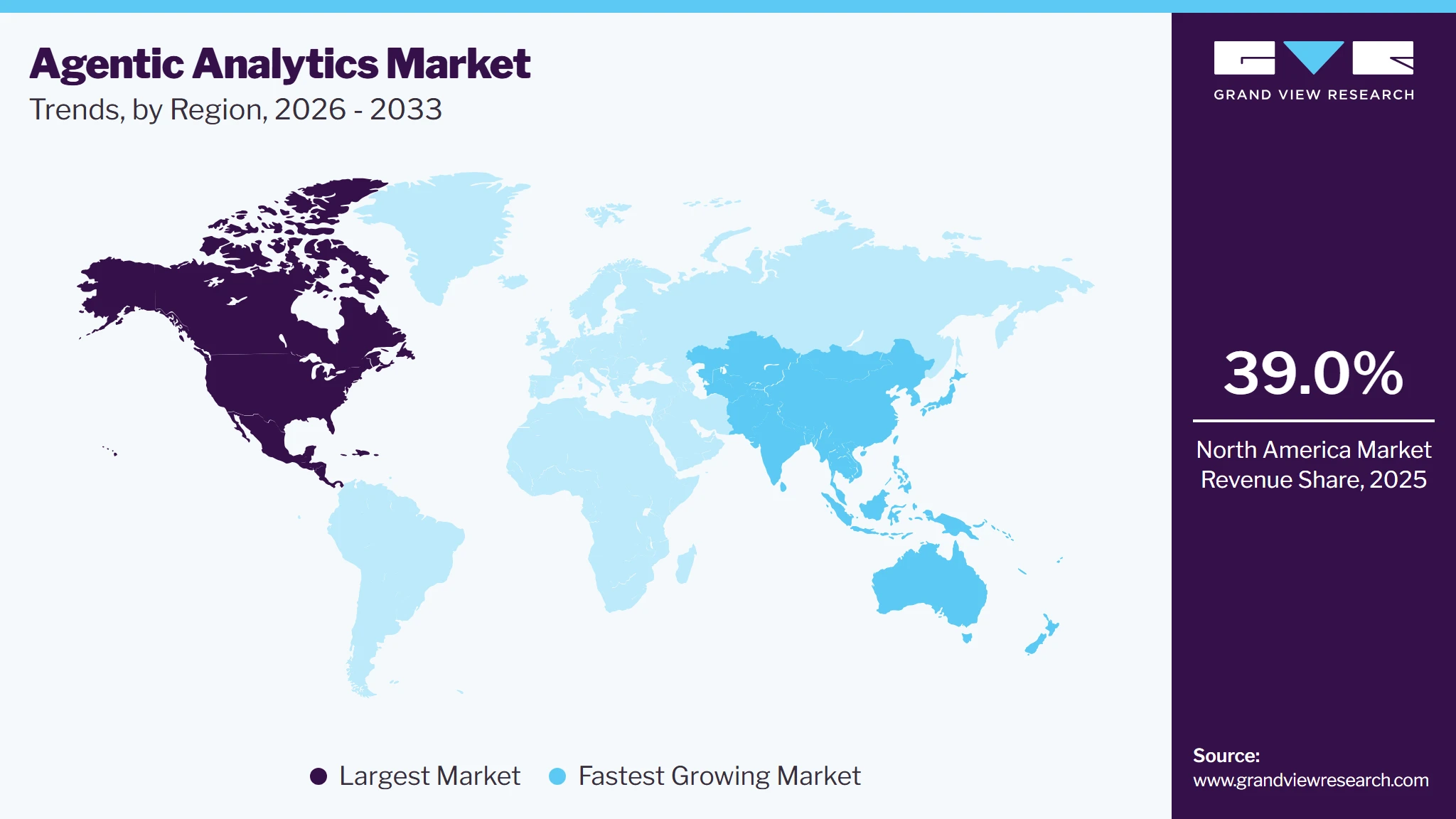
- Largest regional market: North America (39.0% revenue share, 2025)
- Fastest-growing regional market: Asia Pacific (highest CAGR, 2026-2033)
- Leading country: U.S. held the largest share in 2025
Market Size & Forecasts
- Market size in 2025: USD 581.2 Million
- Estimated market size in 2026: USD 754.4 Million
- Projected market size by 2033: USD 6,012.9 Million
- CAGR (2026-2033): 34.5%
Prism AI by Grand View Research Free to tryAsk a question about the agentic analytics marketTry asking✓Every figure cited from GVR research Prefer the report? Download free sample →
Agentic analytics solutions leverage AI agents to interpret business objectives. Unlike conventional analytics tools that primarily present historical information or respond to predefined queries, these solutions can coordinate multi-step analytical workflows and connect insights with downstream business processes. As organizations seek to improve analytical productivity, accelerate decision-making, and expand self-service analytics beyond specialized data teams, agentic analytics is gaining traction as an evolving category within the broader data and analytics ecosystem.Technological advancements in generative AI, large language models, semantic layers, real-time data processing, and enterprise workflow orchestration are shaping the market's development. Vendors are integrating agentic capabilities into existing BI platforms and enterprise applications, while specialized providers are developing solutions for automated data exploration. The convergence of analytics platforms with AI agents is also expanding the potential for natural-language interaction, continuous monitoring of business metrics, and automated execution of analytical tasks.
 To learn more about this report, Download Free Sample Report
Despite the market's growth potential, commercialization and enterprise adoption remain influenced by concerns surrounding analytical accuracy, data quality, and the cost of deploying and operating AI agents. Organizations are prioritizing measurable business outcomes and specialized, domain-specific applications over broad automation initiatives, while vendors are focusing on improving transparency, contextual understanding, human oversight, and integration with existing enterprise systems.
Market Dynamics
Enterprises are moving beyond dashboard-based reporting toward agentic analytics solutions that can independently investigate business questions, validate findings, identify underlying trends, and recommend actionable next steps with limited human intervention. These capabilities help reduce reliance on specialized analysts, accelerate analytical workflows, and shorten decision-making cycles across finance, sales, and operations. For instance, in June 2026, according to Anthropic, its internal data team automated approximately 95% of business analytics queries using Claude, achieving roughly 95% aggregate accuracy. Such developments demonstrate the potential of agentic AI to automate routine analytical tasks and strengthen the business case for integrating autonomous analytical capabilities into enterprise data platforms.
Inconsistent data definitions, fragmented data environments, and inadequate access controls remain significant barriers to the enterprise-wide deployment of agentic analytics. As AI agents independently query data, interpret metrics, and generate insights, the absence of governed semantic layers and robust security controls can result in inaccurate conclusions, inconsistent key performance indicators (KPIs), and unauthorized access to sensitive information. These challenges increase the complexity and cost of implementation, reinforce concerns regarding the reliability and accountability of autonomous analytical outputs, and encourage organizations to retain human oversight or limit deployments to pilot projects, thereby slowing broader commercial adoption.
The growing emphasis on governed semantic layers and standardized interoperability frameworks presents an opportunity for agentic analytics vendors to improve the reliability, security, and scalability of autonomous analytical workflows. Semantic layers provide consistent definitions of business metrics and relationships, while standardized interfaces enable AI agents to interact with enterprise data systems through controlled access mechanisms. For instance, in July 2026, Strategy highlighted developments showcased at Google Cloud Next '26, including Looker BI Agents grounded in a governed semantic layer and a native Model Context Protocol (MCP) server for governed data access. These developments create opportunities for vendors and service providers offering semantic modeling, data governance, agent integration, and managed agent operations. Over time, such capabilities could lower deployment barriers and support wider adoption among small and medium-sized enterprises (SMEs) and data-sensitive industries, including banking, financial services and insurance (BFSI) and healthcare.
Market Concentration & Characteristics
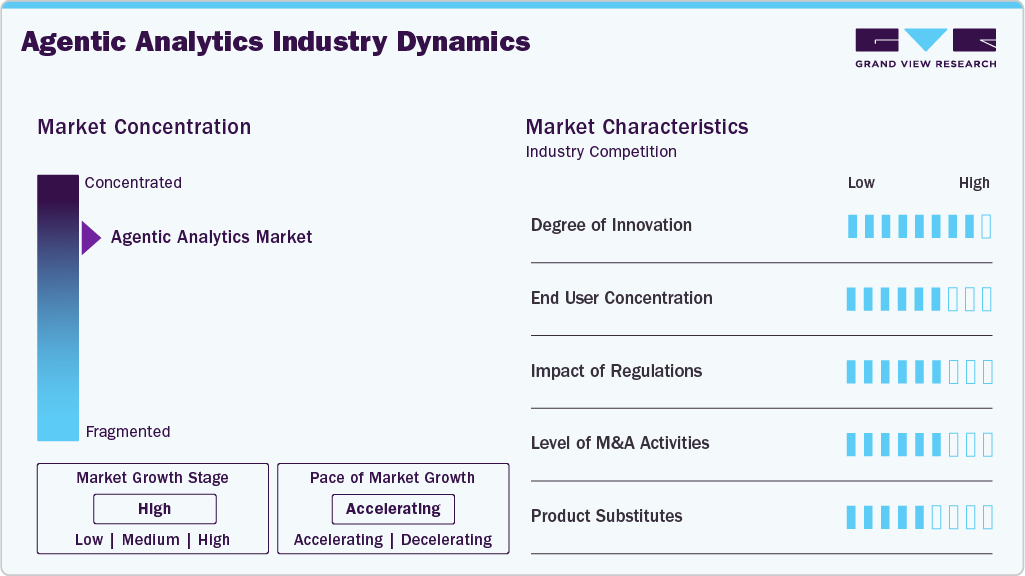
The agentic analytics market is an emerging and rapidly evolving segment within the broader analytics, business intelligence, and enterprise AI landscape. The market comprises large cloud and data platform providers, enterprise application and business intelligence vendors, and AI-native analytics specialists that offer autonomous, multi-step analytical capabilities. Competition is primarily driven by the ability to deliver reliable and explainable agent-led analysis, enforce governed access to enterprise data, integrate with existing data platforms and applications, and support auditability of autonomous decisions. Many relevant capabilities are embedded within broader analytics and data platforms rather than offered as standalone solutions, with incumbents extending their installed customer base through agent features while specialists compete through purpose-built offerings.
 To learn more about this report, Download Free Sample Report
The market is characterized by increasing emphasis on governed semantic layers, interoperability through open agent standards, guardrails and validation controls, and human oversight of autonomous actions. As organizations expand their use of cloud data platforms, unified data architectures, and AI-driven workflows, agentic analytics is becoming increasingly relevant for faster decision-making, operational efficiency, and reduced dependence on specialist analysts. However, the market remains difficult to define and quantify independently, as agentic features are frequently bundled with broader analytics, data platform, and enterprise application offerings, and the distinction between assistive copilots and truly autonomous agents is not always clear. Data quality, integration with heterogeneous and legacy data environments, inference costs, and the demonstration of measurable business value remain key considerations for solution providers and adopters.
Analyst Perspective
The global agentic analytics market is expected to evolve as enterprises prioritize autonomous, decision-ready insights over conventional dashboard-led analytics. Advancements in generative AI, AI agent orchestration, and governed semantic layers are enabling organizations to automate complex analytical workflows, improve access to business intelligence, and accelerate data-driven decision-making. However, the pace of adoption will depend on vendors' ability to ensure analytical accuracy, maintain data security, establish consistent metric definitions, and demonstrate measurable returns on investment. Over the forecast period, the market's expansion will be shaped by the transition from experimental deployments to reliable, production-scale implementations, with growing opportunities for specialized solutions across finance, operations, sales, and regulated industries.
Component Insights
The software/platforms segment accounted for the largest market share of 66.2% in 2025, reflecting enterprise preference for agent-ready analytics platforms that combine natural-language interaction, governed semantic modeling and integration with existing data estates. Growth is being driven by platform vendors embedding autonomous agents directly into their analytics and data offerings, which allows organizations to adopt agentic capabilities without building them in-house. For instance, in April 2026, Google Cloud announced Looker BI Agents at Google Cloud Next ‘26, which are grounded in the Looker semantic layer and the existing enterprise governance framework, and trigger downstream business actions rather than only providing static answers. Continued product innovation and the close coupling of agents with governed data platforms are expected to sustain the segment’s leadership over the forecast period.
The services segment is projected to register the fastest CAGR during the forecast period, as enterprises increasingly seek external expertise to design, integrate, govern, and operate agentic analytics in production. Growth is being driven by the integration complexity of connecting autonomous agents to enterprise data platforms, semantic layers and security frameworks, which is expanding demand for consulting, implementation and managed operations from system integrators and technology partners. For instance, in June 2026, Microsoft introduced Fabric agent connectors and OneLake agent memory at Microsoft Build 2026, which partner commentary framed as a billable architecture opportunity for professional and managed services providers. As deployments move from pilots to governed production use, the need for ongoing monitoring, tuning, and support is expected to sustain the segment’s faster growth through 2033.
Deployment Mode Insights
The cloud segment accounted for the largest market share in 2025, as agentic analytics is delivered primarily through cloud data platforms, managed AI model services and software-as-a-service applications, which provide the elastic compute and ready access to unified enterprise data that autonomous agents require. Growth is being driven by cloud and data platform vendors extending their lakehouse and data cloud offerings with governed, agent-ready analytics, which lets enterprises deploy agents without investing in dedicated on-premises infrastructure. For instance, in June 2026, at its Data + AI Summit, Databricks introduced Genie One, which repositions its Genie conversational analytics capability as an agentic coworker for business teams across marketing, finance, sales and operations, built natively on the lakehouse and governed by Unity Catalog. The scalability, rapid release cycles and consumption-based pricing of cloud platforms are expected to sustain the segment’s leadership over the forecast period.
The on-premises segment is projected to register a significant CAGR during the forecast period given that organizations in regulated and security-sensitive sectors seek to run autonomous analytics within their own infrastructure, with full control over data, models and audit trails. Growth is being driven by data sovereignty and residency requirements, which are pushing banks, government bodies and critical infrastructure operators toward private and air-gapped deployments of agentic capabilities, supported by the growing availability of capable models that run on local infrastructure. For instance, in September 2026, Airrived launched a sovereign AI platform that lets governments and enterprises build, deploy and run agentic AI entirely within their own walls, covering models, agents, data and GPU infrastructure, across on-premises, private and fully air-gapped environments. As vendors extend agentic offerings to self-hosted and sovereign configurations, demand from regulated industries is expected to sustain the segment’s strong growth, even as cloud retains the larger share.
Organization Size Insights
The large enterprises segment accounted for the largest market share in 2025, largely attributed to organizations having the mature data estates, governance frameworks, and technology budgets needed to deploy autonomous analytics across multiple business functions. Growth is being driven by large enterprises moving from isolated pilots to production-scale deployments, supported by technology and services alliances that help them integrate agents with complex, multi-source data environments. For instance, in March 2026, Accenture and Databricks launched the Accenture Databricks Business Group to help enterprises move AI from pilot to production using unified data infrastructure. Large enterprises are expected to retain the largest share over the forecast period, although SMEs are gaining ground through embedded and lower-cost agentic offerings.
The Small and Medium Enterprises (SMEs) segment is projected to register the fastest CAGR during the forecast period, as smaller organizations gain access to agentic analytics without dedicated data science teams or large infrastructure investments. Growth is being driven by SME-focused analytics and business application vendors embedding no-code, natural-language agents into affordable subscription platforms, which lowers the cost and skill barriers to adoption. For instance, in September 2025, Zoho rolled out new agentic AI capabilities in Ask Zia within Zoho Analytics, through which an LLM-powered agent helps data engineers, analysts, and business users build data pipelines, reports, and dashboards and receive diagnostic and prescriptive recommendations through natural language prompts, with an MCP server in beta for building custom agents. As such offerings spread across SME-focused platforms and cloud marketplaces, SMEs are expected to be the fastest-growing user group through 2033, albeit from a smaller base than large enterprises.
Application Insights
The customer and sales analytics segment accounted for the largest market share in 2025. The growth is due to organizations prioritizing use cases with a direct link to revenue, supported by rich, well-structured data in CRM, customer data platform and commerce systems. Growth is being driven by the shift from static customer dashboards to agents that investigate churn, pipeline and customer lifetime value, and recommend or trigger next actions, which is encouraging data platform and CRM vendors to build agentic analytics directly into customer data environments. For instance, in June 2026, at its Data + AI Summit, Databricks launched CustomerLake, an agentic customer data platform built natively on the lakehouse and governed by Unity Catalog. The fast, measurable returns from improved retention, conversion and pricing decisions are expected to keep the segment in the leading position over the forecast period, although finance, supply chain and IT operations use cases are expected to gain share.
The HR and workforce analytics segment is projected to register the fastest CAGR during the forecast period, from a smaller base than the other application segments. Organizations are under pressure to plan skills, headcount and compensation more dynamically as AI reshapes job structures, which is raising demand for agents that continuously analyze workforce data and surface recommendations. Growth is being driven by human capital management vendors embedding autonomous agents into their suites, supported by unified people data and governed skills information. For instance, in April 2026, SAP introduced agentic AI capabilities in its SuccessFactors 1H 2026 release, embedding autonomous agents across core human capital management modules, linking recruiting, payroll, workforce administration and talent development in a unified data flow, and adding People Intelligence pay-transparency analytics with stronger skills governance. As these capabilities extend from administrative support to workforce planning and talent decisions, the segment is expected to record the fastest growth through 2033.
End Use Insights
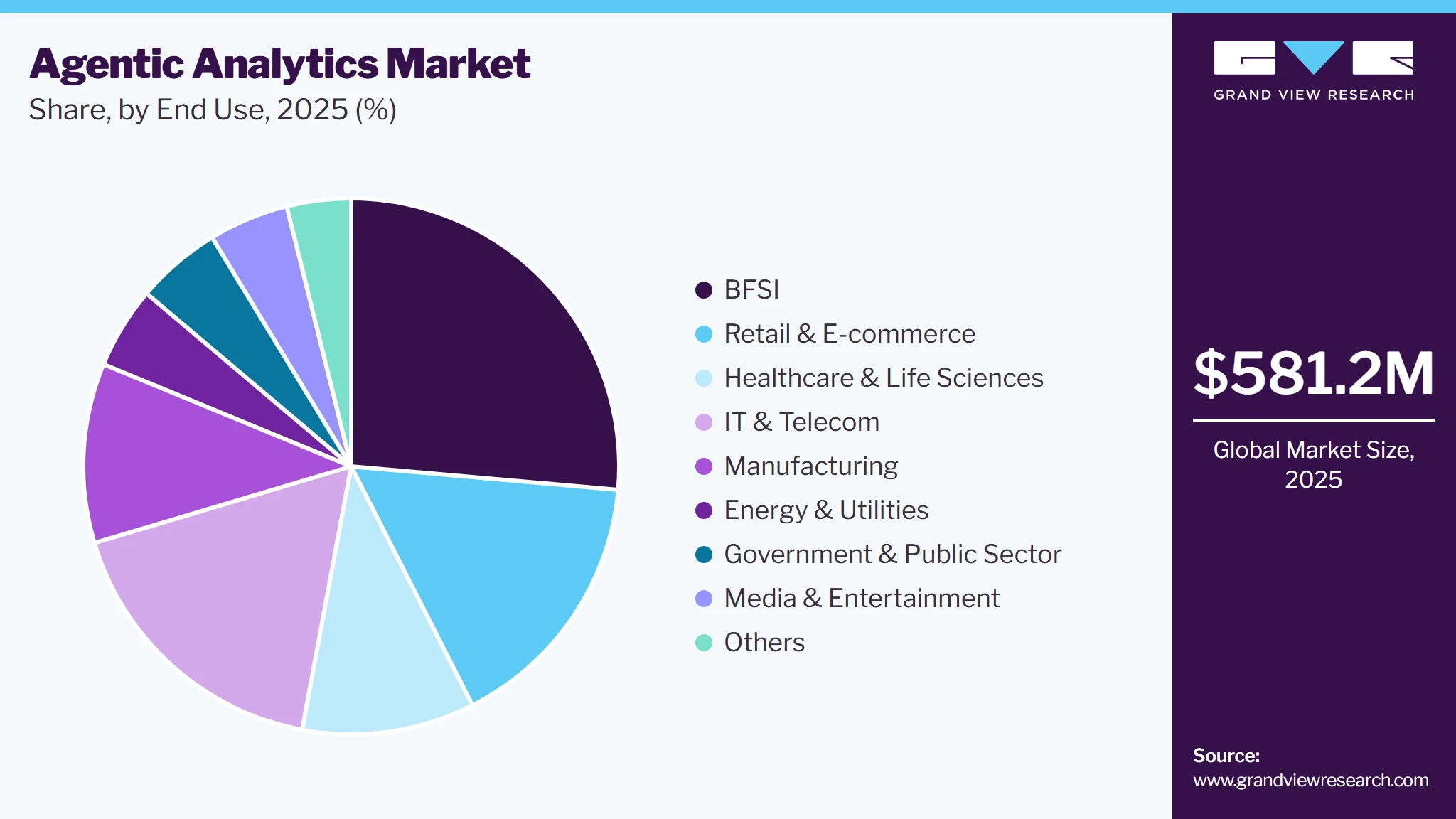
The BFSI segment accounted for the largest market share in 2025, owing to the sector’s mature data estates, strict regulatory reporting obligations, and the high value of faster, better-informed decisions in fraud, credit risk, compliance, and customer engagement. Growth is being driven by banks and insurers moving from experimental pilots to production deployments of autonomous analytics, with technology and payments providers packaging agentic capabilities for financial institutions. For instance, in September 2026, Mastercard and Backbase announced a strategic collaboration to bring agentic banking solutions to more than 120 global banks, integrating Mastercard’s analytics, personalization and cybersecurity capabilities directly into Backbase’s AI-native Banking Operating System. Rising fraud pressure, tightening regulation and demand for explainable, real-time decisions are expected to keep BFSI the leading end use over the forecast period, although healthcare and life sciences and manufacturing are expected to gain share.
 To learn more about this report, Download Free Sample Report
The healthcare and life sciences segment is projected to register the fastest CAGR during the forecast period, supported by growing data volumes from clinical trials, real-world evidence, and healthcare operations, along with the need to accelerate research, commercial, and operational decisions. Growth is being driven by life sciences and healthcare technology providers packaging domain-specific agents that connect proprietary data with regulated workflows, which lowers the barrier for providers and pharmaceutical companies to adopt agentic analytics. For instance, in March 2026, IQVIA launched IQVIA.ai, a unified agentic AI platform built with Nvidia to orchestrate tasks across clinical, commercial and real-world domains, with 19 of the top 20 pharmaceutical companies having begun integrating its agents at launch. As adoption extends from large pharmaceutical companies to providers, payers and research organizations, and as agents become embedded in clinical, regulatory and commercial workflows, the segment is expected to record the fastest growth.
Regional Insights
The North America agentic analytics market contributed the largest revenue share of 39.0% in 2025 towards the global industry. The growth is being shaped by the shift from conversational dashboards to agents that investigate business questions, validate findings, and trigger follow-up actions within defined governance boundaries. Enterprises and platform vendors are adopting governed semantic layers as the foundation for consistent, trusted agent responses, while open interoperability standards such as the Model Context Protocol are enabling agents to access governed data across platforms and applications. Cloud and data platform providers are embedding agentic capabilities directly into their lakehouse and data cloud environments, so a large share of revenue is generated through embedded features and consumption-based pricing rather than standalone products. Adoption is led by large U.S. enterprises in BFSI, technology, retail and healthcare, with customer and sales analytics, financial and risk analytics, and IT operations as the most active use cases.
 To learn more about this report, Download Free Sample Report
U.S. Agentic Analytics Market Trends
The agentic analytics market in the U.S. is experiencing robust growth due to the rapid adoption of generative AI, increasing enterprise demand for autonomous data analysis, and the strong presence of leading AI and analytics technology providers. Organizations are increasingly deploying AI agents to automate data exploration, identify business trends, generate actionable insights, and accelerate decision-making across finance, sales, marketing, and operations. In addition, investments in cloud-based analytics infrastructure, enterprise AI platforms, and governed data environments are supporting the integration of agentic capabilities into existing business intelligence solutions. However, concerns surrounding data security, analytical accuracy, governance, and implementation costs continue to influence enterprise deployment strategies. As vendors strengthen agent reliability and interoperability, the U.S. market is positioned to benefit from expanding enterprise adoption and the transition from experimental AI initiatives to production-scale agentic analytics applications.
Asia Pacific Agentic Analytics Market Trends
The agentic analytics market in the Asia Pacific is gaining momentum as enterprises accelerate digital transformation initiatives, expand investments in artificial intelligence, and seek more autonomous approaches to data-driven decision-making. The region's expanding cloud infrastructure, growing availability of enterprise AI platforms, and increasing adoption of generative AI are supporting the integration of agentic capabilities into existing analytics environments. In addition, government-led AI initiatives and investments in digital infrastructure are creating favorable conditions for market development. However, fragmented data environments, shortages of specialized AI talent, data sovereignty requirements, and concerns regarding governance and reliability may constrain adoption in certain markets. As enterprises strengthen their data foundations and prioritize scalable AI deployments, the region is expected to present significant opportunities for agentic analytics vendors.
TheChina agentic analytics marketis witnessing steady growth due to increasing enterprise investments in artificial intelligence, the rapid development of domestic large language models, and rising demand for automated business intelligence solutions. In addition, China's expanding digital economy, strong domestic AI ecosystem, and government initiatives promoting AI innovation and industrial digitalization are supporting the development of agentic analytics capabilities. However, regulatory requirements governing data security, cross-border data transfers, and generative AI services, along with concerns regarding analytical accuracy and enterprise data governance, may influence implementation strategies. As domestic technology providers continue to integrate AI agents into enterprise software and data platforms, the market is expected to benefit from broader adoption of autonomous analytical workflows and increasing demand for industry-specific AI solutions.
Theagentic analytics market in Indiais at an emerging stage due to the gradual adoption of autonomous AI technologies, increasing enterprise investments in digital transformation, and growing demand for faster, data-driven decision-making. Organizations are exploring AI agents to automate analytical workflows, improve operational efficiency, and generate actionable insights from large datasets. The country's expanding cloud infrastructure, growing generative AI ecosystem, availability of technology talent, and increasing focus on enterprise AI adoption are creating favorable conditions for market development. However, limited data standardization, integration challenges across legacy systems, concerns regarding data privacy and AI reliability, and the need for clear governance frameworks continue to influence large-scale deployment. As businesses move from experimental AI projects toward practical enterprise applications, the market is expected to benefit from growing investments in AI-enabled business intelligence, automated analytics, and industry-specific agentic solutions.
Europe Agentic Analytics Market Trends
The Agentic Analytics Market in Europe is gaining traction as enterprises adopt advanced analytics and AI-driven automation to improve operational efficiency, enhance business intelligence, and accelerate decision-making. The region's established enterprise software ecosystem, expanding cloud adoption, and growing investments in generative AI are supporting the integration of autonomous analytical capabilities into existing data platforms. However, stringent data protection requirements, particularly under the General Data Protection Regulation (GDPR), alongside the EU AI Act's applicable risk-based obligations, concerns about data governance, and the need for transparent and accountable AI systems, are shaping implementation strategies. As enterprises prioritize secure, compliant, and reliable AI deployments, demand is expected to grow for agentic analytics solutions that combine autonomous capabilities with robust governance, human oversight, and integration with existing enterprise systems.
Key Agentic Analytics Company Insights
Key players operating in the Agentic Analytics Market include Amazon Web Services, Databricks, Google, Microsoft, and Oracle, among others.
-
Databricks is expanding its presence in the Agentic Analytics Market by combining its data intelligence platform, AI-powered business intelligence capabilities, and governed data environment to facilitate autonomous analysis. Its AI/BI portfolio, including Genie Agents, enables business users to interact with enterprise data using natural language, explore complex business questions, and generate insights without relying extensively on data specialists.
-
Google is advancing its position in the market by integrating Gemini-powered capabilities with Google Cloud's data analytics and business intelligence offerings. Through Looker, BigQuery, and its broader Agentic Data Cloud strategy, the company is developing solutions that enable users to investigate business data, generate insights through natural-language interactions, and initiate actions within enterprise workflows.
-
Amazon Web Services is strengthening its position in the agentic AI analytics industry by integrating autonomous analytical capabilities into its cloud-based data and business intelligence ecosystem. Through Amazon Quick, Amazon Bedrock AgentCore, Amazon Athena, and Amazon SageMaker, the company enables enterprises to develop AI agents that query structured and unstructured data, generate insights, and automate analytical workflows.
Key Agentic Analytics Companies
The following key companies have been profiled for this study on the agentic analytics market.
-
Amazon Web Services
-
Databricks
-
Google
-
Microsoft
-
Oracle
-
Qlik
-
Salesforce
-
SAP SE
-
Sigma
-
Snowflake
-
Tellius
-
ThoughtSpot
Competitive Benchmarking
Operating Strategies
Competitive Edge
Weaknesses
Mature Players: Amazon Web Services; Google; Microsoft; Oracle; Salesforce; SAP SE; Snowflake
- Integrating agentic analytics capabilities into established cloud data platforms, business intelligence solutions, enterprise applications, and AI ecosystems to enable autonomous data exploration, insight generation, and decision support.
- Strengthening AI agent orchestration, natural-language querying, semantic modeling, and governed data access to improve analytical accuracy and support multi-step workflows across enterprise data environments.
- Expanding partnerships, enterprise integrations, and industry-specific AI capabilities to accelerate adoption while leveraging existing customer relationships and cloud infrastructure.
- Established enterprise customer bases, extensive cloud infrastructure, and broad software ecosystems facilitate the integration of agentic analytics into existing business intelligence and data management environments.
- Access to large-scale data platforms, foundation models, enterprise applications, and governance capabilities supports the development of integrated solutions that connect analytical insights with business workflows.
- Strong research and development capabilities, established distribution channels, and financial resources support continuous product development, enterprise deployment, and global market expansion.
- Agentic analytics capabilities are frequently bundled with broader cloud, AI, and business intelligence offerings, making standalone market positioning and revenue attribution challenging.
- Dependence on enterprise data quality, semantic consistency, integration readiness, and governance frameworks can limit the reliability and scalability of autonomous analytical workflows.
- Competition from specialized agentic analytics providers and other established platforms may intensify pricing pressure and increase the need for continuous innovation, differentiation, and demonstrable returns on investment.
Emerging Players: Databricks; Qlik; Sigma; Tellius; ThoughtSpot
- Developing AI-native and agent-assisted analytics capabilities that automate natural-language data exploration, multi-step analysis, insight generation, and business question resolution.
- Strengthening semantic layers, contextual understanding, AI agent orchestration, and integration with enterprise data warehouses and cloud platforms to improve the reliability and relevance of analytical outputs.
- Expanding partnerships, application integrations, and domain-specific analytics capabilities to differentiate offerings and increase adoption among enterprises seeking alternatives to conventional dashboard-led business intelligence.
- Focused expertise in analytics, data intelligence, and AI-powered business intelligence supports the development of specialized solutions for autonomous analysis and decision support.
- Flexible integration with existing data warehouses, cloud platforms, and enterprise applications enables organizations to introduce agentic capabilities without necessarily replacing their established data infrastructure.
- Product specialization and emphasis on natural-language interaction, contextual analytics, and streamlined workflows can improve accessibility for business users and reduce dependence on specialist analysts.
- Smaller scale or narrower product ecosystems, relative to some established technology providers, may constrain access to enterprise customers, distribution channels, and resources for large-scale deployment.
- Dependence on third-party cloud infrastructure, foundation models, and enterprise data environments can introduce integration challenges and limit control over the end-to-end analytical experience.
- Establishing trust in autonomous analytical outputs, demonstrating consistent business value, and differentiating agentic capabilities from increasingly advanced features offered by established BI vendors remain key challenges.
Recent Developments
-
In June 2026, Databricks introduced Genie One, an agentic AI coworker designed to help business teams automate and coordinate work across structured and unstructured data, supported by Genie Agents and a unified business context layer.
-
In April 2026, AWS demonstrated an agentic analytics architecture combining Amazon Quick, Amazon Athena, Amazon SageMaker, and knowledge bases to support natural-language data exploration while maintaining enterprise security and governance. These capabilities position AWS to address demand for scalable, cloud-native agentic analytics solutions across industries.
-
In April 2026, Google Cloud announced Looker BI Agents, including dashboard and conversational agents grounded in Looker's governed semantic layer, alongside developments in Model Context Protocol (MCP) support to facilitate secure connections between AI agents and enterprise data.
Agentic Analytics Market Report Scope
Report Attribute
Details
Market size in 2025
USD 581.2 million
Estimated market size in 2026
USD 754.4 million
Projected market size by 2033
USD 6,012.9 million
Growth rate
CAGR of 34.5% from 2026 to 2033
Actual data
2021 - 2025
Forecast period
2026 - 2033
Quantitative units
Revenue in USD million and CAGR from 2026 to 2033
Report coverage
Revenue forecast, company share, competitive landscape, growth factors, and trends
Segments covered
Component, deployment mode, organization size, application, end use, region
Regional scope
North America; Europe; Asia Pacific; Latin America; Middle East and Africa
Country scope
U.S.; Canada; Mexico; UK; Germany; France; China; Japan; India; South Korea; Australia; Brazil; UAE; KSA; South Africa
Key companies profiled
Amazon Web Services; Databricks; Google; Microsoft; Oracle; Qlik; Salesforce; SAP SE; Sigma; Snowflake; Tellius; ThoughtSpot
Customization scope
Free report customization (equivalent to up to 8 analyst working days) with purchase. Addition or alteration to country, regional & segment scope.
Pricing and purchase options
Avail customized purchase options to meet your exact research needs. Explore purchase options
Global Agentic Analytics Market Report Segmentation
This report forecasts revenue growth at global, regional, and country levels and provides an analysis of the latest industry trends in each of the sub-segments from 2021 to 2033. For this study, Grand View Research has segmented the global agentic analytics market report based on component, deployment mode, organization size, application, end use, and region:
-
Component Outlook (Revenue, USD Million, 2021 - 2033)
-
Software/Platforms
-
Standalone Agentic Analytics Platforms
-
Embedded Agentic Capabilities
-
-
Services
-
Professional Services
-
Managed Services
-
-
-
Deployment Mode Outlook (Revenue, USD Million, 2021 - 2033)
-
Cloud
-
On-Premises
-
-
Organization Size Outlook (Revenue, USD Million, 2021 - 2033)
-
Large Enterprises
-
Small and Medium Enterprises (SMEs)
-
-
Application Outlook (Revenue, USD Million, 2021 - 2033)
-
Customer & Sales Analytics
-
Marketing Optimization
-
Financial & Risk Analytics
-
Supply Chain & Operations
-
Fraud Detection & Security Analytics
-
HR & Workforce Analytics
-
IT Operations
-
Others
-
-
End Use Outlook (Revenue, USD Million, 2021 - 2033)
-
BFSI
-
Retail & E-commerce
-
Healthcare & Life Sciences
-
IT & Telecom
-
Manufacturing
-
Energy & Utilities
-
Government & Public Sector
-
Media & Entertainment
-
Others
-
-
Regional Outlook (Revenue, USD Million, 2021 - 2033)
-
North America
-
U.S.
-
Canada
-
Mexico
-
-
Europe
-
UK
-
Germany
-
France
-
-
Asia Pacific
-
China
-
Japan
-
India
-
South Korea
-
Australia
-
-
Latin America
-
Brazil
-
-
Middle East and Africa
-
UAE
-
KSA
-
South Africa
-
-
Research Methodology
The agentic analytics marketfigures in this report are based on a proven research process that combines executive interviews with secondary research from proprietary databases, company filings, and recognized regulatory and institutional sources. Market size is built through value-chain sizing-reconciling supply-side and demand-side estimates-and triangulated with bottom-up and top-down approaches. Every estimate passes multiple levels of expert validation before publication, with eachagentic analyticssegment quantified using the revenue-capture definitions in the table below.
Segment Definition
Component
Revenue Capture Definition
Software/Platforms
Revenue generated from software licenses, subscriptions, credits and consumption-based fees for platforms and applications in which autonomous AI agents plan, execute and iterate multi-step analytical tasks, including data querying, analysis, insight generation and recommended or triggered actions.
Services
Revenue generated from professional and managed services that support the design, implementation, integration, governance, operation and optimization of agentic analytics solutions.
Deployment Mode
Revenue Capture Definition
Cloud
Revenue generated from agentic analytics solutions delivered through public, private or hybrid cloud infrastructure, including SaaS applications, cloud data platform-based agents and cloud-hosted managed analytics services.
On-Premises
Revenue generated from agentic analytics solutions deployed and hosted on an organization’s own servers, data centers or air-gapped environments, including self-hosted model inference to meet data sovereignty and regulatory requirements.
Organization Size
Revenue Capture Definition
Large Enterprises
Revenue generated from agentic analytics solutions and services purchased or subscribed to by large organizations to support enterprise-wide, multi-function analytics across complex and distributed data environments.
Small and Medium Enterprises (SMEs)
Revenue generated from agentic analytics solutions and services purchased or subscribed to by small and medium-sized organizations, typically through embedded features and cloud subscriptions, to enable cost-effective, self-service analysis without dedicated data science resources.
Application
Revenue Capture Definition
Customer and Sales Analytics
Revenue generated from agentic analytics used to analyze customer behavior, churn, lifetime value, pipeline, sales performance, and revenue data, and to recommend or trigger follow-up actions.
Marketing Optimization
Revenue generated from agentic analytics used to analyze campaign performance, attribution, audience segmentation, pricing and promotion effectiveness, and to optimize marketing spend and engagement.
Financial and Risk Analytics
Revenue generated from agentic analytics used for financial planning and analysis, variance investigation, forecasting, credit and market risk assessment, and compliance reporting.
Supply Chain and Operations
Revenue generated from agentic analytics used for demand forecasting, inventory and logistics optimization, production and quality analysis, and operational planning and exception management.
Fraud Detection and Security Analytics
Revenue generated from agentic analytics used to detect anomalies, investigate fraud and security events, and prioritize risks. Fraud and security platform license revenue is excluded.
HR and Workforce Analytics
Revenue generated from agentic analytics used for workforce planning, attrition and engagement analysis, skills and talent analytics, and compensation insights.
IT Operations
Revenue generated from agentic analytics used for observability, root-cause analysis, performance and capacity monitoring, incident investigation, and automated remediation recommendations in IT environments.
Others
Revenue generated from agentic analytics used for other applications, including healthcare operations, public-sector decision support, sustainability and energy analytics, legal and procurement analytics, and strategic planning.
End Use
Revenue Capture Definition
BFSI
Revenue generated from agentic analytics solutions and services used by banks, insurers, capital markets firms and other financial institutions for risk, fraud, compliance, customer and financial analytics.
Retail and E-commerce
Revenue generated from agentic analytics solutions and services used by retailers and e-commerce companies for demand forecasting, pricing, merchandising, customer and supply chain analytics.
Healthcare and Life Sciences
Revenue generated from agentic analytics solutions and services used by providers, payers, pharmaceutical, biotechnology, and medical device companies for clinical, operational, commercial, and real-world data analytics.
IT and Telecom
Revenue generated from agentic analytics solutions and services used by technology, software and telecommunications companies for network, product, customer and IT operations analytics.
Manufacturing
Revenue generated from agentic analytics solutions and services used by industrial and discrete and process manufacturers for production, quality, maintenance and supply chain analytics.
Energy and Utilities
Revenue generated from agentic analytics solutions and services used by oil and gas, power and utility companies for asset performance, grid and network, demand and operational analytics.
Government and Public Sector
Revenue generated from agentic analytics solutions and services used by government agencies, defense and public institutions for policy, citizen services, security and operational decision support.
Media and Entertainment
Revenue generated from agentic analytics solutions and services used by media, gaming and entertainment companies for audience, content performance and advertising analytics.
Others
Revenue generated from agentic analytics solutions and services used by other industries, including education, transportation and logistics, agriculture, real estate and professional services.
Estimation Model
Layer
Key Questions
Description
Agentic Analytics Infrastructure Layer (TAM)
Who might require agentic analytics solutions?
Organizations, enterprises, and technology providers that generate, manage, or analyze large volumes of data and could benefit from AI-driven analytical capabilities, including cloud service providers, data platform operators, business intelligence vendors, and enterprises with established data infrastructure.
Agentic Analytics Addressable Market Layer (SAM)
Who can technically and commercially adopt agentic analytics solutions?
Organizations with accessible and sufficiently reliable data, compatible analytics infrastructure, and business requirements suited to autonomous or semi-autonomous analytical workflows. These organizations can adopt agentic analytics through standalone solutions or agentic capabilities integrated into existing business intelligence, cloud data, and enterprise software platforms.
Active Agentic Analytics Adoption Layer (SOM)
Who actively uses or purchases relevant solutions today?
Organizations purchasing or deploying agentic analytics software and services to automate data exploration, investigate business questions, identify patterns and anomalies, generate actionable insights, and support decision-making. Adoption includes production deployments and paid implementations, while pilots and experimental projects should be distinguished from commercially active deployments.
Revenue Realization Layer
How is revenue generated?
Revenue attributable to agentic analytics software subscriptions, standalone agentic analytics platforms, usage-based fees, premium agentic features embedded in existing analytics products, and related implementation, integration, customization, and support services, where included in the market scope. Revenue from conventional BI, general-purpose AI models, and unrelated cloud infrastructure should be excluded unless specifically attributable to agentic analytics.
Delivered Customizations
This report has been delivered with the following in-depth customizations
Client Request
Customization Delivered
Value Adds
Agentic Analytics Market Strategy and Enterprise Adoption Assessment
Assessment of global demand for agentic analytics solutions that automate data exploration, investigate business questions, identify patterns, validate findings, and generate decision-ready insights with limited human intervention.
Evaluation of enterprise adoption across industries, including BFSI, healthcare, manufacturing, retail, IT and telecommunications, with consideration of data infrastructure readiness, AI investments, and analytical requirements.
Developed a market assessment framework focused on autonomous analytical workflows, agent-led decision support, and the transition from conventional business intelligence to agentic analytics.
Identified growth opportunities based on enterprise AI adoption, increasing demand for self-service analytics, automation of analytical tasks, and the integration of agentic capabilities into existing data platforms.
Agentic Analytics Technology and Vendor Benchmarking
Comparative assessment of Amazon Web Services, Databricks, Google, Microsoft, Oracle, Qlik, Salesforce, SAP SE, Sigma, Snowflake, Tellius, and ThoughtSpot, considering agentic analytics capabilities, natural-language interfaces, autonomous workflow execution, semantic modeling, and enterprise integrations.
Evaluation of standalone agentic analytics solutions versus capabilities embedded within business intelligence platforms, cloud data environments, and enterprise software ecosystems.
Delivered a structured vendor benchmarking framework to assess product maturity, functionality, differentiation, integration capabilities, and enterprise applicability across established and specialized providers.
Identified competitive positioning based on autonomous analytical capabilities, governed data access, multi-step reasoning, platform integration, commercialization, and the extent to which agentic features are independently monetized or bundled with broader offerings.
Agentic Analytics Use-Case, Technology, and Adoption Assessment
Assessment of key use cases, including automated data exploration, anomaly detection, root-cause analysis, predictive insights, business performance monitoring, and analytical recommendations across enterprise functions.
Evaluation of enabling technologies and deployment requirements, including generative AI, AI agent orchestration, large language models, semantic layers, data integration, access controls, governance, and human oversight.
Provided recommendations for identifying high-potential adoption areas based on analytical complexity, data readiness, automation potential, business value, and enterprise governance requirements.
Identified adoption opportunities across data-intensive industries and organizations seeking to improve analytical productivity, accelerate decision-making, and transition from experimental AI initiatives to reliable, production-scale agentic analytics deployments.
Frequently Asked Questions About This Report
The global agentic analytics market size was estimated at USD 581.2 million in 2025 and is expected to reach USD 754.4 million in 2026.
The global agentic analytics market is expected to grow at a compound annual growth rate of 34.5% from 2026 to 2033 to reach USD 6,012.9 million by 2033.
Asia Pacific is the fastest-growing region over the forecast period.
North America dominated with 39.0% revenue share in 2025.
Key factors include enterprises transition from traditional business intelligence (BI) and dashboard-based reporting toward autonomous, insight-driven decision-making.
Key players operating in the agentic analytics market include Amazon Web Services; Databricks; Google; Microsoft; Oracle; Qlik; Salesforce; SAP SE; Sigma; Snowflake; Tellius; ThoughtSpot; and Others.
The software/platforms segment held the largest share (over 66.2%) in 2025, while services segment is the fastest-growing segment.
The customer and sales analytics segment held the largest share (over 20.6%) in 2025, while HR and workforce analytics segment is the fastest-growing segment.
The BFSI segment held the largest share (over 26.4%) in 2025, while healthcare and life sciences segment is the fastest-growing segment.
About the Author(s)
IT Services & Applications Research Team
Technology · IT Services & ApplicationsThis report was authored by the it services & applications research team at Grand View Research - comprising two research analysts, one senior research analyst, and one industry expert - with specialized expertise in the it services & applications segment of the technology industry. All findings are based on proprietary technology databases, executive interviews, and regulatory analysis, subject to internal peer review prior to publication.
Last Updated:
Speak to Analyst

Customize this report to your needs - add regions, segments, or data points, with 20% free customization.
Or view our licence options:


ISO 9001:2015 & 27001:2022 Certified
We are GDPR and CCPA compliant! Your transaction & personal information is safe and secure. For more details, please read our privacy policy.


