
- Home
- »
- Agrochemicals
- »
-
Agricultural Microbials Market Size, Share Report, 2026-2033GVR Report cover

Agricultural Microbials Market (2026 - 2033) Size, Share & Trends Analysis Report By Product (Bacteria, Fungi, Protozoa, Virus), By Formulation (Liquid, Dry), By Application (Foliar, Soil, Seed), By Crop Type (Cereals & Grains, Oilseeds & Pulses, Fruits & Vegetables), By Region, And Segment Forecasts
Market Size, 2025
$8.5BMarket Estimate, 2026
$9.6BMarket Forecast, 2033
$23.5BCAGR, 2026–2033
13.7%Agricultural Microbials Market Summary
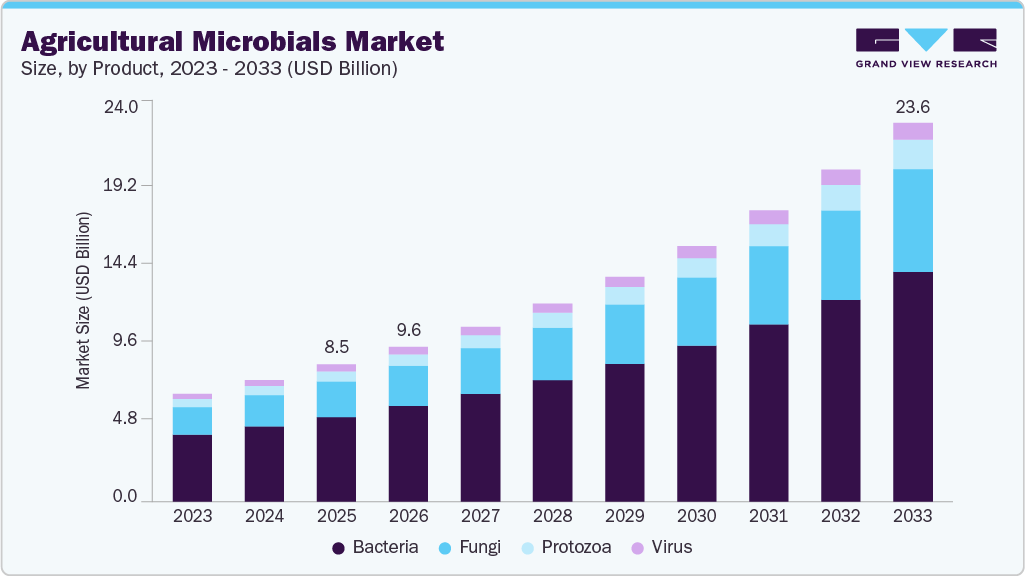
The global agricultural microbials market size was valued at USD 8.5 billion in 2025 and is projected to grow from USD 9.6 billion in 2026 to USD 23.5 billion by 2033, at a CAGR of 13.7% from 2026 to 2033. The market in North America dominated with a revenue share of 33.5% in 2025.The market is expanding as farming systems increasingly rely on biological inputs to sustain productivity under rising environmental pressure.
 Source: Grand View Research, IR Documents, Primary Interviews, Paid DatabasesTo learn more about this report,
 Download Free Sample Report
 Key Market Trends & Insights
- By product: Bacteria segment accounted for the largest share of 62.0% in 2025.
- By formulation: Liquid segment held the largest market share of 65.6% in 2025.
- By application: Foliar segment dominated the market with market share of 44.6% in 2025.
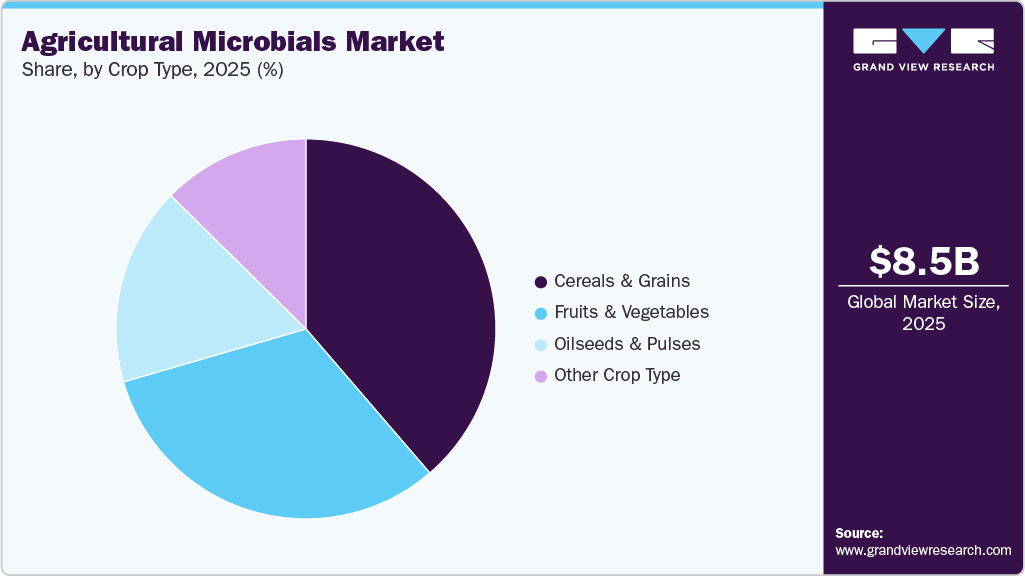
- By crop type: Cereals and grains segment held the largest market share of 38.7% in 2025.
Regional Highlights
- Largest regional market: North America (33.5% revenue share, 2025)
- Fastest-growing regional market: Asia Pacific (highest CAGR, 2026-2033)
- By country: The U.S. held the largest market share in 2025.
Market Size & Forecast
- Market size in 2025: USD 8.5 billion
- Estimated market size in 2026: USD 9.6 billion
- Projected market size by 2033: USD 23.5 billion
- CAGR (2026-2033): 13.7%
Three ways to get this report
Buy it, customize it, or ask a question.Ask an Analyst
A direct answer, usually in 1 working day
- AccessReport author, directly
- Reply timeWithin 1 working day
- No sales callDirect answer only
- FormatEmail reply
- CostFree, no cost
Get the Full Report
What the study covers
- FormatsPDF · Excel · Dashboard
- Timeline2026–2033 annual, 2025 base
- Coverage20+ countries, 5 regions
- Companies10+ key players profiled
Customize the Report
20% free customization
- IncludeCountries, segments, points
- TailorTo your product definition
- ExtendDeeper competitor detail
- OrA fully bespoke study
- Turnaround5–10 working days
Microbial solutions address soil degradation, resistance to chemicals, and yield instability, positioning them as essential tools for long term agricultural resilience. Growing demand for higher crop output from limited arable land is reshaping how growers manage soil and plant health. Agricultural microbials improve nutrient availability, root development, and stress tolerance by working within natural biological cycles rather than replacing them. This functional advantage allows farmers to maintain yields while reducing reliance on synthetic fertilizers and pesticides. As regulatory scrutiny around chemical inputs intensifies across major agricultural regions, microbial products are gaining acceptance not only as alternatives but also as complementary inputs within integrated crop management programs. Their ability to enhance efficiency rather than simply substitute chemicals is accelerating adoption across both developed and emerging markets.Scientific validation and field performance consistency have strengthened confidence in microbial solutions among growers and agribusiness stakeholders. Advances in strain selection, formulation stability, and application methods have improved shelf life and field reliability, addressing earlier concerns related to variability. Seed treatment and soil application have emerged as particularly effective delivery methods, enabling precise placement of beneficial organisms where they can establish symbiotic relationships with crops. These improvements have widened use across cereals, oilseeds, fruits, and vegetables, expanding the addressable market beyond high value specialty crops into large scale row farming systems.
 To learn more about this report, Download Free Sample Report
 Regional growth patterns reflect differing agricultural priorities and policy environments. North America and Europe show steady expansion driven by sustainability commitments and mature biological input markets. Asia Pacific demonstrates faster momentum as governments promote reduced chemical usage and soil restoration across large farming populations. Latin America and parts of Africa are seeing rising interest due to soil health challenges and export crop requirements. Together, these dynamics indicate that agricultural microbials are transitioning from niche biological inputs to foundational components of modern crop production systems, supporting consistent market expansion over the long term.
Market Concentration & Characteristics
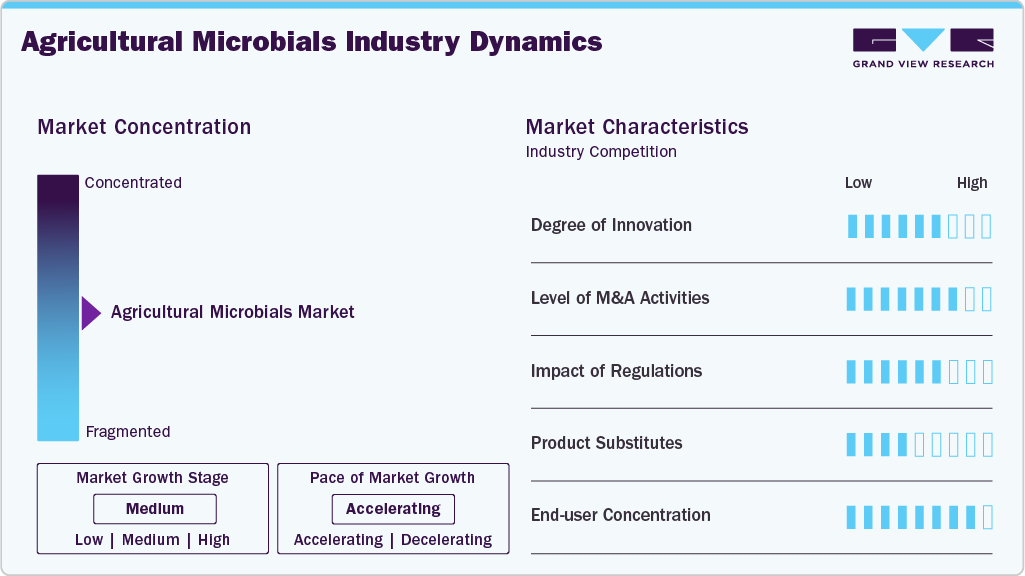
The agricultural microbials market shows moderate concentration, shaped by the presence of large multinational agribusiness companies alongside a broad base of specialized biological producers. Established players benefit from strong research capabilities, regulatory expertise, and global distribution networks, while smaller companies contribute innovation through strain discovery, niche applications, and region specific solutions. This mix creates a competitive environment where scale and specialization coexist rather than exclude one another.
 To learn more about this report, Download Free Sample Report
 Market characteristics are defined by innovation intensity, regulatory complexity, and close linkage to agronomic practices. Product differentiation depends heavily on microbial efficacy, formulation stability, and field performance across varying climatic and soil conditions. Customer trust, technical support, and integration with existing crop management programs play a critical role in adoption.
Product Insights
The bacteria segment dominated the food enzymes market in 2025, accounting for a 62.0% revenue share, due to its wide functional versatility and production efficiency. Bacterial enzymes are extensively used in baking, dairy, beverages, and processed foods because they offer high specificity, rapid fermentation performance, and consistent activity under varying processing conditions. Their ability to be produced at scale with stable yields makes them commercially attractive for manufacturers seeking cost efficiency, reliability, and broad application compatibility across industrial food processing operations.
The fungi segment is projected to record the fastest growth, with a CAGR of 14.4% from 2026 to 2033, driven by rising demand for enzymes used in complex food processing applications. Fungal enzymes are valued for their effectiveness in low-temperature processing, flavor development, and specialty food formulations. Increasing use in plant-based foods, brewing, and dairy alternatives is accelerating adoption, while their natural origin aligns well with clean-label and fermentation-based production trends favored by food manufacturers.
Formulation Insights
The liquid segment led the food enzymes market in 2025, accounting for 65.6% of total revenue, due to its ease of handling, uniform mixing, and faster activation during processing. Liquid enzymes integrate efficiently into continuous production systems, allowing precise dosing and consistent performance. Their suitability for automated processes and reduced preparation time makes them the preferred choice for large-scale food manufacturers seeking operational efficiency and process control.
The dry segment is expected to grow at a CAGR of 13.1% from 2026 to 2033, supported by improvements in formulation stability and storage convenience. Dry enzymes offer longer shelf life, easier transportation, and reduced sensitivity to temperature fluctuations. These advantages are driving adoption among small and mid-sized processors, as well as in regions where cold-chain infrastructure is limited and cost efficiency is a priority.
Application Insights
The foliar segment dominated the market in 2025, accounting for the largest revenue share of 44.6%, due to its ease of application and immediate effectiveness. Foliar delivery allows microbes to interact directly with plant surfaces, improving nutrient uptake and stress tolerance during critical growth stages. Farmers prefer this method because it integrates smoothly with existing spraying practices, offers visible short-term benefits, and supports rapid correction of nutrient and biological imbalances across diverse crop systems.
The seed segment is expected to grow fastest, with a CAGR of 14.7% from 2026 to 2033, as growers increasingly adopt targeted and preventive crop management practices. Seed-applied microbials establish early root colonization, enhancing germination, nutrient absorption, and plant vigor from the outset. This precise application reduces input wastage, improves consistency across fields, and aligns well with rising interest in efficiency-focused and sustainable farming approaches.
Crop Type Insights
The cereals and grains segment dominated the market in 2025, accounting for a 38.7% revenue share, due to the extensive cultivation of staple crops such as wheat, rice, and maize across major agricultural regions. These crops require large input volumes, making microbial solutions attractive for improving soil efficiency and nutrient use across broad acre farming. Widespread adoption is further supported by growing interest in improving yield stability and managing soil health in intensive cropping systems.
 To learn more about this report, Download Free Sample Report
 The fruits and vegetables segment is expected to grow fastest, with a CAGR of 14.3% from 2026 to 2033, driven by the high economic value of these crops and their sensitivity to soil and plant health. Growers increasingly adopt microbial inputs to enhance quality, shelf life, and disease resistance. Rising demand for residue-free produce and premium quality standards further accelerates the use of biological solutions in this segment.
Regional Insights
North America Agricultural Microbials Market Trends
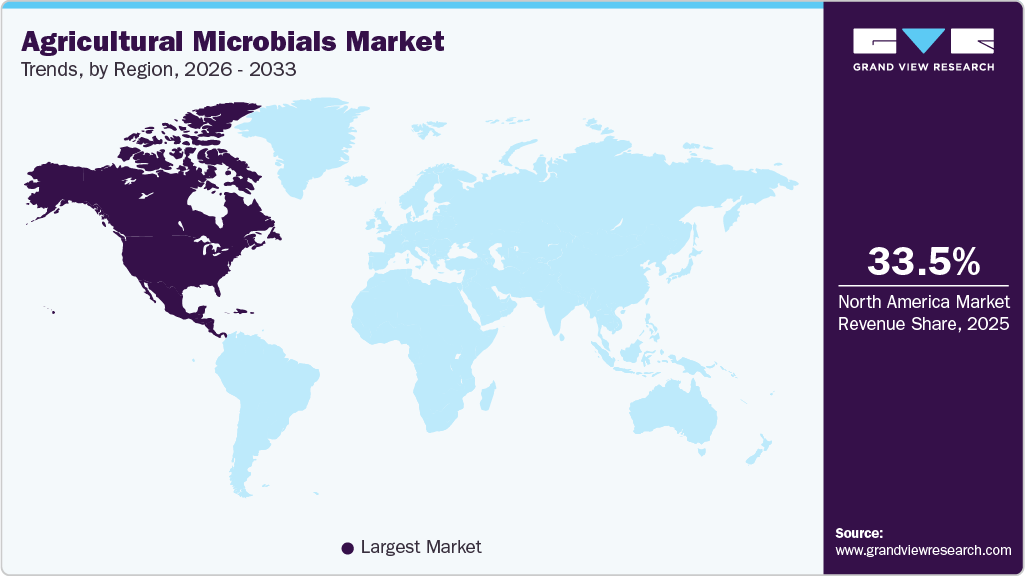
North America held the largest share of the market in 2025, accounting for 33.5% of revenue, due to early adoption of biological solutions and strong acceptance among commercial growers. The region benefits from well-established research infrastructure, clear regulatory pathways, and widespread integration of biological products into conventional crop management programs. High awareness of sustainability goals and consistent investment in agricultural innovation continue to support market leadership.
 To learn more about this report, Download Free Sample Report
 U.S. Agricultural Microbials Market Trends
U.S. held over 81.0% revenue share of the North America agricultural microbials market. U.S. agricultural microbials market leads due to a large commercial farming base, widespread adoption of precision agriculture, and strong R&D investment in microbial solutions. Growers increasingly use microbial products for seed treatments, soil health, and crop protection to maintain high yields while complying with sustainability standards. The presence of major global agribusinesses and efficient distribution networks also supports rapid integration of microbial inputs across diverse crops.
Europe Agricultural Microbials Market Trends
Europe’s market is driven by strict environmental regulations, including restrictions on chemical fertilizers and pesticides. Governments and retailers encourage sustainable farming practices, increasing the use of microbial solutions for soil fertility and crop protection. Strong emphasis on organic and residue-free produce, coupled with advanced infrastructure for biological research and product validation, ensures reliable adoption of microbial inputs across cereals, fruits, vegetables, and specialty crops.
Agricultural microbials market in Germany benefits from advanced agricultural technology, stringent chemical usage regulations, and high environmental awareness among farmers. The country emphasizes sustainable intensification, promoting microbial inputs for soil health, nutrient efficiency, and crop resilience. Strong institutional support for biological research, established cooperatives, and high-value horticultural and cereal production make Germany a key growth hub for microbial products within Europe.
Asia Pacific Agricultural Microbials Market Trends
Asia Pacific is projected to grow at the fastest rate, with a CAGR of 14.8% from 2026 to 2033, driven by increasing pressure to improve agricultural productivity across diverse farming systems. Rising awareness of soil health, supportive government initiatives, and expanding use of biological inputs in fruits, vegetables, and staple crops are accelerating adoption. Large farming populations and improving access to modern agricultural inputs further strengthen regional growth momentum.
Agricultural microbials market in China is expanding due to the need to restore degraded soils and reduce chemical fertilizer dependency across vast agricultural lands. Government initiatives promote sustainable agriculture and soil microbiome enhancement, while large-scale cultivation of cereals, oilseeds, and vegetables drives demand for microbial solutions. Rapid adoption is also supported by increasing local production of microbial strains, training programs for farmers, and growing awareness of long-term soil health.
Latin America Agricultural Microbials Market Trends
Latin America’s growth is fueled by intensive row crop cultivation, including soybeans, maize, and sugarcane, which benefit from microbial inputs to improve yields and reduce chemical inputs. Large-scale commercial farming, export-oriented crop production, and increasing environmental awareness support adoption. Countries such as Brazil and Argentina are investing in research and local manufacturing of microbial products, enabling farmers to access effective solutions tailored to tropical and subtropical conditions.
Middle East & Africa Agricultural Microbials Market Trends
The market in the Middle East and Africa is emerging, driven by the need for improved soil fertility, water efficiency, and sustainable crop production under arid conditions. Governments are promoting biological inputs to enhance resilience against drought and salinity. Adoption is supported by growing awareness of microbial products’ role in nutrient efficiency, crop protection, and yield improvement, especially for high-value fruits, vegetables, and export crops.
Key Agricultural Microbials Company Insights
The two key dominant manufacturers in the agricultural microbials market are BASF SE and Bayer AG.
-
BASF SE is a global leader in crop science, focusing on sustainable solutions that enhance plant health and productivity. The company develops a wide range of microbial products, including biofertilizers and biopesticides, designed to improve soil vitality and crop resilience. Its emphasis on research and innovation allows the creation of high-performance formulations that integrate seamlessly with modern farming practices, supporting both large-scale and specialty crop cultivation while addressing environmental sustainability and agricultural efficiency.
-
Bayer AG is a prominent agricultural science company committed to advancing biological crop solutions. It offers microbial products that strengthen plant growth, enhance nutrient absorption, and protect against diseases. Bayer invests heavily in scientific research to identify effective strains and optimize formulations for diverse climates and crops. Its biological portfolio complements integrated crop management strategies, enabling farmers to achieve improved yields, healthier soils, and reduced reliance on chemical inputs, reflecting the company’s focus on innovation, environmental stewardship, and long-term sustainable agriculture.
Key Agricultural Microbials Companies:
The following key companies have been profiled for this study on the agricultural microbials market
- BASF SE
- Bayer AG
- Corteva
- Syngenta Group
- FMC Corporation
- UPL
- Sumitomo Chemical Co., Ltd.
- Nufarm
- Novonesis Group
- Bioceres Crop Solutions
Recent Developments
-
In January 2026: Koppert India inaugurated its expanded Mycorrhiza Production Facility at IDA Bollaram, boosting local manufacturing of beneficial soil fungi. The facility enhances mycorrhizal solution capacity, supporting sustainable farming, improved nutrient uptake, soil health, and crop resilience.
-
In January 2026: HGS BioScience, backed by Paine Schwartz Partners, acquired Idaho-based Pharmgrade to expand its biological crop solutions platform, strengthening its microbial consortium portfolio following the NutriAg integration and accelerating growth across North American agricultural markets.
Agricultural Microbials Market Report Scope
Report Attribute
Details
Market size in 2025
USD 8.5 billion
Estimated market size in 2026
USD 9.6 billion
Projected market size by 2033
USD 23.5 billion
Growth rate
CAGR of 13.7% from 2026 to 2033
Base year for estimation
2025
Historical data
2018 - 2024
Forecast period
2026 - 2033
Quantitative units
Revenue in USD million/billion, Volume in Kilotons, and CAGR from 2026 to 2033
Report coverage
Revenue forecast, company ranking, competitive landscape, growth factors, and trends
Segments covered
product, formulation, application, crop type, region
Regional scope
North America; Europe; Asia Pacific; Latin America; Middle East & Africa
Country scope
U.S.; Canada; Mexico; Germany; UK; Italy; Spain; France; China; Japan; South Korea; Brazil; Argentina; Saudi Arabia; South Africa
Key companies profiled
BASF SE; Bayer AG; Corteva; Syngenta Group; FMC Corporation; UPL; Sumitomo Chemical Co. Ltd.; Nufarm; Novonesis Group; Bioceres Crop Solutions
Customization scope
Free report customization (equivalent to up to 8 analysts’ working days) with purchase. Addition or alteration to country, regional & segment scope.
Pricing and purchase options
Avail customized purchase options to meet your exact research needs. Explore purchase options
Global Agricultural Microbials Market Report Segmentation
This report forecasts revenue growth at global, regional, and country levels and provides an analysis of the latest industry trends in each of the sub-segments from 2018 to 2033. For this study, Grand View Research has segmented the global agricultural microbials market report based on product, formulation, application, crop type, and region
-
Product Outlook (Revenue, USD Million; Volume, Kilotons, 2018 - 2033)
-
Bacteria
-
Fungi
-
Protozoa
-
Virus
-
-
Formulation Outlook (Revenue, USD Million; Volume, Kilotons, 2018 - 2033)
-
Liquid
-
Dry
-
-
Application Outlook (Revenue, USD Million; Volume, Kilotons, 2018 - 2033)
-
Foliar
-
Soil
-
Seed
-
Other Application
-
-
Crop Type Outlook (Revenue, USD Million; Volume, Kilotons, 2018 - 2033)
-
Cereals & Grains
-
Oilseeds & Pulses
-
Fruits & Vegetables
-
Other Crop Type
-
-
Regional Outlook (Revenue, USD Million; Volume, Kilotons, 2018 - 2033)
-
North America
-
U.S.
-
Canada
-
Mexico
-
-
Europe
-
Germany
-
UK
-
Italy
-
Spain
-
France
-
-
Asia Pacific
-
China
-
Japan
-
South Korea
-
-
Latin America
-
Brazil
-
Argentina
-
-
Middle East & Africa
-
Saudi Arabia
-
South Africa
-
-
Frequently Asked Questions About This Report
The global agricultural microbials market size was estimated at USD 8.5 billion in 2025 and is expected to reach USD 9.6 billion in 2026.
The agricultural microbials market is expected to grow at a compound annual growth rate of 13.7% from 2026 to 2033, reaching USD 23.5 billion by 2033.
The bacteria segment dominated the food enzymes market in 2025, accounting for a 62.0% revenue share, due to its wide functional versatility and production efficiency. Bacterial enzymes are extensively used in baking, dairy, beverages, and processed foods because they offer high specificity, rapid fermentation performance, and consistent activity under varying processing conditions. Their ability to be produced at scale with stable yields makes them commercially attractive for manufacturers seeking cost efficiency, reliability, and broad application compatibility across industrial food processing operations.
Some of the key players operating in the agricultural microbials Market include BASF SE, Bayer AG, Corteva, Syngenta Group, FMC Corporation, UPL, Sumitomo Chemical Co., Ltd., Nufarm, Novonesis Group, Bioceres Crop Solutions
The agricultural microbials market is expanding as farming systems increasingly rely on biological inputs to sustain productivity under rising environmental pressure. Microbial solutions address soil degradation, resistance to chemicals, and yield instability, positioning them as essential tools for long term agricultural resilience.
The market in North America dominated with a revenue share of 33.5% in 2025.
The bacteria segment dominated the food enzymes market in 2025, accounting for a 62.0% revenue share
The liquid segment led the food enzymes market in 2025, accounting for 65.6% of total revenue, due to its ease of handling, uniform mixing, and faster activation during processing.
The foliar segment dominated the market in 2025, accounting for the largest revenue share of 44.6%, due to its ease of application and immediate effectiveness.
About the Author(s)
Agrochemicals Research Team
Specialty & Chemicals · AgrochemicalsThis report was authored by the agrochemicals research team at Grand View Research - comprising two research analysts, one senior research analyst, and one industry expert - with specialized expertise in the agrochemicals segment of the specialty & chemicals industry. All findings are based on proprietary specialty & chemicals databases, executive interviews, and regulatory analysis, subject to internal peer review prior to publication.
Last Updated:
Speak to Analyst

Customize this report to your needs - add regions, segments, or data points, with 20% free customization.
Or view our licence options:


ISO 9001:2015 & 27001:2022 Certified
We are GDPR and CCPA compliant! Your transaction & personal information is safe and secure. For more details, please read our privacy policy.


