
- Home
- »
- Plastics, Polymers & Resins
- »
-
Agriculture Chemical Packaging Market Size Report, 2033GVR Report cover

Agriculture Chemical Packaging Market (2026 - 2033)
Size, Share & Trends Analysis Report By Material (Paper, Plastic, Metal), By Chemical (Pesticides, Insecticides, Herbicides, Fertilizers), By Region (North America, Europe, APAC, Latin America, MEA), And Segment Forecasts
Market Size, 2025
$6.6BMarket Estimate, 2026
$6.9BMarket Forecast, 2033
$10.7BCAGR, 2026–2033
6.4%Agriculture Chemical Packaging Market Summary
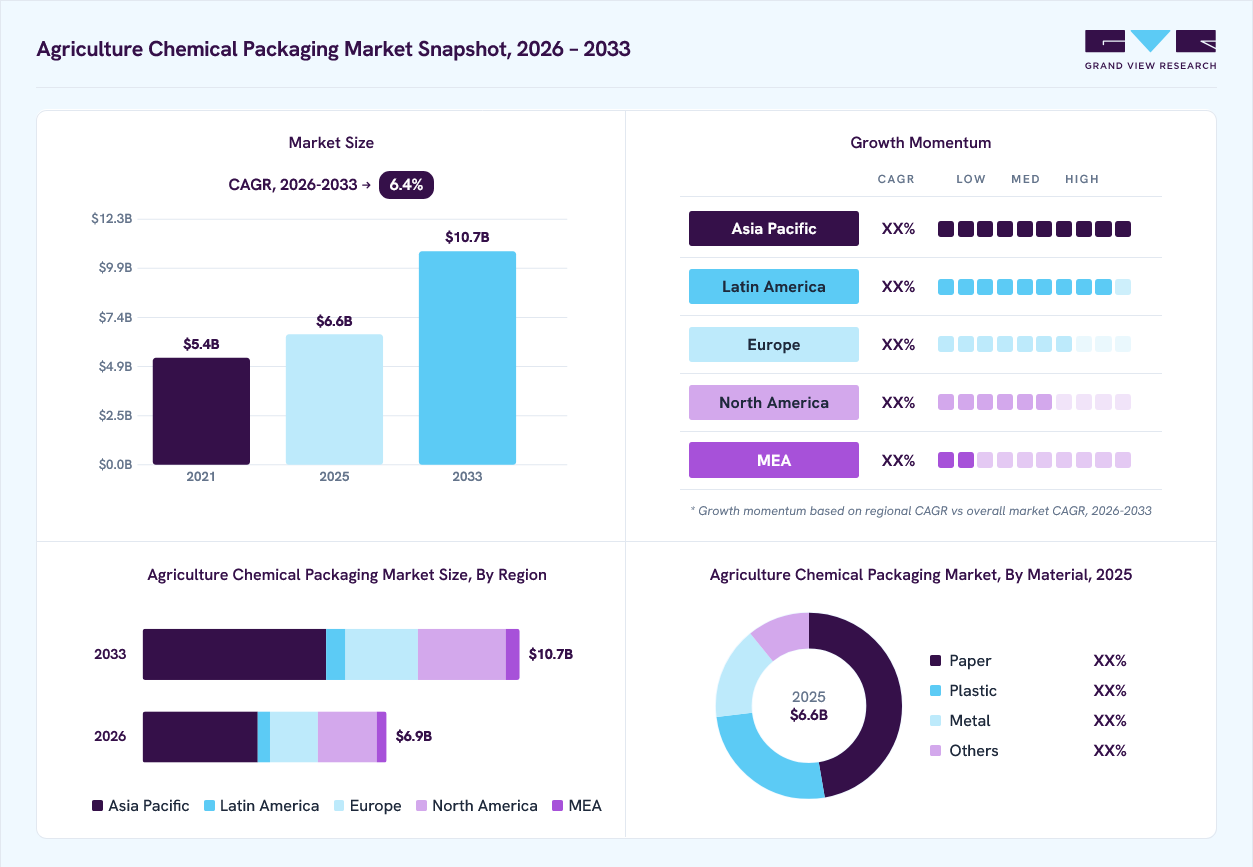
The global agriculture chemical packaging market size was valued at USD 6.6 billion in 2025 and is projected to grow from USD 6.9 billion in 2026 to USD 10.7 billion by 2033, at a CAGR of 6.4% from 2026 to 2033. The market in Asia Pacific dominated with a revenue share of 47.0% in 2025. The market growth is driven by the rising adoption of high-efficiency agrochemicals to boost crop yields and ensure food security.
 Source: Grand View Research, IR Documents, Primary Interviews, Paid DatabasesTo learn more about this report,
 Download Free Sample Report
Key Market Trends & Insights
- By material: The paper segment is expected to grow at a considerable CAGR of 6.9% from 2026 to 2033 in terms of revenue.
- By chemical: The pesticides segment is expected to grow at a considerable CAGR of 6.9% from 2026 to 2033 in terms of revenue.
Regional Highlights
- Largest regional market: Asia Pacific (47.0% revenue share, 2025)
- By country: The China held the largest market share in 2025.
Market Size & Forecast
- Market size in 2025: USD 6.6 Billion
- Estimated market size in 2026: USD 6.9 Billion
- Projected market size by 2033: USD 10.7 Billion
- CAGR (2026-2033): 6.4%
Prism AI by Grand View Research Free to tryAsk a question about the agriculture chemical packaging marketTry asking✓Every figure cited from GVR research Prefer the report? Download free sample →
Additionally, stringent regulations on the transportation, storage, and handling of hazardous agricultural chemicals are pushing manufacturers toward advanced, leakproof, and contamination-resistant packaging solutions. Increasing use of fertilizers, pesticides, and crop protection agents to enhance yield performance and mitigate pest-related losses has amplified the demand for durable and safe packaging solutions. For example, countries such as India, Brazil, and China are witnessing a surge in agrochemical adoption due to expanding farmland and the shift toward high-efficiency crops, resulting in greater demand for rigid HDPE containers, intermediate bulk containers, and multi-layer bags designed to safely store and transport chemicals.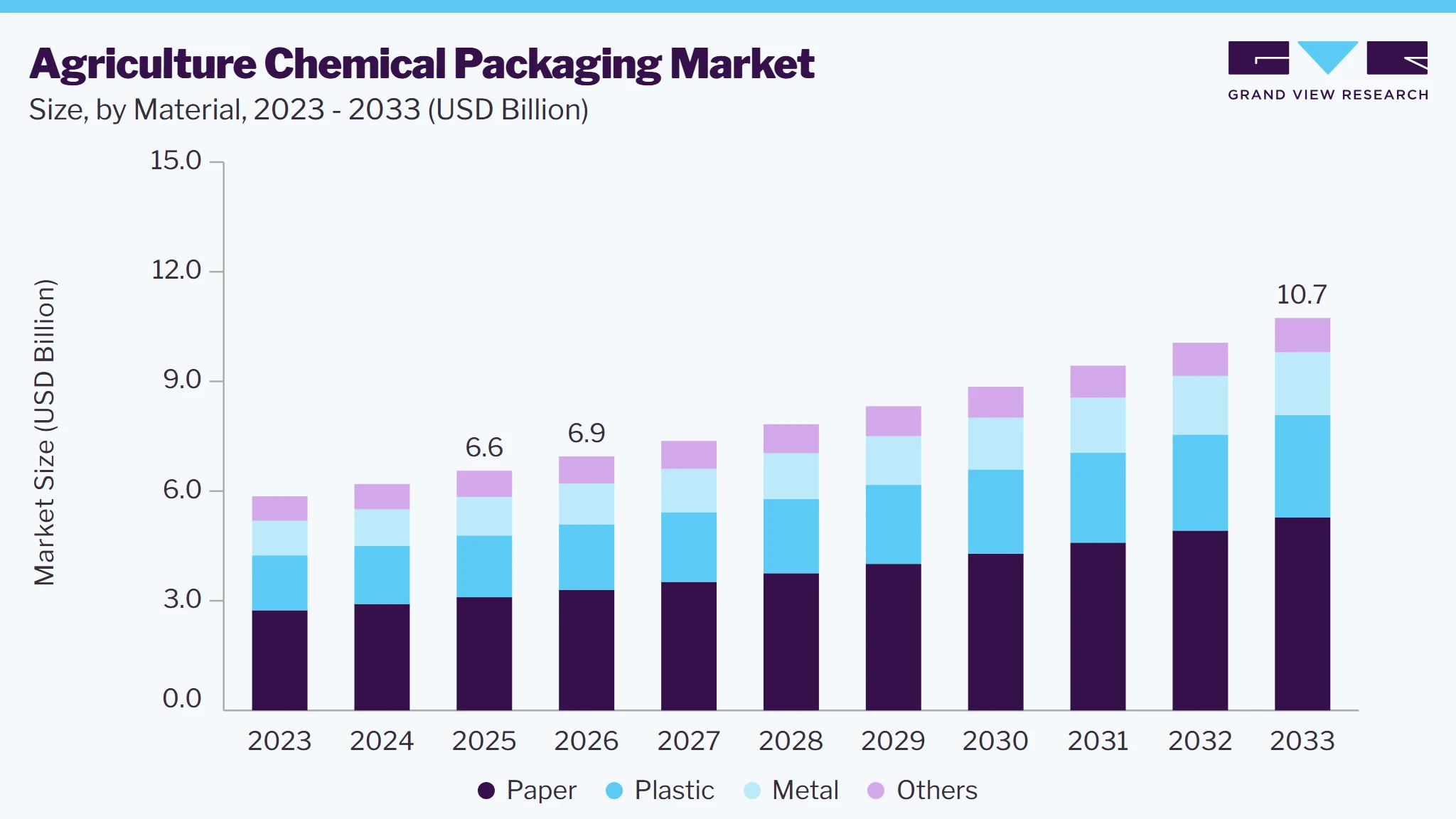 To learn more about this report, Download Free Sample Report
Stringent global regulations related to the handling, storage, and transportation of agricultural chemicals are also accelerating the adoption of advanced packaging formats. Government bodies and safety organizations continue to impose standards to reduce spillage, contamination, and worker exposure, driving manufacturers to adopt leak-proof, corrosion-resistant, and tamper-evident packaging. Packaging innovations such as UN-approved drums, anti-counterfeit labels, child-resistant caps, and multi-layer barrier film bags are becoming essential components for market players. These advancements not only improve compliance but also build trust among distributors and farming consumers.
The rising focus on sustainable, user-friendly packaging solutions in the agricultural sector further propels the growth of the agricultural chemical packaging industry. Increasing awareness of environmental safety, along with sustainability commitments from agrochemical producers, is supporting the adoption of recyclable plastics, bio-based resins, and lightweight packaging formats that reduce environmental footprints. At the same time, user-friendly designs such as easy-pour caps, single-dose sachets, and water-soluble packaging are improving handling efficiency for farmers while minimizing accidental exposure to chemicals.
Market Concentration & Characteristics
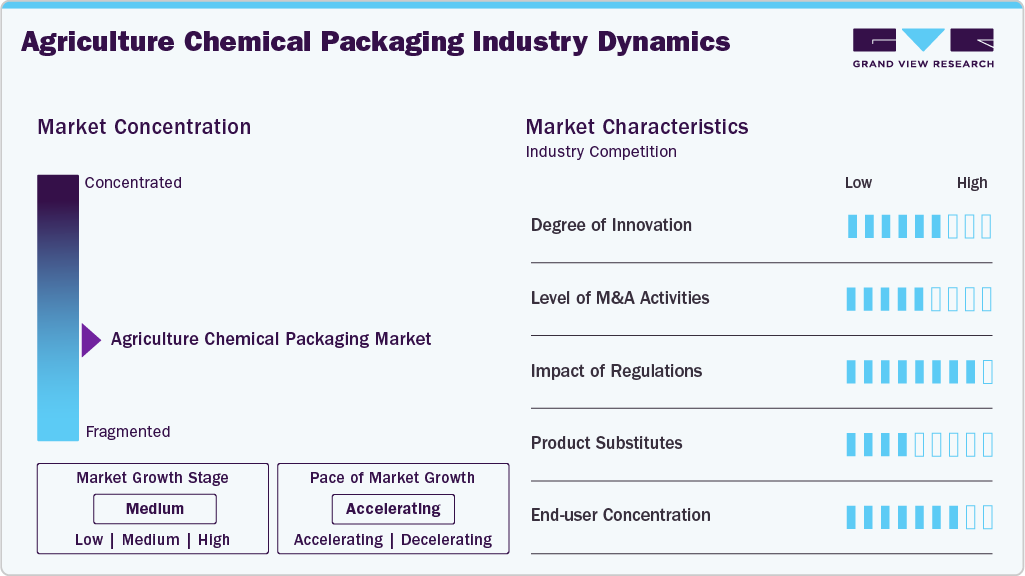
The industry operates within a performance-driven structure that prioritizes long-term durability, ease of use, and the ability to withstand challenging conditions in the agricultural supply chain. Packaging solutions must be compatible with corrosive liquids and powders, support multi-format distribution channels, and maintain product integrity in varying climate settings. As a result, the market heavily relies on engineered materials, such as HDPE, multilayer polymer films, rigid drums, intermediate bulk containers, and barrier-sealed bags, which offer strength, reusability, and protection against contamination.
 To learn more about this report, Download Free Sample Report
The agriculture chemical packaging market is also marked by rapid technological innovation and sustainability transformation, driven by brand reputation and cost-optimization pressures among global agrochemical producers. Manufacturers are investing in lightweight packaging formats, bio-based polymers, anti-counterfeit labeling, smart tracking systems, and ergonomic dispensing designs to enhance user safety and support circular economy goals. Additionally, strong relationships between packaging suppliers, agrochemical producers, recyclers, and logistics partners form the backbone of the industry's value chain, highlighting the importance of collaboration, customization, and continuous product development.
Material Insights
The paper segment recorded the largest revenue share of 47.2% in 2025 and is expected to grow at the fastest CAGR of 6.9% during the forecast period.Paper-based packaging is increasingly used for dry agricultural chemical products, such as fertilizers, soil conditioners, micronutrient powders, and pesticides, in powder or granular form. It is widely favored for its biodegradability and recyclability, making it suitable for companies committed to reducing their carbon footprint. Multiwall kraft paper bags and laminated paper sacks offer high tensile strength and moisture resistance, ensuring that powders remain dry during transit and storage. Additionally, low disposal costs, a lightweight structure, and the growing bans on single-use plastics in agricultural exporting countries are accelerating adoption.
HDPE drums and jerry cans are extensively used for herbicides, insecticides, fungicides, and liquid fertilizers due to their resistance to corrosion, impact, and moisture. PET bottles, LDPE pouches, and IBCs (Intermediate Bulk Containers) are also utilized based on volume and distribution channel requirements. Tamper-evident caps, child-resistant closures, and UV-protective additives enhance safety and regulatory compliance, which are crucial for hazardous chemicals. Plastic packaging is driven by its superior barrier performance, long-term storage capability, and strong suitability for bulk transportation.
Chemical Insights
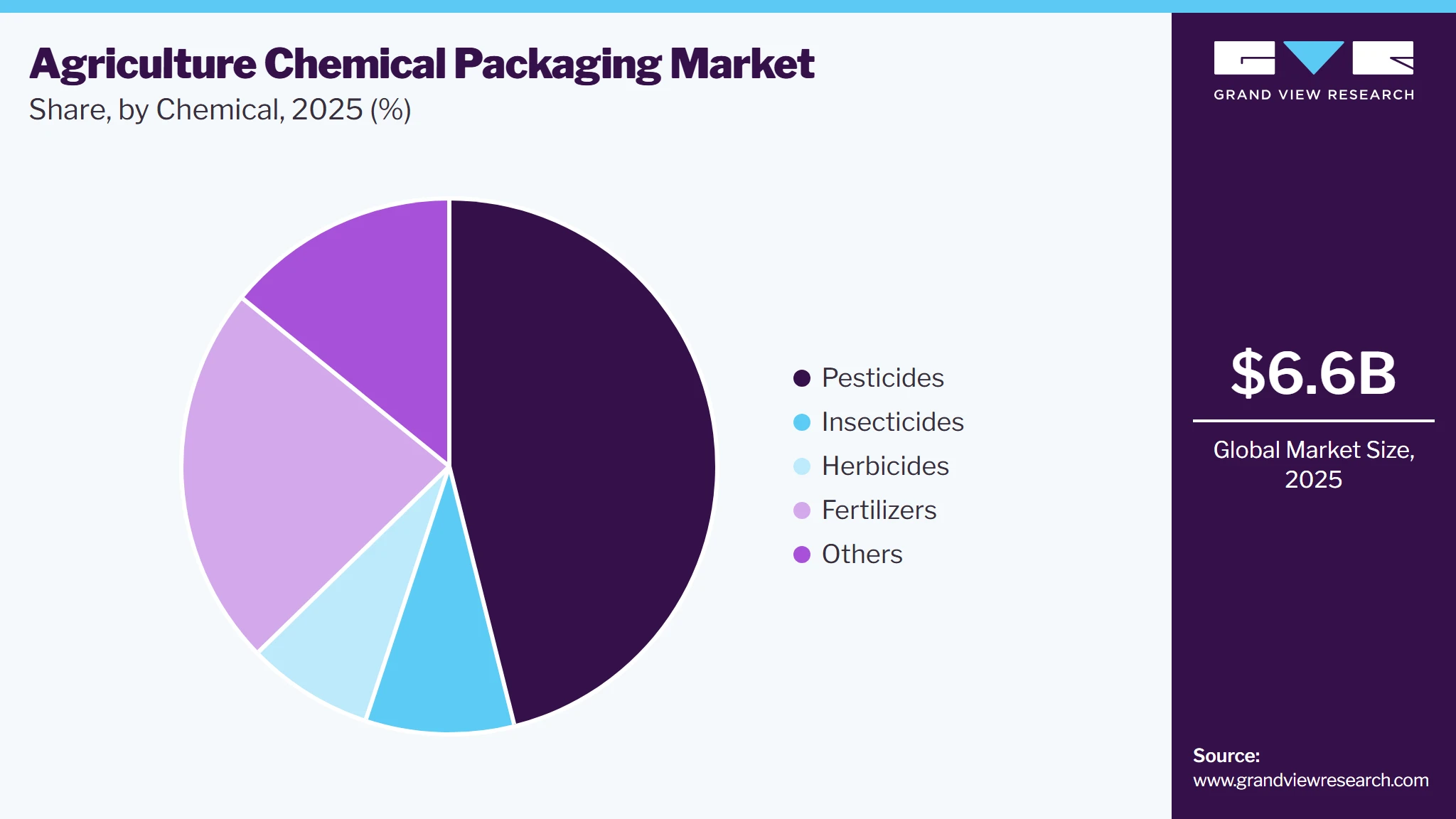
The pesticides segment dominated the agriculture chemical packaging industry, recording the largest share of 46.1% in 2025, and is projected to grow at the fastest CAGR of 6.9% during the forecast period.Pesticide packaging is designed to protect chemical formulations used to control pests, insects, weeds, and fungi across agricultural applications. Packaging in this segment must provide high chemical resistance, prevent leaks, support safe transportation, and comply with global standards on toxicity, labeling, and disposal. Growth in high-value crops, expansion of commercial farming, and stricter regulations on product safety require packaging that ensures safe storage, controlled dispensing, and secure logistics.
 To learn more about this report, Download Free Sample Report
Fertilizer packaging is used for granular, liquid, and water-soluble fertilizers that replenish soil nutrients to improve crop performance. Packaging formats vary from polypropylene woven bags for solid fertilizers to rigid HDPE drums and IBC tanks for liquids, ensuring moisture protection, material stability, and contamination control. Packaging designs typically support heavy loads, stacking strength, and UV resistance to maintain nutrient quality during long-distance transportation and open-yard storage. Growth in global agricultural output, government initiatives to support fertilizer accessibility, and improvements in rural distribution networks further push packaging suppliers to provide cost-efficient, durable, and recyclable packaging formats.
Regional Insights
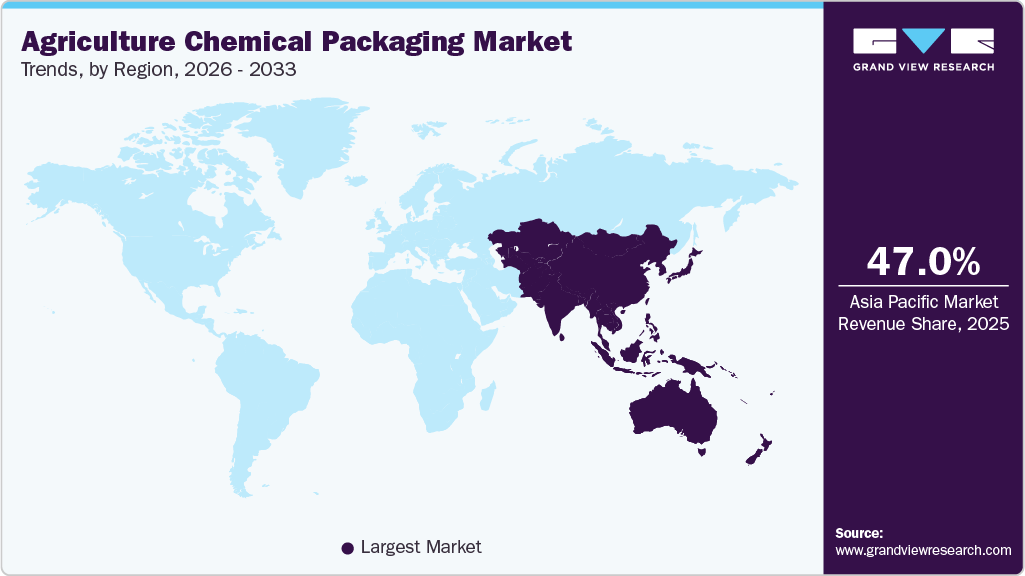
Asia Pacific dominated the agriculture chemical packaging market, accounting for the largest revenue share of over 47.0% in 2025, and is expected to grow at the fastest CAGR of 6.9% during the forecast period. The region dominates the market due to the rapid expansion of agricultural production and the rising use of fertilizers, pesticides, herbicides, and crop nutrition products across high-output farming nations such as China, India, and Vietnam. The region’s growing population and rising demand for high-yield food crops have accelerated agrochemical consumption, driving demand for durable, corrosion-resistant packaging formats.
 To learn more about this report, Download Free Sample Report
The China agriculture chemical packaging market leads the country segment, driven by intensive crop cultivation and agricultural modernization initiatives, making it the world’s largest consumer of fertilizers and pesticides. The large farming population and government programs supporting crop protection greatly increase demand for agrochemical products, driving the consumption of high-volume chemical packaging. Rapid rural e-commerce penetration has further expanded the retail distribution of agrochemicals, boosting the use of small and medium-format packaging. drives the country segment due to being the world’s largest consumer of fertilizers and pesticides, fueled by intensive crop cultivation and agricultural modernization initiatives.
North America Agriculture Chemical Packaging Market
The growth of the North America agriculture chemical packaging industry is primarily driven by technologically advanced farming practices and high adoption of precision agriculture, which relies heavily on specialty and performance-enhancing agrochemicals. Farmers in the U.S. and Canada are early adopters of innovative herbicides, pesticides, and biopesticides, creating sustained demand for premium packaging solutions designed for measured dosing, long shelf life, and transportation safety. Moreover, leading companies, including BASF, Nutrien, FMC Corporation, and Corteva, operate large-scale formulation and distribution facilities in North America, boosting the need for commercial-grade packaging across both industrial and retail channels.
U.S. Agriculture Chemical Packaging Market Trends
The U.S. agriculture chemical packaging industry leads North America due to high levels of agricultural mechanization and the intensive use of specialty crop solutions, such as selective herbicides, pesticide concentrates, and seed treatment chemicals. Large commercial farms demand packaging formats that support precision dosing, bulk chemical transport, and safe on-site storage, resulting in significant usage of industrial-grade containers such as IBCs, fluorinated HDPE drums, and rigid canisters. Strong adoption of herbicide-tolerant and GM crops also increases chemical utilization and subsequent packaging demand.
Europe Agriculture Chemical Packaging Market Trends
The region has a high concentration of agrochemical manufacturers, such as BASF, ADAMA, and UPL, operating alongside advanced packaging producers focused on lightweight, low-emission, and refill-friendly designs. Strong sustainability policies, such as the EU Green Deal, have accelerated the adoption of recyclable polymers, reusable drums, and eco-safe dispensing systems. These progressive efforts, combined with steady investments in new packaging materials that reduce residual chemical waste, continue to reinforce Europe’s dominance in the segment.
Key Agriculture Chemical Packaging Company Insights
The competitive environment of the agriculture chemical packaging market is characterized by a mix of global packaging leaders and regional specialty manufacturers competing on product safety, cost efficiency, and regulatory compliance. Companies are increasingly focusing on developing durable, tamper-evident, and UN-certified packaging formats, such as HDPE drums, IBCs, PET containers, and multilayer pouches, engineered to withstand chemical corrosion and logistical stress.
The market is also witnessing strong differentiation through sustainability initiatives, including PCR-based resins, recyclable barrier films, lightweight rigid containers, and closed-loop refill systems to reduce chemical residue and plastic waste. Strategic partnerships between agrochemical producers and packaging suppliers are becoming common to ensure an uninterrupted supply. At the same time, players invest in smart packaging features such as RFID tracking, QR authentication, and anti-counterfeit labeling to enhance product traceability and safety.
-
In June 2025, Mauser Packaging Solutions opened a new reconditioning and recycling facility at the BASF site in Tarragona, Spain. The facility reconditions IBCs and produces high-quality PCR from end-of-life industrial plastic packaging, improving logistics efficiency, reducing carbon emissions, and supporting safe handling of dangerous goods.
-
In April 2025, Amcor plc completed its all-stock acquisition of Berry Global Inc, creating a global packaging leader with around 400 facilities, 75,000 employees, and operations in 140 countries. The merger, valued at approximately USD 13.0 billion, enhances Amcor's portfolio with expanded material science and innovation capabilities, positioning it to deliver more consistent growth and improved margins.
Key Agriculture Chemical Packaging Companies:
The following key companies have been profiled for this study on the agriculture chemical packaging market.
- Amcor plc
- Greif
- Mauser Packaging Solutions
- Schütz GmbH & Co. KGaA
- ALPLA
- CDF Corporation
- CurTec
- Phoenix Closures, Inc.
- Bag Supply Company
- Pyramid Technoplast Ltd
Agriculture Chemical Packaging Market Report Scope
Report Attribute
Details
Market size in 2025
USD 6.6 billion
Estimated market size in 2026
USD 6.9 billion
Projected market size by 2033
USD 10.7 billion
Growth rate
CAGR of 6.4% from 2026 to 2033
Historical data
2021 - 2024
Forecast period
2026 - 2033
Quantitative units
Revenue in USD million/billion and CAGR from 2026 to 2033
Report coverage
Revenue forecast, competitive landscape, growth factors, and trends
Segments covered
Material, chemical, region
Regional scope
North America; Europe; Asia Pacific; Latin America; Middle East & Africa
Country scope
U.S.; Canada; Mexico; Germany; France; UK; Italy; Spain; China; India; Japan; Australia; South Korea; Brazil; Argentina; South Africa; Saudi Arabia; UAE
Key companies profiled
Amcor plc; Greif; Mauser Packaging Solutions; Schütz GmbH & Co. KGaA; ALPLA; CDF Corporation; CurTec; Phoenix Closures, Inc.; Bag Supply Company; Pyramid Technoplast Ltd
Customization scope
Free report customization (equivalent up to 8 analyst’s working days) with purchase. Addition or alteration to country, regional, and segment scope.
Pricing and purchase options
Avail customized purchase options to meet your exact research needs. Explore purchase options
Global Agriculture Chemical Packaging Market Report Segmentation
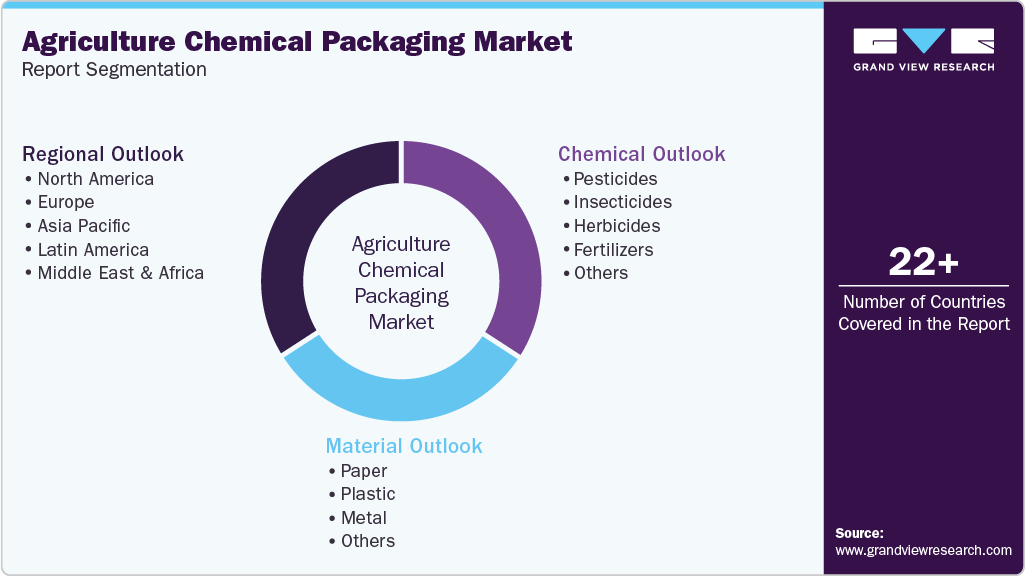
This report forecasts revenue growth at the global, regional & country levels and provides an analysis of the latest industry trends in each of the sub-segments from 2021 to 2033. For this study, Grand View Research has segmented the global agriculture chemical packaging market report based on material, chemical, and region:
 To learn more about this report, Download Free Sample Report
-
Material Outlook (Revenue, USD Million, 2021 - 2033)
-
Paper
-
Plastic
-
Metal
-
Others
-
-
Chemical Outlook (Revenue, USD Million, 2021 - 2033)
-
Pesticides
-
Insecticides
-
Herbicides
-
Fertilizers
-
Others
-
-
Regional Outlook (Revenue, USD Million, 2021 - 2033)
-
North America
-
U.S.
-
Canada
-
Mexico
-
-
Europe
-
Germany
-
France
-
UK
-
Italy
-
Spain
-
-
Asia Pacific
-
China
-
India
-
Japan
-
Australia
-
South Korea
-
-
Latin America
-
Brazil
-
Argentina
-
-
Middle East & Africa
-
South Africa
-
Saudi Arabia
-
UAE
-
-
Frequently Asked Questions About This Report
The global agriculture chemical packaging market was valued at around USD 5.4 billion in the year 2025 and is expected to reach around USD 5.8 billion in 2026.
The global agriculture chemical packaging market is expected to grow at a compound annual growth rate of 6.4% from 2026 to 2033 to reach around USD 8.9 billion by 2033.
The pesticides segment dominated the agriculture chemical packaging industry, recording the largest share of 46.1% in 2025
The paper held the largest share (over 47.2%) in 2025 and is the fastest-growing model.
Asia Pacific dominated with a 47.0% revenue share in 2025.
Key players include Amcor plc; Greif; Mauser Packaging Solutions; Schütz GmbH & Co. KGaA; ALPLA; CDF Corporation; CurTec; Phoenix Closures, Inc.; Bag Supply Company; and Pyramid Technoplast Ltd.
Key factors include agrochemical consumption, stringent safety and regulatory standards, growing global trade of farm inputs, and increasing demand for sustainable and user-convenient packaging solutions.
About the Author(s)
Plastics, Polymers & Resins Research Team
Bulk Chemicals · Plastics, Polymers & ResinsThis report was authored by the plastics, polymers & resins research team at Grand View Research - comprising two research analysts, one senior research analyst, and one industry expert - with specialized expertise in the plastics, polymers & resins segment of the bulk chemicals industry. All findings are based on proprietary bulk chemicals databases, executive interviews, and regulatory analysis, subject to internal peer review prior to publication.
Last Updated:
Speak to Analyst

Customize this report to your needs - add regions, segments, or data points, with 20% free customization.
Or view our licence options:


ISO 9001:2015 & 27001:2022 Certified
We are GDPR and CCPA compliant! Your transaction & personal information is safe and secure. For more details, please read our privacy policy.


