
- Home
- »
- Next Generation Technologies
- »
-
Agriculture Drones Market Size & Share Report 2026-2033GVR Report cover

Agriculture Drones Market (2026 - 2033)
Size, Share & Trends Analysis Report By Type (Fixed Wing, Rotary Wing), By Component (Hardware, Software), By Farming Environment (Indoor, Outdoor), By Application (Crop Management, Field Mapping, Crop Spraying), By Region, And Segment Forecasts
Market Size, 2025
$3.4BMarket Estimate, 2026
$3.9BMarket Forecast, 2033
$13.2BCAGR, 2026–2033
18.8%Agriculture Drones Market Summary
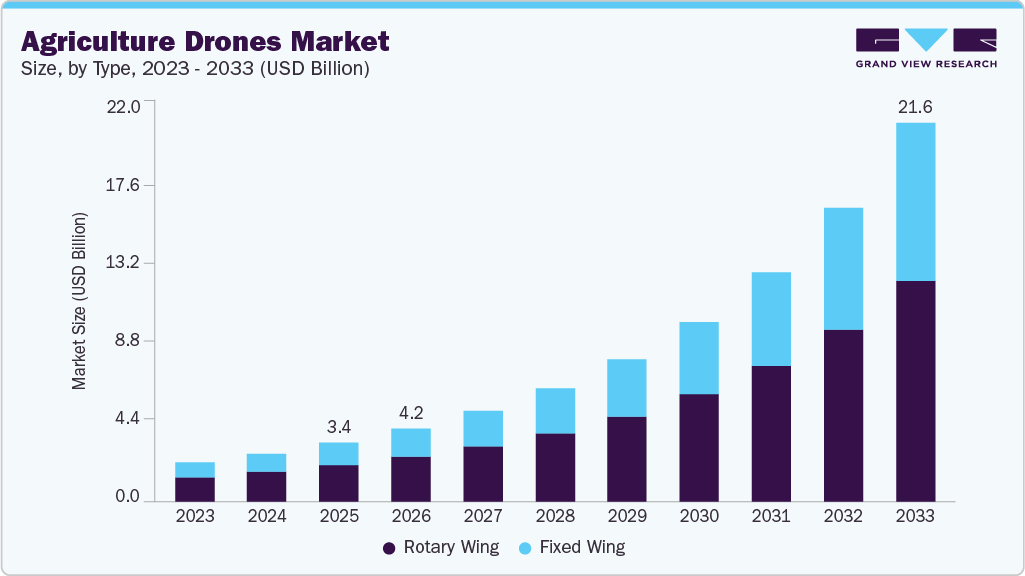
The global agriculture drones market size was valued at USD 3.4 billion in 2025 and is projected to grow from USD 3.9 billion in 2026 to USD 13.2 billion by 2033, growing at a CAGR of 18.8% from 2026 to 2033. North America dominated globally with a share of over 33.5% in 2025. The growing demand for precision farming is driving the adoption of agriculture drones.
 Source: Grand View Research, IR Documents, Primary Interviews, Paid DatabasesTo learn more about this report,
 Download Free Sample Report
 Key Market Trends & Insights
- By type: Rotary wing segment led the market and held the largest revenue share of 61.7% in 2025.
- By component: Services segment is expected to grow at the highest CAGR of 28.0% during the forecast period.
- By farming environment: Outdoor farming segment led the market and held the largest revenue share of 82.3% in 2025.
- By application: Crop management segment led the market and held the largest revenue share of 24.9% in 2025.
Regional Highlights
- Largest regional market: North America (33.5% revenue share, 2025)
- By country: The U.S. held the largest market share in 2025
Market Size & Forecast
- Market Size in 2025: USD 3.4 Billion
- Estimated market size in 2026: USD 3.9 Billion
- Projected market size by 2033: USD 13.2 Billion
- CAGR (2026-2033): 18.8%
Three ways to get this report
Buy it, customize it, or ask a question.Ask an Analyst
Analyst response in 1 business day
- AccessReport author, directly
- Reply timeWithin 1 working day
- No sales callDirect answer only
- FormatEmail reply
- CostFree, no cost
Get the Full Report
What the study covers
- FormatsPDF · Excel · Dashboard
- Timeline2026–2033 annual, 2025 base
- Coverage20+ countries, 5 regions
- Companies10+ key players profiled
Customize the Report
20% free customization
- IncludeCountries, segments, points
- TailorTo your product definition
- ExtendDeeper competitor detail
- OrA fully bespoke study
- Turnaround5–10 working days
Precision farming techniques maximize crop yields while minimizing the use of resources such as water, fertilizers, and pesticides. Drones equipped with high-resolution cameras, multispectral sensors, and GPS technology enable farmers to gather detailed data on crop health, soil conditions, and moisture levels. This real-time information allows farmers to make data-driven decisions about where and when to apply inputs, optimizing crop production and reducing waste.The demand for precision farming solutions, including drones, is rising as the agricultural component faces pressure to increase efficiency and sustainability. According to data from the U.S. Department of Agriculture (USDA), the top five states adopting precision agriculture technologies, namely North Dakota, Nebraska, Iowa, South Dakota, and Illinois, represented nearly half of the 2022 U.S. cash receipts for field crops. This trend reflects a significant opportunity for the compact tractor market, as sales of advanced machinery to support precision farming practices continue to increase in these states.
The increasing adoption of IoT (Internet of Things) and big data analytics in agriculture enhances drones' utility. When integrated with IoT devices and data analytics platforms, drones provide a more comprehensive view of farm operations. They collect data instantly, analyze and transmit it to farmers via cloud-based platforms. This connectivity allows for more accurate and real-time monitoring of crops and soil conditions, helping farmers take immediate action to improve productivity and crop health. The integration of drones with IoT and big data solutions is driving the digital transformation of agriculture, further boosting the adoption of drone technology.
 To learn more about this report, Download Free Sample Report
 In addition, the rise of autonomous and AI-powered drones drives further innovation in the agriculture drone market. Autonomous drones with artificial intelligence (AI) perform more complex tasks with minimal human intervention. These drones autonomously navigate fields, identify crop health issues, and even apply fertilizers or pesticides with precision. AI-powered drones also process and analyze vast amounts of data in real-time, allowing farmers to make quick and accurate decisions. This capability is particularly valuable for large-scale farms that require continuous monitoring and fast responses to changing field conditions. The integration of AI makes drones more efficient and effective, enhancing their appeal to farmers.
Furthermore, growing awareness about sustainable and organic farming practices drives the adoption of agricultural drones. As consumers become more concerned about the environmental impact of food production and the use of chemicals in agriculture, there is increasing demand for organically grown produce. Agriculture drones enable farmers to monitor crops more closely, reduce synthetic inputs, and employ targeted spraying methods that minimize chemical usage. This supports organic and eco-friendly farming practices, which are increasingly prioritized in developed and developing markets. According to the International Federation of Organic Agriculture Movements, in 2022, 96.4 million hectares (Mha) of land were managed organically, reflecting a 26.6% rise from 2021. Oceania accounted for the largest share, with 53.2 Mha, Europe with 18.5 Mha, and Latin America with 9.5 Mha.
Market Dynamics
Agriculture drones are gaining traction as they offer advanced capabilities such as crop health monitoring, aerial field mapping, precision spraying, soil and field analysis, irrigation management, livestock monitoring, and yield estimation. These drone-based solutions enable farmers to optimize agricultural operations through real-time data collection, actionable insights, and precision-based decision-making. The growing focus on improving farm productivity, reducing input costs, and supporting sustainable agricultural practices, coupled with the increasing adoption of precision farming technologies, is expected to continue driving growth in the agriculture drones market.
The growing adoption of aerial imaging and field-mapping solutions is a major driver of the agriculture drones market, as farmers increasingly rely on high-resolution aerial data to improve crop monitoring, resource management, and decision-making. Agriculture drones equipped with advanced cameras and sensors can capture detailed images of fields, enabling real-time assessment of crop health, soil conditions, irrigation patterns, and pest infestations. These insights help farmers identify issues early and implement corrective measures before they affect productivity. Compared to traditional ground-based monitoring methods, aerial imaging provides faster coverage of large agricultural areas with greater accuracy. As precision agriculture adoption grows, demand for drone-based imaging and mapping solutions continues to increase significantly.
High initial investment and equipment acquisition costs represent a significant restraint on the agriculture drones market, as advanced agricultural drones require substantial upfront capital for hardware, sensors, imaging systems, software platforms, and supporting infrastructure. Modern agriculture drones are often equipped with multispectral cameras, thermal sensors, GPS navigation systems, AI-powered analytics, and automated flight capabilities, all of which increase purchase costs. For many farmers, especially small and medium-sized agricultural operators, the high cost of acquiring these technologies can be prohibitive. This financial barrier limits adoption despite the long-term benefits of improved productivity and resource optimization. As a result, cost-related concerns remain a major challenge for market expansion.
The growing adoption of drone-as-a-service (DaaS) business models presents a significant opportunity for the agriculture drones market, as it lowers the financial barriers to purchasing and operating advanced drone systems. Instead of investing heavily in drone hardware, software, maintenance, and pilot training, farmers can access drone-based services through subscription or pay-per-use models. This allows agricultural producers to benefit from aerial imaging, crop monitoring, spraying, and field mapping capabilities without substantial capital expenditure. DaaS models make advanced drone technologies accessible to small and medium-sized farms that may otherwise be unable to afford them. As affordability improves, the potential customer base for agricultural drone services expands considerably.
Market Concentration & Characteristics
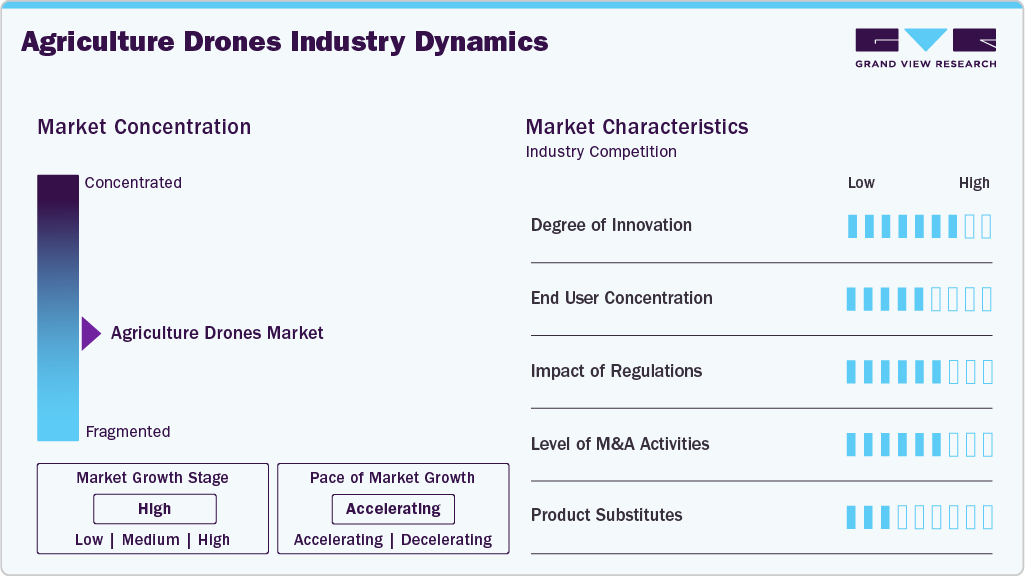
The market for agriculture drones is highly concentrated, with global drone manufacturers and precision agriculture solution providers competing alongside regional agri-tech firms. Companies such as DJI lead the market due to strong hardware capabilities, advanced imaging technology, and integrated farm analytics solutions. Entry barriers are relatively high due to regulatory compliance requirements, R&D costs, and the need for agricultural domain expertise.
The market is characterized by regulatory restrictions, seasonal demand patterns, and dependency on weather conditions that affect drone operations. Many users adopt drone-as-a-service models due to high upfront costs, especially small and medium farmers. Integration with farm management and analytics platforms is increasingly important for converting aerial data into actionable insights.
 To learn more about this report, Download Free Sample Report
 Competitive dynamics show moderate customer stickiness due to reliance on historical farm data and operational familiarity with specific drone ecosystems. Switching costs are driven by training requirements, data continuity, and platform integration challenges. Innovation in autonomous flight, AI-based crop analysis, and improved imaging systems continues to be a key differentiator among players.
Analyst Perspective
The agriculture drones market sits at a compelling intersection of long-term growth drivers that few agricultural technology segments can match, increasing pressure to improve farm productivity, rising adoption of precision agriculture practices, and growing demand for data-driven farm management solutions that optimize resource utilization. The central competitive moat, however, will belong to the provider that integrates aerial imaging, crop health analytics, precision spraying, field mapping, and farm management software into a unified platform, transforming drones from standalone monitoring tools into indispensable decision-support systems that deliver measurable improvements in yield, operational efficiency, and sustainability across the agricultural value chain.
Type Insights
Based on type, the rotary wing segment led the market with the largest revenue share of 61.7% in 2025 and is expected to grow at the significant CAGR over the forecast period. The expansion of smart farming ecosystems is propelling the growth of the rotary wing segment. As more farms integrate smart technologies, such as the Internet of Things (IoT), cloud computing, and AI-powered analytics, rotary-wing drones are becoming an integral part of these ecosystems. These drones are connected to other smart farming devices, such as soil sensors, weather stations, and irrigation systems, to create a fully automated and interconnected farming environment. The data collected by the drones is fed into centralized farm management platforms, which are analyzed alongside data from other sources to provide a holistic view of farm conditions. Integrating rotary-wing drones into smart farming ecosystems enables farmers to optimize resource use, improve operational efficiency, and enhance crop yields.
The fixed-wing segment is anticipated to grow at the highest CAGR of 27.8% during the forecast period. The expanding applications of fixed-wing drones in crop monitoring and disease detection drive their demand. Fixed-wing drones are equipped with sensors capable of detecting subtle changes in crop health, often before visible disease symptoms appear. By flying over crops regularly, these drones provide early warnings of potential problems, allowing farmers to take preventative measures before diseases spread or yield is significantly impacted. This early detection capability is critical for reducing crop losses and optimizing harvests. Additionally, fixed-wing drones monitor crop growth stages, assess plant density, and estimate harvest timing, providing farmers with valuable information throughout the growing season.
Component Insights
Based on component, the hardware segment led the market with the largest revenue share of 49.6% in 2025. The growing demand for longer flight times and increased payload capacities drives the segment growth. As farms expand and precision agriculture becomes more widespread, drones need to cover larger areas without the need for frequent recharging or refueling. Innovations in battery technology and energy-efficient motors enable agriculture drones to fly for longer durations, making them more practical for large-scale farming operations. Additionally, advancements in payload capabilities allow drones to carry more sophisticated sensors or even deliver small quantities of inputs like seeds or fertilizers. The demand for drones that can carry heavier payloads and operate for extended periods is pushing manufacturers to develop more robust and durable hardware, which is crucial for meeting the growing needs of modern agriculture.
The servicessegment is expected to grow at a significant CAGR during the forecast period. The expansion of drone-as-a-service (DaaS) business models is playing a crucial role in driving the services segment of the agriculture drone market. With DaaS, farmers can outsource field mapping, crop scouting, and spraying tasks to expert drone operators. This reduces the need for farmers to become proficient in drone operation and ensures that they receive high-quality, reliable data and services from skilled professionals. The growth of these service models is particularly advantageous for smaller farms or regions with limited access to advanced technology, as it allows them to benefit from drone-based services without significant investments in equipment and training.
Farming Environment Insights
Based on farming environment, the outdoor farming segment led the market with the largest revenue share of 82.3% in 2025. The increasing need for large-scale outdoor agricultural operations is driving the market growth. Managing vast tracts of land becomes more challenging as farms expand, requiring more efficient monitoring and management solutions. Agricultural drones with advanced sensors and imaging technologies allow farmers to gather detailed information about their crops in real-time. This enables them to optimize the use of inputs such as water, fertilizers, and pesticides, which is crucial for maintaining crop health and improving yield in outdoor farming. The ability to make data-driven decisions based on drone-collected information is becoming vital for farmers looking to enhance productivity and reduce waste.
The indoor farming segment is expected to grow at a significant CAGR during the forecast period. The rise of urban farming in densely populated areas, where indoor agriculture is a viable solution to meet the increasing demand for fresh produce. As cities grow and space becomes limited, indoor farms are established in urban areas to reduce food miles and bring production closer to consumers. Drones assist in efficiently managing these compact farming systems, helping automate processes such as crop monitoring, pest detection, and climate control. Urban indoor farms can operate with greater precision and less manual labor by utilizing drones, making them more sustainable and cost-effective. The ability of drones to navigate tight spaces within indoor farms and provide detailed analytics on crop health is a key factor driving their adoption in this segment. According to the United States Department of Agriculture, urban farming contributes 15 to 20% of the global food supply, a sector that agriculture drones increasingly enhance through improved efficiency and crop management.
Application Insights
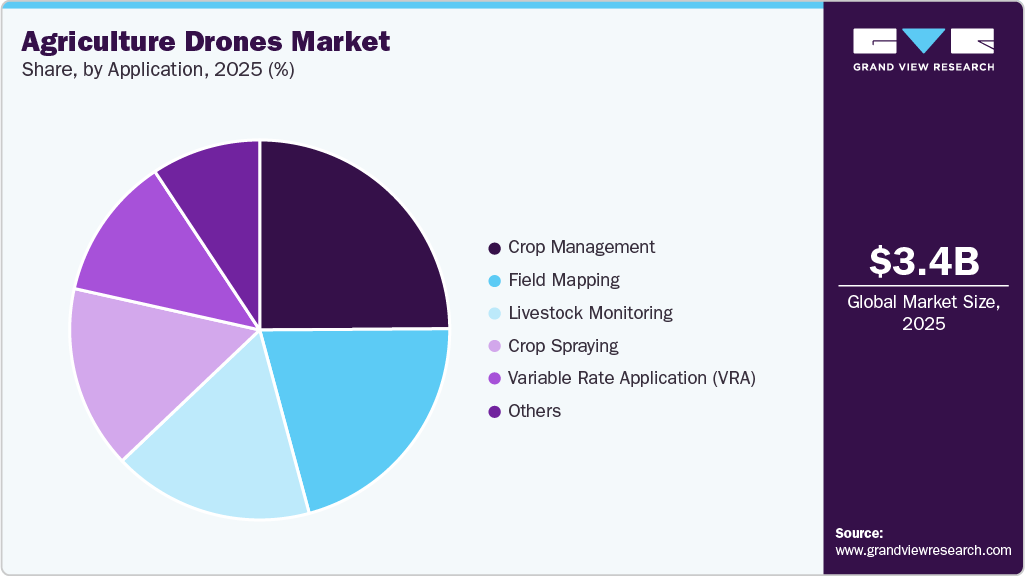
Based on application, the crop management segment led the market with the largest revenue share of 24.9% in 2025. The growing awareness of the need for crop monitoring in the face of climate change is shaping the demand for drones in crop management. As extreme weather events become more frequent, farmers must adapt their practices to mitigate risks and ensure stable yields. Drones assist in monitoring crop conditions during adverse weather events, allowing farmers to assess damage and take corrective actions swiftly. The ability to respond quickly to changing environmental conditions enhances resilience in crop production and contributes to food security in a changing climate.
 To learn more about this report, Download Free Sample Report
 The field mapping segment is expected to grow at a significant CAGR during the forecast period. The rising availability of drone-related software and analytics platforms drives growth in the field mapping segment. These platforms allow farmers to analyze drone data and derive actionable insights easily. With user-friendly interfaces and advanced analytical tools, farmers can interpret their field maps and make data-informed decisions regarding crop management, irrigation, and resource allocation. This accessibility to technology enhances the appeal of drone-based field mapping solutions.
Regional Insights
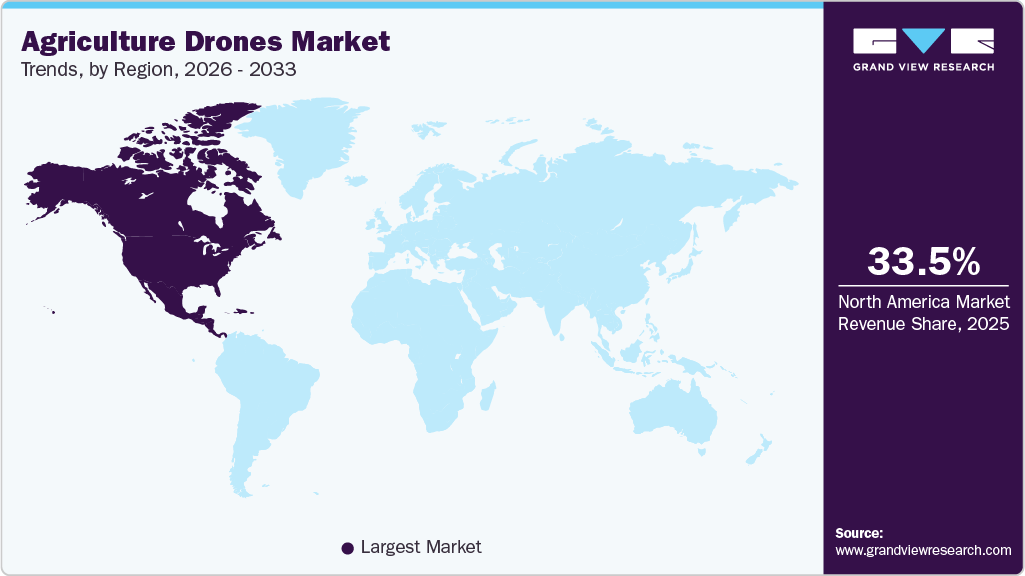
North America dominated the agriculture drones market with the largest revenue share of 33.5% in 2025. The growing popularity of remote sensing technologies is a key factor influencing the agriculture drone market. Drones with various sensors, such as multispectral and thermal imaging, enable farmers to gather detailed information about their crops from above. These remote sensing technologies allow for the monitoring of plant health, moisture levels, and nutrient deficiencies, providing insights that were previously difficult to obtain. As farmers increasingly adopt these technologies to enhance their monitoring capabilities, the demand for drones will continue to grow.
 To learn more about this report, Download Free Sample Report
 U.S. Agriculture Drones Market Trends
The agriculture drones market in the U.S. held the largest share in the North America region in 2025. The U.S. drives the agriculture drones market due to the growing movement toward sustainable agriculture. Farmers increasingly seek ways to minimize their ecological impact as consumers demand more environmentally friendly products. Drones facilitate sustainable practices by enabling precise applications of fertilizers and pesticides, reducing chemical runoff and environmental harm. Furthermore, drones assist in soil health assessments and crop rotation planning, contributing to sustainable land management practices. As sustainability becomes a core focus for the agricultural sector, the use of drones will likely expand.
Europe Agriculture Drones Market Trends
The agriculture drones market in Europe is anticipated to register significant growth from 2026 to 2033. The Europe agriculture drone sector is growing quickly as more farmers and agribusinesses adopt drones for precision farming. This growth is driven by labor shortages, the need to use water, fertilizers, and pesticides more efficiently, and strong government support for smart farming. Drones with sensors, GPS, and AI tools are widely used to monitor crop health, map fields, spray inputs accurately, and forecast yields. These uses help improve farm productivity, reduce input costs, and support sustainable farming. As environmental concerns increase across the Europe, agricultural drones are becoming an important part of modern farm operations.
The UK agriculture drones market is expected to grow rapidly in the coming years. The UK agriculture drone market is growing as more farmers use drones to improve productivity and reduce costs. Drones are mainly used to monitor crop health, map fields, and carry out targeted spraying, especially for cereals, vegetables, and pasture land. Labor shortages and higher farming costs are pushing farmers to adopt automation. Government support for digital and sustainable farming is also boosting adoption. In addition, agri-tech startups offering drone services are making this technology easier for small and mid-sized farms to use.
The agriculture drones market in Germany held a significant market share in 2025. Germany is one of the major markets for agricultural drones in Europe because of its strong focus on modern farming and sustainability. Farmers widely use drones for crop monitoring, soil checking, precision spraying, and yield tracking. Strict environmental rules require accurate use of fertilizers and pesticides, which increases the need for drones. High farm mechanization, good infrastructure, and government support for smart farming are helping drive the rapid growth of drone use across Germany.
Asia Pacific Agriculture Drones Market Trends
The agriculture drones market in Asia Pacific held a significant share in the global market in 2025. Government support and favorable policies promoting the use of technology in agriculture drive market growth. Many governments in the Asia Pacific region recognize drones' potential to revolutionize farming practices. They are implementing policies and initiatives to encourage the adoption of drone technology, including subsidies, training programs, and regulatory frameworks that facilitate drone usage. For instance, countries such as China and India actively promote the integration of drones in agriculture to improve efficiency and sustainability, creating a conducive environment for market growth.
Japan agriculture drones market is expected to grow rapidly in the coming years. Japan is a key market for agriculture drones due to its advanced technology adoption and strong focus on precision farming. Drones are widely used for crop spraying, field monitoring, and yield assessment, especially in rice farming. Labor shortages caused by an aging farming population are a major driver of drone adoption. Government support for smart agriculture and automation is further helping expand the use of drones across Japanese farms.
The agriculture drones market in China held a substantial market share in 2025. Drones are extensively used for spraying pesticides, monitoring crops, and managing large farming areas. Strong government promotion of digital agriculture and food security is driving rapid adoption. The presence of local drone manufacturers and low-cost drone solutions is also making the technology widely accessible to farmers across China.
Key Agriculture Drones Company Insights
Key players operating in the agriculture drones market are undertaking various initiatives to strengthen their presence and increase the reach of their products and services. Strategies such as expansion activities and partnerships are key in propelling the market growth. Key players operating in the agriculture drones industry include DJI, Parrot Drone SAS, AgEagle Aerial Systems Inc., AeroVironment, Inc., PrecisionHawk, Trimble Inc., DroneDeploy, Autel Robotics, Draganfly Inc., Pix4D SA, Sky-Drones Technologies Ltd, Sentera, XAG Co., Ltd., Airpix, Airbots Aerospace Pvt. Ltd. The companies are focusing on various strategic initiatives, including new product development, partnerships & collaborations, and agreements to gain a competitive advantage over their rivals.
Key Agriculture Drones Companies
The following key companies have been profiled for this study on the agriculture drones market.
-
DJI
-
Parrot Drone SAS
-
AgEagle Aerial Systems Inc.
-
AeroVironment, Inc.
-
PrecisionHawk
-
Trimble Inc.
-
DroneDeploy
-
Autel Robotics
-
Draganfly Inc.
-
Pix4D SA
-
Sky-Drones Technologies Ltd
-
Sentera
-
XAG Co., Ltd.
-
Airpix
-
Airbots Aerospace Pvt. Ltd.
Competitive Benchmarking
Category
Operating Strategies
Competitive Edge
Weakness
Established Players (DJI; XAG; Yamaha Motor; Parrot; Trimble Inc.)
Mature players in the agriculture drones market focus on integrated drone and precision farming solutions. They combine aerial imaging, spraying, and field mapping capabilities. Their platforms connect with farm management and analytics systems. They also expand through strong distributor and dealer networks.
Mature players benefit from advanced drone technology and global market presence. Their solutions provide high accuracy in crop monitoring and spraying. Strong R&D supports innovation in automation and data analytics. Established brands help drive adoption among commercial farms.
These companies face high manufacturing and technology development costs. Drone regulations can limit deployment across some regions. Advanced systems may be costly for small and medium-sized farms. Maintenance and pilot training requirements can also slow adoption.
Emerging Players AgEagle Aerial Systems; Hylio; American Robotics; DroneDeploy; PrecisionHawk)
Emerging players focus on autonomous drone operations and AI-driven analytics. They offer drone-based crop scouting, mapping, and spraying services. Many use subscription and drone-as-a-service business models. Their strategy aims to improve affordability and accessibility for farmers.
Emerging players offer flexible, specialized drone solutions for agriculture. Their platforms are easier to deploy and scale across farms. Strong focus on AI improves crop monitoring and field insights. They also adapt quickly to evolving farming requirements.
Emerging players have limited manufacturing scale and global reach. Their solutions often depend on partnerships for distribution and support. Funding limitations can restrict expansion and product development. Lower brand recognition can affect adoption among large farming enterprises.
Recent Developments
-
In December 2025, Jyoti Global Plast launched its new agricultural drone, the AeroCrop UAS, designed to improve efficiency, safety, and accuracy in crop spraying. With over 40 years of experience in plastic and FRP moulding, the company is expanding its presence in the unmanned systems market. Through this product, Jyoti Global Plast aims to solve key challenges faced by Indian farmers and support the wider adoption of precision agriculture in India.
-
In April 2024, DJI, the manufacturer of civilian drones announced the global release of the Agras T50 and T25 drones. The T50 delivers exceptional efficiency for large-scale farming operations, while the T25 drones are designed for greater portability and are suitable for smaller fields. Both drones integrate seamlessly with the enhanced SmartFarm app, providing robust and comprehensive aerial application management capabilities.
-
In July 2023, Pix4D SA launched PIX4Dfields 2.4, an enhanced workflow to facilitate precision application scenarios. With the introduction of Targeted Operations, users could have a more streamlined process for creating personalized prescription maps.
Agriculture Drones Market Report Scope
Report Attribute
Details
Market size in 2025
USD 3.4 billion
Estimated market size in 2026
USD 3.9 billion
Projected market size by 2033
USD 13.2 billion
Growth rate
CAGR of 18.8% from 2026 to 2033
Base year for estimation
2025
Historical data
2021 - 2024
Forecast period
2026 - 2033
Quantitative units
Revenue in USD million/billion and CAGR from 2026 to 2033
Report coverage
Revenue forecast, company market share analysis, competitive landscape, growth factors, and trends
Segments covered
Type, component, farming environment, application, region
Regional scope
North America; Europe; Asia Pacific; Latin America; MEA
Country scope
U.S.; Canada; Mexico; Germany; UK; France; China; Japan; India; South Korea; Australia; Brazil; Saudi Arabia; South Africa; UAE
Key companies profiled
DJI; Parrot Drone SAS; AgEagle Aerial Systems Inc.; AeroVironment, Inc.; PrecisionHawk; Trimble Inc.; DroneDeploy; Autel Robotics; Draganfly Inc.; Pix4D SA; Sky-Drones Technologies Ltd; Sentera; XAG Co., Ltd.; Airpix; Airbots Aerospace Pvt. Ltd
Customization scope
Free report customization (equivalent up to 8 analysts' working days) with purchase. Addition or alteration to country, regional & segment scope.
Pricing and purchase options
Avail customized purchase options to meet your exact research needs. Explore purchase options
Global Agriculture Drones Market Report Segmentation
This report forecasts revenue growth at the global, regional, and country levels and provides an analysis of the latest industry trends in each of the sub-segments from 2021 to 2033. For this study, Grand View Research has segmented the global agriculture dronesmarket report based on type, component, farming environment, application, and region.
-
Type Outlook (Revenue, USD Million, 2021 - 2033)
-
Fixed Wing
-
Rotary Wing
-
-
Component Outlook (Revenue, USD Million, 2021 - 2033)
-
Hardware
-
Frames
-
Flight Control Systems
-
Navigation Systems
-
Propulsion Systems
-
Cameras
-
Sensors
-
Others
-
-
Software
-
Services
-
Professional Services
-
Managed Services
-
-
-
Farming Environment Outlook (Revenue, USD Million, 2021 - 2033)
-
Indoor Farming
-
Outdoor Farming
-
-
Application Outlook (Revenue, USD Million, 2021 - 2033)
-
Crop Management
-
Field Mapping
-
Crop Spraying
-
Livestock Monitoring
-
Variable Rate Application (VRA)
-
Others
-
-
Regional Outlook (Revenue, USD Million, 2021 - 2033)
-
North America
-
U.S.
-
Canada
-
Mexico
-
-
Europe
-
UK
-
Germany
-
France
-
-
Asia Pacific
-
China
-
India
-
Japan
-
South Korea
-
Australia
-
-
Latin America
-
Brazil
-
-
Middle East & Africa
-
UAE
-
Saudi Arabia
-
South Africa
-
-
Research Methodology
Segment Definition
Segment - Type
Revenue capture definition
Fixed Wing
Revenue is generated through the sale and leasing of long-endurance agricultural drones designed for large-scale farm surveillance, crop scouting, and mapping. Additional revenue is captured through software subscriptions for geospatial analytics, flight planning, and precision agriculture insights, particularly among commercial farms and agribusinesses managing extensive land areas.
Rotary Wing
Revenue is primarily captured through drone sales, spraying service contracts, and recurring software subscriptions for autonomous flight operations. These drones are widely used for crop spraying, seeding, and targeted field interventions, creating strong demand from farmers seeking labor reduction and higher application efficiency.
Segment - Component
Revenue capture definition
Hardware
As the largest revenue-generating component, income is captured through the sale of drones, sensors, cameras, GPS modules, LiDAR systems, batteries, and communication equipment. Revenue growth is driven by increasing demand for high-performance UAVs capable of carrying heavier payloads and operating across diverse agricultural environments.
Software
Revenue is earned through subscription-based farm management platforms, drone fleet management software, AI-powered crop analytics, image processing tools, and cloud-based precision agriculture solutions. Vendors increasingly adopt SaaS pricing models that provide recurring revenue streams through data analytics and decision-support capabilities.
Services
Revenue is generated through drone-as-a-service (DaaS) offerings, aerial surveying, spraying services, maintenance contracts, pilot training, consulting, and regulatory compliance support. Many farmers prefer outsourced drone operations, enabling service providers to capture recurring income without requiring farmers to purchase equipment directly.
Segment - Farming Environment
Revenue capture definition
Indoor Farming
Revenue is captured through specialized drone deployments within greenhouses and vertical farms for crop monitoring, environmental assessment, and inventory management. Additional income comes from integrated software solutions that support climate optimization, plant health tracking, and automated facility management.
Outdoor Farming
The dominant farming environment segment captures revenue through drone sales, spraying operations, mapping services, and precision farming solutions across open-field agriculture. Large-scale cultivation of cereals, oilseeds, fruits, and vegetables continues to drive demand for outdoor drone applications and associated software ecosystems.
Segment - Application
Revenue capture definition
Crop Management
Revenue is generated through subscriptions and service contracts for crop health monitoring, pest detection, nutrient assessment, and yield forecasting. AI-enabled analytics and multispectral imaging solutions allow providers to monetize actionable agronomic insights that improve farm productivity and decision-making.
Field Mapping
Revenue is captured through aerial surveying services and software platforms that create high-resolution maps, terrain models, and field boundary assessments. Precision mapping supports farm planning, drainage optimization, and resource allocation, making it a critical application for commercial agriculture.
Crop Spraying
One of the fastest-growing application segments, revenue is earned through drone sales, spraying service fees, and chemical application contracts. Precision spraying reduces input waste and labor dependency, encouraging widespread adoption among growers seeking operational efficiency and regulatory compliance.
Livestock Monitoring
Revenue is generated through drone-enabled animal tracking, grazing management, herd surveillance, and health assessment solutions. Service providers and technology vendors capture value through monitoring platforms that improve livestock productivity while reducing labor and operational costs.
Variable Rate Application (VRA)
Revenue is primarily captured through advanced software platforms, prescription mapping tools, and sensor-enabled drones that enable precise application of fertilizers, pesticides, and seeds. The segment benefits from increasing adoption of precision agriculture practices aimed at maximizing yields while minimizing input costs.
Others
This segment includes applications such as crop insurance assessment, irrigation management, seeding, pollination support, disaster monitoring, and agricultural research. Revenue is generated through a combination of project-based services, specialized software subscriptions, and customized drone deployment contracts tailored to niche farming requirements.
Estimation Model
Agricultural Addressable Layer
Technology Access Layer
Adoption & Utilization Layer
Monetisation Layer
Who can benefit from agricultural drones?
Who can deploy drones in farming operations?
Who actively uses event management software?
How much revenue is generated?
Identify total cultivated farmland, commercial farms, and high-value crop acreage globally to define the potential user base for drone-enabled agriculture.
Apply drone regulation readiness, connectivity infrastructure, mechanization rates, and service-provider availability to determine the digitally and operationally reachable market.
Apply precision farming adoption rates, drone service utilization benchmarks, and farm-size-based deployment trends to convert reachable farms into active drone users.
Assess revenue generation potential by analyzing expenditure on agricultural drone technologies, associated software ecosystems, value-added services, and recurring service contracts across the active user base.
Delivered Customizations
This report has been delivered with the following In-depth customizations
Client Request
Customization Delivered
Value Adds
Precision Agriculture & Crop Monitoring Trends
Conducted a focused analysis of agriculture drone applications covering crop health monitoring, multispectral imaging, NDVI mapping, field scouting, disease detection, and AI-enabled crop analytics across key farming regions.
Helps stakeholders identify high-growth drone applications, evaluate adoption trends in precision agriculture, and assess revenue opportunities in data-driven farm management solutions.
Drone-Based Spraying & Farm Automation Adoption Trends
Evaluated adoption trends for drone-based pesticide spraying, fertilizer application, seed broadcasting, and automated field operations, including integration with precision farming platforms and smart agriculture ecosystems.
Provides insights into operational efficiency improvements, labor-saving opportunities, and commercially attractive use cases supporting agricultural automation strategies.
Agricultural Drone Ecosystem & Smart Farming Opportunities Assessment
Assessed demand for autonomous drone solutions, drone-as-a-service models, and AI-powered farm intelligence platforms, and integrated aerial analytics systems, along with regulatory, operational, and technology adoption challenges.
Supports investment and expansion strategies by identifying underserved agricultural markets, evaluating technology readiness, and strengthening long-term growth opportunities in precision farming and sustainable agriculture.
Frequently Asked Questions About This Report
The global agriculture drones market size was valued at USD 3.4 billion in 2025 and is estimated to reach USD 3.9 billion in 2026.
North America dominated the agriculture drones market, accounting for a 33.5% revenue share in 2025.
The Asia Pacific region is projected to be the fastest-growing market during the forecast period.
The hardware segment accounted for the largest share 49.6% in 2025, and software segment is anticipated to be the fastest-growing deployment model.
The outdoor farming segment held the largest revenue share in 2025, while indoor farming is expected to be the fastest-growing segment.
The global agriculture drones market is expected to grow at a CAGR of 18.8% from 2026 to 2033, reaching USD 13.2 billion by 2033.
The rotary wing segment led the market with a 61.3% revenue share in 2025, while the fixed wing segment is expected to register the fastest growth.
Some key players operating in the agriculture drones market include DJI; Parrot Drone SAS; AgEagle Aerial Systems Inc.; AeroVironment, Inc.; PrecisionHawk; Trimble Inc.; DroneDeploy; Autel Robotics; Draganfly Inc.; Pix4D SA; Sky-Drones Technologies Ltd; Sentera; XAG Co., Ltd.; Airpix; Airbots Aerospace Pvt. Ltd.
Key factors driving the growing adoption of aerial imaging, growing adoption of smart farming and data-driven agriculture practices and growing adoption of drone-as-a-service (DaaS) business models.
About the Author(s)
Next Generation Technologies Research Team
Technology · Next Generation TechnologiesThis report was authored by the next generation technologies research team at Grand View Research - comprising two research analysts, one senior research analyst, and one industry expert - with specialized expertise in the next generation technologies segment of the technology industry. All findings are based on proprietary technology databases, executive interviews, and regulatory analysis, subject to internal peer review prior to publication.
Last Updated:
Speak to Analyst

Customize this report to your needs - add regions, segments, or data points, with 20% free customization.
Or view our licence options:


ISO 9001:2015 & 27001:2022 Certified
We are GDPR and CCPA compliant! Your transaction & personal information is safe and secure. For more details, please read our privacy policy.


