
- Home
- »
- Next Generation Technologies
- »
-
AI Assistant Software Market Size And Share Report, 2033GVR Report cover

AI Assistant Software Market (2026 - 2033)
Size, Share & Trends Analysis Report By Component (Software, Services), By Functionality (Chatbots, Generative AI Assistants, Task-specific Assistants, General-purpose Assistants), By Application, By Region, And Segment Forecasts
Market Size, 2025
$9.8BMarket Estimate, 2026
$11.5BMarket Forecast, 2033
$35.7BCAGR, 2026–2033
17.6%AI Assistant Software Market Summary
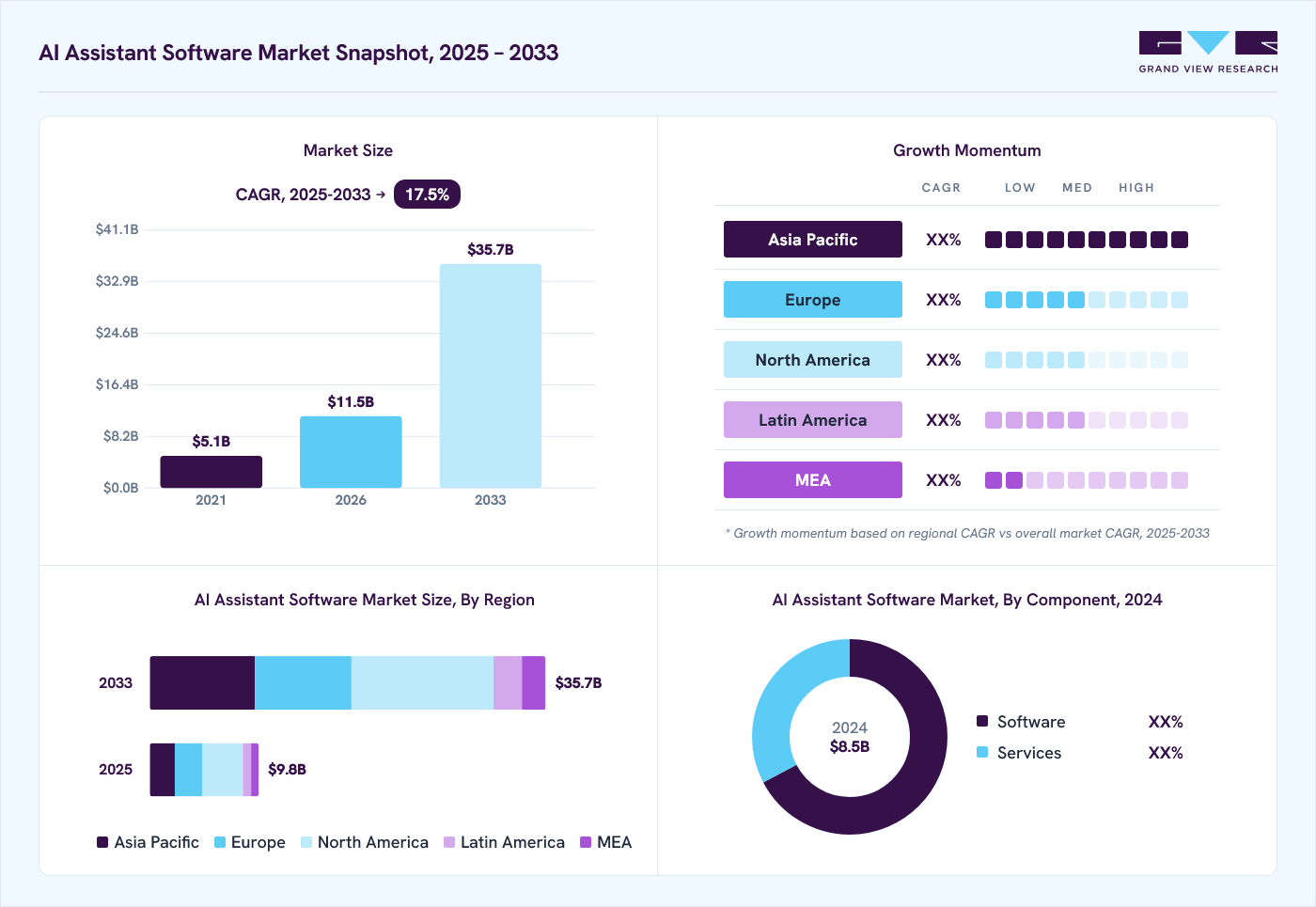
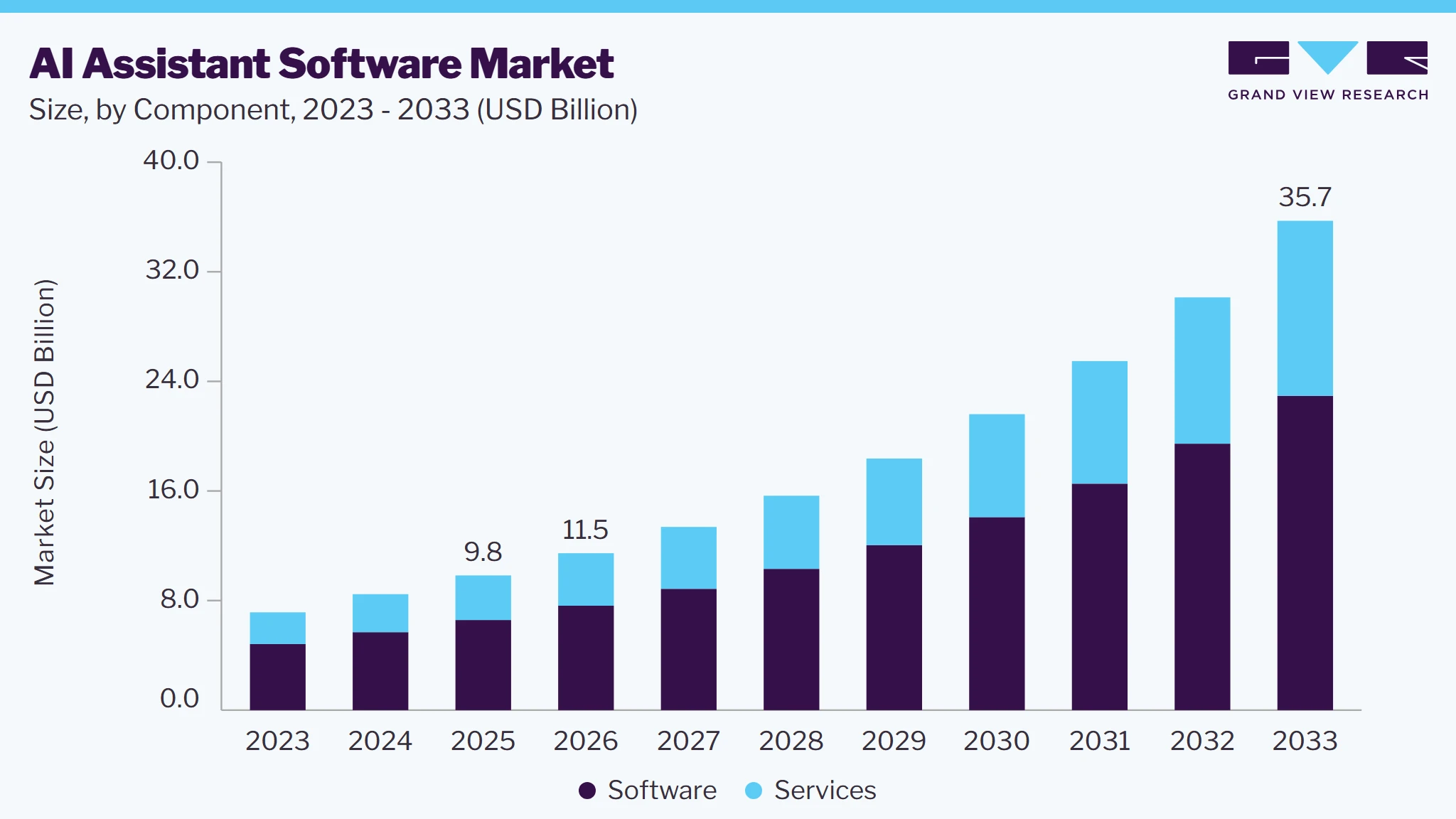
The global AI assistant software market size was valued at USD 9.8 billion in 2025 and is projected to grow from USD 11.5 billion in 2026 to USD 35.7 billion by 2033, at a CAGR of 17.6% from 2026 to 2033. North America dominated the AI assistant software market with the largest revenue share of 37.4% in 2025. The artificial intelligence assistant software industry is experiencing strong growth as enterprises adopt these tools to improve operational efficiency and decision support.
 Source: Grand View Research, IR Documents, Primary Interviews, Paid DatabasesTo learn more about this report,
 Download Free Sample Report
 Key Market Trends & Insights
- By component: Software segment held a significant 66.9% revenue share in 2025.
- By functionality: Chatbots segment led the market with the largest revenue share of 33.7% in 2025.
- By application: Customer Service & Support segment held a significant 34.9% revenue share in 2025.
Regional Highlights
- Largest regional market: North America (37.4% revenue share, 2025)
- Fastest growing regional market: Asia Pacific (highest CAGR, 2026-2033)
- By country: The U.S. held the largest market share in 2025.
Market Size & Forecast
- Market size in 2025: USD 9.8 Billion
- Estimated market size in 2026: USD 11.5 Billion
- Projected market size by 2033: USD 35.7 Billion
- CAGR (2026-2033): 17.6%
Three ways to get this report
Buy it, customize it, or ask a question.Ask an Analyst
A direct answer, usually in 1 working day
- AccessReport author, directly
- Reply timeWithin 1 working day
- No sales callDirect answer only
- FormatEmail reply
- CostFree, no cost
Get the Full Report
What the study covers
- FormatsPDF · Excel · Dashboard
- Timeline2026–2033 annual, 2025 base
- Coverage20+ countries, 5 regions
- Companies10+ key players profiled
Customize the Report
20% free customization
- IncludeCountries, segments, points
- TailorTo your product definition
- ExtendDeeper competitor detail
- OrA fully bespoke study
- Turnaround5–10 working days
The global AI Assistant Software Market is experiencing rapid growth, driven by increasing adoption of generative AI and automation technologies across industries. Organizations are deploying AI assistant software to improve productivity, enhance customer experiences, and automate routine workflows. Advancements in large language models and enterprise AI integration are further supporting market growth.
AI assistant software is evolving from rule-based solutions to systems powered by large language models. These advanced assistants manage complex, open-ended business interactions with greater accuracy and flexibility. They support tasks such as drafting emails, summarizing content, and executing multi-step queries. Generative AI is being embedded into enterprise software to enable large-scale automation of complex business tasks. It allows AI assistants to process natural language inputs, generate contextual responses, and support real-time decision-making. These assistants are powered by large language models trained on diverse datasets and fine-tuned for specific organizational needs.
Organizations are actively deploying AI assistants across functions such as operations, customer support, and IT to improve efficiency, accelerate workflows, and reduce manual effort. For instance, in February 2025, Honeywell International Inc., a U.S.-based technology and manufacturing company, announced the release of its Forge Production Intelligence platform, with a generative AI assistant that helps engineers and plant managers access insights, automate tasks, and resolve issues through natural language prompts. These assistants enhance performance monitoring and support faster, data-driven decisions in industrial operations.
 To learn more about this report, Download Free Sample Report
 In the AI assistant software market, solutions are shifting toward multifunctional capabilities. Assistants now combine natural language interaction, reasoning, and task automation in a single platform. This integration allows users to perform end-to-end activities such as querying, planning, and execution without switching tools. It enhances efficiency across personal, enterprise, and industrial use cases. Market participants are focusing on unified systems to address the growing demand for intelligent, action-oriented assistants. Organizations are actively developing such integrated AI assistant platforms. For instance, in March 2025, Alibaba Group Holding Limited, an e-commerce company in China, launched a version of its AI assistant app powered by its advanced Qwen AI reasoning model, integrating chatbot, deep thinking, and task execution into a single platform. This move demonstrates its effort to compete globally by investing heavily in AI infrastructure and forming strategic partnerships to expand its capabilities.
AI assistant vendors are increasingly adopting hybrid architectures that combine cloud-based large language models (LLMs) with on-device models. This approach enables a balance between computational efficiency and user privacy. Cloud-based models provide the power to handle complex tasks and real-time updates. On-device models support faster responses and function without an active internet connection. This reduces latency and enhances user experience, particularly in mobile and consumer electronics. By processing sensitive data locally, vendors address rising privacy and regulatory concerns. Hybrid deployment also lowers infrastructure costs for frequently used functions. It enables context-aware interactions by storing user preferences on the device. This trend is especially relevant for smartphones, wearables, and embedded systems. Leading companies are integrating this approach into next-generation AI assistant platforms to improve reliability and accessibility.
Market Dynamics
The AI assistant software market is driven by the increasing adoption of artificial intelligence and automation across industries. Organizations are using AI assistant software to improve productivity, streamline business processes, and enhance user experiences. Growing digital transformation initiatives and cloud adoption continue to support market growth. Data privacy concerns, implementation complexities, and regulatory requirements may restrain market expansion. Ongoing advancements in AI technologies and increasing enterprise adoption are expected to create significant growth opportunities during the forecast period.
The growing adoption of generative AI and large language models (LLMs) is a major factor driving the AI Assistant Software Market. Businesses are integrating AI assistants to automate routine tasks and improve operational efficiency. These solutions help users generate content, summarize information, and respond to queries more effectively. Continuous improvements in AI models are enhancing the accuracy and relevance of responses. As a result, organizations across multiple industries are increasing investments in AI assistant software.
Generative AI and LLMs are becoming an integral part of enterprise digital transformation strategies. Organizations are embedding AI assistants into business applications to improve employee productivity and customer engagement. The availability of cloud-based AI services has made deployment more accessible for businesses of different sizes. Technology providers continue to introduce enhanced AI capabilities to support a broader range of business functions. This growing adoption is expected to support sustained expansion of the AI assistant software market over the forecast period.
High implementation and integration costs remain a key challenge for the AI assistant software market. Deploying AI assistant solutions often requires investments in software, infrastructure, and system integration. Organizations may also need to customize these solutions to meet specific business requirements. The overall cost can be higher for enterprises with complex IT environments. These factors may slow adoption, particularly among small and medium-sized businesses.
Integrating AI assistant software with existing enterprise applications can require significant time and technical expertise. Businesses often need to update legacy systems to support AI-enabled capabilities. Employee training and ongoing maintenance further increase deployment costs. Organizations carefully evaluate the expected return on investment before large-scale implementation. As AI technologies become more accessible, implementation costs are expected to decline over the forecast period.
The expansion of AI copilots is creating significant growth opportunities in the AI assistant software market. Organizations are adopting these solutions to improve productivity and simplify everyday business tasks. AI copilots assist users by generating content, providing recommendations, and supporting decision-making. Their integration into enterprise applications is increasing across multiple industries. Growing demand for intelligent workplace tools continues to support market growth.
AI copilots are becoming widely used across software development, sales, and knowledge management functions. They help reduce manual effort and improve the efficiency of routine workflows. Businesses are integrating these solutions with existing enterprise platforms to enhance collaboration and information access. Continuous advancements in AI technologies are expanding the capabilities of AI copilots. This trend is expected to drive further adoption throughout the forecast period.
Market Concentration & Characteristics
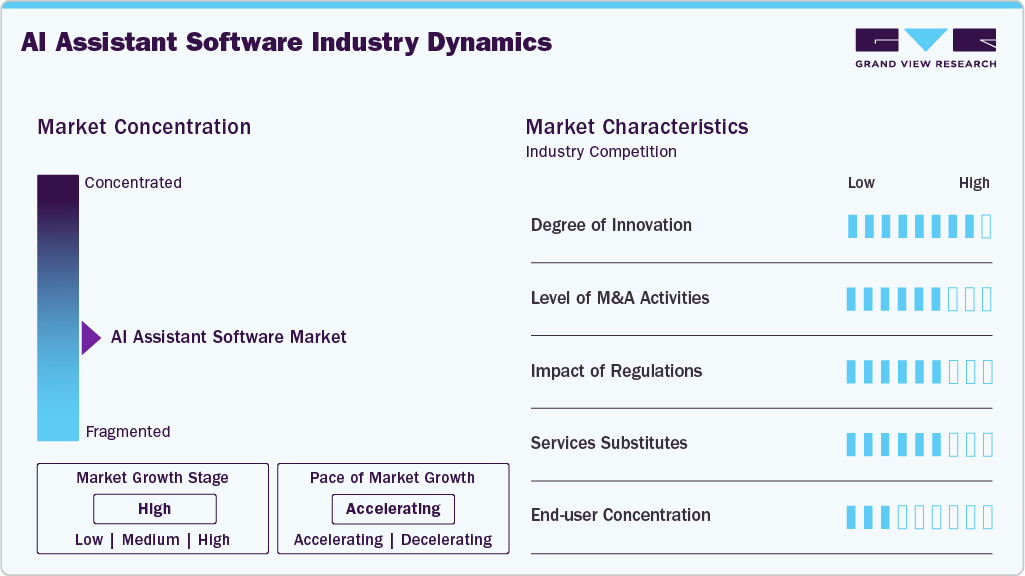
The global AI assistant software market is moderately fragmented, with established technology companies and specialized AI solution providers competing across enterprise and consumer applications. Leading vendors focus on expanding AI capabilities, enhancing product performance, and integrating AI assistants into broader software ecosystems. Continuous product innovation and strategic collaborations remain key competitive factors. The presence of numerous emerging companies further contributes to the competitive landscape. Growing enterprise demand continues to attract new market participants.
 To learn more about this report, Download Free Sample Report
 Market participants are strengthening their product portfolios through partnerships, acquisitions, and cloud-based deployments to expand their market presence. Companies are enhancing the accuracy, functionality, and scalability of AI assistant software to address evolving customer requirements. Increasing demand across enterprises is encouraging vendors to introduce industry-specific AI assistant solutions. As adoption continues to grow, competition is expected to intensify throughout the forecast period.
Analyst Perspective
The AI Assistant Software Market is witnessing strong growth as organizations increasingly adopt AI-powered solutions to improve productivity and automate business processes. Growing digital transformation initiatives and advancements in artificial intelligence are supporting wider adoption across industries. Vendors are focusing on enhancing AI capabilities, expanding integration with enterprise applications, and introducing industry-specific solutions to strengthen their market position. The competitive landscape continues to evolve with established technology providers and emerging vendors introducing innovative offerings. The market outlook remains positive, supported by increasing enterprise adoption and continuous advancements in AI technologies.
Component Insights
Based on component, software segment led the market with a significant revenue share of 66.9%in 2025, due to its foundational role in enabling intelligent system behavior. The core value is derived from advanced algorithms, natural language processing, and reasoning capabilities embedded within the software. Vendors focus on software innovation to improve accuracy, contextual understanding, and response quality. Most performance enhancements and new features are delivered through regular software updates. Subscription-based and license-driven models ensure predictable revenue for vendors. Software platforms are also essential for integrating with third-party applications and APIs.
The services segment is witnessing rapid growth as businesses demand more integration and support for AI deployment. Organizations seek professional services to customize AI assistants according to specific workflows and operational needs. Managed services are becoming crucial for continuous model training, system monitoring, and performance optimization. Consulting services assist clients navigate data privacy, ethical concerns, and industry-specific compliance. With increasing adoption across sectors, service providers are expanding capabilities to handle scale and complexity. The rise of AI-as-a-service models reflects a shift toward recurring support and flexible delivery.
Functionality Insights
Based on functionality, the chatbots segment led the market with the largest revenue share of 33.7% in 2025. Chatbots have historically dominated the AI assistant market due to their early adoption across customer service, e-commerce, and enterprise communication. They are designed for rule-based or scripted interactions, providing structured responses to predefined queries. Their low deployment cost and easy integration into websites and apps have driven widespread use. Businesses have relied on them to handle high volumes of repetitive inquiries with minimal human intervention. Chatbots continue to serve as entry-level automation tools in many industries.
Generative AI assistants are witnessing rapid growth due to advancements in large language models and contextual understanding. These assistants can generate human-like responses, perform multi-step reasoning, and handle complex, unstructured tasks. Similarly, rule-based chatbots, they learn from context and adapt to user inputs dynamically. Their growing use in enterprise productivity, healthcare, education, and creative tasks marks a shift toward intelligent, proactive systems. Organizations are adopting generative assistants to enhance personalization and automate decision support. Investments in generative AI platforms and APIs are accelerating this growth.
Application Insights
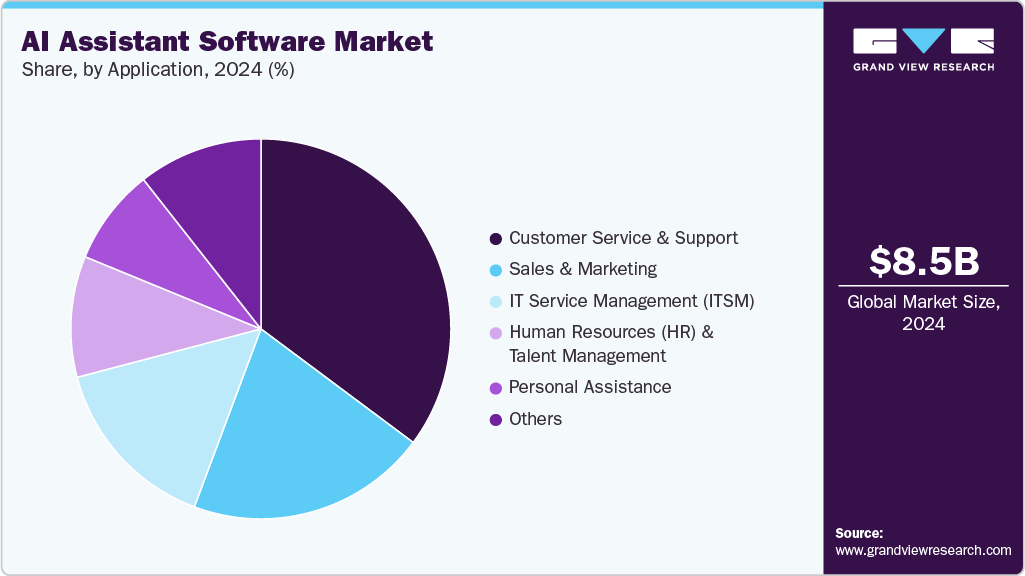
Based on application, the customer service & support segment led the market with a significant revenue share of 34.9% in 2025. Organizations widely use AI to automate responses, resolve queries, and manage high volumes of customer interactions. AI assistants improve response times, reduce operational costs, and maintain service availability 24/7. Rule-based chatbots were the early tools in this space, now being replaced by more intelligent generative assistants. The segment continues to benefit from strong demand across retail, banking, telecom, and travel sectors. Customer satisfaction and operational efficiency remain the key drivers for AI adoption in this domain. The dominance of this use case shows its clear return on investment and scalability.
 To learn more about this report, Download Free Sample Report
 AI assistant adoption is growing steadily in IT Service Management (ITSM) as organizations seek to automate internal support and technical operations. AI assistants help resolve employee IT requests, reset credentials, manage tickets, and provide real-time system diagnostics. This reduces the workload on human support teams and improves resolution times. Integration with ITSM platforms is driving broader adoption across enterprises. Natural language interfaces enable employees to interact with IT systems conversationally, improving usability and efficiency. As enterprise IT environments become more complex, demand for intelligent, self-service support tools is increasing.
Regional Insights
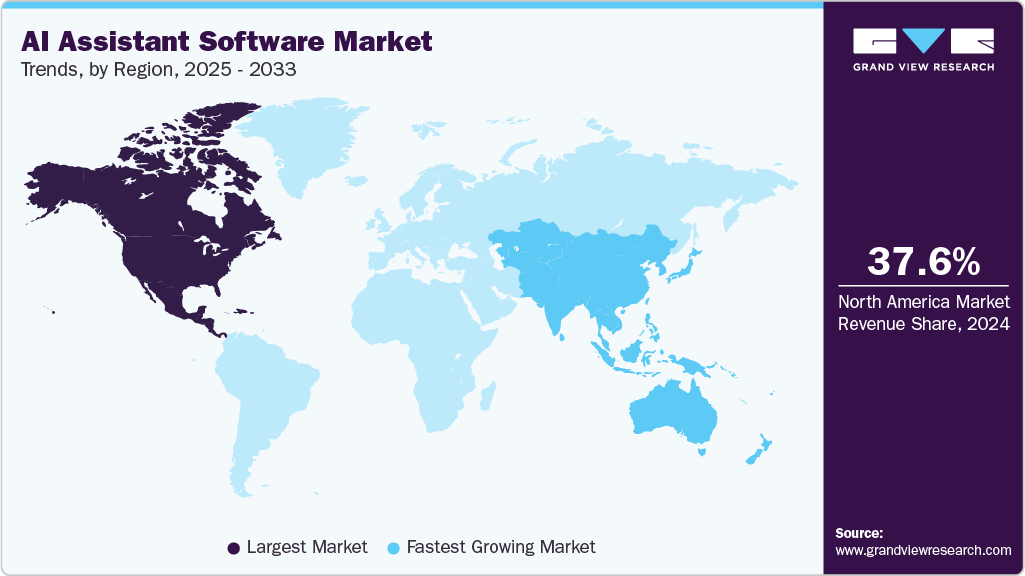
North America dominated the AI assistant software market with the largest revenue share of 37.4% in 2025. This dominance is driven by early technology adoption and high investment in AI infrastructure. Major companies in the region continue to develop advanced assistant platforms across industries. The strong presence of key vendors supports regional growth and innovation. Regulatory support and enterprise digitalization further strengthen the market position.
 To learn more about this report, Download Free Sample Report
 U.S. AI Assistant Software Market Trends
The AI assistant software market in the U.S. held the largest share in the North America region in 2025. High enterprise adoption and strong R&D investments drive sustained growth. Major tech companies continue to release advanced generative AI assistants across sectors. Government initiatives and regulatory clarity support innovation and commercialization. The market benefits from robust cloud infrastructure and a mature digital ecosystem.
Europe AI Assistant Software Market Trends
Europe is witnessing steady growth in AI assistant adoption across the public and private sectors. Emphasis on ethical AI and data privacy is shaping product development. Enterprises are integrating AI assistants into customer support, IT operations, and compliance functions. Regional regulations such as GDPR influence design and deployment strategies. Collaboration between governments and AI vendors is expanding use cases in healthcare, finance, and manufacturing.
Asia Pacific AI Assistant Software Market Trends
Asia Pacific is emerging as the fastest-growing region in the AI assistant software market. Rapid digital transformation and mobile penetration support mass adoption. Local companies are developing region-specific assistants with multilingual capabilities. Government-backed AI initiatives in countries such as China, India, and South Korea are accelerating growth. The region is also attracting significant investments in AI infrastructure and platform development.
Key AI Assistant Software Company Insights
Some of the key companies in the AI Assistant Software industry include Amazon.com, Inc., Apple Inc., Google LLC, IBM Corporation, Meta Platforms, Inc., Microsoft, Oracle, SAP SE, Salesforce, Inc., ServiceNow, Inc. and others. Organizations are focusing on increasing customer base to gain a competitive edge in the industry. Therefore, key players are taking several strategic initiatives, such as mergers and acquisitions, and partnerships with other major companies.
-
Google has developed its generative AI assistant under the Gemini brand, replacing its earlier Bard model. Gemini is integrated into Google Workspace tools such as Gmail, Docs, Sheets, and Meet, providing real-time writing, summarization, and task execution capabilities. It also powers voice interactions on Android devices and enhances search experiences with contextual awareness. Google has focused on making Gemini multimodal, allowing it to process and generate text, images, code, and more.
-
IBM Corporation has advanced its AI assistant offering through Watsonx Assistant, part of the broader Watsonx AI and data platform. The assistant is designed for enterprise environments and supports both voice and chat-based interactions across customer service, IT support, and HR functions. It emphasizes transparency, control, and data privacy, aligning with corporate governance standards. Watsonx Assistant integrates seamlessly with IBM’s automation, cloud, and analytics tools.
Key AI Assistant Software Companies
The following key companies have been profiled for this study on the AI assistant software market.
- Amazon.com, Inc.
- Apple Inc.
- Google LLC
- IBM Corporation
- Meta Platforms, Inc.
- Microsoft
- Oracle
- SAP SE
- Salesforce, Inc.
- ServiceNow, Inc.
Competitive Benchmarking
Operating Strategies
Competitive Edge
Weaknesses
Mature Players: Microsoft, Google LLC, IBM Corporation, Salesforce, Inc.
- Focus on continuous product innovation, expanding enterprise AI capabilities, strengthening cloud ecosystems, forming strategic partnerships, and enhancing industry-specific AI assistant solutions.
- Comprehensive AI portfolios, established enterprise customer base, strong cloud ecosystems, extensive partner networks, and advanced AI research capabilities.
- Higher implementation and maintenance costs, complex integration with enterprise environments, longer product development cycles, and greater compliance and data governance requirements.
Emerging Players: Amazon.com, Inc., Apple Inc., Meta Platforms, Inc.
- Focus on developing differentiated AI features, targeting niche applications, expanding through technology partnerships, improving generative AI capabilities, and increasing market presence through cloud-based offerings.
- Specialized AI solutions, faster product innovation, agile development, niche industry focus, flexible deployment capabilities, strong customization options, and rapid response to evolving customer requirements.
- Limited market presence, smaller customer base, fewer enterprise partnerships, constrained resources for large-scale expansion, and lower brand recognition compared to established vendors.
Recent Developments
-
In June 2024, Apple Inc. launched Apple Intelligence, integrating generative AI across iPhone, iPad, and Mac with features such as writing assistance, image creation, and an upgraded Siri. The company aims to improve user experience through personalized, context-aware AI while maintaining strong privacy standards.
-
In February 2024, Amazon.com, Inc. launched Alexa+, a next-generation AI-powered voice assistant, featuring generative AI, enhanced personalization, multimodal capabilities, and smart task management. The assistant supports document analysis, video understanding, contextual memory, and broader integration with devices and services.
-
In May 2023, SAP SE collaborated with IBM Corporation to integrate IBM Watson artificial intelligence into SAP solutions to enhance user experiences through AI-driven insights and automation. As part of the collaboration, IBM Watson powers SAP’s digital assistant in SAP Start, aiming to improve productivity with natural language capabilities and predictive analytics.
AI Assistant Software Market Report Scope
Report Attribute
Details
Market size in 2025
USD 9.8 billion
Estimated market size in 2026
USD 11.5 billion
Projected market size by 2033
USD 35.7 billion
Growth rate
CAGR of 17.6% from 2026 to 2033
Base year for estimation
2025
Historical data
2021 - 2024
Forecast period
2026 - 2033
Quantitative units
Revenue in USD million/billion and CAGR from 2026 to 2033
Report coverage
Revenue forecast, company ranking, competitive landscape, growth factors, and trends
Segments covered
Component, functionality, application, region
Regional scope
North America; Europe; Asia Pacific; Latin America; MEA
Country scope
U.S.; Canada; Mexico; Germany; UK; France; China; Japan; India; Australia; South Korea; Brazil; KSA; UAE; South Africa
Key companies profiled
Amazon.com, Inc.; Apple Inc.; Google LLC; IBM Corporation; Meta Platforms, Inc.; Microsoft; Oracle; SAP SE; Salesforce, Inc.; ServiceNow, Inc.
Customization scope
Free report customization (equivalent up to 8 analysts' working days) with purchase. Addition or alteration to country, regional & segment scope.
Pricing and purchase options
Avail customized purchase options to meet your exact research needs. Explore purchase options
Global AI Assistant Software Market Report Segmentation
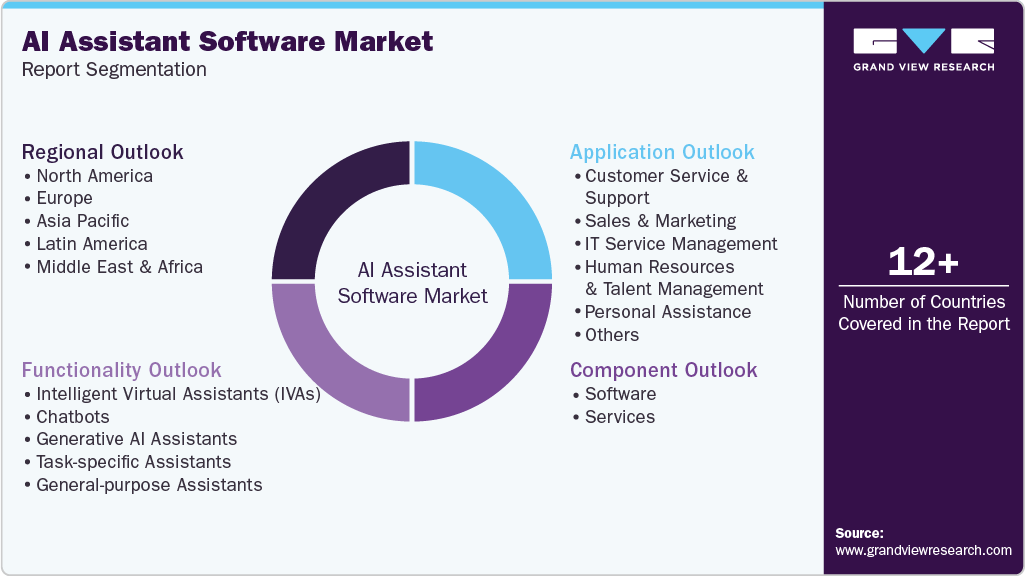
This report forecasts revenue growth at global, regional, and country levels and provides an analysis of the latest industry trends and opportunities in each of the sub-segments from 2021 to 2033. For this study, Grand View Research has segmented the global AI assistant software market in terms of component, functionality, application, and region.
 To learn more about this report, Download Free Sample Report
 -
Component Outlook (Revenue, USD Million, 2021 - 2033)
-
Software
-
Services
-
-
Functionality Outlook (Revenue, USD Million, 2021 - 2033)
-
Intelligent Virtual Assistants (IVAs)
-
Chatbots
-
Generative AI Assistants
-
Task-specific Assistants
-
General-purpose Assistants
-
-
Application Outlook (Revenue, USD Million, 2021 - 2033)
-
Customer Service & Support
-
Sales & Marketing
-
IT Service Management (ITSM)
-
Human Resources (HR) & Talent Management
-
Personal Assistance
-
Others
-
-
Regional Outlook (Revenue, USD Million, 2021 - 2033)
-
North America
-
U.S.
-
Canada
-
Mexico
-
-
Europe
-
UK
-
Germany
-
France
-
-
Asia Pacific
-
China
-
Japan
-
India
-
Australia
-
South Korea
-
-
Latin America
-
Brazil
-
-
Middle East & Africa (MEA)
-
KSA
-
UAE
-
South Africa
-
-
Research Methodology
The AI assistant software market figures in this report are based on a proven research process that combines executive interviews with secondary research from proprietary databases, company filings, and recognized regulatory and institutional sources. Market size is built through value-chain sizing-reconciling supply-side and demand-side estimates-and triangulated with bottom-up and top-down approaches. Every estimate passes multiple levels of expert validation before publication, with each AI assistant software segment quantified using the revenue-capture definitions in the table below.
Segment Definition
Segment - Component
Revenue Capture Definition
Software
Revenue generated from AI assistant software platforms, applications, licenses, and subscription-based solutions that enable conversational AI, task automation, content generation, and intelligent user interactions. It also includes cloud-based AI assistant software deployed across enterprise and consumer environments.
Services
Revenue derived from professional and managed services associated with AI assistant software implementation and lifecycle management. This includes consulting, deployment, system integration, customization, training, technical support, maintenance, and optimization services.
Segment - Functionality
Revenue Capture Definition
Intelligent Virtual Assistants (IVAs)
Revenue generated from AI-powered virtual assistants designed to understand user requests, provide information, automate tasks, and support voice- or text-based interactions across enterprise and consumer applications.
Chatbots
Revenue derived from conversational AI solutions deployed to automate customer interactions, answer queries, provide support, and improve communication across digital channels.
Generative AI Assistants
Revenue earned from AI assistant solutions that generate text, summarize content, create documents, answer complex queries, and assist users with knowledge-based and creative tasks using generative AI technologies.
Task-specific Assistants
Revenue generated from AI assistants developed to perform dedicated business functions, including scheduling, coding assistance, document management, workflow automation, and other specialized tasks.
General-purpose Assistants
Revenue derived from AI assistants designed to support a wide range of personal and enterprise activities, including information retrieval, productivity enhancement, communication, and task management across multiple use cases.
Segment - Application
Revenue Capture Definition
Customer Service & Support
Revenue generated from AI assistant software deployed to automate customer engagement, resolve inquiries, support helpdesk operations, and improve overall customer service efficiency.
Sales & Marketing
Revenue derived from AI assistant solutions used to support lead generation, customer engagement, sales activities, marketing content creation, campaign management, and business communications.
IT Service Management (ITSM)
Revenue earned from AI assistant software implemented to automate IT support, manage service requests, resolve incidents, provide knowledge management, and improve IT operational efficiency.
Human Resources (HR) & Talent Management
Revenue generated from AI assistant solutions used to support recruitment, employee onboarding, workforce management, HR service delivery, and employee engagement activities.
Personal Assistance
Revenue derived from AI assistant applications that help users manage schedules, emails, reminders, documents, communications, and other day-to-day productivity tasks.
Others
Revenue generated from AI assistant software used across additional applications beyond the defined categories, including healthcare, education, finance, legal services, research, and other emerging enterprise and consumer use cases.
Estimation Model
Layer Name
Key Question
Description
End-user Layer
Who creates demand for AI assistant software?
Identifies the total base of organizations and individual users adopting or requiring AI assistant software, including enterprises across industries such as BFSI, healthcare, retail, IT & telecom, manufacturing, education, government, and other commercial sectors.
Adoption / Usage Layer
Who actively adopts AI assistant software?
Filters the total addressable market based on digital transformation initiatives, AI adoption maturity, automation requirements, cloud adoption, workforce productivity goals, and enterprise demand for intelligent assistants across business functions.
Application & Functionality Layer
Where is AI assistant software deployed?
Estimates AI assistant software adoption across applications including customer service & support, sales & marketing, IT service management (ITSM), human resources (HR) & talent management, personal assistance, and other use cases through intelligent virtual assistants, chatbots, generative AI assistants, task-specific assistants, and general-purpose assistants.
Revenue Capture Layer
How is revenue generated in the AI Assistant Software ecosystem?
Calculates revenue generated from AI assistant software platforms, subscription-based and cloud-based solutions, implementation and integration services, consulting, customization, training, maintenance, technical support, and other professional services associated with AI assistant software deployment.
Delivered Customizations
This report has been delivered with the following In-depth customizations
Client Objective
Custom Research Modules Delivered
Strategic Value / Business Impact
Market Entry & Expansion Assessment
Regional demand sizing and forecasting
Customer segmentation and adoption analysis
Competitive landscape benchmarking
Regulatory and deployment assessment
Identified high-growth market opportunities
Supported go-to-market strategy development
Highlighted expansion priorities and risks
Enabled data-driven market entry planning
Product Positioning & Competitive Intelligence
Product benchmarking and feature comparison
Pricing and value proposition analysis
Customer preference assessment
Competitor strategy evaluation
Improved product differentiation
Supported pricing strategy optimization
Identified unmet customer requirements
Strengthened competitive positioning
Customer & End-User Insights Study
Enterprise adoption and usage analysis
Customer journey mapping
Satisfaction assessment
Workflow and pain-point evaluation
Identified adoption drivers and barriers
Supported customer-centric product development
Improved customer engagement strategies
Identified opportunities for product enhancement
Frequently Asked Questions About This Report
Some key players operating in the AI assistant software market include Amazon.com, Inc., Apple Inc., Google LLC, IBM Corporation, Meta Platforms, Inc., Microsoft, Oracle, SAP SE, Salesforce, Inc., and ServiceNow, Inc.
Key factors driving the market growth include rising demand for automation in business processes, increasing adoption of AI technologies across industries, growing use of virtual assistants for customer support, and advancements in natural language processing capabilities.
The global AI assistant software market size was valued at USD 8.5 billion in 2024 and is estimated at USD 11.5 billion for 2026.
The global AI assistant software market is expected to grow at a CAGR of 17.6% from 2025 to 2033, reaching USD 35.7 billion by 2033.
Software segment led the market with a significant revenue share of 66.9%in 2025.
The chatbots segment led the market with the largest revenue share of 33.7% in 2025.
The customer service & support segment led the market with a significant revenue share of 34.9% in 2025.
Asia Pacific is the fastest-growing region over the forecast period.
North America dominated the AI assistant software market with the largest revenue share of 37.4% in 2025.
About the Author(s)
Next Generation Technologies Research Team
Technology · Next Generation TechnologiesThis report was authored by the next generation technologies research team at Grand View Research - comprising two research analysts, one senior research analyst, and one industry expert - with specialized expertise in the next generation technologies segment of the technology industry. All findings are based on proprietary technology databases, executive interviews, and regulatory analysis, subject to internal peer review prior to publication.
Last Updated:
Speak to Analyst

Customize this report to your needs - add regions, segments, or data points, with 20% free customization.
Or view our licence options:


ISO 9001:2015 & 27001:2022 Certified
We are GDPR and CCPA compliant! Your transaction & personal information is safe and secure. For more details, please read our privacy policy.


