
- Home
- »
- Next Generation Technologies
- »
-
AI And Automation In Banking Market Report, 2026-2033GVR Report cover

AI And Automation In Banking Market (2026 - 2033)
Size, Share & Trends Analysis Report By Automation Type (Robotic Process Automation, Intelligent Automation, Hyper Automation), By Deployment, By Application, By End Use, By Region, And Segment Forecasts
Market Size, 2025
$42.6BMarket Estimate, 2026
$50.5BMarket Forecast, 2033
$239.6BCAGR, 2026–2033
24.9%AI And Automation In Banking Market Summary
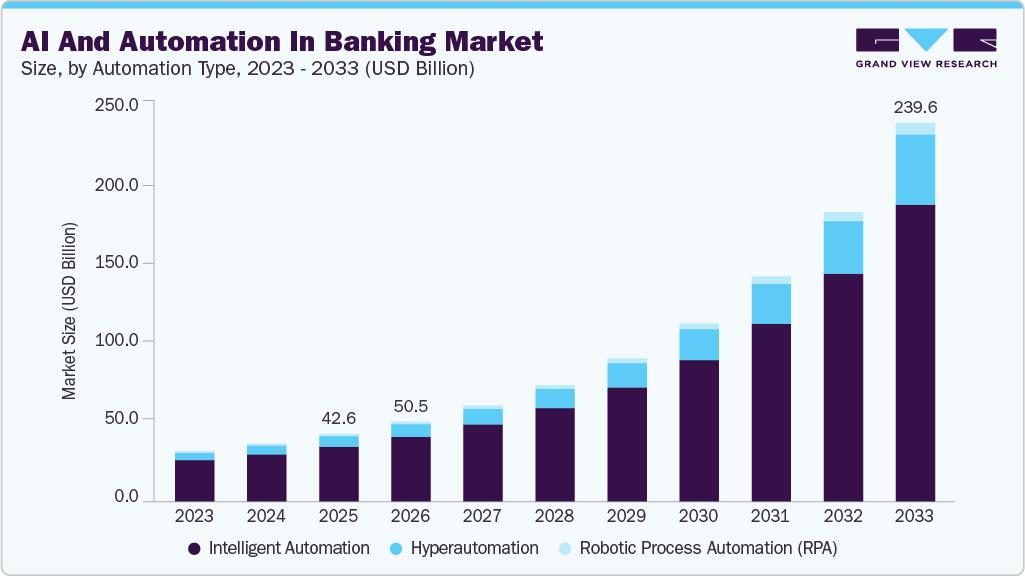
The global AI and automation in banking market size was valued at USD 42.6 billion in 2025 and is projected to grow from USD 50.5 billion in 2026 to USD 239.6 billion by 2033, at a CAGR of 24.9% from 2026 to 2033. North America held the largest share, at 37.8%, of the global market in 2025. The increasing pressure on banks to improve operational efficiency and control costs is driving the adoption of AI and automation.
 Source: Grand View Research, IR Documents, Primary Interviews, Paid DatabasesTo learn more about this report,
 Download Free Sample Report
 Key Market Trends & Insights
- By automation type: Intelligent automation segment held the largest market share of 81.2% in 2025.
- By deployment: Hybrid segment accounted for the largest market share in 2025.
- By application: Risk management segment held a significant share in 2025.
- By end use: Commercial banks segment held the largest market share in 2025.
Regional Highlights
- Largest regional market: North America (37.8% revenue share, 2025)
- Fastest-growing regional market: Asia Pacific (27.7% CAGR, 2026-2033)
- By country: The U.S. held a dominant market position in 2025.
Market Size & Forecast
- Market size in 2025: USD 42.6 Billion
- Estimated market size in 2026: USD 50.5 Billion
- Projected market size by 2033: USD 239.6 Billion
- CAGR (2026-2033): 24.9%
Three ways to get this report
Buy it, customize it, or ask a question.Ask an Analyst
Analyst response in 1 business day
- AccessReport author, directly
- Reply timeWithin 1 working day
- No sales callDirect answer only
- FormatEmail reply
- CostFree, no cost
Get the Full Report
What the study covers
- FormatsPDF · Excel · Dashboard
- Timeline2026–2033 annual, 2025 base
- Coverage20+ countries, 5 regions
- Companies10+ key players profiled
Customize the Report
20% free customization
- IncludeCountries, segments, points
- TailorTo your product definition
- ExtendDeeper competitor detail
- OrA fully bespoke study
- Turnaround5–10 working days
Banks operate in a highly competitive environment with tightening margins, rising compliance costs, and increasing customer expectations. To remain profitable, financial institutions are focusing on streamlining internal processes, reducing manual intervention, and eliminating inefficiencies. AI-powered automation helps banks achieve these goals by accelerating routine operations and minimizing operational waste. AI and automation deliver substantial efficiency gains in back-office functions such as transaction processing, reconciliations, reporting, and customer onboarding, which have traditionally been resource-intensive. Technologies such as robotic process automation (RPA) and AI-driven workflow systems help banks reduce processing time and error rates while lowering dependence on large operational teams. Reflecting this impact, insights referenced by the Reserve Bank of India (RBI) indicate that the adoption of generative AI has the potential to improve operational efficiency in Indian banks by up to 46%, underscoring the scale of cost savings achievable through automation.Beyond process automation, artificial intelligence (AI) enhances operational efficiency by improving decision-making and optimizing resources. Advanced analytics and machine learning models analyze large volumes of operational data in real time to identify inefficiencies, forecast workloads, and proactively manage risks. These capabilities enable banks to optimize staffing, reduce system downtime, and avoid unplanned operational costs, further reinforcing the business case for AI-led transformation across banking operations.
 To learn more about this report, Download Free Sample Report
 In addition, AI-driven automation supports cost optimization by reducing errors and improving regulatory compliance outcomes. Manual processes are prone to inaccuracies, often resulting in financial losses, remediation expenses, and regulatory penalties. AI-based systems improve accuracy across fraud detection, compliance monitoring, and risk assessment. By minimizing operational errors and ensuring consistent compliance with regulatory requirements, banks can significantly reduce compliance-related costs, positioning AI and automation as critical enablers of long-term operational efficiency and cost optimization in the banking sector.
Cybersecurity risks and data privacy concerns restrain the growth of AI and automation in the banking market. Banks handle vast volumes of sensitive financial and personal data, making them prime targets for cyberattacks such as data breaches, ransomware, and identity theft. The increasing reliance on AI-driven systems and automated processes expands the digital attack surface, raising concerns among banks about potential vulnerabilities that could compromise customer trust and financial stability.
Automation Type Insights
The intelligent automation segment accounted for the largest share, at 81.2%, in 2025. The growing need for operational efficiency, improved customer experience, and stronger regulatory compliance is accelerating the adoption of intelligent automation in the banking industry. Intelligent automation combines traditional automation technologies with artificial intelligence capabilities such as machine learning, natural language processing, intelligent document processing, and predictive analytics. Unlike standalone RPA, it enables banking systems to process semi-structured and unstructured data, interpret contextual information, and support decision-intensive workflows.
The hyperautomation segment is expected to grow at the fastest CAGR during the forecast period. The increasing complexity of banking operations and the need to automate end-to-end processes at scale are fueling the adoption of hyperautomation in the AI and automation market for banking. Hyperautomation is an advanced, holistic approach that integrates multiple technologies to systematically identify automation opportunities, redesign workflows, deploy intelligent bots, and continuously monitor and optimize performance. Moving beyond isolated task automation, it enables banks to address complex, interconnected processes such as lending, KYC, payments reconciliation, trade finance, and regulatory compliance.
Deployment Insights
The hybrid segment dominated the market in 2025. Stringent data security, data residency, and regulatory compliance requirements are driving the adoption of hybrid deployment models in the AI and automation market in banking. Hybrid deployment combines on-premise infrastructure with cloud-based automation solutions, enabling banks to balance innovation, scalability, and regulatory control. This model allows institutions to retain sensitive customer data and mission-critical workloads on-premise while leveraging cloud platforms for advanced analytics, AI model training, and non-critical automation processes.
The cloud segment is projected to grow at the fastest CAGR over the forecast period. The growing demand for scalability, rapid innovation, and cost-efficient IT infrastructure is fueling the adoption of cloud-based AI and automation in the banking market. Cloud deployment refers to delivering automation platforms and AI solutions via public or private cloud infrastructure, enabling banks to access elastic computing resources, faster implementation cycles, and more flexible cost structures than traditional on-premises models. Banks increasingly adopt cloud-based automation to support real-time analytics, intelligent document processing, AI-driven fraud detection, and digital customer service automation.
Application Insights
The risk management segment held a significant share in 2025. Increasing market volatility, heightened regulatory scrutiny, and the growing complexity of financial risks are driving the adoption of risk management automation in the banking sector. Risk management automation applies AI, analytics, and automation technologies to identify, assess, and mitigate financial, operational, and credit risks. Automated systems analyze large volumes of structured and unstructured data to support credit evaluation, portfolio monitoring, stress testing, and exposure analysis. AI-driven models enable real-time risk detection and early warning signals, improving decision-making under dynamic market conditions.
The loan underwriting segment is expected to grow at the fastest CAGR over the forecast period. The growing need to accelerate loan processing while maintaining accurate credit risk assessment is fueling the growth of the segment. Loan underwriting automation applies AI, analytics, and automation technologies to assess borrower creditworthiness, verify documentation, and streamline loan approval processes. Automated underwriting systems analyze financial data, alternative data sources, and historical performance to enable accurate and consistent credit decisions. These solutions significantly reduce manual intervention, shorten turnaround times, and enhance customer experience across retail, SME, and corporate lending segments.
End Use Insights
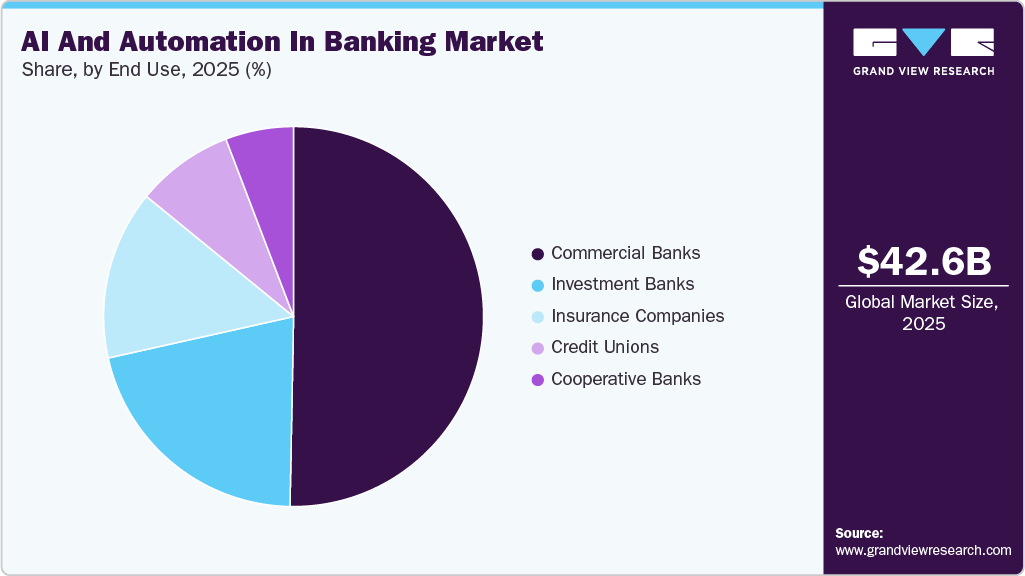
The commercial banks segment held the largest share in the market in 2025. The large-scale, transaction-intensive nature of operations and the need to improve efficiency while meeting regulatory requirements are positioning commercial banks as the leading end-user segment in AI and automation in the banking industry. Commercial banks deploy automation across both retail and corporate banking functions, including customer onboarding, lending, payments processing, compliance, and customer service. AI and automation enable these institutions to handle high transaction volumes, enhance service delivery, and reduce operational costs. Automation also supports digital transformation initiatives by modernizing legacy systems and improving end-to-end process efficiency.
 To learn more about this report, Download Free Sample Report
 The credit unions segment is projected to grow at the fastest CAGR over the forecast period. The need to improve cost efficiency, enhance member experience, and remain competitive with larger financial institutions is accelerating the adoption of AI and automation among credit unions. Credit unions leverage AI and automation to modernize operations, strengthen member services, and improve risk and compliance management. Given their relatively smaller scale of operations, scalability and efficient resource utilization are critical considerations driving adoption. Automation supports key functions such as member onboarding, loan servicing, customer service, and compliance monitoring. AI-driven tools further enable improved credit assessment, fraud detection, and personalized member engagement.
Regional Insights
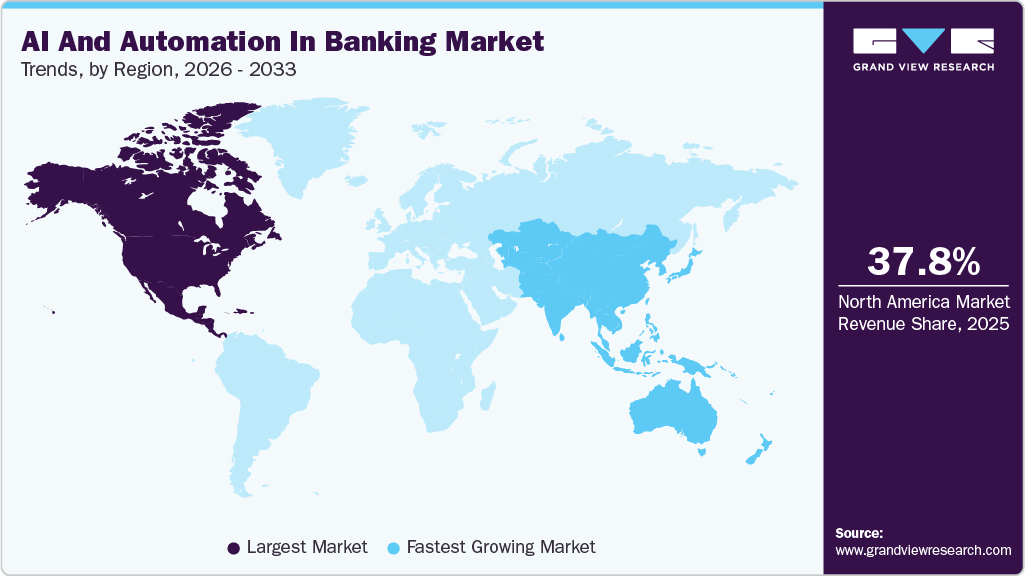
North America's AI and automation in banking market accounted for 37.8% of the overall market in 2025. The North America AI and automation in banking market held a significant share in 2025. The development and deployment of AI-powered financial tools that strengthen core banking and treasury functions are driving the growth of AI and automation in the banking sector across North America. Banks in the region are increasingly adopting intelligent solutions to improve cash flow forecasting, liquidity management, risk assessment, and real-time financial visibility.
 To learn more about this report, Download Free Sample Report
 U.S. AI And Automation In Banking Market Trends
The AI and automation market in the U.S. banking sector held a dominant position in 2025. The growing investment by financial institutions in AI and next-generation technology initiatives is accelerating the adoption of AI and automation in the U.S. banking sector. Banks are allocating larger technology budgets toward advanced analytics, machine learning, intelligent automation, and cloud-based platforms to modernize legacy systems and improve scalability.
Europe AI And Automation In Banking Market Trends
The AI and automation market in the banking sector in Europe was identified as a lucrative region in 2025. Strategic collaboration between banks and global technology partners is accelerating the growth of AI and automation in the European banking sector. By partnering with leading technology providers, cloud platforms, and consulting firms, banks can rapidly develop and deploy advanced AI solutions that modernize core banking systems and enable large-scale digital transformation.
The UK AI and automation in the banking industry is expected to grow rapidly in the coming years. The introduction of AI-powered financial assistants and intelligent digital tools is fueling the growth of AI and automation in the banking sector in the UK. Banks are increasingly deploying these solutions to enhance digital customer engagement by offering real-time support, personalized financial insights, and proactive guidance on spending, saving, and budgeting.
Asia Pacific AI And Automation In Banking Market Trends
The AI and automation market in the banking sector in Asia Pacific is expected to grow at the fastest CAGR of 27.7% over the forecast period. The growth of AI and automation in banking across the Asia Pacific region is driven by a combination of strategic partnerships, process automation, and institution-led innovation tailored to local market needs. Banks in the region are increasingly collaborating with global and regional AI technology providers to access advanced capabilities while adapting solutions to country-specific regulatory, operational, and customer requirements.
Japan AI and automation in Japan's banking industry is expected to grow rapidly in the coming years. The formation of long-term strategic partnerships between major banks and specialized AI innovators to build AI systems is driving the growth of AI and automation in the banking market in Japan. Rather than relying solely on off-the-shelf solutions, Japanese banks are increasingly collaborating with advanced AI developers to create customized systems that align with their unique operational requirements, data environments, and regulatory expectations.
China held the largest share of the Asia-Pacific AI and automation in banking market. The adoption of AI-powered customer service and training solutions through partnerships between banks and specialized AI technology firms is driving the growth of AI and automation in the banking market in China.
Key AI And Automation In Banking Companies Insights
Some of the key companies in the AI and automation in banking market include Nintex, Pegasystems Inc., Capgemini SE, Sutherland, Itrex Group, and others. Organizations are focusing on increasing the customer base to gain a competitive edge in the industry. Therefore, key players are taking several strategic initiatives, such as mergers and acquisitions, as well as partnerships with other major companies.
-
Nintex is a provider of workflow automation, process orchestration, and low-code platforms that enable organizations to digitize and optimize business operations across departments. The company focuses on simplifying complex processes through configurable, user-friendly automation tools. Nintex supports banks with end-to-end workflow automation, forms and document digitization, and intelligent document processing. Its solutions are widely applied in account opening, loan approvals, compliance workflows, and customer onboarding, helping banks reduce manual intervention, improve auditability, and accelerate turnaround times.
-
Pegasystems is an enterprise software provider offering low-code platforms for workflow automation, case management, and real-time decisioning. The company is known for enabling large organizations to orchestrate complex, customer-centric processes. Pegasystems plays a critical role in AI-driven process automation and decision management, supporting customer service automation, credit decisioning, dispute resolution, collections, and personalized engagement. Its use of process AI and real-time analytics allows banks to optimize operational efficiency while improving customer experience across digital and assisted channels.
Key AI And Automation In Banking Companies:
The following key companies have been profiled for this study on the AI and automation in banking market.
- Nintex
- Tungsten Automation Corporation
- Pegasystems Inc.
- Capgemini SE
- Sutherland
- Itrex Group
- BoTree Technologies
- AutomationEdge
- Automation Anywhere, Inc.
- Fortra, LLC
Recent Developments:
-
In January 2026, Automation Anywhere, a provider of Agentic Process Automation (APA), unveiled advanced AI-native agentic solutions developed in partnership with OpenAI to enable enterprises to achieve more autonomous operations and faster time-to-value. The integration combines Automation Anywhere's Process Reasoning Engine (PRE), which securely orchestrates actions across enterprise systems, with OpenAI's advanced reasoning models, creating a complete reasoning-to-action loop where AI interprets and reasons. It executes governance workflows across finance, HR, IT, and customer service.
-
In December 2025, Pegasystems Inc. announced expanded agentic/AI compliance and client lifecycle management capabilities (agentic compliance/CLM enhancements) to automate onboarding, document workflows and regulated decisioning, directly relevant to KYC/AML and onboarding automation in banks.
AI And Automation In Banking Market Report Scope
Report Attribute
Details
Market size in 2025
USD 42.6 billion
Estimated market size in 2026
USD 50.5 billion
Projected market size by 2033
USD 239.6 billion
Growth rate
CAGR of 24.9% from 2026 to 2033
Base year for estimation
2025
Historical data
2021 - 2025
Forecast period
2026 - 2033
Quantitative units
Revenue in USD million/billion and CAGR from 2026 to 2033
Report coverage
Revenue forecast, company ranking, competitive landscape, growth factors, and trends
Segments covered
Automation type, deployment, application, end use, region
Regional scope
North America; Europe; Asia Pacific; Latin America; MEA
Country scope
U.S.; Canada; Mexico; Germany; UK; France; Spain; China; Japan; India; South Korea; Australia; Brazil; KSA; UAE; South Africa
Key companies profiled
Nintex; Tungsten Automation Corporation; Pegasystems Inc.; Capgemini SE; Sutherland; Itrex Group; BoTree Technologies; AutomationEdge; Automation Anywhere, Inc.; Fortra, LLC
Customization scope
Free report customization (equivalent up to 8 analysts working days) with purchase. Addition or alteration to country, regional & segment scope.
Pricing and purchase options
Avail customized purchase options to meet your exact research needs. Explore purchase options
Global AI And Automation In Banking Market Report Segmentation
This report forecasts revenue growth at the global, regional, and country levels and provides an analysis of the latest industry trends in each of the sub-segments from 2021 to 2033. For this study, Grand View Research has segmented the global AI and automation in banking market report based on automation type, deployment, application, end use, and region.
-
Automation Type Outlook (Revenue, USD Billion, 2021 - 2033)
-
Robotic Process Automation (RPA)
-
Intelligent Automation
-
Hyper automation
-
-
Deployment Outlook (Revenue, USD Billion, 2021 - 2033)
-
Cloud
-
Hybrid
-
On-premise
-
-
Application Outlook (Revenue, USD Billion, 2021 - 2033)
-
Customer Service Automation
-
Risk Management
-
Fraud Detection and Prevention
-
Compliance Management
-
Loan Underwriting
-
Others
-
-
End Use Outlook (Revenue, USD Billion, 2021 - 2033)
-
Commercial Banks
-
Investment Banks
-
Cooperative Banks
-
Insurance Companies
-
Credit Unions
-
-
Regional Outlook (Revenue, USD Billion, 2021 - 2033)
-
North America
-
U.S.
-
Canada
-
Mexico
-
-
Europe
-
Germany
-
UK
-
France
-
-
Asia Pacific
-
China
-
Japan
-
India
-
South Korea
-
Australia
-
-
Latin America
-
Brazil
-
-
Middle East and Africa (MEA)
-
KSA
-
UAE
-
South Africa
-
-
Frequently Asked Questions About This Report
Asia Pacific is the fastest-growing regional market and is expected to grow at a CAGR of 27.7% during the forecast period.
The intelligent automation segment led the market with an 81.2% share in 2025, while the hyperautomation segment is expected to grow at the fastest CAGR during the forecast period.
The hybrid segment held the largest market share in 2025, while the cloud segment is projected to grow at the fastest CAGR over the forecast period.
The risk management segment held a significant market share in 2025, while the loan underwriting segment is expected to grow at the fastest CAGR during the forecast period.
The commercial banks segment held the largest market share in 2025, while the credit unions segment is projected to grow at the fastest CAGR over the forecast period.
The global AI and automation in banking market size was valued at USD 42.6 billion in 2025 and is estimated at USD 50.5 billion for 2026.
The global AI and automation in banking market is expected to grow at a CAGR of 24.9% from 2026 to 2033, reaching USD 239.6 billion by 2033.
North America dominated the market with a 37.8% revenue share in 2025.
Some of the key players operating in the AI and automation in banking market include Nintex, Tungsten Automation Corporation, Pegasystems Inc., Capgemini SE, Sutherland, Itrex Group, BoTree Technologies, AutomationEdge, Automation Anywhere, Inc., and Fortra, LLC.
Key factors driving the AI and automation in banking market include the increasing pressure on banks to improve operational efficiency, reduce costs, automate routine processes, enhance decision-making through AI-driven analytics, optimize regulatory compliance, and improve customer service through intelligent automation technologies.
About the Author(s)
Next Generation Technologies Research Team
Technology · Next Generation TechnologiesThis report was authored by the next generation technologies research team at Grand View Research - comprising two research analysts, one senior research analyst, and one industry expert - with specialized expertise in the next generation technologies segment of the technology industry. All findings are based on proprietary technology databases, executive interviews, and regulatory analysis, subject to internal peer review prior to publication.
Last Updated:
Speak to Analyst

Customize this report to your needs - add regions, segments, or data points, with 20% free customization.
Or view our licence options:


ISO 9001:2015 & 27001:2022 Certified
We are GDPR and CCPA compliant! Your transaction & personal information is safe and secure. For more details, please read our privacy policy.


