
- Home
- »
- Medical Devices
- »
-
AI In Dentistry Market Size, Share, Growth Report, 2026-2033GVR Report cover

AI In Dentistry Market (2026 - 2033)
Size, Share & Trends Analysis Report By Solution Type (AI-Powered Diagnostic Software, AI-Powered Treatment Planning Software), By Technology, By Clinical Application, By Deployment Mode, By End User, By Region, And Segment Forecasts
Market Size, 2025
$1.3BMarket Estimate, 2026
$1.6BMarket Forecast, 2033
$6.6BCAGR, 2026–2033
22.7%AI In Dentistry Market Summary
The global AI in dentistry market size was valued at USD 1.3 billion in 2025 and is projected to grow from USD 1.6 billion in 2026 to USD 6.6 billion by 2033, at a CAGR of 22.7% from 2026 to 2033. Europe dominated the market with the largest revenue share of 32.4% in 2025. The market growth is driven by the increasing adoption of digital dentistry, rising demand for accurate diagnosis, and expanding use of AI in imaging, orthodontics, and implant planning.
 Source: Grand View Research, IR Documents, Primary Interviews, Paid DatabasesTo learn more about this report,
 Download Free Sample Report
 Key Market Trends & Insights
- By solution type: AI-powered diagnostic software segment led the market with the largest revenue share of 42.0% in 2025.
- By technology: Computer vision segment led the market with the largest revenue share of 31.4% in 2025.
- By clinical application: General dentistry segment led the market with the largest revenue share of 31.8% in 2025.
- By deployment mode: Cloud-based segment led the market with the largest revenue share of 75.1% in 2025.
- By end user: Dental clinics segment led the market with the largest revenue share of 68.6% in 2025.
Regional Highlights
- Largest regional market: Europe (32.4% revenue share, 2025)
- Fastest-growing regional market: Asia Pacific (highest CAGR, 2026-2033)
- By country: Germany dominated the market in Europe in 2025.
Market Size & Forecast
- Market size in 2025: USD 1.3 Billion
- Estimated market size in 2026: USD 1.6 Billion
- Projected market size by 2033: USD 6.6 Billion
- CAGR (2026-2033): 22.7%
Three ways to get this report
Buy it, customize it, or ask a question.Ask an Analyst
A direct answer, usually in 1 working day
- AccessReport author, directly
- Reply timeWithin 1 working day
- No sales callDirect answer only
- FormatEmail reply
- CostFree, no cost
Get the Full Report
What the study covers
- FormatsPDF · Excel · Dashboard
- Timeline2026–2033 annual, 2025 base
- Coverage20+ countries, 5 regions
- Companies10+ key players profiled
Customize the Report
20% free customization
- IncludeCountries, segments, points
- TailorTo your product definition
- ExtendDeeper competitor detail
- OrA fully bespoke study
- Turnaround5–10 working days
Integration with CBCT, intraoral scanners, and CAD/CAM systems, along with workflow automation and improved treatment outcomes, is further driving market growth. In addition, the market is driven by the increasing collaborations between AI technology providers, dental device manufacturers, and oral healthcare companies to integrate AI into everyday clinical workflows. These partnerships enable continuous integration of AI with dental imaging systems, treatment planning software, and preventive care solutions, helping clinicians improve diagnostic accuracy, streamline workflows, and support evidence-based decision-making. To learn more about this report, Download Free Sample Report
 AI-powered solutions are also enhancing patient communication, enabling earlier disease detection, and promoting minimally invasive treatment approaches. For instance, in August 2025, VideaHealth and vVARDIS expanded their collaboration to integrate AI-powered early caries detection with the drill-free Curodont Repair Fluoride Plus treatment. The integrated workflow has helped more than 400,000 patients receive early intervention for dental caries by enabling same-day diagnosis and treatment, improving preventive care adoption, and demonstrating the growing role of AI in routine clinical practice.
“We founded VideaHealth to bring clinical clarity and consistency to every dental visit. This partnership demonstrates what’s possible when AI is used to strengthen and not replace clinical decision-making,” said Florian Hillen, CEO of VideaHealth. “In our collaboration with vVARDIS, we’re helping to create a world where early detection and drill-free treatment are the standards rather than the exception.”
U.S. FDA Regulatory Approvals for AI-Based Dental Devices (2021-2026):
Date of Final Decision
Submission Number
Device
Company
Panel (Lead)
3/5/2026
K252538
CEPHX3D
Orca Dental AI, Ltd.
Radiology
9/19/2025
K251002
Videa Dental AI
VideaHealth Inc.
Radiology
5/17/2024
DEN230035
DentalMonitoring
Dental Monitoring SAS
Dental
5/16/2024
K233625
RAYDENT SW
RAY Co., Ltd.
Dental
2/21/2024
K232148
X-Guide Surgical Navigation System
X-Nav Technologies, LLC
Dental
1/31/2024
K231396
CEPHX - Cephalometric Analysis Software
Orca Dental AI Ltd.
Radiology
12/15/2023
K232384
Videa Dental Assist
VideaHealth, Inc.
Radiology
5/19/2021
K210187
Overjet Dental Assist
Overjet, Inc.
Radiology
Source: U.S.FDA
The table highlights major U.S. FDA-cleared AI devices for the dentistry market between 2021 and 2026, showcasing advancements in AI-powered dental diagnostics, orthodontic monitoring, cephalometric analysis, imaging software, and implant navigation. These regulatory clearances demonstrate the increasing adoption of artificial intelligence in clinical dentistry, supporting improved diagnostic accuracy, treatment planning, workflow efficiency, and patient outcomes across diverse dental applications.
 To learn more about this report, Download Free Sample Report
 Traditional dentistry relies on manual interpretation of dental images, clinician experience, and paper- or software-based documentation, which can result in variability in diagnosis, longer treatment planning, and inconsistent clinical outcomes. In contrast, AI-powered dentistry leverages technologies such as deep learning, computer vision, and cloud-based platforms to automate image analysis, support treatment planning, standardize diagnostic decisions, streamline documentation, and enhance patient communication. These capabilities improve diagnostic accuracy, operational efficiency, and workflow integration while enabling remote monitoring and more personalized dental care.
AI-Driven Oral Health Insights from the Pearl Oral Health Index:
Category
Key Findings (2026)
Study Overview
Pearl analyzed 26 million dental X-rays, 15 million patients, and 737 million individual teeth, creating the first large-scale radiographic census of U.S. oral health.
Untreated Dental Decay
AI analysis found that untreated dental decay is 4.5× higher than estimates reported by the U.S. CDC NHANES survey.
Decay Detection
Average decayed teeth per patient were Pearl 6.07 compared with 0.7 reported by NHANES, representing an 8.7× higher detection rate.
Missing Teeth Validation
Pearl reported 2.16 missing teeth per patient, closely matching NHANES (2.0), validating the AI methodology.
Restored Teeth
Average restored teeth per patient reached 7.01, closely aligned with NHANES (6.0).
Young Adults (18-24 Years)
More than 52% of dental disease remained untreated, representing the highest level of untreated disease among all age groups.
Older Adults (75+ Years)
Individuals aged 75 years and older had 19.14 affected teeth (out of 28), while only 28% of disease remained untreated, indicating greater treatment management.
Lowest Disease Burden
Hawaii recorded the lowest disease burden with 9.63 affected teeth and the lowest calculus prevalence (45.0%).
Highest Disease Burden
Delaware showed the highest disease burden with 14.22 affected teeth and 62.6% calculus prevalence.
Highest Tooth Extraction Rate
Kansas reported the highest extraction rate, with nearly 1 in 10 affected teeth extracted rather than restored.
Practice Diagnostic Variation
AI identified a 4× variation in detected affected teeth between high- and low-diagnosing dental practices (12.4 vs. 3.1 teeth per patient).
Gender-Based Dental Visits
Women represented 56.2% of dental patients compared with 43.8% for men, indicating women were 28% more likely to visit a dentist.
U.S. vs. U.K. Comparison
U.S. patients averaged 2.16 missing teeth, compared with 6.36 in the U.K. The extraction rate was 14.5% in the U.S. versus ~31% in the U.K., reflecting differences in healthcare systems.
Source: Pearl Inc.
Market Dynamics
The AI in dentistry market is experiencing strong growth due to the increasing adoption of digital dentistry and the rising demand for accurate, efficient, and standardized diagnosis. AI-powered solutions are transforming dental workflows by enabling automated image analysis, early disease detection, clinical decision support, and personalized treatment planning across specialties such as orthodontics, implantology, endodontics, periodontics, and restorative dentistry. The market is further driven by the integration of AI with CBCT systems, intraoral scanners, CAD/CAM platforms, electronic dental records, and cloud-based practice management software, improving workflow efficiency and patient outcomes. In addition, the growing prevalence of oral diseases, increasing investments in digital dental infrastructure, expansion of DSOs, and continuous advancements in machine learning, computer vision, and generative AI are expected to support sustained market growth during the forecast period.
The increasing adoption of AI-assisted dental imaging is a major driver of the AI in dentistry market. Dental clinics and hospitals are integrating AI with digital imaging systems such as CBCT, panoramic X-rays, and intraoral radiography to improve diagnostic accuracy and clinical efficiency. AI automatically detects dental caries, periodontal bone loss, periapical lesions, and other oral abnormalities, reducing interpretation time and supporting evidence-based treatment planning. AI also enhances consistency across clinicians and improves patient communication through visual diagnostic reports.
The limited availability of large, diverse, and high-quality annotated dental datasets remains a significant restraint for the AI in dentistry market. AI models require extensive clinical data from different populations, imaging systems, and dental conditions to achieve reliable performance. However, variations in image quality, inconsistent annotation standards, fragmented data sources, and patient privacy regulations restrict access to comprehensive datasets. These challenges can reduce algorithm accuracy, limit generalizability across clinical settings, and increase the time and cost required for AI development, validation, and regulatory approval, particularly for smaller AI developers.
The growing focus on preventive and minimally invasive dentistry presents a significant opportunity for AI in dentistry market. AI enables the early detection of dental caries, periodontal disease, and other oral conditions before they progress, allowing clinicians to provide timely preventive treatment and improve long-term oral health outcomes. Increasing awareness of preventive dental care, combined with the expansion of digital dentistry in emerging economies, is expected to accelerate AI adoption.
Market Concentration & Characteristics
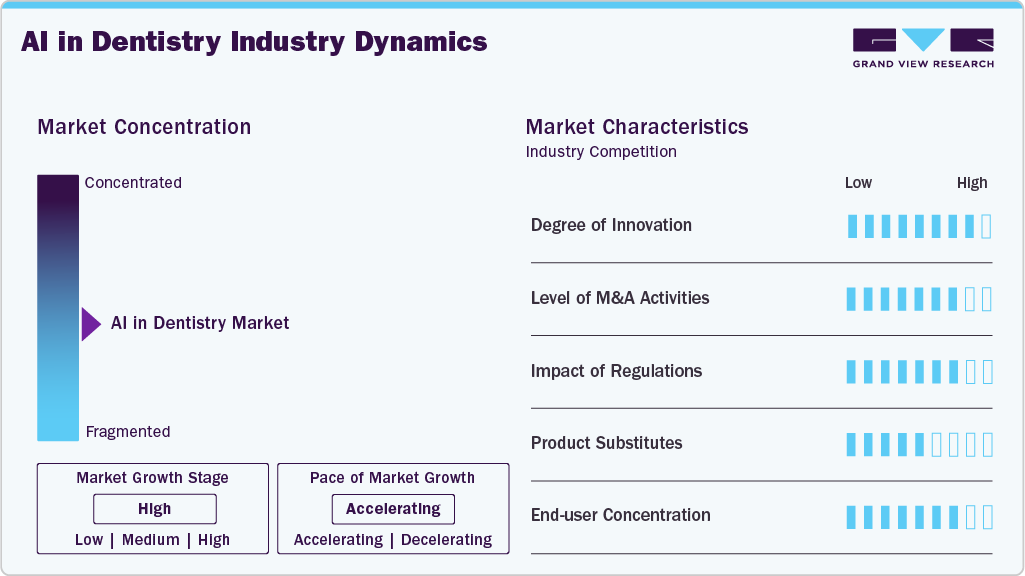
The AI in dentistry market is characterized by a high degree of innovation, driven by rapid advancements in machine learning, computer vision, generative AI, and cloud-based digital dentistry. AI is integrated with CBCT systems, intraoral scanners, CAD/CAM platforms, and practice management software to create connected digital workflows. For instance, in May 2025, Pearl became the first dental AI company to receive FDA clearance for both 2D and 3D dental image analysis, extending AI capabilities to CBCT imaging and strengthening AI-assisted diagnosis in dental practices.
 To learn more about this report, Download Free Sample Report
 “Pearl’s mission has always been to deliver the most advanced and clinically trusted AI solutions in dentistry,” said Ophir Tanz, founder and CEO of Pearl. “Becoming the first company to achieve FDA clearance for both 2D and 3D radiologic analysis isn’t just a milestone for us-it’s a milestone for dentistry.”
The AI in dentistry market has witnessed moderate to high strategic collaboration, partnership, and acquisition activity as companies expand their AI-enabled digital dentistry portfolios. AI developers are partnering with imaging companies, dental software providers, and DSOs to integrate AI into routine clinical workflows. For instance, in September 2025, Dentsply Sirona partnered with Pearl to integrate Pearl’s Second Opinion AI software into the DS Core cloud platform, enabling AI-assisted analysis of 2D dental X-rays. The collaboration enhanced radiologic support by improving detection of conditions such as early-stage caries and bone loss while strengthening patient communication through AI-generated visual annotations and measurements.
“This collaboration with Dentsply Sirona brings our vision of accessible, trustworthy dental AI to an even broader global audience,” said Ophir Tanz, CEO of Pearl. “By embedding Second Opinion directly into DS Core, we’re giving clinicians seamless access to AI insights that strengthen their diagnostic confidence, improve patient communication, and ultimately elevate the standard of care across every practice.”
AI-powered dental software is regulated as Software as a Medical Device (SaMD), making regulatory approval a critical factor for commercialization. Manufacturers must comply with requirements related to clinical validation, algorithm performance, cybersecurity, data privacy, quality management systems, and post-market monitoring. In major markets, AI solutions require regulatory clearance before commercial deployment.
The AI in dentistry market faces moderate competition from traditional diagnostic methods, manual radiographic interpretation, and conventional dental software without AI functionality. Many dental practices continue to rely on clinician expertise for image interpretation and treatment planning, particularly where digital infrastructure is limited. However, AI offers significant advantages by improving diagnostic consistency, reducing interpretation time, supporting clinical decision-making, and enhancing patient communication. As digital dentistry adoption increases, AI-enabled solutions are gradually replacing conventional manual workflows in advanced dental practices.
Demand for AI in dentistry solutions is highly concentrated among dental clinics, multispecialty dental hospitals, DSOs, specialty dental centers, and academic institutions. Organizations with high patient volumes and advanced digital infrastructure are the primary adopters because AI improves diagnostic consistency, workflow efficiency, and treatment planning. Large DSOs are deploying AI across multiple locations to standardize clinical decision-making. For instance, in June 2026, Smile Brands partnered with Pearl to deploy its Radiographic AI platform across its dental network following a successful pilot. The rollout improved diagnostic consistency, patient communication, and same-day treatment acceptance, supporting higher-quality dental care.
Analyst Perspective
The AI in dentistry market is expected to grow steadily, driven by the increasing adoption of digital dentistry, rising demand for accurate diagnosis, and growing use of AI-powered imaging and treatment planning solutions. AI is being widely adopted in dental radiology, orthodontics, implantology, and restorative dentistry to improve diagnostic accuracy, automate image analysis, and support clinical decision-making. The market is also benefiting from greater integration of AI with CBCT systems, intraoral scanners, CAD/CAM platforms, and practice management software. Increasing investments in digital dental infrastructure and the expansion of specialty dental clinics are further supporting market growth. Companies that offer clinically validated, easy-to-use, and interoperable AI solutions while ensuring regulatory compliance, data security, and seamless workflow integration will be well positioned to strengthen their market presence and achieve long-term growth.
Solution Type Insights
The AI-powered diagnostic software segment dominated the AI in dentistry market, accounting for 42.0% of the market in 2025. This dominance is supported by the growing adoption of AI-assisted radiographic analysis, increasing demand for early and accurate detection of dental diseases, widespread integration with digital imaging systems, rising FDA-cleared diagnostic solutions, and the need to improve clinical efficiency, diagnostic consistency, and treatment planning. For instance, in March 2025, Align Technology launched Align X-ray Insights across the European Union and the UK, an AI-powered computer-aided detection (CADe) software that automatically analyzes 2D dental radiographs. The solution enhances diagnostic accuracy and supports more efficient clinical decision-making in digital dentistry.
The AI-powered patient communication & engagement software segment in the AI in dentistry market is expected to grow at the fastest rate during the forecast period due to the increasing adoption of AI-driven patient engagement platforms, automated appointment scheduling, personalized treatment communication, virtual assistants, multilingual support, and digital follow-up solutions that enhance patient experience, improve treatment acceptance, and strengthen practice efficiency. For instance, in August 2025, 3Shape launched the TRIOS 6 intraoral scanner with AI-assisted Dx Plus diagnostic software to enhance dental examinations through AI-powered diagnostics. The solution improves disease detection, streamlines diagnostic workflows, and strengthens communication between dentists and patients.
Technology Insights
The computer vision segment dominated the AI in dentistry market, accounting for 31.4% of the market in 2025. This dominance is supported by the widespread preference for AI-assisted dental image analysis, increasing adoption of digital radiography and CBCT systems, growing use of automated detection of caries and periodontal diseases, and the integration of computer vision algorithms into diagnostic, orthodontic, and treatment planning workflows to improve accuracy and clinical efficiency.
The generative AI segment in the AI in dentistry market is expected to grow at the fastest rate during the forecast period due to the increasing adoption of AI-powered clinical documentation, automated treatment recommendations, patient communication tools, personalized treatment planning, report generation, and workflow automation. Growing investments in cloud-based AI platforms and the integration of generative AI into dental practice management systems are further accelerating segment growth. For instance, in December 2024, the American Dental Association (ADA) made a strategic investment in Pearl's dental AI platform to support the advancement of AI in dentistry. The investment highlights the ADA's commitment to accelerating AI-driven innovations that improve diagnostic accuracy, patient care, and clinical outcomes.
Clinical Application Insights
The general dentistry segment dominated the AI in dentistry market, accounting for 31.8% of the market in 2025. This dominance is supported by the widespread use of AI for routine dental examinations, radiographic interpretation, caries detection, periodontal disease assessment, and treatment planning. Increasing adoption of digital imaging systems, growing patient volumes, and the need for improved diagnostic accuracy and workflow efficiency have further strengthened the segment's market position.
The implant dentistry segment in the AI in dentistry market is expected to grow at the fastest rate during the forecast period due to the increasing demand for dental implants, rising adoption of CBCT-guided implant planning, AI-assisted 3D anatomical analysis, surgical navigation technologies, and digital treatment planning. Growing integration of AI with CAD/CAM workflows and implant simulation software is further driving market growth by improving precision, reducing procedural risks, and enhancing clinical outcomes.
Deployment Mode Insights
The cloud-based segment dominated the AI in dentistry market, accounting for 75.1% of the market in 2025. This dominance is supported by the widespread adoption of Software-as-a-Service (SaaS) platforms, seamless integration with digital imaging systems, remote access to patient records and AI analytics, automatic software updates, lower upfront infrastructure costs, and the growing preference among dental clinics and DSOs for scalable, interoperable, and subscription-based AI solutions.
The on-premise segment in the AI in dentistry market is expected to grow at a significant rate during the forecast period due to increasing demand from large hospitals, academic dental centers, and multi-site healthcare organizations requiring greater control over sensitive patient data, compliance with internal cybersecurity and data privacy policies, integration with existing IT infrastructure, and customization of AI applications for specialized clinical workflows.
End User Insights
The dental clinics segment dominated the AI in dentistry market, accounting for 68.6% in 2025. This dominance is driven by the high volume of routine dental examinations, widespread adoption of AI-powered diagnostic software and digital imaging systems, increasing use of cloud-based practice management platforms, and the continued expansion of private and multi-location dental clinic networks. For instance, in April 2026, Eka Dental Care announced plans to expand its network to 25+ clinics by FY2027, extending beyond the Mumbai Metropolitan Region into Pune and Bengaluru. The company is also developing a proprietary AI platform for treatment planning and patient management, highlighting the growing investment in AI-enabled digital workflows as dental clinic networks scale across India.
 To learn more about this report, Download Free Sample Report
 The Dental Service Organizations (DSOs) segment of the AI in dentistry market is expected to grow at a significant rate during the forecast period. Growth is driven by the rapid expansion of DSO networks, increasing consolidation of dental practices, rising investments in standardized AI-enabled clinical workflows, and the adoption of centralized cloud-based practice management systems. AI solutions enable DSOs to improve diagnostic consistency, operational efficiency, patient communication, and scalable practice management across multiple locations.
Regional Insights
North America accounted for the significant share of the AI in dentistry market in 2025, supported by the strong presence of leading AI developers, dental technology companies, and large DSOs. The region benefits from advanced digital healthcare infrastructure, high healthcare spending, and rapid commercialization of AI-enabled dental solutions. In addition, increasing collaborations between AI companies and organized dental networks are accelerating AI adoption across routine clinical practice.
U.S. AI In Dentistry Market Trends
The U.S. AI in dentistry market is growing due to the strong presence of AI innovators, increasing partnerships between oral healthcare companies and digital health providers, and rising adoption of virtual dental care. Companies are integrating artificial intelligence with telehealth platforms to improve access to early diagnosis, preventive care, and patient engagement. For instance, in July 2025, Sunstar Americas partnered with Dentistry.One to launch GUM Virtual Care, providing consumers across the U.S. with AI-powered oral health scans and 24/7 virtual dental consultations. This partnership expands access to AI-enabled preventive dentistry while supporting early detection of oral health conditions and demonstrating the growing commercialization of AI-driven dental care services in the U.S.
Europe AI In Dentistry Market Trends
The Europe AI in dentistry market is witnessing steady growth due to increasing investments in healthcare digitalization, strong research activities in artificial intelligence, and favorable regulatory frameworks supporting AI-based medical technologies. Countries such as Germany, France, Italy, Spain, and the UK are expanding digital dental infrastructure while universities and research institutes continue developing clinically validated AI solutions for dental diagnostics and treatment planning.
 To learn more about this report, Download Free Sample Report
 Germany dominated the AI in dentistry market in Europe in 2025, driven by increasing healthcare digitalization, rising adoption of advanced dental technologies, and growing awareness of the benefits of artificial intelligence in clinical practice. Germany has a well-established healthcare system and a strong network of dental clinics, research institutions, and technology companies, creating a favorable environment for the development and adoption of AI-based solutions. The increasing use of digital imaging, intraoral scanning, CAD/CAM systems, and electronic dental records is also generating opportunities for AI integration across dental workflows.
The UK market is expanding due to the high prevalence of oral diseases and growing government focus on improving oral healthcare. The UK AI in dentistry market is growing due to the high prevalence of oral diseases, increasing focus on preventive dentistry, and rising adoption of AI-enabled diagnostic technologies for early disease detection. In January 2026, according to the Oral Health Foundation, 41% of UK adults have untreated tooth decay, 9% show signs of severe gum disease, and 23.7% of five-year-old children in England have obvious tooth decay. In addition, there are approximately 10,825 new cases of mouth cancer annually in the UK. The substantial burden of oral diseases is encouraging dental providers to adopt AI-assisted imaging and diagnostic solutions to improve early detection, clinical decision-making, and preventive care, supporting continued growth of the UK AI in dentistry market.
Asia Pacific AI In Dentistry Market Trends
The Asia Pacific AI in dentistry market is expected to register the fastest growth due to rapid expansion of dental healthcare infrastructure, increasing government investments in healthcare digitalization, and rising awareness of advanced dental care. Growing private investments in multispecialty dental clinics, expanding dental chains, and increasing demand for cosmetic and restorative dentistry are further accelerating AI adoption across the region.
The China AI in dentistry market is witnessing strong growth due to rapid expansion of digital dental infrastructure, increasing investments by global dental technology companies, and the country's growing focus on advanced dental manufacturing and digital workflows. Rising adoption of AI-enabled imaging, CAD/CAM systems, and smart dental technologies across private clinics and hospitals is further accelerating market development. For instance, in April 2026, Ivoclar Vivadent signed an agreement to establish its first manufacturing facility in mainland China, with a Phase I investment of USD 10 million to build an automated dental medical device production line in Shanghai Xinzhuang Industrial Park. This investment is expected to strengthen China's digital dentistry ecosystem, support the adoption of AI-integrated dental technologies, and enhance the availability of advanced dental solutions across the country.
Latin America AI In Dentistry Market Trends
The Latin America AI in dentistry market is growing due to increasing oral disease prevalence, improving access to dental care, and expanding dental tourism. Countries such as Brazil are investing in modern dental clinics and digital technologies to attract international patients seeking implantology and cosmetic dentistry. These investments are creating favorable opportunities for AI-assisted diagnostics and digital treatment planning.
Brazil is one of the world's leading destinations for dental tourism, supported by a large network of private dental clinics and internationally recognized dental professionals. Growing investments in digital dentistry and increasing adoption of AI-enabled diagnostic technologies are helping clinics improve treatment quality and operational efficiency while serving both domestic and international patients.
MEA AI In Dentistry Market Trends
The Middle East & Africa AI in dentistry market is experiencing steady growth due to increasing government investments in healthcare modernization, expansion of private dental hospitals, and national digital health initiatives. Countries such as Saudi Arabia and the UAE are implementing healthcare transformation programs, including Saudi Vision 2030 and the UAE Digital Health Strategy, which encourage the adoption of artificial intelligence across healthcare services, including dentistry. These initiatives, combined with improving dental infrastructure and increasing awareness of preventive oral healthcare, are expected to support long-term market growth.
Key AI In Dentistry Company Insights
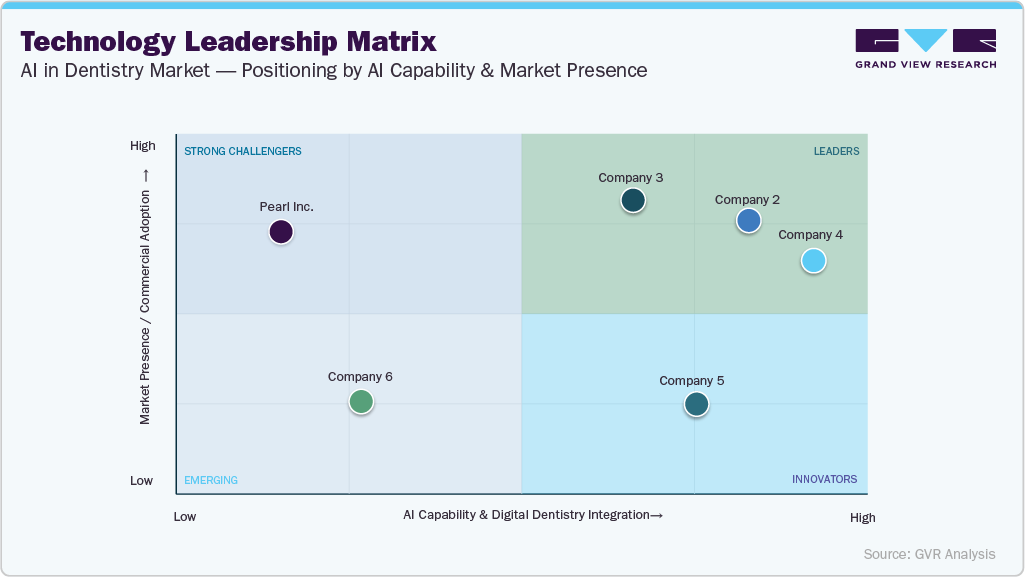
Some of the key companies in the AI in dentistry market include Pearl Inc., Align Technology, Inc., VideaHealth, Diagnocat, Planmeca Oy, Dentsply Sirona, DentalMonitoring, Angelalign Technology Inc., Overjet, CD Newco, LLC, Henry Schein One, LLC., Bola Technologies Inc., and Yapi Inc. Organizations are focusing on increasing customer base to gain a competitive edge in the industry. Therefore, key players are taking several strategic initiatives, such as product launch, and partnerships with other major companies.
Competitive Positioning Matrix
 To learn more about this report, Download Free Sample Report
 Key AI In Dentistry Companies:
The following key companies have been profiled for this study on the AI in dentistry market
-
Overjet
-
Pearl Inc.
-
3Shape
-
Align Technology, Inc.
-
Angelalign Technology Inc.
-
Bola AI
-
VideaHealth
-
Carestream Dental
-
CD Newco, LLC
-
Dentospire
-
Dentsply Sirona
-
Diagnocat
-
DentalMonitoring
-
Dentbird
-
Henry Schein One, LLC.
-
Oryx Dental
-
Planmeca Oy
-
SCANO AI
Competitive Benchmarking
Category
Operating Strategies
Competitive Edge
Weakness
Established Players (Planmeca Oy, Dentsply Sirona, Align Technology)
Focus on integrating AI into digital dentistry ecosystems, including diagnostics, treatment planning, imaging, orthodontics, and practice management.
Expand capabilities through strategic partnerships, cloud-based platforms, and AI-enabled workflow automation.
Strong global brand recognition, extensive customer base, strong R&D investments, comprehensive digital dentistry portfolios, and well-established sales and service networks.
Continuous integration of AI with imaging, CAD/CAM, aligners, and practice management software strengthens customer retention.
High R&D and software development costs, lengthy regulatory approval processes for AI-enabled diagnostic solutions.
Legacy software integration can also slow implementation.
Emerging Players (Pearl Inc., VideaHealth, Overjet, Diagnocat)
Focus on developing AI-powered diagnostic, radiology, patient communication, remote monitoring, and workflow automation solutions.
Expand through partnerships with dental software providers, DSOs, imaging companies, and cloud-based practice management platforms.
Advanced AI algorithms, rapid innovation cycles, flexible cloud-based deployment, strong specialization in dental AI, and lower implementation costs.
Ability to quickly introduce new AI features and improve clinical efficiency through automation and real-time decision support.
Limited global brand recognition, smaller sales and support networks, dependence on strategic partnerships for market expansion.
Regulatory approvals, data privacy requirements, and competition from established dental technology companies may constrain growth.
Recent Developments:
-
In June 2026, Pearl launched the Pearl Oral Health Index, the first large-scale radiographic census of U.S. oral health. Using its FDA-cleared AI platform, the company analyzed over 26 million dental X-rays from 15 million patients, providing comprehensive insights into oral health trends across demographics and regions.
-
In June 2026, Pearl partnered with ClearDent to integrate its Second Opinion AI-powered dental disease detection software into ClearDent’s practice management platform. The partnership expanded access to AI-assisted radiologic diagnostics for dental practices across Canada.
"Our partnership with ClearDent will markedly accelerate access to the power and benefits of AI for dental practices and clinicians throughout Canada," said Ophir Tanz, CEO of Pearl. "Second Opinion enables dentists to deliver higher quality and more standardized care for patients, and with ClearDent as a partner, more dental patients across Canada will see those benefits in their treatment outcomes."
- In June 2026, Pearl partnered with Seattle Study Club to advance AI education in dentistry. The collaboration focused on educating clinicians about the practical use of AI across dental workflows, including diagnostics, patient communication, documentation, and practice management.
“At Seattle Study Club, we believe exceptional dentistry starts with continuous learning,” said Gary Dickenson, CEO of Seattle Study Club. “AI is becoming an increasingly important part of modern practice, dentistry needs meaningful education around how these technologies support better care, stronger patient communication, and more efficient practice operations. Pearl brings both the technological leadership and the practical perspective to help make that education valuable for our members.”
-
In November 2025, Curve Dental announced a strategic integration partnership with DentalHQ to enhance its cloud-based practice management platform. The collaboration enabled dental practices to seamlessly manage in-house patient membership programs, improving patient engagement, recurring revenue, and operational efficiency.
-
In November 2025, Henry Schein One partnered with Amazon Web Services (AWS) to integrate generative AI across its dental technology platforms, including Dentrix, Dentrix Ascend, and Dentally. The collaboration aimed to enhance clinical workflows, practice management, and patient care through AI-powered automation and decision support.
“This collaboration represents a pivotal moment for dentistry,” said Ryan Hungate, Chief Clinical and Strategy Officer at Henry Schein One. “Cutting-edge AI is finally meeting clinical expertise. We’re not just improving workflows - we’re reimagining how dental care is delivered, documented, and optimized around the world. Our vision is to create an AI-first ecosystem that supports every aspect of care - from diagnostics to documentation, from claims to patient engagement - integrating intelligence into the core of every experience. This is the future of dentistry: connected, efficient, and profoundly human.”
AI In Dentistry Market Report Scope
Report Attribute
Details
Market size in 2025
USD 1.3 billion
Estimated market size in 2026
USD 1.6 billion
Projected market size by 2033
USD 6.6 billion
Growth rate
CAGR of 22.7% from 2026 to 2033
Base year for estimation
2025
Actual estimates/Historical data
2021-2024
Forecast period
2026 - 2033
Quantitative units
Revenue in USD million/ billion and CAGR from 2026 to 2033
Report coverage
Revenue forecast, company ranking, competitive landscape, growth factors, and trends
Segments covered
Solution type, technology, clinical application, deployment mode, end user, region
Regional scope
North America; Europe; Asia Pacific; Latin America; Middle East & Africa
Country scope
U.S.; Canada; Mexico; UK; Germany; France; Italy; Spain; Denmark; Sweden; Norway; Japan; China; India; Thailand; Australia; South Korea; Brazil; Argentina; South Africa; Saudi Arabia; UAE; Kuwait
Key companies profiled
Overjet; Pearl Inc.; 3Shape; Align Technology, Inc.; Angelalign Technology Inc.; Bola AI; VideaHealth; Carestream Dental; CD Newco, LLC; Dentospire; Dentsply Sirona; Diagnocat; DentalMonitoring; Dentbird; Henry Schein One, LLC.; Oryx Dental; Planmeca Oy; and SCANO AI.
Customization scope
Free report customization (equivalent up to 8 analyst’s working days) with purchase. Addition or alteration to country, regional & segment scope
Pricing and purchase options
Avail customized purchase options to meet your exact research needs. Explore purchase options
Global AI In Dentistry Market Report Segmentation
This report forecasts revenue growth at global, regional & country levels and provides an analysis of the latest industry trends in each of the sub-segments from 2021 to 2033. For this study, Grand View Research has segmented the global AI in dentistry market report based on solution type, technology, clinical application, deployment mode, end user, and region:
-
Solution Type Outlook (Revenue, USD Million, 2021 - 2033)
-
AI-Powered Diagnostic Software
-
AI-Powered Treatment Planning Software
-
AI-Powered Orthodontic & Aligner Monitoring Software
-
AI-Powered Practice Management Software
-
AI-Powered Patient Communication & Engagement Software
-
-
Technology Outlook (Revenue, USD Million, 2021 - 2033)
-
Machine Learning (ML)
-
Deep Learning
-
Computer Vision
-
Natural Language Processing (NLP)
-
Generative AI
-
-
Clinical Application Outlook (Revenue, USD Million, 2021 - 2033)
-
General Dentistry
-
Orthodontics
-
Implant Dentistry
-
Prosthodontics
-
Endodontics
-
Periodontics
-
Oral & Maxillofacial Surgery
-
Others
-
-
Deployment Mode Outlook (Revenue, USD Million, 2021 - 2033)
-
Cloud-Based
-
On-Premise
-
-
End User Outlook (Revenue, USD Million, 2021 - 2033)
-
Dental Clinics
-
Dental Service Organizations (DSOs)
-
Hospitals & Academic Dental Centers
-
Dental Laboratories
-
-
Regional Outlook (Revenue, USD Million, 2021 - 2033)
-
North America
-
U.S.
-
Canada
-
Mexico
-
-
Europe
-
UK
-
Germany
-
France
-
Italy
-
Spain
-
Denmark
-
Sweden
-
Norway
-
-
Asia Pacific
-
Japan
-
China
-
India
-
Thailand
-
Australia
-
South Korea
-
-
Latin America
-
Brazil
-
Argentina
-
-
Middle East & Africa
-
South Africa
-
Saudi Arabia
-
UAE
-
Kuwait
-
-
Research Methodology
The market figures for AI in Dentistry shown in this report have been derived through a thorough research methodology which involves conducting primary interviews with industry executives, dental professionals, software vendors, distributors, and key opinion leaders, as well as carrying out extensive secondary research using company annual reports, investor presentations, regulatory publications, industry associations, scientific literature, and proprietary databases. The estimates of market size are prepared by means of a demand-side and a supply-side analysis and are then verified using both bottom-up and top-down estimation methods. Each market estimate is checked against several different data sources and is subject to multiple rounds of expert validation to ensure consistency, accuracy, and reliability. The revenue for market segment is calculated in accordance with the definitions in the table below.
Segment Definition
Segment - Deployment Mode
Revenue capture definition
Cloud-Based
Revenue is generated from cloud-based AI dental software delivered through subscription (SaaS), recurring licensing, usage-based pricing, and cloud-hosted service fees. It includes revenue from AI-powered diagnostics, treatment planning, orthodontic monitoring, practice management, patient communication platforms, software updates, technical support, and cloud integration services.
On-Premise
Revenue is generated from AI dental software deployed and managed on local servers within dental practices or healthcare facilities. It includes perpetual software licensing, implementation and installation fees, hardware integration, maintenance contracts, software upgrades, technical support, and customization services for on-site AI solutions.
Estimation Model
Section
Details
Bottom-Up Estimation
The AI in dentistry market is estimated by analyzing the adoption of AI-powered solutions across dental clinics, DSOs, hospitals & academic dental centers, and dental laboratories at the country, regional, and global levels. Software subscription rates, deployment models (cloud-based and on-premise), user adoption, and average annual spending are used to estimate the overall market value.
Top-Down Approach
The market estimation begins with an assessment of the global digital dentistry and healthcare AI markets, followed by evaluating the contribution of AI-powered dental solutions through secondary research and expert validation. The analysis considers key indicators such as the adoption of digital imaging systems, CAD/CAM workflows, intraoral scanners, AI-assisted diagnostics, orthodontic treatment volumes, and dental software penetration.
Supply-Side Analysis
The analysis evaluates product portfolios, software deployments, annual customer acquisitions, pricing models, AI technology capabilities, regulatory approvals, and geographic presence of leading AI in dentistry vendors. It also considers cloud infrastructure, strategic partnerships, acquisitions, product launches, integration with imaging and practice management systems, distribution networks, regional revenue contribution, and estimated supply potential to determine the overall market size.
Customization Table
This report has been delivered with the following In-depth customizations
Client Request
Customization Delivered
Value Adds
AI Solution Portfolio & Clinical Application Analysis
Conducted a comprehensive assessment of AI-powered dental solutions, including diagnostic software, treatment planning software, and patient monitoring platforms, practice management software, and patient communication & engagement solutions. Evaluated adoption across key clinical applications such as general dentistry, orthodontics, implant dentistry, prosthodontics, endodontics, periodontics, oral & maxillofacial surgery, and other specialty dental procedures. The analysis also examined technology adoption trends, workflow integration, and solution utilization across different dental care settings.
Helps stakeholders identify high-growth AI solution segments, understand application-specific demand, prioritize product development, and optimize commercial strategies based on evolving clinical and digital dentistry requirements.
End-User Adoption, Deployment & Technology Landscape Analysis
Analyzed AI adoption across dental clinics, DSOs, hospitals & academic dental centers, and dental laboratories. Assessed cloud-based versus on-premise deployment preferences, purchasing criteria, implementation challenges, technology adoption (machine learning, deep learning, computer vision, NLP, and generative AI), integration with existing digital workflows, and regional adoption patterns.
Enables companies to identify high-growth end-user segments, optimize deployment strategies, strengthen technology investments, improve customer acquisition, and expand market penetration through targeted commercialization strategies.
Competitive Benchmarking & AI Vendor Positioning Assessment
Evaluated leading AI in dentistry companies based on AI capabilities, product portfolio breadth, clinical accuracy, regulatory approvals, cloud integration, interoperability with dental imaging and practice management platforms, geographic presence, partnership strategies, pricing models, and innovation initiatives. The assessment also analyzed recent product launches, AI platform enhancements, strategic collaborations, and competitive differentiation across the global AI in dentistry market.
Supports competitive benchmarking, identifies innovation opportunities, strengthens product positioning, enhances go-to-market strategies, and enables organizations to capitalize on emerging AI trends, strategic partnerships, and expanding digital dentistry adoption.
Frequently Asked Questions About This Report
The global AI in dentistry market size was valued at USD 1.3 billion in 2025 and is estimated at USD 1.6 billion for 2026.
The global AI in dentistry market is expected to grow at a CAGR of 22.7% from 2026 to 2033, reaching USD 6.6 billion.
Key factors include the increasing adoption of digital dentistry, rising demand for accurate diagnosis, and expanding use of AI in imaging, orthodontics, and implant planning. Integration with CBCT, intraoral scanners, and CAD/CAM systems, along with workflow automation and improved treatment outcomes, is further driving market growth.
Europe dominated with a 32.4% revenue share in 2025.
Asia Pacific is the fastest-growing region over the forecast period.
The AI-powered diagnostic software segment held the largest share of 42.0% in 2025, while AI-powered patient communication & engagement software is the fastest-growing segment over the forecast period.
The general dentistry held the largest share of 31.8% in 2025 while implant dentistry is the fastest-growing segment over the forecast period.
The computer vision held the largest share of 31.4% in 2025, while generative AI is the fastest-growing segment over the forecast period.
The dental clinics held the largest share of 68.6% in 2025 and is the fastest-growing segment over the forecast period.
Key players include Pearl Inc., Align Technology, Inc., VideaHealth, Diagnocat, Planmeca Oy, Dentsply Sirona, DentalMonitoring, Angelalign Technology Inc., Overjet, CD Newco, LLC, Henry Schein One, LLC., Bola Technologies Inc., and Yapi Inc.
About the Author(s)
Medical Devices Research Team
Healthcare · Medical DevicesThis report was authored by the medical devices research team at Grand View Research - comprising two research analysts, one senior research analyst, and one industry expert - with specialized expertise in the medical devices segment of the healthcare industry. All findings are based on proprietary healthcare databases, executive interviews, and regulatory analysis, subject to internal peer review prior to publication.
Last Updated:
Speak to Analyst

Customize this report to your needs - add regions, segments, or data points, with 20% free customization.
Or view our licence options:


ISO 9001:2015 & 27001:2022 Certified
We are GDPR and CCPA compliant! Your transaction & personal information is safe and secure. For more details, please read our privacy policy.


