
- Home
- »
- Next Generation Technologies
- »
-
AI In Filmmaking Market Size, Share & Growth Report, 2033GVR Report cover

AI In Filmmaking Market (2026 - 2033)
Size, Share & Trends Analysis Report By Production Type (Feature Films, Television Series, Documentaries), By Application (Pre-Production, Production), By Customer (Studios & Production Houses, Streaming Platforms), By Region, And Segment Forecasts
Market Size, 2025
$3.8BMarket Estimate, 2026
$4.6BMarket Forecast, 2033
$23.5BCAGR, 2026–2033
26.2%AI In Filmmaking Market Summary
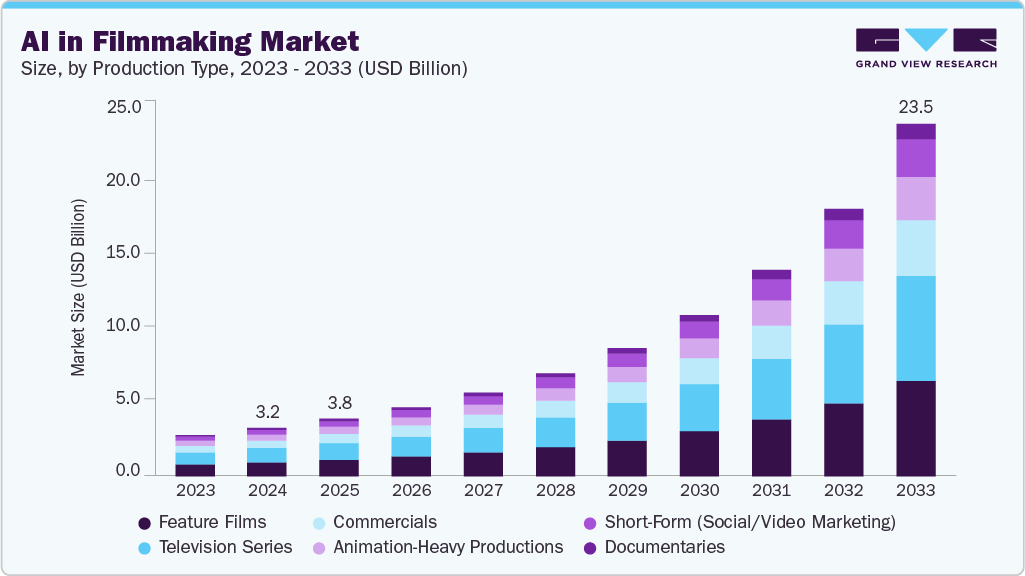
The global AI in filmmaking market size was valued at USD 3.8 billion in 2025 and is projected to grow from USD 4.6 billion in 2026 to USD 23.5 billion in 2033, at a CAGR of 26.2% from 2026 to 2033. North America dominated the market, accounting for a revenue share of 39.0% in 2025. The global market growth is primarily driven by the growing adoption of AI tools for scriptwriting, visual effects (VFX) enhancement, and post-production automation.
 Source: Grand View Research, IR Documents, Primary Interviews, Paid DatabasesTo learn more about this report,
 Download Free Sample Report
Key Market Trends & Insights
- By application: The production segment held the largest market share of around 38.0% in 2025.
- By production type: The feature films segment held the largest market share over 29.0% in 2025
- By customer: The studios & production houses segment held the largest market share of around 36.0% in 2025
Regional Highlights
- Largest regional market: North America (39.0% revenue share, 2025)
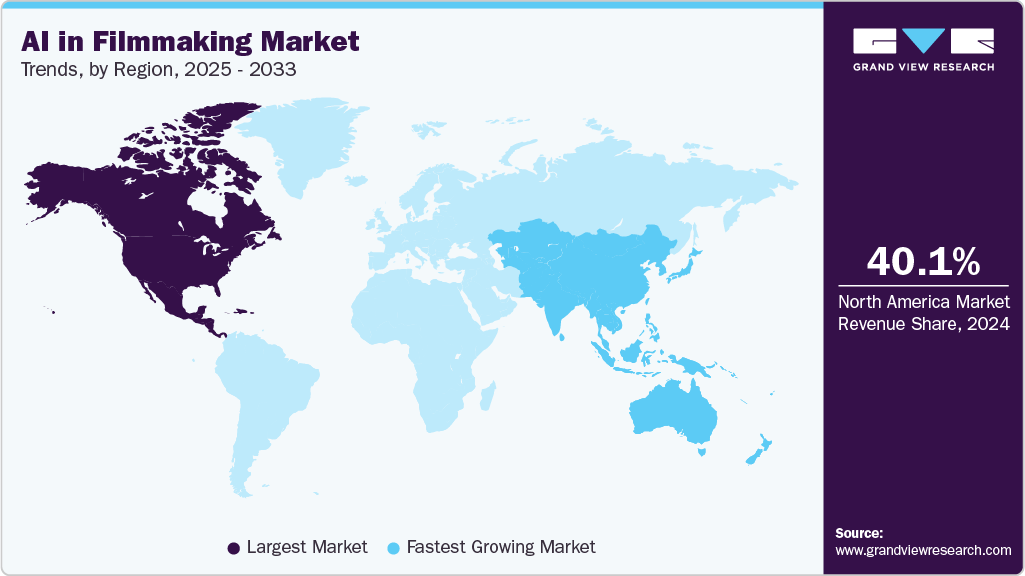
- Fastest-growing regional market: Asia Pacific (highest CAGR, 2026-2033)
Market Size & Forecast
- Market size in 2025: USD 3.8 Billion
- Estimated market size in 2026: USD 4.6 Billion
- Projected market size by 2033: USD 23.5 Billion
- CAGR (2026-2033): 26.2%
Three ways to get this report
Buy it, customize it, or ask a question.Ask an Analyst
Analyst response in 1 business day
- AccessReport author, directly
- Reply timeWithin 1 working day
- No sales callDirect answer only
- FormatEmail reply
- CostFree, no cost
Get the Full Report
What the study covers
- FormatsPDF · Excel · Dashboard
- Timeline2026–2033 annual, 2025 base
- Coverage20+ countries, 5 regions
- Companies10+ key players profiled
Customize the Report
20% free customization
- IncludeCountries, segments, points
- TailorTo your product definition
- ExtendDeeper competitor detail
- OrA fully bespoke study
- Turnaround5–10 working days
The rising demand for cost-efficient production workflows, real-time editing, and personalized content creation is accelerating AI integration across pre-production, production, and post-production processes. Artificial intelligence is transforming the filmmaking process by automating creative and technical workflows, enhancing efficiency, and reducing production costs. AI-powered tools enable script analysis, scene planning, and storyboarding, allowing filmmakers to make data-driven creative decisions. Moreover, machine learning algorithms help predict audience preferences, enhance content personalization, and refine marketing campaigns. The growing use of generative AI for script and dialogue generation, visual enhancement, and character design is streamlining creative workflows and driving productivity. As production studios increasingly seek faster turnaround times and cost-effective methods, AI’s ability to deliver high-quality outputs with minimal manual intervention is fueling market growth across global entertainment industries.
AI-driven visual effects (VFX) and post-production tools are revolutionizing the filmmaking landscape by automating complex editing tasks such as color correction, image enhancement, and scene reconstruction. Deep learning algorithms enable realistic CGI rendering, virtual cinematography, and motion capture, significantly reducing manual labor and production timelines. AI models are also improving sound design, dubbing accuracy, and video restoration quality. The surge in demand for immersive experiences in films, including 3D and virtual reality (VR) formats, is further encouraging AI deployment. Production houses and streaming platforms are adopting AI-powered video analytics and editing systems to ensure consistent visual quality and faster content delivery, strengthening the market outlook.
The proliferation of streaming services and digital media platforms is fueling the demand for AI in content recommendation, audience analytics, and distribution optimization. AI algorithms analyze large datasets to forecast viewer behavior, optimize release strategies, and maximize engagement across multiple channels. In addition, AI supports inclusive and global content creation by enabling automated translation, dubbing, and localization for international audiences. Major studios are collaborating with AI tech companies to integrate generative and predictive tools into their creative pipelines, enhancing innovation while reducing costs. As sustainability gains importance, AI-driven virtual production methods also minimize physical resource use, making filmmaking more eco-efficient and data-driven, thereby sustaining market expansion.
Analyst Perspective
The global AI in filmmaking market is expected to grow steadily, driven by the rising demand for automated content creation and growing interest in predictive audience analytics. Directors, editors, and studio administrators are increasingly incorporating AI-based tools into scriptwriting, pre-visualization, video editing, and visual effects (VFX) due to their benefits in supporting data accuracy, risk management, and overall strategic decision-making. The expanding popularity of cloud-based post-production, real-time edge computing processing, and intelligent robotic process automation (RPA) is further supporting market growth.
Application Insights
The production segment dominated the market with a revenue share of around 38.0% in 2025, driven by rapid adoption of AI to cut costs and compress production timelines such as automating VFX, rotoscoping, cleanup and camera tracking, enable higher-quality visual effects and de-aging at lower budgets, and improve on-set decision-making through real-time analytics such as shot planning and camera optimization. AI also streamlines production logistics, including scheduling, resource and budget optimization, and democratizes advanced post-production for low-budget projects. Meanwhile, predictive analytics, such as casting and greenlight forecasting, increase commercial certainty for studios.
The pre-production segment is expected to register the fastest CAGR over the forecast period. AI-powered script analytics and generative tools accelerate story development and improve market fit by predicting audience response. At the same time, automated storyboarding and pre-visualization (including virtual production) cut planning time and VFX prep costs, enabling faster iteration. AI also streamlines casting, location scouting, budgeting, and shoot scheduling through computer vision and optimization algorithms, democratizing high-quality VFX and de-aging for smaller teams, thereby widening the addressable customer base across indie and studio projects. Together, these factors enhance efficiency, reduce capex, and foster creative experimentation.
Production Type Insights
The feature films segment dominated the market in 2025, driven by the rising adoption of AI tools to enhance creative processes, reduce production costs, and accelerate post-production workflows. AI-powered technologies, such as generative content creation, script analysis, visual effects automation, and real-time scene rendering, are transforming traditional filmmaking by enhancing efficiency and facilitating more informed creative decision-making. Studios increasingly leverage AI for audience behavior prediction, marketing optimization, and box-office forecasting, enabling data-driven production strategies. Moreover, the growing integration of virtual production and AI-assisted editing tools is further propelling the adoption of AI in feature film production worldwide.
The short-form (social/video marketing) segment is expected to register the fastest CAGR over the forecast period. The segment’s growth is primarily driven by the rising demand for quick, engaging, and personalized video content across platforms such as TikTok, Instagram, and YouTube Shorts. Brands and creators are increasingly leveraging AI-driven tools for automated video editing, caption generation, visual enhancement, and performance analytics to accelerate production cycles and optimize audience engagement. The surge in influencer marketing, user-generated content, and data-driven storytelling further supports AI adoption. In addition, the integration of generative AI models enables real-time content adaptation and multilingual customization, enhancing reach and efficiency in digital marketing campaigns worldwide.
Customer Insights
The studios & production houses segment dominated the market in 2025, primarily driven by the growing need to enhance creative efficiency, reduce production costs, and accelerate project timelines. AI tools are increasingly used to automate repetitive tasks, such as script analysis, scene breakdown, and video editing, allowing filmmakers to focus on storytelling and artistic quality. In addition, AI-driven predictive analytics help studios forecast audience preferences and optimize marketing strategies, improving box office performance. The rising adoption of generative AI for virtual production, visual effects (VFX), and content localization further enhances productivity, enabling large studios and production houses to deliver high-quality content on a scale.
The streaming platforms segment is expected to register the fastest CAGR over the forecast period, driven by the rising demand for personalized and high-quality content, as well as the need to optimize production efficiency. Streaming companies such as Netflix, Amazon Prime Video, and Disney+ are increasingly adopting AI-driven tools for script analysis, content recommendation, audience sentiment analysis, and automated editing to enhance viewer engagement and reduce time-to-market. In addition, AI aids in predicting content success through data-driven insights, enabling better investment decisions. The surge in original content production and the competitive need for audience retention further propel AI integration across the filmmaking workflow for streaming platforms.
Regional Insights
The AI in filmmaking industry in North America dominated with a revenue share of over 39.0% in 2025. The segment’s growth is primarily driven by the rapid adoption of advanced technologies across the media and entertainment industry to enhance production efficiency and creativity. Growing use of AI tools for script analysis, visual effects automation, video editing, and audience behavior prediction is fueling demand.
 To learn more about this report, Download Free Sample Report
U.S. AI in Filmmaking Market Trends
The AI in filmmaking industry in the U.S. is expected to grow significantly over the forecast period. Major film studios and streaming platforms in the U.S. are investing heavily in AI to reduce production costs and accelerate post-production processes. In addition, the strong presence of AI technology providers, robust digital infrastructure, and increasing collaborations between AI startups and film production houses further support market expansion across the country.
Europe AI in Filmmaking Market Trends
The AI in filmmaking industry in Europe is expected to grow significantly over the forecast period, driven by the rapid adoption of advanced analytics and machine learning tools for video editing, visual effects (VFX), and post-production automation. The region’s strong presence of creative studios, coupled with government support for digital transformation in the media sector, is fostering AI integration. In addition, rising demand for personalized content, cost-efficient production workflows, and increasing collaborations between AI technology providers and film production houses are propelling market growth across major European countries.
Asia Pacific AI in Filmmaking Market Trends
The AI in filmmaking industry in Asia Pacific is anticipated to grow at the fastest CAGR over the forecast period, driven by the rapid adoption of advanced technologies such as machine learning, computer vision, and natural language processing to enhance content creation, post-production, and visual effects. Growing investments by regional film industries in China, India, and South Korea are accelerating AI integration for script analysis, editing automation, and audience sentiment prediction. In addition, rising demand for cost-efficient production workflows and personalized content for OTT platforms further propels market growth across the region.
Key AI In Filmmaking Company Insights
Some of the key companies in the AI in Filmmaking industry are Adobe Inc. and NVIDIA Corporation.
- Adobe Inc. is a prominent player in creative software and AI integration for media production. Its proprietary AI platform, Adobe Sensei, powers advanced features in Premiere Pro, After Effects, and Photoshop, automating tasks such as scene detection, color matching, audio enhancement, and generative fill. Adobe Inc.’s ongoing innovations in Firefly, generative AI for video and image creation, make it a core player driving AI adoption in professional filmmaking and post-production.
- NVIDIA Corporation is a key player in AI infrastructure and real-time graphics rendering for virtual production. Through its Omniverse, CUDA, and AI-powered rendering engines, it enables real-time simulations, digital twins, and virtual cinematography. Numerous studios utilize NVIDIA Corporation’s GPUs and AI models for VFX, deepfake prevention, animation, and generative scene creation, positioning them as key technology enablers across modern filmmaking pipelines.
Key AI In Filmmaking Companies:
The following key companies have been profiled for this study on the AI in filmmaking market.
-
Adobe Inc.
-
Microsoft
-
Runway AI, Inc.
-
NVIDIA Corporation
-
Google LLC
-
Amazon Web Services, Inc.
-
Synthesia Limited
-
Descript
-
Flawless
-
Respeecher
Recent Developments
- In August 2026, Autodesk announced its expansion of Autodesk Flow Studio and launch of 3D Editor + Canvas, to provide improved control to generative AI filmmaking. This, combined with support for third-party AI models is expected to shift AI's role from a fully automated generator to a controlled rendering engine.
- In May 2026, Flawless, one of the major market participants in cinematic-grade visual dubbing and AI performance-editing tools, announced a specialized filmmaking and visual dubbing ecosystem, its AI platform, Rights-First. Introduced at Cannes Film Festival, the platform features a built-in consent and ownership mechanism, assistive intelligence and more.
- In June 2025, Meta, a technology company, added generative video editing prompts to the Meta AI app and Edits app, and Meta.AI website, enabling preset AI edits such as outfit, lighting, background, location transforms, and rapid share-ready clips, a push to democratize quick AI-driven production & social-first short-form video creation.
- In April 2025, Adobe Inc. introduced Generative Extend for Premiere Pro and AI Media Intelligence for fast footage search. The capability enables editors to expand clips, generate continuation footage, and surface relevant takes from massive libraries, thereby accelerating editorial workflows for film and episodic production.
- In April 2025, Runway AI, Inc. partnered with production outfit Fabula, a film and media production company, to integrate Runway AI, Inc.’s AI video toolset into feature and short production pipelines and support artist-driven projects, signaling deeper studio-level adoption of generative-video tools for creative VFX, previsualization, and post workflows.
AI In Filmmaking Market Report Scope
Report Attribute
Details
Market size in 2025
USD 3.8 billion
Estimated market size in 2026
USD 4.6 billion
Projected market size by 2033
USD 23.5 billion
Growth rate
CAGR of 26.2% from 2026 to 2033
Base year for estimation
2025
Historical data
2021 – 2025
Forecast period
2026 – 2033
Quantitative units
Revenue in USD billion and CAGR from 2026 to 2033
Report coverage
Revenue forecast, company ranking, competitive landscape, growth factors, and trends
Segments covered
Application, production type, customer, region
Regional Scope
North America; Europe; Asia Pacific; Latin America; MEA
Country Scope
U.S.; Canada; Mexico; Germany; UK; France; China; India; Japan; Australia; South Korea; Brazil; UAE; South Africa; KSA
Key companies profiled
Adobe Inc.; Microsoft; Runway AI, Inc.; NVIDIA Corporation; Google LLC; Amazon Web Services, Inc.; Synthesia Limited; Descript; Flawless; Respeecher
Customization scope
Free report customization (equivalent to 8 analyst working days) with purchase. Addition or alteration to country, regional & segment scope.
Pricing and purchase options
Avail of customized purchase options to meet your exact research needs. Explore purchase options
Global AI In Filmmaking Market Report Segmentation
This report forecasts revenue growth at the global, regional, and country levels and provides an analysis of the latest industry trends in each of the sub-segments from 2021 to 2033. For this study, Grand View Research has segmented the global AI in filmmaking market report based on application, production type, customer, and region:
-
Application Outlook (Revenue, USD Billion, 2021 - 2033)
-
Pre-Production
-
Production
-
Post-Production
-
Distribution & Marketing
-
-
Production Type Outlook (Revenue, USD Billion, 2021 - 2033)
-
Feature Films
-
Television Series
-
Documentaries
-
Commercials
-
Animation-Heavy Productions
-
Short-Form (Social/Video Marketing)
-
-
Customer Outlook (Revenue, USD Billion, 2021 - 2033)
-
Studios & Production Houses
-
Streaming Platforms
-
Animation & VFX Studios
-
Advertising Agencies
-
Educational & Prosumer Creators
-
-
Regional Outlook (Revenue, USD Billion, 2021 - 2033)
-
North America
-
U.S.
-
Canada
-
Mexico
-
-
Europe
-
Germany
-
UK
-
France
-
-
Asia Pacific
-
China
-
Japan
-
India
-
South Korea
-
Australia
-
-
Latin America
-
Brazil
-
-
Middle East and Africa (MEA)
-
UAE
-
KSA
-
South Africa
-
-
Frequently Asked Questions About This Report
The global AI in filmmaking market is expected to grow at a CAGR of 26.2% from 2026 to 2033, reaching USD 23.5 billion.
North America dominated with an approximately 39.0% revenue share in 2025.
The global AI in filmmaking market size was valued at USD 3.8 billion in 2025 and is estimated at USD 4.6 billion for 2026.
The production segment accounted for the largest revenue share of around 38.0% in 2025.
Key factors that are driving the AI in filmmaking market growth include the growing adoption of AI tools for scriptwriting, visual effects (VFX) enhancement, and post-production automation. Rising demand for cost-efficient production workflows, real-time editing, and personalized content creation is accelerating AI integration across pre-production, production, and post-production processes.
About the Author(s)
Next Generation Technologies Research Team
Technology · Next Generation TechnologiesThis report was authored by the next generation technologies research team at Grand View Research - comprising two research analysts, one senior research analyst, and one industry expert - with specialized expertise in the next generation technologies segment of the technology industry. All findings are based on proprietary technology databases, executive interviews, and regulatory analysis, subject to internal peer review prior to publication.
Last Updated:
Speak to Analyst

Customize this report to your needs - add regions, segments, or data points, with 20% free customization.
Or view our licence options:


ISO 9001:2015 & 27001:2022 Certified
We are GDPR and CCPA compliant! Your transaction & personal information is safe and secure. For more details, please read our privacy policy.


