
- Home
- »
- IT Services & Applications
- »
-
Robotic Process Automation Market Size, Growth Report, 2026-2033GVR Report cover

Robotic Process Automation Market (2026 - 2033)
Size, Share & Trends Analysis Report By Type (Software, Services), By Deployment (Cloud, On-premise), By Operation (Rule-Based, Knowledge-Based), By Enterprise Size, By End Use, By Region, And Segment Forecasts
Market Size, 2025
$4.7BMarket Estimate, 2026
$6.0BMarket Forecast, 2033
$35.8BCAGR, 2026–2033
29.0%Robotic Process Automation Market Summary
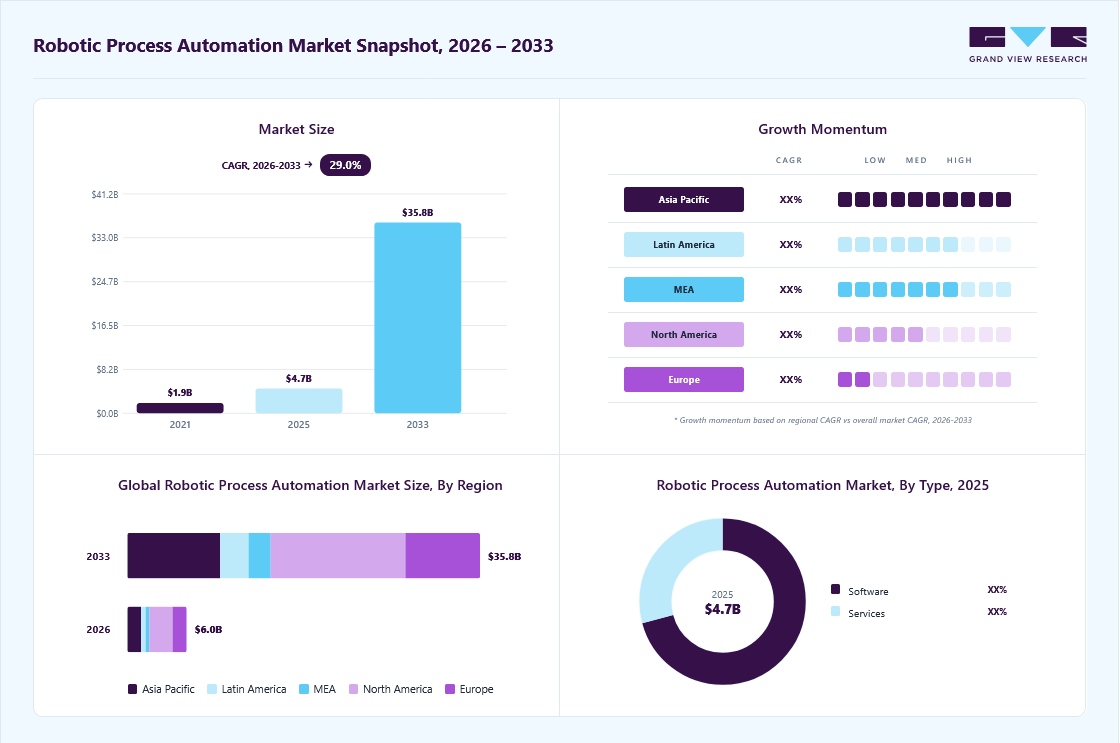
The global robotic process automation market size was valued at USD 4.7 billion in 2025 and is projected to grow from USD 6.0 billion in 2026 to USD 35.8 billion by 2033, at a CAGR of 29.0% from 2026 to 2033. North America dominated the global market, accounting for the largest revenue share of 39.0% in 2025. The market growth can be attributed to the increasing demand for operational efficiency and cost reduction in businesses.
 Source: Grand View Research, IR Documents, Primary Interviews, Paid DatabasesTo learn more about this report,
 Download Free Sample Report
 Key Market Trends & Insights
- By type: Software segment accounted for the largest revenue share of 70.7% in 2025.
- By deployment: Cloud segment accounted for the largest share in 2025.
- By operation: Rule-Based segment accounted for the largest share in 2025.
Regional Highlights
- Largest regional market: North America (39.0% revenue share, 2025)
- Fastest-growing regional market: Asia Pacific (highest CAGR, 2026-2033)
- By country: The U.S. is a major contributor to the global robotic process automation market
Market Size & Forecast
- Market size in 2025: USD 4.7 Billion
- Estimated market size in 2026: USD 6.0 Billion
- Projected market size by 2033: USD 35.8 Billion
- CAGR (2026-2033): 29.0%
Three ways to get this report
Buy it, customize it, or ask a question.Ask an Analyst
Analyst response in 1 business day
- AccessReport author, directly
- Reply timeWithin 1 working day
- No sales callDirect answer only
- FormatEmail reply
- CostFree, no cost
Get the Full Report
What the study covers
- FormatsPDF · Excel · Dashboard
- Timeline2026–2033 annual, 2025 base
- Coverage20+ countries, 5 regions
- Companies10+ key players profiled
Customize the Report
20% free customization
- IncludeCountries, segments, points
- TailorTo your product definition
- ExtendDeeper competitor detail
- OrA fully bespoke study
- Turnaround5–10 working days
Enterprises across industries are adopting Robotic Process Automation (RPA) to automate repetitive, rule-based tasks, thereby streamlining workflows, reducing human error, and allocating resources to higher-value activities. Companies can unlock significant benefits from RPA, with reduced operational costs being a key advantage. The adoption of new technologies is fundamentally changing corporate operations. Business processes are being reinvented across the field through automation, analytics, data, AI, robots, and many others. Businesses must continually assess and innovate their internal procedures to remain competitive. Earlier iterations of RPA were solely concerned with automating processes that required fewer than five decisions, five app accesses, and 500 clicks.
 To learn more about this report, Download Free Sample Report
 The integration of AI to enhance automation capabilities, combined with a strong focus on security and compliance, highlights the significant efficiency gains and ROI potential of RPA, strengthening its value in high-volume, data-intensive industries. By embedding AI technologies such as machine learning, natural language processing, and intelligent document processing into automation platforms, enterprises can move beyond basic task automation to handle complex, judgment-based workflows. At the same time, advanced governance frameworks, audit trails, and compliance controls ensure that automated processes meet regulatory and data protection requirements, making RPA a trusted solution for industries such as BFSI, healthcare, and telecommunications.
Another major driver accelerating RPA adoption is the growing need for operational scalability amid increasing transaction volumes and labor constraints. Organizations across sectors are facing increasing workloads driven by digital transformation, omnichannel customer interactions, and expanding data footprints, while simultaneously contending with skilled labor shortages and cost pressures. RPA enables enterprises to scale operations rapidly without proportional increases in headcount by automating repetitive, rule-based processes such as data entry, claims processing, order management, and reporting. This scalability allows businesses to maintain service quality, meet peak demand, and improve turnaround times while controlling operational expenses.
In addition, the increasing focus on digital transformation and legacy system modernization is fueling demand for RPA solutions. Many enterprises continue to rely on fragmented, outdated IT systems that are costly and complex to replace. RPA serves as a non-intrusive layer that integrates seamlessly with existing applications, enabling organizations to modernize workflows without extensive system overhauls. By bridging legacy and modern systems, RPA accelerates digital transformation initiatives, improves process visibility, and enables organizations to extract greater value from their existing technology investments, thereby further strengthening its adoption in high-volume, data-driven environments.
Type Insights
The software segment dominated the robotic process automation market in 2025. The segment’s growth can be attributed to the growing number of strategic partnerships aimed at expanding software sales channels and accelerating enterprise adoption of RPA platforms. For instance, in June 2025, UiPath announced a strategic partnership with HCLTech to scale the adoption of its automation software through joint go-to-market initiatives and pre-configured AI agent solutions. This collaboration directly supports the software segment by increasing platform licensing, subscription-based deployments, and enterprise-wide usage of UiPath’s RPA and AI automation software across industries such as finance, supply chain, human resources, and customer service. The availability of standardized, reusable automation software components further lowers implementation complexity, enabling faster adoption and driving sustained growth of the RPA software segment.
The services segment is expected to grow at the fastest CAGR from 2026 to 2033. The segment's growth can be attributed to the wide range of services offered by RPA companies, including assessment, deployment & support, strategy, and implementation. Moreover, the growing focus on digital transformation is a significant driver of the service segment. As companies strive to modernize operations and integrate advanced technologies, RPA serves as a foundational tool for automating legacy systems and bridging gaps between various digital platforms. Its ability to quickly deliver measurable results makes it an attractive option for businesses undergoing transformation.
Deployment Insights
The cloud segment led the robotic process automation market, accounting for the largest revenue share in 2025. The growth of cloud RPA solutions can be attributed to the benefits of the cloud-based deployment of RPA solutions, which include lower infrastructure costs, ease of implementation, remote accessibility, ease of use, and scalability. This results in the increased demand for cloud-deployable RPA solutions, which solution providers are offering to cater to the demand for these solutions successfully. Moreover, the increasing adoption of Software-as-a-Service (SaaS) models is a significant driver of growth in the RPA market, particularly within the cloud segment. SaaS-based RPA solutions offer a subscription model, enabling businesses to access automation tools without the need for large upfront investments in hardware or infrastructure.
The on-premise segment is expected to grow at a significant CAGR from 2026 to 2033, driven by the greater control and flexibility it offers organizations. With on-premises deployment, enterprises can define access policies based on internal security protocols, retain full ownership of data and systems, and ensure closer alignment with corporate standards and compliance requirements. This model also allows organizations to customize reports, access complete backend logs and databases, and maintain transparency across automated processes. In addition, on-premises solutions can deliver long-term cost benefits for large-scale deployments and provide better performance reliability for mission-critical operations. The strong presence of RPA vendors such as IBM and UiPath, which continue to support and enhance on-premises offerings, is further contributing to the growth of this segment.
Enterprise Size Insights
The large enterprise segment held the largest revenue share in 2025, driven by the widespread adoption of RPA across large organizations. Large enterprises benefit from RPA through higher productivity, improved operational efficiency, stronger security, and greater scalability across business functions. In a highly competitive environment, these organizations continually seek ways to optimize processes, reduce operational costs, and support business growth, which is driving increased investment in automation technologies. In addition, large enterprises typically face fewer budget limitations than small and medium-sized businesses and have greater awareness of the long-term benefits of RPA implementation. Their ability to deploy automation at scale, integrate RPA with existing enterprise systems, and support complex, high-volume workflows is expected to drive the strong growth of this segment further.
The SMEs segment is expected to grow at the fastest CAGR over the forecast period. The benefits offered by implementing RPA in SMEs have been driving the growth of the SME segment. Some major benefits include enabling staff to focus on priority tasks, greater opportunities to expand and scale the business, enhanced customer satisfaction, improved communication within the company, reduced operational costs and compliance risks, and expedited ROI and time-to-value for automation investments. Major companies in the RPA market have been able to meet the demand for RPA solutions among SMEs, bridging the gap between supply and demand. This is further driving the growth of the small & medium enterprises segment.
Operations Insights
The rule-based operations segment dominated the robotic process automation market in 2025. Many organizations rely on legacy systems that may not have the flexibility to support modern automation technologies. Rule-based RPA solutions can easily integrate with these existing systems without requiring extensive changes or updates. This makes RPA an attractive option for businesses looking to automate their processes without overhauling their entire IT infrastructure. The ability to work seamlessly with legacy systems accelerates the adoption of RPA in industries with older technological frameworks, such as banking and government. Moreover, rule-based RPA helps businesses comply with regulatory requirements by ensuring processes are executed consistently and in accordance with internal policies and industry regulations.
The knowledge-based segment is expected to grow at the fastest CAGR from 2026 to 2033. The integration of AI, natural language processing (NLP), and machine learning (ML) into RPA significantly enhances its capabilities to manage complex tasks typically performed by humans. AI allows RPA systems to handle tasks that require advanced cognitive functions, such as understanding context, making informed decisions, and continuously learning from new data. NLP enables RPA to comprehend and process unstructured data, such as emails, documents, and customer queries, by extracting relevant information and interpreting the meaning behind natural language.
End Use Insights
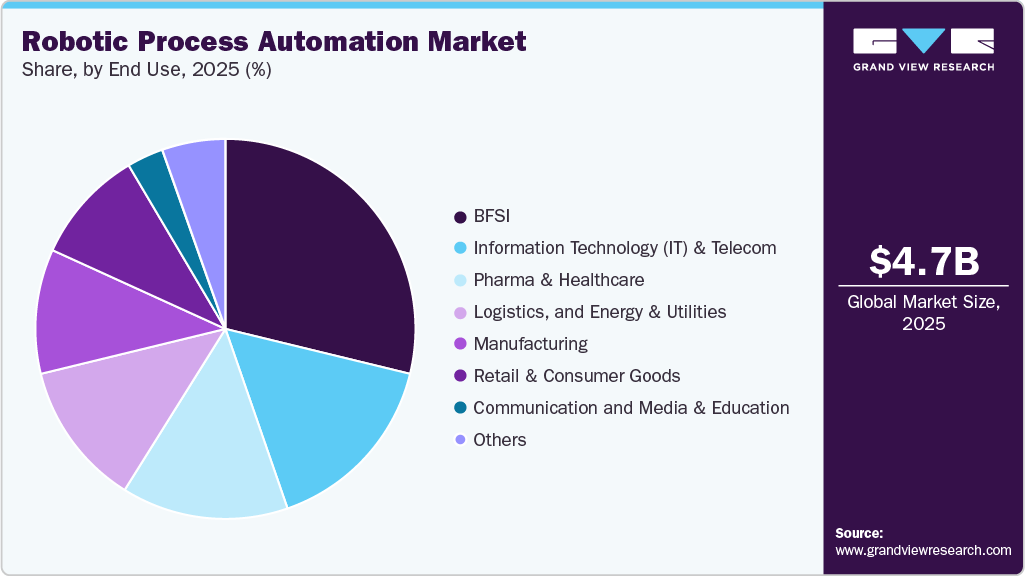
The BFSI segment accounted for the largest revenue share of the robotic process automation market in 2025, supported by the extensive adoption of RPA across banking, financial services, and insurance organizations. RPA helps BFSI companies improve customer experience by accelerating service delivery, automating routine banking operations, and reducing manual errors. It also lowers IT and operational costs while increasing efficiency, productivity, accuracy, and scalability. RPA is widely used across key BFSI functions, including mortgage processing, accounting and reconciliation, risk and compliance reporting, front-office operations, cards and payment systems, and anti-money laundering processes. In addition, the growing need for regulatory compliance, data security, and 24/7 service availability has further encouraged BFSI organizations to adopt RPA, driving strong growth of this segment.
 To learn more about this report, Download Free Sample Report
 The pharma and healthcare segment is expected to grow at the fastest CAGR during the forecast period. This growth is mainly driven by RPA vendors introducing automation solutions specifically designed for healthcare needs, which has encouraged wider adoption among pharmaceutical and healthcare organizations. RPA automates time-consuming processes such as patient data management, billing and claims processing, appointment scheduling, and regulatory documentation, improving efficiency and reducing manual errors. In addition, the increasing focus on regulatory compliance, data accuracy, and patient safety has accelerated the use of automation in this sector. The rising volume of healthcare data, growing administrative workloads, and the need to reduce operational costs while maintaining service quality are further contributing to the strong growth of the pharma and healthcare segment in the RPA market.
Regional Insights
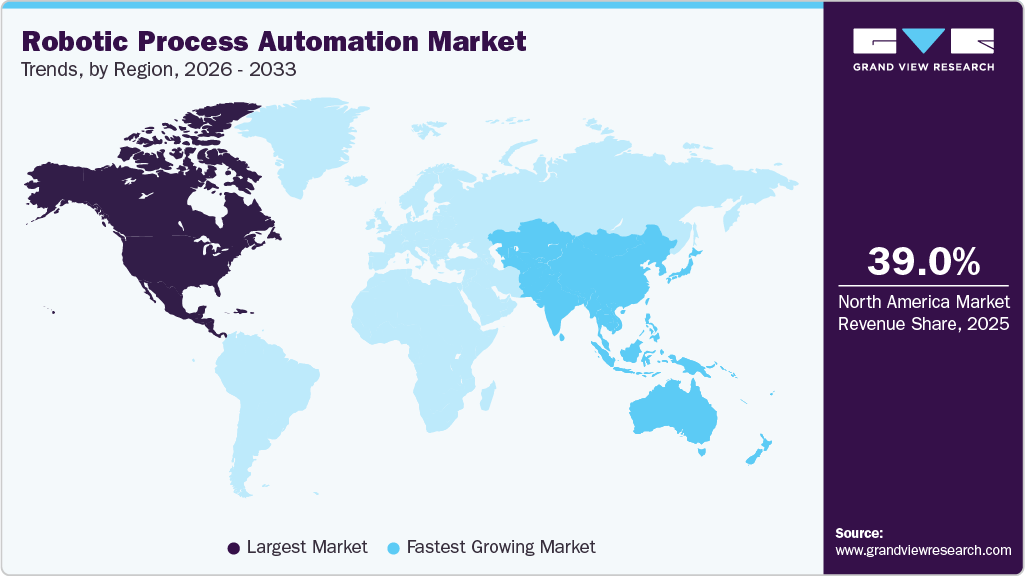
The North America robotic process automation market held the largest revenue share in 2025. In sectors such as finance, healthcare, and pharmaceuticals, companies in North America face increasing regulatory pressures to comply with industry standards and government regulations. RPA helps organizations ensure compliance by automating the tracking, documentation, and reporting of regulatory requirements. With RPA, businesses can reduce the risk of human error in compliance processes, maintain up-to-date records, and meet deadlines more effectively. This need for reliable compliance solutions has contributed to the regional market growth.
 To learn more about this report, Download Free Sample Report
 U.S. Robotic Process Automation Market Trends
The U.S. robotic process automation industry is expected to grow significantly from 2026 to 2033. The market’s growth can be attributed to the increased capabilities and features of the RPA solution, enabled by AI integration, resulting in improved business results, reduced wage costs, higher ROI, and the creation of new positions, among others. RPA robots can also perform tasks across different systems to retrieve information from digital platforms. For instance, adopting RPA in the finance industry enables bank customers to check account details online and process Know Your Customer (KYC) verification, among other functions, via the internet. Such services have reduced manual involvement and enabled the delivery of an improved customer experience.
Asia Pacific Robotic Process Automation Market Trends
The robotic process automation industry in the Asia Pacific is expected to grow significantly at a CAGR of over 30.0% from 2026 to 2033. The Asia Pacific RPA market is experiencing rapid growth, driven by several key factors, including the region's increasing focus on digital transformation and automation. One major driver is the growing need for operational efficiency across industries such as BFSI, healthcare, telecommunications, and manufacturing. With the growing demand for cost optimization, businesses are turning to RPA solutions to automate repetitive tasks, reduce errors, and accelerate workflow processes, thereby enhancing productivity and profitability.
China's robotic process automation market held a significant share of revenue in 2025. The availability of a large pool of skilled IT professionals and the rapid development of cloud infrastructure in China further augment the adoption of RPA. Cloud-based RPA solutions offer scalability, cost-effectiveness, and ease of deployment, making them particularly appealing to small and medium-sized enterprises (SMEs) looking to automate their operations.
The robotic process automation market in Japan accounted for a significant share of revenue in 2025. The RPA market's growth in Japan can be attributed to the increasing need to optimize operations to enhance efficiency and maximize returns, the growing integration of innovative technologies, and the transformation of business processes across organizations. RPA can help businesses reduce errors and increase speed by automating repetitive and routine tasks. The organizations in the region are keen on enhancing their business process using RPA to expedite day-to-day operations, which, in turn, helps them focus on more intensive business decisions.
India's robotic process automation market is expanding rapidly. Robotic process automation is underway in India and quickly changing the business functions and operations. Market players are increasingly acknowledging the fundamental role of automation in resolving their pain points, such as finding automation skills, developing business cases, and selecting an implementation partner, among others, and accelerating growth across the region.
Europe Robotic Process Automation Market Trends
The Europe robotic process automation industry is expected to grow at a significant CAGR from 2026 to 2033, driven by the growing integration of RPA with advanced technologies such as artificial intelligence (AI), machine learning (ML), and natural language processing (NLP). This convergence enables automation systems to handle unstructured data, make predictive decisions, and perform more complex tasks, expanding the scope of RPA applications. Companies in Europe, especially in countries such as Germany, the UK, and France, are increasingly leveraging intelligent automation to enhance customer experiences and optimize resource utilization.
The robotic process automation market in the UK is expected to grow rapidly in the coming years, ascribed to the presence of several logistics and industrial companies in the region. The technology helps streamline pickup and drop-off operations, significantly reducing cycle time and improving the customer experience. This is driven by the growing demand for customer service across industries such as BFSI, IT & telecommunications, government, and insurance, which is expected to propel the adoption of robotic automation processes in the UK.
The Germany robotic process automation market held a significant revenue share in 2025. This growth can be attributed to technological advancements and increasing R&D activities in artificial intelligence, particularly machine learning and deep learning, which are expanding the application of automation technologies.
Key Robotic Process Automation Company Insights
Some of the key companies operating in the market include Automation Anywhere Inc., BlackLine Inc., SS&C Blue Prism, EdgeVerve Systems Limited, FPT Software, Microsoft, and NICE.
-
Automation Anywhere is a global company in Robotic Process Automation (RPA), offering a cloud-native, web-based intelligent automation platform that integrates RPA with AI, machine learning, and analytics to automate repetitive enterprise processes. Its portfolio includes Automation Workspace, AI-driven bots, governance tools, and a broad marketplace of pre-built automations. Operating in over 40 countries, the company supports enterprises across industries in improving productivity, reducing costs, and accelerating digital transformation through scalable automation solutions
-
BlackLine is a global cloud software company that automates and controls financial close and accounting operations, helping organizations replace manual processes with modern, automated workflows. Its platform unifies data and processes to streamline tasks such as financial close, intercompany accounting, and invoice‑to‑cash. Trusted by thousands of customers worldwide, BlackLine drives efficiency, accuracy, and visibility in finance and accounting operations.
Key Robotic Process Automation Companies:
The following key companies have been profiled for this study on the robotic process automation market.
- Automation Anywhere Inc.
- BlackLine Inc.
- SS&C Blue Prism
- EdgeVerve Systems Limited
- FPT Software
- Microsoft
- NICE
- NTT Advanced Technology Corporation*
- OnviSource, Inc.
- Pegasystems Inc.
- SAP SE
- Tungsten Automation Corporation
- UiPath
- Uniphore
- WorkFusion, Inc.
Recent Developments
-
In November 2025, C3 AI launched C3 AI Agentic Process Automation, enabling organizations to automate both business and operational workflows using autonomous AI agents. The platform handles tasks such as order-to-cash, invoice processing, customer service, procurement, and employee onboarding, and supports industrial operations, including equipment troubleshooting, production planning, inventory management, and maintenance.
-
In October 2025, Cognizant announced a strategic partnership with AP Pension to provide Business Process Outsourcing (BPO), Robotic Process Automation (RPA), and administrative process optimization. The collaboration aims to support AP Pension’s digital transformation by enhancing operational capacity, freeing internal resources for strategic work, and improving customer experience. The services will be provided through Cognizant’s Nordic-speaking Center of Excellence located in Vilnius, Lithuania.
Robotic Process Automation Market Report Scope
Report Attribute
Details
Market size in 2025
USD 4.7 billion
Estimated Market size in 2026
USD 6.0 billion
Projected Market size by 2033
USD 35.8 billion
Growth rate
CAGR of 29.0% from 2026 to 2033
Actual data
2021 - 2025
Forecast period
2026 - 2033
Quantitative units
Revenue in USD billion and CAGR from 2026 to 2033
Report coverage
Revenue forecast, company share, competitive landscape, growth factors, and trends
Segments covered
Type, deployment, operations, enterprise size, end use, and region
Regional scope
North America; Europe; Asia Pacific; Latin America; MEA
Country scope
U.S.; Canada; Mexico; UK; Germany; France; China; India; Japan; Australia; South Korea; Brazil; UAE; Saudi Arabia; South Africa
Key companies profiled
Automation Anywhere Inc.; BlackLine Inc.; SS&C Blue Prism; EdgeVerve Systems Limited; FPT Software; Microsoft; NICE; NTT Advanced Technology Corporation; OnviSource, Inc.; Pegasystems Inc.; SAP SE; Tungsten Automation Corporation; UiPath; Uniphore; WorkFusion, Inc.
Customization scope
Free report customization (equivalent to 8 analyst working days) with purchase. Addition or alteration to country, regional & segment scope.
Pricing and purchase options
Avail customized purchase options to meet your exact research needs. Explore purchase options
Global Robotic Process Automation Market Report Segmentation
This report forecasts revenue growth at the global, regional, and country levels and provides an analysis of the latest industry trends in each of the sub-segments from 2021 to 2033. For this study, Grand View Research has segmented the robotic process automation market report based on type, deployment, operations, enterprise size, end use, and region:
-
Type Outlook (Revenue, USD Billion, 2021 - 2033)
-
Software
-
Services
-
Consulting
-
Implementing
-
Training
-
-
-
Deployment Outlook (Revenue, USD Billion, 2021 - 2033)
-
Cloud
-
On-premise
-
-
Operations Outlook (Revenue, USD Billion, 2021 - 2033)
-
Rule-Based
-
Knowledge-Based
-
-
Enterprise Size Outlook (Revenue, USD Billion, 2021 - 2033)
-
Large Enterprise
-
SME
-
-
End Use Outlook (Revenue, USD Billion, 2021 - 2033)
-
BFSI
-
Pharma & Healthcare
-
Retail & Consumer Goods
-
Information Technology (IT) & Telecom
-
Communication and Media & Education
-
Manufacturing
-
Logistics, and Energy & Utilities
-
Others
-
-
Regional Outlook (Revenue, USD Billion, 2021 - 2033)
-
North America
-
U.S.
-
Canada
-
Mexico
-
-
Europe
-
Germany
-
UK
-
France
-
-
Asia Pacific
-
China
-
India
-
Japan
-
South Korea
-
Australia
-
-
Latin America
-
Brazil
-
-
Middle East & Africa
-
UAE
-
Saudi Arabia
-
South Africa
-
-
Frequently Asked Questions About This Report
Asia Pacific is the fastest-growing region over the forecast period.
The major driver accelerating RPA adoption is the growing need for operational scalability amid increasing transaction volumes and labor constraints.
Rule-based operations held the largest revenue share in 2025, while knowledge-based is the fastest-growing area.
North America dominated with a 39.0% revenue share in 2025.
Key players include Automation Anywhere Inc., BlackLine Inc., SS&C Blue Prism, EdgeVerve Systems Limited, FPT Software, Microsoft, NICE, NTT Advanced Technology Corporation, OnviSource, Inc., Pegasystems Inc., SAP SE, Tungsten Automation Corporation, UiPath, Uniphore, and WorkFusion, Inc.
The global robotic process automation market size was estimated at USD 4.7 billion in 2025 and is expected to reach USD 6.0 billion in 2026
The global robotic process automation market is expected to grow at a compound annual growth rate of 29.0% from 2026 to 2033 to reach USD 35.8 billion by 2033
The software segment led with a 70.7% revenue share in 2025, while services is the fastest-growing segment.
The cloud segment led the global robotic process automation market and accounted for the largest revenue share of over 55.0% in 2025.
About the Author(s)
IT Services & Applications Research Team
Technology · IT Services & ApplicationsThis report was authored by the it services & applications research team at Grand View Research - comprising two research analysts, one senior research analyst, and one industry expert - with specialized expertise in the it services & applications segment of the technology industry. All findings are based on proprietary technology databases, executive interviews, and regulatory analysis, subject to internal peer review prior to publication.
Last Updated:
Speak to Analyst

Customize this report to your needs - add regions, segments, or data points, with 20% free customization.
Or view our licence options:


ISO 9001:2015 & 27001:2022 Certified
We are GDPR and CCPA compliant! Your transaction & personal information is safe and secure. For more details, please read our privacy policy.


