
- Home
- »
- Next Generation Technologies
- »
-
AI In Government And Public Services Market Report, 2033GVR Report cover

AI In Government And Public Services Market (2026 - 2033)
Size, Share & Trends Analysis Report By Deployment, By Technology (Natural Language Processing, Machine Learning, Computer Vision), By End Use, By Application, By Region, And Segment Forecasts
Market Size, 2025
$26.4BMarket Estimate, 2026
$31.0BMarket Forecast, 2033
$98.1BCAGR, 2026–2033
17.9%AI in Government And Public Services Market Summary
The global AI in government and public services market size was valued at USD 26.4 billion in 2025 and is projected to grow from USD 31.0 billion in 2026 to USD 98.1 billion in 2033, at a CAGR of 17.9% from 2026 to 2033. North America dominated the market, accounting for a revenue share of 32.2% in 2025. The increasing adoption of AI drives the growth for enhancing operational efficiency, automating public services, and enabling data-driven decision-making across government agencies and public sector organizations.
 Source: Grand View Research, IR Documents, Primary Interviews, Paid DatabasesTo learn more about this report,
 Download Free Sample Report
Key Market Trends & Insights
- By deployment: The cloud segment held the largest market share of around 58.0% in 2025.
- By technology: The machine learning segment held the largest market share of around 33.0% in 2025.
- By application: The public safety and security segment held the largest market share of around 27.0% in 2025.
- By end use: The government agencies segment held the largest market share of around 60.0% in 2025.
Regional Highlights
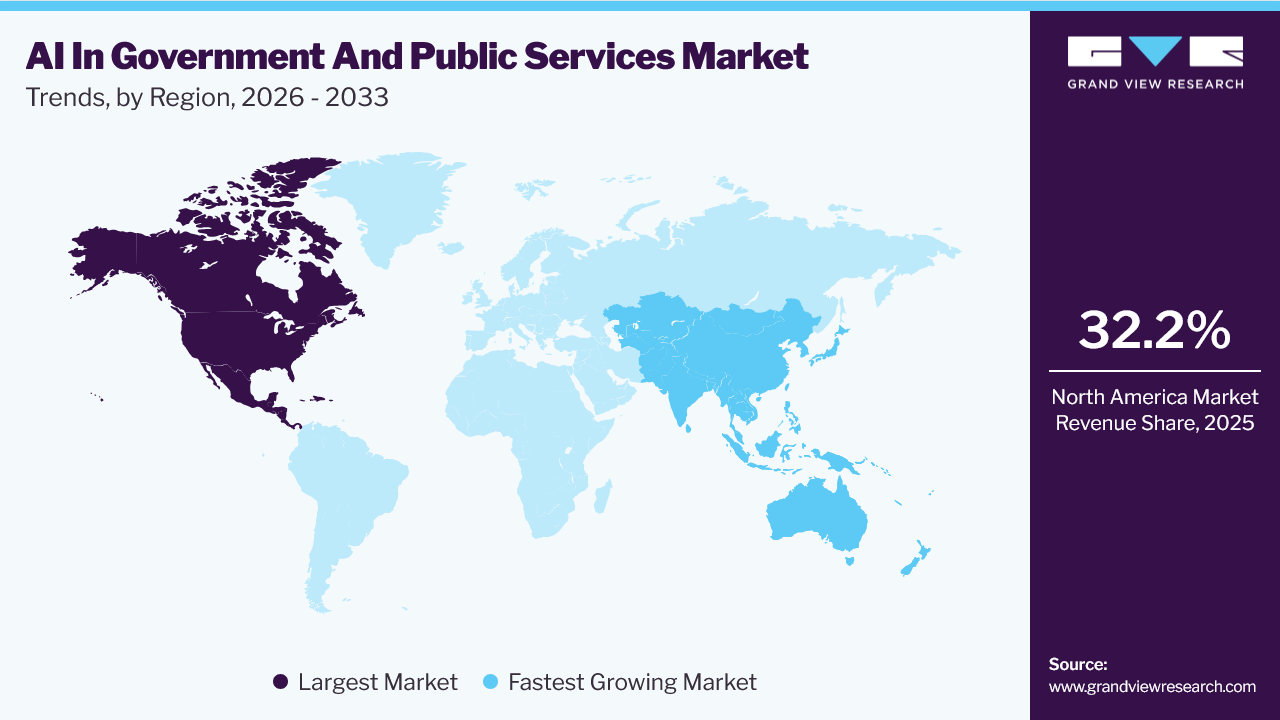
- Largest regional market: North America (32.2% revenue share, 2025)
- Fastest-growing regional market: Asia Pacific (highest CAGR, 2026-2033)
Market Size & Forecast
- Market size in 2025: USD 26.4 Billion
- Estimated market size in 2026: USD 31.0 Billion
- Projected market size by 2033: USD 98.1 Billion
- CAGR (2026-2033): 17.9%
Three ways to get this report
Buy it, customize it, or ask a question.Ask an Analyst
Analyst response in 1 business day
- AccessReport author, directly
- Reply timeWithin 1 working day
- No sales callDirect answer only
- FormatEmail reply
- CostFree, no cost
Get the Full Report
What the study covers
- FormatsPDF · Excel · Dashboard
- Timeline2026–2033 annual, 2025 base
- Coverage20+ countries, 5 regions
- Companies10+ key players profiled
Customize the Report
20% free customization
- IncludeCountries, segments, points
- TailorTo your product definition
- ExtendDeeper competitor detail
- OrA fully bespoke study
- Turnaround5–10 working days
The growth of AI in government and public services industry is driven by efforts to enhance operational efficiency and service delivery across the public sector. Governments implement AI to automate repetitive administrative tasks such as data processing, document handling, and citizen interactions, enabling faster workflows and freeing resources for strategic initiatives.
AI-powered tools such as chatbots and virtual assistants improve citizen engagement by providing 24/7 support and instant responses, while predictive analytics support public safety, traffic management, and infrastructure maintenance. These applications help governments improve transparency, optimize resource allocation, and respond proactively to public needs, creating immediate value and encouraging widespread adoption.
Moreover, the market is supported by technological advancements in AI, including machine learning, natural language processing, and robotic process automation, which collectively elevate the capabilities of public sector operations. Increased investments in digital transformation and AI research allow governments to develop more personalized and accessible services. For instance, in July 2025, the Indian government initiated the 'Skilling for AI Readiness' program to enhance awareness and develop artificial intelligence competencies among school-aged students. This initiative aims to prepare the younger generation for the emerging demands of the AI-driven digital economy. Expanding cloud-based AI platforms facilitate scalable implementation and real-time data analysis, which are important for managing complex governance challenges and large populations. In addition, enhanced cybersecurity measures and fraud detection systems integrated with AI strengthen public trust and safeguard sensitive information, further encouraging the steady integration of AI in government functions.
The expansion of AI in government and the public services industry is also driven by growing government initiatives to modernize public administration and advance smart city development. Policymakers increasingly emphasize AI governance frameworks to ensure transparency, accountability, and ethical use of AI technologies. Strategic collaborations between governments and technology providers accelerate the deployment of ready-to-use AI solutions for diverse applications, from healthcare and social services to law enforcement and urban planning. As governments worldwide recognize the potential for substantial cost savings and improved citizen services, AI adoption continues to scale, reshaping public sector operations toward increased efficiency and responsiveness.
Analyst Perspective
The global AI in government and public services industry is expected to grow steadily, driven by the rising demand for automated public processes and growing interest in predictive policy analytics. Government agencies and public sector organizations are increasingly incorporating AI-based tools into data management, public safety, civic engagement, and fraud detection due to their benefits in enhancing data accuracy, risk management, and strategic decision-making. The expanding popularity of cloud-based citizen portals, real-time edge computing processing, and intelligent robotic process automation (RPA) is further supporting market growth. Technology vendors and platform developers that focus on software integration, machine-learning accuracy, and cybersecurity enhancement are expected to capitalize on long-term growth opportunities.
Deployment Insights
The cloud segment led the market in 2025, accounting for over 58.0% of global revenue due to its scalability and flexibility, enabling government agencies to deploy AI applications quickly without heavy upfront capital expenditure. Cloud infrastructure supports a wide range of AI workloads, from data analytics to machine learning models, allowing real-time processing and decision-making across dispersed departments. In addition, cloud services facilitate seamless integration with legacy government IT systems and offer frequent updates and maintenance handled by providers, reducing the IT burden. The inherent elasticity of cloud environments allows agencies to adjust resources based on demand, supporting large-scale public service applications efficiently and securely.
The on-premises segment is predicted to experience significant growth during the forecast period. On-premises solutions gain importance in government sectors where data sovereignty, confidentiality, and compliance impose strict requirements on data handling and storage. Many agencies prefer deploying AI systems on local infrastructure to retain full control over sensitive citizen information and meet regulatory mandates specific to national security or data privacy laws. This approach allows customization of AI solutions to specific workflows or legacy environments, minimizing latency and maximizing performance where continuous connectivity is limited or unreliable.
Technology Insights
The machine learning segment accounted for the largest revenue share of the market in 2025, as it enables predictive analysis, anomaly detection, and decision automation across numerous public sector domains. Governments utilize machine learning to identify fraud in financial aid programs, forecast resource needs, and enhance public safety through crime pattern recognition. Its ability to continuously improve from new data inputs allows agencies to dynamically refine policies and service delivery. The versatility of machine learning models facilitates adoption in diverse areas such as transportation optimization, tax auditing, and social welfare systems, driving wide-scale implementation.
The Natural Language Processing (NLP) segment is expected to grow at the fastest CAGR during the forecast period, as governments deploy AI-powered chatbots, virtual assistants, and automated document analysis to improve citizen interaction and reduce administrative load. These solutions interpret and generate human language, enabling smoother communication across multiple languages and dialects, which is especially important in multicultural populations. NLP also supports automated processing of legal documents, public records, and policy texts, speeding up workflows and enhancing accuracy. As public demand for accessible, immediate services grows, NLP adoption accelerates to provide inclusive, user-friendly digital interfaces within government portals.
Application Insights
The public safety and security segment accounted for the largest market revenue share in 2025. AI applications in public safety and security contribute significantly to the market by enhancing capabilities in crime prevention, emergency response, and threat detection. Governments deploy AI-powered video analytics, facial recognition, and predictive policing models to monitor public spaces and analyze patterns indicating potential risks. Real-time data feeds from IoT devices and social media are used to coordinate incident response and disaster management efforts. Increased government focus on improving community safety and reducing response times has led to widespread AI adoption in this sector.
The healthcare and social services segment is anticipated to grow at the fastest CAGR during the forecast period. Healthcare and social service agencies increasingly turn to AI to improve patient care, resource management, and welfare program administration. AI-enabled predictive analytics assist in early disease outbreak detection and personalized treatment planning. Automation of care coordination, patient record management, and social service eligibility processing reduces administrative delays and improves access to benefits. The integration of AI with telemedicine and remote monitoring expands healthcare reach, which is particularly important in underserved or rural communities, driving rapid AI uptake in public health sectors.
End Use Insights
The government agencies segment accounted for the largest revenue share in 2025, due to extensive mandates for improving public administration and citizen engagement. These agencies integrate AI for regulatory compliance monitoring, tax collection, and public benefit delivery, enabling better accuracy and reduced manual workload. The scale and complexity of government operations create significant demand for AI solutions that manage large volumes of data and deliver actionable insights. In addition, government agencies lead AI ethics and transparency initiatives, investing in solutions that enhance accountability and trust among the public.
The public services organizations segment is expected to experience the fastest CAGR during the forecast period as they seek to optimize service efficiency and meet increasing citizen expectations for convenience and responsiveness. AI aids agencies in sectors such as transportation, utilities, and social welfare by automating processes such as scheduling, benefit eligibility verification, and customer inquiries. These organizations leverage AI-driven analytics to enhance resource allocation, proactively address service disruptions, and streamline workflows. The growing emphasis on digital transformation and inclusive access to public services supports continued investments in AI across these entities.
Regional Insights
The AI in government and public services industry in North America dominated the global market with a revenue share of approximately 32.2% in 2025, driven by substantial investments in AI infrastructure, innovation hubs, and supportive policies focused on digitizing public sector operations. The region hosts a mature ecosystem of AI vendors, research institutions, and government agencies collaborating on pilot projects and scaled AI deployments. Extensive funding facilitates the integration of AI for public administration, defense, and social service agencies.
 To learn more about this report, Download Free Sample Report
U.S. AI In Government And Public Services Market Trends
The AI in government and public services industry in the U.S. is expected to grow significantly in 2025. The U.S. government prioritizes AI adoption as part of modernization strategies to improve operational efficiency and citizen service delivery across federal, state, and local levels. Increased federal initiatives provide grants and standard guidelines encouraging agencies to implement AI in tax compliance, defense, and emergency management. In August 2025, the U.S. General Services Administration (GSA) launched USAi, a secure generative artificial intelligence evaluation suite designed to enable federal agencies to test with and adopt artificial intelligence at scale. Such developments are likely to support market growth. Strategic partnerships between the government and the private sector accelerate the development of AI technologies tailored to public service needs.
Europe AI In Government And Public Services Market Trends
The AI in government and public services industry in Europe is expected to grow significantly over the forecast period, driven by coordinated efforts across member states focused on harmonizing regulations around AI ethics, data protection, and interoperability within public sectors. The European Union supports digital transformation through funding for AI research and pilot programs aimed at sustainable urban development, healthcare, and public administration. Multilingual and multicultural considerations drive the use of AI tools optimized for diverse populations.
Asia Pacific AI In Government And Public Services Market Trends
The AI in government and public services industry in Asia Pacific is anticipated to grow at the fastest CAGR over the forecast period, driven by digital government frameworks, rising urbanization, and a large youth demographic embracing technology. Governments in this region invest in smart city projects, AI-enabled traffic management, and public safety systems to address the demands of growing populations. Cloud-based AI solutions enable cost-effective scalability and deployment in metropolitan and rural environments. Increased emphasis on public health surveillance, digital education, and social services supports widespread AI adoption, positioning the region as a significant growth center for AI in public services.
Key AI In Government And Public Services Company Insights
Some key companies in the AI in government and public services industry are Accenture plc, OpenAI, Microsoft, and Google LLC.
- Accenture plc supports government and public services by delivering AI-powered solutions that enhance operational efficiency, decision-making, and citizen engagement. Its federal services subsidiary collaborates with technology partners to deploy scalable AI tools addressing complex public sector challenges such as supply chain optimization, financial intelligence, and workflow automation. Accenture emphasizes human-centered design and regulatory compliance while advancing AI adoption through initiatives like its Federal AI Solution Factory and Generative AI Center of Excellence. These efforts focus on accelerating AI integration across government agencies to improve service delivery, transparency, and resilience.
- OpenAI develops advanced AI models that enable governments to leverage natural language processing, machine learning, and generative AI for a range of public services, including automated document processing, citizen support chatbots, and data analytics. Its technologies facilitate transforming traditional operations into more efficient, accessible, and scalable digital services. OpenAI provides foundational language models that support real-time communication, predictive insights, and improved decision-making in government workflows. The organization’s AI innovations contribute to enhancing transparency, responsiveness, and inclusivity in public sector applications.
Key AI In Government And Public Services Companies
The following key companies have been profiled for this study on the AI in government and public services market.
-
Accenture plc
-
IBM Corporation
-
Microsoft
-
Google LLC
-
OpenAI
-
Palantir Technologies Inc.
-
Deloitte Touche Tohmatsu Limited
-
Booz Allen Hamilton Inc.
-
C3.ai, Inc.
-
SAS Institute Inc.
Recent Developments
- In July 2025, OpenAI formalized a strategic partnership with the UK government to leverage AI to enhance productivity within the public sector. This nonbinding memorandum of understanding between OpenAI and the Department for Science, Innovation and Technology grants OpenAI access to government data and enables deployment of its AI technologies across key areas, including education, defense, security, and the justice system. The agreement also outlines a collaborative approach to addressing AI capabilities and security risks, with commitments to develop safeguards that protect public interests and uphold democratic values.
- In July 2025, India launched a comprehensive AI Competency Framework aimed at upskilling over 3.1 million civil servants to integrate artificial intelligence into public governance effectively. Drawing upon UNESCO’s Framework on AI and Digital Competencies for Civil Servants, this initiative seeks to advance the country’s capacity for AI-driven public administration while prioritizing ethical standards and the protection of human rights throughout its digital transformation process. This strategic move positions India as a leader in the large-scale adoption of AI competencies within the public sector.
- In July 2025, Euna Solutions, a prominent provider of cloud-based solutions for the public sector, introduced AI-powered Optical Character Recognition (OCR) capabilities within its Euna Procurement Invoicing module. This enhancement enables the automatic receipt and rekeying of invoices by converting scanned and emailed PDF documents into structured digital data. The integration of AI-driven OCR significantly streamlines traditional invoice processing workflows, improving speed, accuracy, and efficiency across Accounts Payable operations.
AI In Government And Public Services Market Report Scope
Report Attribute
Details
Market size in 2025
USD 26.4 billion
Estimated market size in 2026
USD 31.0 billion
Projected market size by 2033
USD 98.1 billion
Growth Rate
CAGR of 17.9% from 2026 to 2033
Base year for estimation
2025
Historical data
2021 – 2024
Forecast period
2026 – 2033
Quantitative units
Revenue in USD billion and CAGR from 2026 to 2033
Report coverage
Revenue forecast, company ranking, competitive landscape, growth factors, and trends
Segments covered
Application, end use, deployment, technology, region
Regional Scope
North America; Europe; Asia Pacific; Latin America; MEA
Country Scope
U.S.; Canada; Mexico; Germany; UK; France; China; India; Japan; Australia; South Korea; Brazil; UAE; South Africa; KSA
Key companies profiled
Accenture plc; IBM Corporation; Microsoft; Google LLC; OpenAI; Palantir Technologies Inc.; Deloitte Touche Tohmatsu Limited; Booz Allen Hamilton Inc.; C3.ai, Inc.; SAS Institute Inc.
Customization scope
Free report customization (equivalent to 8 analyst working days) with purchase. Addition or alteration to country, regional & segment scope.
Pricing and purchase options
Avail of customized purchase options to meet your exact research needs. Explore purchase options
Global AI In Government And Public Services Market Report Segmentation
This report forecasts revenue growth at the global, regional, and country levels and provides an analysis of the latest industry trends in each of the sub-segments from 2021 to 2033. For this study, Grand View Research has segmented the global AI in government and public services market report based on deployment, technology, end use, application, and region:
-
Deployment Outlook (Revenue, USD Billion, 2021 - 2033)
-
Cloud
-
On-premises
-
-
Technology Outlook (Revenue, USD Billion, 2021 - 2033)
-
Natural Language Processing (NLP)
-
Machine Learning (ML)
-
Computer Vision
-
Others
-
-
End Use Outlook (Revenue, USD Billion, 2021 - 2033)
-
Government Agencies
-
Public Services Organizations
-
-
Application Outlook (Revenue, USD Billion, 2021 - 2033)
-
Public Safety and Security
-
Administrative Services
-
Healthcare and Social Services
-
Smart Cities and Infrastructure
-
Others
-
-
Regional Outlook (Revenue, USD Billion, 2021 - 2033)
-
North America
-
U.S.
-
Canada
-
Mexico
-
-
Europe
-
Germany
-
UK
-
France
-
-
Asia Pacific
-
China
-
Japan
-
India
-
South Korea
-
Australia
-
-
Latin America
-
Brazil
-
-
Middle East and Africa (MEA)
-
UAE
-
KSA
-
South Africa
-
-
Frequently Asked Questions About This Report
The global AI in government and public services market is expected to grow at a CAGR of 17.9% from 2026 to 2033, reaching USD 98.1 billion.
The global AI in government and public services market size was valued at USD 26.4 billion in 2025 and is estimated at USD 31.0 billion for 2026.
Key players in the market include Accenture plc, IBM Corporation, Microsoft, Google LLC, OpenAI, Palantir Technologies Inc., Deloitte Touche Tohmatsu Limited, Booz Allen Hamilton Inc., C3.ai, Inc., SAS Institute Inc.
North America dominated with an approximately 32.2% revenue share in 2025.
The cloud segment accounted for the largest revenue share of around 58.0% in 2025.
About the Author(s)
Next Generation Technologies Research Team
Technology · Next Generation TechnologiesThis report was authored by the next generation technologies research team at Grand View Research - comprising two research analysts, one senior research analyst, and one industry expert - with specialized expertise in the next generation technologies segment of the technology industry. All findings are based on proprietary technology databases, executive interviews, and regulatory analysis, subject to internal peer review prior to publication.
Last Updated:
Speak to Analyst

Customize this report to your needs - add regions, segments, or data points, with 20% free customization.
Or view our licence options:


ISO 9001:2015 & 27001:2022 Certified
We are GDPR and CCPA compliant! Your transaction & personal information is safe and secure. For more details, please read our privacy policy.


