
- Home
- »
- Next Generation Technologies
- »
-
AI Inference Software Market Size And Share Report, 2033GVR Report cover
![AI Inference Software Market (2026 - 2033)Report]()
AI Inference Software Market (2026 - 2033)
Size, Share & Trend Analysis Report By Component (AI Inference Platforms, Managed AI Services, Model Serving & Orchestration Software, AI Development Frameworks), By Deployment, By Application, By Enterprise Function, By Region, And Segment Forecasts
Market Size, 2025
$17.5BMarket Estimate, 2026
$21.1BMarket Forecast, 2033
$80.9BCAGR, 2026–2033
21.1%AI Inference Software Market Summary
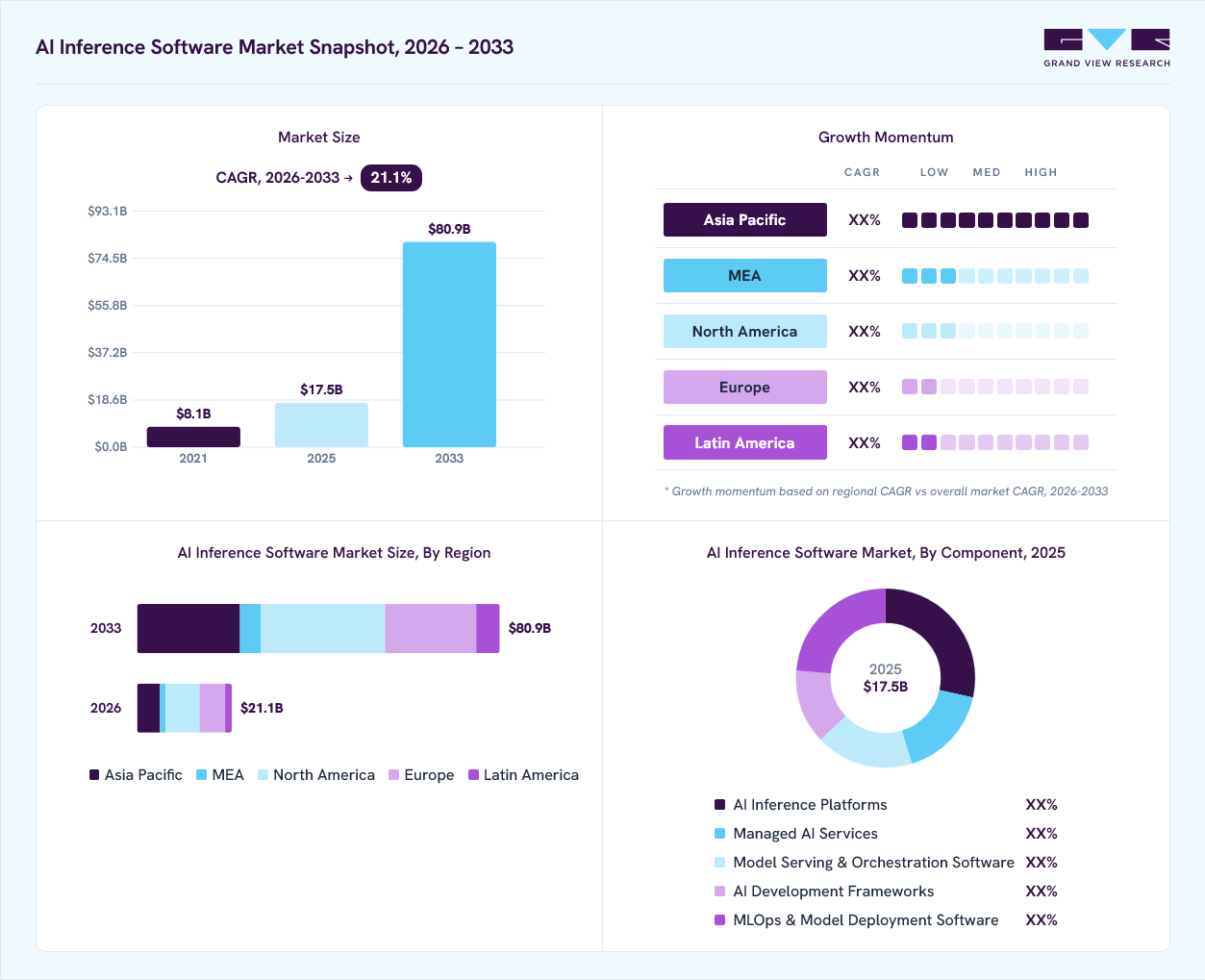
The global AI inference software market size was valued at USD 17.5 billion in 2025 and is projected to grow from USD 21.1 billion in 2026 to USD 80.9 billion by 2033, at a CAGR of 21.1% from 2026 to 2033. North America dominated the market, accounting for the largest revenue share of 36.1% in 2025. The growing adoption of AI and generative AI applications across enterprises drives the global market.
Key Market Trends & Insights
- By component: AI inference platforms segment held the largest revenue share of 28.4% in 2025.
- By deployment: Cloud segment held the largest revenue share of 43.3% in 2025.
- By application: Customer service & virtual agents segment held the largest revenue share of 23.5% in 2025.
- By end use: BFSI segment led the market with the largest revenue share of 25.7% in 2025.
Regional Highlights
- Largest regional market: North America (36.1% revenue share, 2025)
- Fastest growing regional market: Asia Pacific (highest CAGR, 2026-2033)
- By country: The U.S. held the largest revenue share in 2025
Market Size & Forecast
- Market size in 2025: USD 17.5 billion
- Estimated market size in 2026: USD 21.1 billion
- Projected market size by 2033: USD 80.9 billion
- CAGR (2026-2033): 21.1%
Increasing demand for real-time, low-latency AI processing is further supporting market growth. The shift toward production-scale AI deployment is increasing demand for efficient model inference and deployment solutions. These factors are expected to drive strong market expansion.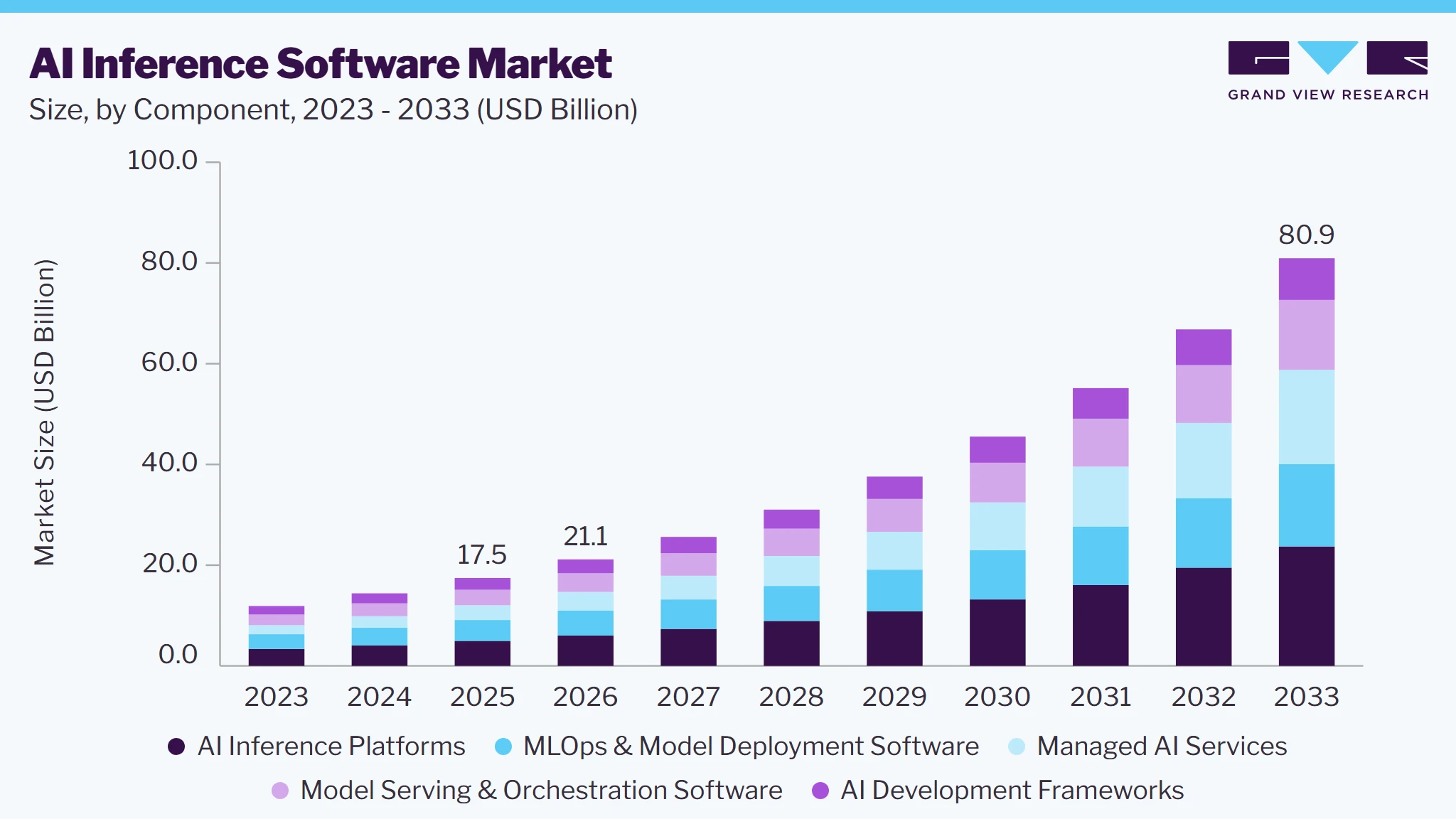
The growing adoption of distributed inference orchestration software is increasing across the AI inference software industry. Generative and agentic AI workloads are increasing the demand for efficient GPU and memory management. AI applications require faster and more scalable inference capabilities. Software providers are developing solutions that distribute inference tasks across computing resources. This is enabling more efficient and scalable AI inference infrastructure. For instance, in March 2026, NVIDIA Corporation launched Dynamo 1.0, an open-source inference software designed to orchestrate GPU and memory resources for AI workloads. The software also integrates with frameworks such as vLLM, SGLang, LangChain, and llm-d to support scalable AI inference.
Growing adoption of Kubernetes-based inference platforms is emerging as an important trend in the AI inference software industry. Enterprises are increasingly seeking flexible inference solutions across cloud and infrastructure environments. AI workloads are becoming more complex and resource-intensive. This is increasing the demand for software that can distribute workloads across multiple computing nodes. Kubernetes-based platforms enable efficient management and scaling of inference workloads. For instance, in May 2026, Red Hat expanded Red Hat AI Inference to managed Kubernetes services, initially supporting CoreWeave Kubernetes Service and Azure Kubernetes Service. The platform uses LLM-d for distributed inference orchestration, enabling AI workloads to scale across multiple GPU nodes.
Increasing adoption of specialized inference optimization software is emerging as a key trend in the AI inference software industry. AI workloads are becoming more complex and demanding higher inference performance. Organizations are seeking software optimized for specific AI accelerators and hardware architectures. This is increasing the demand for hardware-aware inference optimization. Software providers are enhancing model serving, memory management, and execution efficiency. Open-source inference frameworks are expanding support for diverse accelerator platforms. This is creating greater interoperability across AI infrastructure environments. Companies are advancing software optimization for large-scale AI inference. These developments are supporting faster and more efficient deployment of AI models.
Market Dynamics
The AI inference software industry is undergoing rapid technological and workload changes. The increasing adoption of generative and agentic AI is driving demand for faster, more efficient inference. High computing costs and resource requirements remain key challenges for organizations. Advances in inference optimization, orchestration, and hardware acceleration are improving deployment efficiency. The market is therefore evolving toward scalable, cost-efficient, and flexible inference solutions.
Growing demand for real-time AI inference is driving the expansion of the global market. Businesses are increasingly deploying AI applications that require immediate responses and continuous data processing. Applications such as fraud detection, recommendation engines, autonomous systems, and virtual assistants require low-latency inference. This is increasing the demand for software capable of processing AI models quickly and efficiently. Organizations are also adopting real-time inference to improve customer experience and operational decision-making. As AI applications become more interactive, the need for faster inference capabilities is expected to increase.
The growth of edge AI is further supporting demand for real-time inference capabilities. Processing data closer to the source can reduce latency and minimize the need to transfer large volumes of data to centralized cloud environments. This is particularly relevant for applications involving connected devices, industrial systems, vehicles, and healthcare equipment. AI inference software is being optimized to support faster model execution across cloud, edge, and hybrid environments. Improvements in model optimization, hardware acceleration, and workload orchestration are enhancing real-time inference performance. These developments are supporting the broader deployment of AI-powered applications across industries.
High infrastructure and AI accelerator costs remain a major restraint on the global market. AI inference workloads require high-performance GPUs, CPUs, memory, networking, and storage infrastructure. Advanced AI accelerators can significantly increase the initial investment required for inference deployments. Organizations also face ongoing costs for cloud computing, electricity, cooling, and infrastructure maintenance. These expenses can make large-scale inference deployments challenging for small and medium-sized enterprises. The growing complexity of AI models can further increase computing requirements and overall infrastructure costs.
High infrastructure costs can also limit the adoption of AI inference software in cost-sensitive industries. Organizations need to balance inference performance with infrastructure spending to achieve viable deployment economics. Dependence on specialized accelerators can further increase procurement and deployment expenses. Cloud-based inference can reduce upfront hardware investment but may create recurring usage costs at higher workloads. This is encouraging organizations to adopt model optimization, resource management, and cost-efficient inference approaches. As a result, infrastructure affordability remains an important consideration when scaling AI inference deployments.
Growing adoption of edge and on-device inference is creating new opportunities in the AI inference software industry. Organizations are increasingly processing AI workloads closer to where data is generated to reduce latency and improve response times. This approach is particularly relevant for smartphones, IoT devices, vehicles, industrial equipment, and smart cameras. On-device inference can also reduce dependence on centralized cloud infrastructure and lower data transfer requirements. Advances in compact AI models, hardware acceleration, and optimization techniques are making AI inference more practical on resource-constrained devices. These developments are expanding the use of AI inference software across a wider range of edge applications.
The growth of edge AI is also increasing demand for software that can efficiently manage models across distributed devices. Developers require tools for model compression, quantization, runtime optimization, and device-level resource management. Edge inference can support applications where continuous connectivity to cloud platforms is unavailable or impractical. It can also improve data privacy by processing sensitive information locally on devices. As edge deployments expand, inference software providers are developing solutions that support diverse processors and hardware architectures. This is creating opportunities for scalable and hardware-flexible inference software across industries.
Market Concentration & Characteristics
The AI inference software industry is relatively concentrated, with several major technology companies holding strong positions. Leading vendors have established extensive AI software ecosystems and large customer bases. Companies such as NVIDIA Corporation, Microsoft, Google, Amazon Web Services, AMD, and Red Hat compete across different areas of AI inference. Their broad technology portfolios and infrastructure capabilities create significant competitive advantages. These companies also benefit from strong partnerships with cloud providers, enterprises, and AI developers. Leading vendors account for a substantial share of the market.
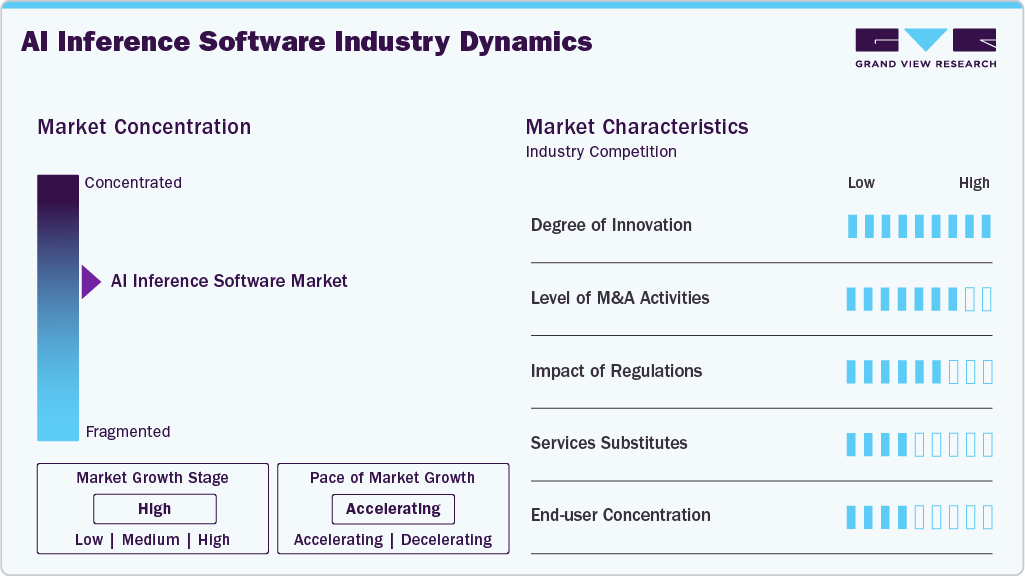
The market remains competitive as companies continue to expand their inference software capabilities. Large vendors are investing in model optimization, inference orchestration, hardware acceleration, and cloud-based deployment tools. Open-source frameworks and emerging startups are also creating alternatives to established platforms. However, the scale of investment and the established ecosystems of major vendors create relatively high barriers to entry. This limits the ability of smaller companies to compete across the entire inference software stack. Consequently, the market is characterized by strong leading players alongside a growing group of specialized competitors.
Analyst Perspective
The AI inference software market is entering a strong growth phase as AI applications move from experimentation to large-scale deployment. Rising adoption of generative, agentic, edge, and real-time AI is increasing demand for scalable and efficient inference solutions. Major technology companies are strengthening their offerings through optimization, orchestration, hardware compatibility, and cloud integration. At the same time, open-source frameworks and specialized platforms are creating greater competition and expanding technology choices. The market is expected to become more competitive, cost-focused, and technologically diverse as inference becomes a core component of enterprise AI deployments.
Component Insights
The AI inference platforms segment led the market with the largest revenue share of 28.4% in 2025, owing to its broad capabilities in deploying and managing AI models. These platforms support model serving, inference optimization, workload management, and resource allocation. Enterprises prefer platforms that provide greater control over their AI inference environments. The growing deployment of generative and agentic AI is further increasing demand for scalable inference platforms. Major technology providers are expanding their platforms with advanced orchestration, optimization, and hardware support. AI inference platforms are expected to maintain a strong position in the market.
The managed AI services segment is anticipated to grow at the fastest CAGR during the forecast period. Managed AI services are experiencing growing adoption as organizations seek simpler ways to deploy and operate AI inference workloads. These services reduce the need for enterprises to manage complex infrastructure and inference environments internally. Cloud providers offer managed services that support model deployment, scaling, monitoring, and performance optimization. This approach allows organizations to access inference capabilities without making significant upfront infrastructure investments. Growing demand for flexible and consumption-based AI services is further supporting this segment. As enterprises prioritize faster AI deployment and operational efficiency, managed AI services are expected to gain market share.
Deployment Insights
The cloud deployment segment led the market with the largest revenue share of 43.3% in 2025, due to its scalability, flexibility, and access to on-demand computing resources. Organizations can quickly scale inference workloads based on changing AI application requirements. Cloud platforms also reduce the need for large upfront investments in AI infrastructure and accelerators. Major cloud providers offer integrated inference tools, model-serving platforms, and AI computing resources. The growing deployment of generative and agentic AI applications is further increasing demand for cloud-based inference. Consequently, cloud deployment is expected to maintain its leading position in the market.
The hybrid cloud segment is anticipated to grow at the fastest CAGR during the forecast period. Hybrid cloud deployment is gaining traction as organizations seek greater flexibility in managing AI inference workloads. Enterprises can combine public cloud resources with private infrastructure based on performance, security, cost, and data requirements. This approach enables sensitive workloads to remain on private infrastructure while scalable workloads can run in the public cloud. Growing data privacy requirements and the need for localized processing are supporting hybrid cloud adoption. Advances in AI orchestration and cloud management tools are making it easier to manage inference workloads across multiple environments. As AI deployments become more complex, hybrid clouds are expected to gain increasing adoption.
Application Insights
The customer service and virtual agents segment led the market with the largest revenue share of 23.5% in 2025, driven by the widespread adoption of AI-powered conversational applications. Businesses are increasingly deploying virtual agents to handle customer queries, provide support, and automate routine interactions. These applications require real-time inference to generate fast and context-aware responses. Growing adoption of chatbots, voice assistants, and AI-powered customer support platforms is increasing inference workloads. Organizations are also using virtual agents to improve service availability and reduce response times. As businesses expand into AI-enabled customer interactions, this segment is expected to maintain its leading position.
The code generation and refactoring segment is anticipated to grow at the fastest CAGR during the forecast period. The segment is growing as organizations increasingly use AI to automate software development tasks. AI inference software enables models to generate, review, debug, optimize, and refactor code in real time. The growing adoption of AI coding assistants is increasing demand for fast, reliable inference capabilities. Developers are using these tools to accelerate development cycles and reduce repetitive programming work. Increasing integration of AI coding features into development environments is further supporting segment growth. As AI-assisted software development expands, demand for inference software supporting code generation and refactoring is expected to increase.
Enterprise Function Insights
The software engineering segment led the market with the largest revenue share of 25.2% in 2025 and is anticipated to grow at the fastest CAGR during the forecast period, due to the increasing adoption of AI across software development workflows. AI inference software supports code generation, debugging, testing, code review, and application optimization. Developers are increasingly using AI coding assistants to improve productivity and accelerate development cycles. The integration of generative AI into integrated development environments is further increasing inference workloads. Enterprises are also deploying AI tools across large-scale software development teams to automate repetitive tasks. As AI-assisted software development continues to expand, software engineering is expected to remain a major application area for AI inference software.
The customer support segment is anticipated to grow at a significant CAGR during the forecast period. Organizations use AI inference software to power chatbots, virtual agents, and automated customer service systems. These applications require real-time processing to understand customer queries and generate relevant responses. AI-powered support solutions can handle large volumes of customer interactions across multiple channels. Integration with CRM and contact-center platforms is expanding the use of AI in customer support operations. The segment is expected to maintain steady demand as businesses continue integrating AI into customer service workflows.
End Use Insights
The BFSI segment led the market with the largest revenue share of 25.7% in 2025, due to the extensive use of AI across financial services. Banks and financial institutions use AI inference software for fraud detection, risk assessment, credit scoring, and customer service. These applications require real-time processing to analyze large volumes of financial and customer data. Rising adoption of digital banking and online financial transactions is further expanding AI workloads across the sector. Financial institutions are also adopting AI to automate operations and improve decision-making. As AI adoption continues across banking, financial services, and insurance, BFSI is expected to maintain its leading position.
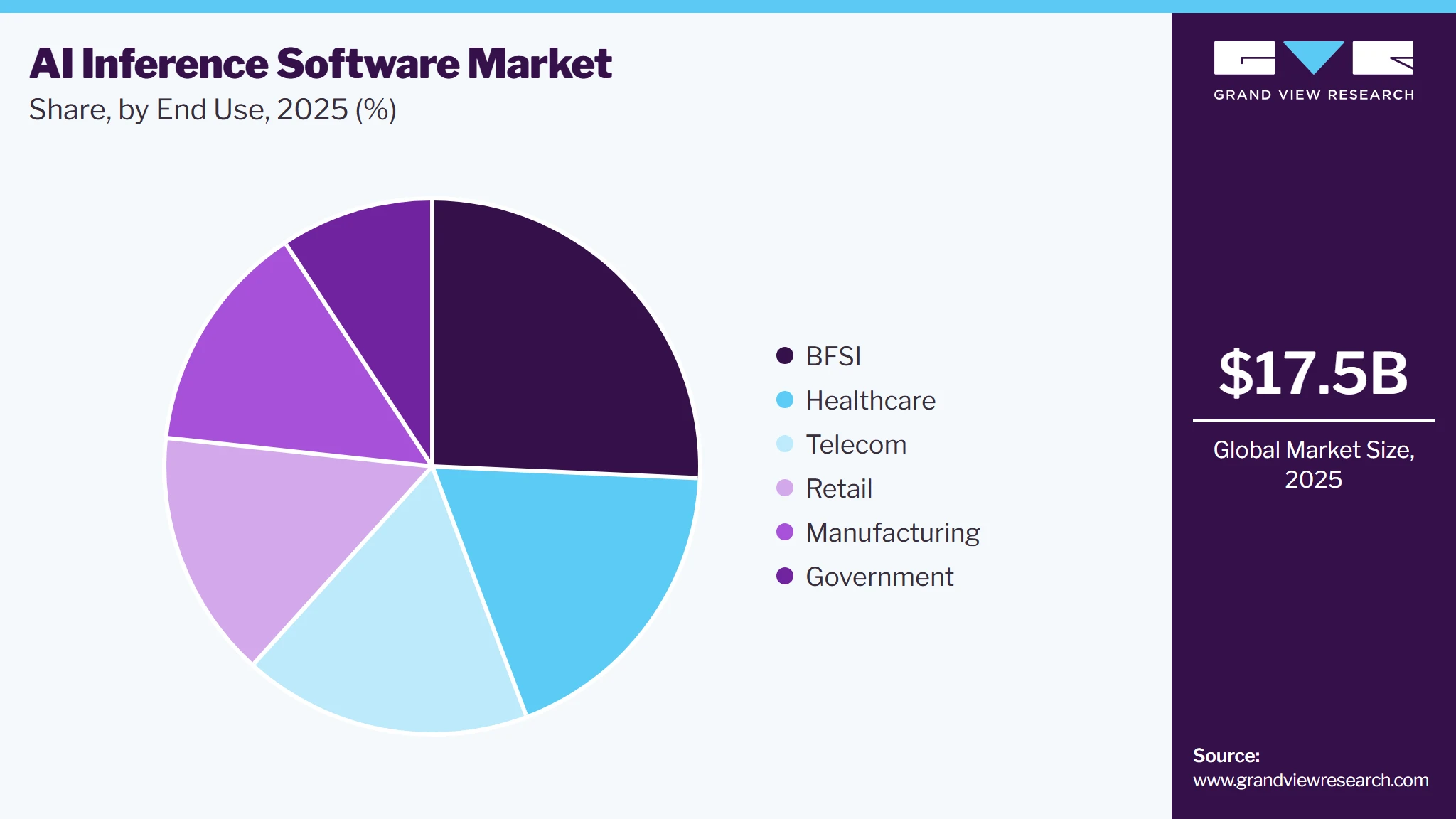
The healthcare segment is anticipated to grow at the fastest CAGR during the forecast period, as healthcare providers increasingly adopt AI-powered applications. AI inference software supports medical imaging, clinical decision support, patient monitoring, and personalized treatment applications. These use cases require fast processing of complex medical data to support timely decisions. The growing adoption of AI-assisted diagnostics and remote healthcare services is increasing inference workloads. Healthcare organizations are also using AI to automate administrative and clinical processes. As AI adoption expands across healthcare, demand for scalable and reliable inference software is expected to increase.
Regional Insights
North America dominated the global AI inference software market with the largest revenue share of 36.1% in 2025, driven by its advanced AI ecosystem and robust technology infrastructure. The region has a high concentration of AI software providers, cloud companies, semiconductor firms, and technology enterprises. Widespread adoption of generative AI and enterprise AI applications is increasing demand for inference software. Strong investments in AI infrastructure and data centers are further supporting market development.

U.S. AI Inference Software Market Trends
The AI inference software market in the U.S. accounted for the largest market revenue share in North America in 2025, as enterprises increasingly deploy generative and agentic AI applications. Major technology and cloud companies are expanding inference capabilities to support growing AI workloads. Companies are also focusing on inference optimization, cost reduction, and efficient resource utilization. Growing adoption of open-source and hardware-flexible inference platforms is further expanding the U.S. market.
Europe AI Inference Software Market Trends
The AI inference software market in Europe is expanding as enterprises increasingly adopt generative AI and AI-powered applications. Growing emphasis on data privacy, regulatory compliance, and sovereign AI is increasing demand for secure and controllable inference solutions. Organizations are also adopting cloud, edge, and hybrid inference architectures to support diverse AI workloads. Investments in AI infrastructure and open-source technologies are expected to further support the adoption of inference software across Europe.
Asia Pacific AI Inference Software Market Trends
The AI inference software market in the Asia Pacific is expected to grow at the fastest CAGR during the forecast period, supported by rapid AI adoption and expanding digital infrastructure. The region is seeing strong deployment of generative AI, edge AI, and real-time AI applications across industries. Growing investments in cloud infrastructure and AI computing are increasing demand for scalable inference solutions. China, India, Japan, and South Korea are among the key markets supporting the region's strong position.
Key AI Inference Software Company Insights
Some key companies in the AI inference software industry are Amazon Web Services, Inc., Microsoft, Google LLC, IBM Corporation, among others
-
Red Hat is strengthening its position in the AI inference software industry through its Red Hat AI Inference platform. The platform combines vLLM and LLM-d to enable scalable, efficient model inference. It enables organizations to run AI models across various hardware accelerators and hybrid cloud environments. Red Hat expanded the platform to managed Kubernetes environments, including CoreWeave and Microsoft Azure. The company is also focusing on improving throughput, latency, and cost per token for enterprise AI workloads.
-
Meta Platforms, Inc. is expanding its AI inference capabilities through its Meta Training and Inference Accelerator (MTIA) program. The company is developing custom AI chips specifically designed to improve the efficiency of inference workloads. Meta announced MTIA 300, 400, 450, and 500, with the MTIA 450 and 500 specifically focused on AI inference. The company is also working with Broadcom to develop multiple generations of custom AI chips. These developments are aimed at improving inference performance, reducing infrastructure costs, and supporting Meta's growing AI workload.
Key AI Inference Software Companies
The following key companies have been profiled for this study on the global AI inference software market:
-
Advanced Micro Devices, Inc.
-
Amazon Web Services, Inc.
-
Cerebras Systems
-
Google LLC
-
IBM Corporation
-
Intel Corporation
-
Meta Platforms, Inc.
-
Microsoft Corporation
-
NVIDIA Corporation
-
Red Hat
Competitive Benchmarking
Operating Strategies
Competitive Edge
Weaknesses
Mature Players: Amazon Web Services, Inc., Microsoft, Google LLC, IBM Corporation
- Focus on expanding AI inference platforms, cloud infrastructure, model-serving capabilities, and inference optimization technologies while strengthening strategic partnerships and investing in generative and agentic AI.
- Strong global presence, extensive AI and cloud infrastructure, diversified software portfolios, established enterprise relationships, and the ability to support large-scale AI inference workloads.
- High infrastructure and operational costs, complex technology portfolios, dependence on specialized computing resources, and challenges associated with integrating inference solutions across diverse enterprise environments.
Emerging Players: Advanced Micro Devices, Inc., Cerebras Systems, Intel Corporation, Meta Platforms, Inc.
- Focus on developing specialized inference software, optimizing AI workloads, supporting diverse hardware architectures, expanding open-source technologies, and forming strategic partnerships.
- Strong AI and computing expertise, specialized inference optimization capabilities, hardware-software integration, open-source contributions, and solutions designed for high-performance AI workloads.
- Smaller enterprise ecosystems compared with major cloud providers, higher dependence on hardware or infrastructure ecosystems, limited presence across some software segments, and challenges in competing with established end-to-end AI platforms.
Recent Developments
-
In March 2026, Google Cloud expanded its AI inference capabilities by integrating NVIDIA Dynamo with GKE Inference Gateway. The integration provides an open-source control plane for optimizing AI inference workloads across applications and GPU infrastructure.
-
In May 2025, Red Hat launched the llm-d community in collaboration with Google Cloud, IBM Research, NVIDIA, and CoreWeave to enable scalable, distributed AI inference. The open-source project combines Kubernetes and vLLM technologies to improve inference scalability, workload efficiency, and hardware flexibility.
AI Inference Software Market Report Scope
Report Attribute
Details
Market size in 2025
USD 17.5 billion
Estimated market size in 2026
USD 21.1 billion
Projected market size by 2033
USD 80.9 billion
Growth rate
CAGR of 21.1% from 2026 to 2033
Base year for estimation
2025
Historical data
2021 - 2024
Forecast period
2026 - 2033
Quantitative units
Revenue in USD billion/billion and CAGR from 2026 to 2033
Report coverage
Revenue forecast, company ranking, competitive landscape, growth factors, and trends
Segments covered
Component, deployment, application, enterprise function, end use, and regional.
Regional scope
North America; Europe; Asia Pacific; Latin America; and MEA
Country scope
U.S.; Canada; Europe; UK; Germany; France; China; Japan; India; South Korea; Australia; Brazil; KSA; UAE; South Africa
Key companies profiled
Amazon Web Services, Inc.; Advanced Micro Devices, Inc.; Cerebras Systems; Google LLC; IBM Corporation; Intel Corporation; Meta Platforms, Inc.; Microsoft Corporation; NVIDIA Corporation; Red Hat
Customization scope
Free report customization (equivalent up to 8 analysts working days) with purchase. Addition or alteration to country, regional & segment scope.
Pricing and purchase options
Avail customized purchase options to meet your exact research needs. Explore purchase options
Global AI Inference Software Market Report Segmentation
This report forecasts revenue growth at global, regional, and country levels and provides an analysis of the latest industry trends in each of the sub-segments from 2021 to 2033. For this study, Grand View Research has segmented the global AI inference software market report based on component, deployment, application, enterprise function, end use, and region.
-
Component Outlook (Revenue, USD Billion, 2021-2033)
-
AI Inference Platforms
-
Managed AI Services
-
Model Serving & Orchestration Software
-
AI Development Frameworks
-
MLOps & Model Deployment Software
-
-
Deployment Outlook (Revenue, USD Billion, 2021-2033)
-
Cloud
-
Hybrid Cloud
-
On-Premise
-
Edge
-
-
Application Outlook (Revenue, USD Billion, 2021 - 2033)
-
Application Modernization
-
Code Generation & Refactoring
-
Intelligent Automation
-
Customer Service & Virtual Agents
-
Knowledge Management
-
Predictive Analytics
-
-
Enterprise Function Outlook (Revenue, USD Billion, 2021-2033)
-
IT Operations
-
Software Engineering
-
Customer Support
-
Finance
-
Security Operations
-
-
End Use Outlook (Revenue, USD Billion, 2021 - 2033)
-
BFSI
-
Healthcare
-
Retail
-
Telecom
-
Manufacturing
-
Government
-
-
Regional Outlook (Revenue, USD Billion, 2021-2033)
-
North America
-
U.S.
-
Canada
-
Mexico
-
-
Europe
-
UK
-
Germany
-
France
-
-
Asia Pacific
-
China
-
Japan
-
India
-
South Korea
-
Australia
-
-
Latin America
-
Brazil
-
Middle East and Africa (MEA)
-
KSA
-
UAE
-
South Africa
-
-
Research Methodology
The AI inference software marketfigures in this report are based on a proven research process that combines executive interviews with secondary research from proprietary databases, company filings, and recognized regulatory and institutional sources. Market size is built through value-chain sizing—reconciling supply-side and demand-side estimates—and triangulated with bottom-up and top-down approaches. Every estimate passes multiple levels of expert validation before publication, with eachAI inference software segment quantified using the revenue-capture definitions in the table below.
Segment Definition
Segment- Component
Revenue Capture Definition
AI Inference Platforms
Revenue generated from AI Inference Platforms-based software solutions used to deploy, execute, optimize, monitor, and manage AI models during inference across cloud, on-premise, hybrid, and edge environments.
Managed AI Services
Revenue generated from Managed AI Services provides hosted AI inference capabilities, including model deployment, inference execution, scaling, monitoring, optimization, and infrastructure management.
Model Serving & Orchestration Software
Revenue generated from Model Serving & Orchestration Software used to deploy models, route inference requests, manage workloads, allocate computing resources, and optimize model execution across distributed environments.
AI Development Frameworks
Revenue generated from AI Development Frameworks used by developers to build, test, optimize, and deploy AI inference applications, including frameworks supporting model execution, acceleration, and hardware integration.
MLOps & Model Deployment Software
Revenue generated from MLOps & Model Deployment Software used to automate model deployment, versioning, monitoring, lifecycle management, performance tracking, and scaling of AI inference workloads.
Segment - Deployment
Revenue Capture Definition
Cloud
Revenue generated from cloud-based AI inference software used to deploy, execute, scale, monitor, and optimize AI models through public cloud infrastructure and on-demand computing resources.
Hybrid Cloud
Revenue generated from AI inference software deployed across integrated public and private cloud environments to manage, distribute, and optimize AI workloads based on performance, security, cost, and data requirements.
On-Premise
Revenue generated from AI inference software deployed within an organization's own data centers and IT infrastructure for localized model execution, workload management, security, and control.
Edge
Revenue generated from AI inference software deployed on edge devices and computing infrastructure to execute AI models closer to data sources, enabling low-latency processing, real-time decision-making, and reduced data transfer.
Segment - Application
Revenue Capture Definition
Application Modernization
Revenue generated from AI inference software used to modernize legacy applications by integrating AI-powered capabilities, intelligent processing, automated decision-making, and AI-enabled application functionality.
Code Generation & Refactoring
Revenue generated from AI inference software used to generate, review, debug, optimize, translate, and refactor source code and support AI-assisted software development workflows.
Intelligent Automation
Revenue generated from AI inference software used to automate business processes, workflows, decisions, document processing, task execution, and other repetitive enterprise activities.
Customer Service & Virtual Agents
Revenue generated from AI inference software used to power chatbots, virtual agents, conversational AI, voice assistants, automated customer interactions, and real-time customer support.
Knowledge Management
Revenue generated from AI inference software used to search, retrieve, summarize, classify, and generate insights from enterprise knowledge, documents, databases, and other information sources.
Predictive Analytics
Revenue generated from AI inference software used to analyze historical and real-time data, identify patterns, generate predictions, detect anomalies, and support data-driven decision-making.
Segment - Enterprise Function
Revenue Capture Definition
IT Operations
Revenue generated from AI inference software used to monitor IT environments, detect anomalies, predict incidents, automate troubleshooting, optimize infrastructure, and support IT service management.
Software Engineering
Revenue generated from AI inference software used for code generation, code review, debugging, testing, refactoring, documentation, and software development automation.
Customer Support
Revenue generated from AI inference software used to automate customer inquiries, support interactions, ticket classification, response generation, knowledge retrieval, and service assistance.
Finance
Revenue generated from AI inference software used for financial analysis, forecasting, fraud detection, document processing, risk assessment, accounting automation, and financial decision support.
Security Operations
Revenue generated from AI inference software used to detect threats, analyze security events, identify anomalies, investigate incidents, and automate cybersecurity monitoring and response.
Segment - End Use
Revenue Capture Definition
BFSI
Revenue generated from AI inference software used by banking, financial services, and insurance organizations for fraud detection, risk assessment, customer service, financial analysis, compliance, and automated decision-making.
Healthcare
Revenue generated from AI inference software used by healthcare providers, pharmaceutical companies, and healthcare organizations for medical imaging, clinical decision support, patient monitoring, diagnostics, and healthcare automation.
Retail
Revenue generated from AI inference software used by retailers for personalized recommendations, demand forecasting, customer service, inventory optimization, pricing, fraud detection, and intelligent commerce.
Telecom
Revenue generated from AI inference software used by telecommunications companies for network optimization, predictive maintenance, customer service, anomaly detection, traffic management, and service personalization.
Manufacturing
Revenue generated from AI inference software used by manufacturers for predictive maintenance, quality inspection, process optimization, robotics, production monitoring, and intelligent automation.
Government
Revenue generated from AI inference software used by government agencies for public services, document processing, citizen support, security, infrastructure monitoring, fraud detection, and administrative automation.
Estimation Model
Layer No.
Layer Name
Key Question
Description
01
End-user Industry Layer
Who creates demand for AI Inference Software?
Identifies the total base of organizations generating demand for AI Inference Software across end-use industries such as BFSI, Healthcare, Retail, Telecom, Manufacturing, and Government that require AI-powered applications and real-time inference capabilities.
02
Adoption / Usage Layer
Who actively adopts AI Inference Software?
Filters the addressable market based on AI adoption, digital transformation, increasing deployment of generative and agentic AI, demand for real-time applications, and investments in cloud, hybrid cloud, on-premise, and edge inference infrastructure.
03
Component & Infrastructure Layer
Which Technologies are deployed?
Estimates adoption across technologies, including AI Inference Platforms, Managed AI Services, Model Serving & Orchestration Software, AI Development Frameworks, and MLOps & Model Deployment Software, supported by cloud, hybrid cloud, on-premise, and edge infrastructure.
04
Revenue Capture Layer
How is revenue generated in the AI Inference Software ecosystem?
Calculates revenue generated from AI inference platforms, managed AI services, model serving and orchestration software, AI development frameworks, MLOps, and model deployment software, implementation, integration, optimization, monitoring, maintenance, and managed inference services.
Delivered Customizations
This report has been delivered with the following In-depth customizations
Client Objective
Custom Research Modules Delivered
Strategic Value / Business Impact
Component & Infrastructure Assessment
- Emerging AI inference software component trend analysis
- AI infrastructure and innovation pipeline assessment
- AI Inference Platforms, Managed AI Services, Model Serving & Orchestration Software, AI Development Frameworks, and MLOps adoption assessment
- AI inference ecosystem and technology partner mapping
- Identified future AI inference software opportunities
- Supported AI infrastructure investment planning
- Evaluated technology and component adoption readiness
- Strengthened ecosystem partnership decisions
Platform Positioning & Competitive Intelligence
- AI inference software platform and solution benchmarking
- Feature and capability comparison
- Pricing and value proposition analysis
- Competitive strategy evaluation
- Improved platform differentiation strategy
- Supported pricing optimization
- Identified customer requirements and capability gaps
- Enhanced competitive positioning
Market Entry & Growth Assessment
- Regional market sizing and forecasting
- End-user segmentation and AI adoption analysis
- Competitive landscape benchmarking
- Regulatory and AI ecosystem assessment
- Identified high-growth regional opportunities
- Supported go-to-market strategy development
- Highlighted investment priorities and market risks
- Enabled data-driven expansion planning
Frequently Asked Questions About This Report
Cloud segment held the largest revenue share of 43.3% in 2025.
The global AI Inference Software market size was estimated at USD 17.5 billion in 2025 and is expected to reach USD 21.1 billion in 2026.
The global AI Inference Software market is expected to grow at a compound annual growth rate of 21.1% from 2026 to 2033 to reach USD 80.9 billion by 2033.
North America dominated the AI Inference Software market with a share of 36.1% in 2025, driven by strong AI adoption, advanced computing infrastructure, and increasing deployment of AI applications across industries.
Asia Pacific is the fastest-growing region over the forecast period.
Key factors that are driving the market growth include increasing adoption of AI applications, rising demand for real-time inference, growing use of generative AI, expansion of edge AI deployments, and the need for faster and more cost-efficient AI processing.
Some key players operating in the AI Inference Software market include Amazon Web Services, Inc., Advanced Micro Devices, Inc., Cerebras Systems, Google LLC, IBM Corporation, Intel Corporation, Meta Platforms, Inc., Microsoft Corporation, NVIDIA Corporation, Red Hat
The AI inference platforms segment led with a 28.4% revenue share in 2025, while managed AI services is the fastest-growing segment.
The BFSI segment led with a 25.7% revenue share in 2025, while healthcare is the fastest-growing segment.
About the Author(s)
Next Generation Technologies Research Team
Technology · Next Generation TechnologiesThis report was authored by the next generation technologies research team at Grand View Research - comprising two research analysts, one senior research analyst, and one industry expert - with specialized expertise in the next generation technologies segment of the technology industry. All findings are based on proprietary technology databases, executive interviews, and regulatory analysis, subject to internal peer review prior to publication.
Last Updated:
Speak to Analyst


Customize this report to your needs — add regions, segments, or data points, with 20% free customization.
Or view our licence options:


ISO 9001:2015 & 27001:2022 Certified
We are GDPR and CCPA compliant! Your transaction & personal information is safe and secure. For more details, please read our privacy policy.


