
- Home
- »
- Next Generation Technologies
- »
-
AI-optimization For Quantum Computing Market Report, 2025-2033GVR Report cover

AI-optimization For Quantum Computing Market (2025 - 2033)
Size, Share & Trends Analysis Report By Component (Software, Hardware), By Technology (Superconducting Qubits, Trapped Ions), By Application, By End Use, By Region, And Segment Forecasts
Market Size, 2024
$112.3MMarket Estimate, 2026
$154.7MMarket Forecast, 2033
$541.4MCAGR, 2025–2033
19.3%AI-optimization For Quantum Computing Market Summary
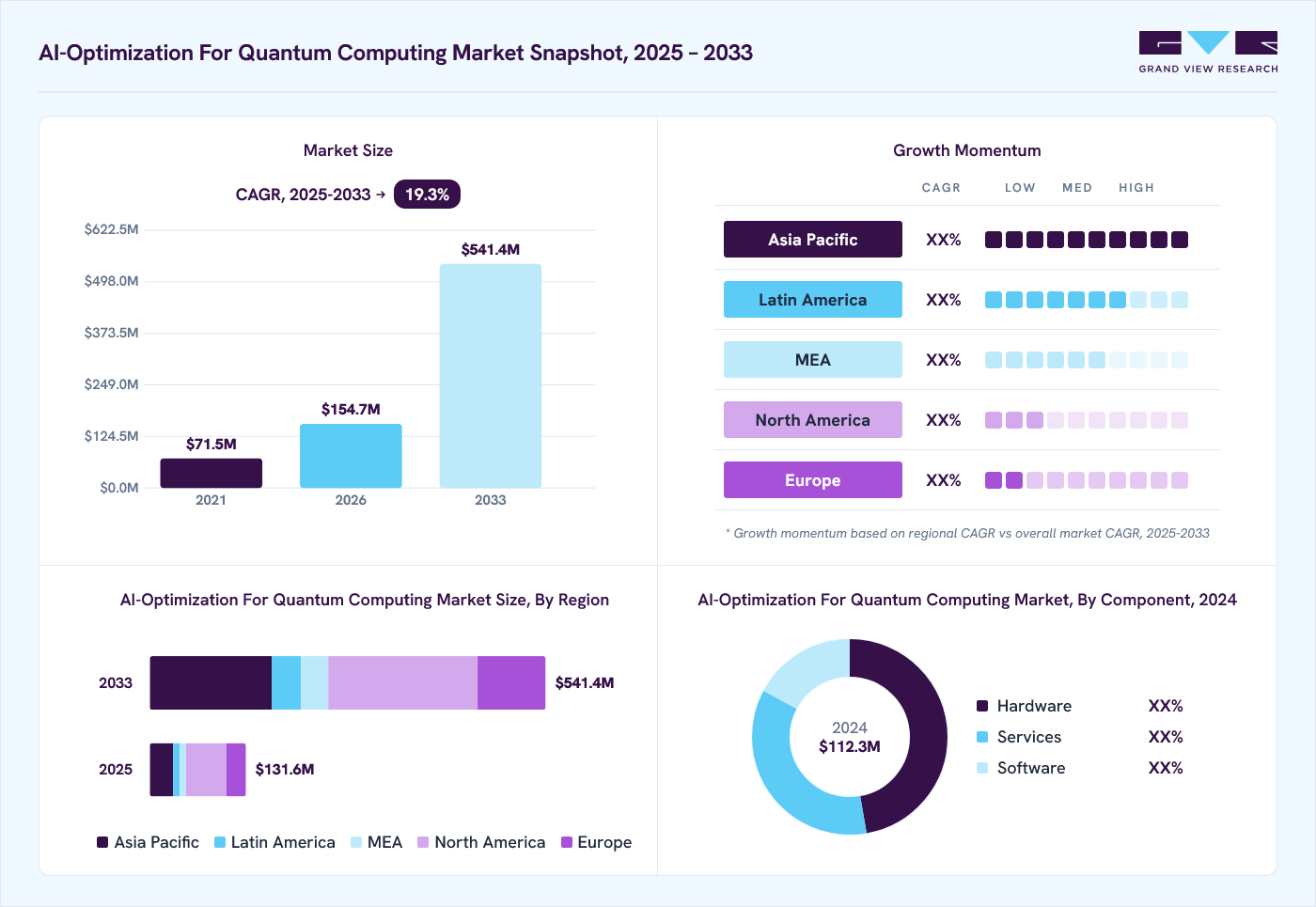
The global AI-optimization for quantum computing market size was valued at USD 112.3 million in 2024 and is projected to grow from USD 154.7 million in 2026 to USD 541.4 million by 2033, at a CAGR of 19.3% from 2025 to 2033. North America dominated the market, accounting for a revenue share of 42.4% in 2024. The rapid advancement of quantum hardware is creating a strong need for AI-driven optimization to improve system accuracy and efficiency.
 Source: Grand View Research, IR Documents, Primary Interviews, Paid DatabasesTo learn more about this report,
 Download Free Sample Report
 Key Market Trends & Insights
- The AI-optimization for quantum computing market in the U.S. led the North America market and held the largest revenue share in 2024.
- By component, hardware segment led the market and held the largest revenue share of 47.2% in 2024.
- By technology, machine learning model optimization segment held the dominant position in the market and accounted for the leading revenue share of 20.7% in 2024.
- By end use, healthcare & life sciences segment is expected to grow at the fastest CAGR of 24.8% from 2025 to 2033.
Market Size & Forecast
- 2024 Market Size: USD 112.3 Million
- 2033 Projected Market Size: USD 541.4 Million
- CAGR (2025-2033): 19.3%
- North America: Largest Market in 2024
Three ways to get this report
Buy it, customize it, or ask a question.Ask an Analyst
Analyst response in 1 business day
- AccessReport author, directly
- Reply timeWithin 1 working day
- No sales callDirect answer only
- FormatEmail reply
- CostFree, no cost
Get the Full Report
What the study covers
- FormatsPDF · Excel · Dashboard
- Timeline2025–2033 annual, 2024 base
- Coverage20+ countries, 5 regions
- Companies10+ key players profiled
Customize the Report
20% free customization
- IncludeCountries, segments, points
- TailorTo your product definition
- ExtendDeeper competitor detail
- OrA fully bespoke study
- Turnaround5–10 working days
As quantum processors scale to higher qubit counts, error rates, qubit decoherence, and noise challenges intensify, requiring intelligent algorithms to stabilize operations. Quantum algorithms are becoming more complex as enterprises explore use cases in chemistry, materials science, finance, and logistics. These workloads demand precise optimization of circuits, resource allocation, and noise-aware execution strategies. AI helps automate circuit optimization by shortening gate depth, lowering noise exposure, and selecting the most efficient qubit pathways. Organizations recognize that algorithm optimization is essential to approach quantum advantage in the near term. AI-driven optimization platforms provide automated tools that would otherwise require extensive human expertise. This growing complexity of workloads directly fuels demand for AI-enabled optimization solutions.Additionally, the rise of trapped ion computing, where classical AI systems work alongside quantum processors. These trapped ions workflows rely on AI to orchestrate task allocation, optimize circuit execution, and manage data transfer across environments. AI models enable adaptive learning loops where classical systems train and refine quantum models iteratively. This approach significantly increases quantum algorithm performance and accelerates convergence times for optimization problems. Enterprises adopting trapped ions architectures rely on AI tools to streamline interactions between classical GPUs and quantum devices. As trapped ions computing becomes the standard for near-term quantum use cases, demand for AI-driven orchestration tools accelerates.
 To learn more about this report, Download Free Sample Report
 Industries such as pharmaceuticals, automotive, Machine Learning Model Optimization, logistics, and energy are rapidly exploring quantum applications that require optimization support. These sectors face complex computational problems-such as molecular modeling, portfolio optimization, and route planning-that benefit from AI-enhanced quantum workflows. AI improves solution accuracy by fine-tuning quantum circuits for domain-specific challenges. Vendors are building an industry focused on optimization models that simplify integration into existing enterprise applications. As quantum cloud platforms expand their service offerings, AI-assisted optimization tools become more accessible to commercial users. This rising adoption aligns with growing enterprise awareness of quantum computing’s long-term value.
Component Insights
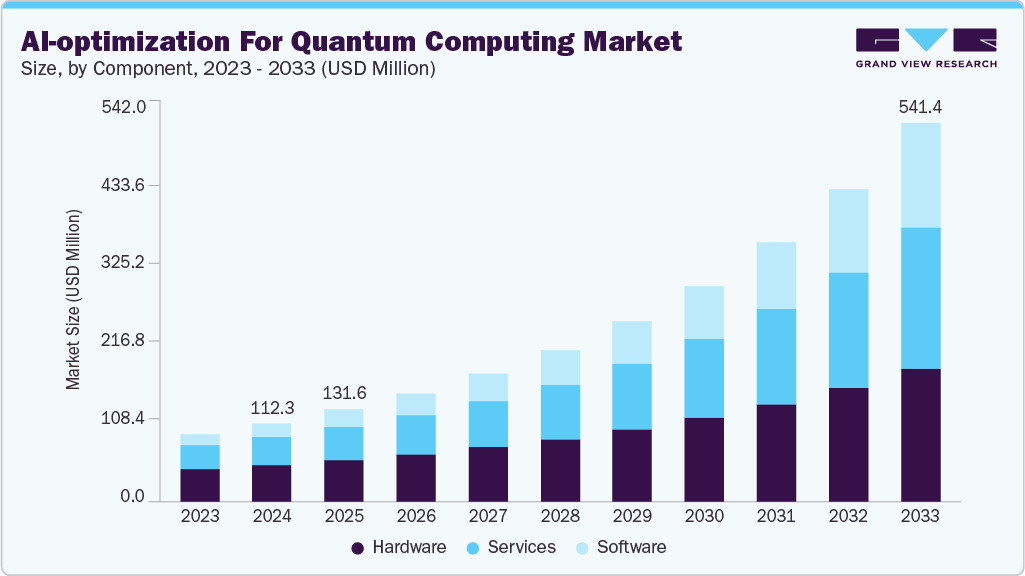
The hardware segment led the market and accounted for 47.2% of the global revenue in 2024. The rise of trapped ions architectures increases dependency on hardware that supports AI-driven optimization at the chip and system levels. For instance, in November 2024, D-Wave Quantum announced the successful calibration and benchmarking of its sixth-generation Advantage2 processor featuring over 4,400 qubits. This processor demonstrates significant performance enhancements over the previous advantage system, including doubled qubit coherence time, a 40% increase in energy scale, and improved qubit connectivity from 15-way to 20-way.
The software segment is predicted to foresee significant growth in the forecast period. Software vendors integrate machine learning models to refine circuit depth, enhance fidelity, and manage workflow orchestration across classical and quantum environments. For instance, in November 2025, PsiQuantum introduced Construct, a comprehensive software platform designed for the development and optimization of fault-tolerant quantum algorithms. The platform features tools such as Circuit Designer for visual circuit prototyping, a Python-based Workbench for large-scale algorithm development, and a Resource Analyzer for detailed cost and bottleneck assessment.
Technology Insights
The superconducting qubits segment accounted for the largest market revenue share in 2024. Increasing qubit counts intensifies noise management challenges, and AI systems support faster stabilization across multi-qubit architectures. Hardware teams depend on AI-driven analysis to reduce decoherence effects and improve execution fidelity during algorithm testing. For instance, in December 2024, Google introduced Willow, its latest quantum chip featuring 105 high-quality superconducting qubits with significantly improved coherence times of nearly 100 microseconds. This chip achieves an exponential reduction in error rates through advanced quantum error correction techniques.
The photonic quantum computing segment is predicted to foresee significant growth in the forecast period. Photonic systems benefit from AI tools that refine photon routing, source quality, and error reduction in optical circuits. As photonic architectures expand toward large-scale integration, AI assists in optimizing component alignment and signal calibration. For instance, in April 2025, Xanadu Quantum Technologies Inc. announced a four-year strategic research and development partnership with the U.S. Air Force Research Laboratory (AFRL) aimed at accelerating the development of silicon photonic integrated circuits for quantum computing and communication applications.
Application Insights
The machine learning model optimization segment is expected to hold the highest market share of the global revenue in 2024. AI-driven optimization supports the refinement of quantum-enhanced machine learning models by improving circuit structures, reducing depth, and enhancing fidelity during training. For instance, in December 2024, Quantum Machines and Rigetti Computing announced the successful application of artificial intelligence to automate the calibration of a 9-qubit Rigetti Novera quantum processing unit. The AI tools achieved high gate fidelity and significantly reduced the manual effort and time traditionally required for quantum computer calibration.
The material simulation & drug discovery segment is predicted to foresee significant growth in the forecast period. The complexity of molecular modelling and reaction pathway analysis increases demand for AI-optimized quantum circuits that handle high-dimensional simulation tasks. For instance, in April 2023, Moderna and IBM announced a collaboration to explore the application of quantum computing and artificial intelligence to advance and accelerate messenger RNA (mRNA) research and development. The partnership includes Moderna's participation in the IBM Quantum Accelerator program and Quantum Network, where Moderna scientists will gain expertise in quantum computing technologies.
End Use Insights
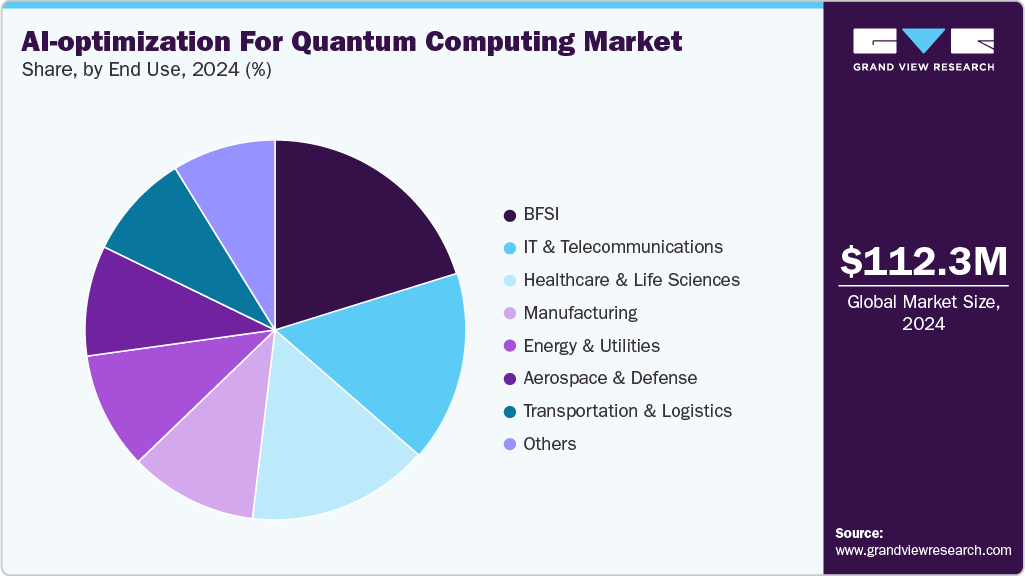
The Machine Learning Model Optimization segment accounted for the largest market revenue share in 2024. Financial institutions are increasing the use of quantum approaches for portfolio optimization, fraud detection, and risk analytics, which drives demand for AI-optimized quantum workflows. For instance, in February 2025, BMO became the first Canadian bank to join the IBM Quantum Network, enhancing its technology leadership in North America. This strategic integration provides BMO access to IBM's advanced quantum infrastructure, supporting the development and deployment of quantum-powered solutions across its financial services.
 To learn more about this report, Download Free Sample Report
 The healthcare & life sciences segment is projected to grow significantly over the forecast period. The segment depends on accelerated analysis for genomics, diagnostics, and therapeutic discovery, creating strong need for AI-optimized quantum circuits that manage complex biological datasets. For instance, in June 2025, IonQ announced a collaborative research outcome with AstraZeneca, AWS, and NVIDIA that demonstrated a quantum-accelerated computational chemistry workflow. The work exemplifies significant progress in using quantum computing to address complex pharmaceutical challenges and enhance efficiency in drug discovery.
Regional Insights
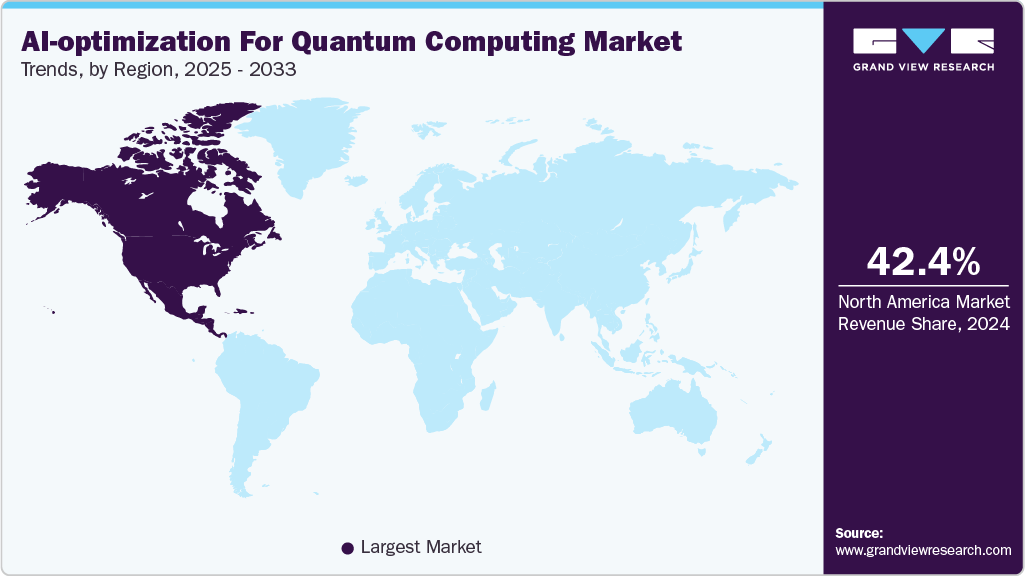
North America dominated the market by 42.4% revenue share in 2024. North America experiences strong advancement in quantum hardware and cloud-accessible quantum platforms, increasing the need for AI-based optimization tools. Regional enterprises accelerate experimentation with trapped ions architectures, raising demand for automated circuit tuning and workflow orchestration. Large technology firms invest in AI models that refine qubit control and calibration to enhance system consistency. Growing collaborations between industry and national labs strengthen the adoption of optimization frameworks that support complex algorithm testing.
 To learn more about this report, Download Free Sample Report
 U.S. AI-optimization For Quantum Computing Market Trends
The U.S. maintains a strong concentration of quantum hardware developers, prompting extensive adoption of AI systems that refine error mitigation and gate operation accuracy. Advanced R&D programs encourage continuous testing of new qubit designs, increasing reliance on optimization algorithms that improve performance across prototype devices. Commercial adoption in defense, finance, and biotechnology enhances demand for stable quantum workflows supported by AI-based tuning. Expanding developer ecosystems drive innovation in optimization software that supports high-volume experimentation on domestic quantum platforms.
Europe AI-optimization For Quantum Computing Market Trends
In Europe, the research ecosystem is expanding quantum programs focused on precision engineering, encouraging the integration of AI tools to refine circuit stability and execution quality. Scheduling & Resource Allocation-backed initiatives promote development of advanced quantum applications in mobility, energy, and industrial design, increasing dependence on optimization software. Strong presence of academic consortiums supports innovation in AI-driven error reduction and noise modelling. Regional emphasis on secure computing environments drives the need for optimization systems that enhance performance in quantum cryptography and simulation workloads.
Asia Pacific AI-optimization For Quantum Computing Market Trends
Asia Pacific has the highest CAGR for the forecasted period as the market expansion is due to the rapid investment in quantum technology accelerates the requirement for AI-driven optimization to manage expanding hardware capabilities across diverse architectures. Regional enterprises explore quantum solutions in manufacturing, telecom, and logistics, increasing demand for automated circuit enhancement tools. Growing interest in scalable quantum-classical infrastructures supports wider integration of AI models for workflow alignment and calibration efficiency. Research institutions contribute to new approaches in optimization that address region-specific industrial use cases.
Key AI-optimization For Quantum Computing Company Insights
Some key companies in the AI-optimization quantum computing industry are Microsoft, Amazon Web Services, Inc., NVIDIA Corporation, Fujitsu
-
Atos Quantum offers a comprehensive suite of digital solutions including cloud, cybersecurity, data and AI services, smart platforms and digital workplace consulting. It supports clients in regulated and sovereign sectors by managing critical IT environments and enabling full-lifecycle transformation from strategy through operations. Its portfolio spans end-to-end IT services, application management and infrastructure services, with a dedicated sub-brand (Eviden) that provides advanced computing, mission-critical systems and cybersecurity products. Atos integrates consulting, technology and operational services to serve evolving enterprise demands.
-
Intel Corporation designs and manufactures a broad range of computing and related technology products for business and consumer markets, including microprocessors, chipsets, GPUs, AI accelerators and networking components. The company’s purpose centres on creating technology that supports connectivity, creation and achievement across everyday life. It delivers hardware and software across data centres, client computing and edge devices, addressing both performance and power efficiency requirements. Intel emphasises innovation in process technology, packaging and architectural design to address evolving demands in computing, AI and networking.
Key AI-optimization For Quantum Computing Companies:
The following are the leading companies in the AI-optimization for quantum computing market. These companies collectively hold the largest market share and dictate industry trends.
- Atos Quantum
- D-Wave Quantum Inc.
- Google LLC
- IBM Corporation
- Intel Corporation
- IonQ, Inc.
- Microsoft
- PsiQuantum
- Rigetti Computing, Inc.
- Xanadu Quantum Technologies
Recent Developments
-
In March 2025, D-Wave Quantum Inc. and the pharmaceutical division of Japan Tobacco Inc. completed a joint proof-of-concept project that integrated quantum computing technology with artificial intelligence to enhance drug discovery processes. By employing a quantum-trapped ions workflow to train large language models, the project generated novel, more drug-like molecular structures beyond those in the original datasets.
-
In December 2024, Quantum Machines and Rigetti Computing announced the successful application of AI to automate the calibration of a 9-qubit Rigetti Novera quantum processing unit. This was achieved through the "AI for Quantum Calibration Challenge" held at the Israeli Quantum Computing Center, involving AI tools from Quantum Elements and Qruise integrated with Quantum Machines' OPX1000 control system and NVIDIA's DGX Quantum platform.
AI-optimization For Quantum Computing Market Report Scope
Report Attribute
Details
Market size in 2024
USD 112.3 million
Estimated market size in 2026
USD 154.7 million
Projected market size by 2033
USD 541.4 million
Growth rate
CAGR of 19.3% from 2025 to 2033
Base year for estimation
2024
Actual data
2021 - 2023
Forecast period
2025 - 2033
Quantitative units
Revenue in USD billion/million and CAGR from 2025 to 2033
Report coverage
Revenue forecast, company ranking, competitive landscape, growth factors, and trends
Segments covered
Component, technology, application, end use, regional
Regional scope
North America; Europe; Asia Pacific; Latin America; Middle East & Africa
Country scope
U.S.; Canada; Mexico; Europe; UK; Germany; France; China; Japan; India; South Korea; Australia; Brazil; KSA; UAE; South Africa
Key companies profiled
Atos Quantum; D-Wave Quantum Inc.; Google LLC; IBM Corporation; Intel Corporation; IonQ, Inc.; Microsoft; PsiQuantum; Rigetti Computing, Inc.; Xanadu Quantum Technologies
Customization scope
Free report customization (equivalent up to 8 analysts working days) with purchase. Addition or alteration to country, regional & segment scope.
Pricing and purchase options
Avail customized purchase options to meet your exact research needs. Explore purchase options
Global AI-optimization For Quantum Computing Market Report Segmentation
This report forecasts revenue growth at global, regional, and country levels and provides an analysis of the latest industry trends in each of the sub-segments from 2021 to 2033. For this study, Grand View Research has segmented the global AI-optimization for quantum computing market report based on component, technology, application, end use, and region.
-
Component Outlook (Revenue, USD Million, 2021 - 2033)
-
Software
-
Hardware
-
Services
-
-
Technology Outlook (Revenue, USD Million, 2021 - 2033)
-
Superconducting Qubits
-
Trapped Ions
-
Quantum Annealing
-
Photonic Quantum Computing
-
Others
-
-
Application Outlook (Revenue, USD Million, 2021 - 2033)
-
Machine Learning Model Optimization
-
Quantum Circuit Optimization
-
Scheduling & Resource Allocation
-
Material Simulation & Drug Discovery
-
Financial Modeling & Portfolio Optimization
-
Supply Chain & Logistics Optimization
-
Others
-
-
End Use Outlook (Revenue, USD Million, 2021 - 2033)
-
BFSI
-
Healthcare & Life Sciences
-
Energy & Utilities
-
Manufacturing
-
IT & Telecommunications
-
Aerospace & Defense
-
Transportation & Logistics
-
Others
-
-
Regional Outlook (Revenue, USD Million, 2021 - 2033)
-
North America
-
U.S.
-
Canada
-
Mexico
-
-
Europe
-
UK
-
Germany
-
France
-
-
Asia Pacific
-
China
-
Japan
-
India
-
South Korea
-
Australia
-
-
Latin America
-
Brazil
-
-
Middle East and Africa (MEA)
-
KSA
-
UAE
-
South Africa
-
-
Frequently Asked Questions About This Report
Some key players operating in the AI-optimization for quantum computing market include Atos Quantum; D-Wave Quantum Inc.; Google LLC; IBM Corporation; Intel Corporation; IonQ, Inc.; Microsoft; PsiQuantum; Rigetti Computing, Inc.; Xanadu Quantum Technologies
Key factors that are driving the market growth include the need for precise optimization of circuits, resource allocation, and noise-aware execution strategies.
The global AI-optimization for quantum computing market size was valued at USD 112.3 million in 2024 and is estimated at USD 154.7 million for 2026.
The global AI-optimization for quantum computing market is expected to grow at a CAGR of 19.3% from 2025 to 2033, reaching USD 541.4 million by 2033.
North America dominated the AI-optimization for quantum computing market with a share of 42.4% in 2024. North America experiences strong advancement in quantum hardware and cloud-accessible quantum platforms, increasing the need for AI-based optimization tools.
About the Author(s)
Next Generation Technologies Research Team
Technology · Next Generation TechnologiesThis report was authored by the next generation technologies research team at Grand View Research - comprising two research analysts, one senior research analyst, and one industry expert - with specialized expertise in the next generation technologies segment of the technology industry. All findings are based on proprietary technology databases, executive interviews, and regulatory analysis, subject to internal peer review prior to publication.
Last Updated:
Speak to Analyst

Customize this report to your needs - add regions, segments, or data points, with 20% free customization.
Or view our licence options:


ISO 9001:2015 & 27001:2022 Certified
We are GDPR and CCPA compliant! Your transaction & personal information is safe and secure. For more details, please read our privacy policy.


