
- Home
- »
- Next Generation Technologies
- »
-
AI in Packaging Design Market Size Report, 2025-2033GVR Report cover
![AI In Packaging Design Market (2025 - 2033)Report]()
AI In Packaging Design Market (2025 - 2033)
Size, Share & Trends Analysis Report By Technology (Generative Design AI, Computer Vision, NLP), By Industry Vertical (Food & Beverage, Healthcare & Pharmaceuticals), By End Use, By Region, And Segment Forecasts
Market Size, 2024
$2.8BMarket Estimate, 2026
$3.5BMarket Forecast, 2033
$7.9BCAGR, 2025–2033
12.2%AI In Packaging Design Summary
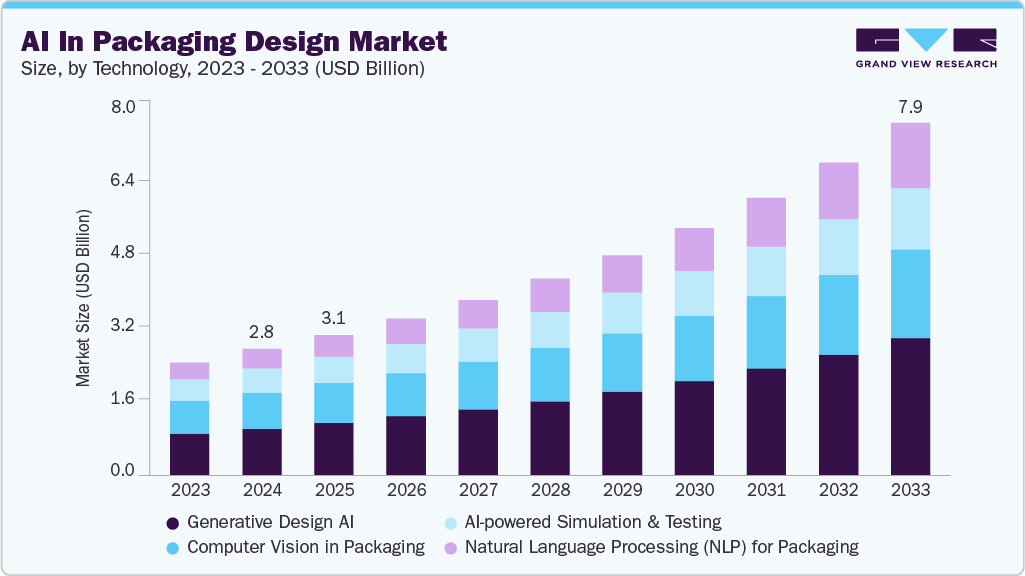
The global AI in packaging design market size was valued at USD 2.8 billion in 2024 and is projected to grow from USD 3.5 billion in 2026 to USD 7.9 billion by 2033, at a CAGR of 12.2% from 2025 to 2033. North America dominated the market, accounting for a revenue share of 34.8% in 2024. The growth is due to its capacity to streamline and speed up design processes.

Key Market Trends & Insights
- The U.S. led the North American market in 2024.
- By technology, the generative design AI segment led the market, holding the largest revenue share of 37.2% in 2024.
- By industry vertical, the food and beverage segment held the dominant position in the market and accounted for the leading revenue share of 37.9% in 2024.
- By end use, manufacturers and packaging companies are expected to grow at the fastest CAGR of 13.3% from 2025 to 2033.
Market Size & Forecast
- Market size in 2024: USD 2.8 Billion
- Estimated market size in 2026: USD 3.5 Billion
- Projected market size by 2033: USD 7.9 Billion
- CAGR (2025-2033): 12.2%
Three ways to get this report
Buy it, customize it, or ask a question.Get the Full Report
What the study covers
- FormatsPDF · Excel · Dashboard
- Timeline2025–2033 annual, 2024 base
- Coverage20+ countries, 5 regions
- Companies10+ key players profiled
Customize the Report
20% free customization
- IncludeCountries, segments, points
- TailorTo your product definition
- ExtendDeeper competitor detail
- OrA fully bespoke study
- Turnaround5–10 working days
Ask Prism AI
A cited answer in seconds
- Corpus30K studies, 1.2M points
- ScopeAll markets, not just this
- CitationTraced to report & table
- HonestySays "not covered" if so
- SpeedSeconds, not days
AI-driven tools help in faster designing with algorithm-based iterations, generating numerous design options immediately. Designers can use automated stress analysis to check the strength of packaging before developing physical prototypes. This leads to faster product launches, lower development costs, and reduced use of resources. As a result, brands can enter the market more quickly while maintaining high standards of quality and creativity.The expansion of AI in packaging design is primarily driven by the rising consumer expectations for personalized experiences, which has accelerated the AI in packaging customization. AI algorithms can focus on design aspects such as colors, visuals, and messaging to specific regions or demographic groups, making packaging more relevant to target audiences. By using customer data such as buying behavior or preferences, brands can create unique packaging at scale and the level of personalization strengthens brand loyalty and boosts product visibility in both physical stores and online platforms. Ultimately, packaging evolves into a strategic asset for marketing and engaging consumers.
The industry is driven by the increasing regulatory demands and consumer expectations for sustainability. AI’s strength lies in processing large datasets to suggest sustainable materials and streamline designs that reduce waste of time and enhance recyclability. Machine learning models enable performance simulations, helping designers choose materials that effectively balance functionality, cost, and environmental impact. Beyond conserving resources, AI-powered optimization supports companies in reducing emissions and achieving their sustainability targets. This technological advantage is becoming essential as the packaging sector follows tighter environmental regulations.
Furthermore, AI’s ability to support data-driven decisions and adapt smoothly to market changes. AI analyzes consumer feedback, forecasts trends, and delivers insights that guide packaging innovation. By using this intelligence, brands can quickly react to shifts in consumer preferences or competitor moves, adjusting their packaging strategies in real time. Additionally, AI-powered virtualization tools allow for rapid testing and iteration, minimizing the risks and expenses of conventional trial-and-error methods. This flexibility helps companies maintain a competitive edge in rapidly changing consumer markets.
Technology Insights
The generative design AI led the market in 2024, accounting for 37.2% of global revenue driven by its ability to quickly generate hundreds of optimized design variations based on factors such as product dimensions, material limitations, budget, and branding needs. It shortens the design timeline from weeks to minutes enabling quicker product launches and lowering development costs and also enhances material efficiency, reducing waste and supporting sustainability, while maintaining structural strength through simulations. Additionally, AI allows for customization, allowing brands to deliver personalized packaging for various markets or consumer segments without compromising on cost or consistency. For instance, Adobe’s AI-driven tool, Adobe Sensei, utilize generative AI to boost creativity and enable large-scale personalization. It allows designers to quickly create distinctive packaging designs, with features that streamline prototyping, automate graphic modifications, and support rapid design iterations.
The NLP segment is expected to grow at the highest CAGR during the forecast period, driven due to its ability to process and interpret large volumes of customer feedback and market data. It identifies trends, sentiments, and keywords that reflect consumer preferences. NLP enables AI systems to extract valuable insights from unstructured text, allowing brands to adjust packaging designs in response to current market demands. By integrating NLP, designers can continuously refine and update packaging to match shifting consumer expectations. This technology ensures timely customization and keeps packaging relevant and competitive. NLP also helps AI agents detect trends from customer feedback, making it more effective in packaging redesign.
Industry Vertical Insights
The food and beverage sector accounted for the largest market revenue share in 2024, due to the growing consumer expectations for personalization and customer-focused experiences. The growth of e-commerce for food and beverage has further increased the demand for packaging designed specifically for online retail, with features that support convenient returns and a memorable unboxing experience. Moreover, the industry’s focus on sustainability is driving the use of AI to create environmentally friendly packaging that meets both ecological goals and consumer appeal. For instance, in September 2023,Coca-Cola introduced Coca-Cola 3000 Zero Sugar, featuring packaging co-designed with artificial intelligence (AI) and inspired by a futuristic, optimistic vision. It highlights dynamic liquid shapes in different shades of violet, magenta, and cyan set against a silver backdrop, along with a modern take on the classic Spencerian Script to reflect connectedness. AI played a role in shaping both the flavor and visual aesthetics, while an interactive element is added through an on-pack QR code, boosting consumer engagement.
The healthcare and pharmaceuticals sector is expected to grow at the highest CAGR over the forecast period, driven by the need to improve security and patient safety through advanced anti-counterfeiting measures. AI-driven deep learning models detect irregularities in packaging, helping to identify fake medications and ensure product authenticity. AI also enhances supply chain transparency when integrated with blockchain, allowing real-time tracking from production to delivery and reducing the risk of tampering or diversion. In addition, AI enables automated quality checks by accurately inspecting labels, barcodes, and seals, minimizing human error and ensuring compliance with regulations. When combined with IoT sensors, AI further strengthens smart packaging by monitoring conditions such as temperature to preserve drug effectiveness during transport.
End Use Insights
The manufacturers and packaging companies accounted for the largest market revenue share in 2024 is driven to enhance efficiency and speed up the development process, minimizing production time and expensive rework. Moreover, AI-powered rapid prototyping and iteration enable quick adaptation to market trends and consumer needs, boosting operational agility and fostering innovation. For instance, in August 2023, Sourceful introduced Spring, a free AI-driven packaging design tool that quickly creates a variety of unique and sustainable packaging ideas based on simple prompts for simplifying the creative process. Spring empowers small businesses and e-commerce brands to develop packaging concepts rapidly without relying on costly designers or agencies. The tool features real-time editing, 3D visualizations, and collaborative capabilities to speed up and enhance the design workflow.
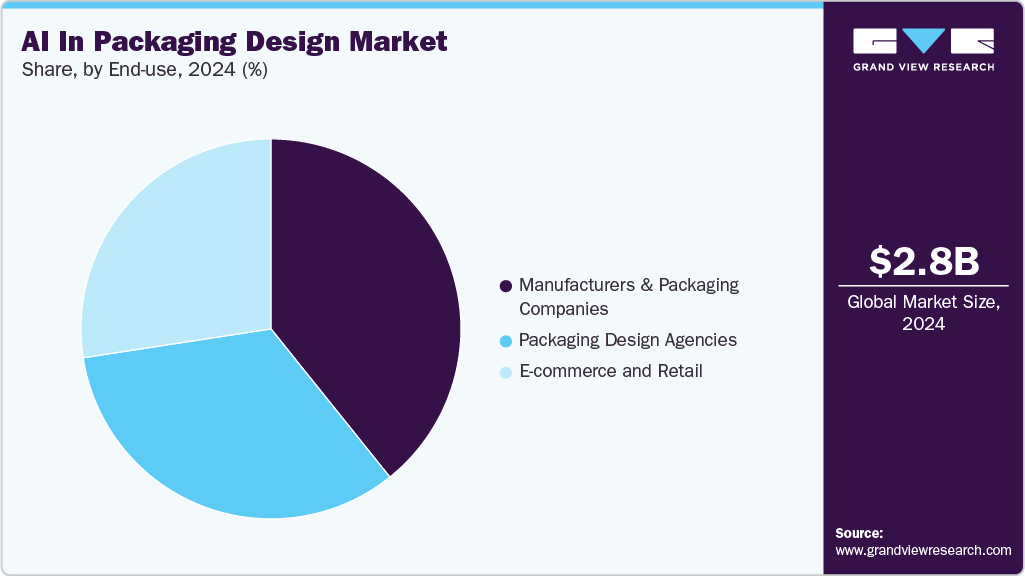
The e-commerce and retail segment is anticipated to grow at a CAGR of 11.6% during the forecast period, driven by the demand for customized, right-sized packaging that minimizes material use and shipping expenses while ensuring product protection. AI allows for the swift creation and refinement of design concepts, enabling brands to quickly respond to changing consumer tastes and market dynamics. It also strengthens brand identity and shelf presence by producing visually appealing designs focused on specific audiences, enhancing recognition and loyalty. Furthermore, AI-driven predictive analytics help to optimize placement and anticipate consumer responses, supporting data-informed strategies that boost product performance.
Regional Insights
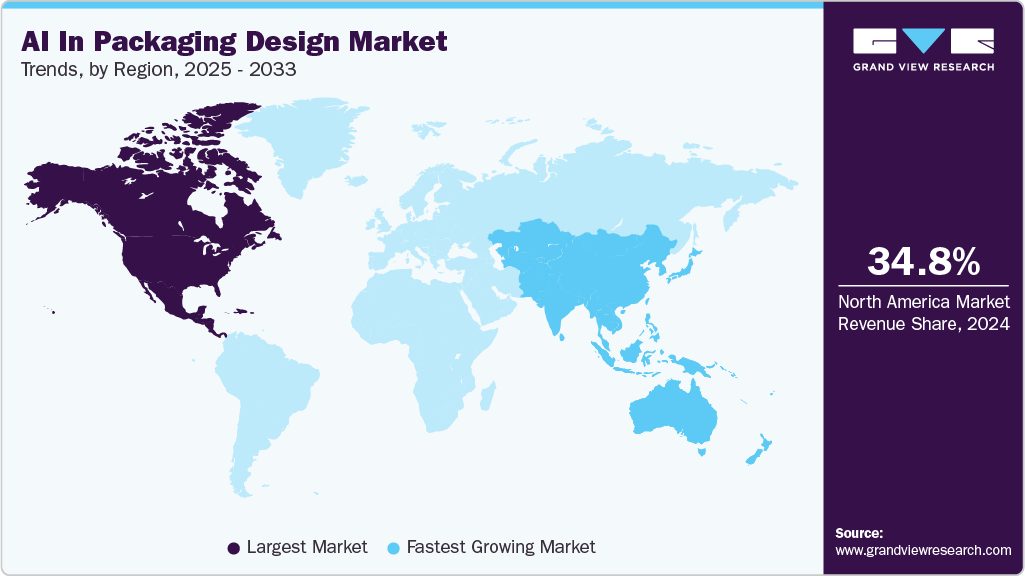
North America AI in packaging design industry dominated with a revenue share of 34.8% in 2024, driven by the region’s strong technological foundation and early AI adoption, where advancements in automation, smart packaging, and digital printing are prominent. Regulatory initiatives such as extended producer responsibility (EPR) laws promote sustainable packaging solutions, while major companies invest significantly in R&D to develop recyclable and efficient designs. Growing consumer demand for personalized packaging and reliable quality, particularly in the food, beverage industry, also drives the increasing use of AI.
U.S. AI In Packaging Design Market Trends
The AI in packaging design market in the U.S. is expected to grow significantly, driven by its strong AI infrastructure, large packaging sector, and growing consumer demand for personalized and sustainable solutions. Generative AI enables fast prototyping and efficient material use, while AI-powered quality control helps minimize defects and waste. The use of virtual and augmented reality adds immersive, engaging elements to brand packaging. AI also brings significant advantages to the healthcare and pharmaceutical industries by ensuring precision and compliance with strict safety standards.
Europe AI In Packaging Design Market Trends
The AI in packaging design market in Europe is witnessing steady growthdue to the strict environmental regulations and a strong focus on the circular economy, which prioritizes sustainability and waste minimization. European manufacturers use AI to optimize the use of eco-friendly materials, ensuring compliance with regulations while meeting consumer demand for greener solutions. AI supports the creation of modular, recyclable packaging and enables greater supply chain transparency through advanced tracking technologies. Additionally, the integration of AI with big data provides valuable consumer insights, fueling marketing-focused packaging innovations focused on various market segments.
Asia Pacific AI In Packaging Design Market Trends
The AI in packaging design market in the Asia Pacific region is anticipated to register the highest CAGR over the forecast period, led by rapid industrial growth, booming e-commerce, and progress in packaging design automation. Nations such as China, Japan, South Korea, and India are utilizing generative AI to increase cost efficiency, enable large-scale customization, and optimize AI usage to meet rising demand in automated packaging. Local packaging companies are embracing AI to enhance their competitiveness in global supply chains, while smart packaging with real-time tracking is gaining popularity. Growing demand from the expanding middle class for personalized and eco-friendly packaging, along with government support for AI innovation, further accelerates advancements in manufacturing quality and sustainability.
Key AI In Packaging Design Companies Insights
Key players operating in the AI in packaging design market are undertaking various initiatives to strengthen their presence and increase the reach of their products and services. Strategies such as expansion activities and partnerships are key in propelling the market growth.
Key AI In Packaging Design Companies:
The following are the leading companies in the AI in packaging design market. These companies collectively hold the largest market share and dictate industry trends.
- ABB
- Adobe Inc.
- Autodesk Inc.
- AWS
- Dassault Systèmes
- Esko-Graphics BV.
- Kongsberg Precision Cutting Systems
- SAP SE
- Siemens AG
- Transcontinental Inc.
- Sourceful Ltd
Recent Developments
-
In December 2024, ABB introduced the ABB Ability Genix Copilot, a generative AI platform built in partnership with Microsoft to turn real-time industrial data into actionable insights. Designed to boost productivity, efficiency, and sustainability, the system supports a wide range of operations, including packaging design workflows. By applying large language models tailored for industrial environments, Genix Copilot interprets data from factory floors, operator feedback, and enterprise systems to deliver predictive maintenance, operational guidance, and energy-saving strategies. This innovation helps manufacturers make quicker, data-driven decisions, optimize packaging assets, and lower both operational expenses and environmental impact, while enabling smarter packaging design and production through AI-driven intelligence and automation.
-
In August 2023, ABB Robotics inaugurated its new Packaging and Logistics Headquarters in Alpharetta, Georgia, strengthening its presence in the U.S. market. The facility serves as a hub for developing and showcasing advanced robotic automation solutions for packaging, e‑commerce, and logistics operations. It features new AI-enabled technologies, including autonomous mobile robots and intelligent item-picking systems. The investment reflects ABB’s commitment to supporting faster, smarter, and more sustainable supply chain automation.
AI In Packaging Design Market Report Scope
Report Attribute
Details
Market size in 2024
USD 2.8 billion
Estimated market size in 2026
USD 3.5 billion
Projected market size by 2033
USD 7.9 billion
Growth rate
CAGR of 12.2% from 2025 to 2033
Base year for estimation
2024
Actual data
2021 - 2023
Forecast period
2025 - 2033
Quantitative units
Revenue in USD million/billion & CAGR from 2025 to 2033
Report coverage
Revenue forecast, company ranking, competitive landscape, growth factors, and trends
Segments covered
Technology, industry vertical, end use, region
Regional scope
North America; Europe; Asia Pacific; Latin America; MEA
Country scope
U.S.; Canada; UK; Germany; France; China; India; Japan; South Korea; Australia; Brazil; Mexico; KSA; UAE; South Africa
Key companies profiled
ABB; Adobe Inc.; Autodesk Inc.; AWS; Dassault Systèmes; Esko-Graphics BV.; Kongsberg Precision Cutting Systems; SAP SE; Siemens AG; Transcontinental Inc.; Sourceful Ltd
Customization scope
Free report customization (equivalent up to 8 analysts working days) with purchase. Addition or alteration to country, regional, and segment scope.
Pricing and purchase options
Avail customized purchase options to meet your exact research needs. Explore purchase options
Global AI In Packaging Design Market Report Segmentation
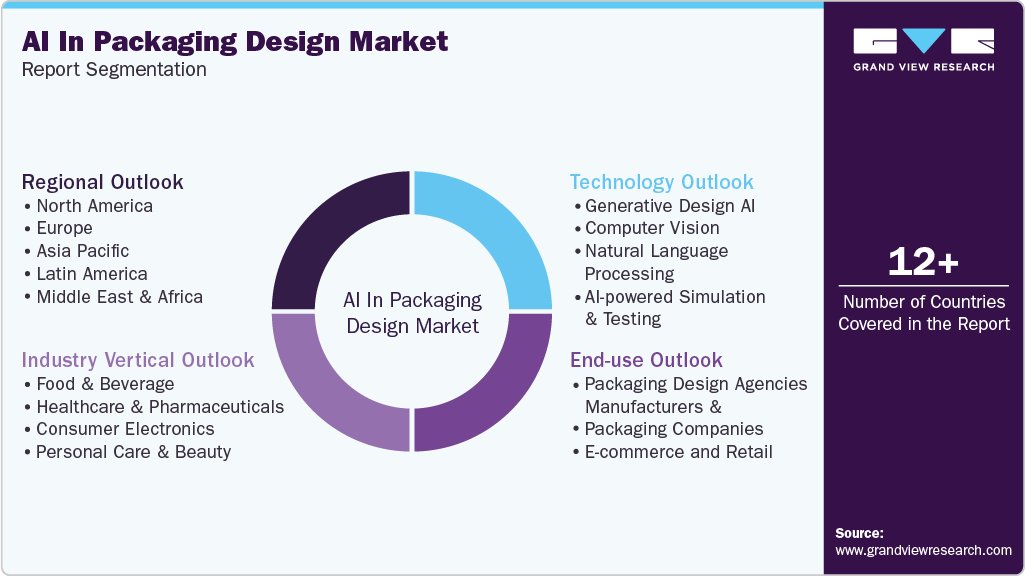
This report forecasts revenue growth at the global, regional, and country levels and provides an analysis of the industry trends in each of the sub-segments from 2021 to 2033. For this study, Grand View Research has segmented the global AI in packaging design market report based on the technology, industry vertical, end use, and region.
-
Technology Outlook (Revenue, USD Million, 2021 - 2033)
-
Generative Design AI
-
Computer Vision
-
Natural Language Processing
-
AI-powered Simulation and Testing
-
-
Industry Vertical Outlook (Revenue, USD Million, 2021 - 2033)
-
Food and Beverage
-
Healthcare and Pharmaceuticals
-
Consumer Electronics
-
Personal Care and Beauty
-
-
End Use Outlook (Revenue, USD Million, 2021 - 2033)
-
Packaging Design Agencies
-
Manufacturers and Packaging Companies
-
E-commerce and Retail
-
-
Regional Outlook (Revenue, USD Million, 2021 - 2033)
-
North America
-
U.S.
-
Canada
-
Mexico
-
-
Europe
-
UK
-
Germany
-
France
-
-
Asia Pacific
-
China
-
India
-
Japan
-
South Korea
-
Australia
-
-
Latin America
-
Brazil
-
-
Middle East and Africa
-
KSA
-
UAE
-
South Africa
-
-
Frequently Asked Questions About This Report
The global AI in packaging design market size was valued at USD 2.8 billion in 2024 and is estimated at USD 3.5 billion for 2026.
The global AI in packaging design market is expected to grow at a CAGR of 12.2% from 2025 to 2033, reaching USD 7.9 billion by 2033.
The expansion of AI in packaging design is primarily driven by the rising consumer expectations for personalized experiences have accelerated the AI in packaging customization.
North America dominated with a revenue share of 34.8% in 2024.
Some key players operating in the AI in packaging design market include ABB; Adobe Inc.; Autodesk Inc.; AWS; Dassault Systèmes; Esko-Graphics BV.; Kongsberg Precision Cutting Systems; SAP SE; Siemens AG; Transcontinental Inc.; and Sourceful Ltd.
About the Author(s)
Next Generation Technologies Research Team
Technology · Next Generation TechnologiesThis report was authored by the next generation technologies research team at Grand View Research - comprising two research analysts, one senior research analyst, and one industry expert - with specialized expertise in the next generation technologies segment of the technology industry. All findings are based on proprietary technology databases, executive interviews, and regulatory analysis, subject to internal peer review prior to publication.
Last Updated:
Speak to Analyst


Customize this report to your needs - add regions, segments, or data points, with 20% free customization.
Or view our licence options:


ISO 9001:2015 & 27001:2022 Certified
We are GDPR and CCPA compliant! Your transaction & personal information is safe and secure. For more details, please read our privacy policy.


