
- Home
- »
- Advanced Interior Materials
- »
-
Air To Air Heat Exchangers Market Size & Share Report 2033GVR Report cover

Air To Air Heat Exchangers Market (2026 - 2033)
Size, Share & Trends Analysis Report By Product (Plate Heat Exchangers, Rotary Heat Exchangers, Heat Pipe Heat Exchangers, Run-Around Coil Systems), By End-use (Residential, Commercial), By Region, And Segment Forecasts
Market Size, 2025
$3.5BMarket Estimate, 2026
$3.7BMarket Forecast, 2033
$5.8BCAGR, 2026–2033
6.6%Air To Air Heat Exchangers Market Summary
The global air to air heat exchangers market size was valued at USD 3.5 billion in 2025 and is projected to grow from USD 3.7 billion in 2026 to USD 5.8 billion by 2033, at a CAGR of 6.6% from 2026 to 2033. Europe dominated the market, accounting for a revenue share of 32.5% in 2025. Rising emphasis on energy efficiency and building decarbonization is driving demand for air-to-air heat exchangers across residential, commercial, and industrial facilities.
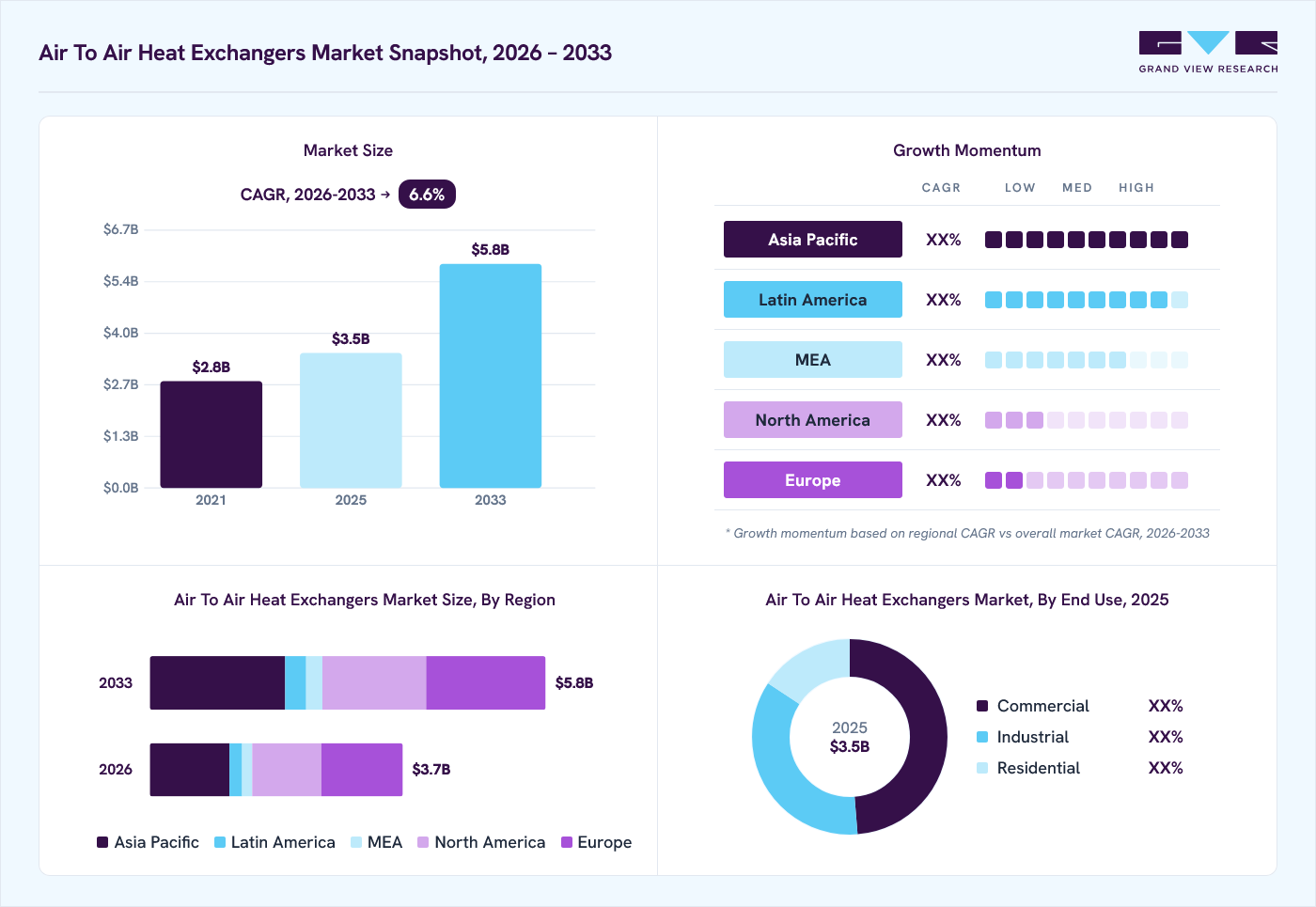 Source: Grand View Research, IR Documents, Primary Interviews, Paid DatabasesTo learn more about this report,
 Download Free Sample Report
Key Market Trends & Insights
- By product: The plate heat exchangers segment led the market with the largest revenue share of 46.3% in 2025.
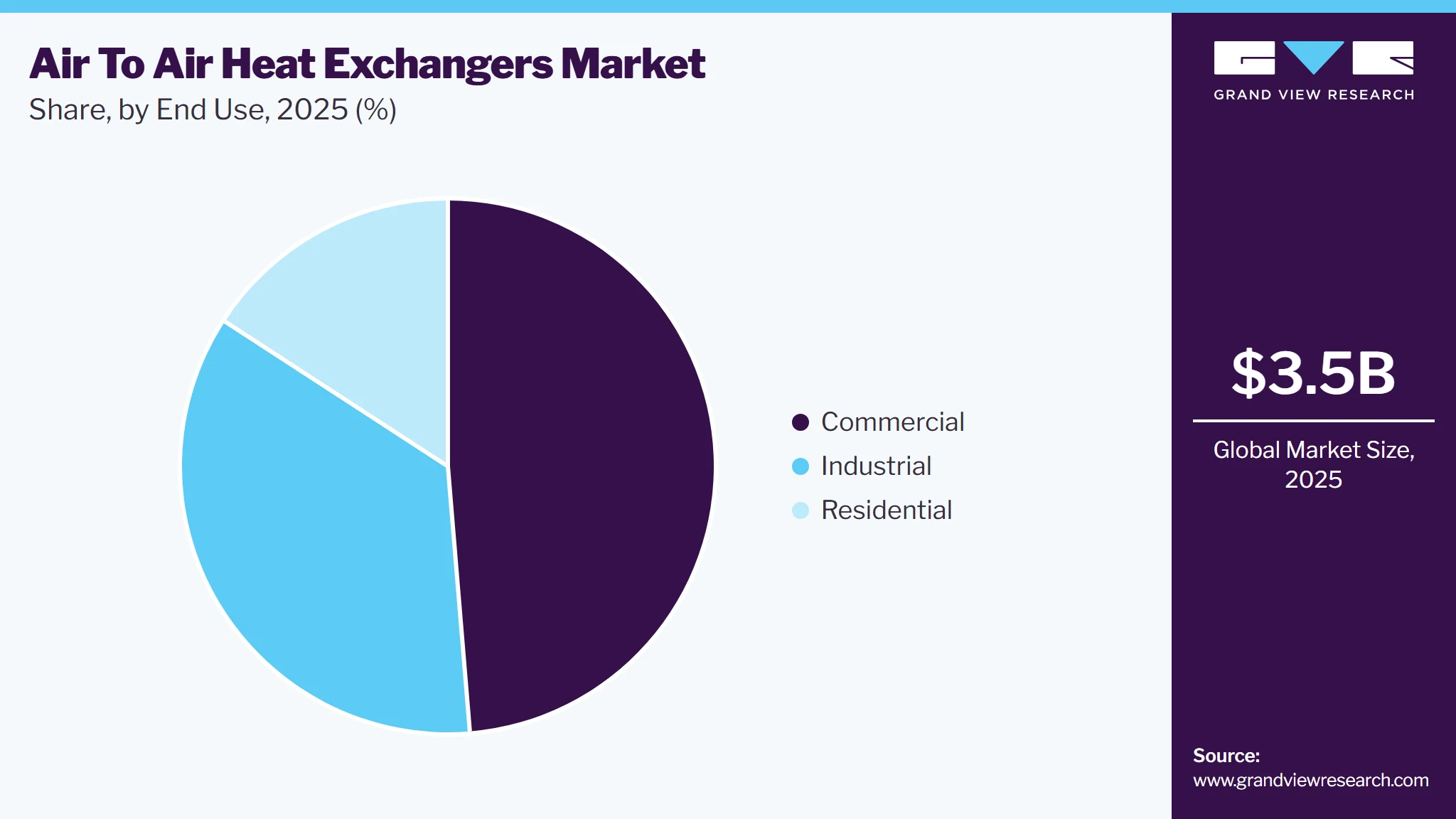
- Based on end-use: The commercial segment led the market with the largest revenue share of 48.7% in 2025.
Regional Highlights
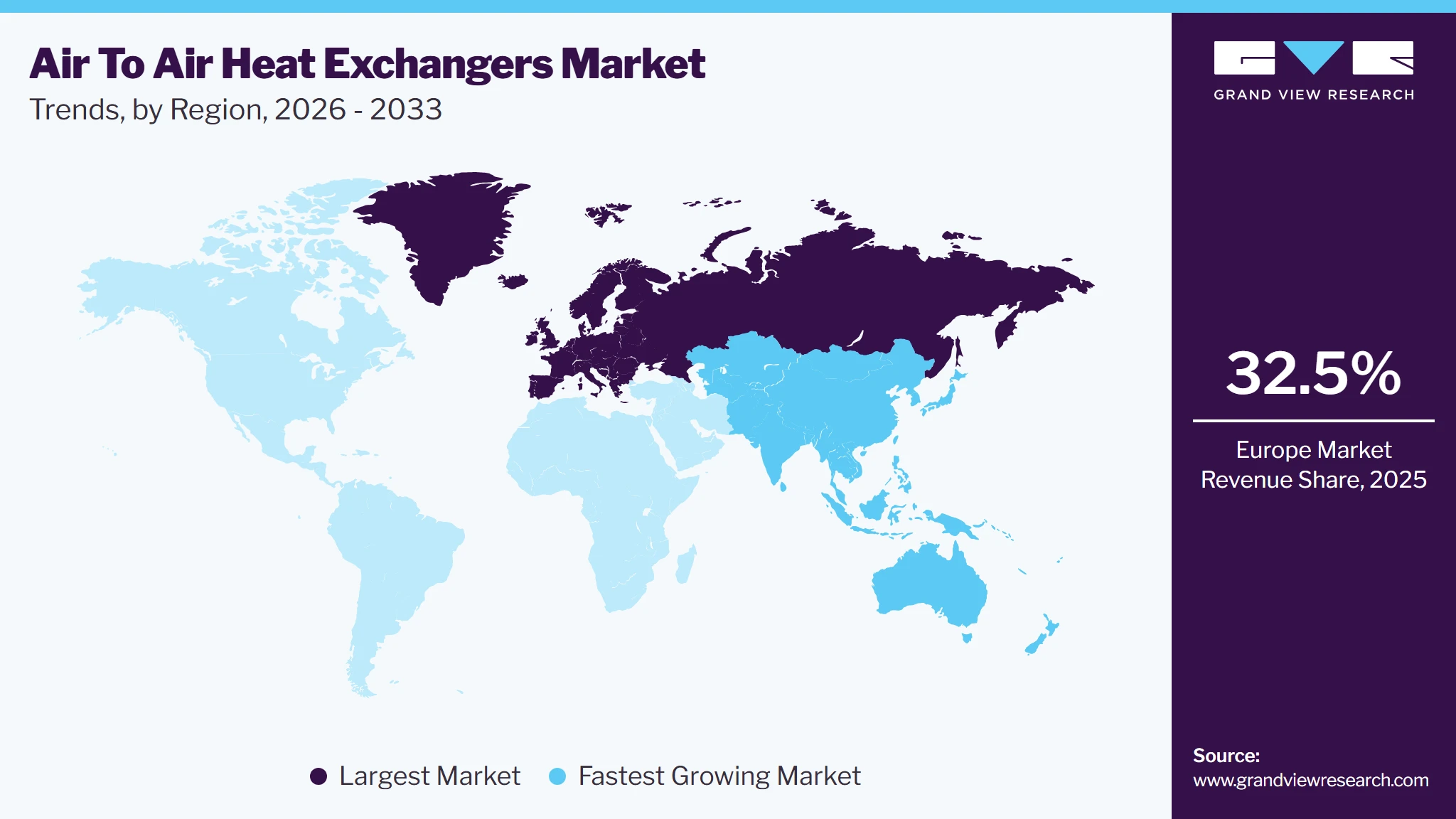
- Largest Regional Market: Europe (32.5% revenue share, 2025)
- Fastest-growing Regional Market: Asia Pacific (highest CAGR, 2026-2033)
- By Country: Germany held the largest market share in 2025.
Market Size & Forecast
- Market Size in 2025: USD 3.5 Billion
- Estimated Market Size in 2026: USD 3.7 Billion
- Projected Market Size in 2033: USD 5.8 Billion
- CAGR (2026-2033): 6.6%
Prism AI by Grand View Research Free to tryAsk a question about the air to air heat exchangers market✓Every figure cited from GVR research Prefer the report? Download free sample →
These systems recover thermal energy from exhaust air and reduce the heating and cooling load on HVAC equipment, helping operators lower energy consumption and operating costs.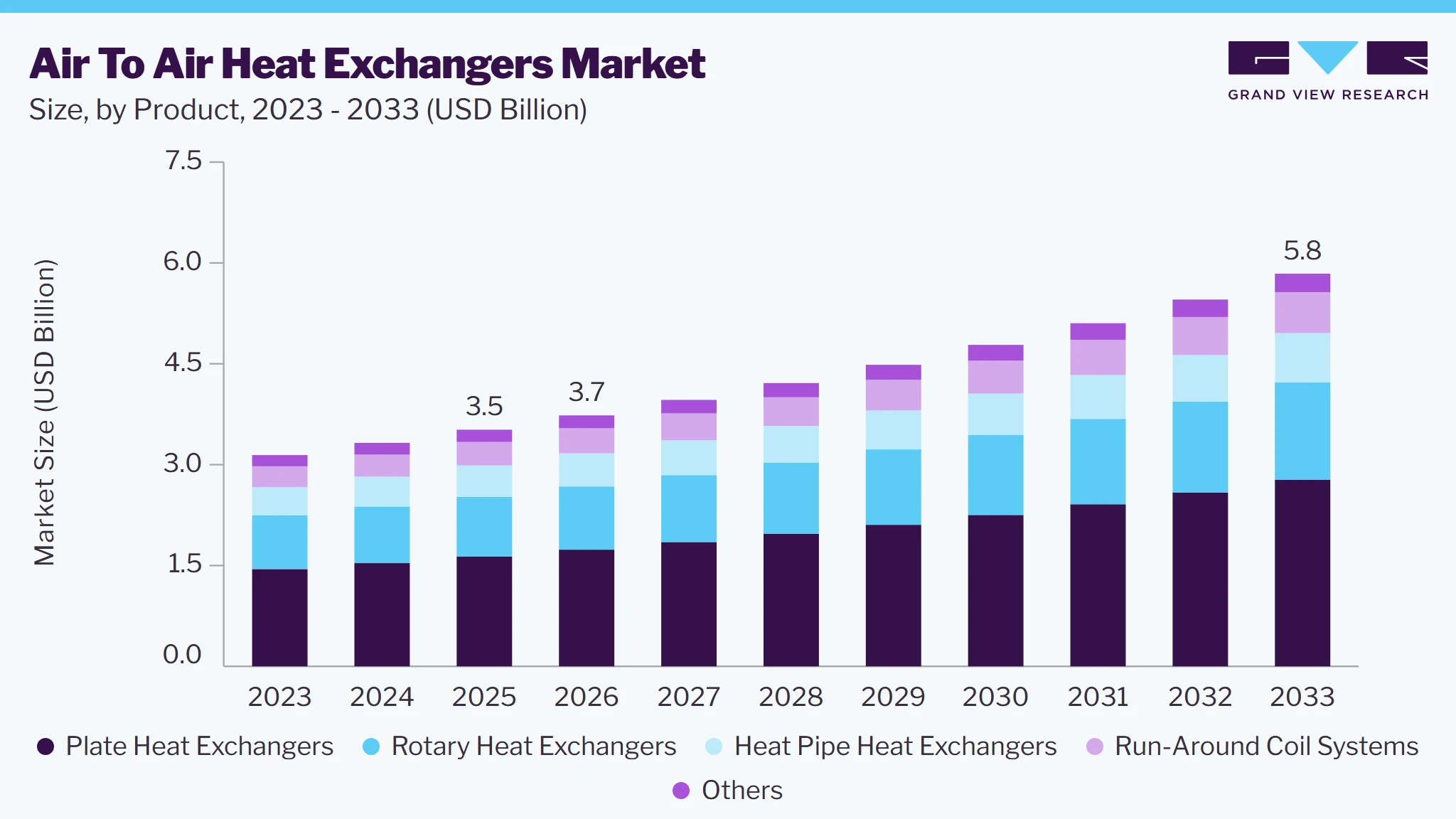 To learn more about this report, Download Free Sample Report
The expansion of data centers, advanced manufacturing facilities, and energy-intensive commercial buildings is creating additional demand for efficient ventilation and thermal management solutions. Rising AI and high-performance computing workloads are increasing cooling requirements in data centers, while a greater focus on indoor air quality is encouraging efficient fresh-air ventilation with heat recovery. These trends are supporting the adoption of plate, rotary, and other air-to-air heat exchanger technologies.
Market Dynamics
The industry is being shaped by the growing need to improve HVAC energy efficiency while maintaining adequate ventilation and indoor air quality. Demand is supported by stricter building efficiency requirements, increasing adoption of energy recovery ventilation, and expansion of commercial and industrial facilities. At the same time, manufacturers are focusing on compact designs, higher recovery efficiency, lower pressure drops, and integration with smart HVAC controls.
Increasing efforts to reduce building energy consumption are driving the adoption of air-to-air heat exchangers. These systems recover thermal energy from exhaust air and transfer it to incoming outdoor air, reducing the heating and cooling load on HVAC equipment. This is particularly relevant for offices, healthcare facilities, hotels, data centers, and industrial buildings with high ventilation requirements. Building energy standards that promote or require exhaust-air energy recovery further support demand.
The push toward lower operating costs and building decarbonization is further encouraging heat recovery solutions. Air-to-air heat exchangers allow facilities to maintain required fresh-air ventilation while minimizing energy losses associated with conditioned air being exhausted. Increasing investment in energy-efficient building upgrades and HVAC modernization is therefore creating sustained demand for plate, rotary, and other heat recovery technologies.
High upfront costs associated with purchasing and installing air-to-air heat exchanger systems can restrict market adoption, particularly among small commercial facilities and cost-sensitive industrial users. Installation may require modifications to existing ductwork, ventilation systems, controls, and building layouts, increasing project costs. In addition, the added pressure drop across heat exchangers can require appropriate fan sizing and may increase system complexity, making some users hesitant to adopt the technology in retrofit projects.
The rapid development of data centers presents a significant opportunity for manufacturers. Data centers require continuous ventilation and thermal management while operators increasingly prioritize energy efficiency and lower cooling-related power consumption. Heat recovery technologies can help improve overall HVAC efficiency, particularly when integrated with advanced air-handling and cooling systems. The growing deployment of AI and high-density computing facilities is expected to further increase demand for efficient thermal-management solutions.
Market Concentration & Characteristics
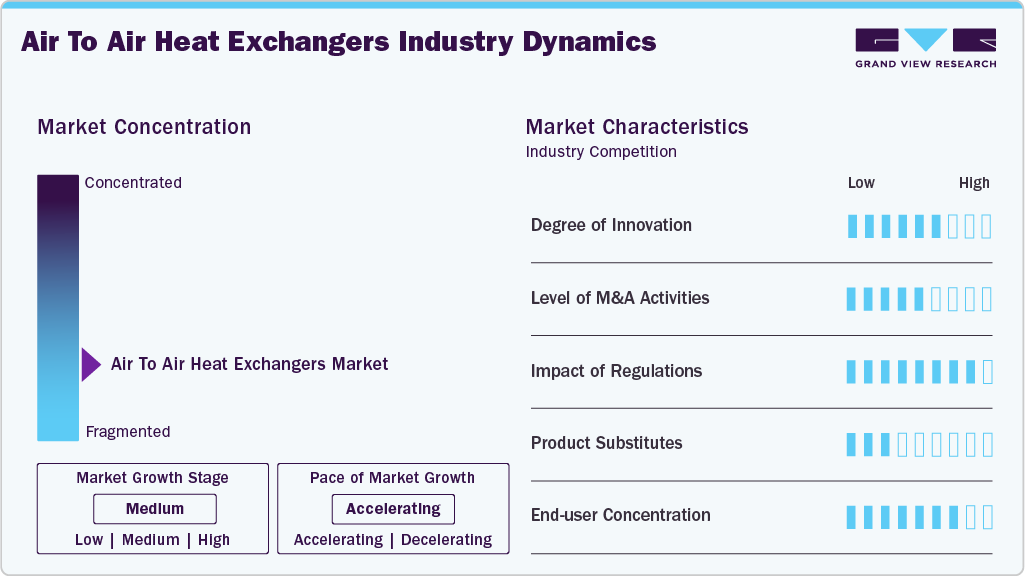
The industry is fragmented, with competition spread across large HVAC manufacturers, specialized heat exchanger producers, and regional suppliers. Market participants differentiate themselves through product efficiency, customized designs, technological improvements, and application-specific solutions. The presence of multiple suppliers across residential, commercial, and industrial applications limits market concentration and creates a competitive environment focused on energy efficiency, product performance, innovation, and cost-effectiveness.
The industry has a moderate to high degree of innovation, driven by demand for higher thermal efficiency, compact equipment, lower pressure drops, and improved indoor air quality. Manufacturers are developing advanced plate and rotary designs, improved heat-transfer materials, smart controls, and systems that can integrate with modern HVAC platforms. Increasing adoption of connected ventilation systems is also encouraging the use of sensors and automated controls to optimize heat recovery performance.
 To learn more about this report, Download Free Sample Report
Regulations have a high impact on the market because building energy-efficiency standards increasingly encourage or require energy recovery from exhaust air. For example, ASHRAE Standard 90.1 includes requirements for energy recovery in qualifying ventilation systems and specifies minimum recovery performance. These requirements encourage building owners and HVAC manufacturers to adopt efficient heat recovery equipment while influencing product design and performance standards.
The industry has moderate end-user concentration, as demand is distributed across residential buildings, commercial facilities, and industrial applications. Commercial buildings such as offices, healthcare facilities, hotels, retail spaces, and data centers represent important demand centers because of their substantial ventilation and HVAC requirements. Industrial users further diversify demand across manufacturing, food and beverage, pharmaceuticals, transportation, and power generation, reducing dependence on any single end-use sector.
Analyst Perspective
The market is positioned for steady expansion as building owners and industrial operators increasingly prioritize energy efficiency, ventilation performance, and reduction of HVAC energy consumption. Demand is expected to remain strong across commercial and industrial facilities, while residential adoption is likely to accelerate with tighter building envelopes and greater awareness of indoor air quality. Plate heat exchangers currently offer broad applicability, whereas run-around coil systems present attractive growth opportunities in applications requiring flexible installation and separation of air streams.
Product Insights
The plate heat exchangers segment dominated the market with the largest revenue share of 46.3% in 2025, supported by their high thermal recovery efficiency, compact construction, and ability to transfer heat between supply and exhaust air streams without moving parts. Their relatively simple design and flexibility across ventilation and HVAC applications make them suitable for residential, commercial, and industrial facilities.
The run-around coil systems segment is expected to register the fastest CAGR of 7.2%, driven by their flexibility in applications where supply and exhaust air ducts are physically separated. These systems enable heat recovery through a closed fluid loop and avoid direct mixing between airstreams, making them particularly suitable for retrofit projects, hospitals, laboratories, and industrial facilities. Recent research also highlights their potential to reduce cooling and reheating loads in energy-efficient building applications.
End-use Insights
The commercial segment dominated the market with the largest revenue share of 48.7% in 2025, driven by the extensive ventilation and HVAC requirements of offices, data centers, hotels, retail facilities, and healthcare buildings. These facilities require continuous outdoor-air circulation while managing heating and cooling loads, making heat recovery an effective way to reduce energy consumption. Growing emphasis on indoor air quality, energy-efficient buildings, and sustainable HVAC systems is further supporting adoption across commercial facilities.
 To learn more about this report, Download Free Sample Report
The residential segment is expected to register the fastest CAGR of 7.6% over the forecast period, supported by increasing demand for energy-efficient ventilation and improved indoor air quality in homes. Better insulated and more airtight residential buildings require controlled mechanical ventilation, creating opportunities for heat recovery systems that precondition incoming air using energy from exhaust air. Rising adoption of low-energy homes, compact ventilation equipment, and energy-efficient building designs is expected to further strengthen residential demand.
Regional Insights
Europe dominated the market accounting for a revenue share of 32.5% in 2025. The air to air heat exchangers market in Europe is supported by a strong emphasis on energy-efficient buildings, established HVAC infrastructure, and growing adoption of heat recovery technologies. Building renovation, decarbonization initiatives, and tighter efficiency requirements are encouraging the replacement of conventional ventilation systems with solutions that recover energy from exhaust air. Demand is also supported by the region’s mature commercial, healthcare, hospitality, and residential building sectors.
 To learn more about this report, Download Free Sample Report
Germany Air To Air Heat Exchangers Market Trends
The Germany air-to-air heat exchangers market is supported by its strong focus on energy-efficient buildings, industrial activity, and modernization of existing infrastructure. According to the German Federal Ministry for Economic Affairs and Energy, new buildings are subject to energy-performance requirements, while government-backed programs continue to support climate-friendly construction and building upgrades. Germany’s KfW also provides incentives for energy-efficient non-residential buildings and heating modernization, creating favorable conditions for efficient ventilation and heat-recovery technologies.
The air to air heat exchangers market in France is expected to witness strong growth, driven by extensive building renovation, energy-efficiency programs, and increasing attention to ventilation and indoor air quality. According to France’s Ministry for Ecological Transition, the building sector accounted for 45% of final energy consumption and 27% of CO₂ emissions, making energy renovation a major national priority. Government-backed renovation programs also include ventilation improvements, while France’s 2025 regulations specify efficiency requirements for certain double-flow mechanical ventilation systems, supporting demand for air-to-air heat recovery solutions.
North America Air To Air Heat Exchangers Market Trends
The North America air to air heat exchangers market is expected to witness steady growth as building owners increasingly focus on reducing HVAC energy consumption and improving ventilation performance. Demand is supported by commercial buildings, healthcare facilities, educational institutions, industrial sites, and data centers, where continuous fresh-air requirements create opportunities for heat recovery. Replacement of aging HVAC equipment and integration of energy recovery into building upgrades are also contributing to market expansion.
The U.S. market is supported by its extensive commercial building base and diverse industrial activities. According to the U.S. Energy Information Administration (EIA), the country had an estimated 5.9 million commercial buildings consuming 6.8 quadrillion Btu of energy, indicating substantial demand for energy-efficient HVAC and ventilation solutions. In addition, the U.S. residential market provides a large potential customer base, with 132.5 million occupied homes recorded in 2024, supporting opportunities for residential ventilation and heat recovery systems. These factors across commercial, industrial, and residential applications strengthen the U.S. market position.
Asia Pacific Air To Air Heat Exchangers Market Trends
The air to air heat exchangers market in Asia Pacific is expected to register the fastest growth, driven by rapid urbanization, expanding construction activity, industrial development, and rising installation of modern HVAC systems. Increasing development of commercial complexes, manufacturing facilities, data centers, and energy-efficient buildings is creating new applications for air-to-air heat recovery. Growing awareness of indoor air quality and the need to manage rising cooling and ventilation loads are further supporting adoption across the region.
The China air-to-air heat exchangers market is supported by its large building stock, industrial base, and continued focus on improving energy efficiency. Rising adoption of efficient HVAC and ventilation systems across residential, commercial, and industrial facilities is creating demand for heat recovery technologies. China is also shifting greater attention toward energy-efficient retrofits of existing buildings, while expanding green-building practices and improving building energy standards, creating further opportunities for air-to-air heat exchangers.
The air to air heat exchangers market in India is expected to witness strong growth, driven by the rapid expansion of commercial and residential buildings, industrialization, and increasing adoption of energy-efficient HVAC technologies. According to the Bureau of Energy Efficiency (BEE), India is adding around 300,000 square feet of commercial floor space every day, while buildings account for more than 30% of the country's electricity consumption, creating significant potential for energy-saving ventilation solutions. In addition, according to the Ministry of Electronics & IT, India's data-center capacity increased from about 375 MW in 2020 to around 1,500 MW in 2025, while data-center electricity demand is projected to reach 13.56 GW by 2031-32, supporting additional demand for efficient cooling and air-management technologies.
Middle East & Africa Air To Air Heat Exchangers Market Trends
The air to air heat exchangers market in the Middle East & Africa is anticipated to grow steadily, with demand driven by large-scale commercial developments, hotels, healthcare facilities, airports, industrial projects, and other infrastructure requiring extensive ventilation and cooling. High cooling requirements in many parts of the region are increasing interest in technologies that can reduce HVAC energy losses. New sustainable building projects and modernization of existing facilities are expected to create additional opportunities for air-to-air heat recovery systems.
The Saudi Arabia air to air heat exchangers market is emerging as a key market in the Middle East & Africa, supported by large-scale construction, commercial development, and growing emphasis on building energy efficiency. According to the Saudi Standards, Metrology and Quality Organization (SASO), updated energy-efficiency requirements for air conditioners were introduced under the 2025 standards, strengthening the focus on efficient HVAC equipment. In addition, the government launched an energy-efficiency retrofit project covering more than 500 buildings and facilities in 2026, demonstrating increasing investment in reducing building energy consumption. These developments, together with major residential, hospitality, commercial, and infrastructure projects under Vision 2030, are creating favorable opportunities for efficient ventilation and heat-recovery technologies.
Latin America Air To Air Heat Exchangers Market Trends
The air to air heat exchangers market in Latin America is projected to experience gradual growth, supported by increasing urban development, commercial construction, hospitality projects, and industrial expansion. Growing electricity demand for cooling and ventilation is encouraging businesses to consider technologies that can improve HVAC efficiency without compromising indoor comfort. Adoption is expected to increase, particularly in new, modern buildings where energy-efficient ventilation can be incorporated during the design stage.
The Brazil air to air heat exchangers market is supported by growing attention to energy-efficient buildings and the modernization of HVAC infrastructure. The country is strengthening its building energy-efficiency policies through programs such as PBE Edifica and Procel, which promote efficient building systems across residential, commercial, service, and public facilities. Increasing adoption of energy-efficient ventilation, sustainable building practices, and HVAC upgrades is creating opportunities for air-to-air heat recovery solutions across multiple end-use sectors.
Key Air To Air Heat Exchangers Company Insights
Some of the key players operating in the market include Munters Group AB, Heatex, and Daikin Industries, Ltd.
-
Munters Group AB is a global provider of climate control solutions designed for applications requiring precise management of humidity, temperature, and air quality. Its portfolio serves industries including data centers, pharmaceuticals, food production, battery manufacturing, and agriculture. The company operates through three business areas, which are AirTech, Data Center Technologies, and FoodTech and focuses on energy and resource-efficient technologies. Munters has been developing climate control solutions since 1955 and operates across more than 25 countries.
-
Heatex is a cleantech company specializing in heat exchangers and heat-transfer solutions for ventilation and thermal-management applications. Its portfolio includes crossflow, counterflow, and rotary heat exchangers used across residential, commercial, and industrial ventilation, as well as data center and electronics cooling. The company develops customized products based on customer requirements and thermodynamic calculations, with a strong focus on energy efficiency and heat recovery. Heatex has roots in Sweden dating back to the 1960s and operates internationally through facilities and a global network.
Key Air To Air Heat Exchangers Companies:
The following key companies have been profiled for this study on the air heat exchangers market.
-
Munters Group AB
-
Heatex
-
Daikin Industries, Ltd.
-
Greenheck Fan Corporation
-
Trane
-
Zehnder Group AG
-
Swegon Group AB
-
FläktGroup (SAMSUNG)
-
Systemair AB
-
RenewAire LLC
-
Airxchange Inc.
-
Desiccant Rotors International Pvt. Ltd.
-
RECUTECH s.r.o.
-
Air Change Australia
-
TROX GmbH
Competitive Benchmarking
Category
Operating Strategies
Competitive Edge
Weakness
Established Players (e.g., Munters Group AB; Daikin Industries, Ltd.; Greenheck Fan Corporation; Trane; Zehnder Group AG)
- Expand energy-efficient air-to-air heat recovery portfolios across commercial, residential, and industrial HVAC applications.
- Invest in advanced exchanger designs, smart controls, and integrated ventilation technologies.
- Strengthen global distribution networks and partnerships with HVAC system integrators.
- Strong brand recognition and established relationships with major customers and HVAC contractors.
- Broad product portfolios covering plate, rotary, heat pipe, and other heat recovery technologies.
- Strong engineering capabilities and capacity to support large-scale commercial and industrial projects.
- Higher product and installation costs can limit adoption in price-sensitive markets.
- Large organizational structures may result in slower customization and product adaptation.
- Broad HVAC portfolios can reduce focus on specialized air-to-air heat recovery applications.
Emerging & Regional Players (e.g., Heatex; Swegon Group AB; Systemair AB; RenewAire LLC; Airxchange Inc.; Desiccant Rotors International Pvt. Ltd.)
- Focus on customized and application-specific air-to-air heat exchanger solutions.
- Target residential ventilation, retrofit projects, and specialized commercial and industrial applications.
- Expand through regional distributors, OEM partnerships, and specialized HVAC channels.
- Greater flexibility in customization and faster response to specific customer requirements.
- Competitive pricing compared with larger multinational suppliers.
- Strong specialization in selected heat exchanger technologies and regional applications.
- Limited geographic presence and distribution networks compared with established players.
- Lower brand recognition among large multinational customers and major project developers.
- Smaller R&D and production capacities can restrict participation in complex, large scale projects.
Recent Developments
-
In June 2026, Daikin introduced the VKM-JM fresh air solution for commercial buildings, integrating ventilation, heat recovery, humidity control, heating, cooling, and filtration. The system supports airflow rates of 500-1,000 m³/h and can be connected with Daikin VRV systems. Its heat exchanger delivers up to 74% enthalpy recovery, improving energy efficiency. The launch expands Daikin’s energy-efficient ventilation and air-to-air heat recovery solutions for commercial applications.
-
In November 2025, Samsung Electronics completed its acquisition of FläktGroup, expanding its presence in the global HVAC industry. The transaction strengthens Samsung’s capabilities in ventilation, air handling, and commercial HVAC solutions.
Global Air To Air Heat Exchangers Market Report Scope
Report Attribute
Details
Market size value in 2025
USD 3.5 billion
Estimated market size in 2026
USD 3.7 billion
Revenue forecast in 2033
USD 5.8 billion
Growth rate
CAGR of 6.6% from 2026 to 2033
Historical data
2021 - 2024
Forecast period
2026 - 2033
Quantitative units
Revenue in USD billion and CAGR from 2026 to 2033
Report coverage
Revenue forecast, company ranking, competitive landscape, growth factors, and trends
Segments covered
Product, end-use, region
Regional scope
North America; Europe; Asia Pacific; Latin America; Middle East & Africa; Africa
Country scope
U.S.; Canada; Mexico; UK; Germany; France; Spain; Italy; China; Japan; India; Australia; South Korea; Brazil; Argentina; Saudi Arabia; UAE; South Africa
Key companies profiled
Munters Group AB; Heatex; Daikin Industries, Ltd.; Greenheck Fan Corporation; Trane; Zehnder Group AG; Swegon Group AB; FläktGroup (Samsung); Systemair AB; RenewAire LLC; Airxchange Inc.; Desiccant Rotors International Pvt. Ltd.; RECUTECH s.r.o.; Air Change Australia; TROX GmbH.
Customization scope
Free report customization (equivalent up to 8 analysts working days) with purchase. Addition or alteration to country, regional & segment scope.
Pricing and purchase options
Avail customized purchase options to meet your exact research needs. Explore purchase options
Global Air To Air Heat Exchangers Market Report Segmentation
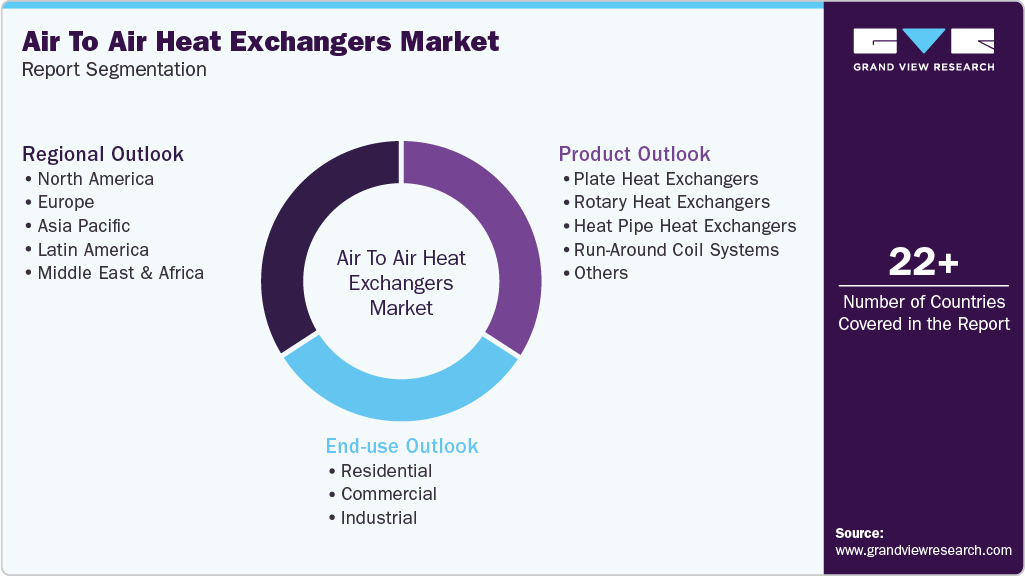
This report forecasts revenue growth at global, regional, and country levels and provides an analysis of the latest industry trends in each of the sub-segments from 2021 to 2033. For this study, Grand View Research has segmented the global air to air heat exchangers market report based on product, end-use, and region:
 To learn more about this report, Download Free Sample Report
-
Product Outlook (Revenue, USD Billion, 2021 - 2033)
-
Plate Heat Exchangers
-
Rotary Heat Exchangers
-
Heat Pipe Heat Exchangers
-
Run-Around Coil Systems
-
Others
-
-
End-use Outlook (Revenue, USD Billion, 2021 - 2033)
-
Residential
-
Commercial
-
Offices
-
Data Centers
-
Hotels and restaurants
-
Malls & Retail facilities
-
Hospitals and healthcare facilities
-
Others
-
-
Industrial
-
General manufacturing
-
Food and beverage
-
Transportation
-
Pharmaceuticals
-
Power generation
-
Others
-
-
-
Regional Outlook (Revenue, USD Billion, 2021 - 2033)
-
North America
-
U.S.
-
Canada
-
Mexico
-
-
Europe
-
Germany
-
France
-
Italy
-
Spain
-
UK
-
-
Asia Pacific
-
China
-
India
-
Japan
-
South Korea
-
Australia
-
-
Latin America
-
Brazil
-
Argentina
-
-
Middle East & Africa
-
Saudi Arabia
-
UAE
-
South Africa
-
-
Research Methodology
The air to air heat exchangers market figures in this report are based on a proven research process that combines executive interviews with secondary research from proprietary databases, company filings, and recognized regulatory and institutional sources. Market size is built through value-chain sizing-reconciling supply-side and demand-side estimates-and triangulated with bottom-up and top-down approaches. Every estimate passes multiple levels of expert validation before publication, with each air to air heat exchangers segment quantified using the revenue-capture definitions in the table below.
Segment Definition
Product
Revenue Capture Definition
Plate Heat Exchangers
Revenue generated from the sale of fixed-plate air-to-air heat exchanger units that transfer thermal energy between supply and exhaust air streams through separate channels. These systems are used for efficient ventilation and heat recovery across residential, commercial, and industrial facilities.
Rotary Heat Exchangers
Revenue generated from the sale of rotary heat exchanger or energy-wheel systems that rotate between supply and exhaust airstreams to recover sensible and, in suitable designs, latent heat. These systems are commonly integrated into ventilation and air-handling equipment.
Heat Pipe Heat Exchangers
Revenue generated from the sale of heat pipe-based air-to-air heat recovery systems that use sealed heat pipes and phase-change processes to transfer heat between separate airstreams. These systems are suitable for applications requiring compact and passive heat recovery.
Run-Around Coil Systems
Revenue generated from the sale of run-around coil heat recovery systems comprising separate coils connected through a circulating heat-transfer fluid. These systems are particularly suitable where supply and exhaust air streams are physically separated or located in different areas of a facility.
Others
Revenue generated from the sale of other air-to-air heat recovery configurations, hybrid systems, and specialized exchanger technologies that do not fall within the primary product categories.
End Use
Revenue Capture Definition
Residential
Revenue generated from the sale of air-to-air heat exchanger systems used in houses, apartments, and other residential buildings for controlled ventilation and recovery of thermal energy from exhaust air.
Commercial
Revenue generated from the sale of air-to-air heat exchanger systems used in commercial buildings to improve ventilation efficiency, recover energy from exhaust air, and reduce heating and cooling loads.
Industrial
Revenue generated from the sale of air-to-air heat exchanger systems used in industrial facilities for process ventilation, thermal energy recovery, temperature management, and improved HVAC efficiency.
Estimation Model
Layer Name
Key Question
Description
Installed Base & Demand Assessment
What is the addressable demand for air-to-air heat exchangers?
Assess residential, commercial, and industrial facilities requiring ventilation and heat recovery, considering new construction, HVAC upgrades, retrofits, and replacement demand.
Product & Application Penetration
What share of demand is captured by each product and end-use segment?
Estimate adoption across plate, rotary, heat pipe, run-around coil, and other technologies, and assess their penetration across residential, commercial, and industrial applications.
Market Volume & Segment Allocation
How is demand distributed across products, applications, and regions?
Quantify market demand by product type, end use, country, and region while accounting for technology adoption, building activity, industrial development, and replacement requirements.
Revenue
What is the total market revenue?
Aggregate the estimated revenue across product types, end-use segments, countries, and regions to determine the overall air-to-air heat exchangers market size.
Delivered Customizations
This report has been delivered with the following In-depth customizations
CLIENT REQUEST
CUSTOMIZATION DELIVERED
VALUE ADDS
Regional Segmentation
The report provides a detailed regional and country-level assessment covering North America, Europe, Asia Pacific, Latin America, and the Middle East & Africa, with specific analysis of key countries such as the U.S., Germany, France, China, India, Brazil, and Saudi Arabia.
Provides a clear understanding of regional market leadership, growth potential, demand drivers, and country-level opportunities, enabling more targeted market evaluation and strategic planning.
Competitive Benchmarking
The report benchmarks key air-to-air heat exchanger manufacturers based on product offerings, market positioning, operating strategies, competitive strengths, and weaknesses. It also categorizes participants into established and emerging/regional players.
Enables comparison of competitive positioning, identifies key differentiation factors, and highlights areas where established and emerging participants can strengthen their market presence.
Opportunity Assessment
The report evaluates major growth opportunities across product technologies and residential, commercial, and industrial applications, with particular emphasis on energy-efficient ventilation, HVAC modernization, building efficiency initiatives, data centers, and industrial expansion.
Helps identify high-potential applications and technologies, supports investment prioritization, and provides a basis for evaluating future revenue opportunities within the air-to-air heat exchangers market.
Frequently Asked Questions About This Report
Asia Pacific is the fastest-growing region over the forecast period.
The market is primarily driven by the growing focus on energy-efficient HVAC systems, increasing demand for heat recovery in buildings, stricter building energy-efficiency requirements, and rising adoption of sustainable ventilation technologies. Expansion of commercial buildings, data centers, healthcare facilities, manufacturing plants, and other energy-intensive facilities is further increasing demand for efficient air-to-air heat recovery solutions.
The plate heat exchangers segment dominated the market with the largest revenue share of 46.3% in 2025, while run-around coil systems segment is the fastest growing product.
The commercial segment dominated the market with the largest revenue share of 48.7% in 2025, while residential segment is the fastest growing end-use.
Some of the key players operating in the global air to air heat exchangers market include Munters Group AB; Heatex; Daikin Industries, Ltd.; Greenheck Fan Corporation; Trane; Zehnder Group AG; Swegon Group AB; FläktGroup (Samsung); Systemair AB; RenewAire LLC; Airxchange Inc.; Desiccant Rotors International Pvt. Ltd.; RECUTECH s.r.o.; Air Change Australia; TROX GmbH.
The global air to air heat exchangers market size was valued at USD 3.5 billion in 2025 and is projected to reach at USD 3.7 billion in 2026.
The global air to air heat exchangers market is expected to grow at a CAGR of 6.6% from 2026 to 2033 to reach USD 5.8 billion by 2033.
Europe dominated the market, accounting for a revenue share of 32.5% in 2025.
About the Author(s)
Advanced Interior Materials Research Team
Advanced Materials · Advanced Interior MaterialsThis report was authored by the advanced interior materials research team at Grand View Research - comprising two research analysts, one senior research analyst, and one industry expert - with specialized expertise in the advanced interior materials segment of the advanced materials industry. All findings are based on proprietary advanced materials databases, executive interviews, and regulatory analysis, subject to internal peer review prior to publication.
Last Updated:
Speak to Analyst

Customize this report to your needs - add regions, segments, or data points, with 20% free customization.
Or view our licence options:


ISO 9001:2015 & 27001:2022 Certified
We are GDPR and CCPA compliant! Your transaction & personal information is safe and secure. For more details, please read our privacy policy.


