
- Home
- »
- Performance Chemicals
- »
-
Antiscalants And Scale Inhibitors Market Report, 2026-2033GVR Report cover

Antiscalants And Scale Inhibitors Market (2026 - 2033)
Size, Share & Trends Analysis Report By Product (Phosphonate-based, Polyacrylate-based), By Application (Membrane Water Treatment, Cooling Water Treatment), By End Use (Municipal Water & Wastewater), By Region, And Segment Forecasts
Market Size, 2025
$4.1BMarket Estimate, 2026
$4.3BMarket Forecast, 2033
$6.2BCAGR, 2026–2033
5.3%Antiscalants And Scale Inhibitors Market Summary
The global antiscalants and scale inhibitors market size was valued at 4.1 billion in 2025 and is projected to grow from USD 4.3 billion in 2026 to USD 6.2 billion by 2033, at a CAGR of 5.3% from 2026 to 2033. Asia Pacific dominated the market, accounting for the largest revenue share of 38.2% in 2025. The industry is driven by the expanding adoption of water treatment, desalination, reverse osmosis (RO), and industrial water-reuse systems.
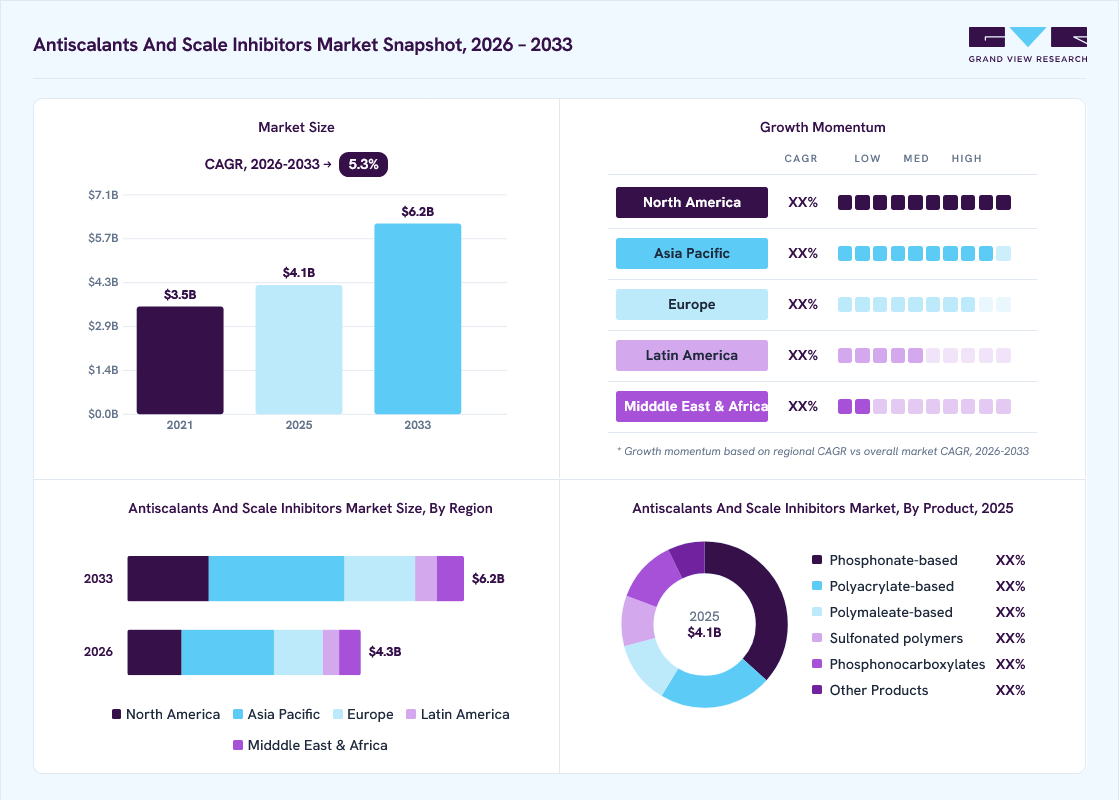 Source: Grand View Research, IR Documents, Primary Interviews, Paid DatabasesTo learn more about this report,
 Download Free Sample Report
Key Market Trends & Insights
- By product: Phosphonate-based segment held the largest revenue share of 35.3% in 2025.
- By application: Membrane water treatment segment dominated the market with a revenue share of 30.9% in 2025.
- By end use: Municipal water & wastewater segment dominated the market with a revenue share of 25.5% in 2025.
Regional Highlights
- Largest Region: Asia Pacific (38.2%, revenue share, 2025)
- By country: China held the largest revenue share in 2025
Market Size & Forecast
- Market size in 2025: USD 4.1 Billion
- Estimated market size in 2026: USD 4.3 Billion
- Projected market size by 2033: USD 6.2 Billion
- CAGR (2026-2033): 5.3%
GVR research-powered AIAsk Prism AI about the antiscalants and scale inhibitors marketGet cited answers from GVR research on market growth, segments, regulations and forecasts.Start with✓ Source-linked answers ✓ Market-specific context ✓ Traceable figuresExplore Prism AI ↗
Antiscalants are used to control mineral deposits such as calcium carbonate, calcium sulfate, and silica, helping maintain membrane efficiency, extend equipment service life, reduce cleaning frequency, and lower operating costs.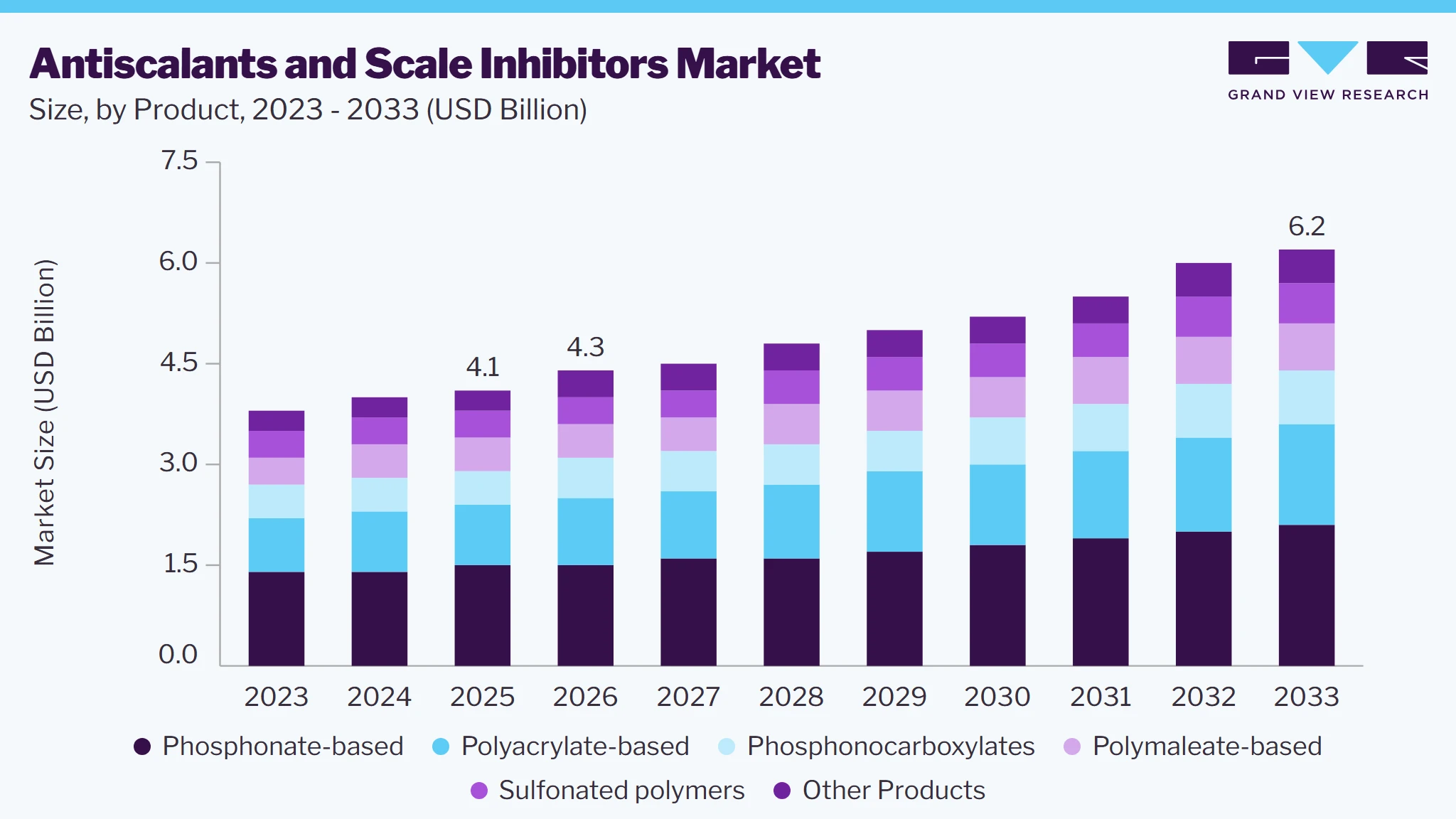 To learn more about this report, Download Free Sample Report
The industry is expanding alongside the growing need for effective scale-control solutions in livestock, aquaculture, and animal-production facilities. Antiscalants and scale inhibitors are used in water-treatment systems supporting animal farms and feed operations, where maintaining water quality and preventing mineral buildup in pipelines, drinking systems, filtration units, and treatment equipment is important for reliable operations. Increasing investments in modern poultry, swine, cattle, and aquaculture facilities are driving the adoption of automated water-delivery and treatment infrastructure, creating demand for scale-management chemicals. Growing emphasis on water efficiency, equipment longevity, and hygienic operating conditions is expected to strengthen the use of antiscalants and scale inhibitors across animal-production facilities.
Market Dynamics
The industry is supported by increasing demand for effective scale-control solutions across water treatment, desalination, oil & gas, power generation, mining, and industrial processing. These chemicals help prevent the deposition of inorganic salts on membranes, pipelines, heat exchangers, boilers, and other equipment, improving operational efficiency and reducing maintenance requirements. Expansion of water-intensive industrial activities, growing investments in wastewater treatment infrastructure, and rising adoption of membrane-based water purification technologies are strengthening demand across major end-use sectors.
Growing water scarcity and increasing pressure on freshwater resources are accelerating investments in desalination, wastewater recycling, and advanced water-treatment systems. Antiscalants and scale inhibitors play an important role in reverse osmosis and other membrane-based processes by limiting mineral deposition and maintaining membrane performance. The expansion of municipal and industrial water-treatment facilities, particularly in water-stressed regions, is increasing the consumption of scale-control chemicals. Rising requirements for reliable water recovery, reduced membrane fouling, and longer equipment operating cycles are further supporting the adoption of antiscalants across treatment applications.
Environmental considerations associated with certain conventional antiscalant and scale-inhibitor chemistries can restrict market expansion. Some formulations may contain phosphorus-based compounds or other chemical constituents that require careful management because of their potential impact on wastewater discharge and aquatic environments. Increasing regulatory scrutiny of chemical discharge, coupled with stricter wastewater-quality requirements, is encouraging end users to evaluate the environmental profile and biodegradability of treatment chemicals. Compliance requirements can increase formulation, testing, and certification costs for manufacturers and may create challenges in markets with stringent environmental standards.
The transition toward environmentally responsible water-treatment solutions is creating opportunities for manufacturers to develop biodegradable, low-phosphorus, phosphorus-free, and application-specific antiscalant formulations. Demand for products that provide effective scale control while minimizing environmental impact is increasing among municipal and industrial water-treatment operators. Technological advances in polymer chemistry and formulation development are enabling suppliers to improve performance against difficult scale types, including silica, sulfate, and carbonate deposits. Development of customized formulations for reverse osmosis, cooling-water systems, boilers, and industrial wastewater treatment can further expand application opportunities.
Market Concentration & Characteristics
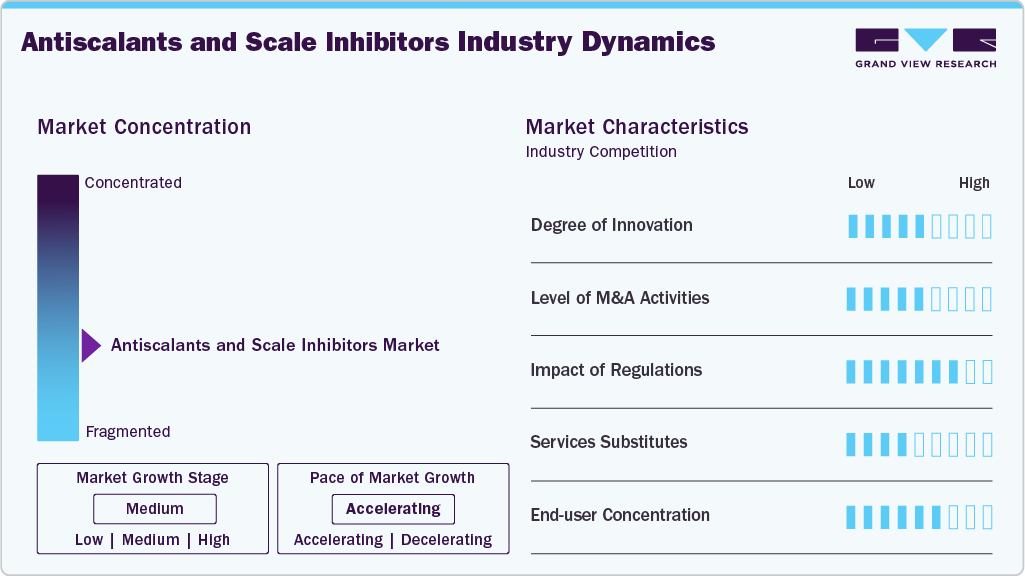
The industry comprises specialty chemical manufacturers, water-treatment chemical suppliers, and regional formulation companies serving diverse industrial applications. Competition is influenced by product performance, compatibility with treatment systems, chemical stability, dosage efficiency, technical support, regulatory compliance, and supply reliability. Companies are focusing on formulation development and application-specific solutions to address different water chemistries and scaling conditions.
Market participants are also strengthening their competitive positions through expansion of distribution networks, technical service capabilities, and partnerships with water-treatment operators and equipment providers. As customers increasingly prioritize treatment efficiency, operating-cost reduction, and environmental compliance, suppliers with broad product portfolios and customized scale-control solutions are positioned to capture opportunities across desalination, industrial water treatment, power generation, oil & gas, and other water-intensive industries.
 To learn more about this report, Download Free Sample Report
Leading companies in the industry are strengthening their competitive positions through product innovation, capacity expansion, strategic partnerships, and broader distribution networks. Manufacturers are investing in advanced formulation technologies, high-performance products, and application-specific solutions to improve scale-control efficiency across water treatment, desalination, industrial processing, and other end-use sectors. Companies are also enhancing technical support, quality management, and supply-chain capabilities to meet diverse customer requirements. The development of environmentally compatible formulations, improved product consistency, and customized solutions is expected to support differentiation and intensify competition over the forecast period.
Analyst Perspective
The industry is being shaped by rising demand for reliable water-treatment performance across desalination, industrial processing, power generation, oil & gas, mining, and wastewater applications. From a market perspective, growing pressure to improve asset utilization, minimize maintenance frequency, and extend membrane and equipment life is supporting the shift toward higher-performance formulations. Product development is increasingly focused on application-specific chemistries and more environmentally compatible formulations that can perform under complex water conditions while meeting evolving regulatory requirements. At the same time, investments in water infrastructure, industrial water reuse, and desalination are expanding the addressable market, creating growth opportunities for suppliers with differentiated products, technical support capabilities, and solutions tailored to regional water-treatment requirements.
Product Insights
The phosphonate-based segment dominated the industry, accounting for 35.3% of total revenue in 2025. Its strong market position is attributed to its proven ability to inhibit carbonate, sulfate, and other mineral scale formation across a broad range of operating conditions. The segment benefits from established use in industrial water-treatment systems where maintaining equipment efficiency and minimizing scale-related maintenance are important operational priorities.
The polyacrylate-based segment is expected to expand at the fastest CAGR of 6.3% during the forecast period. Growth is supported by increasing preference for polymer-based formulations that offer effective dispersion of scale-forming particles and improved performance in challenging water chemistries. Their adaptability across industrial processes is also encouraging wider adoption among end users seeking efficient and application-specific scale-management solutions.
Application Insights
The membrane water treatment segment dominated the industry, accounting for 30.9% of total revenue in 2025. The segment's leading position is supported by the increasing deployment of reverse osmosis and other membrane technologies for producing high-quality water. Antiscalants are important in these systems because they help limit mineral deposition on membrane surfaces, supporting stable filtration performance and reducing the frequency of cleaning and maintenance.
The evaporation & concentration processes segment is expected to register the fastest CAGR of 5.8% during the forecast period. Increasing utilization of evaporation and concentration technologies in industrial processing is creating greater requirements for effective scale management. The need to maintain heat-transfer efficiency, reduce equipment fouling, and improve process continuity is expected to encourage adoption of specialized scale-inhibition solutions in these applications.
End Use Insights
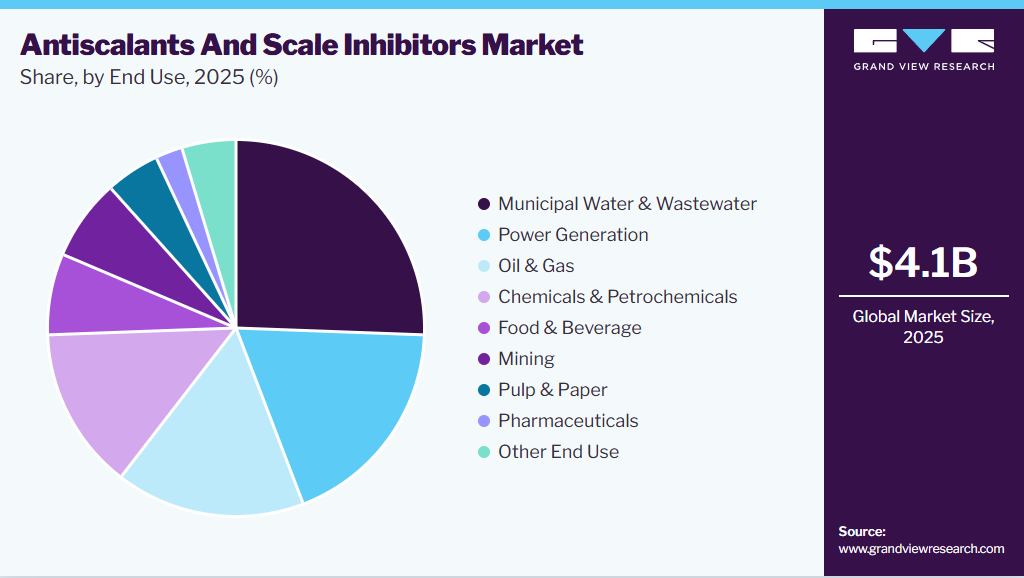
The municipal water & wastewater segment dominated the market with a revenue share of 25.5% in 2025. Growth in municipal treatment infrastructure, rising wastewater volumes, and increasing emphasis on water reuse are supporting demand from this segment. Expansion of treatment capacity and modernization of existing facilities are also encouraging the use of chemical solutions that help maintain reliable system performance and manage mineral deposition.
 To learn more about this report, Download Free Sample Report
The pharmaceutical segment is expected to grow at a CAGR of 6.7% during the forecast period,supported by expanding pharmaceutical manufacturing capacity and stringent requirements for process and purified water. Increasing adoption of advanced water-treatment systems in pharmaceutical facilities is creating demand for specialized scale-control solutions that can operate reliably under tightly controlled production and water-quality conditions.
Regional Insights
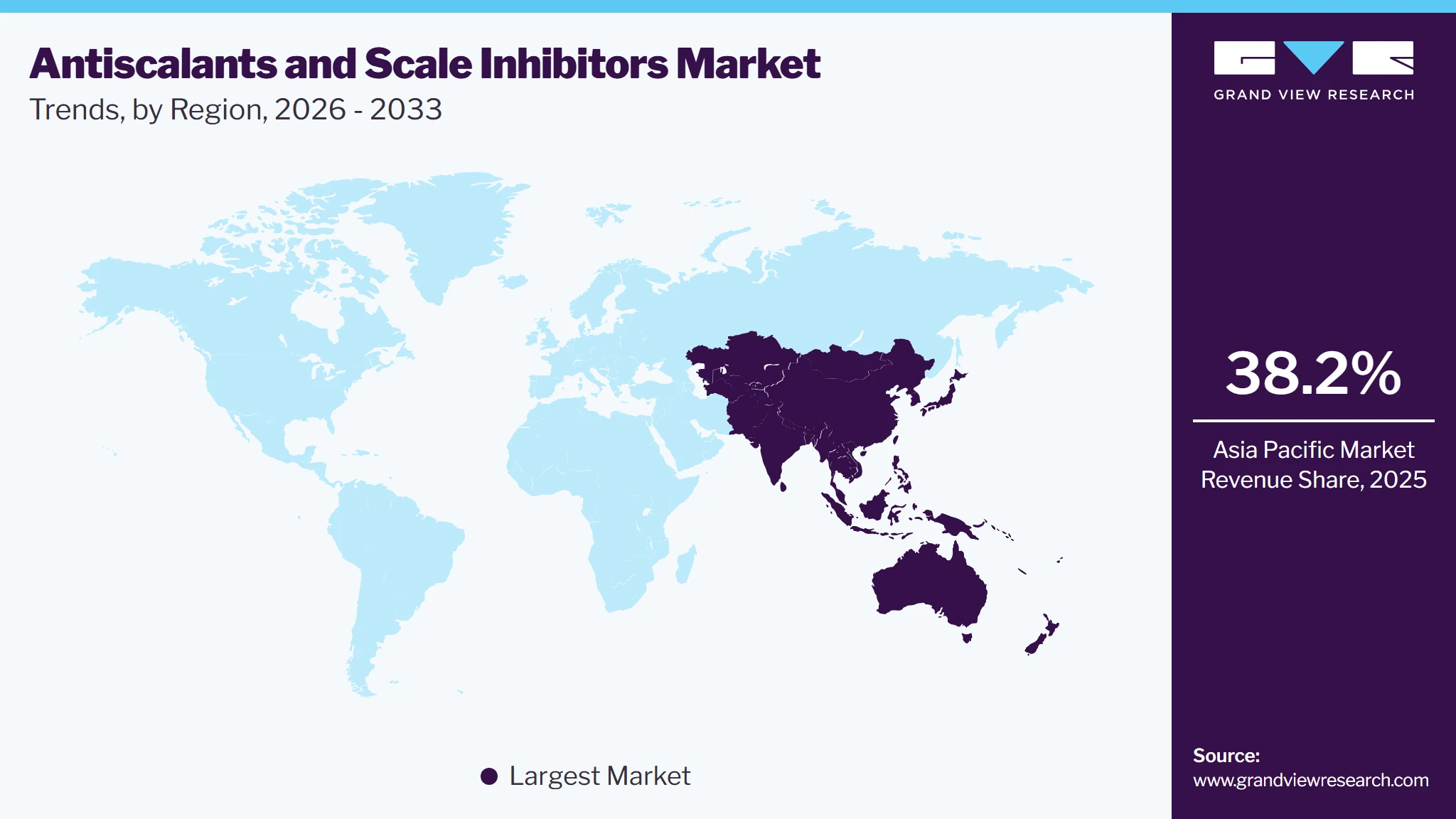
The Asia Pacific antiscalants and scale inhibitors market led with a 38.2% revenue share in 2025, and is also expected to witness the fastest CAGR from 2026 to 2033. The growth is supported by rapid industrialization, expanding municipal water-treatment infrastructure, rising wastewater generation, and increasing investments in desalination and water-reuse projects. Growing manufacturing activity across China, India, Southeast Asia, and other regional economies is strengthening demand for scale-control chemicals in industrial water systems, power generation, pharmaceuticals, and process industries.
 To learn more about this report, Download Free Sample Report
The antiscalants and scale inhibitors market in China represents a major market in Asia Pacific, supported by large-scale industrial water consumption and continued investment in wastewater treatment and water-recycling infrastructure. Expansion of chemical manufacturing, power generation, electronics, pharmaceuticals, and other water-intensive industries is increasing the need for reliable scale-management solutions. Government emphasis on water conservation, pollution control, and industrial water efficiency is also encouraging the adoption of advanced treatment chemicals.
North America Antiscalants and Scale Inhibitors Market Trends
The antiscalants and scale inhibitors market in North America is supported by established water-treatment infrastructure and growing demand for advanced solutions across municipal and industrial applications. Increasing adoption of reverse osmosis, desalination, wastewater recycling, and zero-liquid-discharge technologies is creating demand for effective scale-control formulations. The region's mature industrial base, stringent water-quality requirements, and focus on operational efficiency are encouraging users to adopt higher-performance and environmentally compatible products.
U.S. Antiscalants and Scale Inhibitors Market Trends
The antiscalants and scale inhibitors market in the U.S. is driven by increasing investments in municipal water infrastructure, industrial wastewater treatment, water reuse, and membrane-based purification systems. Demand is particularly supported by applications in power generation, oil & gas, pharmaceuticals, food processing, and manufacturing, where scale formation can affect equipment performance and operating costs. Growing emphasis on water conservation and infrastructure modernization is expected to sustain demand for advanced antiscalant and scale-inhibitor technologies.
Europe Antiscalants and Scale Inhibitors Market Trends
The antiscalants and scale inhibitors market in Europe is witnessing increasing demand as industries focus on water efficiency, wastewater reuse, and compliance with stringent environmental standards. The adoption of membrane filtration, advanced wastewater-treatment systems, and circular water-management practices is supporting market development. Demand for lower-impact formulations and improved chemical efficiency is also encouraging suppliers to develop products aligned with European sustainability and regulatory requirements.
Latin America Antiscalants and Scale Inhibitors Market Trends
The antiscalants and scale inhibitors market in Latin America is benefiting from increasing investments in industrial water treatment, mining operations, municipal wastewater infrastructure, and water-reuse systems. Mining activities in countries such as Chile, Brazil, and Peru generate significant requirements for process-water management and mineral scale prevention. Growing industrialization and efforts to address water scarcity are encouraging the adoption of treatment chemicals that improve system reliability and optimize water consumption.
Middle East & Africa Antiscalants and Scale Inhibitors Market Trends
The antiscalants and scale inhibitors market in the Middle East & Africa represents an important market due to severe freshwater constraints and extensive reliance on desalination and water-treatment technologies. Expansion of seawater desalination, municipal water infrastructure, industrial water reuse, and large-scale development projects is increasing demand for scale-control chemicals, particularly in membrane-based systems. Growing investments in water security and advanced desalination capacity are expected to create sustained opportunities for antiscalant suppliers across the region.
Key Antiscalants and Scale Inhibitors Company Insights
Companies operating in the antiscalants and scale inhibitors market are strengthening their competitive positions through product innovation, portfolio expansion, production capacity enhancement, strategic partnerships, and investments in advanced water-treatment technologies. Leading manufacturers are focusing on improving scale-control performance, formulation stability, dosage efficiency, compatibility with membranes and process equipment, and environmental performance. Companies are also developing application-specific solutions for reverse osmosis, desalination, wastewater treatment, cooling-water systems, oil & gas, power generation, and other industrial applications while expanding distribution networks and technical support capabilities to address evolving customer requirements.
-
Dow is a major participant in the market, offering water-treatment chemicals and scale-control solutions for industrial, municipal, and process-water applications. The company leverages its expertise in specialty materials and water-treatment technologies to develop solutions designed to control mineral deposits, protect membranes and process equipment, and improve treatment efficiency. Its broad technical capabilities, established customer base, and global distribution network support its position across applications, including reverse osmosis, desalination, wastewater treatment, cooling-water systems, and industrial water management.
-
Solenis is a prominent participant in the market, providing specialty water-treatment chemicals and process solutions for industries with demanding water-management requirements. The company focuses on scale-control technologies that help optimize membrane and equipment performance, reduce operational challenges, and improve water-treatment efficiency. Its application expertise, technical support capabilities, and broad portfolio enable it to serve customers across industrial water treatment, municipal water systems, desalination, pulp and paper, power, and other water-intensive industries.
Key Antiscalants and Scale Inhibitors Companies
The following key companies have been profiled for this study on the antiscalants and scale inhibitors market.
-
Dow
-
Solenis
-
Kemira
-
Nouryon
-
Ecolab Inc.
-
Italmatch Chemicals S.p.A
-
H2O Innovation
-
Kurita America Inc.
-
Lenntech B.V.
-
AquaChemie
Company Categorization
Operating Strategies
Competitive Edge
Weaknesses
Mature Players: Dow, Solenis, Kemira, Nouryon, Ecolab Inc., Italmatch Chemicals S.p.A
- Invest in advanced polymer, phosphonate, and specialty chemical technologies to improve scale-control performance, treatment efficiency, and formulation stability.
- Expand antiscalant and scale-inhibitor portfolios across reverse osmosis, desalination, wastewater treatment, cooling-water systems, power generation, oil & gas, mining, and other industrial applications.
- Strengthen R&D, technical service, and application-testing capabilities to develop customized solutions for different water chemistries and operating conditions.
- Increase focus on environmentally compatible, low-phosphorus, phosphorus-free, and biodegradable formulations to address evolving regulatory requirements and sustainability targets.
- Pursue strategic partnerships, acquisitions, distribution agreements, and technology collaborations to strengthen geographic coverage and access to major industrial customers.
- Strong expertise in specialty chemicals, water-treatment technologies, polymers, and scale-control chemistry.
- Broad product portfolios and established capabilities serving multiple industrial and water-treatment applications.
- Extensive global distribution networks and established relationships with large industrial, municipal, and commercial customers.
- Strong R&D and technical capabilities support formulation development, application optimization, and product differentiation.
- Established quality-management, regulatory-compliance, and technical-support systems strengthen customer confidence and facilitate international market access.
- Large global operations can result in higher operating, compliance, and infrastructure costs compared with smaller regional suppliers.
- Exposure to fluctuations in raw material, energy, transportation, and manufacturing costs can affect product economics.
- Complex product portfolios and organizational structures may limit flexibility in responding rapidly to smaller or highly customized customer requirements.
- Stringent environmental and chemical regulations across major markets can increase testing, certification, and formulation-development costs.
- Strong competition among established specialty chemical suppliers can place pressure on pricing, innovation cycles, and customer retention.
Emerging Players: H2O Innovation, Kurita America Inc., Lenntech B.V., AquaChemie
- Expand scale-control product portfolios and integrated water-treatment solutions to capture opportunities across industrial and municipal applications.
- Focus on application-specific formulations, competitive pricing, technical support, and reliable supply to strengthen relationships with regional customers.
- Improve formulation capabilities, treatment-system integration, monitoring, and dosing technologies to enhance scale-control performance.
- Strengthen regional sales, distribution, engineering, and service networks to improve penetration in developing water-treatment markets.
- Develop customized treatment programs combining chemicals, equipment, monitoring, and technical services to differentiate offerings from conventional chemical suppliers.
- Strong specialization in water treatment, water-management systems, engineering, and application-specific solutions.
- Greater flexibility in developing customized treatment programs for regional and specialized customers.
- Integrated chemical, equipment, engineering, monitoring, and service capabilities can provide customers with comprehensive water-treatment solutions.
- Regional market expertise and proximity to customers can support responsive technical service and faster implementation.
- Ability to target niche applications and develop tailored solutions can support penetration into specialized industrial and water-treatment segments.
- Comparatively narrower geographic coverage in certain markets than the largest multinational chemical suppliers.
- Greater dependence on regional projects, distributors, engineering contracts, and specialized customer segments can create revenue concentration risks.
- Expansion into new regions may require significant investment in technical personnel, service infrastructure, regulatory approvals, and distribution networks.
- Exposure to fluctuations in chemical raw material, equipment, logistics, and project costs can affect margins.
- Building stronger brand recognition and long-term relationships with large multinational customers may require sustained investment in R&D, technical support, and market development.
Recent Developments
-
In April 2024, Gradiant launched CURE Chemicals, a portfolio comprising more than 300 proprietary chemical formulations, including antiscalants and cleaners, scale inhibitors, corrosion inhibitors, process chemicals, biocides, and coagulants & flocculants. The portfolio is designed to improve water-treatment efficiency and operational performance while reducing environmental impact. The solutions are tailored for industries including semiconductors, pharmaceuticals, food & beverage, mining, energy, and renewable energy, strengthening Gradiant’s presence in specialty water-treatment chemicals.
Antiscalants and Scale Inhibitors Market Report Scope
Report Attribute
Details
Market size value in 2025
USD 4.1 billion
Estimated market size in 2026
USD 4.3 billion
Projected market size by 2033
USD 6.2 billion
Growth rate
CAGR of 5.3% from 2026 to 2033
Base year for estimation
2025
Historical data
2021 - 2024
Forecast period
2026 - 2033
Quantitative units
Revenue in USD billion, and CAGR from 2026 to 2033
Report coverage
Revenue forecast, company ranking, competitive landscape, growth factors, and trends
Segments covered
Product, application, end use, region
Regional scope
North America; Asia Pacific; Europe; Latin America; Middle East & Africa
Country scope
U.S.; Canada; Mexico; Germany; UK; France; Italy; Spain; China; India; Japan; South Korea; Brazil; Argentina; Saudi Arabia; South Africa
Key companies profiled
Dow; Solenis; Kemira; Nouryon; Ecolab Inc.; Italmatch Chemicals S.p.A; H2O Innovation; Kurita America Inc.; Lenntech B.V.; AquaChemie
Customization scope
Free report customization (equivalent up to 8 analysts’ working days) with purchase. Addition or alteration to country, regional & segment scope.
Pricing and purchase options
Avail customized purchase options to meet your exact research needs. Explore purchase options
Global Antiscalants and Scale Inhibitors Market Report Segmentation
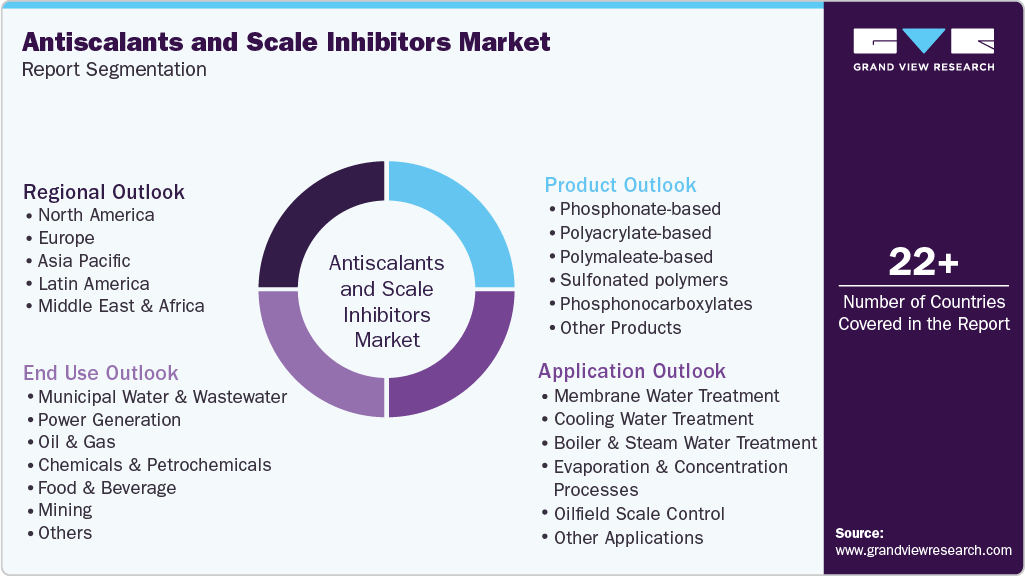
This report forecasts revenue growth at the global, regional and country levels and provides an analysis of the latest industry trends in each of the sub-segments from 2021 to 2033. For this study, Grand View Research has segmented the global antiscalants and scale inhibitors market report based on product, application, end use, & region:
 To learn more about this report, Download Free Sample Report
-
Product Outlook (Revenue, USD Billion, 2021 - 2033)
-
Phosphonate-based
-
Polyacrylate-based
-
Polymaleate-based
-
Sulfonated polymers
-
Phosphonocarboxylates
-
Other Products
-
-
Application Outlook (Revenue, USD Billion, 2021 - 2033)
-
Membrane Water Treatment
-
Cooling Water Treatment
-
Boiler & Steam Water Treatment
-
Evaporation & Concentration Processes
-
Oilfield Scale Control
-
Other Applications
-
-
End Use Outlook (Revenue, USD Billion, 2021 - 2033)
-
Municipal Water & Wastewater
-
Power Generation
-
Oil & Gas
-
Chemicals & Petrochemicals
-
Food & Beverage
-
Mining
-
Pulp & Paper
-
Pharmaceuticals
-
Other End Use
-
-
Region Outlook (Revenue, USD Billion, 2021 - 2033)
-
North America
-
U.S.
-
Canada
-
Mexico
-
-
Europe
-
Germany
-
UK
-
France
-
Italy
-
Spain
-
-
Asia Pacific
-
China
-
India
-
Japan
-
South Korea
-
-
Latin America
-
Brazil
-
Argentina
-
-
Middle East & Africa
-
Saudi Arabia
-
South Africa
-
-
Research Methodology
The antiscalants and scale inhibitors market figures in this report are based on a proven research process that combines executive interviews with secondary research from proprietary databases, company filings, and recognized regulatory and institutional sources. Market size is built through value-chain sizing—reconciling supply-side and demand-side estimates—and triangulated with bottom-up and top-down approaches. Every estimate passes multiple levels of expert validation before publication, with each antiscalants and scale inhibitors segment quantified using the revenue-capture definitions in the table below.
Segment Definition
Segment - Product
Revenue capture definition
Phosphonate-based
Revenue is generated from the sale of phosphonate-based antiscalants and scale inhibitors used to control mineral deposits in water-treatment and industrial process systems.
Polyacrylate-based
Revenue is captured from polyacrylate-based formulations supplied for scale dispersion and mineral-deposit control in membrane systems, cooling-water circuits, industrial processes, and other treatment applications.
Polymaleate-based
Sales are generated from polymaleate-based products used to inhibit and disperse scale deposits in industrial water and process systems. Revenue is influenced by their performance under elevated temperatures, resistance to precipitation, treatment efficiency, and suitability for applications requiring stable scale control.
Sulfonated polymers
Revenue arises from sulfonated polymer formulations used for controlling and dispersing scale-forming compounds in demanding water-treatment and industrial applications. Demand is shaped by their ability to remain effective under varying temperatures, pressures, and water compositions.
Phosphonocarboxylates
Market revenues are derived from phosphonocarboxylate-based antiscalants and scale inhibitors used in applications requiring combined threshold inhibition and mineral-dispersion capabilities.
Other Products
Revenue is generated from other antiscalant and scale-inhibitor chemistries, blends, and specialty formulations used for specific scale-control requirements. Demand depends on application performance, formulation characteristics, compatibility, regulatory requirements, and the ability to address specialized water-treatment conditions.
Segment - Application
Revenue capture definition
Membrane Water Treatment
Revenue is generated from antiscalants and scale inhibitors supplied for reverse osmosis, nanofiltration, and other membrane-based water-treatment systems. Products are used to minimize mineral deposition on membrane surfaces, maintain filtration efficiency, extend membrane operating life, and reduce cleaning and maintenance requirements.
Cooling Water Treatment
Sales are generated from antiscalants and scale inhibitors used in cooling towers, heat exchangers, recirculating cooling systems, and related industrial water circuits. Revenue is influenced by the need to control mineral deposition, maintain heat-transfer efficiency, and minimize equipment fouling and downtime.
Boiler & Steam Water Treatment
Market revenues arise from products used to control scale formation in boilers, steam-generation systems, and associated water circuits. Demand is driven by requirements to protect heat-transfer surfaces, maintain boiler efficiency, reduce deposits, and support reliable steam-generation operations.
Evaporation & Concentration Processes
Revenue is captured from antiscalants and scale inhibitors used in evaporation, concentration, crystallization, and related processes. Product demand is influenced by the need to limit scale buildup on heat-transfer surfaces, maintain process efficiency, and reduce cleaning frequency in high-concentration operating environments.
Oilfield Scale Control
Sales are generated from scale-control chemicals used in oil and gas production, injection-water systems, production wells, pipelines, and other oilfield operations. Revenue is influenced by the ability to control deposits under high-temperature, high-pressure, and complex formation-water conditions.
Other Applications
Revenue is derived from antiscalants and scale inhibitors supplied for specialized applications such as industrial process-water treatment, wastewater management, mining operations, pulp and paper processing, food and beverage production, and other scale-sensitive systems.
Segment - End Use
Revenue capture definition
Municipal Water & Wastewater
Revenue is generated from antiscalants and scale inhibitors used in municipal drinking-water treatment, wastewater treatment, water recycling, and desalination facilities. Demand is influenced by expanding treatment capacity, increasing water reuse, infrastructure modernization, and the need to maintain reliable system performance.
Power Generation
Market revenues arise from scale-control chemicals used in power plants, cooling systems, boiler-water treatment, and steam-generation processes. Product consumption is driven by requirements to maintain heat-transfer efficiency, protect equipment, reduce deposits, and support continuous plant operation.
Oil & Gas
Revenue is captured from antiscalants and scale inhibitors used across upstream, midstream, and downstream oil and gas operations. Applications include production wells, pipelines, injection systems, and processing facilities where mineral deposition can restrict flow and reduce equipment performance.
Chemicals & Petrochemicals
Sales are generated from scale-control solutions used in chemical and petrochemical processing, cooling circuits, boilers, water-treatment units, and process-water systems. Demand is supported by the need to minimize fouling, maintain process efficiency, and protect equipment operating under demanding conditions.
Food & Beverage
Market revenues arise from antiscalants and scale inhibitors used in water-treatment and process-water systems within food and beverage manufacturing facilities. Adoption is influenced by requirements for reliable water quality, equipment protection, hygienic processing environments, and efficient operation of filtration and heating systems.
Mining
Revenue is derived from scale-control products used in mining water-treatment systems, mineral processing, slurry operations, desalination, and water-recovery processes. Demand is supported by the need to manage mineral deposits in systems exposed to high concentrations of dissolved solids and challenging process-water conditions.
Pulp & Paper
Sales are generated from antiscalants and scale inhibitors used in process-water circuits, boilers, cooling systems, and paper-production operations. Products help control mineral deposits that can affect equipment performance, water circulation, heat transfer, and production efficiency.
Pharmaceuticals
Revenue is generated from high-performance scale-control products used in pharmaceutical water-treatment systems, purified-water production, process-water circuits, and related manufacturing infrastructure. Demand is influenced by stringent water-quality requirements, system reliability, contamination-control considerations, and the need for consistent treatment performance.
Other End Use
Market revenues arise from antiscalants and scale inhibitors supplied to applications such as institutional water treatment, hospitality, agriculture, electronics, industrial manufacturing, and other specialized sectors. Demand varies according to water chemistry, operating conditions, scale-forming potential, and specific treatment requirements.
Estimation Model
Layer No.
Layer Name
Key Question
Description
01
Raw Material & Production Layer
What forms is the supply base?
Examine the cultivation, harvesting, processing, and extraction of tea tree leaves, primarily from Melaleuca alternifolia, along with the availability and quality of botanical raw materials. The assessment covers steam distillation and other extraction processes, oil recovery, filtration, purification, storage, production capacity, quality-control practices, and supply-chain management. It also evaluates factors such as cultivation conditions, plant maturity, oil yield, terpinen-4-ol content, processing efficiency, sustainability practices, and technological developments that influence product quality, consistency, cost, and scalability.
02
Form Adoption Layer
Where is antiscalants and scale inhibitors utilized?
Evaluate the adoption of antiscalants and scale inhibitors across liquid essential-oil formulations and its incorporation into cosmetics, personal care products, household cleaners, aromatherapy products, healthcare formulations, animal-care products, and other specialty applications. Demand is influenced by formulation requirements, functional properties, aroma characteristics, consumer preference for botanical ingredients, and the expansion of natural and wellness-oriented product categories.
03
Consumption Intensity Layer
How much antiscalants and scale inhibitors is consumed?
Assess consumption based on antiscalants and scale inhibitors usage across major end-use industries, including cosmetics and personal care, pharmaceuticals and healthcare, household and cleaning, aromatherapy, agriculture, and animal care. The analysis considers product manufacturing volumes, application-specific inclusion levels, formulation requirements, consumer demand, production intensity, and the adoption of antiscalants and scale inhibitors-based products to estimate annual consumption across key markets.
04
Revenue Layer
How is market revenue generated?
Market revenue is generated through the production and sale of antiscalants and scale inhibitors across consumer, healthcare, household, agricultural, animal-care, and specialty applications. Revenue growth is supported by increasing demand for botanical ingredients, expansion of natural personal care and wellness products, growing use in household formulations, product innovation, premiumization, and wider commercialization of antiscalants and scale inhibitors in emerging applications.
Delivered Customizations
This report has been delivered with the following In-depth customizations
Client Request
Customization Delivered
Value Adds
Cross-segmentation
The assessment provides detailed cross-segmentation of the antiscalants and scale inhibitors market across product type, application, end use, and region. The analysis evaluates phosphonate-based, polyacrylate-based, carboxylate-based, and other formulations; applications across membrane water treatment, desalination, industrial water treatment, power generation, oil & gas, mining, and wastewater treatment; and key end-use industries with varying water chemistries and treatment requirements.
Enables identification of high-growth opportunities across specific product-application-end-use combinations. Supports formulation development, capacity planning, sourcing, distribution, and market-entry strategies by highlighting applications with distinct performance requirements, operating conditions, regulatory considerations, and demand potential.
Opportunity Assessment
Detailed evaluation of growth opportunities arising from increasing investment in desalination, industrial water reuse, wastewater treatment, and water infrastructure. The assessment covers advanced formulation development, environmentally compatible chemistries, membrane protection, treatment efficiency, emerging industrial applications, and expansion across high-potential regional markets.
Enables identification of attractive investment opportunities across the antiscalants and scale inhibitors value chain. Supports decisions related to product development, technology adoption, production expansion, regional market entry, and distribution partnerships by highlighting high-potential applications, evolving regulatory requirements, and changing customer needs.
Competitive Benchmarking
Comparative assessment of leading antiscalants and scale inhibitors producers based on product portfolios, formulation technologies, performance characteristics, application coverage, production capabilities, R&D activities, geographic presence, distribution networks, sustainability initiatives, and strategic partnerships. The benchmarking evaluates product differentiation, technical capabilities, supply reliability, regulatory positioning, customer coverage, and commercialization strategies.
Supports benchmarking against key competitors while identifying opportunities to strengthen product differentiation, improve formulation performance, expand application coverage, optimize manufacturing and distribution capabilities, and develop application-specific solutions. The analysis assists strategic decisions concerning R&D investment, portfolio expansion, manufacturing capabilities, partnerships, and long-term market positioning.
Frequently Asked Questions About This Report
The antiscalants and scale inhibitors market size was estimated at USD 4.1 billion in 2025 and is expected to reach USD 4.3 billion in 2026.
The antiscalants and scale inhibitors market is expected to grow at a compound annual growth rate of 5.3% from 2026 to 2033 to reach USD 6.2 billion by 2033.
By product, phosphonate-based dominated the market with a 35.3% revenue share in 2025 due to its strong performance in preventing mineral deposition across membrane systems and industrial water-treatment processes.
Key players include Dow, Solenis, Kemira, Nouryon, Ecolab Inc., Italmatch Chemicals S.p.A, H2O Innovation, Kurita America Inc., Lenntech B.V., AquaChemie.
The market is driven by the growing adoption of membrane-based water treatment, increasing desalination and wastewater treatment activities, rising industrial water consumption, and the need to minimize scale formation in treatment equipment and process systems
Asia Pacific dominated the global antiscalants and scale inhibitors market, accounting for 38.2% of revenue in 2025, supported by expanding industrialization, increasing water-treatment investments, and growing demand for efficient water-management solutions.
The evaporation & concentration processes is expected to register the fastest growth, expanding to a CAGR of 5.8% during the forecast period during the forecast period, driven by increasing adoption of concentration technologies across industrial processing and water-treatment applications.
The membrane water treatment segment dominated the antiscalants and scale inhibitors market, capturing 30.9% of revenue in 2025 supported by the widespread use of reverse osmosis and other membrane-based purification systems.
Pharmaceuticals is expected to grow fastest at a CAGR of 6.7% during the forecast period, driven by stringent water-quality requirements and increasing demand for purified water in pharmaceutical manufacturing processes.
About the Author(s)
Performance Chemicals Research Team
Specialty & Fine Chemicals · Performance ChemicalsThis report was authored by the performance chemicals research team at Grand View Research - comprising two research analysts, one senior research analyst, and one industry expert - with specialized expertise in the performance chemicals segment of the specialty & fine chemicals industry. All findings are based on proprietary specialty & fine chemicals databases, executive interviews, and regulatory analysis, subject to internal peer review prior to publication.
Last Updated:
Speak to Analyst

Customize this report to your needs - add regions, segments, or data points, with 20% free customization.
Or view our licence options:


ISO 9001:2015 & 27001:2022 Certified
We are GDPR and CCPA compliant! Your transaction & personal information is safe and secure. For more details, please read our privacy policy.


