
- Home
- »
- Plastics, Polymers & Resins
- »
-
Appliance Adhesives Market Size Report, 2026-2033GVR Report cover

Appliance Adhesives Market (2026 - 2033)
Size, Share & Trends Analysis Report By Product (Rubber, Acrylic, Silicone), By Application (Washing Machine, Cooktops, Air Conditioners, Microwaves & Ovens), By Region, And Segment Forecasts
Market Size, 2025
$8.1BMarket Estimate, 2026
$8.9BMarket Forecast, 2033
$16.7BCAGR, 2026–2033
9.4%Appliance Adhesives Market Summary
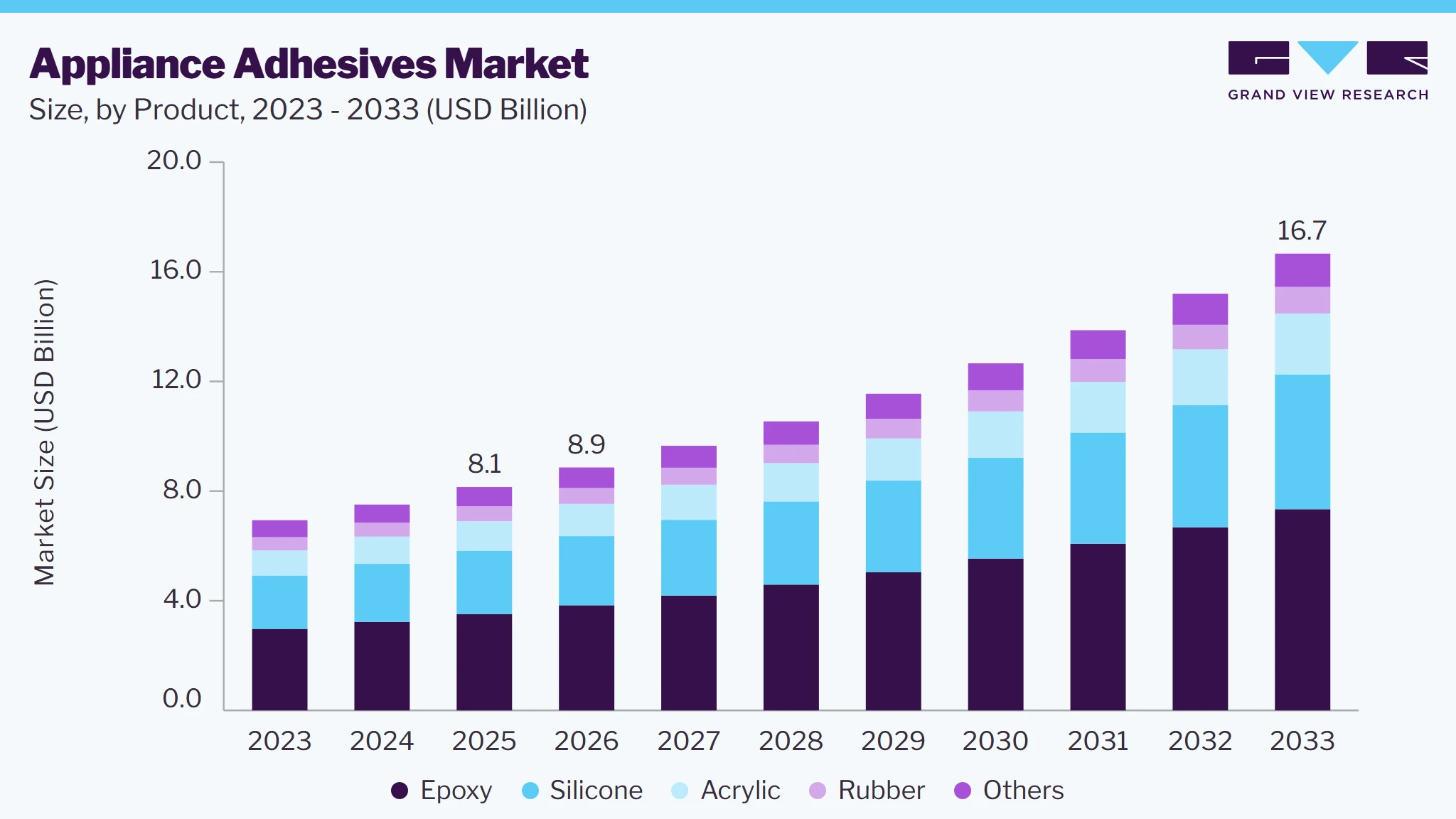
The global appliance adhesives market size was valued at USD 8.1 billion in 2025 and is projected to grow from USD 8.9 billion in 2026 to USD 16.7 billion by 2033, at a CAGR of 9.4% from 2026 to 2033. Asia Pacific dominated the market, accounting for a revenue share of 53.2% in 2025. The market is being driven by a combination of factors, including consumer preferences, technological advancements, environmental concerns, and industry trends.
 Source: Grand View Research, IR Documents, Primary Interviews, Paid DatabasesTo learn more about this report,
 Download Free Sample Report
Key Market Trends & Insights
- By product: Epoxy accounted for the highest market share, representing 43.2% of total revenue in 2025.
- By application: Refrigerators held a dominant position, contributing 33.9% of total revenue in 2025.
Regional Highlights
- Largest regional market: Asia Pacific (53.2% revenue share, 2025)
- By country: The China held the largest market share in 2025.
Market Size & Forecast
- Market size in 2025: USD 8.1 Billion
- Estimated market size in 2026: USD 8.9 Billion
- Projected market size by 2033: USD 16.7 Billion
- CAGR (2026-2033): 9.4%
Prism AI by Grand View Research Free to tryAsk a question about the appliance adhesives marketTry asking✓Every figure cited from GVR research Prefer the report? Download free sample →Consumers are increasingly seeking appliances that are durable, long-lasting, and energy-efficient. The development of eco-friendly and sustainable adhesives is driving market growth. Additionally, advancements in adhesive technology, such as innovative formulations and customized solutions, contribute to market growth. The expanding construction and renovation market, both residential and commercial, is also a significant driver for the market.
To cater to evolving consumer needs, manufacturers have increased their focus on developing adhesives tailored to specific industries. The global automotive sector's growth has spurred demand for electronics adhesives, which are used in various applications, including LED packaging, power electronics modules, anti-theft systems, engine status displays, and collision avoidance systems.
 To learn more about this report, Download Free Sample Report
The rising demand for energy-efficient appliances is a major force behind the growth of the global market. As they become more conscious of environmental sustainability, consumers increasingly choose appliances that consume less energy. This trend will persist as governments worldwide implement stricter energy efficiency regulations.
Appliance adhesives play a crucial role in ensuring that appliances meet these energy efficiency standards. By sealing gaps and seams, these products prevent air and heat leakage, improving overall appliance efficiency and reducing energy consumption. Consequently, the increasing demand for energy-efficient appliances is a key factor driving the global market expansion.
Market Dynamics
The appliance adhesives market is supported by increasing exploration and production activities across conventional and unconventional oil and gas reserves. Rising investments in deepwater and ultra-deepwater drilling projects are driving demand for high-performance fluid systems capable of operating under challenging geological conditions. Technological advancements in fluid formulations, including environmentally responsible and high-temperature-resistant solutions, are enhancing drilling efficiency, wellbore stability, and equipment protection. At the same time, stringent environmental regulations governing waste disposal and chemical usage are encouraging manufacturers to develop sustainable and low-toxicity appliance adhesives. Volatility in crude oil prices, however, continues to influence upstream capital expenditure, creating fluctuations in drilling activity and product demand. Growing emphasis on optimizing drilling performance, reducing non-productive time, and lowering operational costs is accelerating the adoption of advanced fluid management solutions.
The appliance adhesives market is primarily driven by the continuous growth in global household appliance production, supported by rapid urbanization, rising disposable incomes, and increasing consumer demand for energy-efficient and smart home appliances. Manufacturers are expanding production of refrigerators, washing machines, air conditioners, dishwashers, and cooking appliances to meet evolving consumer preferences, thereby increasing the consumption of structural, sealing, and assembly adhesives. Additionally, the growing penetration of connected and IoT-enabled appliances is creating demand for high-performance adhesive systems capable of securely bonding electronic components, lightweight materials, and complex assemblies while ensuring long-term durability and reliability.
The expansion of appliance manufacturing facilities across Asia Pacific, North America, and Europe is further strengthening market demand. Increasing investments in localized manufacturing, automation, and production capacity expansion are encouraging appliance OEMs to adopt advanced adhesive technologies that improve production efficiency, reduce assembly time, and enhance product performance. As manufacturers continue to focus on product innovation and operational efficiency, adhesive consumption across appliance manufacturing is expected to increase steadily.
Volatility in the prices of key raw materials such as epoxy resins, acrylic resins, polyurethane precursors, silicones, and petrochemical-based feedstocks remains a significant restraint for the appliance adhesives market. Fluctuations in crude oil prices, supply chain disruptions, transportation costs, and geopolitical uncertainties directly influence manufacturing costs and profit margins for adhesive producers. Additionally, increasingly stringent environmental regulations governing volatile organic compound (VOC) emissions and chemical safety require manufacturers to invest continuously in reformulation, regulatory compliance, and sustainable product development, increasing overall production costs.
The growing transition toward smart appliances, automated manufacturing, and sustainable product design presents significant opportunities for the appliance adhesives market. Increasing adoption of Industry 4.0 manufacturing practices, robotic assembly systems, and lightweight appliance components is creating demand for high-performance adhesive solutions capable of improving manufacturing efficiency and product reliability. Furthermore, the development of bio-based, recyclable, and low-emission adhesive formulations, coupled with expanding appliance production in emerging economies such as India, Vietnam, Indonesia, and Mexico, is expected to create new avenues for market growth over the coming years.
Product Insights
Based on product, the market is segmented into rubber, silicone, epoxy, and acrylic. The epoxy accounted for the highest market share, representing 43.2% of total revenue in 2025. Epoxy is a versatile adhesive and coating material widely used in appliance manufacturing due to its excellent bonding properties, durability, and resistance to various environmental factors. It is also used as an insulating material in appliances, particularly electrical components. Its dielectric properties help prevent electrical short circuits and ensure safe operation. Epoxy encapsulates electronic components within appliances, protecting them from moisture, dust, and mechanical shock, improving their reliability and lifespan.
Acrylic is a versatile material commonly used in appliances due to its durability, resistance to scratches and stains, and ease of maintenance. These create transparent or translucent panels in appliances like refrigerators, ovens, and dishwashers, allowing users to see the contents inside without opening the door. Acrylic is used to manufacture various appliance components, such as knobs, handles, and control panels. Its lightweight and durable nature makes it ideal for these applications.
Rubber isolates appliances from vibrations, reducing noise and preventing damage to sensitive components. This is particularly important in appliances like washing machines and refrigerators. Rubber handles and knobs provide a comfortable and non-slip grip for users. They are also resistant to wear and tear, ensuring long-lasting performance. It absorbs appliance shocks and impacts, protecting delicate components and preventing damage.
Application Insights
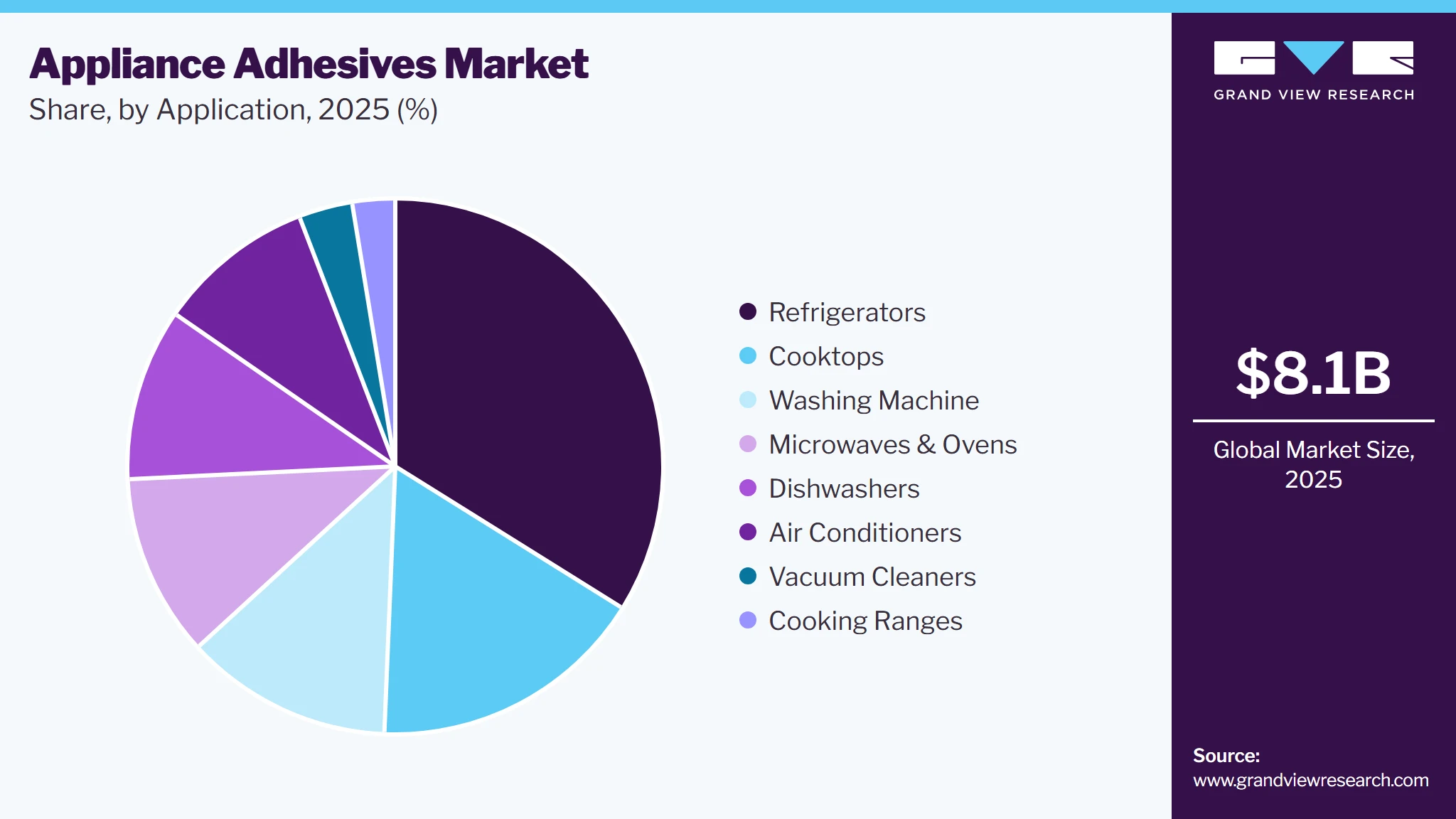
Based on application, the market is segmented into washing machines, refrigerators, air conditioners, cooking ranges, cooktops, vacuum cleaners, dishwashers, microwaves, & ovens. Refrigerators held a dominant position, contributing 33.9% of total revenue in 2025. Adhesives play a crucial role in the construction and assembly of refrigerators, ensuring the structural integrity, insulation, and overall performance of these appliances. They are used to bond the various components of the refrigerator cabinet, such as the sides, top, bottom, and door. They are used to bond polyurethane foam insulation to the interior walls of the refrigerator cabinet, ensuring effective insulation and preventing heat transfer.
 To learn more about this report, Download Free Sample Report
Adhesives are essential for constructing, assembling, and performing air conditioners. They provide structural integrity, insulation, sealing, and vibration damping, ensuring these appliances function efficiently and effectively. They also bond the various components of the washing machine cabinet, such as the top, bottom, sides, and door. They also attach internal components, like the drum, motor, and tub, to the cabinet. Finally, they attach shelves, drawers, and other accessories to the washing machine interior.
Regional Insights
North America appliance adhesive marketis growing due to the emphasis on sustainability in the region, which drives the demand for eco-friendly and sustainable adhesives for appliance manufacturing. Consumers are increasingly opting for energy-efficient appliances to reduce their environmental impact and utility bills, leading to a higher demand for product used in the construction of these appliances.
Government regulations on energy efficiency and product safety have influenced the use of adhesives in appliances, driving demand for specific types of adhesives that meet these standards. The overall economic growth in North America has led to increased consumer spending on appliances, driving market demand.
U.S. Appliance Adhesive Market Trends
As the people invest more in their homes and appliances, the demand for adhesives to secure and repair these appliances is growing. More people are opting to repair their appliances themselves rather than calling professionals. This trend has led to a higher demand for adhesives. Manufacturers are also developing specialized adhesives that are more durable, versatile, and easy to use, catering to the needs of both professionals and DIY enthusiasts.
Asia Pacific Appliance Adhesive Market Trends
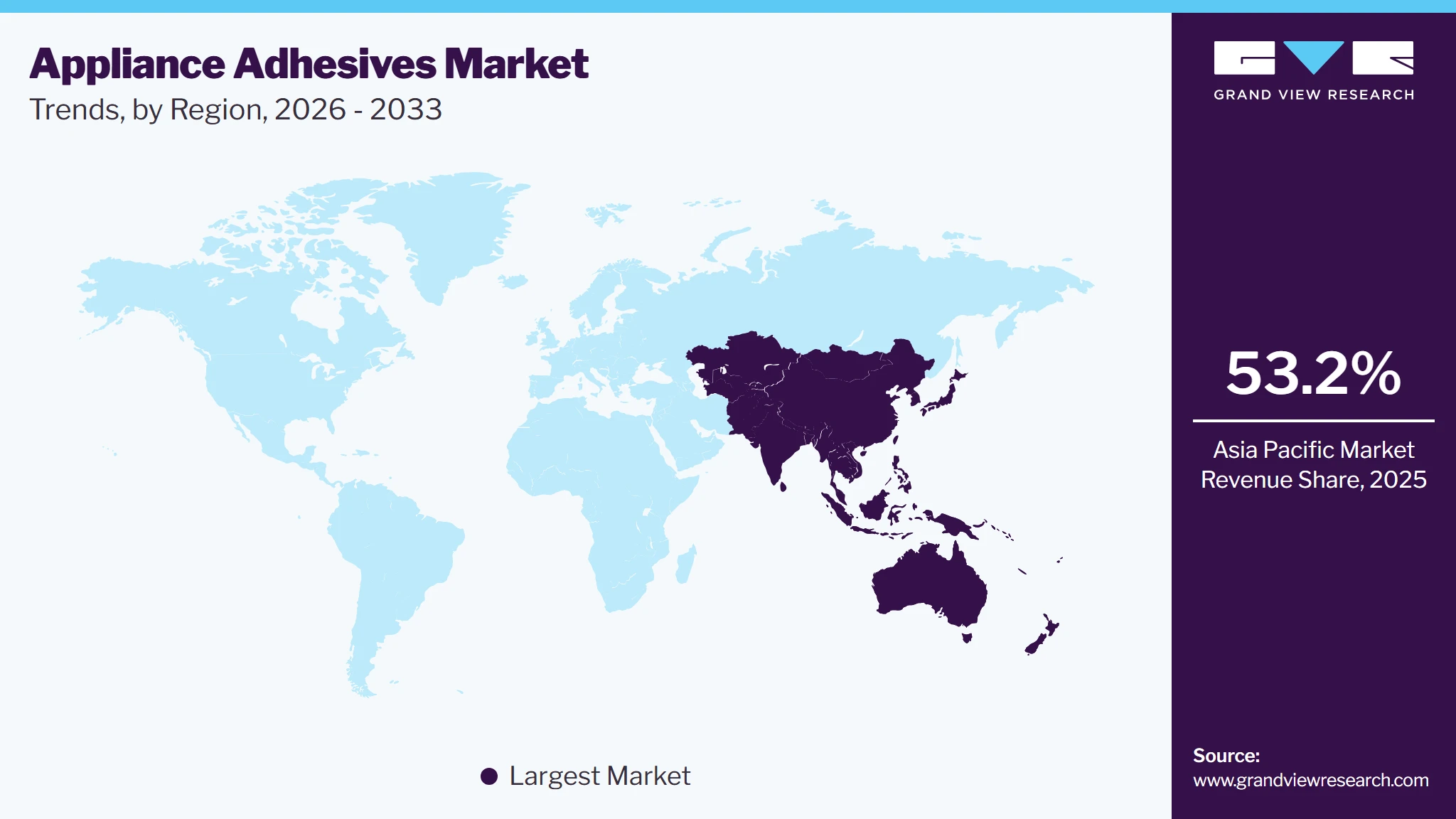
Asia Pacific dominated the appliance adhesives market with the highest revenue share of 53.2% in 2025 and is expected to grow at a significant rate over the forecast period. China dominated the Asia Pacific appliance adhesives market in 2025. The region's strong economic growth has led to a surge in demand for appliances, driving the need for the product in their production. Consumers are becoming more aware of the importance of appliance quality and durability, leading to a preference for high-performance adhesives. Advances in appliance technology, such as smart appliances and IoT-enabled devices, require specialized adhesives for their assembly and components.
 To learn more about this report, Download Free Sample Report
Europe Appliance Adhesive Market Trends
The appliance adhesive market in Europe is growing as the European Union (EU) has implemented stringent regulations regarding energy efficiency and product safety, which influence the use of adhesives in appliances. Manufacturers must comply with these regulations to sell their products in the European market. A growing focus on sustainability in Europe is driving the demand for eco-friendly and sustainable adhesives for appliance manufacturing.
Central & South America Appliance Adhesive Market Trends
The appliance adhesive market in the Central & South America region is experiencing rapid economic growth, leading to a surge in demand for appliances, especially in urban areas. As disposable incomes increase, consumers purchase more appliances, fueling market growth. Trade agreements between countries in the region have facilitated the movement of goods, including appliance adhesives, contributing to market growth.
Key Appliance Adhesive Company Insights
Some of the key players operating in the market are 3M and Sika AG:
-
3M is a global diversified technology company known for its innovative products and solutions. Founded in 1902, 3M has a long history of applying science and innovation to create products that improve lives and communities around the world.
-
Sika AG is a Swiss multinational specialty chemicals company. It is one of the world's largest manufacturers of adhesives, sealants, and waterproofing products. Sika specializes in solutions for the construction, industrial, and automotive markets.
RPM International Inc. and Wacker Chemie AG are some of the emerging participants in the market.
-
RPM International Inc. is a global leader in the specialty chemicals industry, primarily focused on coatings, sealants, and building materials. The company offers a wide range of products used in various applications, including construction, industrial, and consumer markets.
-
Wacker Chemie AG is a German chemical company that specializes in silicones, polyvinyl acetate (PVAc), and hyperpure polysilicon. Founded in 1914, Wacker is one of the world's leading producers of these materials.
Key Appliance Adhesive Companies
The following key companies have been profiled for this study on the appliance adhesive market.
-
Pidilite Industries Ltd.
-
Arkema
-
Wacker Chemie AG
-
Huntsman International LLC
-
RPM International Inc.
-
H.B. Fuller Company
-
Henkel Corporation
-
3M
-
Sika AG
-
Dow
Competitive Benchmarking
Category
Operating Strategies
Competitive Edge
Weakness
Established Players (Henkel Corporation, H.B. Fuller Company, Dow, Arkema, Huntsman International LLC, Sika AG, 3M)
- Invest in advanced adhesive technologies to support lightweight appliance manufacturing and automated assembly.
- Expand manufacturing footprint and strengthen global distribution networks through acquisitions and strategic partnerships.
- Focus on sustainable, low-VOC, and high-performance adhesive formulations complying with evolving environmental regulations.
- Develop customized solutions through close collaboration with leading appliance OEMs
- Extensive global manufacturing and distribution capabilities.
- Broad product portfolios serving multiple appliance applications.
- Strong R&D capabilities supporting continuous product innovation.
- Long-standing relationships with global appliance manufacturers and OEMs.
- High operating costs associated with global manufacturing operations.
- Exposure to fluctuations in petrochemical raw material prices.
- Stringent regulatory compliance requirements increase operating expenses.
- Longer commercialization timelines for new product development.
Emerging Players (Pidilite Industries Ltd., Wacker Chemie AG, RPM International Inc)
- Focus on expanding regional market presence through application-specific adhesive solutions.
- Strengthen partnerships with regional appliance manufacturers and distributors.
- Invest in specialty adhesive formulations offering improved thermal performance, durability, and sustainability.
- Enhance customer support and technical service capabilities to strengthen market penetration.
- Greater flexibility in developing customized adhesive formulations.
- Strong regional customer relationships and technical support capabilities.
- Faster response to evolving customer requirements and niche applications.
- Competitive pricing strategies supporting regional market expansion.
- Limited global manufacturing footprint compared with multinational competitors.
- Smaller product portfolios across diversified industrial applications.
- Lower investment capacity for large-scale R&D and international expansion.
- Higher dependence on regional demand and customer concentration.
Recent Developments
- In May 2024, Arkema acquired Dow’s flexible packaging laminating adhesives business, one of the leading producers of adhesives for the flexible packaging market, generating annual sales of around US$250 million.
Appliance Adhesive Market Report Scope
Report Attribute
Details
Market size in 2025
USD 8.1 billion
Estimated market size in 2026
USD 8.9 billion
Projected market size by 2033
USD 16.7 billion
Growth rate
CAGR of 9.4% from 2026 to 2033
Base year for estimation
2025
Historical data
2021 - 2024
Forecast period
2026 - 2033
Quantitative units
Revenue in USD billion/million, and CAGR from 2026 to 2033
Report coverage
Revenue forecast, company ranking, competitive landscape, growth factors, and trends
Segments covered
Product, End-use, region
Regional scope
North America; Europe; Asia Pacific; Latin America; Middle East & Africa
Country scope
U.S., Canada, Mexico, UK, Germany, France, Italy, Spain, China, India, Japan, South Korea, Brazil, Argentina, South Africa, Saudi Arabia
Key companies profiled
Pidilite Industries Ltd., Arkema , Wacker Chemie AG, Huntsman International LLC, RPM International Inc., H.B. Fuller Company, Henkel Corporation, 3M , Sika AG, Dow
Customization scope
Free report customization (equivalent up to 8 analysts' working days) with purchase. Addition or alteration to country, regional & segment scope.
Pricing and purchase options
Avail customized purchase options to meet your exact research needs. Explore purchase options
Global Appliance Adhesive Market Report Segmentation
This report forecasts volume & revenue growth at the global, regional & country levels and provides an analysis of the latest industry trends in each of the segments from 2021 to 2033. For this study, Grand View Research has segmented the appliance adhesive market report on the basis of product, application, and region:
 To learn more about this report, Download Free Sample Report
-
Product Outlook (Volume, Kilotons; Revenue, USD Million, 2021 - 2033)
-
Rubber
-
Acrylic
-
Silicone
-
Epoxy
-
Others
-
-
Application Outlook (Volume, Kilotons; Revenue, USD Million, 2021 - 2033)
-
Washing Machine
-
Cooktops
-
Cooking Ranges
-
Dishwashers
-
Refrigerators
-
Air Conditioners
-
Microwaves & Ovens
-
Vacuum Cleaners
-
-
Regional Outlook (Volume, Kilotons; Revenue, USD Million, 2021 - 2033)
-
North America
-
U.S.
-
Canada
-
Mexico
-
-
Europe
-
Germany
-
UK
-
France
-
Italy
-
Spain
-
-
Asia Pacific
-
China
-
Japan
-
India
-
South Korea
-
-
Central & South America
-
Brazil
-
Argentina
-
-
Middle East & Africa
-
Saudi Arabia
-
South Africa
-
-
Research Methodology
Segment Definition
Segment - Product
Revenue capture definition
Rubber
Revenue is generated from rubber-based adhesives utilized in appliance manufacturing for flexible bonding applications requiring excellent elasticity, vibration resistance, and long-term durability. Demand is driven by increasing production of washing machines, refrigerators, HVAC equipment, and other household appliances requiring resilient sealing and component assembly
Acrylic
Market growth is supported by widespread adoption of acrylic adhesives offering superior adhesion, weather resistance, UV stability, and long-term bonding performance across metal, plastic, and composite appliance components. Their increasing use in lightweight appliance designs and automated manufacturing processes continues to strengthen demand
Silicone
Revenue is generated from silicone adhesives used in appliances requiring excellent thermal stability, moisture resistance, electrical insulation, and flexibility. Increasing demand from ovens, cooktops, refrigerators, microwaves, and HVAC systems supports market expansion due to their ability to withstand extreme operating conditions
Epoxy
Commercial growth is driven by epoxy adhesives utilized for structural bonding, high mechanical strength, and chemical resistance in appliance components including motors, compressors, electronic assemblies, and metal housings. Increasing adoption of energy-efficient appliances continues to support product demand
Other Products
Revenue is generated from polyurethane, hot melt, cyanoacrylate, anaerobic, and other specialty adhesive systems utilized across appliance assembly, sealing, insulation, electronic components, and specialty manufacturing applications requiring customized bonding performance
Segment - End Use
Revenue capture definition
Washing Machine
Revenue is generated from adhesives used in bonding metal panels, plastic housings, electronic assemblies, insulation materials, drums, and sealing components. Increasing demand for high-efficiency washing machines and smart appliances continues to support adhesive consumption
Cooktops
Market demand is driven by high-temperature-resistant adhesive systems utilized in assembling ceramic glass, metal components, insulation materials, and electronic control systems. Growth is supported by rising adoption of induction and electric cooktops globally
Cooking Ranges
Revenue is generated from adhesives used in structural assembly, thermal insulation, control panels, and sealing applications requiring high durability and heat resistance in residential and commercial cooking appliances.
Dishwashers
Commercial growth is supported by increasing utilization of moisture-resistant and chemically resistant adhesives for internal component assembly, insulation, pumps, and sealing systems designed to withstand repeated washing cycles.
Refrigerators
Revenue is generated through the use of structural, polyurethane, silicone, and acrylic adhesives for insulation panels, door assemblies, compressors, evaporators, and electronic components. Rising demand for energy-efficient refrigeration systems continues to drive market expansion.
Air Conditioners
Market demand is supported by increasing use of adhesives in evaporators, condensers, insulation panels, electrical components, and HVAC assemblies requiring vibration resistance, thermal stability, and moisture protection.
Microwaves & Others
Revenue is generated from appliance adhesives utilized in microwave ovens, small kitchen appliances, coffee makers, water purifiers, and other consumer appliances requiring durable bonding, electrical insulation, and thermal resistance.
Vaccum Cleaners
Commercial growth is driven by adhesives used in plastic housings, motor assemblies, filters, electronic circuits, and structural components requiring lightweight construction, vibration resistance, and reliable long-term performance.
Estimation Model
Layer Name
Key Question
Description
Raw Material & Production Layer
What forms the supply base?
Assess global appliance adhesive production based on the availability of acrylic resins, epoxy resins, silicone polymers, polyurethane precursors, rubber-based polymers, tackifiers, curing agents, fillers, additives, and specialty bonding materials. The assessment evaluates manufacturing capacities, production technologies, raw material sourcing, production economics, and regional manufacturing hubs supporting global adhesive supply
Application Adoption Layer
Where are appliance adhesives consumed?
Evaluate adhesive adoption across major household appliance categories including refrigerators, washing machines, dishwashers, cooking appliances, air conditioners, microwaves, and small domestic appliances. Adoption is influenced by lightweight product designs, automation in appliance manufacturing, energy-efficient product development, and increasing use of multi-material assemblies.
Consumption Intensity Layer
How much appliance adhesive is utilized?
Analyze adhesive consumption intensity by evaluating adhesive loading per appliance, manufacturing processes, material combinations, assembly techniques, production volumes, product complexity, and replacement of traditional mechanical fastening methods across global appliance manufacturing.
Revenue Layer
How is market revenue generated?
Market revenue is generated through the production and commercialization of acrylic, epoxy, silicone, rubber-based, polyurethane, and specialty adhesives supplied to household appliance manufacturers and OEMs. Revenue growth is supported by increasing appliance production, technological advancements in adhesive formulations, lightweight product designs, energy-efficient appliances, automation in manufacturing, and growing consumer demand for durable, high-performance household appliances.
Delivered Customizations
This report has been delivered with the following In-depth customizations
Client Request
Customization Delivered
Value Adds
Regional Segmentation
The study provides comprehensive country-level analysis across major appliance manufacturing and adhesive consumption markets. It evaluates production capacity, appliance manufacturing trends, raw material availability, supply chain dynamics, import-export activities, pricing outlook, regulatory framework, and adhesive demand across key appliance categories including refrigerators, washing machines, air conditioners, cooking appliances, and other household appliances
Enables stakeholders to identify high-growth regional markets, evaluate manufacturing competitiveness, understand regional demand patterns, optimize sourcing strategies, and prioritize investments based on appliance production trends and market opportunities.
Cross-Segmentation
The study delivers detailed cross-segmentation analysis by evaluating adhesive product demand across major appliance categories. Product-wise demand (rubber, acrylic, silicone, epoxy, and other adhesives) is mapped against end-use applications including refrigerators, washing machines, air conditioners, cooking appliances, dishwashers, vacuum cleaners, and other household appliances to identify high-growth product-application combinations.
Supports portfolio optimization by identifying the most attractive product-application opportunities, improving product positioning, resource allocation, and long-term business development strategies.
Pricing-Analysis Assessment
The study evaluates historical and current pricing trends for appliance adhesives across major regions. It assesses raw material cost movements, production economics, supply-demand dynamics, manufacturing costs, regional pricing variations, and factors influencing average selling prices across different adhesive chemistries.
Supports procurement planning, pricing strategy development, supplier negotiations, margin optimization, and improved understanding of cost structures and future pricing outlook.
Frequently Asked Questions About This Report
Epoxy segmnt dominated the market with a revenue share of 43.2%, in 2025.
The silicone segment is expected to grow the fastest with a compound annual growth rate of 10.0%, from 2026 to 2033.
The refrigerators segment dominated the market with a revenue share of 33.9% in 2025.
The refrigerators segment is expected to grow the fastest with a compound annual growth rate of 9.8%, from 2026 to 2033.
Some key players operating in the appliance adhesives market include Pidilite Industries Ltd., Arkema, Wacker Chemie AG, Huntsman International LLC, RPM International Inc., H.B. Fuller Company, Henkel Corporation, 3M, Sika AG, Dow
Key factors that are driving the market growth include consumer preferences, technological advancements, environmental concerns, and industry trends
The global appliance adhesive market size was valued at USD 8.1 billion in 2025 and is estimated at USD 8.9 billion for 2026.
The global appliance adhesive market is expected to grow at a CAGR of 9.4% from 2026 to 2033, reaching USD 16.7 billion by 2033.
Asia Pacific dominated the appliance adhesive market with a share of 53.2% in 2025. This is attributable to rising awareness among consumers about the importance of appliance quality and durability, leading to a preference for high-performance adhesives
About the Author(s)
Plastics, Polymers & Resins Research Team
Bulk Chemicals · Plastics, Polymers & ResinsThis report was authored by the plastics, polymers & resins research team at Grand View Research - comprising two research analysts, one senior research analyst, and one industry expert - with specialized expertise in the plastics, polymers & resins segment of the bulk chemicals industry. All findings are based on proprietary bulk chemicals databases, executive interviews, and regulatory analysis, subject to internal peer review prior to publication.
Last Updated:
Speak to Analyst

Customize this report to your needs - add regions, segments, or data points, with 20% free customization.
Or view our licence options:


ISO 9001:2015 & 27001:2022 Certified
We are GDPR and CCPA compliant! Your transaction & personal information is safe and secure. For more details, please read our privacy policy.


