
- Home
- »
- Next Generation Technologies
- »
-
AI Image Generator Market Size & Share Report, 2026-2033GVR Report cover

AI Image Generator Market (2026 - 2033)
Size, Share & Trends Analysis Report By Component (Software, Services), By End-user (Media & Entertainment, Healthcare, Fashion, Social Media, E-commerce), By Region, And Segment Forecasts
Market Size, 2025
$474.2MMarket Estimate, 2026
$555.1MMarket Forecast, 2033
$1,853.0MCAGR, 2026–2033
18.8%AI Image Generator Market Summary
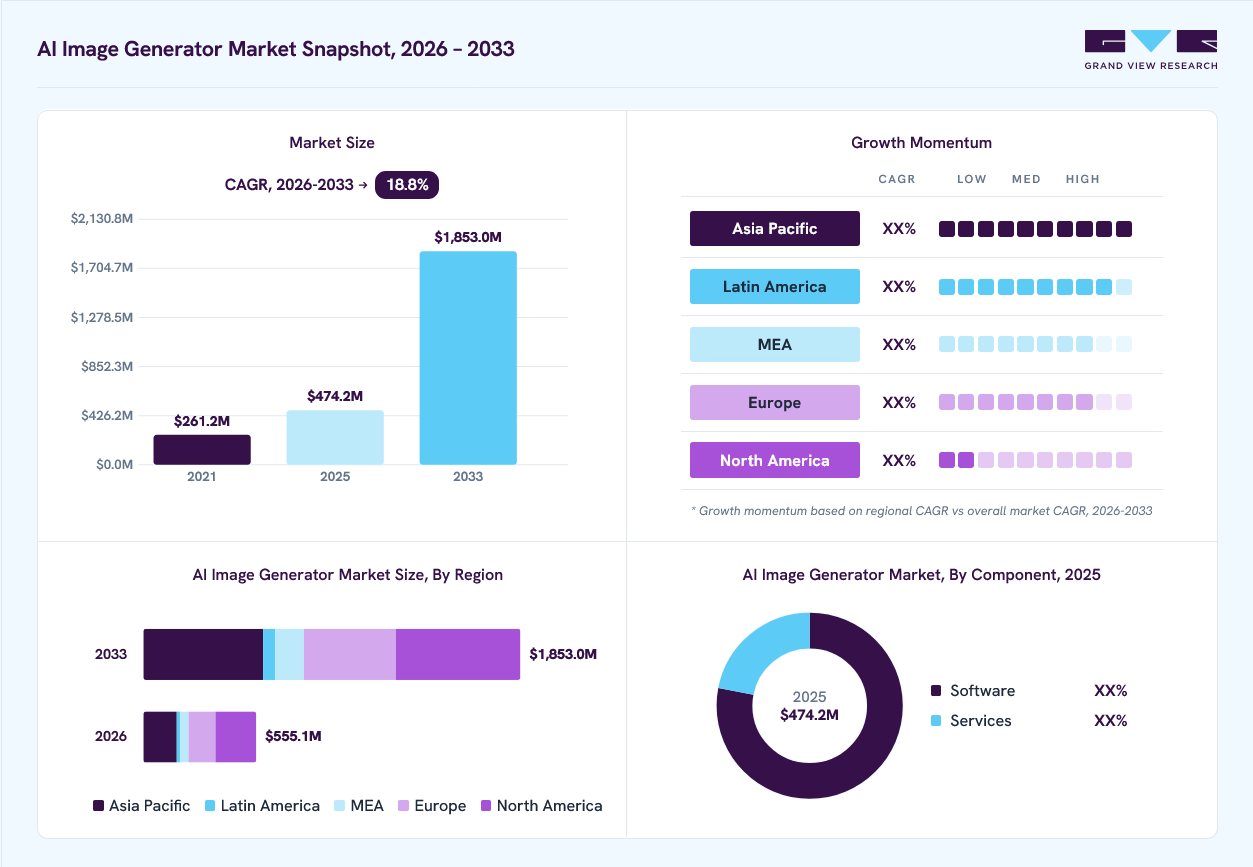
The global AI image generator market size was valued at USD 474.2 million in 2025 and is projected to grow from USD 555.1 million in 2026 to USD 1,853.0 million by 2033, growing at a CAGR of 18.8% from 2026 to 2033. North America dominated the global market with the largest revenue share of 36.6% in 2025. Multimodal AI platforms that combine image generation with text, video, and design capabilities are becoming a key trend, enabling end-to-end content creation from a single interface.
 Source: Grand View Research, IR Documents, Primary Interviews, Paid DatabasesTo learn more about this report,
 Download Free Sample Report
Key Market Trends & Insights
- By component: Software segment dominated the market, with a revenue share of 78.0% in 2025.
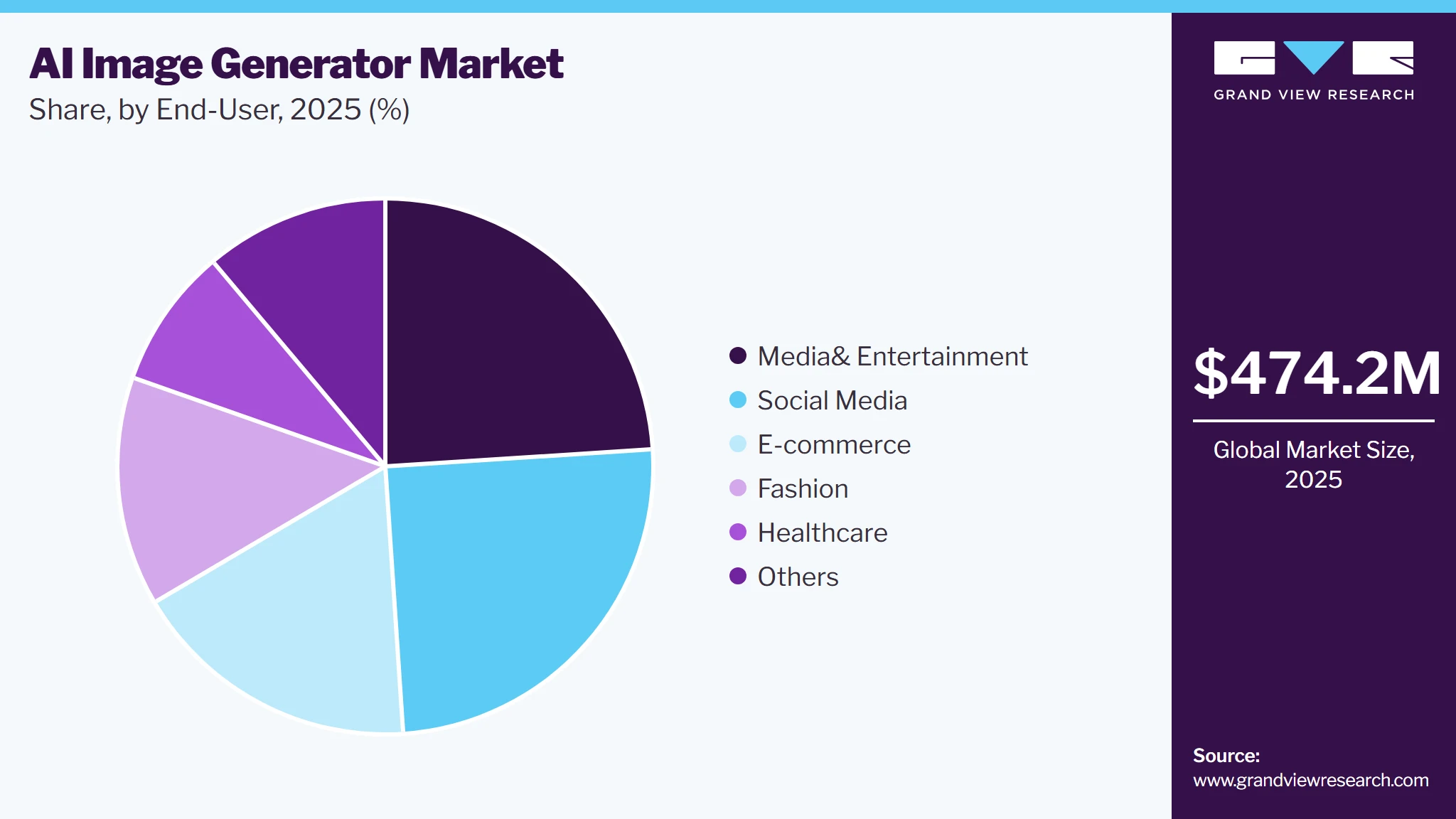
- By end-user: Social media segment held the largest market share of 24.9% in 2025.
Regional Highlights
- Largest regional market: North America (36.6% revenue share, 2025)
- Fastest-growing regional market: Asia Pacific (highest CAGR, 2026-2033)
- By country: The U.S. held the largest market share in 2025.
Market Size & Forecast
- Market size in 2025: USD 474.2 Million
- Estimated market size in 2026: USD 555.1 Million
- Projected market size by 2033: USD 1,853.0 Million
- CAGR (2026-2033): 18.8%
Prism AI by Grand View Research Free to tryAsk a question about the AI image generator marketTry asking✓Every figure cited from GVR research Prefer the report? Download free sample →Innovations in neural network architectures, such as generative adversarial networks (GANs), have led to the generation of high-quality and realistic images. As these algorithms advance, the potential for artificial intelligence (AI) image generator applications expands, driving the market growth.
 To learn more about this report, Download Free Sample Report
Artificial intelligence image generators offer efficient and cost-effective solutions for generating high-quality visual content, such as images, graphics, and illustrations, to meet this growing demand. For example, AI image generators are employed in creating visual effects for films, television shows, and commercials. They can generate realistic and visually stunning computer-generated imagery (CGI) elements, such as virtual environments, creatures, and simulations. AI image generators assist in the seamless integration of CGI with live-action footage, enhancing the overall visual impact of the content.
The rise of e-commerce and online shopping has increased the need for virtual try-on experiences and personalized visual content. AI image generators play a crucial role in enabling virtual try-on for fashion, accessories, and cosmetic products, allowing customers to visualize how these items would look on them. By providing personalized and interactive experiences, AI image generators enhance customer engagement and improve conversion rates. According to a report published by Stock image search engine Everypixel, nearly 15.5 billion AI-generated images have been created up to August 2023, with roughly 34 million new AI-generated images generated daily. For instance, a report from OpenAI dated August 2023 indicates that the AI image generator DALL-E and the ChatGPT platform have collectively amassed a user base exceeding 3 million active users. These users collaboratively generated over 4 million images on a daily basis.
Further, the growing prominence of NFTs has sparked an increase in demand for unique digital collectibles and artwork. This surge in demand resulted in the use of AI image generators to create original and exclusive visual content. This trend has helped legitimize AI-generated art as a form of artistic expression, subsequently fostering the expansion of the AI image generator market.
Market Dynamics
The AI image generator market is expanding rapidly as businesses, creators, and marketing teams increasingly adopt AI-powered tools to produce high-quality visual content with greater speed and lower production costs. Growing demand for personalized digital assets across advertising, e-commerce, gaming, social media, and entertainment is accelerating platform adoption. Continuous improvements in generative AI models, prompt accuracy, image quality, and editing capabilities are making AI-generated visuals suitable for both professional and commercial use. In addition, cloud-based deployment and user-friendly interfaces are enabling wider adoption among enterprises, small businesses, and individual creators.
The increasing need for high-quality visual content across industries is a major factor driving the AI image generator market. Businesses in advertising, e-commerce, media, gaming, education, and entertainment require a continuous stream of images for campaigns, product promotions, digital experiences, and customer engagement. Traditional content creation methods often involve higher costs and longer production timelines, encouraging organizations to adopt AI-powered image generation tools that deliver faster results while reducing creative expenses.
AI image generators also enable businesses to produce personalized and localized visuals at scale, supporting targeted marketing strategies and improving audience engagement. Content creators, designers, and small businesses are increasingly using these platforms to accelerate workflows, rapidly test creative concepts, and respond to changing market trends. As digital-first business strategies continue to expand, the demand for efficient, scalable, and accessible visual content creation solutions is expected to further strengthen adoption of AI image generation technologies across multiple sectors.
The widespread availability of AI image generators has increased concerns over the creation of deepfakes, manipulated visuals, and misleading digital content that can be difficult to distinguish from authentic images. Such misuse can contribute to misinformation, identity impersonation, reputational damage, and unauthorized use of an individual's likeness, creating significant ethical and legal challenges for businesses and governments.
As a result, organizations are adopting stricter governance policies and implementing content authentication, watermarking, and AI safety mechanisms before deploying image generation tools at scale. These compliance requirements, along with growing public concerns over responsible AI use, can slow enterprise adoption and increase development costs, thereby restraining the overall growth of the AI image generator market.
The integration of AI image generation into creative design, media, and productivity platforms is creating significant growth opportunities by enabling users to produce professional-quality visuals without advanced design expertise. Software providers are embedding AI-powered image creation directly into design suites, office applications, presentation tools, and content management platforms, allowing users to generate, edit, and refine visuals within their existing workflows. This seamless integration improves productivity, shortens content development cycles, and reduces reliance on external creative resources.
As organizations increasingly adopt AI-assisted workflows, integrated image generation is becoming a valuable feature for marketing teams, educators, publishers, and business professionals. The ability to combine image creation with text generation, document editing, video production, and collaborative tools within a single platform enhances user efficiency and expands commercial adoption. This growing demand for end-to-end creative ecosystems is expected to create long-term opportunities for AI image generator providers across enterprise and consumer applications.
Market Concentration & Characteristics
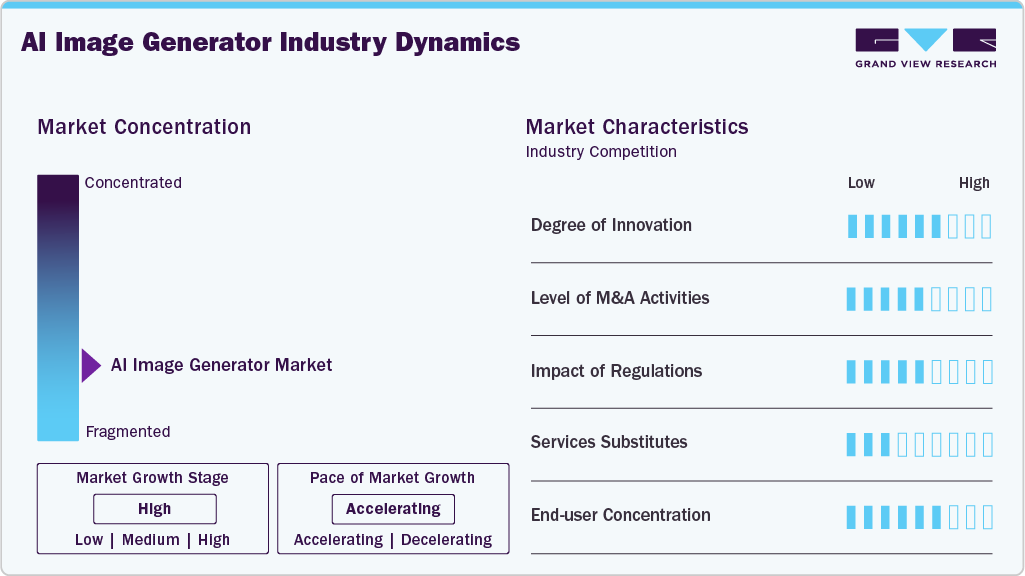
The AI image generator market is increasingly influenced by regulations related to copyright, intellectual property, data privacy, AI transparency, and responsible AI development. Governments and regulatory bodies are introducing frameworks to improve accountability while protecting creators and consumers from misuse of AI-generated content. Although compliance requirements may increase development costs, they also promote greater enterprise confidence and long-term market adoption.
 To learn more about this report, Download Free Sample Report
The market serves a broad range of industries, but demand is increasingly concentrated among sectors with high digital content requirements, including marketing, advertising, media, e-commerce, gaming, education, and enterprise communications. Large enterprises generate substantial demand through organization-wide AI adoption, while small businesses and individual creators are also driving rapid usage growth. This expanding and diverse customer base supports continued commercialization of AI image generation solutions across multiple end-user segments.
Analyst Perspective
The AI image generator market stands at the convergence of advances in generative AI, expanding enterprise demand for digital content, and the growing need for faster, lower-cost creative production across industries. As organizations integrate AI-generated visuals into marketing, e-commerce, media, gaming, and product design workflows, image generation is evolving from a standalone creative tool into a core component of enterprise content operations. The strongest competitive advantage will belong to vendors that combine high-quality image generation with multimodal capabilities, enterprise-grade governance, copyright protection, and seamless integration with existing business applications.
Component Insights
Based on component, the software segment led the market with the largest revenue share of 78.0% in 2025 and is expected to grow at a significant CAGR over the forecast period. AI image generator software incorporates features that enable customization and personalization of the generated images. Users can adjust various parameters, styles, or attributes to create images that align with their requirements and preferences. This customization capability enhances user engagement and provides more tailored and unique visual outputs. Cloud computing is playing a significant role in the AI image generator market. Moreover, deep learning platforms like TensorFlow, PyTorch, and Keras continue to evolve and improve, offering enhanced capabilities for developing AI image generator models. These frameworks provide developers with powerful tools and libraries for building, training, and deploying AI models, making it easier to create sophisticated AI image generator software solutions.
AI image generator services can generate new images based on inputs such as text descriptions, semantic tags, or specific style preferences. These services use deep learning models, such as generative adversarial networks (GANs), to generate images that mimic certain styles, objects, or concepts. Moreover, AI image generator services offer style transfer capabilities, allowing users to apply the visual style of one image to another. Users can transfer artistic styles, such as paintings or visual effects, to their images, creating unique and visually appealing compositions.
End-user Insights
Based on end-user, the social media segment led the market with the largest revenue share of 24.9% in 2025 and is expected to grow at a significant CAGR over the forecast period. AI image generators are increasingly utilized in the media and entertainment industry to enhance various aspects of content creation, production, and delivery. For example, AI image generators are employed in creating visual effects for films, television shows, and commercials. They can generate realistic and visually stunning computer-generated imagery (CGI) elements, such as virtual environments, creatures, and simulations. AI image generators assist in the seamless integration of CGI with live-action footage, enhancing the overall visual impact of the content. Moreover, AI image generators restore and remaster old or damaged media content. They can enhance image quality, reduce noise, restore color, and repair artifacts, breathing new life into classic films, documentaries, and archival footage.
 To learn more about this report, Download Free Sample Report
AI image generators are revolutionizing the e-commerce industry by enhancing the visual experience, improving product visualization, and increasing customer engagement. AI image generators enable virtual try-on experiences for fashion and accessories. Customers can upload their photos or use their device's camera to see how clothing items, eyewear, or accessories would look on them. AI algorithms generate realistic representations of the products on the user's image, allowing them to visualize the fit, style, and overall appearance. This helps customers make informed purchase decisions and reduces the likelihood of returns. Examples of e-commerce platforms utilizing virtual try-on include Warby Parker, based in the U.S, for eyewear, and ASOS, based in London, for clothing.
Regional Insights
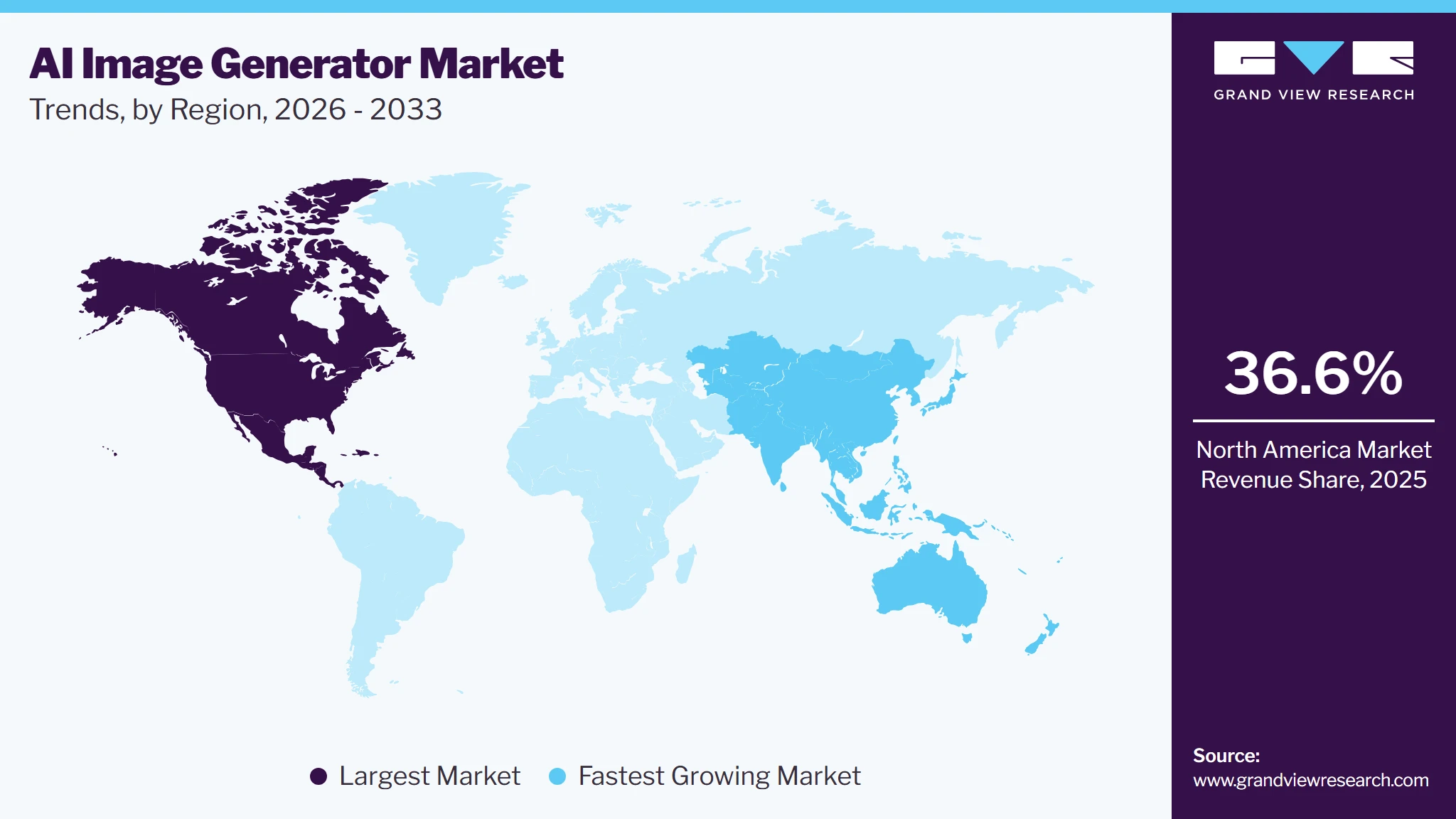
North America dominated the AI image generator market with the largest revenue share of 36.6% in 2025. The presence of major technology companies, research institutions, and startups focused on AI development drives innovation and adoption of AI image generator technology. The region has a mature e-commerce industry, which fuels the demand for advanced visual experiences and personalized product recommendations. Moreover, industries such as media and entertainment, gaming, and advertising extensively utilize AI image generator technology in North America.
 To learn more about this report, Download Free Sample Report
U.S. AI Image Generator Market Trends
The AI image generator market in the U.S. held the largest share in the North America region in 2025. This is attributed to a booming demand for AI image generation solutions across diverse industrial sectors, driven by the need for visually compelling content, enhanced user experiences, creative design and artistic expressions and innovative applications of artificial intelligence technology.
Europe AI Image Generator Market Trends
AI Image generator market in Europe is estimated to account for nearly one fourth of the global revenue share in 2025 owing to the substantial investments by the countries in the region. The investments are aimed at AI research and development to maintain competitiveness in the global AI landscape. Government funding, academic partnerships, and corporate initiatives are driving innovation in AI image generation technologies and applications.
The UK AI image generator market is estimated to hold leading share in 2025. The digitalization of banking, insurance, healthcare, and business services in the country is the key driver for the growth of AI technologies. The country also has a well-developed ICT infrastructure, and the increasing number of AI start-ups will significantly contribute to the growth of AI image generator market in the UK.
The AI image generator market in France is projected to expand with highest CAGR of 20.0% over the forecast period. This growth is likely fueled by France's vibrant creative industries including fashion, advertising, etc. and a growing tech startup ecosystem that embraces innovation. Further, the confluence of technological advancements, rising digital content needs, and industry adoption also provide impetus to the demand growth.
Asia Pacific AI Image Generator Market Trends
The AI image generator market in Asia Pacific is projected to expand with a highest CAGR over the forecast period. Countries such as China, Japan, South Korea, and India are leading the adoption of AI technologies. E-commerce giants in the region are integrating AI image generators to enhance the visual experience, improve product discovery, and increase customer engagement. The gaming industry in the Asia Pacific is also utilizing AI image generators for character and world design.
The China AI image generator market is a powerhouse in the Asia Pacific region, holding leading share of over 30.7% in 2025 and growing with a significant CAGR over the forecast period. China has a strong domestic tech industry, and homegrown AI image generator companies are capturing a significant market share. Super apps, such as WeChat and Alipay, are a defining feature of the Chinese internet ecosystem. AI image generation technology is being integrated into these platforms, allowing users to create personalized content within the app itself.
Key AI Image Generator Company Insights
The AI image generator market is highly competitive, characterized by a diverse range of players offering innovative solutions across various industries. Companies invest heavily in research and development to enhance the capabilities of their AI algorithms, improve image quality, and develop new applications across industries. Innovations such as style transfer, image-to-image translation, and conditional image generation are key areas of focus for driving competitive advantage.
Key AI Image Generator Companies:
The following key companies have been profiled for this study on the ai image generator market.
-
AISEO
-
Box 20 LLC
-
Craiyon LLC.
-
CodeSandbox B.V.
-
DeepAI
-
Jasper.ai
-
NightCafe Studio
-
Panabee, LLC.
-
Runway AI, Inc.
-
Starryai
Competitive Benchmarking
Category
Operating Strategies
Competitive Edge
Weakness
Established Players (Jasper.ai; Runway AI, Inc.; NightCafe Studio; DeepAI)
Focus on expanding enterprise subscriptions, API offerings, and strategic partnerships with productivity and creative software platforms.
Invest continuously in proprietary AI models, multimodal capabilities, and security features to support commercial-scale deployments.
Strong brand recognition, established customer base, and recurring subscription revenue provide market stability.
Comprehensive product ecosystems with advanced image quality, collaboration features, and enterprise-grade compliance differentiate their offerings.
Higher operating costs associated with AI infrastructure and continuous model training affect profitability.
Enterprise-focused pricing and feature complexity may limit adoption among budget-conscious individual users and small businesses.
Emerging Players (AISEO; Box 20 LLC; Craiyon LLC.; CodeSandbox B.V.; Panabee, LLC.; Starryai)
Focus on niche applications, affordable pricing, and rapid feature releases to build user adoption in specific customer segments.
Expand market presence through community engagement, freemium models, and integration with digital content creation platforms.
Agile development cycles enable faster experimentation with new AI capabilities and user-driven enhancements.
Flexible pricing and specialized use cases help differentiate offerings in a competitive marketplace.
Limited financial resources and smaller customer bases restrict large-scale product development and global expansion.
Lower brand visibility and dependence on third-party AI models can reduce long-term competitive differentiation.
Recent Developments
-
In September 2023, OpenAI unveiled DALL-E 3, the latest version of its image-generating software. This advancement, driven by the ChatGPT controller, generates top-notch images in response to natural-language prompts and integrates ethical protections.
-
In May 2023, Stability AI launched StableStudio, an open-source iteration of its DreamStudio AI platform, designed specifically for transforming text into images. This release made the technology accessible to developers and creators, empowering them to harness its capabilities and innovate various applications for text-to-image conversion.
-
In April 2023, VanceAI introduced VanceAI Art Generator, an AI-driven text-to-image tool fueled by Stable Diffusion technology. This innovative platform enabled users to input text descriptions and produce corresponding artworks. Users can have the flexibility to blend various image types, styles, and artist influences while adjusting sizes, thereby translating their imaginative concepts into captivating visual art.
-
In March 2023, Adobe introduced Adobe Firefly, a beta version of a generative AI tool designed to assist users lacking graphic design expertise in crafting images and text effects. Concurrently, Microsoft rolled out Copilot, providing automated content generation for users of 365 and Dynamics 365. These developments in generative AI offered significant assistance and prospects for individuals encountering difficulties with writing, design, or organization.
-
In February 2023, Runway AI unveiled Gen-2, a fusion of AI models designed to create brief video clips based on text inputs. Gen-2, an evolution from its forerunner Gen-1, promised superior clip quality and expanded customization features for users.
AI Image Generator Market Report Scope
Report Attribute
Details
Market size value in 2025
USD 474.2 million
Market size value in 2026
USD 555.1 million
Revenue forecast in 2033
USD 1,853.0 million
Growth rate
CAGR of 18.8% from 2026 to 2033
Base year for estimation
2025
Historical data
2021 - 2024
Forecast period
2026 - 2033
Quantitative units
Revenue in USD million/billion, and CAGR from 2026 to 2033
Report coverage
Revenue forecast, company ranking, competitive landscape, growth factors, and trends
Segments covered
Component, end-user, region
Regional scope
Asia Pacific; Europe; MEA; Latin America; MEA
Country scope
U.S.; Canada; Mexico; Germany; UK; France; China; Japan; India; South Korea; Australia; Brazil; Saudi Arabia; South Africa; UAE
Key companies profiled
AISEO; Box 20 LLC.; Craiyon LLC.; CodeSandbox B.V.; DeepAI; Jasper.ai; NightCafe Studio; Panabee, LLC.; Runway AI, Inc.; Starryai
Customization scope
Free report customization (equivalent up to 8 analysts' working days) with purchase. Addition or alteration to country, regional & segment scope.
Pricing and purchase options
Avail customized purchase options to meet your exact research needs. Explore purchase options
Global AI Image Generator Market Report Segmentation
This report forecasts revenue growth on global, regional, and country levels and provides an analysis of the industry trends in each of the sub-segments from 2021 to 2033. For the purpose of this study, Grand View Research has segmented the global AI image generator market on the basis of component, end-user, and region:
 To learn more about this report, Download Free Sample Report
-
Component Outlook (Revenue, USD Million; 2021 - 2033)
-
Software
-
Services
-
-
End-user Outlook (Revenue, USD Million; 2021 - 2033)
-
Media & Entertainment
-
Healthcare
-
Fashion
-
Social Media
-
E-commerce
-
Others
-
-
Regional Outlook (Revenue, USD Million; 2021 - 2033)
-
North America
-
U.S.
-
Canada
-
Mexico
-
-
Europe
-
UK
-
Germany
-
France
-
-
Asia Pacific
-
China
-
Japan
-
India
-
South Korea
-
Australia
-
-
Latin America
-
Brazil
-
-
Middle East and Africa
-
Kingdom of Saudi Arabia (KSA)
-
UAE
-
South Africa
-
-
Research Methodology
The AI image generator market figures in this report are based on a proven research process that combines executive interviews with secondary research from proprietary databases, company filings, and recognized regulatory and institutional sources. Market size is built through value-chain sizing - reconciling supply-side and demand-side estimates - and triangulated with bottom-up and top-down approaches. Every estimate passes multiple levels of expert validation before publication, with each AI image generator segment quantified using the revenue-capture definitions in the table below.
Segment Definition
Segment - Product
Revenue capture definition
Software
The software segment captures revenue generated from AI image generation platforms, model licensing, APIs, desktop and cloud applications, and subscription-based creative tools. Revenue also includes image editing, customization, prompt optimization, and enterprise AI image generation solutions.
Services
The services segment includes revenue from implementation, integration, consulting, customization, training, technical support, and managed services associated with AI image generation platforms. It also covers model fine-tuning, workflow integration, and ongoing maintenance provided to enterprise and commercial customers.
Segment - End-User
Revenue capture definition
Media& Entertainment
This segment captures revenue from AI image generators used for digital artwork, concept design, visual effects, animation assets, advertising creatives, and promotional content. Growing demand for high-volume visual production across streaming, publishing, and gaming supports revenue generation.
Healthcare
Revenue in this segment comes from AI-generated medical illustrations, patient education materials, healthcare marketing visuals, and research presentations. Healthcare organizations also use these tools to create standardized visual content for communication and training.
Fashion
This segment includes revenue generated through AI-created apparel concepts, virtual product designs, campaign visuals, and lookbook development. Fashion brands and designers use AI image generation to accelerate design iterations and digital merchandising.
Social Media
Revenue is derived from AI-generated images created for social media campaigns, influencer content, branded posts, and audience engagement. Content creators and businesses use these platforms to produce platform-specific visuals with minimal production time.
E-commerce
This segment accounts for revenue from AI-generated product images, lifestyle visuals, promotional banners, and catalog content for online retail platforms. Retailers use AI image generation to improve product presentation while reducing content production costs.
Others
This category includes education, real estate, architecture, travel, corporate communications, and public sector applications. Revenue is generated from creating customized visual assets for presentations, marketing materials, training content, and digital documentation.
Estimation Model
Layer Name
Key Questions
Description
User Base Layer
Who uses AI image generators?
Estimate the addressable user base by identifying individuals and organizations that create digital visual content, including enterprises, SMEs, creators, designers, marketers, and developers. This establishes the potential customer base for AI image generation solutions.
Adoption Layer
How many users adopt AI image generation?
Apply AI adoption rates across industries and user groups to estimate active users of AI image generation platforms. This converts the potential user base into the active market for AI-powered image creation tools.
Deployment Layer
Which platforms generate revenue?
Measure adoption across cloud-based, web-based, mobile, API, and enterprise-integrated platforms to estimate revenue contribution from different deployment channels. This reflects how organizations and individuals access AI image generation capabilities.
Monetization Layer
How much revenue is generated?
Apply average subscription fees, enterprise licensing, API usage, and pay-per-generation pricing across active users. Aggregate revenues from software subscriptions, enterprise contracts, and usage-based services to estimate the total AI image generator market size.
Delivered Customizations
This report has been delivered with the following In-depth customizations
Client Request
Customization Delivered
Value Adds
Market Entry & Expansion Assessment
• Regional demand sizing and forecasting
• Customer segmentation and buying behavior analysis
• Competitive landscape benchmarking
• Regulatory and distribution channel assessment
• Identified high-growth market opportunities
• Supported go-to-market strategy development
• Highlighted investment priorities and risks
• Enabled data-driven expansion planning
Technology & Innovation Assessment
• Emerging technology trend analysis
• Innovation pipeline
• Technology adoption readiness assessment
• Ecosystem and partnership mapping
• Identified future growth areas
• Supported innovation roadmap planning
• Evaluated commercialization potential
• Strengthened strategic partnership decisions
Customer & End-User Insights Study
• Consumer awareness and adoption analysis
• Purchase decision journey mapping
• Satisfaction and loyalty assessment
• Usage pattern and pain-point evaluation
• Revealed key adoption drivers and barriers
• Supported customer-centric product development
• Improved targeting and engagement strategy
• Identified opportunities for retention and upselling
Frequently Asked Questions About This Report
Key factors driving the AI image generator market growth are the increasing demand for visual content, advancements in AI technology, expanding use cases, integration with AR and VR, and ongoing research and development efforts, such as progressive growing GANs or style-based GANs.
The Software segment dominated the market, with a revenue share of 78.0% in 2025.
The Social media segment held the largest market share of 24.9% in 2025.
The global AI image generator market size was valued at USD 474.2 million in 2025 and is estimated at USD 555.1 million for 2026.
The global AI image generator market is expected to grow at a CAGR of 18.8% from 2026 to 2033, reaching USD 1,853.0 million by 2033.
North America dominated with a 36.6% revenue share in 2025.
Key players include AISEO; Box 20 LLC.; Craiyon LLC.; CodeSandbox B.V.; DeepAI; Jasper.ai; NightCafe Studio; Panabee, LLC.; Runway AI, Inc.; Starryai
About the Author(s)
Next Generation Technologies Research Team
Technology · Next Generation TechnologiesThis report was authored by the next generation technologies research team at Grand View Research - comprising two research analysts, one senior research analyst, and one industry expert - with specialized expertise in the next generation technologies segment of the technology industry. All findings are based on proprietary technology databases, executive interviews, and regulatory analysis, subject to internal peer review prior to publication.
Last Updated:
Speak to Analyst

Customize this report to your needs - add regions, segments, or data points, with 20% free customization.
Or view our licence options:


ISO 9001:2015 & 27001:2022 Certified
We are GDPR and CCPA compliant! Your transaction & personal information is safe and secure. For more details, please read our privacy policy.


