
- Home
- »
- Next Generation Technologies
- »
-
Artificial Intelligence in Supply Chain Market Size Report, 2024-2030GVR Report cover

Artificial Intelligence in Supply Chain Market (2024 - 2030)
Size, Share & Trends Analysis Report By Offering (Hardware, Software, Services), By Technology, By Application, By End Use, By Region, And Segment Forecasts
Market Size, 2023
$5.1BMarket Estimate, 2026
$13.9BMarket Forecast, 2030
$51.1BCAGR, 2024–2030
38.9%Artificial Intelligence in Supply Chain Market Summary
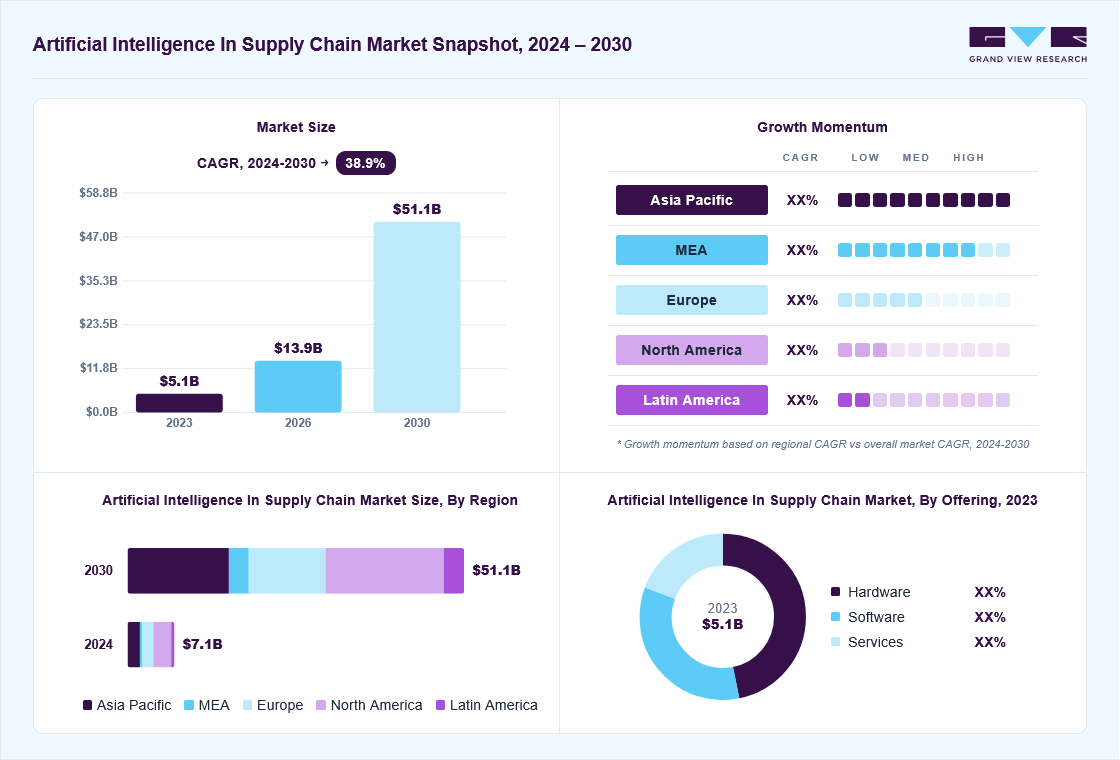
The global artificial intelligence in supply chain market size was valued at USD 5.1 billion in 2023 and is projected to grow from USD 13.9 billion in 2026 to USD 51.1 billion by 2030, at a CAGR of 38.9% from 2024 to 2030. The market in North America dominated with a revenue share of 38.4% in 2023. Companies are increasingly seeking ways to optimize their supply chains, reduce costs, and gain greater visibility into operations.
 Source: Grand View Research, IR Documents, Primary Interviews, Paid DatabasesTo learn more about this report,
 Download Free Sample Report
  To learn more about this report, Download Free Sample Report
 Key Market Trends & Insights
- North America dominated with the artificial intelligence in supply chain market with a revenue share of 38.4% in 2023.
- The artificial intelligence in supply chain market in the U.S. is expected to grow at the fastest CAGR from 2024 to 2030.
- Based on offering, the software segment led the market with the largest revenue share of 41.8% in 2023.
- Based on application, the supply chain planning segment led the market with the largest revenue share of 32.5% in 2023.
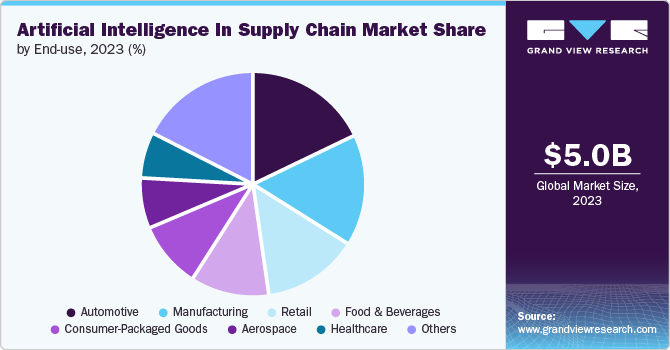
- Based on end use, the automotive segment led the market with the largest revenue share of 17.7% in 2023.
Market Size & Forecast
- 2023 Market Size: USD 5.05 Billion
- 2030 Projected Market Size: USD 51.12 Billion
- CAGR (2024-2030): 38.9%
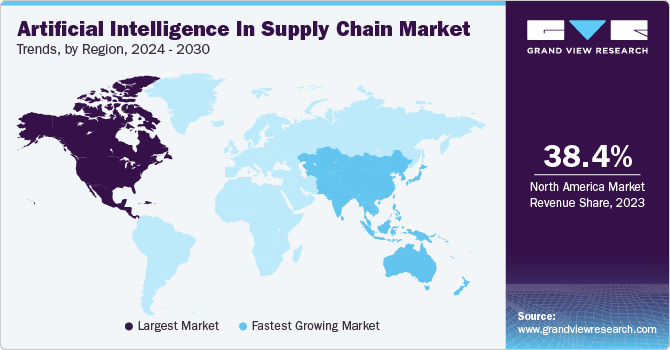
- North America: Largest market in 2023
- Asia Pacific: Fastest growing market
Three ways to get this report
Buy it, customize it, or ask a question.Ask an Analyst
Analyst response in 1 business day
- AccessReport author, directly
- Reply timeWithin 1 working day
- No sales callDirect answer only
- FormatEmail reply
- CostFree, no cost
Get the Full Report
What the study covers
- FormatsPDF · Excel · Dashboard
- Timeline2024–2030 annual, 2023 base
- Coverage20+ countries, 5 regions
- Companies10+ key players profiled
Customize the Report
20% free customization
- IncludeCountries, segments, points
- TailorTo your product definition
- ExtendDeeper competitor detail
- OrA fully bespoke study
- Turnaround5–10 working days
AI offers solutions for automating tasks, analyzing vast amounts of data, and generating actionable insights that improve efficiency and transparency. The rise of e-commerce has amplified the demand for streamlined and efficient supply chains. Consumers expect fast and reliable delivery, which necessitates AI-powered solutions for demand forecasting, inventory management, and optimized logistics. Moreover, supply chains are vulnerable to disruptions caused by various factors. AI helps businesses anticipate and mitigate these disruptions by analyzing real-time data and suggesting proactive measures.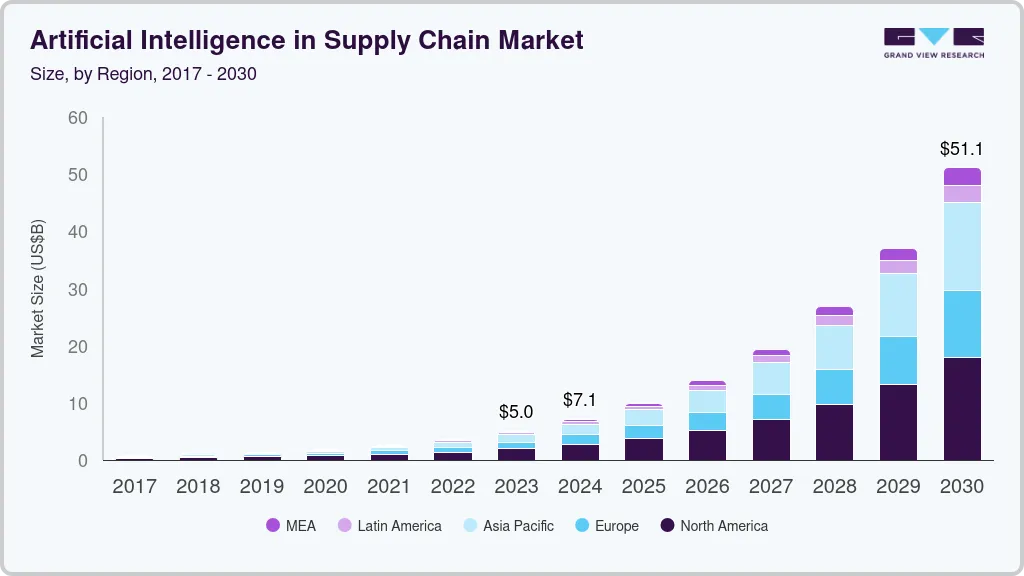 To learn more about this report, Download Free Sample Report
 Technological advancements also help end use companies to implement market growth. The increasing volume of data generated within supply chains necessitates powerful tools for analysis. AI excels at handling big data, extracting valuable insights, and transforming them into actionable strategies. Furthermore, the integration of AI with Internet of Things (IoT) sensors and cloud computing platforms allows for real-time data collection, processing, and analysis. This enables AI to make more informed decisions and provide greater agility within the supply chain. Thus, driving the market growth.
The AI in supply chain helps in enhancing transportation planning and execution, optimizing store-level assortments, automating order settlement. Thus, companies are developing new solutions to help clients in various industries, such as retail and consumer packaged goods (CPG) Industries. For instance, in January 2024, International Business Machines Corporation, AI in supply chain solutions provider, collaborated with SAP SE, to develop business new AI solutions for the consumer goods and retail industries. Leveraging their combined expertise in technology, International Business Machines Corporation integrated its enterprise-ready AI and data platform, along with AI assistants, into SAP solutions. This collaboration between International Business Machines Corporation and SAP SE is paving the way for the development of both generative and traditional AI solutions, aimed at simplifying the complexities associated with the direct store delivery business process and product portfolio management. IBM Consulting and SAP SE are currently engaging with CPG clients globally to identify precise requirements for creating secure and scalable AI solutions. These solutions would seamlessly integrate with SAP's Direct Distribution solution. The aim of developing these new solutions is to aid CPG companies, wholesale distributors, and retailers in optimizing store-level assortments, enhancing product distribution, and boosting incremental revenue.
Market Dynamics
Increasing demand for supply chain automation and operational efficiency is driving growth in the Artificial Intelligence in Supply Chain market. Companies are adopting AI-powered technologies to automate inventory management, warehouse operations, procurement activities, and logistics processes across complex supply chain networks. Automation solutions help organizations reduce manual errors, improve operational accuracy, and increase workflow efficiency in day-to-day supply chain activities. Businesses are increasingly focusing on reducing operational costs and improving productivity through intelligent process optimization and automated decision-making systems. The growing adoption of robotics, smart warehouses, and autonomous material handling systems is further contributing to market growth.
AI-enabled systems provide real-time monitoring, predictive insights, and faster decision-making capabilities for supply chain management operations. Organizations are utilizing automation technologies to streamline transportation planning, route optimization, and order fulfillment processes across regional and global supply chains. The increasing complexity of global trade operations and rising customer expectations for faster delivery are increasing the need for intelligent operational management solutions. Companies are also integrating AI with IoT and cloud-based platforms to improve visibility and coordination across supply chain networks. Growing demand for efficient logistics operations, optimized resource utilization, and improved workflow management is further supporting market expansion.
High implementation and infrastructure costs associated with AI technologies are restraining growth of the Artificial Intelligence in Supply Chain market. Organizations are required to invest significantly in AI software, cloud infrastructure, advanced analytics platforms, data management systems, and system integration services. Deployment of AI-powered supply chain solutions often involves additional expenses related to hardware upgrades, cybersecurity systems, and digital transformation initiatives. Small and medium-sized enterprises frequently face budget limitations that restrict adoption of advanced AI technologies across supply chain operations.
Implementation of AI technologies also requires continuous investments in system maintenance, software updates, and employee training programs to ensure efficient utilization of AI tools. Integration of AI solutions with existing legacy infrastructure can increase operational complexity and deployment costs for businesses operating with older systems. Companies may also encounter challenges associated with long implementation timelines and uncertain return on investment during the early stages of adoption. These cost-related barriers are slowing adoption of AI technologies across several supply chain operations, particularly among cost-sensitive organizations and developing markets.
Rising adoption of AI in e-commerce and omnichannel logistics operations is creating significant growth opportunities in the Artificial Intelligence in Supply Chain market. E-commerce companies are increasingly utilizing AI technologies to improve inventory management, warehouse automation, order processing, and delivery optimization across large distribution networks. AI-powered systems help businesses manage fluctuating customer demand and improve operational efficiency in fast-moving online retail environments. The growing expansion of omnichannel retail models is increasing the need for intelligent logistics solutions capable of coordinating online and offline operations efficiently.
AI technologies are supporting route optimization, demand forecasting, and real-time shipment tracking across complex logistics networks. Retailers and logistics providers are utilizing AI-driven analytics to improve customer experience through faster deliveries and accurate order fulfillment processes. Integration of AI with robotics, IoT devices, and cloud platforms is further improving supply chain visibility and operational coordination in e-commerce environments. Increasing global growth of online shopping and digital commerce activities is expected to accelerate adoption of AI-powered logistics and supply chain management solutions.
Market Concentration & Characteristics
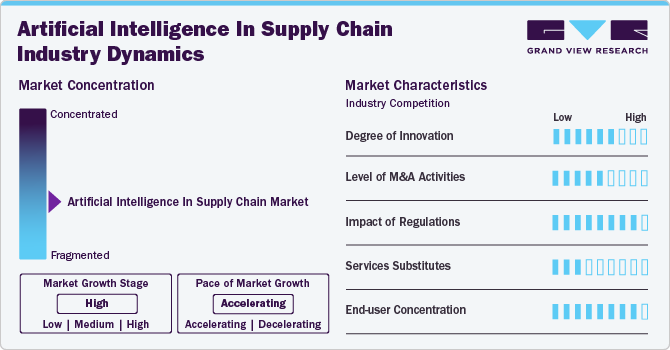
The Artificial Intelligence in supply chain market is slightly fragmented due to the presence of numerous technology providers, cloud service companies, supply chain software vendors, and emerging AI-focused firms. Large enterprises maintain a notable market presence through broad AI and supply chain solution portfolios, while several regional companies and startups provide customized analytics, warehouse automation, and logistics optimization solutions. Continuous product innovation and increasing adoption of AI technologies are contributing to competitive market conditions across industries. The market also experiences strong competition due to the growing demand for intelligent and data-driven supply chain operations.
 To learn more about this report, Download Free Sample Report
 The market is characterized by rapid technological advancements, increasing investments in digital transformation, and growing integration of AI with cloud, IoT, and automation technologies. Companies are focusing on strategic partnerships, acquisitions, and platform expansion to strengthen operational capabilities and improve supply chain efficiency. Demand for predictive analytics, real-time visibility, intelligent automation, and demand forecasting solutions is supporting development of advanced AI platforms. The increasing expansion of e-commerce, omnichannel logistics, and smart warehouse operations is further intensifying market competition.
Offering Insights
Based on offering, the software segment led the market with the largest revenue share of 41.8% in 2023. AI software offers a wide range of functionalities within the supply chain, from demand forecasting and inventory optimization to predictive maintenance and automated decision-making. This versatility allows businesses to address various challenges and customize solutions to their specific needs. In addition, AI software can be easily scaled up or down depending on the size and complexity of the supply chain.
The services segment is anticipated to grow at a significant CAGR over the forecast period. AI supply chain solutions require ongoing maintenance and updates to function optimally. Service providers offer support packages that ensure the AI systems are running smoothly, addressing any technical issues that may arise. End users are increasingly seeking measurable benefits from their AI investments. Service providers can help businesses define key performance indicators (KPIs) and track the ROI of their AI implementations, demonstrating the value of AI within the supply chain.
Application Insights
Based on application, the supply chain planning segment led the market with the largest revenue share of 32.5% in 2023. AI algorithms analyze historical data, sales trends, and external factors to accurately forecast demand. This allows businesses to maintain optimal inventory levels, avoiding stockouts and overstocking, which can be both costly and inefficient. Moreover, AI considers factors such as, traffic patterns, fuel costs, and delivery deadlines to optimize transportation routes, reducing transportation costs and improving delivery times.
The warehouse management segment is expected to grow at a significant CAGR over the forecast period. AI systems can automate repetitive tasks like order picking, packing, and sorting. This eliminates human workers for more complex tasks and reduces the risk of errors associated with manual processes. Moreover, AI algorithms can optimize picking routes and packing configurations based on factors like item size, weight, and destination. This minimizes travel time within the warehouse and ensures efficient packing, leading to faster order fulfillment.
End Use Insights
Based on end use, the automotive segment led the market with the largest revenue share of 17.7% in 2023. The growing demand for Electric Vehicles (EVs) and Autonomous Vehicles (AVs) challenges the supply chain due to the complexity of these vehicles. Thus, AI in supply chain solutions can handle the intricate networks of suppliers involved in EV and AV production, ensuring timely delivery of specialized parts. Moreover, AI-powered quality control systems ensure these advanced vehicles meet stringent safety and performance standards.
 To learn more about this report, Download Free Sample Report
 The retail segment is anticipated to grow at a significant CAGR over the forecast period. AI analyzes historical sales data, customer trends, and external factors to predict demand with greater accuracy. This allows retailers to maintain optimal inventory levels, preventing stockouts that frustrate customers and overstocking that leads to wasted storage space and potential markdowns. Moreover, AI enables unified inventory management across online and physical stores, ensuring smooth order fulfillment regardless of the chosen channel. AI facilitates real-time tracking of goods throughout the supply chain, providing retailers with greater transparency and control over their operations.
Regional Insights
North America dominated with the artificial intelligence in supply chain market with a revenue share of 38.4% in 2023. North American companies face intense competition and pressure to reduce costs while maintaining high levels of customer service. AI supply chain solutions for automating tasks, analyzing vast amounts of data, and generating actionable insights that improve efficiency, transparency, and agility within the supply chain.
 To learn more about this report, Download Free Sample Report
 U.S. Artificial Intelligence in Supply Chain Market Trends
The artificial intelligence in supply chain market in the U.S. is expected to grow at the fastest CAGR from 2024 to 2030. The U.S. manufacturing and logistics sectors face labor shortages. AI can address this by eliminating human workforce to focus on higher-value activities that require skills and experience. Moreover, the U.S. is a prominent country in AI research and development. This fosters the creation of advanced AI solutions specifically designed for supply chain applications.
The Canada artificial intelligence in supply chain market held a significant share in the North America in 2023. Canadian companies grapple with managing complex supply chains that often stretch across vast geographical distances. AI optimizes delivery routes, considering factors such as weather and traffic patterns, to ensure efficient and cost-effective transportation of goods across Canada's large landmass.
Europe Artificial Intelligence in Supply Chain Market Trends
The artificial intelligence in supply chain market in the Europe is expected to witness at a significant CAGR over the forecast period. European supply chains are often intricate and involve multiple countries with varying regulations. AI offers solutions for visibility and traceability.Moreover, Europe faces an aging workforce and labor shortages in logistics and manufacturing. AI can address this by augmenting the workforce, and upskilling and reskilling initiatives.
The UK artificial intelligence in supply chain market held a significant share in the Europe in 2023. The UK has a thriving AI research community with universities and institutions at the forefront of AI development. This fosters innovation in AI solutions specifically designed for UK supply chain challenges. UK continues to collaborate with international partners in the AI and supply chain sectors. This collaboration fosters knowledge sharing and accelerates AI adoption within the UK supply chain landscape.
The artificial intelligence in supply chain market in Germany is expected to grow at the fastest CAGR from 2024 to 2030. Germany is a prominent country in adopting Industry 4.0, which emphasizes automation and data exchange across the manufacturing value chain. AI plays a crucial role in optimizing production processes, and predictive maintenance.
The France artificial intelligence in supply chain market is expected to grow at the fastest CAGR from 2024 to 2030. France, a major player in the European manufacturing and logistics sector, is experiencing significant growth in AI adoption for its supply chains.Sustainability is a growing concern for France businesses. AI can be used to optimize logistics routes, reduce emissions, and ensure responsible sourcing throughout the supply chain, aligning with France's commitment to environmental responsibility.
Asia Pacific Artificial Intelligence in Supply Chain Market Trends
The artificial intelligence in supply chain market in the Asia Pacific is anticipated to register at the fastest CAGR over the forecast period. The APAC region is experiencing a significant surge in AI adoption for supply chain management, fueled by a confluence of factors specific to the region's economic landscape and technological advancements. The APAC region boasts the fastest-growing e-commerce market globally. AI offers solutions for efficient order fulfillment and delivery, and personalized customer experiences.
The India artificial intelligence in supply chain marketheld a significant share in the Asia Pacific in 2023. India, with its rapidly growing economy and complex supply chains, presents a unique landscape for AI adoption in the logistics and manufacturing sectors. Indian supply chains are often plagued by inefficiencies, such as congestion, unpredictable demand, and poor logistics management. AI offers solutions for route optimization and traffic management, demand forecasting and inventory management.
The artificial intelligence in supply chain market in China held a significant share in the Asia Pacific in 2023. China's "Made in China 2025" initiative emphasizes automation and smart manufacturing. AI plays a crucial role in optimizing production processes. Moreover, China boasts the world's largest e-commerce market with a growing demand for fast and reliable delivery. AI offers solutions for Intelligent Warehousing and Order Fulfillment.
The Japan artificial intelligence in supply chain market held a significant share in the Asia Pacific in 2023. Japan, a prominent country in automation and robotics, is actively integrating AI into its supply chains to address unique challenges and maintain its competitive edge. Moreover, Japan faces a shrinking workforce due to its low birth rate and aging population. AI offers solutions for Just-in-Time (JIT) manufacturing and inventory management.
Middle East & Africa Artificial Intelligence in Supply Chain Market Trends
The artificial intelligence in supply chain market in Middle East & Africa is anticipated to grow at the fastest CAGR over the forecast period. MEA supply chains often face inefficiencies like inadequate infrastructure, limited visibility, and manual processes. AI offers solutions for demand forecasting and inventory management. Moreover, several MEA governments are actively promoting AI adoption through initiatives like funding research projects, offering tax breaks for AI implementation, and developing national AI strategies.
Key Artificial Intelligence In Supply Chain Company Insights
Key companies included in this market are Advanced Micro Devices, Inc., Alibaba.com, and Amazon.com, Inc. The active companies in the global market are focusing aggressively on expanding their customer base and gaining a competitive edge over their rivals. Hence, they pursue various strategic initiatives, including partnerships, mergers & acquisitions, collaborations, and new product/ technology development. For instance, in December 2023, Blue Yonder Group, Inc., a provider of supply chain platforms, introduced a new generative AI feature called Blue Yonder Orchestrator as part of its Luminate Cognitive Platform. The latest feature integrates large language models (LLMs), cloud data, and prompts engineering to suggest decisions for supply chain management. Businesses can leverage Blue Yonder Orchestrator as a reliable supply chain aide, enhancing intuition with data value to enable smarter and quicker decision-making.
Key Artificial Intelligence in Supply Chain Companies:
The following are the leading companies in the artificial intelligence in supply chain market. These companies collectively hold the largest market share and dictate industry trends.
- Advanced Micro Devices, Inc.
- Alibaba.com
- Amazon.com, Inc.
- Deutsche Post DHL Group
- FedEx
- International Business Machines Corporation
- Intel Corporation
- Microsoft Corporation
- NVIDIA Corporation
- Oracle Corporation
- Samsung
- SAP SE
Competitive Benchmarking
Operating Strategies
Competitive Edge
Weaknesses
Mature Players: Amazon.com, Inc.; Deutsche Post DHL Group; FedEx; International Business Machines Corporation
- Expanding AI-powered supply chain platforms, automation technologies, and predictive analytics capabilities
- Investing in partnerships, acquisitions, cloud integration, and advanced research and development activities
- Advanced AI technologies, strong financial resources, and broad solution portfolios
- Established global presence, strategic partnerships, and scalable supply chain capabilities
- High operational complexity and slower decision-making due to large organizational structures
- Heavy dependence on legacy systems in some areas, which can limit agility in rapid innovation adoption
Emerging Players: Advanced Micro Devices, Inc.; Alibaba.com, Samsung
- Focus on innovation-led development with rapid adoption of AI and emerging technologies
- Agile and flexible business models to quickly respond to market needs and deliver customized solutions
- High agility and faster innovation cycles enabling quick adoption of emerging technologies
- Strong focus on niche solutions and customization for specific customer needs
- Limited financial resources and smaller scale of global operations compared to established players
- Lower brand recognition and dependency on niche markets, which can restrict rapid expansion
Recent Developments
-
In April 2024, SAP SE introduced significant AI enhancements within its supply chain solutions, set to drive a revolutionary surge in productivity, efficiency, and accuracy within manufacturing sectors. Leveraging AI to analyze real-time data, these advancements would empower businesses to harness their data for improved decision-making throughout the supply chain, streamline product development processes, and enhance manufacturing efficiency
-
In April 2024, Vitesco Technologies GmbH, an automotive supplier, partnered with DHL Group to enhance the resilience and robustness of supply chains within the automotive sector. DHL Supply Chain acting as the principal logistics partner, consolidating cargo volumes from various major corporations to create synergies and unlock new optimization opportunities. The logistics specialists tap into the full spectrum of freight carriers and forwarding agents, ensuring the delivery of transport solutions are the most eco-friendly, and cost-efficient. This partnership would be beneficial for Vitesco Technologies’ customers, leading to supply chains that are durable
-
In January 2024, Lenovo, a provider of IT products, developed Supply Chain Intelligence (SCI), a solution powered by AI that constantly examines data from the supply chain to detect and address issues as they occur. This solution consolidates all the company's supply chain transactions and management systems into one unified platform, which is managed by smart tools
Artificial Intelligence In Supply Chain Market Report Scope
Report Attribute
Details
Market size in 2023
USD 5.1 billion
Estimated market size in 2026
USD 13.9 billion
Projected market size by 2030
USD 51.1 billion
Growth rate
CAGR of 38.9% from 2024 to 2030
Base year for estimation
2023
Historical data
2017 - 2022
Forecast period
2024 - 2030
Quantitative units
Revenue in USD billion/million and CAGR from 2024 to 2030
Report coverage
Revenue forecast, company ranking, competitive landscape, growth factors, and trends
Segments covered
Offering, technology, application, end use, region
Regional scope
North America; Europe; Asia Pacific; Latin America; Middle East & Africa
Country scope
U.S.; Canada; Mexico; Germany; UK; France; China; India; Japan; Australia; South Korea; Brazil; UAE; South Africa; KSA
Key companies profiled
Advanced Micro Devices, Inc.; Alibaba.com; Amazon.com, Inc.; Deutsche Post DHL Group; FedEx; International Business Machines Corporation; Intel Corporation; Microsoft Corporation; NVIDIA Corporation; Oracle Corporation; Samsung; SAP SE
Customization scope
Free report customization (equivalent up to 8 analyst’s working days) with purchase. Addition or alteration to country, regional & segment scope.
Pricing and purchase options
Avail customized purchase options to meet your exact research needs. Explore purchase options
Global Artificial Intelligence In Supply Chain Market Report Segmentation
This report forecasts revenue growth at global, regional, and country levels and provides an analysis of the latest industry trends in each of the sub-segments from 2017 to 2030. For this study, Grand View Research has segmented the global artificial intelligence in supply chain market report based on offering, technology, application, end use, and region.
-
Offering Outlook (Revenue, USD Billion, 2017 - 2030)
-
Hardware
-
Software
-
Services
-
-
Technology Outlook (Revenue, USD Billion, 2017 - 2030)
-
Machine Learning
-
Computer Vision
-
Natural Language Processing
-
Context-Aware Computing
-
Others
-
-
Application Outlook (Revenue, USD Billion, 2017 - 2030)
-
Supply Chain Planning
-
Warehouse Management
-
Fleet Management
-
Virtual Assistant
-
Risk Management
-
Inventory Management
-
Planning & Logistics
-
-
End Use Outlook (Revenue, USD Billion, 2017 - 2030)
-
Manufacturing
-
Food and Beverages
-
Healthcare
-
Automotive
-
Aerospace
-
Retail
-
Consumer-Packaged Goods
-
Others
-
-
Regional Outlook (Revenue, USD Billion, 2017 - 2030)
-
North America
-
U.S.
-
Canada
-
Mexico
-
-
Europe
-
UK
-
Germany
-
France
-
-
Asia Pacific
-
China
-
India
-
Japan
-
Australia
-
South Korea
-
-
Latin America
-
Brazil
-
-
Middle East & Africa
-
UAE
-
South Africa
-
KSA
-
-
Delivered Customizations
This report has been delivered with the following In-depth customizations
Client Objective
Custom Research Modules Delivered
Strategic Value / Business Impact
Technology & Innovation Assessment
- AI, automation, and emerging technology trend analysis
- Technology adoption readiness and maturity evaluation
- Innovation pipeline and ecosystem mapping
- Identifies future growth and innovation opportunities
- Supports technology roadmap and investment planning
- Strengthens strategic partnerships and adoption decisions
Supply Chain & Procurement Intelligence
- Supplier benchmarking and network mapping
- Cost structure, raw material, and sourcing analysis
- Logistics, distribution, and risk assessment
- Improves supply chain visibility and efficiency
- Identifies cost optimization and sourcing opportunities
- Reduces procurement risks and operational disruptions
Market Entry & Expansion Assessment
- Regional demand sizing and growth forecasting
- Customer segmentation and adoption behavior analysis
- Competitive landscape and benchmarking study
- Identifies high-potential markets and expansion opportunities
- Supports go-to-market strategy and investment planning
- Highlights risks, barriers, and entry requirements
Frequently Asked Questions About This Report
The global artificial intelligence in supply chain market size was valued at USD 5.1 billion in 2023 and is estimated at USD 13.9 billion for 2026.
The global artificial intelligence in supply chain market is expected to grow at a CAGR of 38.9% from 2024 to 2030, reaching USD 51.1 billion by 2030.
Key players include Advanced Micro Devices, Inc.; Alibaba.com; Amazon.com, Inc.; Deutsche Post DHL Group; FedEx; International Business Machines Corporation; Intel Corporation; Microsoft Corporation; NVIDIA Corporation; Oracle Corporation; Samsung; and SAP SE.
North America dominated with a 38.4% revenue share in 2023.
Key factors that are driving artificial intelligence in supply chain market growth include the growing adoption of AI to enhance consumer services and satisfaction and the growing focus on improving organizational performance and operational efficiency.
About the Author(s)
Next Generation Technologies Research Team
Technology · Next Generation TechnologiesThis report was authored by the next generation technologies research team at Grand View Research - comprising two research analysts, one senior research analyst, and one industry expert - with specialized expertise in the next generation technologies segment of the technology industry. All findings are based on proprietary technology databases, executive interviews, and regulatory analysis, subject to internal peer review prior to publication.
Last Updated:
Speak to Analyst

Customize this report to your needs - add regions, segments, or data points, with 20% free customization.
Or view our licence options:


ISO 9001:2015 & 27001:2022 Certified
We are GDPR and CCPA compliant! Your transaction & personal information is safe and secure. For more details, please read our privacy policy.


