
- Home
- »
- IT Services & Applications
- »
-
Asset Tokenization Market Size, Share Report, 2026-2033GVR Report cover
![Asset Tokenization Market (2026 - 2033)Report]()
Asset Tokenization Market (2026 - 2033)
Size, Share & Trends Analysis Report By Asset Class (Real Estate, Art & Collectibles, Commodities, Intellectual Property), By Investor Type, By Tokenization Platform, By Offering, By Region, And Segment Forecasts
Market Size, 2025
$1.8TMarket Estimate, 2026
$2.1TMarket Forecast, 2033
$24.5TCAGR, 2026–2033
42.1%Asset Tokenization Market Summary
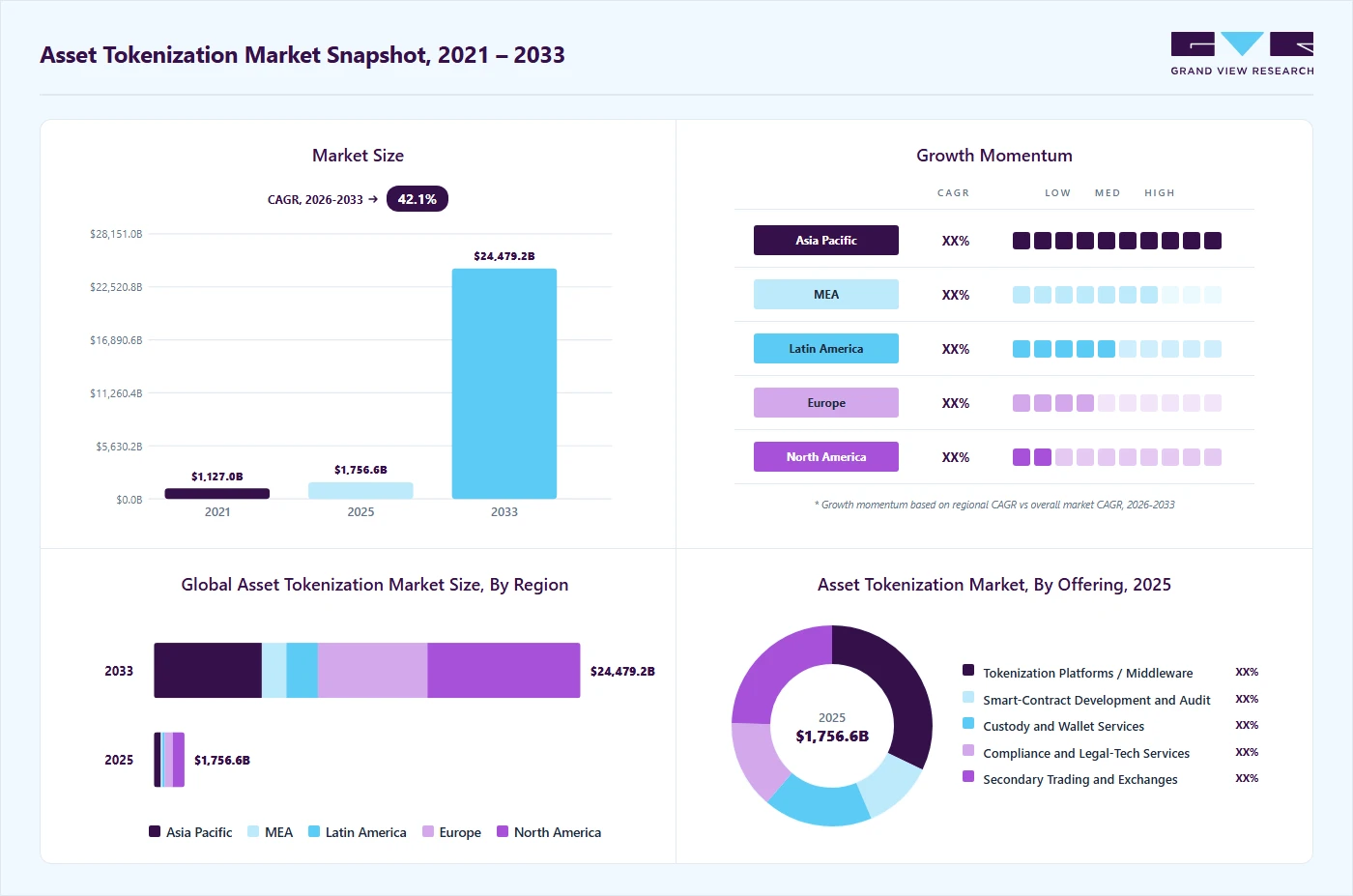
The global asset tokenization market size was valued at USD 1.8 trillion in 2025 and is projected to grow from USD 2.1 trillion in 2026 to USD 24.5 trillion by 2033, at a CAGR of 42.1% from 2026 to 2033. The market in North America dominated with a revenue share of 38.4% in 2025. The rapid adoption of blockchain and distributed ledger technology is driving the growth of the asset tokenization industry.
Key Market Trends & Insights
- By asset class: Financial instruments segment held the largest market share of 34.1% in 2025.
- By investor type: Institutional investors segment held the largest market share in 2025.
- By tokenization platform: Permissioned (private) blockchains segment held the largest market share in 2025.
- By offering: Tokenization platforms/middleware segment held the largest market share in 2025.
Regional Highlights
- Largest regional market: North America (38.4% revenue share, 2025)
- Fastest-growing regional market: Asia Pacific (highest CAGR, 2026-2033)
- By country: The U.S. held the largest market share in 2025
Market Size & Forecast
- Market size in 2025: USD 1.8 Trillion
- Estimated market size in 2026: USD 2.1 Trillion
- Projected market size by 2033: USD 24.5 Trillion
- CAGR (2026-2033): 42.1%
Blockchain enables secure, transparent, and tamper-resistant recording of asset ownership and transactions, reducing the need for intermediaries and improving trust among participants. Increasing adoption of blockchain technology is being observed, through which traditional assets are converted into digital tokens to improve liquidity and accessibility. Fractional ownership has been enabled through tokenization, which allows investments in assets such as real estate and private equity to be accessed by a wider group of investors. Market expansion has also been supported by the ability of tokenization to reduce transaction costs and eliminate intermediaries, while ownership records are securely maintained on decentralized networks. As a result, improved transparency, faster asset transfers, and broader participation in investment markets have been facilitated.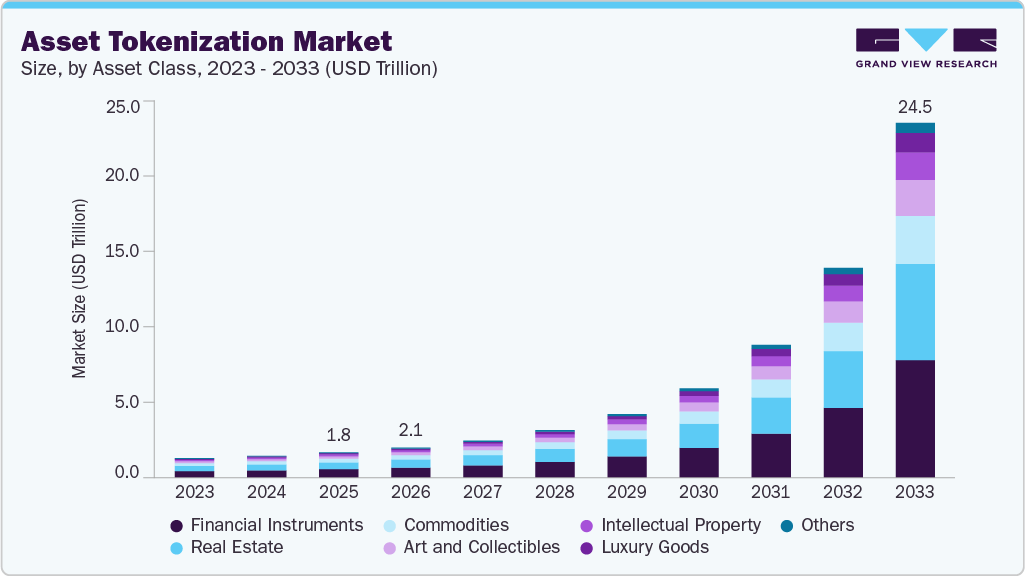
Technological advancements in blockchain infrastructure have been increasingly integrated into asset tokenization platforms. The use of smart contracts has enabled transaction processes, ownership transfers, and compliance procedures to be executed automatically, thus reducing operational complexity. In addition, distributed ledger systems have been used to improve transparency and traceability in asset management. Interoperable blockchain platforms and digital asset management systems have also been developed to support the tokenization of multiple asset classes. Similarly, decentralized financial ecosystems such as decentralized finance have further strengthened technological innovation in the market.
Increasing investment has been directed toward asset tokenization platforms by financial institutions, asset managers, and blockchain infrastructure providers. For instance, in December 2025, JPMorgan Chase & Co., launched a tokenized money market fund named My OnChain Net Yield Fund (MONY), on the public Ethereum blockchain, marking the largest global systemically important bank (GSIB) to offer such a product. Available exclusively to qualified investors via the Morgan Money platform, a pioneering institutional liquidity tool integrating traditional and on-chain assets, MONY is structured as a 506(c) private placement seeded with USD 100 million, investing solely in U.S. Treasury securities and fully collateralized repurchase agreements for USD yields, daily dividend reinvestment, and subscriptions/redemptions in cash or stablecoins.
The regulatory environment surrounding asset tokenization has been gradually evolving as governments and financial authorities develop frameworks for digital assets and tokenized securities. Regulatory guidelines are being introduced to ensure investor protection, compliance standards, and transparency in digital asset transactions. For instance, the Crypto-Assets Regulation (MiCA) introduced by the European Union, which began implementation in December 2024, established a unified regulatory framework for crypto-assets and tokenized financial instruments across EU member states. Through this regulation, clearer rules for digital asset issuance, service providers, and investor protection mechanisms have been established.
Regulatory uncertainty and the lack of standardized frameworks across different countries have made compliance difficult for market participants. In addition, limited awareness among traditional investors and concerns regarding cybersecurity and the custody of digital assets have been identified as barriers to adoption. Further, interoperability issues between blockchain networks and the absence of well-developed secondary markets for tokenized assets have restricted liquidity and hindered broader market expansion.
Asset Class Insights
The financial instruments segment accounted for the largest share of 34.1% in 2025. The growing liquidity in financial markets drives the dominance of the financial instruments segment. Traditional securities such as stocks, bonds, and money market funds are being tokenized to enable fractional ownership, allowing investors of all sizes to access previously restricted markets. For instance, in June 2024, FIL Limited selected JPMorgan Chase & Co.’s Onyx digital assets blockchain to tokenize shares of its money market fund, enabling fund units to be used as collateral with improved settlement efficiency and reduced operational risk. Similarly, in July 2025, Goldman Sachs partnered with Bank of New York Mellon Corporation to launch a solution in which money market fund shares were represented as digital tokens on a blockchain‑based record system, allowing institutional investors to subscribe and redeem tokenized fund positions more efficiently.
The intellectual property segment is expected to grow at the fastest CAGR during the forecast period. Tokenization is being increasingly applied to patents, copyrights, trademarks, and creative works to enable monetization and fractional ownership. Revenues from licensing and royalties are being managed more efficiently as Intellectual Property rights are recorded on blockchain networks, enabling secure, transparent tracking of ownership and revenue distribution. For instance, in July 2024, tokenization methods were applied to film financing models, allowing investors to purchase digital tokens representing future revenue shares in the film “Braid,” thereby democratizing access to film investment opportunities.
Investor Type Insights
The institutional investors segment dominated the market in 2025. Strong interest and capital allocations by major financial institutions, which are increasingly integrating tokenized products to improve liquidity, transparency, and operational efficiency in their portfolios have driven the dominance of the institutional investors segment. For instance, in March 2024, the BlackRock USD Institutional Digital Liquidity Fund (BUIDL) was launched as a tokenized, blockchain-based money market fund on the Ethereum network. The fund invests 100% of its assets in U.S. treasuries, cash, and repos, offering a stable USD 1 token value, daily yields, and 24/7 transfers. This initiative has enabled institutional investors to hold and trade tokenized fund shares efficiently, thus reinforcing confidence in tokenized financial products.
The retail investors segment is projected to grow at the fastest CAGR over the forecast period. Increasing accessibility of tokenized assets to smaller investors is driving the retail investors segment. Fractional ownership and lower investment thresholds are enabled by blockchain‑based platforms, thereby democratizing investment opportunities that were once restricted to large institutions. For instance, in July 2025, the crowdfunding platform Republic launched “mirror tokens” representing equity interests in high‑profile private companies such as SpaceX, Anthropic, and Epic Games, through which retail investors were allowed to reserve and trade fractional tokenized equity exposure on the Solana blockchain, opening access to private market opportunities that were previously inaccessible to most individual investors. This initiative has helped expand retail participation in tokenized financial instruments by making high‑value assets more accessible and tradable for smaller investors.
Tokenization Platform Insights
The permissioned (private) blockchains segment dominated the market in 2025. The adoption of private blockchain networks by banks, asset managers, and enterprises, as controlled access and centralized governance are preferred for high-value, regulatory-compliant transactions. Transaction validation and data access are restricted to authorized participants to improve security and transparency. For instance, in July 2025, Bank of New York Mellon (BNY) and Goldman Sachs (GS) partnered to support the increased tokenization of financial assets. Bank of New York Mellon (BNY)’s Liquidity Direct platform was connected to Goldman’s private blockchain, GS DAP, allowing select institutional investors to subscribe and redeem tokenized versions of money market funds.
The hybrid models segment is expected to grow at the fastest CAGR over the forecast period. The increasing need for blockchain platforms that combine the control of private networks with the transparency and accessibility of public blockchains, drives the market. Tokenized assets are being made interoperable across multiple networks to enable participation from both institutional and retail investors. For instance, in April 2025, Tokeny Solutions continued to drive the tokenization of real estate by implementing hybrid blockchain models that enable compliant, programmable ownership of real-world assets (RWAs). These solutions combine private control for compliance with public and permissionless blockchain infrastructure, thereby ensuring regulatory adherence while allowing liquidity and transparency for investors.
Offering Insights
The tokenization platforms/middleware segment held the largest share in the market in 2025. Tokenization platforms play a critical role in enabling the creation, issuance and management of tokenized assets. Middleware solutions are being leveraged to ensure interoperability, regulatory compliance, and secure asset lifecycle management, thereby facilitating the adoption of tokenization by financial institutions and enterprises. For instance, in October 2025, Securitize Inc. held a prominent position in the tokenization platform, particularly for private equity and alternative assets with major institutional milestones. The company had tokenized over USD 4 billion in assets, with 2024 being a key year for growth driven by institutional partnerships.
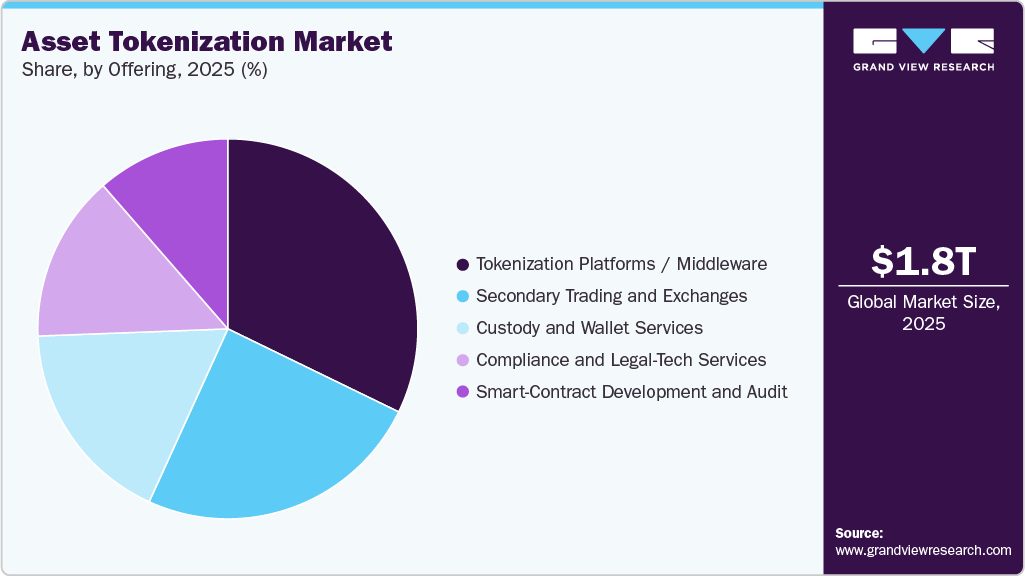
The secondary trading and exchanges segment is expected to grow at the fastest CAGR over the forecast period. Tokenized securities and digital assets are traded on secondary platforms designed to provide real-time settlement, fractional ownership, as well as secure transaction execution. For instance, in September 2025, tZERO received FINRA approval to expand its Alternative Trading System (ATS) to include the secondary trading of corporate debt securities, thus enabling broader access and trading of tokenized debt instruments. Further, increasing demand for liquidity, transparency, and accessibility in tokenized asset markets is being driven by investors seeking efficient trading mechanisms and real-time settlement. Tokenized securities, including equities, funds, and debt instruments, are being made available on secondary trading platforms that support fractional ownership and automated compliance. For instance, in June 2024, Archax, a regulated digital securities exchange, was launched in the UK with authorization from the Financial Conduct Authority (FCA), enabling tokenized equities and fixed‑income products to be traded on a compliant secondary market.
Regional Insights
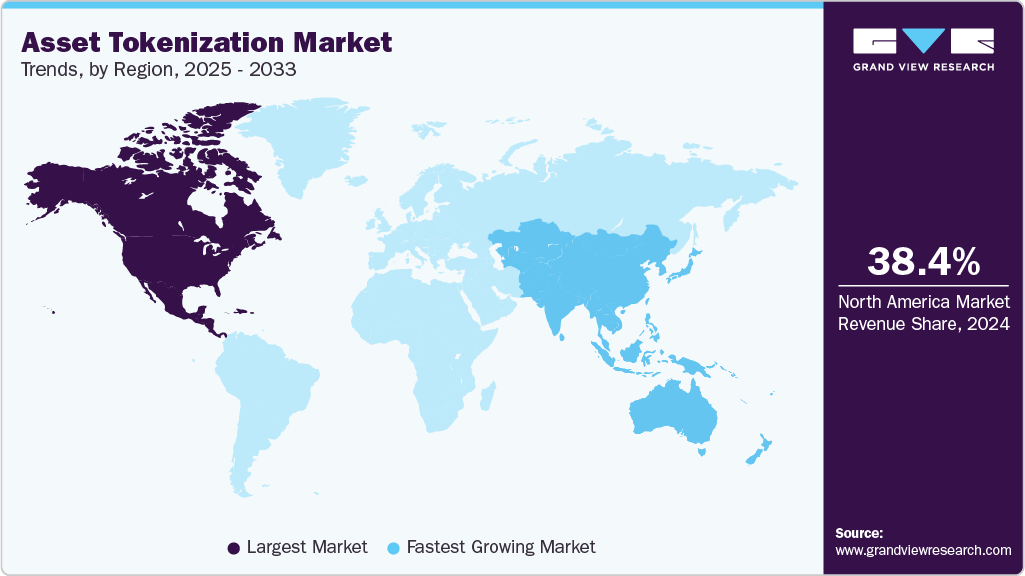
The North America asset tokenization market held a significant share in 2025. The growth is driven by the demand for improved transparency, efficiency, and security in asset management, which was facilitated by tokenization solutions. In addition, regulatory frameworks were increasingly developed and refined, allowing digital assets to be widely recognized and utilized. The integration of advanced technologies such as smart contracts and decentralized finance (DeFi) platforms also contributed to the market expansion. Moreover, the prominence of the market was reinforced as investors and organizations were encouraged to explore tokenized assets for diversified investment opportunities and streamlined operations.
U.S. Asset Tokenization Market Trends
The asset tokenization market in the U.S. held a dominant position in 2025. Rapid technological integration and evolving regulatory frameworks have been key drivers of the U.S. asset tokenization market. Focus has been placed on improving transparency, liquidity, and efficiency in asset management, thus enabling faster and secure transactions. Increased participation by institutional investors and fintech firms has accelerated the adoption of tokenization across sectors such as real estate, equities, fixed-income instruments, and others. In addition, the development of standardized protocols and compliance frameworks has facilitated smoother market operations and investor confidence.
Europe Asset Tokenization Market Trends
The asset tokenization market in Europe was identified as a lucrative region in 2025. The European market has been expanding due to progressive regulatory frameworks and institutional engagement. The Markets in Crypto‑Assets (MiCA) regulation and the EU’s DLT Pilot Regime have provided legal clarity and cross‑border infrastructure, thus encouraging compliant issuance and trading of tokenized securities across member states. This regulatory momentum has enabled growing use cases across real estate, fixed‑income instruments and structured products. Secondary market development and regulatory sandboxes have also attracted institutional interest. While adoption by traditional banks and asset managers continues to rise, reflecting a broader shift toward digital asset modernization in Europe’s financial ecosystem.
The UK asset tokenization industry is expected to grow rapidly in the coming years. The government and the Financial Conduct Authority (FCA) have advanced frameworks and sandboxes that support the issuance and settlement of digital securities. The Digital Gilt Instrument (DIGIT) pilot, leveraging HSBC’s blockchain platform for tokenized government bonds, exemplifies the move toward real‑world use cases and is part of broader efforts to modernize capital markets infrastructure. In addition, projected market expansion reflects rising demand from asset managers and investors alike, with units such as funds and fixed‑income tokenization increasingly explored.
The asset tokenization industry in Germany benefits from clear regulatory groundwork such as the Electronic Securities Act (eWpG), launched in June 2021, which enables the issuance and recording of digital securities on blockchain infrastructure, thus reducing reliance on paper‑based processes and legal uncertainty. Moreover, the issuance of tokenized securities has seen significant expansion, particularly in sectors such as real estate, private equity as well as fixed-income instruments, with established financial institutions leading the adoption
Asia Pacific Asset Tokenization Market Trends
The asset tokenization industry in Asia Pacific is expected to grow at the fastest CAGR of 44.1% over the forecast period. The growth across the Asia Pacific region is driven by growing regulatory clarity and increasing adoption of blockchain-based solutions. Tokenized financial products and pilot programs were introduced in Singapore and Hong Kong to enable broader investor participation. For instance, a retail-focused tokenized fund was approved in Hong Kong in February 2025 to demonstrate the region’s shift toward accessible digital assets. Similarly, regulatory measures in China in February 2026 influenced market operations, showing that adoption has been guided by both innovation and oversight.
The China asset tokenization industry is expected to grow rapidly in the coming years. The issuance and trading of tokenized assets were controlled to ensure financial stability and pilot programs were implemented under state supervision. Regulatory measures were enacted to restrict the issuance of overseas tokenized securities, shaping how domestic investors and institutions could access digital assets. Similarly, China’s central bank promoted blockchain-based digital finance initiatives, such as the digital yuan, which indirectly supported tokenization infrastructure.
The asset tokenization market in Japan has been actively developed through regulatory support and institutional initiatives. For instance, in July 2025, GATES Inc., a Tokyo‑based real estate investment firm, announced a project to tokenize USD 75 million worth of prime Tokyo real estate assets on the Oasys blockchain, to enable fractional ownership and aiming to unlock broader liquidity in the market. In addition, major financial players such as Nomura Holdings completed the issuance of a security token backed by a domestic VC fund in December 2025, marking one of the first tokenized venture capital products in the country.
Key Asset Tokenization Companies Insights
Some of the key companies in the asset tokenization market include Securitize, tZERO, Tokeny Solutions, Centrifuge, and others. Organizations are focusing on increasing the customer base to gain a competitive edge in the industry. Therefore, key players are taking several strategic initiatives, such as mergers and acquisitions, and partnerships with other major companies.
-
Securitize Inc. is a digital asset securities platform specializing in the tokenization of real-world assets, including private equity, funds, real estate and credit. The company provides end-to-end infrastructure for issuing, managing as well as trading tokenized securities while ensuring regulatory compliance. Its platform integrates investor onboarding, KYC/AML verification and lifecycle management. Securitize Inc. has partnered with major financial institutions and has tokenized assets, thus strengthening its position in the institutional asset tokenization ecosystem.
-
tZERO Technologies is a financial technology company that utilizes blockchain technology to facilitate the issuance and secondary trading of tokenized securities. The company operates a regulated Alternative Trading System (ATS) that allows for compliant trading of digital securities and tokenized assets. Its platform includes features such as automated compliance, transparency and secure settlement. tZERO technologies play a vital role in improving liquidity for tokenized assets and increasing institutional participation in blockchain-based capital markets.
Key Asset Tokenization Companies:
The following key companies have been profiled for this study on the asset tokenization market.
- Securitize Inc
- tZERO Technologies
- Tokeny Solutions
- Centrifuge
- Ondo Finance
- Franklin Templeton
- Polymath (Polymesh)
- Vertalo
- RealT
- R3 (Corda)
Recent Developments
-
In October 2025, Securitize Inc. announced plans to go public through a merger with a SPAC sponsored by Cantor Fitzgerald, valuing the company at around USD 1.25 billion. The move aimed to expand its institutional tokenization services and strengthen the adoption of blockchain-based securities in global capital markets.
-
In September 2025, tZERO Technologies received approval from FINRA to expand its Alternative Trading System (ATS) to support the secondary trading of corporate debt securities. This approval enabled the platform to broaden its asset classes and strengthen its role in the regulated trading of tokenized financial assets.
Asset Tokenization Market Report Scope
Report Attribute
Details
Market size in 2025
USD 1.8 trillion
Estimated market size in 2026
USD 2.1 trillion
Projected market size by 2033
USD 24.5 trillion
Growth rate
CAGR of 42.1% from 2026 to 2033
Base year for estimation
2025
Historical data
2021 - 2025
Forecast period
2026 - 2033
Quantitative units
Revenue in USD million/billion, and CAGR from 2026 to 2033
Report coverage
Revenue forecast, company ranking, competitive landscape, growth factors, and trends
Segments covered
Asset class, investor type, tokenization platform, offering, region
Regional scope
North America; Europe; Asia Pacific; Latin America; MEA
Country scope
U.S.; Canada; Mexico; Germany; UK; France; Spain; China; Japan; India; South Korea; Australia; Brazil; KSA; UAE; South Africa
Key companies profiled
Securitize Inc; tZERO Technologies; Tokeny Solutions; Centrifuge; Ondo Finance; Franklin Templeton; Polymath (Polymesh); Vertalo; RealT; R3 (Corda)
Customization scope
Free report customization (equivalent up to 8 analysts working days) with purchase. Addition or alteration to country, regional & segment scope.
Pricing and purchase options
Avail customized purchase options to meet your exact research needs. Explore purchase options
Global Asset Tokenization Market Report Segmentation
This report forecasts revenue growth at global, regional, and country levels and provides an analysis of the latest industry trends in each of the sub-segments from 2021 to 2033. For this study, Grand View Research has segmented the global asset tokenization market report based on asset class, investor type, tokenization platform, offering, and region.
-
Asset Class Outlook (Revenue, USD Million, 2021 - 2033)
-
Real Estate
-
Art and Collectibles
-
Commodities
-
Intellectual Property
-
Financial Instruments
-
Luxury Goods
-
Others
-
-
Investor Type Outlook (Revenue, USD Million, 2021 - 2033)
-
Institutional Investors
-
Accredited Retail Investors
-
Retail Investors
-
-
Tokenization Platform Outlook (Revenue, USD Million, 2021 - 2033)
-
Permissioned (Private) Blockchains
-
Permissionless (Public) Blockchains
-
Hybrid Models
-
-
Offering Outlook (Revenue, USD Million, 2021 - 2033)
-
Tokenization Platforms / Middleware
-
Smart-Contract Development and Audit
-
Custody and Wallet Services
-
Compliance and Legal-Tech Services
-
Secondary Trading and Exchanges
-
-
Regional Outlook (Revenue, USD Million, 2021 - 2033)
-
North America
-
U.S.
-
Canada
-
Mexico
-
-
Europe
-
Germany
-
UK
-
France
-
-
Asia Pacific
-
China
-
Japan
-
India
-
South Korea
-
Australia
-
-
Latin America
-
Brazil
-
-
Middle East and Africa (MEA)
-
KSA
-
UAE
-
South Africa
-
-
Frequently Asked Questions About This Report
The global asset tokenization market size was valued at USD 1.8 trillion in 2025 and is estimated at USD 2.1 trillion for 2026.
The global asset tokenization market is expected to grow at a CAGR of 42.1% from 2026 to 2033, reaching USD 24.5 trillion by 2033.
North America dominated with a 38.4% revenue share in 2025.
Asia Pacific is the fastest-growing region over the forecast period.
The rapid adoption of blockchain and distributed ledger technology is driving the growth of the asset tokenization market.
The financial instruments segment led with a 34.1% revenue share in 2025, while the intellectual property segment is the fastest-growing.
The institutional investors segment held the largest revenue share in 2025, while the retail investors segment is the fastest-growing.
The permissioned (private) blockchains segment held the largest revenue share in 2025, while the hybrid models segment is the fastest-growing.
The tokenization platforms/middleware segment held the largest revenue share in 2025, while the secondary trading and exchanges segment is the fastest-growing.
Key players include Securitize Inc; tZERO Technologies; Tokeny Solutions; Centrifuge; Ondo Finance; Franklin Templeton; Polymath (Polymesh); Vertalo; RealT; R3 (Corda)
About the Author(s)
IT Services & Applications Research Team
Technology · IT Services & ApplicationsThis report was authored by the it services & applications research team at Grand View Research - comprising two research analysts, one senior research analyst, and one industry expert - with specialized expertise in the it services & applications segment of the technology industry. All findings are based on proprietary technology databases, executive interviews, and regulatory analysis, subject to internal peer review prior to publication.
Last Updated:
Speak to Analyst


Customize this report to your needs — add regions, segments, or data points, with 20% free customization.
Or view our licence options:


ISO 9001:2015 & 27001:2022 Certified
We are GDPR and CCPA compliant! Your transaction & personal information is safe and secure. For more details, please read our privacy policy.


