
- Home
- »
- Next Generation Technologies
- »
-
Augmented Reality Headsets Market Size Report, 2026-2033GVR Report cover

Augmented Reality Headsets Market (2026 - 2033)
Size, Share & Trends Analysis Report By Product (Standalone, Tethered, Smartphone Enabled), By Application (Enterprise, Consumer), By Region, And Segment Forecasts
Market Size, 2025
$9.7BMarket Estimate, 2026
$13.3BMarket Forecast, 2033
$110.8BCAGR, 2026–2033
35.3%Augmented Reality Headsets Market Summary
The global augmented reality headsets market size was valued at USD 9.7 billion in 2025 and is projected to grow from USD 13.3 billion in 2026 to USD 110.8 billion by 2033, at a CAGR of 35.3% from 2026 to 2033. North America dominated the market, accounting for a revenue share of 40.0% in 2025. The market is experiencing substantial expansion due to industry investments, the adoption of
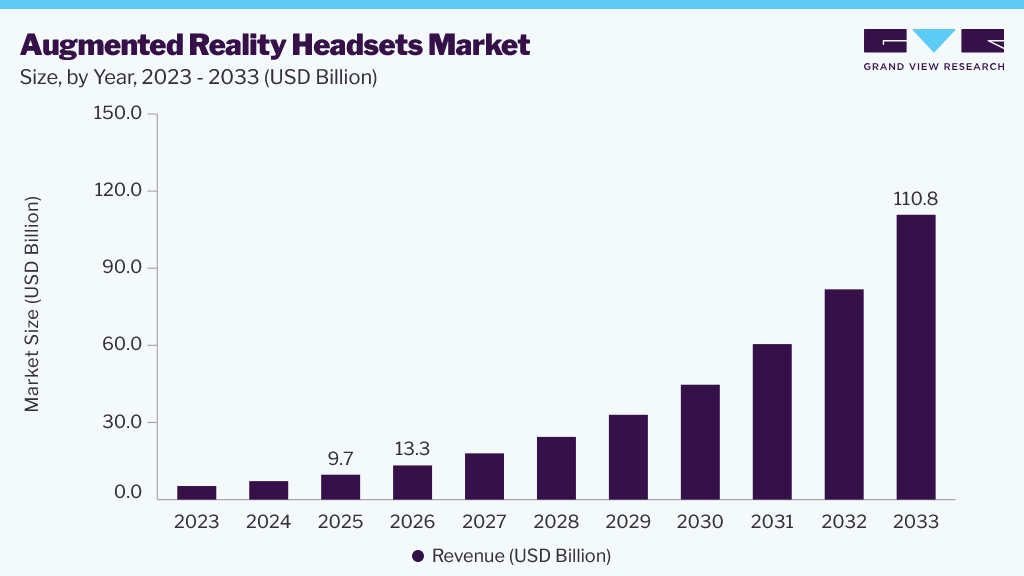 Source: Grand View Research, IR Documents, Primary Interviews, Paid DatabasesTo learn more about this report,
 Download Free Sample Report
Key Market Trends & Insights
- By product: The standalone headsets segment held the largest market share of around 50.0% in 2025.
- By application: The enterprise segment accounted for the largest market revenue share in 2025.
Regional Highlights
- Largest regional market: North America (40.0% revenue share, 2025)
- Fastest-growing regional market: Asia Pacific (highest CAGR, 2026-2033)
Market Size & Forecast
- Market size in 2025: USD 9.7 Billion
- Estimated market size in 2026: USD 13.3 Billion
- Projected market size by 2033: USD 110.8 Billion
- CAGR (2026-2033): 35.3%
Prism AI by Grand View Research Free to tryAsk a question about the augmented reality headsets market✓Every figure cited from GVR research Prefer the report? Download free sample →Increased funding is driving innovation and facilitating the development of more advanced, user-friendly headsets. The growing adoption of augmented reality technologies across industries such as education, healthcare, and entertainment is expanding the market’s reach and enhancing consumer interest.
Recent technological advancements in display, sensor, and processing capabilities are enabling increasingly sophisticated and immersive AR experiences. The wide range of applications for AR, such as gaming, entertainment, and enterprise solutions, including manufacturing and healthcare, is broadening the market’s potential. Significant investments in AR research and development by both established tech companies and startups are also fueling innovation. These improvements enhance the user experience through improved headset comfort, functionality, and immersive features. Together, these factors position AR headsets as essential tools for both professional and personal use, indicating notable market growth. Moreover, the rising consumer demand for interactive and engaging experiences is further driving market expansion.
AR headsets allow users to understand real-time objects in their surroundings using a camera. Consequently, companies in industries such as education, healthcare, entertainment, and retail are adopting AR technology to provide users with a real-life, immersive 3D experience. The increasing trend of overlaying virtual objects onto the real environment and the desire to interact with them are expected to boost product demand. For example, the Microsoft HoloLens, an AR headset, enables users to interact with and access analytical information about displayed products during trials.
In addition, several factors are driving growth in the augmented reality headset industry, including the increasing integration of AR with other technologies, such as 5G, artificial intelligence, and cloud computing. These integrations enhance AR capabilities and expand its potential applications. Furthermore, the growing adoption of smartphones and wearable devices is creating a larger user base familiar with immersive technologies, thereby accelerating the adoption of AR headsets. Supportive government initiatives and policies that promote AR development and adoption are also fostering a favorable market environment.
Analyst Perspective
The augmented reality headsets industry is witnessing steady growth owing to increasing adoption of wearable digital technologies across many sectors such as healthcare, industrial, defense, education, and enterprise applications. The market is witnessing growing demand for lightweight, high-performing AR headsets as organizations focus on improving productivity, remote collaboration, workforce training, and real-time access to digital information. Advancements in artificial intelligence, spatial computing, display technologies, sensors, and connectivity are further improving the capabilities of AR headsets and expanding their use across professional environments. Although challenges such as high product costs, limited battery performance, and the need for wider application development remain, continuous innovation and increasing investments by technology companies are creating new growth opportunities. Companies developing comfortable, AI-enabled, and application-specific AR headset solutions are expected to benefit from long-term market growth by enabling more efficient workflows, immersive training experiences, and enhanced decision-making across industries.
Product Insights
The standalone headsets segment led the market with the largest revenue share of 50.0% in 2025. The ability to operate independently, without relying on external devices such as smartphones or PCs, offers users convenience. Standalone headsets offer advanced processing capabilities that enable high-quality graphics, immersive experiences, and a wider range of applications. In addition, with advancements in standalone technology, prices have become more competitive, allowing a more comprehensive range of consumers to access them. The increasing focus on portability and wireless connectivity has also contributed to the rise of standalone headsets, as users are getting smoother, more unrestricted experiences with them.
For instance, in January 2025, Meta Quest unveiled the standalone VR headset segment with its Meta Quest 3 and Quest 3S devices, which operate as all-in-one virtual and mixed reality headsets without requiring a PC or external console. The devices integrate advanced processing capabilities, hand tracking, and mixed reality features, enabling broader adoption across gaming, training, enterprise, and immersive experiences. This development highlights the growing demand for standalone VR headsets as users and organizations increasingly prefer portable, easy-to-deploy devices with improved performance and accessibility.
The smartphone-enabled headsets are expected to grow at the fastest CAGR over the forecast period, primarily due to the widespread availability of smartphones, which serve as a common platform for AR experiences. As smartphone technology continues to improve with better cameras, processors, and AR software, the quality and features of smartphone-compatible headsets are also improving. For instance, in January 2026, XREAL Project Aura was highlighted as a next-generation smartphone-enabled AR headset designed to work with Android XR devices and external computing sources, such as smartphones and PCs. Developed in partnership with Google, the AR glasses are expected to provide a lightweight, wearable experience with spatial displays, AI-enabled interactions, and access to Android applications, reflecting the growing shift toward smartphone-connected AR headsets that reduce reliance on standalone computing hardware. This development highlights the increasing demand for portable AR solutions that combine smartphone connectivity with immersive digital experiences.
In addition, the affordability of these headsets, compared to standalone devices, allows greater accessibility for a wider range of consumers. Incorporating AR into well-known smartphone apps across fields such as gaming, shopping, education, and navigation is driving greater acceptance and user engagement. These factors contribute to the rapid growth of the smartphone-connected headset sector in the augmented reality industry.
Application Insights
The enterprise segment accounted for the largest market revenue share in 2025, owing to increased adoption of AR technology across the manufacturing, healthcare, and logistics industries to boost operational efficiency, improve training, and simplify complex procedures. AR headsets allow workers to access information without using their hands, helping them to complete tasks more accurately and quickly. In addition, the increased emphasis on remote assistance and maintenance has boosted demand for AR solutions, enabling experts to provide real-time guidance to on-site personnel. Furthermore, to improve workflows and gain a competitive edge, businesses are increasingly incorporating AR into their operations to drive growth in the enterprise sector of the global market.
The consumer segment is projected to grow at the fastest CAGR over the forecast period, driven by increased affordability of AR devices, rising demand for gaming and entertainment applications, and growing interest in immersive digital experiences. Enhancements in AR technology offer more realistic and engaging experiences for consumers. These devices are attracting customers for entertainment and social purposes. Furthermore, incorporating AR into smartphones and other consumer gadgets has increased its availability, reaching a broader demographic. The explosive growth of the AR headset consumer segment is driven by technological advancements, declining costs, and rising demand for interactive digital content.
Regional Insights
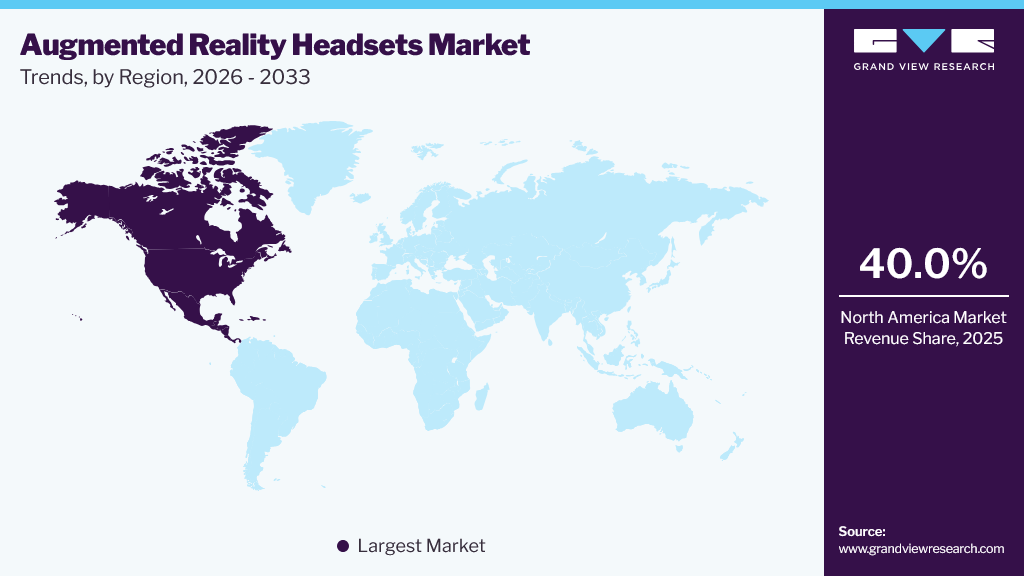
North America dominated the global augmented reality headset market with the largest revenue share of around 40.0% in 2025. The early adoption of cutting-edge technologies in the region has created a favorable setting for the development and implementation of AR in North America. The growth of AR technology has been sped up by the presence of big tech giants in the region and significant funding for research and development. Moreover, the growing consumer interest in immersive experiences and the availability of high-speed internet infrastructure have driven demand for AR headsets in North America.
 To learn more about this report, Download Free Sample Report
In October 2025, Apple introduced an updated version of its Vision Pro spatial computing headset in the U.S. market, featuring the M5 chip, improved performance, enhanced AI processing capabilities, and upgraded visionOS features. The device strengthens Apple’s presence in the AR/VR headset ecosystem by targeting enterprise applications such as healthcare, design, training, and collaboration. This development highlights the growing adoption of advanced AR headsets in North America, supported by strong investments from technology leaders and increasing demand for immersive computing solutions across professional applications.
U.S. Augmented Reality Headset Market Trends
The augmented reality headset market in the U.S. accounted for the largest market revenue share in North America in 2025, owing to a large consumer base with high purchasing power. Citizens strongly favor advanced technologies, which increases demand for AR headsets. In addition, the nation's established supply chain and manufacturing abilities have helped produce and deliver AR devices smoothly, further propelling market growth.
Europe Augmented Reality Headset Market Trends
The augmented reality headset market in Europe is anticipated to grow at a lucrative CAGR during the forecast period, attributed to the significant presence of key industries such as manufacturing, automotive, and healthcare, which are early adopters of AR solutions and have driven demand. Moreover, the growing consumer demand for immersive experiences and higher disposable incomes has fueled growth in the European market.
The UK augmented reality headset market is expected to grow at a rapid CAGR during the forecast period, due to the robust technological infrastructure and flourishing digital economy, which provide a strong base for implementing AR technology. In addition, early investment in research and development, along with government support for innovation, has accelerated the advancement of AR technology in the UK. For instance, in June 2026, Samsung Electronics announced the upcoming UK launch of Samsung Galaxy XR, its first extended reality headset powered by the Android XR platform developed with Google and Qualcomm Technologies. The device combines AI-driven interactions, spatial computing capabilities, and immersive virtual and mixed reality experiences for applications across work, entertainment, and productivity. This development highlights the growing adoption of advanced AR/XR headsets in the UK, supported by increasing investments from global technology companies and rising demand for next-generation wearable computing devices.
Asia Pacific Augmented Reality Headset Market Trends
The augmented reality headset market in the Asia Pacific is anticipated to grow at the fastest CAGR during the forecast period. This growth is due to the significant increase in investments in augmented reality technologies across the region. AR has the potential to revolutionize various industries, and numerous countries in the Asia-Pacific region are investing heavily in the research and development of AR technologies. China, Japan, South Korea, Singapore, and India are leading the way in promoting AR adoption and fostering innovation through government-led initiatives.
The China augmented reality headset market held a substantial share in the Asia Pacific in 2025, owing to its large population and rapidly growing middle class, which drove massive demand for AR devices. Moreover, China's role as a global manufacturing hub established a solid base for producing and distributing AR headsets at affordable prices. Furthermore, the Chinese government's support for technological progress, such as AR, has led to substantial research and development funding, driving industry advancements. Incorporating AR technology across sectors such as gaming, education, and manufacturing has also driven market expansion.
In June 2025, Rokid and Lens Technology began mass production of Rokid Glasses, AI-powered augmented-reality smart glasses, at Lens Technology’s manufacturing facility in China. The lightweight AR glasses integrate AI capabilities, real-time translation, object recognition, navigation, and Micro LED display technology, marking a major step toward large-scale commercialization of consumer AR wearables in China. This development highlights the growing adoption of AR headsets in China, supported by domestic manufacturing capabilities, investments in wearable technology, and increasing demand for lightweight, AI-enabled smart glasses.
Key Augmented Reality Headsets Company Insights
Some of the key companies in the augmented reality headsets industry include Google LLC, Magic Leap, Inc., Microsoft, VUZIX, Seiko Epson Corporation, RealWear Inc., and others. Key companies are focusing on expanding their customer base to gain a competitive advantage in the industry. As a result, key players are taking several calculated risks, including partnerships, mergers, and acquisitions with other large businesses.
- Google LLC (Google), a subsidiary of Alphabet Inc., provides search and advertising services. The company’s main business areas are advertising, search, Google Maps, Google Docs, Chrome, Google Photos, and various hardware products in the Mixed Reality, Virtual Reality, and augmented reality markets.
- Magic Leap, Inc. combines scalable production, optics, and AI technology to create immersive AR experiences. The company focuses on pushing the limits of AR technology, which has led to numerous patents globally covering key aspects such as projectors, eyepieces, headsets, waveguides, manufacturing processes, and related technologies.
Key Augmented Reality Headsets Companies
The following key companies have been profiled for this study on the global augmented reality headsets market:
-
Google LLC
-
Magic Leap, Inc.
-
Microsoft
-
VUZIX
-
Seiko Epson Corporation
-
RealWear Inc,
-
Kopin Corporation
-
Sony Corporation
-
Virtuix
-
Niantic.
-
Meta
-
YORD
-
Groove Jones, Inc.
Recent Developments
-
In June 2026, Meta introduced Meta Glasses, a new generation of AI-powered smart glasses developed with EssilorLuxottica. The glasses integrate Meta AI capabilities, cameras, audio features, and prescription-compatible designs, expanding the company’s wearable technology ecosystem. This launch demonstrates the growing shift toward consumer-focused AR smart glasses that combine artificial intelligence, everyday usability, and lightweight wearable designs.
-
In March 2026, Meta expanded its smart glasses portfolio with new prescription-focused Ray-Ban Meta models designed to improve comfort and accessibility for everyday users. The launch supports Meta’s strategy of making AI-enabled smart glasses more practical for daily use by integrating wearable computing features into familiar eyewear formats.
-
In January 2026, Vuzix showcased its latest AI-powered smart glasses, waveguide solutions, and AR display technologies at CES 2026. The company demonstrated new smart-glasses projection systems and enterprise-focused AR solutions designed for industrial, defense, and professional applications. This development highlights continued investment in lightweight AR wearables, optical display improvements, and scalable smart-glasses platforms.
-
In December 2025, Magic Leap announced a manufacturing collaboration with Pegatron to scale production of AR glasses components, including Magic Leap’s advanced waveguide technology. The partnership combines Magic Leap’s optical expertise with Pegatron’s manufacturing capabilities to support the development of next-generation lightweight AR glasses. This development highlights the industry's increasing focus on improving AR headset scalability, display performance, and the commercialization of enterprise-focused wearable devices.
-
In October 2025, Magic Leap extended its partnership with Google to support the development of future AR glasses and Android XR experiences. Magic Leap contributed its expertise in optics, display systems, and AR hardware integration to support the development of Google’s XR glasses ecosystem. This collaboration reflects the increasing importance of advanced optical technologies and strategic partnerships in accelerating AR headset innovation.
Augmented Reality Headsets Market Report Scope
Report Attribute
Details
Market size in 2025
USD 9.7 billion
Estimated market size in 2026
USD 13.3 billion
Projected market size by 2033
USD 110.8 billion
Growth rate
CAGR of 35.3% from 2026 to 2033
Base year for estimation
2025
Historical data
2021 – 2024
Forecast period
2026 – 2033
Quantitative units
Revenue in USD million/billion, and CAGR from 2026 to 2033
Report coverage
Revenue forecast, company ranking, competitive landscape, growth factors, and trends
Segments covered
Product, application, region
Regional scope
North America; Europe; Asia Pacific; Latin America; MEA
Country scope
U.S.; Canada; Mexico; Germany; UK; France; China; Japan; India; South Korea; Australia; Brazil; Argentina; Saudi Arabia; UAE; South Africa
Key companies profiled
Google LLC; Magic Leap, Inc.; Microsoft; VUZIX; Seiko Epson Corporation; RealWear Inc.; Kopin Corporation; Sony Corporation; Virtuix; Niantic.; Meta; YORD; Groove Jones, Inc.
Customization scope
Free report customization (equivalent up to 8 analysts working days) with purchase. Addition or alteration to country, regional & segment scope.
Pricing and purchase options
Avail of customized purchase options to meet your exact research needs. Explore purchase options
Global Augmented Reality Headsets Market Report Segmentation
This report forecasts revenue growth at global, regional, and country levels and provides an analysis of the latest industry trends in each of the sub-segments from 2021 to 2033. For this study, Grand View Research has segmented the global augmented reality headsets market report based on product, application, and region.
-
Product Outlook (Revenue, USD Million, 2021 - 2033)
-
Standalone Headsets
-
Tethered Headsets
-
Smartphone-Enabled Headsets
-
-
Application Outlook (Revenue, USD Million, 2021 - 2033)
-
Enterprise
-
Consumer
-
-
Regional Outlook (Revenue, USD Million, 2021 - 2033)
-
North America
-
U.S.
-
Canada
-
Mexico
-
-
Europe
-
Germany
-
UK
-
France
-
-
Asia Pacific
-
China
-
Japan
-
India
-
South Korea
-
Australia
-
-
Latin America
-
Brazil
-
Argentina
-
-
Middle East and Africa (MEA)
-
Saudi Arabia
-
UAE
-
South Africa
-
-
Frequently Asked Questions About This Report
North America dominated with a 40.0% revenue share in 2025.
Key players include Google LLC; Magic Leap, Inc.; Microsoft; VUZIX; Seiko Epson Corporation; RealWear Inc.; Kopin Corporation; Sony Corporation; Virtuix; Niantic; Meta; YORD; Groove Jones, Inc., and others.
The standalone headsets segment accounted for the largest revenue share of around 50.0% in 2025.
The global augmented reality headsets market size was valued at USD 9.7 billion in 2025 and is estimated at USD 13.3 billion for 2026.
The global augmented reality headsets market is expected to grow at a CAGR of 35.3% from 2026 to 2033, reaching USD 110.8 billion by 2033.
About the Author(s)
Next Generation Technologies Research Team
Technology · Next Generation TechnologiesThis report was authored by the next generation technologies research team at Grand View Research - comprising two research analysts, one senior research analyst, and one industry expert - with specialized expertise in the next generation technologies segment of the technology industry. All findings are based on proprietary technology databases, executive interviews, and regulatory analysis, subject to internal peer review prior to publication.
Last Updated:
Speak to Analyst

Customize this report to your needs - add regions, segments, or data points, with 20% free customization.
Or view our licence options:


ISO 9001:2015 & 27001:2022 Certified
We are GDPR and CCPA compliant! Your transaction & personal information is safe and secure. For more details, please read our privacy policy.


