
- Home
- »
- Next Generation Technologies
- »
-
Augmented Reality In Retail Market Size Report, 2026-2033GVR Report cover

Augmented Reality In Retail Market (2026 - 2033)
Size, Share & Trends Analysis Report By Component (Hardware, Software, Services), By Display (HMD (Head-Mounted Display), Smart Glass), By Application, By Retail, By Region, And Segment Forecasts
Market Size, 2025
$11.2BMarket Estimate, 2026
$15.7BMarket Forecast, 2033
$105.9BCAGR, 2026–2033
31.3%Augmented Reality In Retail Market Summary
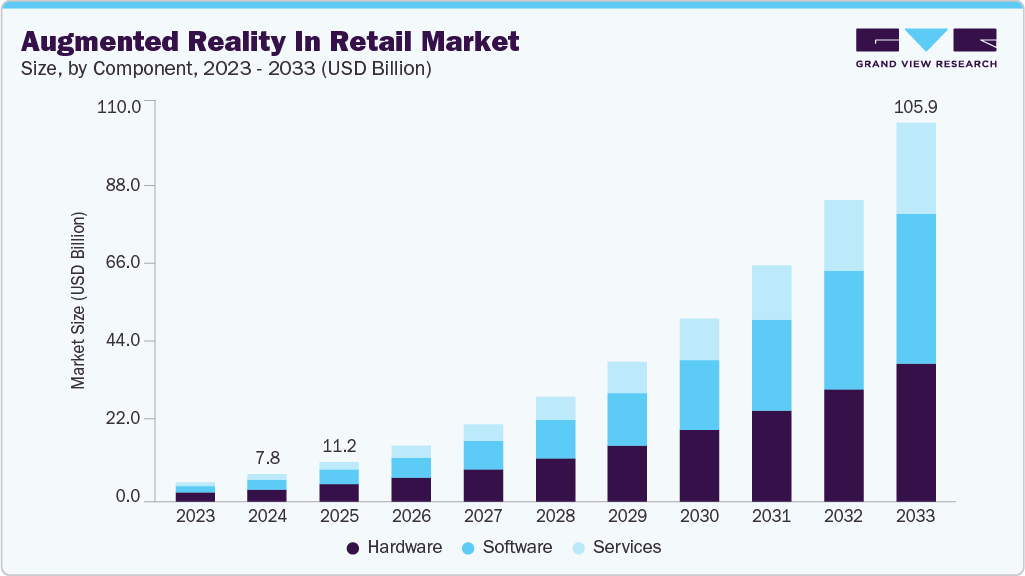
The global augmented reality in retail market size was valued at USD 11.2 billion in 2025 and is projected to grow from USD 15.7 billion in 2026 to USD 105.9 billion in 2033, at a CAGR of 31.3% from 2026 to 2033. North America dominated the market, accounting for a revenue share of 35.0% in 2025. The market growth is primarily driven by the adoption of AR-based virtual try-on solutions, expansion of AR-powered social commerce, deployment of AR smart mirrors in retail stores, and the integration of AR with AI for personalized shopping experiences.
 Source: Grand View Research, IR Documents, Primary Interviews, Paid DatabasesTo learn more about this report,
 Download Free Sample Report
 Key Market Trends & Insights
- By component: The hardware segment led the market, holding the largest revenue share of around 45.0% in 2025.
- By display: The handheld devices segment held the largest market share of over 45.0% in 2025.
- By application: The virtual try-on segment is expected to grow at the fastest CAGR from 2026 to 2033.
Regional Highlights
- Largest regional market: North America (35.0% revenue share, 2025)
- Fastest-growing regional market: Asia Pacific (highest CAGR, 2026-2033)
Market Size & Forecast
- Market size in 2025: USD 11.2 Billion
- Estimated market size in 2026: USD 15.7 Billion
- Projected market size by 2033: USD 105.9 Billion
- CAGR (2026-2033): 31.3%
Three ways to get this report
Buy it, customize it, or ask a question.Ask an Analyst
Analyst response in 1 business day
- AccessReport author, directly
- Reply timeWithin 1 working day
- No sales callDirect answer only
- FormatEmail reply
- CostFree, no cost
Get the Full Report
What the study covers
- FormatsPDF · Excel · Dashboard
- Timeline2026–2033 annual, 2025 base
- Coverage20+ countries, 5 regions
- Companies10+ key players profiled
Customize the Report
20% free customization
- IncludeCountries, segments, points
- TailorTo your product definition
- ExtendDeeper competitor detail
- OrA fully bespoke study
- Turnaround5–10 working days
The increasing demand for AR-driven personalized shopping journeys is pushing retailers to deliver experiences that go beyond traditional browsing. The rapid adoption of AR-based product visualization in sectors such as furniture, beauty, and footwear is reducing product returns while boosting buyer confidence. The growing demand for AR-powered virtual shopping assistants and chatbots is creating new standards for real-time engagement and customer service. Retailers are leveraging AR for interactive window displays and pop-up stores, transforming storefronts into immersive brand experiences. The retail store landscape is also being redefined by AR-driven inventory management and staff training solutions, which simultaneously enhance operational efficiency and customer satisfaction.The increasing demand for virtual try-on features is reshaping the augmented reality in retail industry by enabling customers to preview apparel, cosmetics, and eyewear digitally. This reduces uncertainty and drives higher conversion rates while addressing one of online retail’s major challenges-product returns. Retailers are leveraging AR tools to enhance customer convenience and improve satisfaction. As a result, virtual try-on is becoming an essential capability for competitive retailers.
The rapid growth of AR-driven navigation systems is transforming customer experiences in retail market. Shoppers are guided seamlessly to products while receiving real-time promotions, improving engagement and operational efficiency. This technology enhances the in-store journey and increases average purchase values. Large retail stores are adopting AR navigation as a key driver of customer satisfaction and loyalty.
The growing demand for interactive advertising is pushing the retail market to embrace AR-driven marketing campaigns. Customers engage with products through immersive experiences that create stronger brand connections than traditional ads. Retailers benefit from elevated engagement rates and improved brand visibility. As competition intensifies, AR marketing is becoming a decisive factor in driving loyalty and differentiation.
The rapid adoption of AR features by e-commerce players is revolutionizing the market. Customers can visualize products in their real environments, reducing hesitation and boosting purchase confidence. This technology helps tackle persistent challenges, such as high return rates, by providing a more informed shopping experience. With AR becoming standard on online platforms, retailers strengthen their value proposition and enhance customer trust.
Analyst Perspective
The augmented reality in retail market is growing as retailers adopt immersive technologies to improve customer engagement and create more interactive shopping experiences. AR enables shoppers to try products virtually, visualize items in physical spaces, access digital product information, and navigate stores more efficiently. Increasing smartphone adoption, advances in computer vision, and growing demand for personalized shopping are supporting market growth. Retailers are also using AR to strengthen brand engagement, improve product discovery, and reduce purchase uncertainty. Companies with strong AR capabilities, retail technology expertise, and seamless integration with existing digital platforms are likely to strengthen their market position. In the coming years, market growth will depend on the affordability of technology, ease of deployment, content quality, and the ability to deliver practical AR experiences that improve customer satisfaction and support retail sales.
Component Insights
The hardware segment dominated the market with a share of around 45.0% in 2025, driven by strong demand for AR-enabled devices, including smart glasses, head-mounted displays, and handheld devices, across retail and enterprise applications. Increasing investments by retailers in immersive in-store experiences and virtual try-on solutions further fueled hardware adoption. Technological advancements, including lighter, more durable devices and improved AR display quality, are enabling broader deployment across multiple retail verticals. Looking ahead, while hardware will continue to play a critical role, its growth will be complemented by the rising adoption of software platforms and AR services that enhance device functionality and customer engagement.
The services segment is expected to register the fastest CAGR from 2026 to 2033, primarily driven by the surging need for seamless AR deployment and integration across retail channels. Enterprises are increasingly investing in managed services to ensure operational efficiency and consistent user experiences. Strategic consulting is gaining traction as retailers look to align AR solutions with digital transformation roadmaps and customer engagement strategies. Furthermore, the growing demand for training, maintenance, and long-term support is reinforcing the services segment as a critical enabler of sustained AR adoption in retail.
Display Insights
The handheld devices segment dominated the market, with a share of over 45.0% in 2025, owing to the widespread use of smartphones and tablets as primary platforms for AR retail applications. Retailers are leveraging mobile AR to deliver virtual try-ons, immersive product demonstrations, and interactive marketing campaigns directly to customers. This accessibility and convenience have lowered adoption barriers, making AR experiences more scalable across diverse consumer groups. With ongoing advancements in mobile processors and AR-enabled apps, handheld devices are expected to remain a key driver of AR retail engagement over the forecast period.
The smart glass segment is expected to grow at the fastest CAGR in the coming years, driven by increasing demand for lightweight, wearable AR devices that enhance customer engagement and employee productivity. Retailers and enterprises are adopting smart glasses for virtual try-ons, real-time inventory management, and interactive marketing campaigns. Continuous innovation in display technology, battery life, and connectivity is making these devices more accessible and efficient for large-scale deployments. As adoption accelerates, smart glasses are poised to become a critical tool in bridging physical and digital experiences, complementing software and services in the AR ecosystem.
Retail Insights
The fashion retail segment dominated the market in 2025, supported by the growing adoption of AR-based virtual fitting rooms and smart mirrors. Retailers are leveraging these solutions to enhance personalization, reduce return rates, and create engaging in-store experiences. The seamless integration of AR with e-commerce platforms is also enabling customers to visualize apparel and accessories in real time, boosting purchase confidence. As fashion brands increasingly focus on experiential retail, AR is set to remain a key driver of competitive differentiation in the segment.
The cosmetic retail segment is expected to grow at the fastest CAGR in the coming years, driven by the rising adoption of AR-powered virtual try-on solutions for makeup and skincare products. Consumers are increasingly seeking personalized, contactless experiences that let them test shades and styles in real time via mobile apps and smart mirrors. This innovation not only enhances customer confidence but also reduces product returns, a persistent challenge in the beauty industry. As global beauty brands accelerate their digital strategies, AR integration in cosmetic retail is set to become a mainstream differentiator.
Application Insights
The digital product information segment dominated the market in 2025, driven by the growing need for immersive product visualization and real-time information across retail environments. Retailers are leveraging AR to provide interactive product details, specifications, and comparisons, enhancing the overall customer shopping experience. The increasing adoption of smartphones, tablets, and AR-enabled devices has made it easier to access digital product content both in-store and online. Moving forward, the segment is expected to maintain a strong presence as brands invest in advanced AR platforms and integrate analytics to deliver personalized, data-driven product experiences.
The virtual try-on segment is expected to grow at a significant CAGR in the coming years, owing to the growing shift toward e-commerce and omnichannel retail strategies. Consumers increasingly expect realistic, interactive AR experiences that allow them to visualize products before purchase, improving confidence and reducing return rates. Retailers are integrating virtual try-on into mobile apps, websites, and in-store kiosks to create seamless shopping journeys. Enhanced AR software and AI-driven personalization are further accelerating adoption, positioning virtual try-on as a transformative tool in retail digital transformation.
Regional Insights
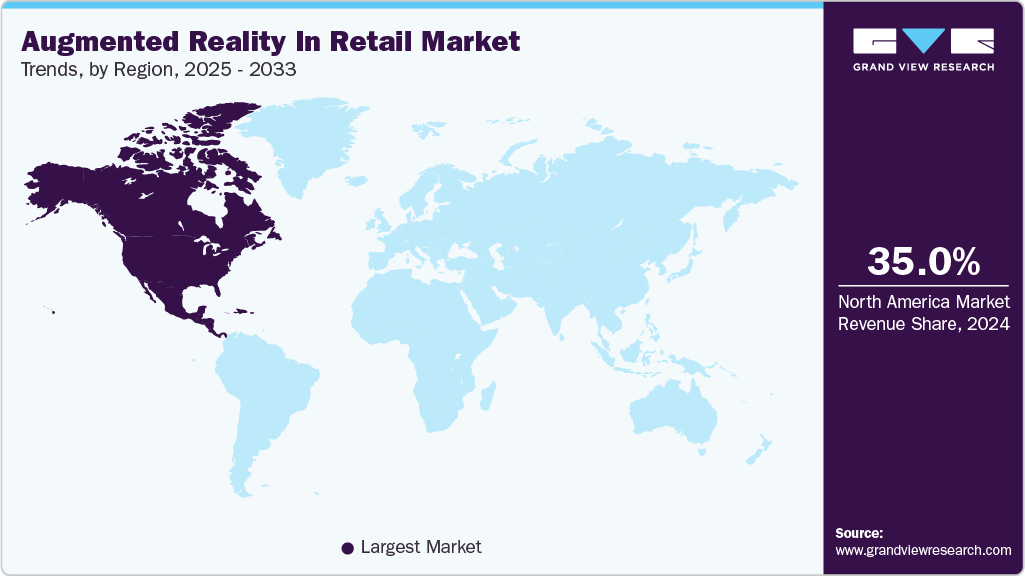
The augmented reality in retail industry in North America dominated the global market with a share of around 35.0% in 2025, owing to the rapid adoption of AR-powered e-commerce platforms that improve product visualization. Retailers are heavily investing in immersive marketing campaigns to enhance customer engagement and brand differentiation. In addition, widespread consumer awareness and access to advanced AR hardware are strengthening the region’s leadership position.
 To learn more about this report, Download Free Sample Report
 U.S. Augmented Reality In Retail Market Trends
The augmented reality in retail industry in the U.S. dominated the North American region in 2025, fueled by strong technology adoption among leading retailers such as Walmart and Amazon. The presence of advanced digital infrastructure is accelerating the integration of AR solutions in both online and offline channels. Moreover, consumer preference for personalized and interactive shopping experiences is sustaining strong demand for AR.
Asia Pacific Augmented Reality In Retail Market Trends
The augmented reality in retail industry in Asia Pacific is expected to grow at the fastest CAGR from 2026 to 2033. The increasing demand for AR-driven mobile shopping apps is fueling adoption across diverse consumer segments. Furthermore, regional players are investing in AR-powered gamification strategies to strengthen brand loyalty and drive higher engagement.
China’s augmented reality in retail industry is primarily driven by the massive growth of e-commerce giants integrating AR to enhance product experiences. Retailers are rapidly deploying AR try-on solutions for fashion, beauty, and accessories to reduce return rates. In addition, government support for digital innovation is creating favorable conditions for AR expansion in retail.
The augmented reality in retail industry in Japan is fueled by high consumer readiness for advanced technologies and immersive experiences. Retailers are adopting AR smart mirrors and interactive displays to improve in-store engagement. Moreover, Japan’s strong electronics ecosystem is accelerating the development and deployment of AR hardware and solutions.
Key Augmented Reality In Retail Company Insights
The augmented reality market in retail is characterized by global, regional, and niche solution providers competing through technological innovation, strategic partnerships, acquisitions, and product portfolio expansion.
-
Apple Inc. is a market leader in AR retail, leveraging its ARKit framework to enable immersive shopping experiences on iOS devices. The company specializes in AR applications that allow customers to virtually try on products such as clothing, eyewear, and furniture directly from their devices. Apple’s integration of AR with its hardware ecosystem provides retailers with scalable solutions for both online and in-store engagement.
-
Samsung Electronics Co. Ltd. is a key player in AR retail, offering AR-enabled devices and immersive shopping experiences. The company specializes in mobile-based AR applications that allow customers to visualize products in real environments before making a purchase. Samsung’s focus on integrating AR with smartphones and smart displays supports seamless retail interactions and personalized shopping journeys.
Magic Leap Inc. and Vuzix Corporation are among the emerging market participants.
-
Magic Leap Inc. is an emerging AR player specializing in immersive retail experiences through its lightweight AR headsets. The company focuses on interactive product demonstrations, virtual try-ons, and enhanced in-store engagement for retailers. By combining hardware and software, Magic Leap enables brands to create unique, experiential shopping environments.
-
Vuzix Corporation develops smart glasses designed for retail applications, making it an emerging player in AR-powered customer engagement. The company specializes in AR solutions for inventory management, product visualization, and employee-assisted shopping experiences. Vuzix’s devices help retailers improve both operational efficiency and the in-store customer journey.
Key Augmented Reality In Retail Companies
The following key companies have been profiled for this study on the augmented reality in retail market:
-
Apple Inc.
-
Microsoft Corporation
-
Samsung Electronics Co. Ltd.
-
Sony Group Corporation.
-
HP Development Company, L.P.
-
Qualcomm Inc.
-
Magic Leap Inc.
-
Vuzix Corporation.
-
Lumus Ltd.
-
NexTech AR Solutions Corporation.
-
Upskill
-
Zugara Inc.
Recent Developments
-
In August 2025, RayNeo partnered with Ant Group to integrate AR glasses with Alipay’s digital payment solutions, enabling hands-free payments through Alipay QR codes and Alipay Tap!. The collaboration expands the use of AR glasses in retail transactions and other everyday consumer services.
-
In June 2025, Wyr.ai partnered with Vuzix to launch an AI-powered quality assurance platform using Vuzix M400 smart glasses. The solution enables hands-free inspection, defect detection, barcode scanning, and automated reporting, supporting retail-related industries such as apparel, textiles, jewelry, and handicrafts.
-
In May 2025, HCLTech, CareAR, and ServiceNow introduced an AR-based IT infrastructure solution for remote assistance, digital workflows, and troubleshooting. The solution supports retailers by enabling faster resolution of in-store technology issues and improving operational efficiency.
Augmented Reality In Retail Market Report Scope
Report Attribute
Details
Market size in 2025
USD 11.2 billion
Estimated market size in 2026
USD 15.7 billion
Projected market size by 2033
USD 105.9 billion
Growth rate
CAGR of 31.3% from 2026 to 2033
Base year for estimation
2025
Historical data
2021 - 2025
Forecast period
2026 - 2033
Quantitative units
Revenue in USD billion and CAGR from 2026 to 2033
Report coverage
Revenue forecast, company ranking, competitive landscape, growth factors, and trends
Segments covered
Component, display, application, retail, region
Regional Scope
North America; Europe; Asia Pacific; Latin America; Middle East & Africa
Country Scope
U.S.; Canada; Mexico; Germany; UK; France; China; Japan; India; South Korea; Australia; Brazil; UAE; Saudi Arabia; South Africa
Key companies profiled
Apple Inc.; Microsoft Corporation; Samsung Electronics Co. Ltd.; Sony Group Corporation; HP Development Company, L.P.; Qualcomm Inc.; Magic Leap Inc.; Vuzix Corporation; Lumus Ltd.; NexTech AR Solutions Corporation; Upskill; Zugara Inc.
Customization scope
Free report customization (equivalent to 8 analyst working days) with purchase. Addition or alteration to country, regional & segment scope.
Pricing and purchase options
Avail of customized purchase options to meet your exact research needs. Explore purchase options
Global Augmented Reality In Retail Market Report Segmentation
This report forecasts revenue growth at the global, regional, and country levels and provides an analysis of the latest industry trends and opportunities across each sub-segment from 2021 to 2033. For this study, Grand View Research has segmented the global augmented reality in retail market report based on component, display, application, retail, and region:
- Component Outlook (Revenue, USD Billion, 2021 - 2033)
- Hardware
- Software
- Services
- Display Outlook (Revenue, USD Billion, 2021 - 2033)
- HMD (Head-Mounted Display)
- Smart Glass
- Head-up Display (HUD)
- Handheld Devices
- Application Outlook (Revenue, USD Billion, 2021 - 2033)
- Digital Product Information
- AR Campaigns
- Virtual Try-On
- AR Layout Planning
- Others
- Retail Outlook (Revenue, USD Billion, 2021 - 2033)
- Interior & Lighting Retail
- Cosmetic Retail
- Fashion Retail
- Jewelry
- Food Retail
- Footwear Fitting
- Others
- Regional Outlook (Revenue, USD Billion, 2021 - 2033)
- North America
- U.S.
- Canada
- Mexico
- Europe
- Germany
- UK
- France
- Asia Pacific
- China
- Japan
- India
- South Korea
- Australia
- Latin America
- Brazil
- Middle East and Africa (MEA)
- UAE
- Saudi Arabia
- South Africa
- North America
Frequently Asked Questions About This Report
Key players in the market include Apple Inc., Microsoft Corporation, Samsung Electronics Co. Ltd., Sony Group Corporation, HP Development Company, L.P., Qualcomm Inc., Magic Leap Inc., Vuzix Corporation, Lumus Ltd., NexTech AR Solutions Corporation, Upskill, and Zugara Inc., among others.
The global augmented reality in retail market size was valued at USD 11.2 billion in 2025 and is estimated at USD 15.7 billion in 2026.
The global augmented reality in retail market is expected to grow at a CAGR of 31.3% from 2026 to 2033, reaching USD 105.9 billion.
The North America region dominated the global augmented reality in retail market with an approximately 35.0% revenue share in 2025.
The hardware segment accounted for the largest revenue share, at around 45.0% in 2025.
About the Author(s)
Next Generation Technologies Research Team
Technology · Next Generation TechnologiesThis report was authored by the next generation technologies research team at Grand View Research - comprising two research analysts, one senior research analyst, and one industry expert - with specialized expertise in the next generation technologies segment of the technology industry. All findings are based on proprietary technology databases, executive interviews, and regulatory analysis, subject to internal peer review prior to publication.
Last Updated:
Speak to Analyst

Customize this report to your needs - add regions, segments, or data points, with 20% free customization.
Or view our licence options:


ISO 9001:2015 & 27001:2022 Certified
We are GDPR and CCPA compliant! Your transaction & personal information is safe and secure. For more details, please read our privacy policy.


