
- Home
- »
- Advanced Interior Materials
- »
-
Autoclave Aerated Concrete Market Size, Growth Report, 2026-2033GVR Report cover

Autoclave Aerated Concrete Market (2026 - 2033)
Size, Share & Trends Analysis Report By Product (Block, Panel), By Application (Residential, Commercial), By Region (North America, EU, APAC), And Segment Forecasts
Market Size, 2025
$17.4BMarket Estimate, 2026
$18.5BMarket Forecast, 2033
$28.6BCAGR, 2026–2033
6.4%Autoclave Aerated Concrete Market Summary
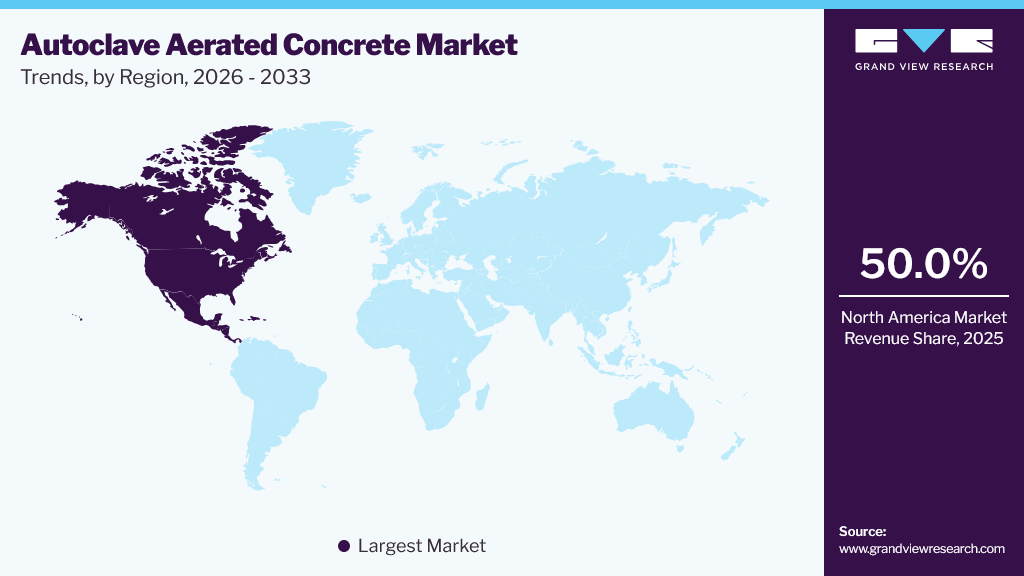
The global autoclave aerated concrete market size was valued at USD 17.4 billion in 2025 and is projected to grow from USD 18.5 billion in 2026 to USD 28.6 billion in 2033, at a CAGR of 6.4% from 2026 to 2033. North America dominated the market, accounting for a revenue share of 50.0% in 2025. This industry is expected to witness exponential growth due to increasing emphasis on green and soundproof buildings. In addition, factors such as its lightweight, textured, and versatile applicability are expected to drive its use. Growth in demand for the material in the building & construction industry can be attributed to its superior properties, including higher thermal insulation and improved molding ability compared to conventional materials such as cement bricks and burnt clay blocks.
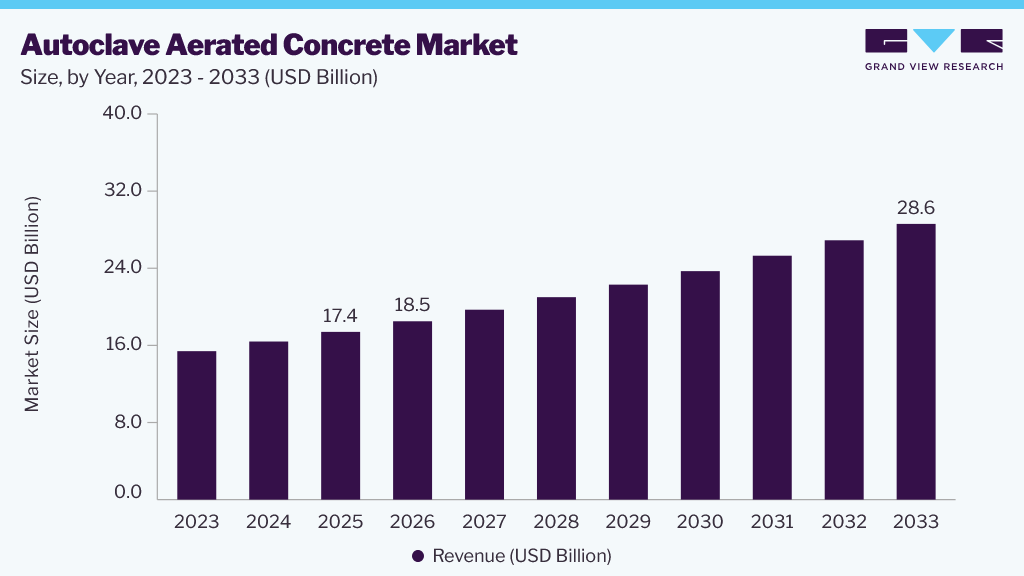 Source: Grand View Research, IR Documents, Primary Interviews, Paid DatabasesTo learn more about this report,
 Download Free Sample Report
Key Market Trends & Insights
- By product: The blocks segment held the largest market share of around 45.0% in 2025.
- By application: The residential segment held the largest market share of over 40.0% in 2025.
Regional Highlights
- Largest regional market: North America (50.0% revenue share, 2025)
Market Size & Forecast
- Market size in 2025: USD 17.4 Billion
- Estimated market size in 2026: USD 18.5 Billion
- Projected market size by 2033: USD 28.6 Billion
- CAGR (2026-2033): 6.4%
Prism AI by Grand View Research Free to tryAsk a question about the autoclave aerated concrete marketTry asking✓Every figure cited from GVR research Prefer the report? Download free sample →The high adoption of autoclave aerated concrete (AAC) by construction companies can be attributed to its key characteristics, including resistance to seismic fluctuations, extreme temperatures, and pests. Additionally, its low water requirements during construction, combined with superior insulation properties, are expected to drive product usage in the coming years.
A major driver of the AAC market is industrialization, particularly in developing countries. Factors such as increased purchasing power, rising urbanization, population growth, and the demand for affordable housing are anticipated to boost demand. AAC is made using fly ash, a byproduct from thermal power plants, which is readily available. The material also consists of gypsum, limestone, cement, and traces of aluminum, all of which are more economical than traditional alternatives such as sand and anhydrite used in conventional concrete. This precast, lightweight, and foam concrete material provides insulation, structural integrity, and mold- and fire-resistance, making it a popular choice for both commercial and residential construction.
In the U.S., the AAC industry is expected to thrive due to increased construction activities in urban and suburban areas. Rising demand for additional floor space across various sectors has spurred growth in new construction and renovation projects. Furthermore, a growing number of large-scale infrastructure investment projects, such as hotels and hospitals in cities including New York, Missouri, and Los Angeles, is likely to enhance growth in the construction industry and drive demand for AAC.
AAC is a lightweight, eco-friendly building material made from natural raw materials, including sand, cement, lime, and aluminum powder. Its production process requires less energy and generates fewer greenhouse gases compared to traditional building materials such as concrete or brick. As sustainability and environmental concerns grow in importance, there is increasing demand for green building materials such as AAC, which offer energy efficiency, recyclability, and a reduced carbon footprint.
AAC also boasts excellent thermal insulation properties, which help minimize heat transfer through walls and floors. Buildings constructed with AAC panels or blocks require less energy for heating and cooling, resulting in lower energy bills and enhanced indoor comfort. As energy-efficiency regulations become stricter worldwide, the demand for building materials that promote energy savings and sustainable building practices continues to grow.
Market Concentration & Characteristics
The industry's growth stage is high, and the pace of growth is accelerating. Furthermore, the market is moderately fragmented owing to the presence of several large players. Some prominent manufacturers of autoclave aerated concrete are focused on increasing production capacity and strengthening their industry presence by expanding their geographical reach.
Prominent manufacturers have been adopting various strategies, including investments, agreements, partnerships, contracts, production capacity expansion, joint ventures, and collaborations, to enhance their industry presence and to cater to the changing requirements of application industries.
The industry is subject to scrutiny by regulations approved by several bodies, such as the American Section of the International Association for Testing Materials (ASTM). ASTM is the primary body that defines technical standards for products. These standards, defined by these bodies, are followed by a majority of industry players across the globe.
The top market players are investing heavily in research and development to develop low-cost, high-value products. Regulatory guidelines promoting green and energy-efficient buildings are expected to drive market demand. With the increased focus on eco-friendliness and energy efficiency, companies are investing in the development of green building products.
Major players are investing in technological innovation to develop new products and consolidate their market presence. Rising consumer demand and a shift in consumer preference toward high-quality products are projected to open up growth avenues for the new entrants in the market over the forecast period.
Analyst Perspective
The autoclaved aerated concrete (AAC) market is undergoing robust growth, owing to factors such as urbanization, high construction activity, and rising requirement for eco-friendly and energy-efficient construction materials. Characteristic advantages of autoclaved aerated concrete, including lightweight structure, thermal insulation, fire resistance, soundproofing, and durability, are making it relevant in construction applications, helping it drive the market. On the contrary, the market may be hindered by a lack of awareness in certain developing countries, coupled with the availability of conventional construction materials at relatively low cost. Growth opportunities are expected to arise from strict green building regulations, growth in investment in low-cost housing, and an increasing focus on reducing carbon emissions in the construction sector. As governments and builders increasingly adopt environmentally sustainable, energy-efficient construction, the market is likely to continue to grow over the forecast period.
Product Insights
By product, the blocks segment led the market with the largest revenue share of around 45.0% in 2025. AAC blocks are among the primary building materials used for both external and internal construction applications. Moreover, these blocks are made from natural raw materials such as sand, cement, lime, and aluminum powder. Their production process uses less energy than that of traditional building materials such as concrete or clay bricks. In addition, AAC manufacturing emits fewer greenhouse gases, thereby reducing overall carbon emissions. As sustainability and environmental concerns become more prevalent, this segment is expected to grow at a rapid CAGR over the forecast period.
AAC panels also accounted for a significant share of revenue in the global autoclave aerated concrete industry. This is attributed to their high thermal insulation, excellent strength, and fire resistance characteristics. As a result, these panels are increasingly replacing conventional products in wall, roof, and flooring applications; therefore, companies are introducing them into their portfolios. For instance, in June 2026, James Hardie, a global building materials manufacturer, launched Hardie Gravis AAC Panels. The company stated in its press release that the new AAC paneling system will increase the efficiency and speed of the building process while meeting current building codes. The launch highlights the increasing use of AAC panels as alternative wall-building materials.
Application Insights
By application, the residential segment led the market, with a revenue share of over 40.0% in 2025. The growing awareness of sustainability and energy efficiency has led end-users to switch from conventional materials to autoclave aerated concrete (AAC) products for their high thermal insulation properties. Such products help reduce electricity consumption for heating and cooling in residential buildings. These products also help make living spaces more cost-efficient for end users over time.
The commercial application segment is expected to grow at a significant CAGR over the forecast period. Commercial building structures include shopping malls, supermarkets, hypermarkets, departmental stores, hospitals & clinics, restaurants & hotels, resorts, and others. Commercial construction generally involves large buildings or clusters of buildings that require rapid construction with durable materials capable of withstanding extreme loads and weather conditions. Autoclave aerated concrete offers design flexibility and versatility, allowing architects and builders to create a wide range of architectural styles and configurations. AAC blocks or panels can be easily customized to meet specific design requirements, such as curved walls, intricate shapes, or large openings. The lightweight nature of autoclave aerated concrete also enables the construction of taller buildings with reduced structural loads, expanding the scope of design possibilities.
Regional Insights
The autoclave aerated concrete market in North America accounted for the largest revenue share, at around 50.0%, in 2025. This is attributed to the increasing demand for this product in residential and commercial buildings, due to increased awareness of the benefits of green building solutions over conventional products. For instance, in December 2025, Caldera Building Systems, a global building materials manufacturer, published an article stating that the introduction of new building performance standards in the U.S. and changes to Canada’s national energy code are driving up demand for highly insulated building materials.
 To learn more about this report, Download Free Sample Report
U.S. Autoclave Aerated Concrete Market Trends
The U.S. autoclave aerated concrete market is driven by growing demand for panels in the country. This product segment is expected to grow at the fastest CAGR over the forecast period. AAC panels offer excellent thermal insulation, helping reduce heat transfer through walls and maintain consistent indoor temperatures. This energy efficiency can lead to lower heating and cooling costs for buildings, which is especially appealing in regions with extreme temperatures. As energy efficiency becomes a priority for building owners and developers, the demand for AAC panels as a sustainable building material is increasing.
Central & South America Autoclave Aerated Concrete Market Trends
The autoclave aerated concrete market in Central & South America is expected to grow at a rapid CAGR over the forecast period, on account of the increasing adoption of sustainable products in the construction industry. The Brazil autoclave aerated concrete market is expected to grow at the fastest CAGR during the forecast period. This is due to growing construction investments in the country, along with government initiatives to support the construction industry.
Asia Pacific Autoclave Aerated Concrete Market Trends
Asia Pacific is also expected to experience significant growth over the forecast period, driven by increasing urbanization and industrialization. Due to the availability of inexpensive labor and raw materials, several companies worldwide are investing in establishing manufacturing facilities in the region, further driving demand for construction materials. This is expected to propel the demand for AAC products in the region over the coming decade.
The China autoclave aerated concrete market is expected to be driven by increased demand for cost effective construction materials in the country. Moreover, the high-paced industrialization in the country is further triggering demand for autoclave aerated concrete (AAC) products such as blocks, panels, and tiles. For instance, in 2025, Autoclave aerated concrete worldwide published a report on ongoing investments in AAC manufacturing plants and machinery in China. According to the report, demand for AAC products in building activities such as residential, commercial, and industrial construction drives AAC production growth in China.
Europe Autoclave Aerated Concrete Market Trends
The Europe region experienced significant growth in the autoclave aerated concrete market in 2025. AAC blocks comply with European building codes and standards, ensuring they meet safety, structural, and performance requirements. As building regulations evolve to prioritize energy efficiency, sustainability, and resilience, AAC blocks offer a viable solution that meets regulatory requirements and industry standards.
The Germany autoclave aerated concrete market is anticipated to grow at the significant CAGR over the forecast period. This is due to its characteristics, such as energy efficiency, durability & longevity, which are expected to promote the adoption of AAC across different applications.
Middle East & Africa Autoclave Aerated Concrete Market Trends
The autoclave aerated concrete market in the Middle East & Africa is also expected to grow at a significant rate over the forecast period. This is due to growing investments in construction and infrastructure development in the region.
Key Autoclave Aerated Concrete Market Companies Insights
Some key players operating in this industry include Xella International and Aercon Florida LLC
- Xella International is involved in building and insulation materials under its brands such as Ytong, Silka, and Hebel
- Aercon Florida LLC is engaged in the manufacturing of autoclave aerated concrete in the U.S. This company also produces AAC products such as blocks and panels for residential and commercial constructions. This company also provides technical support and training to architects, engineers, contractors, and builders
- Bauroc AS and Buildmate Projects Private Limited are some of the emerging market participants in the industry.
- Bauroc AS is a manufacturer of AAC products based in Northern Europe, with manufacturing capacity across several countries, including Iceland, Poland, Germany, and Switzerland.
- Buildmate Projects Private Limited is a manufacturer, supplier, and exporter of construction materials, including autoclaved aerated concrete. This company has its production plants located in India and exports to several countries and regions, including Saudi Arabia, Kenya, the Middle East, Asian countries, and East Africa
Key Autoclave Aerated Concrete Companies
The following key companies have been profiled for this study on the autoclave aerated concrete market:
-
Xella International
-
Aercon Florida LLC
-
Bauroc AS
-
Buildmate Projects Private Limited.
-
H+H International
-
SOLBET
-
ACICO
-
Isoltech Srl
-
Broco
-
Cematix
-
Aircrete
Recent Developments
-
In June 2026, Holcim, a global sustainable construction firm, announced that it successfully concluded the acquisition of Xella, a prominent European company that specializes in providing AAC solutions. In the process of acquisition, Holcim has expanded its range of sustainable building solutions by including leading AAC brands such as Ytong and Hebel of Xella.
-
In May 2025, BirlaNu, a flagship company of the CKA Birla Group specializing in sustainable manufacturing, publicized the commencement of the commercial production of autoclave aerated concrete blocks at the company’s plant in Chennai after expansion. The expansion of the factory has enabled the plant to increase AAC block capacity.
Autoclave Aerated Concrete Market Report Scope
Report Attribute
Details
Market size in 2025
USD 17.4 billion
Estimated market size in 2026
USD 18.5 billion
Projected market size by 2033
USD 28.6 billion
Growth rate
CAGR of 6.4% from 2026 to 2033
Base year for estimation
2025
Actual data
2021 – 2024
Forecast period
2026 – 2033
Quantitative units
Revenue in USD billion, and CAGR from 2026 to 2033
Report coverage
Revenue forecast, company ranking, competitive landscape, growth factors, and trends
Segments covered
Product, application, and region
Regional scope
North America; Europe; Asia Pacific; Central & South America; Middle East & Africa
Country scope
U.S.; Canada; Mexico; UK; Germany; France; Italy; Spain; China; India; Japan; Australia & New Zealand; South Korea; Brazil; Argentina; South Africa; UAE
Key companies profiled
Xella International; Aercon Florida LLC; Bauroc AS; Buildmate Projects Private Limited; H+H International; SOLBET; ACICO; Isoltech Srl; Broco; Cematix; Aircrete
Customization scope
Free report customization (equivalent up to 8 analysts working days) with purchase. Addition or alteration to country, regional & segment scope.
Pricing and purchase options
Avail of customized purchase options to meet your exact research needs. Explore purchase options
Global Autoclave Aerated Concrete Market Report Segmentation
This report forecasts revenue growth at global, regional, and country levels and provides an analysis of the latest industry trends and opportunities in each of the sub-segments from 2021 to 2033. For this study, Grand View Research has segmented the global autoclave aerated concrete market report based on product, application, and region:
-
Product Outlook (Revenue, USD Billion, 2021 - 2033)
-
Block
-
Panel
-
Tiles
-
Others
-
-
Application Outlook (Revenue, USD Billion, 2021 - 2033)
-
Residential
-
Commercial
-
Others
-
-
Regional Outlook (Revenue, USD Billion, 2021 - 2033)
-
North America
-
U.S.
-
Canada
-
Mexico
-
-
Europe
-
Germany
-
UK
-
France
-
Italy
-
Spain
-
-
Asia Pacific
-
China
-
Japan
-
India
-
South Korea
-
-
Middle East & Africa
-
Saudi Arabia
-
-
Central & South America
-
Brazil
-
-
Frequently Asked Questions About This Report
The global autoclave aerated concrete market size was valued at USD 17.4 billion in 2025 and is estimated at USD 18.5 billion for 2026.
The global autoclave aerated concrete market is expected to grow at a CAGR of 6.4% from 2026 to 2033, reaching USD 28.6 billion.
North America dominated with an approximately 50.0% revenue share in 2025.
The blocks autoclave aerated concrete segment accounted for the largest revenue share of approximately 45.0% in 2025.
Key players in the market include Xella International; Aercon Florida LLC; Bauroc AS; Buildmate Projects Private Limited; H+H International; SOLBET; ACICO; Isoltech Srl; Broco; Cematix; Aircrete, and others.
About the Author(s)
Advanced Interior Materials Research Team
Advanced Materials · Advanced Interior MaterialsThis report was authored by the advanced interior materials research team at Grand View Research - comprising two research analysts, one senior research analyst, and one industry expert - with specialized expertise in the advanced interior materials segment of the advanced materials industry. All findings are based on proprietary advanced materials databases, executive interviews, and regulatory analysis, subject to internal peer review prior to publication.
Last Updated:
Speak to Analyst

Customize this report to your needs - add regions, segments, or data points, with 20% free customization.
Or view our licence options:


ISO 9001:2015 & 27001:2022 Certified
We are GDPR and CCPA compliant! Your transaction & personal information is safe and secure. For more details, please read our privacy policy.


