
- Home
- »
- Advanced Interior Materials
- »
-
Automated Drilling And Riveting Systems Market Report, 2033GVR Report cover

Automated Drilling And Riveting Systems Market (2026 - 2033)
Size, Share & Trends Analysis Report By Machine Type (Integrated Drilling & Riveting Systems, Drilling Systems), By Automation (Fully Automated Systems, Semi-Automated Systems), By End Use, By Region, And Segment Forecasts
Market Size, 2025
$5.9BMarket Estimate, 2026
$6.2BMarket Forecast, 2033
$8.9BCAGR, 2026–2033
5.3%Automated Drilling and Riveting Systems Market Summary
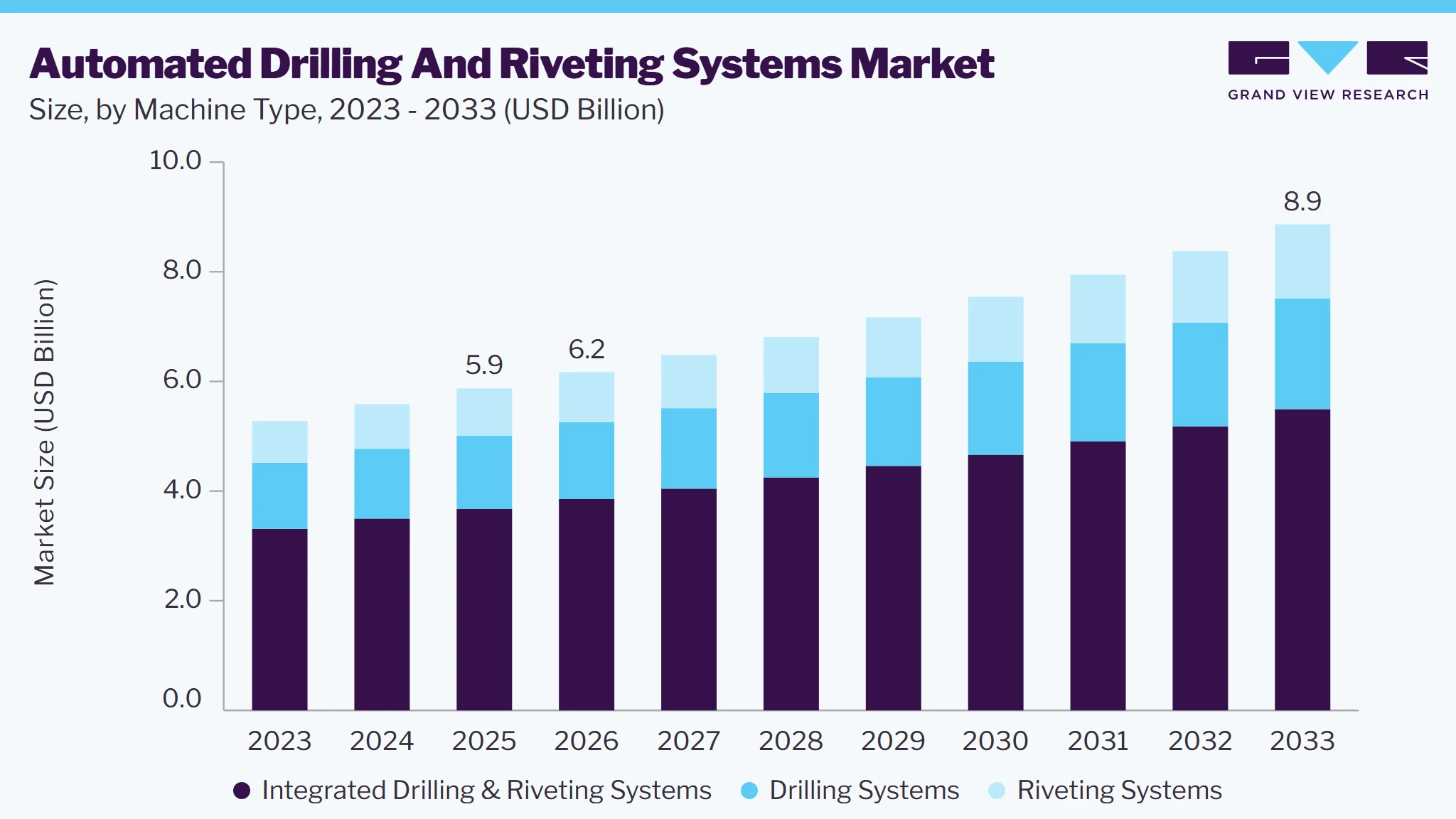
The global automated drilling and riveting systems market size was valued at USD 5.9 billion in 2025 and is projected to grow from USD 6.2 billion in 2026 to USD 8.9 billion by 2033, at a CAGR of 5.3% from 2026 to 2033. North America dominated the market, accounting for a revenue share of 34.7% in 2025. The industry is driven by rising aircraft production and the growing need for precision in aerospace structural assembly.
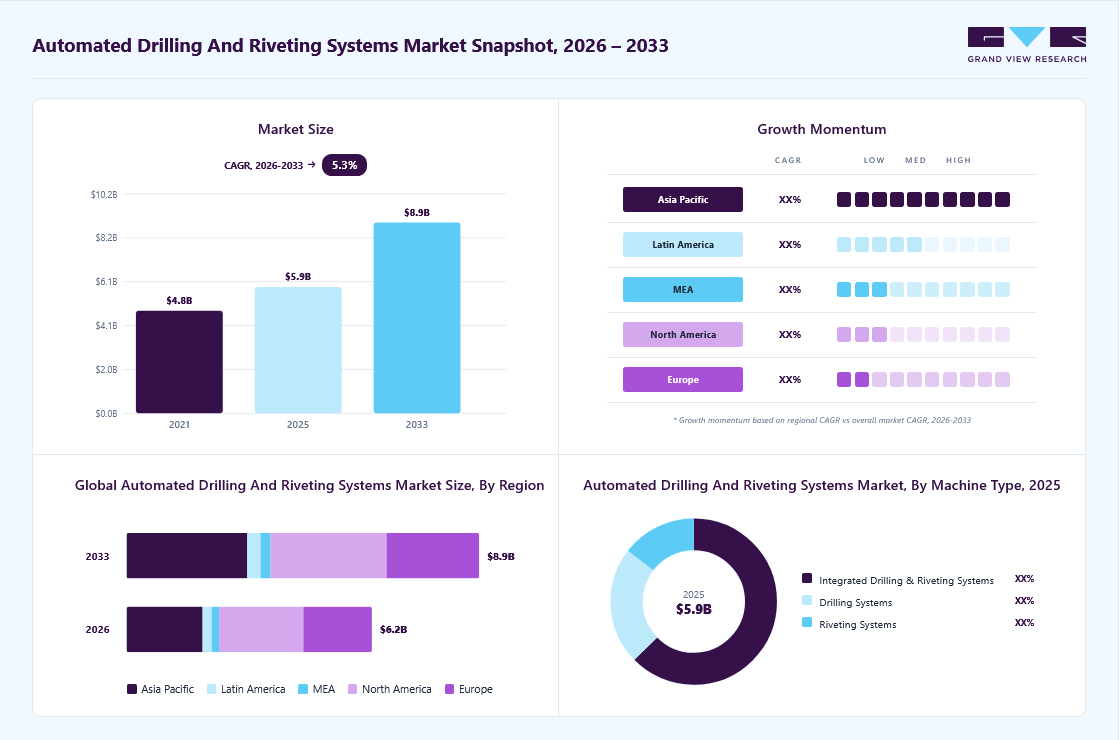 Source: Grand View Research, IR Documents, Primary Interviews, Paid DatabasesTo learn more about this report,
 Download Free Sample Report
Key Market Trends & Insights
- By machine type: Integrated drilling & riveting systems segment led the market with the largest revenue share of 62.6% in 2025.
- By automation: Semi-automated systems segment is expected to grow at a 4.9% CAGR during the forecast period.
- By end use: Automotive segment is projected to register the fastest CAGR of 6.2% during the forecast period.
Regional Highlights
- Largest regional market: North America (34.7% revenue share, 2025)
- Fastest growing-regional market: Asia Pacific (highest CAGR, 2026-2033)
Market Size & Forecast
- Market size in 2025: USD 5.9 Billion
- Estimated market size in 2026: USD 6.2 Billion
- Projected market size by 2033: USD 8.9 Billion
- CAGR (2026-2033): 5.3%
GVR research-powered AIAsk Prism AI about the automated drilling and riveting systems marketGet cited answers from GVR research on market growth, segments, regulations and forecasts.Start with✓ Source-linked answers ✓ Market-specific context ✓ Traceable figuresExplore Prism AI ↗Equipment manufacturers are adopting automated systems to achieve consistent hole quality, accurate fastener installation, and compliance with stringent airframe specifications. The increasing use of lightweight composite materials and aluminum alloys further reinforces demand for automated technologies capable of minimizing material damage and maintaining structural integrity.
 To learn more about this report, Download Free Sample Report
Additionally, the growing emphasis on production scalability and assembly-line standardization is accelerating investments in robotic drilling, automated riveting, and integrated fastening systems. The incorporation of machine vision, real-time monitoring, and digital positioning technologies is improving process accuracy, defect detection, and production traceability, encouraging aerospace manufacturers to integrate automated systems into aircraft assembly operations.
Market Dynamics
The market is shaped by industrial automation adoption, precision assembly requirements, production throughput targets, and advancements in computer-controlled machining and fastening technologies. Demand is influenced by manufacturing volumes, component complexity, material characteristics, and the extent of automation across assembly operations. Equipment manufacturers are advancing integrated drilling and riveting platforms with enhanced positioning capabilities, programmable control architectures, and process-monitoring functions to address increasingly stringent manufacturing specifications across aerospace and other precision-intensive industries.
The growing emphasis on manufacturing precision and production consistency is accelerating the adoption of automated drilling and riveting systems across complex assembly operations. These systems enable controlled hole formation, accurate fastener placement, and repeatable execution of fastening sequences, reducing variability associated with manual processes. Their integration into aircraft structural assembly and other precision-oriented manufacturing environments allows producers to accommodate intricate component geometries, maintain dimensional tolerances, and standardize repetitive operations across production lines.
Substantial initial investment requirements can restrict the adoption of automated drilling and riveting systems, particularly among small and medium-sized manufacturers and facilities with limited production volumes. Procurement costs extend beyond the primary equipment to encompass specialized tooling, robotic positioning units, control software, installation, and production-line integration. Additional expenditure on operator training, maintenance, and system validation can prolong investment recovery periods, potentially limiting adoption where production requirements do not justify extensive automation.
The increasing use of composite materials and advanced alloys in structurally demanding applications creates opportunities for automated drilling and riveting system manufacturers to develop material-specific processing capabilities. Composite components require carefully controlled drilling parameters to minimize delamination, fiber damage, and dimensional deviations, while dissimilar material assemblies introduce additional fastening considerations.
Market Concentration & Characteristics
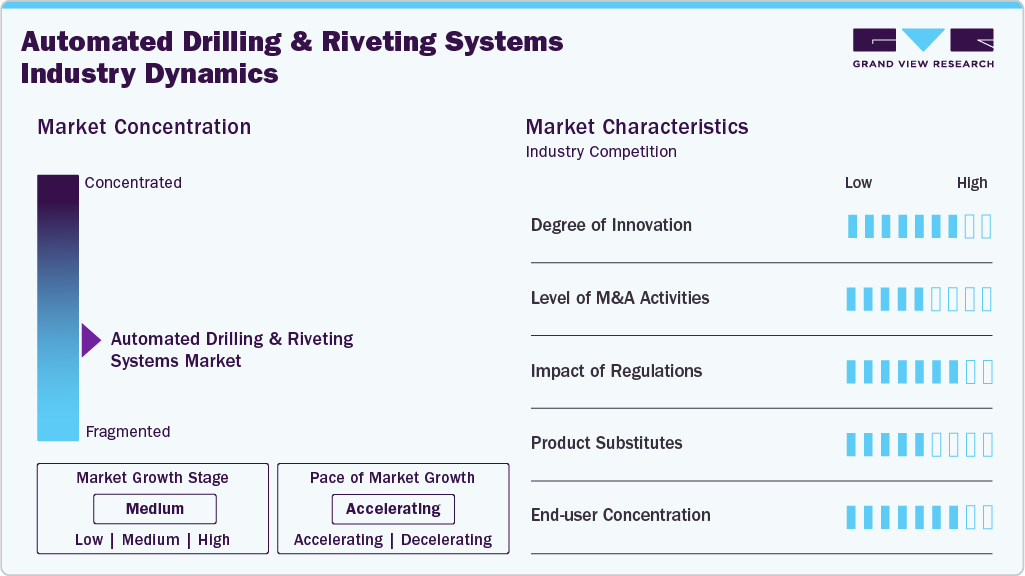
The industry is characterized by a specialized supplier landscape in which technological expertise, aerospace manufacturing credentials, and capital-intensive engineering capabilities influence competitive positioning. High entry barriers arise from stringent qualification protocols, complex equipment development, and the technical demands of integrating automated fastening operations into aircraft assembly processes. Consequently, competition is concentrated among manufacturers with established aerospace industry relationships, application-specific engineering capabilities, and proven equipment performance.
Technological differentiation is determined by drilling accuracy, riveting integrity, operating speed, and compatibility with metallic and composite airframe structures. The increasing complexity of aircraft designs is encouraging the development of multi-axis robotic platforms, integrated drilling and fastening units, and sensor-enabled process control architectures. Equipment manufacturers are also prioritizing configurable automation solutions that accommodate variations in structural geometry, fastening specifications, and production-line layouts without extensive modifications to existing manufacturing infrastructure.
 To learn more about this report, Download Free Sample Report
Commercial competition extends across equipment procurement, customized engineering, installation, commissioning, and aftermarket support. Long equipment qualification cycles and the operational consequences of assembly defects reinforce the importance of supplier reliability and lifecycle service capabilities in purchasing decisions. Meanwhile, modular automation architectures and specialized robotic applications provide alternative entry points for emerging technology providers. Market competition is therefore shaped by the ability to balance capital expenditure, production throughput, technical compliance, and long-term equipment maintainability within increasingly automated aerospace manufacturing environments.
Analyst Perspective
The industry is shaped by aerospace production requirements, investments in advanced manufacturing equipment, and the transition toward automated structural assembly. Equipment suppliers compete through system precision, operational reliability, cycle-time performance, and the ability to accommodate varied airframe designs and fastening specifications. Integrated systems appeal to manufacturers seeking coordinated drilling and riveting operations, whereas dedicated machines address specific assembly tasks. Market entry and technology adoption remain constrained by substantial equipment expenditure, complex installation, and stringent aerospace certification requirements.
Machine Type Insights
The integrated drilling and riveting systems segment accounted for the largest revenue share of the global market in 2025. Its leading position reflects the operational advantages of combining hole preparation and fastener installation within a unified equipment platform. Such configurations reduce component handling, minimize repositioning requirements, and facilitate coordinated execution of structural assembly tasks, particularly in manufacturing environments involving complex geometries and stringent dimensional specifications.
The riveting systems segment is projected to expand at a CAGR of 5.8% during the forecast period, representing the fastest growth among machine types. Demand is supported by the requirement for reliable mechanical joints across structurally demanding applications, alongside advancements in automated fastener installation and riveting process control. Dedicated riveting equipment offers manufacturers greater control over joint formation and process consistency, particularly in assembly operations requiring application-specific fastening capabilities.
Automation Insights
The fully automated systems segment dominated the market, accounting for 68.6% of revenue in 2025. Its substantial share reflects the integration of automated equipment into production environments requiring high operational consistency, repeatable assembly sequences, and reduced dependence on manual intervention. Programmable controls, precision positioning, and coordinated machining and fastening functions strengthen the suitability of these systems for large-scale manufacturing operations with demanding quality specifications.
The semi-automated systems segment is expected to register steady growth during the forecast period as manufacturers pursue incremental automation without undertaking the full capital commitment associated with completely automated installations. These configurations retain operator involvement in selected assembly stages while mechanizing precision-sensitive tasks, offering greater adaptability for varied production volumes, specialized components, and facilities with existing manufacturing infrastructure.
End Use Insights
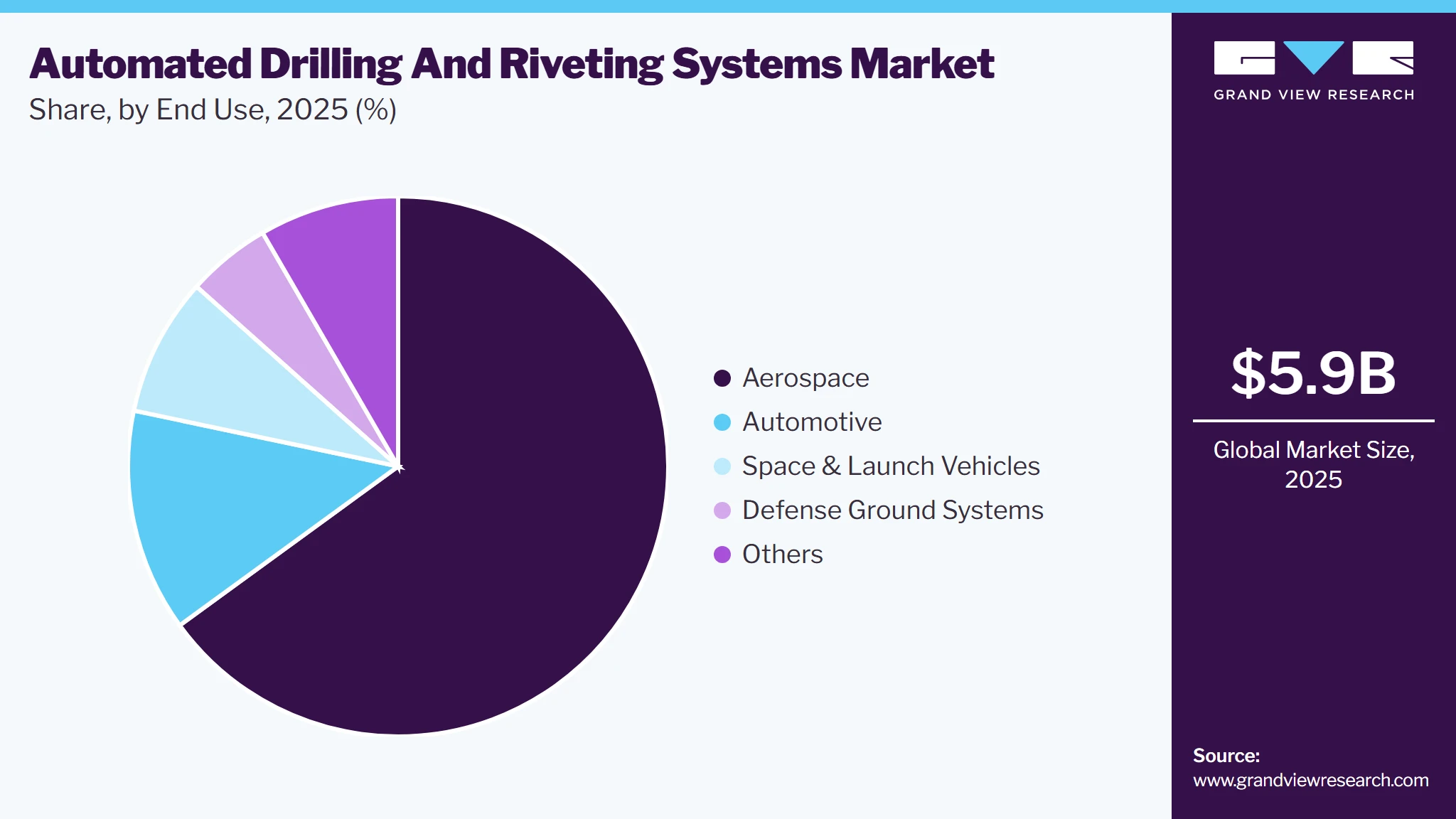
The aerospace segment held the largest revenue share of 65.0% in 2025, reflecting the extensive use of automated drilling and riveting equipment in aircraft structural manufacturing. Fuselage sections, wing assemblies, and other airframe components require accurately positioned holes and consistently formed mechanical joints to satisfy demanding structural and manufacturing specifications. The technical complexity of aircraft assembly reinforces the importance of specialized equipment capable of maintaining process repeatability across intricate structural configurations.
 To learn more about this report, Download Free Sample Report
The automotive segment is projected to record the fastest growth during the forecast period as vehicle manufacturers increase automation across body assembly and structural component production. The adoption of lightweight materials, evolving vehicle architectures, and the need for consistent fastening quality are creating opportunities for automated drilling and riveting solutions. Integration into digitally coordinated production lines further supports the application of these systems in automotive facilities seeking greater manufacturing flexibility and standardized assembly processes.
Regional Insights
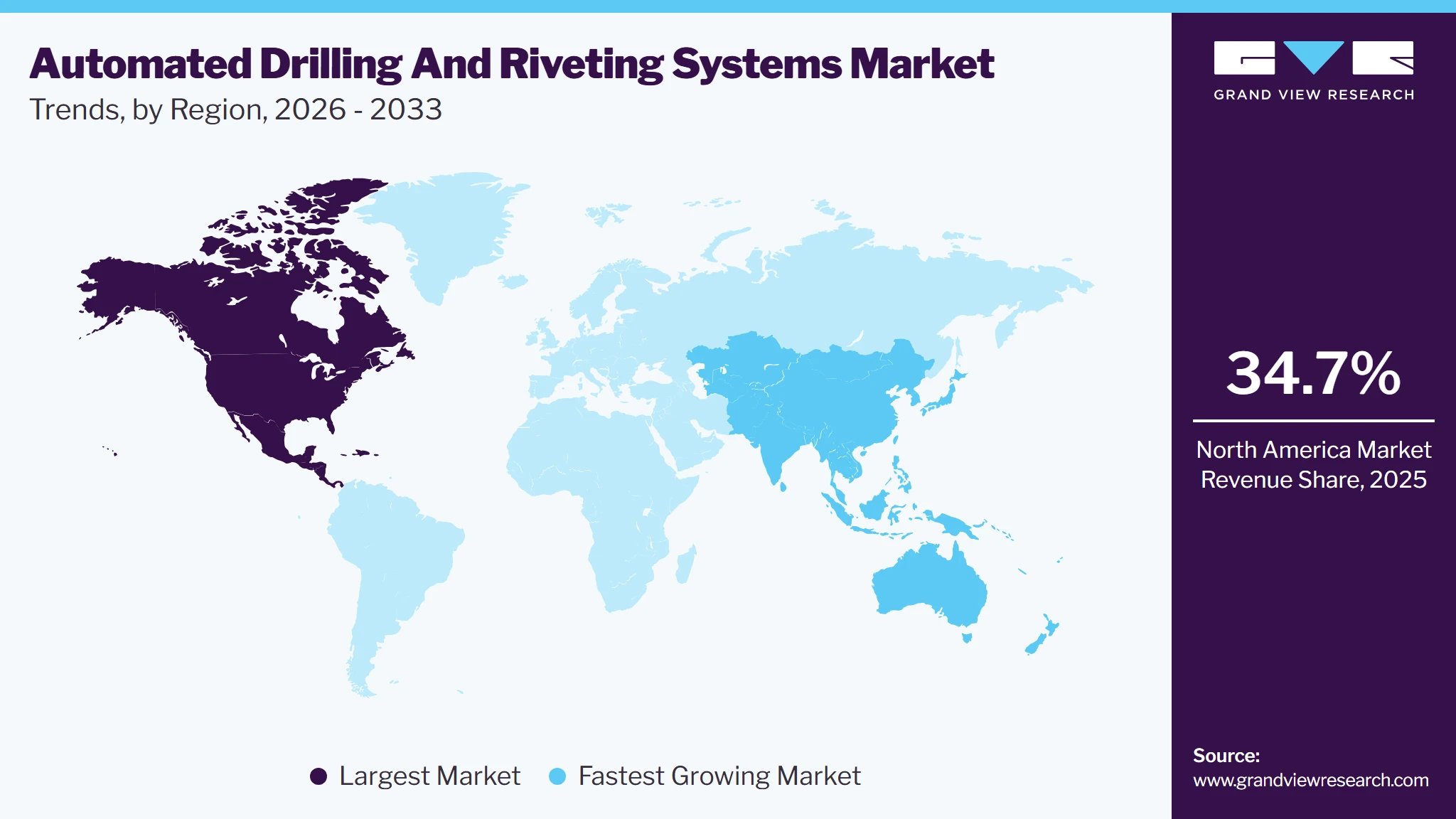
The North America automated drilling and riveting systems market dominated, accounting for a revenue share of 34.7% in 2025. North America maintains an established position in the market, supported by its aerospace manufacturing base, aircraft production programs, and advanced industrial automation capabilities. Investment in robotic assembly technologies and digitally controlled production processes continues to encourage the adoption of specialized equipment across aerospace and other precision-intensive industries.
 To learn more about this report, Download Free Sample Report
U.S. Automated Drilling and Riveting Systems Market Trends
The automated drilling and riveting systems market in the U.S. benefits from commercial aircraft manufacturing, defense procurement programs, and ongoing investment in aerospace production infrastructure. Aircraft manufacturers and component suppliers are incorporating robotic drilling cells, automated fastening platforms, and integrated inspection technologies to accommodate complex airframe configurations and maintain consistent assembly standards. These developments create opportunities for equipment providers offering application-specific systems and production-line integration capabilities.
Asia Pacific Automated Drilling and Riveting Systems Market Trends
The automated drilling and riveting systems market in Asia Pacific is expected to witness the fastest CAGR from 2026 to 2033, shaped by expanding aerospace manufacturing capabilities, greater participation in international aircraft supply chains, and rising automation across industrial production. Investment in aircraft assembly, structural component fabrication, and automotive manufacturing is broadening the application base for automated drilling and riveting equipment. Adoption varies across countries according to manufacturing capacity, technological maturity, and the scale of investment in advanced production infrastructure.
The China automated drilling and riveting systems market is influenced by domestic commercial aircraft development, defense manufacturing, and the expansion of aerospace component production. Efforts to strengthen indigenous manufacturing capabilities are generating requirements for specialized assembly equipment capable of meeting demanding structural specifications. The broader adoption of automation across automotive manufacturing also creates opportunities for drilling and riveting systems designed for repeatable fastening and high-volume production.
The automated drilling and riveting systems market in India is projected to register the fastest CAGR of 7.7% during the forecast period. Expansion of aerospace and defense manufacturing, increasing domestic aircraft component production, and investment in advanced assembly technologies are creating opportunities for specialized automation equipment. Greater participation in global aerospace supply chains and modernization of manufacturing facilities are expected to encourage adoption of systems offering precise drilling, consistent fastening, and repeatable structural assembly.
Europe Automated Drilling and Riveting Systems Market Trends
The automated drilling and riveting systems market in Europe benefits from a well-developed aerospace supply chain, advanced engineering capabilities, and established automotive manufacturing operations. Aircraft structural production requires equipment capable of accommodating complex geometries, material-specific machining parameters, and stringent fastening tolerances. Modernization of production facilities and the integration of robotic assembly technologies continue to support demand for automated drilling and riveting solutions.
The Germany automated drilling and riveting systems market is supported by its automotive manufacturing base, industrial automation expertise, and participation in aerospace component production. Manufacturers are investing in advanced assembly technologies to accommodate lightweight structural designs, complex component configurations, and increasingly automated production workflows. These requirements create opportunities for equipment suppliers specializing in precision fastening and integrated manufacturing systems.
The automated drilling and riveting systems market in the UK is influenced by aerospace and defense manufacturing, including aircraft structures, propulsion-related components, and specialized engineering applications. Production programs requiring high-integrity structural joints create demand for controlled drilling and riveting processes. Continued investment in advanced manufacturing capabilities and aerospace supply-chain development supports the deployment of specialized assembly equipment across component fabrication and aircraft production.
Middle East & Africa Automated Drilling and Riveting Systems Market Trends
The automated drilling and riveting systems market in the Middle East and Africa is shaped by industrial diversification, defense manufacturing initiatives, and the gradual development of advanced engineering capabilities. Investment in localized production and manufacturing infrastructure creates potential demand for automated assembly equipment, although adoption varies according to industrial maturity, capital availability, and the scale of aerospace manufacturing activity within individual countries.
The Saudi Arabia automated drilling and riveting systems market is influenced by initiatives to expand domestic defense production and develop advanced manufacturing capabilities. Investment in aerospace-related production, component fabrication, and industrial infrastructure may generate demand for precision assembly equipment as local manufacturing requirements become more sophisticated. Market development will depend on the progression of domestic production programs and the availability of supporting engineering expertise.
Latin America Automated Drilling and Riveting Systems Market Trends
The automated drilling and riveting systems market in Latin America reflects established aircraft manufacturing operations, automotive production facilities, and industrial suppliers seeking to modernize assembly processes. Demand for automated drilling and riveting systems is associated with requirements for repeatable fastening quality, dimensional control, and reduced dependence on manual assembly. Adoption remains sensitive to capital expenditure constraints, production volumes, and the availability of specialized technical expertise.
Key Automated Drilling and Riveting Systems Company Insights
Some of the key players operating in the market include Pilatus Flugzeugwerke AG, Electroimpact, MTorres, Atlas Copco, among others.
-
Pilatus Flugzeugwerke AG is a Switzerland-based aircraft manufacturer headquartered in Stans. The company specializes in the development and production of business aircraft, turboprop aircraft, and military training aircraft. Its manufacturing operations encompass aircraft structural fabrication, component integration, and final assembly, involving precision machining and fastening processes essential to airframe integrity. The company's relevance to the automated drilling and riveting systems market lies primarily in its aircraft manufacturing activities and associated structural assembly requirements.
-
Electroimpact, Inc. is an engineering and automation company headquartered in Mukilteo, Washington, U.S., specializing in advanced manufacturing equipment and automated aerospace assembly solutions. Its capabilities include automated drilling, fastening, riveting, and large-scale aircraft structural assembly systems. The company serves aerospace manufacturers through specialized equipment designed to improve hole-placement accuracy, fastening consistency, and production repeatability. Its direct involvement in automated drilling and riveting technologies positions it as a relevant participant in the global market.
Key Automated Drilling and Riveting Systems Companies
The following key companies have been profiled for this study on the automated drilling and riveting systems market.
-
Pilatus Flugzeugwerke AG
-
Electroimpact
-
MTorres
-
Atlas Copco
-
Kawasaki Heavy Industries
-
Fanuc
-
Universal Robots
-
Novator
-
PaR Systems
-
Gage Bilt
-
Orbitform
-
BalTec
-
Stanley Engineered Fastening
-
Gesipa
-
FAR
Competitive Benchmarking
Operating Strategies
Competitive Edge
Weaknesses
Mature Players: Electroimpact, MTorres, Atlas Copco, Kawasaki Heavy Industries, FANUC, Novator, PaR Systems, Gage Bilt, Orbitform, BalTec
- Established players focus on precision drilling, automated riveting, robotic assembly, and integrated manufacturing systems for aerospace and industrial applications. Their strategies emphasize equipment customization, process automation, and integration with existing production lines to accommodate complex geometries and stringent assembly tolerances.
- Extensive engineering expertise, established industrial relationships, and specialized automation capabilities strengthen their ability to deliver repeatable drilling and riveting operations. Their experience across robotics, fastening equipment, and automated assembly supports the integration of multiple manufacturing processes.
- High capital expenditure, complex system integration, and rigorous process validation can increase implementation costs and extend project timelines. Customized system requirements and compatibility with existing manufacturing infrastructure may further constrain deployment flexibility.
Emerging Players: Universal Robots, Stanley Engineered Fastening, GESIPA, FAR
- These companies concentrate on collaborative robotics, riveting tools, and specialized fastening technologies that can be incorporated into automated or semi-automated assembly processes. Their strategies emphasize modular equipment, application-specific solutions, and partnerships with system integrators to automate selected manufacturing operations.
- Focused product expertise, adaptable equipment configurations, and knowledge of fastening processes enable these providers to address specific joining requirements. Their solutions can complement larger automated systems and facilitate incremental upgrades to existing production lines.
- Providers focused on individual robotics or fastening products may require external integration, specialized tooling, and additional controls to deliver complete automated drilling and riveting systems. Qualification requirements and integration complexity can also limit their participation in large-scale aerospace assembly projects.
Recent Developments
-
In February 2025, Ascent Aerospace announced enhancements to Gemcor’s automated drilling and fastening technologies for aerospace manufacturing. The developments incorporated machine-learning-based inspection, adaptive process controls, digital-twin capabilities, and cycle-time optimization to improve assembly precision, process monitoring, and production consistency in aircraft structural manufacturing.
-
In June 2026, Advanced Integration Technology (AIT) completed the acquisition of Futuramic Tool & Engineering, including its affiliates Sharp Tooling Solutions and Jordan Tool. The transaction broadened AIT’s aerospace manufacturing and tooling capabilities, strengthening its portfolio in automated assembly, precision positioning, drilling, and integrated manufacturing solutions for aerospace and defense applications.
Automated Drilling and Riveting Systems Market Report Scope
Report Attribute
Details
Market size in 2025
USD 5.9 billion
Estimated market size in 2026
USD 6.2 billion
Projected market size by 2033
USD 8.9 billion
Growth rate
CAGR of 5.3% from 2026 to 2033
Base year for estimation
2025
Historical data
2021-2024
Forecast period
2026 - 2033
Quantitative units
Revenue in USD billion and CAGR from 2026 to 2033
Report coverage
Revenue forecast, company market position analysis, competitive landscape, growth factors, and trends
Segments covered
Machine type, automation, end use, region
Regional scope
North America; Europe; Asia Pacific; Latin America; and Middle East & Africa
Country scope
U.S.; Canada; Mexico; Germany; UK; Italy; Spain; France; China; Japan; India; Australia; South Korea; Brazil; Argentina; Saudi Arabia; UAE; South Africa
Key companies profiled
Pilatus Flugzeugwerke AG; Electroimpact; MTorres; Atlas Copco; Kawasaki Heavy Industries; Fanuc; Universal Robots; Novator; PaR Systems; Gage Bilt; Orbitform; BalTec; Stanley Engineered Fastening; Gesipa; FAR
Customization scope
Free report customization (equivalent up to 8 analysts working days) with purchase. Addition or alteration to country, regional & segment scope.
Pricing and purchase options
Avail customized purchase options to meet your exact research needs. Explore purchase options
Global Automated Drilling and Riveting Systems Market Report Segmentation
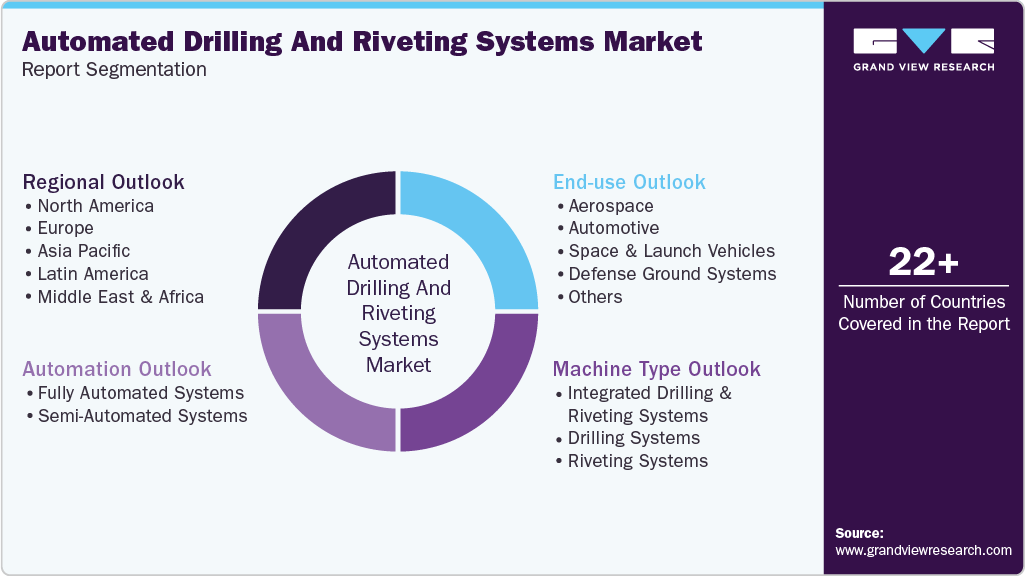
This report forecasts revenue growth at global, regional & country levels and provides an analysis of the industry trends in each of the sub-segments from 2021 to 2033. For this study, Grand View Research has segmented the global automated drilling and riveting systems market report based on machine type, automation, end use, and region:
 To learn more about this report, Download Free Sample Report
-
Machine Type Outlook (Revenue, USD Billion, 2021 - 2033)
-
Integrated Drilling & Riveting Systems
-
Drilling Systems
-
Riveting Systems
-
-
Automation Outlook (Revenue, USD Billion, 2021 - 2033)
-
Fully Automated Systems
-
Semi-Automated Systems
-
-
End Use Outlook (Revenue, USD Billion, 2021 - 2033)
-
Aerospace
-
Automotive
-
Space & Launch Vehicles
-
Defense Ground Systems
-
Others
-
-
Regional Outlook (Revenue, USD Billion, 2021 - 2033)
-
North America
-
U.S.
-
Canada
-
Mexico
-
-
Europe
-
Germany
-
France
-
UK
-
Spain
-
Italy
-
-
Asia Pacific
-
China
-
India
-
Japan
-
South Korea
-
Australia
-
-
Latin America
-
Brazil
-
Argentina
-
-
Middle East & Africa
-
Saudi Arabia
-
UAE
-
South Africa
-
-
Research Methodology
The automated drilling and riveting systems market figures in this report are based on a proven research process that combines executive interviews with secondary research from proprietary databases, company filings, and recognized regulatory and institutional sources. Market size is built through value-chain sizing-reconciling supply-side and demand-side estimates-and triangulated with bottom-up and top-down approaches. Every estimate passes multiple levels of expert validation before publication, with each automated drilling and riveting systems segment quantified using the revenue-capture definitions in the table below.
Segment Definition
Segment - Machine Type
Revenue Capture Definition
Integrated Drilling & Riveting Systems
Revenue generated from the sale of integrated drilling and riveting systems designed to perform coordinated hole-making and fastener-installation operations within a unified assembly platform.
Drilling Systems
Revenue generated from the sale of automated drilling systems engineered to produce precision holes in structural components and assemblies across aerospace, automotive, and other industrial applications.
Riveting Systems
Revenue generated from the sale of automated riveting systems designed to install rivets and establish permanent mechanical joints in manufactured structures and components.
Segment -Automation
Revenue Capture Definition
Fully Automated Systems
Revenue generated from the sale of fully automated drilling and riveting systems that execute programmed assembly operations with minimal manual intervention throughout the production cycle.
Semi-Automated Systems
Revenue generated from the sale of semi-automated drilling and riveting systems that combine mechanized operations with operator-led positioning, loading, alignment, or process control.
Segment -
End Use
Revenue Capture Definition
Aerospace
Revenue generated from the sale of automated drilling and riveting systems for aircraft structures, fuselage sections, wings, airframe components, and other aerospace assemblies.
Automotive
Revenue generated from the sale of automated drilling and riveting systems for vehicle bodies, chassis components, structural assemblies, and other automotive parts requiring precision fastening.
Space & Launch Vehicles
Revenue generated from the sale of automated drilling and riveting systems for spacecraft structures, launch vehicle assemblies, satellite components, and related aerospace structures.
Defense Ground Systems
Revenue generated from the sale of automated drilling and riveting systems for armored vehicle structures, military ground equipment, and other defense-related assemblies requiring permanent mechanical joints.
Others
Revenue generated from the sale of automated drilling and riveting systems for applications across industrial machinery, rail transportation, electronics, and other manufacturing sectors not classified under the specified end-use segments.
Estimation Model
Layer Name
Key Question
Description
Industrial Demand Assessment
Which end-use industries generate demand for automated drilling and riveting systems?
Market demand is assessed across aerospace, automotive, space and launch vehicles, defense ground systems, and other industrial applications. Aircraft structural assembly, vehicle body manufacturing, launch vehicle fabrication, and defense equipment production are evaluated according to component volumes, joining requirements, manufacturing capacity, and investment in automated assembly operations.
Equipment Configuration & Automation Assessment
How do machine type and automation levels determine equipment requirements?
The market is segmented into integrated drilling and riveting systems, drilling systems, and riveting systems, with further classification into fully automated and semi-automated configurations. Assessment criteria include drilling precision, riveting consistency, positioning accuracy, production throughput, component geometry, operator intervention, and integration of drilling and fastening processes.
Application & Equipment Deployment Assessment
What technical and operational requirements influence system selection and deployment?
Equipment deployment is examined across the specified end-use industries, considering structural complexity, material characteristics, hole-placement tolerances, fastener specifications, production-cycle requirements, and assembly-line configuration. The assessment distinguishes demand for integrated systems from standalone equipment and considers procurement associated with new installations, production-capacity expansion, and modernization of existing assembly lines.
Market Revenue Estimation
How is total market revenue calculated across equipment categories?
Total market revenue is derived from sales of integrated drilling and riveting systems, standalone drilling systems, and standalone riveting systems across automation categories, end-use industries, and regional markets. The estimation incorporates equipment sales volumes, average selling prices, automation configuration, technical specifications, and system customization.
Delivered Customizations
This report has been delivered with the following In-depth customizations
Client Request
Customization Delivered
Value Adds
Regional Segmentation
A comprehensive regional assessment was conducted across North America, Europe, Asia Pacific, Latin America, and the Middle East & Africa, with country-level analysis of the U.S., Germany, China, India, Brazil, and Saudi Arabia. The assessment examined aircraft manufacturing activity, aerospace supply-chain development, defense aviation programs, investments in production facilities, and the adoption of automated structural assembly technologies.
Enabled evaluation of geographic demand variations, regional manufacturing capabilities, aerospace investment patterns, and country-specific growth prospects. The analysis also helped identify markets with expanding aircraft production capacity and increasing requirements for automated assembly equipment.
Competitive benchmarking
A structured evaluation of market participants was undertaken across automated drilling and riveting technologies, system configurations, robotic integration, positioning accuracy, fastening precision, process monitoring, production throughput, material compatibility, equipment customization, and service capabilities.
Facilitated comparative assessment of supplier capabilities, technological differentiation, product portfolio coverage, and competitive positioning. The findings also supported evaluation of equipment specialization, integration expertise, and suppliers’ capacity to address complex aerospace assembly requirements.
Opportunity assessment
Market opportunities were examined across integrated drilling and riveting systems, standalone drilling equipment, dedicated riveting systems, fully automated platforms, and semi-automated configurations. The assessment considered aerospace manufacturing requirements, aircraft structural complexity, composite-material processing, production-line modernization, and the integration of automated equipment into existing assembly infrastructure.
Helped identify commercially attractive equipment categories, automation configurations, and application areas. The assessment further supported evaluation of investment prospects associated with manufacturing capacity expansion, replacement of conventional assembly processes, and the adoption of advanced automation technologies.
Frequently Asked Questions About This Report
Aerospace dominated the end-use segment with a revenue share of 65.0% in 2025, reflecting the extensive use of automated drilling and riveting equipment in aircraft structural manufacturing. Automotive is projected to register the fastest CAGR of 6.2% during the forecast period, driven by increasing automation in vehicle body assembly and structural component production.
The market is driven by rising aircraft production, increasing adoption of automated assembly processes, demand for precision fastening, growing use of lightweight composite materials and aluminum alloys, and advancements in robotic drilling, machine vision, and process monitoring technologies
The global automated drilling and riveting systems market was valued at USD 5.9 billion in 2025 and is estimated to reach USD 6.2 billion in 2026.
The global automated drilling and riveting systems market is projected to grow at a compound annual growth rate (CAGR) of 5.3% from 2026 to 2033, reaching USD 8.9 billion by 2033.
North America dominated the global automated drilling and riveting systems market with a revenue share of 34.7% in 2025.
Integrated drilling & riveting systems dominated the machine type segment with a revenue share of 62.6% in 2025, supported by the advantages of combining hole preparation and fastener installation within a unified equipment platform.
Riveting systems are projected to register the fastest CAGR of 5.8% during the forecast period, driven by the need for reliable mechanical joints and advancements in automated fastener installation and riveting process control.
Fully automated systems dominated the automation segment with a revenue share of 68.6% in 2025, supported by the demand for consistent assembly processes, repeatable operations, and reduced dependence on manual intervention.
Key players include Pilatus Flugzeugwerke AG, Electroimpact, MTorres, Atlas Copco, Kawasaki Heavy Industries, Fanuc, Universal Robots, Novator, PaR Systems, Gage Bilt, Orbitform, BalTec, Stanley Engineered Fastening, Gesipa, and FAR.
About the Author(s)
Advanced Interior Materials Research Team
Advanced Materials · Advanced Interior MaterialsThis report was authored by the advanced interior materials research team at Grand View Research - comprising two research analysts, one senior research analyst, and one industry expert - with specialized expertise in the advanced interior materials segment of the advanced materials industry. All findings are based on proprietary advanced materials databases, executive interviews, and regulatory analysis, subject to internal peer review prior to publication.
Last Updated:
Speak to Analyst

Customize this report to your needs - add regions, segments, or data points, with 20% free customization.
Or view our licence options:


ISO 9001:2015 & 27001:2022 Certified
We are GDPR and CCPA compliant! Your transaction & personal information is safe and secure. For more details, please read our privacy policy.


