
- Home
- »
- Next Generation Technologies
- »
-
Automated Guided Vehicle Market Size & Share Report, 2033GVR Report cover

Automated Guided Vehicle Market (2026 - 2033) Size, Share & Trends Analysis Report By Vehicle Type (Tow Vehicle, Unit Load Carrier), By Navigation Technology, By Application, By Industry, By Component, By Battery Type, By Mode Of Operation, And Segment Forecasts
Market Size, 2025
$5.9BMarket Estimate, 2026
$6.5BMarket Forecast, 2033
$11.6BCAGR, 2026–2033
8.5%Automated Guided Vehicle Market Summary
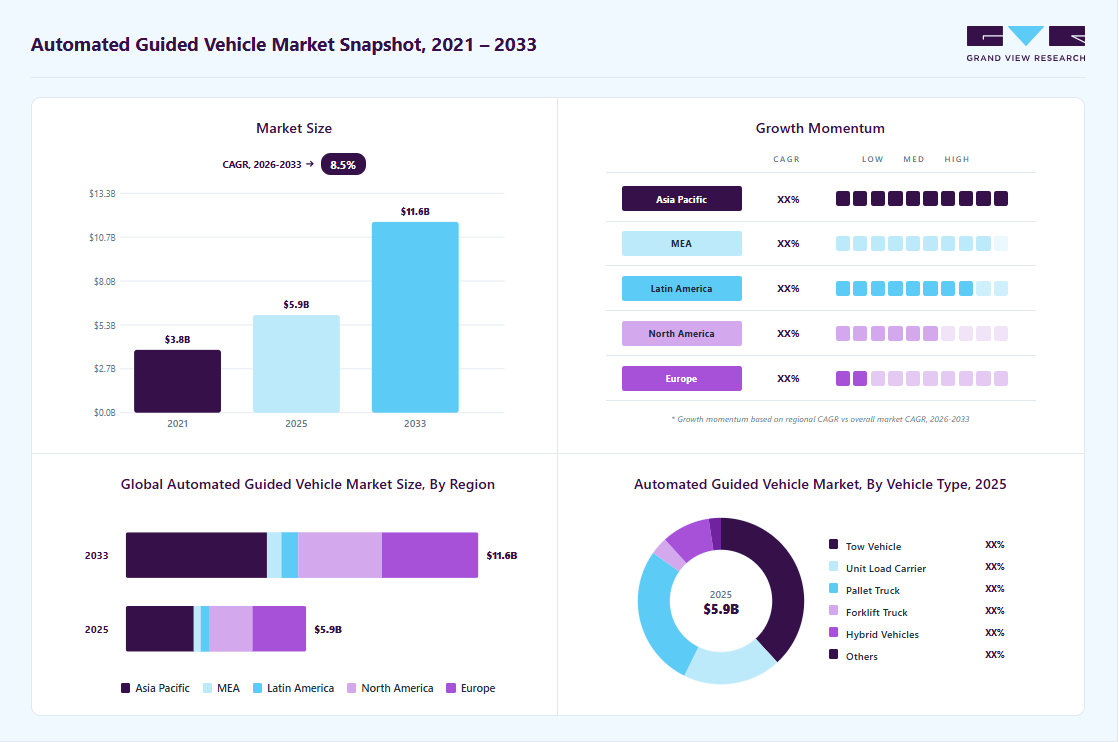
The global automated guided vehicle market size was valued at USD 5.9 billion in 2025 and is projected to grow from USD 6.5 billion in 2026 to USD 11.6 billion by 2033, at a CAGR of 8.5% from 2026 to 2033. Asia Pacific dominated the global automated guided vehicle market with the largest revenue share of 37.6% in 2025. The market is driven by the increasing adoption of Industry 4.0 technologies, rising demand in the warehouse automation industry, growth in the e-commerce and material handling automation sectors, advancements in robotics and AI integration, and the need to reduce labor costs and improve operational efficiency.
 Source: Grand View Research, IR Documents, Primary Interviews, Paid DatabasesTo learn more about this report,
 Download Free Sample Report
 Key Market Trends & Insights
- By vehicle type: Tow vehicle segment led the market with the largest revenue share of 38.2% in 2025.
- By technology: Laser guidance segment led the market with the largest revenue share of 39.4% in 2025.
- By industry: Manufacturing sector segment accounted for the largest market revenue share in 2025.
Regional Highlights
- Largest regional market: Asia Pacific (37.6% revenue share, 2025)
- By country: The China held the largest market share in 2025.
Market Size & Forecast
- Market size in 2025: USD 5.9 Billion
- Estimated market size in 2026: USD 6.5 Billion
- Projected market size by 2033: USD 11.6 Billion
- CAGR (2026-2033): 8.5%
Three ways to get this report
Buy it, customize it, or ask a question.Ask an Analyst
Analyst response in 1 business day
- AccessReport author, directly
- Reply timeWithin 1 working day
- No sales callDirect answer only
- FormatEmail reply
- CostFree, no cost
Get the Full Report
What the study covers
- FormatsPDF · Excel · Dashboard
- Timeline2026–2033 annual, 2025 base
- Coverage20+ countries, 5 regions
- Companies10+ key players profiled
Customize the Report
20% free customization
- IncludeCountries, segments, points
- TailorTo your product definition
- ExtendDeeper competitor detail
- OrA fully bespoke study
- Turnaround5–10 working days
The automated guided vehicle (AGV) industry is witnessing significant growth, driven by the integration of artificial intelligence (AI) and the Internet of Things (IoT) that enable smarter navigation, predictive maintenance, and real-time fleet optimization.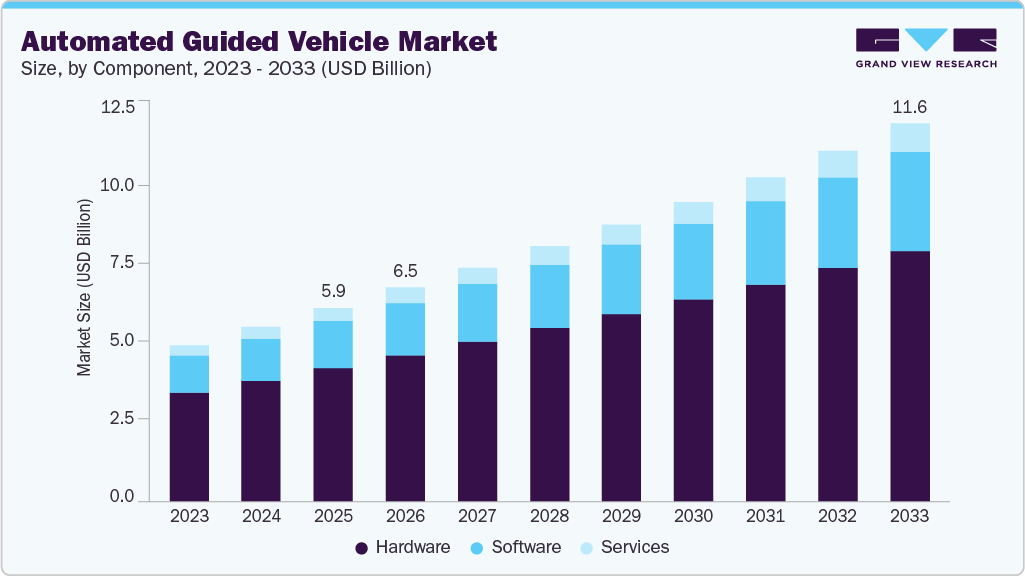 To learn more about this report, Download Free Sample Report
 Rising demand for warehouse automation and efficient material handling is accelerating adoption across manufacturing, logistics, and e-commerce. Hybrid systems combining AGVs with autonomous mobile robots (AMRs) are enhancing operational flexibility, scalability, and interoperability in complex environments. Cloud-based fleet management and centralized control systems are facilitating real-time monitoring, remote diagnostics, and rapid deployment of robotic fleets. In addition, labor shortages, cost reduction imperatives, and the push for higher throughput are strengthening the importance of AGV market growth in modern supply chains.
Advancements in LiDAR, machine vision, and AI-based navigation are enabling the AGVs market to perform complex tasks with greater precision and adaptability. The adoption of AGV-as-a-Service (AGVaaS) is lowering barriers for small and medium enterprises, making automation accessible without significant upfront investment. AGVs are also becoming more adaptable, with applications covering warehouse automation markets and production line optimization. The global focus on Industry 4.0 and smart manufacturing continues to drive demand for the AGV market.
Innovations in battery technology, such as lithium-ion systems, are improving AGV runtime and efficiency in industrial automation vehicles. Integration with advanced software, including warehouse management systems (WMS) and IoT platforms, is expanding automated guided vehicle industry functionality by enabling real-time inventory management and predictive maintenance.
The automated guided vehicle industry is growing in specialized environments such as cold storage and hazardous-material handling, highlighting its adaptability. Growing demand for customized AGV solutions is driving product innovation among market leaders. As organizations focus on supply chain flexibility, AGVs are becoming essential to vehicle and industry automation strategies and supporting long-term growth.
Market Dynamics
The expanding deployment of Automated Guided Vehicles (AGVs) in healthcare facilities is significantly driving market growth by improving operational efficiency, reducing manual transportation activities, and ensuring continuous material flow across hospitals and pharmaceutical environments. Healthcare institutions are increasingly using AGVs to automate the transportation of medicines, laboratory samples, surgical instruments, linens, and medical waste, thereby streamlining workflows and minimizing human intervention in critical operations. Rising emphasis on infection prevention, contactless delivery systems, and hygienic material handling is further accelerating AGV adoption across modern healthcare facilities. Additionally, growing investments in smart hospitals, digital healthcare infrastructure, and autonomous logistics technologies, supported by advancements in navigation software and fleet management systems, are strengthening long-term market expansion.
The increasing deployment of AGVs in airport operations is a major market driver due to rising demand for efficient baggage handling, cargo transportation, and autonomous ground support operations. Airports are integrating AGVs to optimize baggage transfer, improve cargo movement efficiency, and enhance operational productivity amid growing global passenger and freight traffic. Expanding smart airport infrastructure projects and investments in autonomous ground handling technologies support AGV adoption by reducing operational delays and improving service efficiency. Furthermore, integrating artificial intelligence, machine vision, and real-time monitoring technologies into airport AGVs enhances navigation accuracy, fleet coordination, and operational safety, accelerating adoption across the aviation sector.
Rising cybersecurity risks associated with connected AGV fleet operations are emerging as a major restraint for the automated guided vehicle market, as industrial facilities increasingly depend on cloud platforms, IoT connectivity, and centralized fleet management systems. AGVs integrated with wireless networks, autonomous navigation, and real-time monitoring technologies are becoming more vulnerable to cyberattacks, unauthorized access, malware, and data breaches, creating operational risks for manufacturers, warehouses, and logistics providers. These cybersecurity concerns can disrupt fleet coordination, disrupt material transportation, and negatively impact overall production efficiency, particularly in industries that handle sensitive operational data and critical infrastructure. In addition, the growing complexity of cybersecurity frameworks and the requirement for continuous software updates, network protection, and threat monitoring are increasing implementation challenges and operational costs for enterprises deploying AGV technologies.
Cybersecurity vulnerabilities also limit AGV market expansion by creating uncertainty about the reliability, safety, and scalability of autonomous industrial transportation systems. Organizations are increasingly required to invest in advanced cybersecurity infrastructure, encrypted communication protocols, and secure network architectures to protect AGV ecosystems from evolving cyber threats. However, the additional costs associated with cybersecurity implementation, employee training, and ongoing risk management are discouraging small and medium-sized enterprises from adopting large-scale AGVs. Furthermore, concerns about operational downtime, ransomware attacks, and system manipulation are eroding end-user confidence in highly time-sensitive industries such as automotive, healthcare, and e-commerce logistics.
The increasing deployment of automated guided vehicles in semiconductor manufacturing facilities is creating significant growth opportunities as chip manufacturers expand production capacities to meet rising global semiconductor demand. Semiconductor fabrication plants require highly precise, contamination-free, and continuous material transportation systems for wafers, reticles, and sensitive electronic components, making AGVs well-suited for automated cleanroom logistics. Growing investments in advanced semiconductor fabs for artificial intelligence chips, automotive semiconductors, and high-performance computing applications are accelerating AGV adoption to improve operational efficiency, production accuracy, and workflow automation. In addition, the integration of AGVs with smart manufacturing platforms, real-time monitoring systems, and automated material handling infrastructure is strengthening deployment in next-generation semiconductor facilities worldwide.
The rapid expansion of global semiconductor manufacturing ecosystems is also creating substantial revenue opportunities for AGV providers offering advanced navigation, precision handling, and cleanroom-compatible automation technologies. Governments and private enterprises are increasing investments in domestic semiconductor production facilities, driving demand for autonomous transportation systems capable of supporting high-volume manufacturing operations. AGVs integrated with artificial intelligence, machine vision, and intelligent fleet management technologies are enabling semiconductor manufacturers to optimize material flow, reduce operational bottlenecks, and improve production cycle efficiency. Furthermore, the growing focus on smart fabs, Industry 4.0 integration, and fully automated manufacturing environments is expected to accelerate AGV deployment across wafer fabrication plants and advanced electronics manufacturing facilities.
Market Concentration & Characteristics
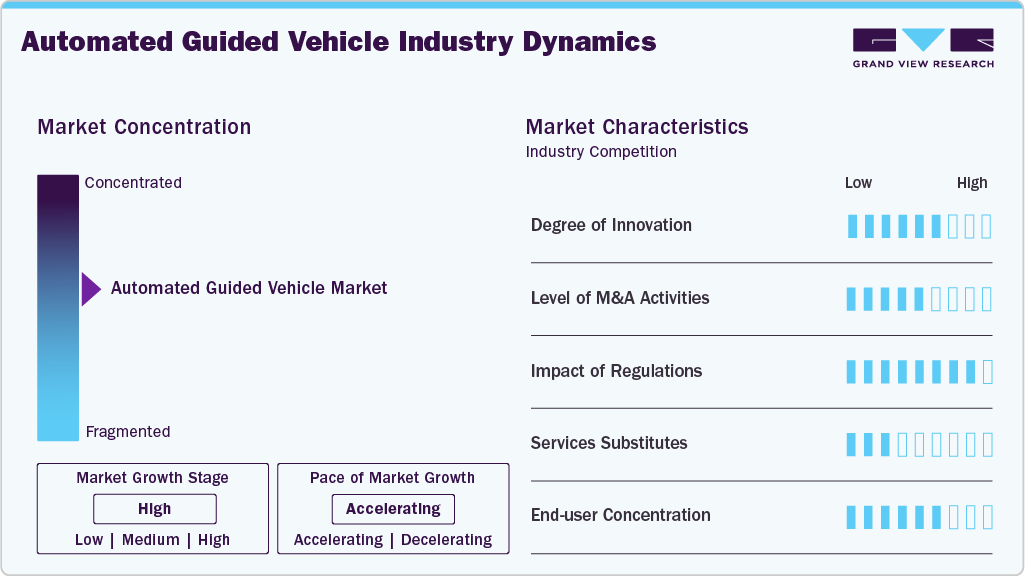
The automated guided vehicle (AGV) market demonstrates moderate concentration, with established intralogistics providers, industrial automation companies, and warehouse robotics vendors competing across manufacturing, e-commerce fulfillment, automotive production, semiconductor fabrication, and healthcare logistics applications. The competitive landscape is shaped by multinational enterprises leveraging integrated automation portfolios, advanced software ecosystems, and extensive industrial partnerships, while emerging technology firms focus on AI-enabled navigation, machine vision, and intelligent fleet management capabilities. Increasing investments in smart factories, warehouse digitalization, and autonomous material handling infrastructure are intensifying competition and accelerating technological innovation across the AGV ecosystem.
 To learn more about this report, Download Free Sample Report
 The market also faces competitive pressure from adjacent automation technologies, such as autonomous mobile robots (AMRs), conveyor systems, robotic forklifts, and traditional material handling equipment. In response, AGV manufacturers are prioritizing advancements in navigation precision, software interoperability, cybersecurity frameworks, and scalable fleet orchestration to strengthen product differentiation and operational performance. Furthermore, enterprise customers are increasingly demanding automation solutions that deliver measurable productivity improvements, reduced labor dependency, enhanced inventory visibility, and faster return on investment, thereby driving continuous innovation and strategic expansion within the market.
Vehicle Type Insights
The tow vehicle segment led the market with the largest revenue share of 38.2% in 2025. This growth is driven by increased demand for efficient material-handling automation across the automotive, manufacturing, and logistics sectors, where moving heavy loads is crucial. Two vehicles provide high load capacity and operational flexibility, supporting automated transport across large facilities while reducing manual labor and disruptions. Their ability to integrate with existing systems and adapt to diverse tasks makes them a preferred solution for scalable automation.
The forklift truck segment is projected to experience at the fastest CAGR over the forecast period. These vehicles automate complex tasks, such as high-level pallet stacking, material handling, and inventory management, which often require substantial manual effort. Automated forklifts help businesses reduce labor costs, minimize human error, and increase throughput across operations. Workplace safety and regulatory compliance are increasingly important as automated systems enhance precision and reduce the risk of accidents.
Navigation Technology Insights
The laser guidance segment accounted for the largest market revenue share in 2025. The high growth is due to the increasing demand for precise navigation solutions that ensure operational efficiency and safety in industrial environments. Laser guidance technology provides precise, reliable, and adaptable navigation solutions, which are essential for optimizing the performance of AGVs in complex industrial environments. Laser-guided AGVs utilize laser scanners to map and navigate their surroundings with high precision, enabling them to follow predefined paths and avoid obstacles with minimal errors. This high level of accuracy is essential for applications that require complex direction and consistent performance, such as in the large warehouse automation industry, the manufacturing automation industry, and distribution centers.
The natural navigation segment is expected to experience at the fastest CAGR during the forecast period, due to its advanced capabilities in using environmental features for navigation, which significantly enhance operational efficiency and adaptability. Natural navigation technology, including techniques such as simultaneous localization and mapping (SLAM) and vision-based systems, enables AGVs to navigate by interpreting and mapping their surroundings in real time, without relying on predefined paths or physical markers. This capability enables them to operate in highly variable and unstructured environments, such as changing warehouse layouts or evolving production lines, without the need for extensive reconfiguration.
Application Insights
The logistics and warehousing segment accounted for the largest market revenue share in 2025, driven by the growing need to improve automated material-handling processes in warehouses and distribution centers. This automation enhances productivity and accelerates order fulfillment, enabling faster and more efficient warehouse operations by improving accuracy and workflow efficiency. AGVs contribute to cost savings and higher operational performance. As businesses continue to prioritize supply chain optimization, the adoption of AGVs in automation in the sectors such as logistics and warehousing is expected to expand steadily.
The assembly segment is expected to experience at the fastest CAGR during the forecast period, driven by the increasing demand for efficiency, precision, and flexibility in manufacturing and assembly processes. AGVs are essential in modern production environments due to their ability to streamline complex workflows, reduce manual labor, and enhance overall operational efficiency. The ability to automate repetitive, labor-intensive tasks, such as transporting parts and components between stages of the assembly line, is also driving the segment's growth.
Industry Insights
The manufacturing sector segment accounted for the largest market revenue share in 2025, driven by the rising demand for automated solutions that streamline production workflows and reduce reliance on manual labor. This automation reduces traffic, minimizes downtime, and optimizes overall production efficiency, integrating with Industry 4.0 technologies such as IoT and real-time data analytics, enabling manufacturers to continuously monitor and enhance operational performance. As a result, AGVs are becoming essential tools for manufacturers seeking to improve productivity, reduce costs, and maintain operational excellence.
The wholesale and distribution sector segment is expected to experience at the fastest CAGR over the forecast period, driven by the increasing need for operational efficiency, accuracy, and scalability in handling large volumes of goods. AGVs perform warehouse automation tasks such as moving products from receiving docks to storage, picking and sorting items for order fulfillment, and transporting goods to shipping areas, reducing manual labor and minimizing errors. This automation accelerates processing times, enhances accuracy, and supports high-speed operations, all of which are essential to modern supply chains.
Component Insights
The hardware segment accounted for the largest market revenue share in 2025, driven by the increasing adoption of automation technologies that require advanced components for efficiency and scalability. Technological advancements, including more precise sensors and strong battery systems, have significantly enhanced AGV capabilities and versatility. Industries such as manufacturing, logistics, and warehousing are increasingly deploying AGVs to streamline operations, reduce labor costs, and boost productivity. This growing adoption is driving strong demand for high-quality hardware solutions that offer improved accuracy, speed, and durability.
The services segment is projected to grow at the fastest CAGR during the forecast period, driven by increased demand for AGV maintenance, operational support, and employee training as AGVs become more advanced and essential to industrial operations. Comprehensive services are crucial for maintaining performance and reliability. Core offerings include preventive and corrective maintenance, system upgrades, installation support, and health monitoring. These services help businesses improve efficiency, reduce downtime, and extend the lifespan of their AGV fleets. As a result, the complexity and strategic role of AGVs are prompting greater investment in service-based solutions.
Battery Type Insights
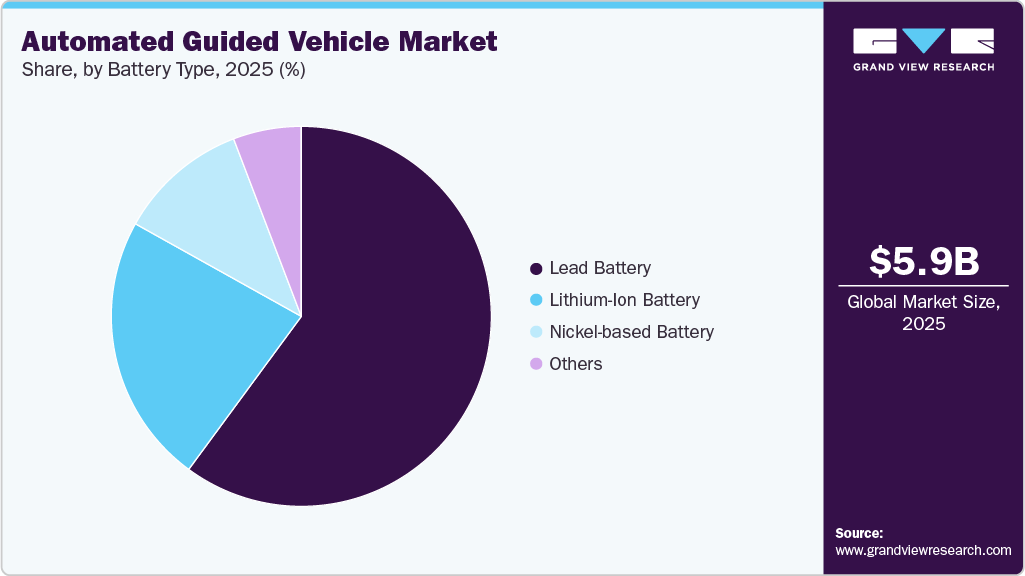
The lead battery segment accounted for the largest market revenue share in 2025, driven by the widespread use of AGVs in cost-sensitive industries. The affordability and reliability of lead-acid batteries make them well-suited for organizations seeking to balance operational efficiency with budgetary limitations. These batteries provide a stable power source, ensuring consistent AGV performance and durability under varying operational conditions. Their robust technology supports industries that depend on AGVs for critical material-handling and warehouse-automation tasks.
 To learn more about this report, Download Free Sample Report
 The lithium-ion battery segment is projected to experience at the fastest CAGR during the forecast period, driven by the rising demand for high-performance, energy-efficient solutions in automated operations. These batteries offer superior energy density, enabling AGVs to operate for extended periods and maintain high productivity without frequent recharging support flexible deployment, particularly in high-demand environments. Industries prioritizing sustainability and operational efficiency are increasingly adopting these batteries to reduce downtime and improve workflow continuity.
Mode of Operation Insights
The indoor segment accounted for the largest market revenue share in 2025, driven by the growing focus on automation in controlled environments where precision and efficiency are critical. Industries that require automation, such as warehousing, manufacturing, and distribution, are increasingly adopting indoor AGVs to optimize space, enhance operational efficiency, and maintain high accuracy in the material handling automation sector. The surge in e-commerce and the focus on streamlined warehouse operations are driving demand for AGVs capable of transporting, sorting, and storing goods with minimal error. Reduced human intervention, improved safety, and better inventory management further boost the adoption of indoor AGVs.
The outdoor segment is expected to grow at the fastest CAGR during the forecast period, driven by rising demand for AGVs capable of managing logistics and material transport in open, unstructured environments such as construction sites, ports, and large industrial facilities. Expansion in supply chain and logistics operations requires efficient automated material handling across extensive outdoor areas. Outdoor AGVs are required to navigate complex environments and perform tasks such as transporting goods between loading docks, managing outdoor storage yards, and supporting construction site operations. Their ability to operate reliably under varying environmental conditions enhances operational continuity and efficiency. As industries increasingly seek scalable automation, warehouse, material handling, and industrial automation vehicle solutions, the market is driven.
Regional Insights
The automated guided vehicle (AGV) market in North America held a significant share in 2025, indicating strong regional adoption of automation technologies. North America AGV market growth is primarily driven by the e-commerce boom, increasing demand for workplace safety and operational efficiency, and a growing focus on environmental sustainability. AGVs are being deployed across industries to automate material handling, enhance inventory management, and streamline order fulfillment. Leading e-commerce players, including Amazon and Walmart, are accelerating the adoption of the North America AGV market to meet rising consumer expectations for faster and more reliable deliveries.
U.S. Automated Guided Vehicle Market Trends
The automated guided vehicle (AGV) market in the U.S. accounted for the largest market revenue share in North America in 2025, driven by the widespread adoption of automation to address labor shortages and improve operational efficiency across various sectors. The rapid expansion of the e-commerce industry, fueled by increasing consumer demand for faster deliveries, is a major driver of U.S. AGV market growth. AGVs play a critical role in automating warehouse operations, including inventory management, order fulfillment, and material handling automation. As businesses prioritize speed, accuracy, and cost efficiency, the deployment of AGVs is becoming increasingly essential for maintaining a competitive advantage in the U.S. AGV market.
Europe Automated Guided Vehicle Market Trends
The automated guided vehicle (AGV) market in Europe is projected to grow rapidly, driven by increasing automation across key industries. The Europe AGV market’s automotive sector, particularly in Germany and the UK, extensively deploys AGVs for automated assembly lines, material transport, and parts handling. European companies are placing greater focus on energy-efficient and sustainable solutions, with electric-powered AGVs supporting environmental goals and reducing carbon footprints. As operational efficiency and sustainability become top priorities, the European AGV automation market is emerging as an essential tool for modernizing industrial and manufacturing processes.
Asia Pacific Automated Guided Vehicle Market Trends
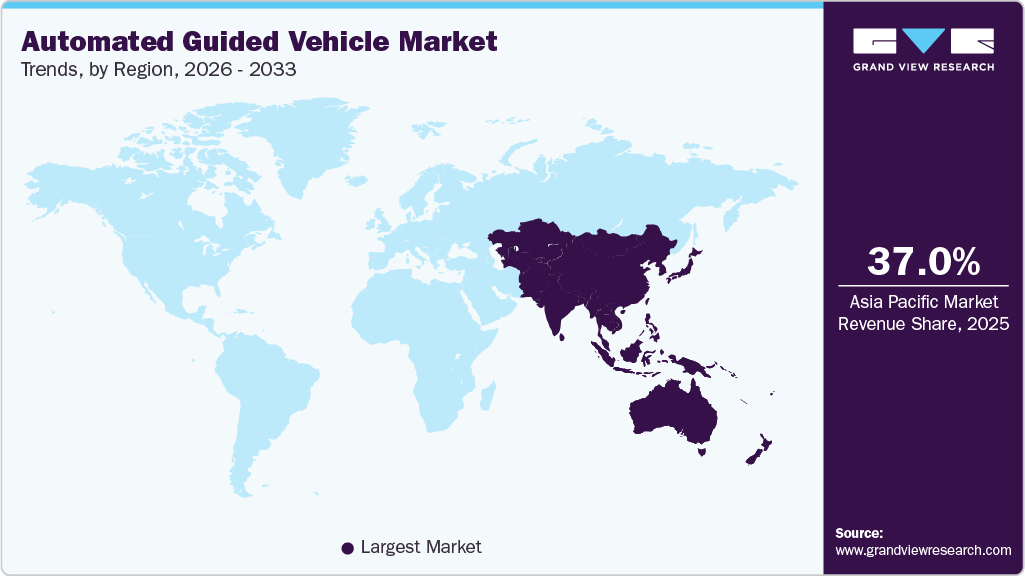
Asia Pacific dominated the global automated guided vehicle (AGV) market with the largest revenue share of 37.6% in 2025 and is expected to register at the fastest CAGR over the forecast period, driven by rapid industrialization and growing adoption of automation in the region. The Asia Pacific AGV market is experiencing a surge in e-commerce, particularly in countries like China and India, where online retail has become a dominant sales channel. AGVs are increasingly deployed in warehouses and fulfillment centers to manage high order volumes, streamline inventory management, and optimize order processing. As businesses focus on efficiency, scalability, and faster delivery, the Asia Pacific AGV market is becoming critical for supporting the region’s expanding logistics and manufacturing operations.
 To learn more about this report, Download Free Sample Report
 Key Automated Guided Vehicle Company Insights
Some key players in the automated guided vehicle industry, such as BALYO, Bastian Solutions, LLC, and Daifuku Co., Ltd., are actively expanding their customer base and seeking to gain a competitive advantage. To achieve this, they are pursuing strategic initiatives such as partnerships, mergers and acquisitions, collaborations, and the development of new products and technologies. This proactive approach allows them to enhance their market presence and innovate in response to evolving security needs.
-
BALYO specializes in designing, engineering, and manufacturing autonomous forklifts by converting standard trucks into intelligent, self-driving vehicles. Their technology enables conventional forklifts to operate independently, assisting human operators without the need for reflectors or ground lines. BALYO offers a diverse range of Autonomous Guided Vehicles (AGVs) designed to automate warehouse and factory operations, enhancing efficiency and productivity. The company plays a key role in the AGV market by providing innovative solutions that support seamless material handling and operational automation.
-
Bastian Solutions LLC is a provider of material handling and automation solutions, offering integrated systems that include AGVs, robotics, conveyor systems, and Warehouse Management Systems (WMS). The company focuses on helping businesses optimize operations, boost productivity, and enhance supply chain efficiency through customized automation solutions. Its offerings are broadly divided into solutions and services, covering system design, implementation, and ongoing support. In the AGV market, Bastian Solutions helps companies deploy automated material handling systems that improve operational performance and scalability.
Key Automated Guided Vehicle Companies:
The following key companies have been profiled for this study on the automated guided vehicle market.
- Swisslog Holding AG
- KION GROUP AG
- Bastian Solutions, LLC
- Daifuku Co., Ltd.
- Dematic
- JBT
- Seegrid Corporation
- TOYOTA INDUSTRIES CORPORATION
- Hyster-Yale Materials Handling, Inc.
- BALYO
- E&K Automation GmbH
- Kollmorgen
- KMH Fleet Solutions
- ELETTRIC80 S.P.A.
- inVia Robotics, Inc.
- Locus Robotics
- Schaefer Systems International, Inc.
- System Logistics Spa
- Transbotics (A division of Scott Systems International Incorporated)
- Zebra Technologies Corp.
Competitive Benchmarking
Operating Strategies
Competitive Edge
Weaknesses
Mature Players: Daifuku Co., Ltd.; KION GROUP AG; Dematic; Swisslog Holding AG
- Mature players are increasing investments in AI-powered AGV fleet optimization technologies.
- Leading companies are expanding partnerships with smart warehouse automation providers globally.
- Mature players benefit from strong global distribution and industrial service networks.
- Established companies possess advanced automation expertise and large enterprise customer bases.
- Mature companies face challenges adapting quickly to evolving automation technologies.
- Large organizational structures often reduce agility in rapidly changing market conditions.
Emerging Players: BALYO; Locus Robotics; inVia Robotics, Inc.; Seegrid Corporation
- Emerging players are focusing on AI-enabled and vision-guided AGV innovations.
- Emerging vendors are emphasizing flexible and customizable AGV deployment capabilities.
- Emerging players rapidly adopt advanced navigation and real-time analytics technologies.
- Startups are leveraging cloud-based fleet management for operational scalability advantages.
- Emerging players face difficulties competing with established vendors’ large R&D investments.
- Emerging companies face limited financial resources for large-scale global expansion.
Recent Developments
-
In November 2025, Dematic expanded its Automated Guided Vehicle (AGV) portfolio with the launch of the RTS 120 Reach Truck, a driverless vehicle designed for high-bay, single-selective racking environments. The RTS 120 can be deployed in both new and existing warehouse layouts without major infrastructure modifications, enabling seamless and cost-effective automation. With lifting capacities up to 1,200 kg and reaching heights of 10 meters, it enhances high-bay handling, improves safety, and reduces manual labor requirements. Integrated with Dematic’s MANAGE+ AGV Warehouse Control Software, the RTS 120 provides end-to-end operational visibility and data-driven optimization, boosting overall warehouse efficiency.
-
In June 2025, enVista launched enMotion, an end-to-end warehouse optimization platform designed to manage multiple robotic systems, including AGVs, cobots, and goods-to-person technologies. The platform uses an AI-powered orchestration engine combined with enVista’s WES and WCS to optimize the flow of orders, inventory, and automation assets in real time. Its autonomous robotic solutions, featuring lidar-guided SLAM navigation and 360° safety scanners, can reduce travel and search times by up to 80%, enhancing throughput and operational safety. Offered through a Robotics-as-a-Service (RaaS) model, enMotion enables scalable deployment without heavy upfront investment, helping businesses improve efficiency and reduce labor dependency.
-
In March 2025, Scott Technology launched NexBot, a modular Automated Guided Vehicle (AGV) designed to reduce deployment costs and accelerate automation adoption. Its flexible architecture allows configuration with various functional modules, including counterbalance forks, tugger units, and conveyor decks, to meet diverse material handling needs. NexBot integrates seamlessly with Scott’s Maestro+ platform and features advanced navigation, safety systems, and fast-charging lithium-ion power for continuous operation. The AGV provides scalable, efficient automation solutions that address labor shortages and optimize workflow across warehousing, logistics, manufacturing, and e-commerce operations.
Automated Guided Vehicle Market Report Scope
Report Attribute
Details
Market size in 2025
USD 5.9 billion
Estimated market size in 2026
USD 6.5 billion
Projected market size by 2033
USD 11.6 billion
Growth rate
CAGR of 8.5% from 2026 to 2033
Base year for estimation
2025
Historical data
2021 - 2024
Forecast period
2026 - 2033
Quantitative units
Revenue in USD million/billion, and CAGR from 2026 to 2033
Report coverage
Revenue forecast, company ranking, competitive landscape, growth factors, and trends
Segments covered
Vehicle type, navigation technology, application, industry, component, battery type, mode of operation, region
Regional scope
North America; Europe; Asia Pacific; Latin America; MEA
Country scope
U.S.; Canada; Mexico; Germany; UK; France; China; India; Japan; Australia; South Korea; Brazil; UAE; South Africa; KSA
Key companies profiled
Swisslog Holding AG; KION GROUP AG; Bastian Solutions, LLC; Daifuku Co., Ltd.; Dematic; JBT; Seegrid Corporation; TOYOTA INDUSTRIES CORPORATION; Hyster-Yale Materials Handling, Inc.; BALYO; E&K Automation GmbH; Kollmorgen; KMH Fleet Solutions; ELETTRIC80 S.P.A.; inVia Robotics, Inc.; Locus Robotics; Schaefer Systems International, Inc.; System Logistics Spa; Transbotics (A division of Scott Systems International Incorporated); Zebra Technologies Corp.
Customization scope
Free report customization (equivalent up to 8 analysts working days) with purchase. Addition or alteration to country, regional & segment scope.
Pricing and purchase options
Avail customized purchase options to meet your exact research needs. Explore purchase options
Global Automated Guided Vehicle Market Report Segmentation
This report forecasts revenue growth at global, regional, and country levels and provides an analysis of the latest industry trends in each of the sub-segments from 2021 to 2033. For this study, Grand View Research has segmented the global automated guided vehicle market report based on vehicle type, navigation technology, application, industry, component, battery type, mode of operation, and region.
-
Vehicle Type Outlook (Revenue, USD Billion, 2021 - 2033)
-
Tow Vehicle
-
Unit Load Carrier
-
Pallet Truck
-
Forklift Truck
-
Hybrid Vehicles
-
Others
-
-
Navigation Technology Outlook (Revenue, USD Billion, 2021 - 2033)
-
Laser Guidance
-
Magnetic Guidance
-
Vision Guidance
-
Inductive Guidance
-
Natural Navigation
-
Others
-
-
Application Outlook (Revenue, USD Billion, 2021 - 2033)
-
Logistics and Warehousing
-
Transportation
-
Cold Storage
-
Wholesale & Distribution
-
Cross-Docking
-
-
Assembly
-
Packaging
-
Trailer Loading and Unloading
-
Raw Material Handling
-
Others
-
-
Industry Outlook (Revenue, USD Billion, 2021 - 2033)
-
Manufacturing Sector
-
Automotive
-
Aerospace
-
Electronics
-
Chemical
-
Pharmaceuticals
-
Plastics
-
Defense
-
FMCG
-
Tissue
-
Others
-
-
Wholesale and Distribution Sector
-
E-commerce
-
Retail Chains/Conveyance Stores
-
Grocery Stores
-
Hotels and Restaurants
-
-
-
Component Outlook (Revenue, USD Billion, 2021 - 2033)
-
Hardware
-
Software
-
Services
-
-
Battery Type Outlook (Revenue, USD Billion, 2021 - 2033)
-
Lead Battery
-
Lithium-Ion Battery
-
Nickel-based Battery
-
Others
-
-
Mode of Operation Outlook (Revenue, USD Billion, 2021 - 2033)
-
Indoor
-
Outdoor
-
-
Regional Outlook (Revenue, USD Billion, 2021 - 2033)
-
North America
-
U.S.
-
Canada
-
Mexico
-
-
Europe
-
UK
-
Germany
-
France
-
-
Asia Pacific
-
China
-
India
-
Japan
-
Australia
-
South Korea
-
-
Latin America
-
Brazil
-
-
MEA
-
UAE
-
South Africa
-
KSA
-
-
Delivered Customizations
This report has been delivered with the following In-depth customizations
Client Objective
Custom Research Modules Delivered
Strategic Value / Business Impact
Market Entry & Expansion Assessment
- Regional AGV demand analysis across manufacturing, warehousing, and e-commerce sectors
- Evaluation of warehouse automation adoption trends and investment patterns
- Competitive benchmarking of AGV vendors and automation providers
- Assessment of industrial infrastructure readiness and distribution partnerships
- Identified high-growth opportunities in smart warehouse and factory automation markets
- Supported expansion planning across emerging industrial regions
- Highlighted investment risks associated with infrastructure and technology adoption
- Enabled data-driven market penetration strategies
Technology & Innovation Assessment
- Analysis of AI, LiDAR, SLAM, and machine vision integration trends in AGVs
- Evaluation of autonomous navigation and fleet optimization technologies
- Assessment of smart factory and Industry 4.0 adoption readiness
- Mapping of automation technology partnerships and innovation ecosystems
- Identified future growth opportunities in intelligent warehouse automation
- Supported AGV innovation and product roadmap development
- Evaluated commercialization potential for next-generation autonomous solutions
- Strengthened strategic collaboration and technology investment decisions
Frequently Asked Questions About This Report
The global automated guided vehicle market size was estimated at USD 5.9 billion in 2025 and is expected to reach USD 6.5 billion in 2026.
Some key players operating in the AGV market include Swisslog Holding AG; Dematic; Bastian Solutions, Inc.; Daifuku Co., Ltd.; JBT; Seegrid Corporation; Hyster-Yale Materials Handling, Inc.; Kollmorgen; and KMH Fleet Solutions.
Key factors driving the AGV market include the increasing adoption of automation across manufacturing and logistics to enhance operational efficiency, the rising demand for warehouse optimization driven by e-commerce growth, and advancements in navigation, AI, and sensor technologies, which enable safer and more flexible AGV deployments.
The global automated guided vehicle market is expected to grow at a compound annual growth rate (CAGR) of 8.5% from 2026 to 2033, reaching USD 11.6 billion by 2033.
The Asia Pacific dominated the automated guided vehicle market in 2025, accounting for a revenue share of over 37.6%, driven by rapid industrialization and growing adoption of automation.
The tow vehicle segment led with a 38.2% revenue share in 2025, while forklift truck is the fastest-growing segment.
Laser guidance held the largest revenue share in 2025, while natural navigation is the fastest-growing area.
Manufacturing sector held the largest share in 2025 and wholesale and distribution sector is the fastest-growing market.
About the Author(s)
Next Generation Technologies Research Team
Technology · Next Generation TechnologiesThis report was authored by the next generation technologies research team at Grand View Research - comprising two research analysts, one senior research analyst, and one industry expert - with specialized expertise in the next generation technologies segment of the technology industry. All findings are based on proprietary technology databases, executive interviews, and regulatory analysis, subject to internal peer review prior to publication.
Last Updated:
Speak to Analyst

Customize this report to your needs - add regions, segments, or data points, with 20% free customization.
Or view our licence options:


ISO 9001:2015 & 27001:2022 Certified
We are GDPR and CCPA compliant! Your transaction & personal information is safe and secure. For more details, please read our privacy policy.


