
- Home
- »
- Automotive & Transportation
- »
-
Automotive Carbon Canister Market Size Report, 2026-2035GVR Report cover

Automotive Carbon Canister Market (2026 - 2035)
Size, Share & Trends Analysis Report By Type (Standard High-Capacity, Enhanced/Advanced, Integrated), By Vehicle Type (LCV, HCV), By Application, By Region, And Segment Forecasts
Market Size, 2025
$2.1BMarket Estimate, 2026
$2.2BMarket Forecast, 2035
$3.2BCAGR, 2026–2035
4.7%Automotive Carbon Canister Market Summary
The global automotive carbon canister market size was valued at USD 2.1 billion in 2025 and is projected to grow from USD 2.2 billion in 2026 to USD 3.2 billion in 2035, at a CAGR of 4.7% from 2026 to 2035. Asia Pacific dominated the market, accounting for a revenue share in 2025. Automotive carbon canisters are essential emission-control components that capture and store fuel vapors from vehicle fuel systems, helping to reduce harmful hydrocarbon emissions. They play a crucial role in improving vehicle efficiency and meeting stringent environmental regulations. Growing environmental concerns and the transition toward cleaner automotive technologies are further strengthening the role of carbon canisters in modern vehicle emission-control systems.
Key Market Trends & Insights
- By type: The standard carbon canisters segment held the largest market share in 2025.
- By vehicle type: The passenger cars segment held the largest market share in 2025.
- By application: The fuel vapor emission control segment held the largest market share in 2025.
Regional Highlights
- Largest regional market: Asia Pacific (largest revenue share, 2025)
Market Size & Forecast
- Market size in 2025: USD 2.1 Billion
- Estimated market size in 2026: USD 2.2 Billion
- Projected market size by 2035: USD 3.2 Billion
- CAGR (2026-2035): 4.7%
Prism AI by Grand View Research Free to tryAsk a question about the automotive carbon canister marketTry asking✓Every figure cited from GVR research Prefer the report? Download free sample →
The growing focus on reducing vehicle emissions and improving fuel efficiency is supporting the expansion of the industry. Stringent regulations governing evaporative emissions, coupled with rising environmental concerns, are encouraging automakers to adopt advanced evaporative emission control systems. At the same time, increasing production of passenger and commercial vehicles and growing demand for fuel-efficient, low-emission vehicles are driving the use of automotive carbon canisters worldwide.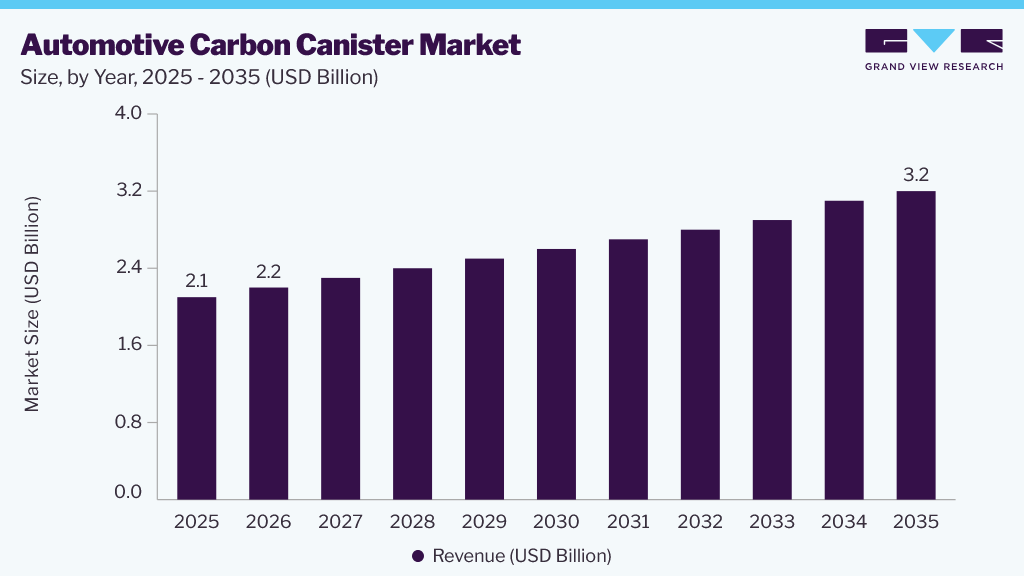 Source: Grand View Research, IR Documents, Primary Interviews, Paid DatabasesTo learn more about this report,
 Download Free Sample Report
In addition, the rising adoption of hybrid vehicles and advancements in fuel-system technologies are creating further growth opportunities. Automotive carbon canisters capture and store fuel vapors, preventing harmful hydrocarbons from entering the atmosphere and supporting compliance with emission standards. Increasing investments by automakers in emission-reduction technologies and efforts to meet evolving environmental regulations are expected to strengthen market demand further.
Analyst Perspective
The industry is growing as automakers face increasing pressure to reduce evaporative emissions and meet stricter environmental regulations. Rising vehicle production, growing adoption of fuel-efficient vehicles, and tighter emissions standards are supporting demand across passenger and commercial vehicles. Manufacturers are focusing on improving activated carbon materials, adsorption capacity, durability, and compact designs to meet evolving vehicle requirements. The transition toward hybrid vehicles is also creating opportunities for advanced vapor management systems due to their unique fuel-system operating conditions. Companies with strong emission-control technologies, established relationships with automotive OEMs, and advanced manufacturing capabilities are likely to strengthen their market position. In the coming years, market growth will depend on regulatory developments, vehicle production, material innovation, and the continued need for effective evaporative emission control.
Type Insights
The standard carbon canister segment held the largest share of the market in 2025, supported by its widespread use in gasoline-powered passenger cars and light commercial vehicles. These canisters capture and store fuel vapors from the fuel tank and release them into the engine during purge cycles, helping automakers meet stringent evaporative emission standards such as U.S. EPA, Euro 6/7, China VI, and Bharat Stage VI. Their proven performance, cost-effectiveness, and compatibility with high-volume vehicle platforms have made them a preferred solution among OEMs. Despite the growing adoption of more advanced designs, standard carbon canisters continue to lead the market due to their established manufacturing base and extensive use in mass-market vehicles.
The integrated carbon canister systems segment is expected to register the fastest growth over the forecast period, driven by increasing demand for compact, lightweight, and efficient EVAP solutions. Automakers are integrating carbon canisters with purge valves, vent valves, pressure sensors, and other components into a single module to optimize packaging, simplify assembly, reduce weight, and improve system reliability. Stricter evaporative emissions regulations and rising adoption of hybrid vehicles are further supporting demand, as hybrid powertrains require more sophisticated fuel vapor management. Advances in activated carbon materials and modular EVAP architectures are also creating opportunities for integrated systems. For instance, in February 2026, Haycarb PLC commenced operations at its high-capacity energy carbon manufacturing facility, strengthening its capabilities in advanced carbon materials and expanding its presence in high-value applications.
Vehicle Type Insights
The passenger cars segment accounted for the largest share of the market in 2025, driven by high global vehicle production and the widespread use of gasoline-powered vehicles equipped with evaporative emission control systems. Carbon canisters are commonly installed in gasoline passenger vehicles to capture and store fuel vapors, helping automakers comply with stringent standards such as U.S. EPA, Euro 6/7, China VI, and Bharat Stage VI. Continued consumer demand for passenger vehicles, particularly SUVs and crossovers, is further expanding the installed base. As passenger cars account for the largest share of gasoline-powered vehicle production, they drive substantial demand for both OEM-installed and replacement carbon canisters.
The light commercial vehicle (LCV) segment is expected to register the fastest growth over the forecast period, supported by the expansion of e-commerce, last-mile delivery, and urban logistics. Rising production of gasoline-powered vans and pickup trucks, particularly in emerging markets, is increasing demand for effective evaporative emission control systems. Stricter emission standards and the adoption of newer commercial vehicle platforms are also creating opportunities for higher-capacity and integrated carbon canister systems. Continued investment in cleaner commercial transportation is expected to support growth in the segment further.
Application Insights
The fuel vapor emission control segment accounted for the largest share of the market in 2025, as Evaporative Emission Control System (EVAP) systems are widely used in gasoline-powered passenger cars, light commercial vehicles, and hybrid vehicles. Carbon canisters are a key component of these systems, capturing fuel vapors from the fuel tank and releasing them into the engine for combustion during purge cycles. Increasingly stringent emission standards, including U.S. EPA Tier 3, Euro 6/7, China VI, and Bharat Stage VI, are driving the adoption of advanced EVAP technologies. The continued presence of gasoline and hybrid vehicles across the global fleet is expected to sustain demand for carbon canisters used in EVAP systems.
The EVAP system vapor control segment is expected to register the fastest growth over the forecast period. The Onboard Refueling Vapor Recovery (ORVR) systems capture fuel vapors released during vehicle refueling, thereby requiring carbon canisters with higher adsorption capacity and improved vapor-management capabilities. Stricter emission regulations and the growing adoption of advanced emission-control technologies are increasing demand for ORVR systems across North America, Europe, and the Asia Pacific. Rising hybrid vehicle production is also supporting segment growth, as these vehicles require more advanced fuel vapor management due to intermittent engine operation.
Regional Insights
The Asia Pacific automotive carbon canister market led in 2025, and is expected to remain the largest and fastest-growing region from 2026 to 2035, supported by its position as a major global automotive manufacturing hub and the high production of gasoline-powered passenger and commercial vehicles. Countries such as China, India, Japan, South Korea, and Thailand are witnessing continued demand for vehicles equipped with evaporative emission control systems, supporting the adoption of carbon canisters. Stricter emission regulations, including China VI and Bharat Stage VI, are also encouraging automakers to adopt more advanced fuel vapor management technologies. In addition, expanding domestic vehicle production, increasing localization of automotive components, and investments by global OEMs in regional manufacturing facilities are strengthening the supply base. These factors, combined with rising vehicle sales and tighter environmental standards, are expected to sustain strong demand for automotive carbon canisters across the region.
North America Automotive Carbon Canister Market Trends
The automotive carbon canister market in North America is a mature, technologically advanced market, supported by stringent evaporative emissions regulations, high vehicle ownership, and the presence of major automotive OEMs and Tier 1 suppliers. The U.S. and Canada have established regulatory frameworks, including the U.S. EPA Tier 3 emission standards and California Air Resources Board (CARB) evaporative emission requirements, which require gasoline-powered vehicles to incorporate highly efficient evaporative emission control (EVAP) systems with carbon canisters. The region also has a large fleet of gasoline-powered passenger cars, SUVs, pickup trucks, and light commercial vehicles, sustaining strong OEM and aftermarket demand for carbon canisters. In addition, continuous investments in advanced activated carbon materials, lightweight EVAP systems, and hybrid vehicle technologies are driving innovation and replacement demand across the North American automotive sector.
U.S. Automotive Carbon Canister Market Trends
The automotive carbon canister market in the U.S. has grown in recent years, driven by stringent emissions regulations, rising vehicle production, and increasing demand for environmentally friendly automotive technologies. Moreover, government initiatives focused on reducing air pollution and improving fuel economy have encouraged the adoption of advanced evaporative emission control systems. The presence of leading automotive manufacturers and continuous technological advancements in vehicle emission control solutions are further contributing to market growth in the country.
Key Automotive Carbon Canister Market Company Insights
The automotive carbon canister market is characterized by global, regional, and specialized automotive component manufacturers competing through technological innovation, strategic partnerships, acquisitions, and product portfolio expansion. Leading companies are increasingly investing in advanced activated carbon materials, lightweight canister designs, high-performance evaporative emission-control systems, and sustainable manufacturing technologies to strengthen their competitive positions and meet the growing demand for fuel-efficient, low-emission vehicles.
Key Automotive Carbon Canister Companies
The following key companies have been profiled for this study on the automotive carbon canister market:
-
Robert Bosch GmbH
-
Continental AG
-
MAHLE GmbH
-
Denso Corporation
-
BorgWarner Inc. (Delphi Technologies)
-
Plastic Omnium SE
-
Stant Corporation
-
Futaba Industrial Co., Ltd.
-
ROKI Co., Ltd.
-
Toyoda Gosei Co., Ltd.
Recent Developments
-
In June 2025, Standard Motor Products expanded its evaporative emissions (EVAP) program with more than 40 new applications, including fuel vapor canisters, canister purge and vent valves, leak detection pumps, and related hoses. The expansion strengthens the company's aftermarket EVAP portfolio and supports the growing demand for replacement components for vehicle evaporative emission control systems.
-
In February 2024, BASF Environmental Catalyst and Metal Solutions completed the acquisition of Arc Metal AB, expanding its toll smelting and processing capabilities for spent automotive catalysts across Europe, the Middle East, and Africa. The acquisition strengthened BASF's precious-metal recycling operations and its broader automotive emissions-control value chain.
Global Automotive Carbon Canister Market Report Scope
Report Attribute
Details
Market size in 2025
USD 2.1 billion
Estimated market size in 2026
USD 2.2 billion
Projected market size by 2035
USD 3.2 billion
Growth rate
CAGR of 4.7% from 2026 to 2035
Base year for estimation
2025
Historical data
2021 – 2024
Forecast period
2026 – 2035
Quantitative units
Revenue in USD billion, and CAGR from 2026 to 2035
Report coverage
Revenue forecast, company ranking, competitive landscape, growth factors, and trends
Segments covered
Type, vehicle type, application, region
Regional scope
North America; Europe; Asia Pacific; Central & South America; Middle East & Africa
Country scope
U.S.; Canada; Mexico; UK; Germany; France; China; Japan; India; Australia; South Korea; Brazil; Argentina; South Africa; Saudi Arabia; UAE
Key companies profiled
Robert Bosch GmbH; Continental AG; MAHLE GmbH; Denso Corporation; BorgWarner Inc. (Delphi Technologies); Plastic Omnium SE; Stant Corporation; Futaba Industrial Co., Ltd.; ROKI Co., Ltd.; Toyoda Gosei Co., Ltd.
Customization scope
Free report customization (equivalent to 8 analyst working days) with purchase. Addition or alteration to country, regional & segment scope.
Pricing and purchase options
Avail of customized purchase options to meet your exact research needs. Explore purchase options
Global Automotive Carbon Canister Market Report Segmentation
This report forecasts revenue growth at the global, regional, and country levels and provides an analysis of the latest industry trends and opportunities across each sub-segment from 2021 to 2035. For this study, Grand View Research has segmented the global automotive carbon canister market report based on type, vehicle type, application, and region:
-
Type Outlook (Revenue, USD Billion, 2021 - 2035)
-
Standard Carbon Canisters
-
High-Capacity Carbon Canisters
-
Enhanced/Advanced Carbon Canisters
-
Integrated Carbon Canister Systems
-
-
Vehicle Type Outlook (Revenue, USD Billion, 2021 - 2035)
-
Passenger Cars
-
Light Commercial Vehicles (LCVs)
-
Heavy Commercial Vehicles (HCVs)
-
-
Application Outlook (Revenue, USD Billion, 2021 - 2035)
-
Fuel Vapor Emission Control
-
EVAP System Vapor Control
-
Refueling Vapor Management
-
Hybrid Vehicle Vapor Control
-
-
Regional Outlook (Revenue, USD Billion, 2021 - 2035)
-
North America
-
U.S.
-
Canada
-
Mexico
-
-
Europe
-
UK
-
Germany
-
France
-
-
Asia Pacific
-
China
-
Japan
-
India
-
Australia
-
South Korea
-
-
Central & South America
-
Brazil
-
Argentina
-
-
Middle East and Africa (MEA)
-
South Africa
-
Saudi Arabia
-
UAE
-
-
Frequently Asked Questions About This Report
The global automotive carbon canister market size was valued at USD 2.1 billion in 2025 and is estimated at USD 2.2 billion in 2026.
The global automotive carbon canister market is expected to grow at a CAGR of 4.7% from 2026 to 2035, reaching USD 3.2 billion in 2035.
Asia Pacific dominated the global automotive carbon canister market in 2025.
The standard carbon canister segment accounted for the largest revenue share in 2025.
Key players in the market include Robert Bosch GmbH, Continental AG, MAHLE GmbH, Denso Corporation, BorgWarner Inc. (Delphi Technologies), Plastic Omnium SE, Stant Corporation, Futaba Industrial Co., Ltd., ROKI Co., Ltd., and Toyoda Gosei Co., Ltd., among others.
About the Author(s)
Automotive & Transportation Research Team
Technology · Automotive & TransportationThis report was authored by the automotive & transportation research team at Grand View Research - comprising two research analysts, one senior research analyst, and one industry expert - with specialized expertise in the automotive & transportation segment of the technology industry. All findings are based on proprietary technology databases, executive interviews, and regulatory analysis, subject to internal peer review prior to publication.
Last Updated:
Speak to Analyst

Customize this report to your needs - add regions, segments, or data points, with 20% free customization.
Or view our licence options:


ISO 9001:2015 & 27001:2022 Certified
We are GDPR and CCPA compliant! Your transaction & personal information is safe and secure. For more details, please read our privacy policy.


