
- Home
- »
- Automotive & Transportation
- »
-
Automotive E-commerce Market Size Report, 2026-2035GVR Report cover
![Automotive E-commerce Market (2026 - 2035)Report]()
Automotive E-commerce Market (2026 - 2035)
Size, Share & Trends Analysis Report By Vehicle Type (Passenger Vehicles, Commercial Vehicle), By Category (Pre-Owned Vehicle, New Vehicle), By Region, And Segment Forecasts
Market Size, 2025
$116.2BMarket Estimate, 2026
$135.1BMarket Forecast, 2035
$511.1BCAGR, 2026–2035
15.9%Automotive E-commerce Market Summary
The global automotive e-commerce market size was valued at USD 116.2 billion in 2025 and is projected to grow from USD 135.1 billion in 2026 to USD 511.1 billion in 2035, at a CAGR of 15.9% from 2026 to 2035. Asia Pacific dominated the market, accounting for a revenue share of 35.0% in 2025. The industry is witnessing robust growth as consumers increasingly prefer a digital-first purchasing experience that offers greater convenience, price transparency, and lesser transaction times.
Key Market Trends & Insights
- By vehicle type: The passenger vehicles segment held the largest market share of around 70.0% in 2025.
- By category: The pre-owned vehicle segment held the largest market share of around 65.0% in 2025
Regional Highlights
- Largest regional market: Asia Pacific (35.0% revenue share, 2025)
- Fastest-growing regional market: Asia Pacific (highest CAGR, 2026-2035)
Market Size & Forecast
- Market size in 2025: USD 116.2 Billion
- Estimated market size in 2026: USD 135.1 Billion
- Projected market size by 2035: USD 511.1 Billion
- CAGR (2026-2035): 15.9%
Modern-day websites offer consumers the ability to compare cars, obtain immediate financing, appraise their trade-ins, fill out forms online, and have their cars delivered to their doorstep. This has been made possible by the widespread use of smartphones, internet access, and digital payment gateways. This trend is being adopted at a faster pace across developed and developing countries alike. Moreover, the market is benefiting from the increasing use of technologies such as artificial intelligence (AI), machine learning, and data analysis on online car retailing platforms. These technologies offer benefits such as personalization of cars for customers, AI-based pricing, automated customer service, fraud detection, and inventory prediction, which increase operational efficiency and improve the customer experience.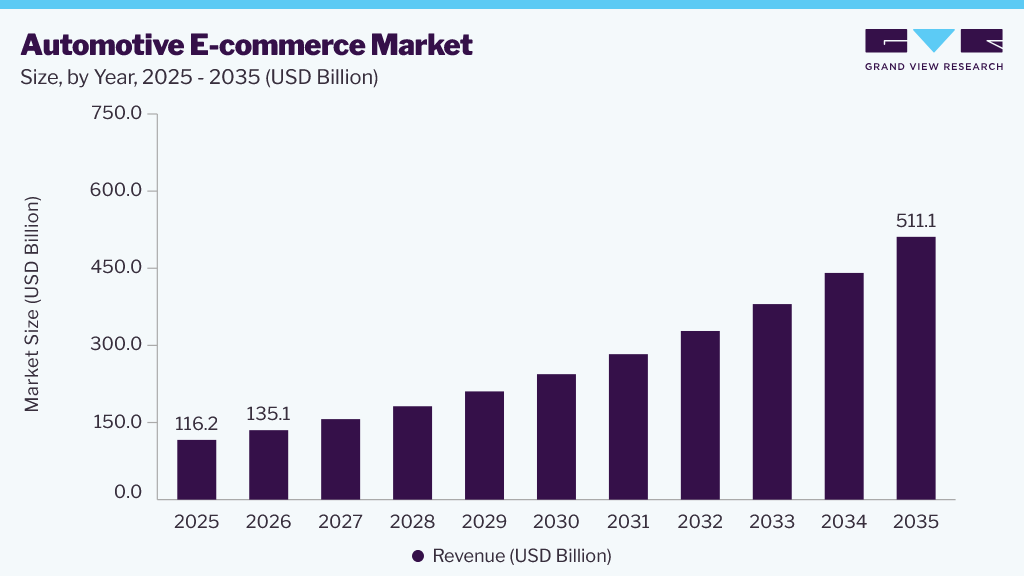
Digital vehicle inspection reports, 360-degree images of cars, virtual showrooms, and remote financing are boosting consumers' trust in buying cars online, especially for used cars. In addition to these factors, another critical element driving market growth is the trend among automakers, dealerships, and online platforms to invest in omnichannel retailing. Omnichannel retailing combines online shopping, fulfillment centers, test drives, and after-sales service networks to provide customers with an integrated experience. Subscription services, CPO programs, and financing facilities are expanding the customer base.
Analyst Perspective
The market is driven by rising digital adoption, evolving consumer purchasing behavior, and the increasing integration of AI-powered retail technologies. However, heavy investment is being made in omnichannel networks, digital financing, virtual car inspections, and home delivery options to increase customer convenience and trust. There is a substantial volume of transactions in the used-car segment. Electric car ownership is increasing, opening up more business for online platforms. The cooperation among automotive retailers, financial institutions, and tech companies is expected to streamline transactions and foster customer engagement and market competitiveness.
Vehicle Type Insights
The passenger vehicles segment accounted for the largest share in 2025. This massive ownership base creates a continuous, high-volume demand for components, making the online procurement of replacement parts, upgrade accessories, and tires highly popular among everyday consumers. Furthermore, major automakers and third-party retailers rapidly expanded their digital platforms during this period. They introduced seamless online vehicle purchasing, transparent pricing, virtual showrooms, and integrated financing options. This shift in consumer behavior toward digital-first shopping, paired with the growing popularity of DIY car maintenance, has firmly positioned passenger vehicles as the primary revenue driver in the online automotive marketplace
The commercial vehicle segment is expected to register the fastest growth during the forecast period. The growth is primarily driven by a rapid, large-scale shift from traditional, relationship-based offline procurement to automated B2B e-commerce platforms. This digital transition is amplified by the adoption of IoT-enabled predictive maintenance, which triggers bulk orders to minimize vehicle downtime.
Category Insights
The pre-owned vehicles segment accounted for the largest share in 2025, driven by increasing consumer demand for affordable mobility solutions and the growing availability of certified pre-owned (CPO) vehicles through digital platforms. Online marketplaces have significantly improved transparency by offering comprehensive vehicle history reports, AI-based price comparisons, digital inspection certificates, warranty options, and flexible financing solutions, enhancing buyer confidence. Rising depreciation of new vehicles, coupled with economic uncertainties and increasing vehicle ownership costs, has further encouraged consumers to opt for quality used vehicles. Moreover, the expansion of organized online used-car retailers with doorstep delivery, easy return policies, and digital documentation has strengthened the segment's dominant position across global markets. For instance, in May 2025, Carvana expanded its same-day vehicle delivery service across the greater Denver area, enabling customers to browse, finance, trade in, complete digital documentation, and receive pre-owned vehicles at their doorstep within hours of purchase. The expansion highlights the growing emphasis on convenient online used-car retailing and seamless end-to-end digital purchasing experiences, reinforcing consumer confidence in organized online used-vehicle platforms.
The new vehicle segment is expected to register the fastest growth during the forecast period, supported by the rapid digital transformation of automotive retail and the increasing adoption of direct online sales by vehicle manufacturers. Automakers are expanding their digital storefronts to enable customers to configure vehicles, compare models, secure financing, purchase insurance, and complete transactions entirely online. The growing availability of electric vehicles (EVs), hybrid models, and connected vehicles through online channels is further accelerating consumer adoption. In addition, attractive manufacturer incentives, subscription-based ownership models, digital trade-in programs, and seamless omnichannel purchasing experiences are expected to drive strong growth in online new vehicle sales, particularly among technology-oriented and younger consumers seeking convenience and personalized buying experiences.
Regional Insights
The Asia Pacific automotive e-commerce market accounted for over 35.0% of global revenue in 2025. The growth is primarily driven by rapid digitization, rising internet and smartphone penetration, and increasing disposable incomes across major economies such as China, India, Japan, and Southeast Asian countries. The expansion of organized online automotive marketplaces, digital lending platforms, and secure electronic payment systems is making vehicle purchases more accessible and convenient for consumers. Furthermore, the growing middle-class population, increasing demand for affordable personal mobility, and accelerating adoption of electric vehicles are creating significant growth opportunities for online automotive retailers. Government initiatives supporting digital commerce, coupled with increasing investments by automakers and technology companies in connected retail ecosystems and AI-enabled customer engagement platforms, are expected to further accelerate market expansion across the region throughout the forecast period.

North America Automotive E-commerce Market Trends
The automotive e-commerce market in North America is expected to register significant growth during the forecast period, driven by high digital adoption, widespread internet penetration, and strong consumer confidence in purchasing vehicles online. The presence of well-established online automotive retailers, advanced digital financing solutions, and extensive certified pre-owned (CPO) vehicle networks has significantly streamlined the vehicle purchasing process. In addition, the integration of artificial intelligence (AI), virtual vehicle tours, digital documentation, and contactless home delivery has enhanced the customer experience while improving transaction efficiency.
Continuous investments by manufacturers, dealerships, and fintech providers in omnichannel retail strategies, coupled with growing demand for electric vehicles (EVs), are expected to influence the North American market throughout the forecast period. For instance, in January 2025, Sony Honda Mobility announced the production-ready AFEELA 1 at CES 2025 and opened online reservations for customers in California through its direct digital sales platform. Such developments highlight the growth potential of this industry.
Key Automotive E-commerce Market Companies Insights
The automotive e-commerce market is characterized by multiple companies with strong digital presence and partnerships with e-commerce industry participants. The key companies rely on various growth strategies, such as improving engagement through an omnichannel presence, offering lucrative deals on pre-owned vehicles, and deploying effective marketing through social media networks. Some of the companies also embrace strategies such as the acquisition of service portfolios offered by companies with strong regional or local presence, innovation in service delivery, and more. For instance, in February 2024, Lithia & Driveway (Lithia Motors, Inc.) completed the acquisition of Pendragon PLC's UK motor and fleet management businesses and entered into a strategic partnership with Pinewood Technologies. The acquisition significantly expanded Lithia's omnichannel automotive retail footprint in the UK while integrating Pinewood's dealer management software to enhance digital vehicle retailing, online purchasing capabilities, and customer engagement.
Key Automotive E-commerce Companies
The following key companies have been profiled for this study on the automotive e-commerce market:
-
Carvana Co.
-
CarMax, Inc.
-
Auto Trader Group plc
-
Cars.com Inc.
-
TrueCar, Inc.
-
AutoScout24 GmbH
-
Auto1 Group SE
-
CarGurus, Inc.
-
CARS24 Services Private Limited
-
CarTrade Tech Limited
Recent Developments
- In July 2026, Carvana Co. announced its latest expansion and availability of same-day vehicle delivery in the greater Fort Myers area of Florida, U.S. The expansion also includes scheduled pickups and drop-offs as soon as the same day.
- In June 2026, UVeye, the vehicle data intelligence company, announced the launch of the Scan to Sold platform expansion, designed to transform the dealership service lane into a new merchandising channel for pre-owned vehicles.
- In June 2025, TrueCar, Inc. announced its partnership with GasBuddy to launch "TrueCar for GasBuddy," an online vehicle buying program designed for direct accessibility through the GasBuddy app and website, enabling users with direct access to TrueCar's network of more than 11,000 certified dealers in the U.S.
Automotive E-commerce Market Report Scope
Report Attribute
Details
Market size in 2025
USD 116.2 billion
Estimated market size in 2026
USD 135.1 billion
Projected market size by 2035
USD 511.1 billion
Growth rate
CAGR of 15.9% from 2026 to 2035
Base year for estimation
2025
Historical data
2021 – 2024
Forecast period
2026 – 2035
Quantitative units
Revenue in USD billion, and CAGR from 2026 to 2035
Report coverage
Revenue forecast, company ranking, competitive landscape, growth factors, and trends
Segments covered
Vehicle type, category, region
Regional scope
North America; Europe; Asia Pacific; Central & South America; Middle East & Africa
Country scope
U.S.; Canada; Mexico; UK; Germany; France; Italy; Spain; China; Japan; India; Australia; South Korea; Brazil; Argentina; South Africa; Saudi Arabia; UAE.
Key companies profiled
Carvana Co.; CarMax, Inc.; Auto Trader Group plc; Cars.com Inc.; TrueCar, Inc.; AutoScout24 GmbH; AUTO1 Group SE; CarGurus, Inc.; Cars24 Services Private Limited; CarTrade Tech Limited.
Customization scope
Free report customization (equivalent to 8 analyst working days) with purchase. Addition or alteration to country, regional & segment scope.
Pricing and purchase options
Avail of customized purchase options to meet your exact research needs. Explore purchase options
Automotive E-commerce Market Report Segmentation
This report forecasts revenue growth at the global, regional, and country levels and provides an analysis of the latest industry trends and opportunities across each sub-segment from 2021 to 2035. For this study, Grand View Research has segmented the global automotive e-commerce market report based on vehicle type, category, and region:
-
Vehicle Type Outlook (Revenue, USD Billion, 2021 - 2035)
-
Passenger Vehicles
-
Commercial Vehicles
-
-
Category Outlook (Revenue, USD Billion, 2021 - 2035)
-
Pre-Owned Vehicle
-
New Vehicle
-
-
Regional Outlook (Revenue, USD Billion, 2021 - 2035)
-
North America
-
U.S.
-
Canada
-
Mexico
-
-
Europe
-
UK
-
Germany
-
France
-
Italy
-
Spain
-
-
Asia Pacific
-
China
-
Japan
-
India
-
Australia
-
South Korea
-
-
Central & South America
-
Brazil
-
Argentina
-
-
Middle East and Africa (MEA)
-
South Africa
-
Saudi Arabia
-
UAE
-
-
Frequently Asked Questions About This Report
The global automotive e-commerce market size was valued at USD 116.2 billion in 2025 and is estimated at USD 135.1 billion for 2026.
Asia Pacific dominated with an approximately 35.0% revenue share in 2025.
The passenger vehicles segment accounted for the largest revenue share of approximately 70.0% in 2025.
Key players in the market include Carvana Co., CarMax, Inc., Auto Trader Group plc, Cars.com Inc., TrueCar, Inc., AutoScout24 GmbH, AUTO1 Group SE, CarGurus, Inc., Cars24 Services Private Limited, CarTrade Tech Limited, and others.
The global automotive e-commerce market is expected to grow at a CAGR of 15.9% from 2026 to 2035, reaching USD 511.1 billion by 2035.
About the Author(s)
Automotive & Transportation Research Team
Technology · Automotive & TransportationThis report was authored by the automotive & transportation research team at Grand View Research - comprising two research analysts, one senior research analyst, and one industry expert - with specialized expertise in the automotive & transportation segment of the technology industry. All findings are based on proprietary technology databases, executive interviews, and regulatory analysis, subject to internal peer review prior to publication.
Last Updated:
Speak to Analyst


Customize this report to your needs — add regions, segments, or data points, with 20% free customization.
Or view our licence options:


ISO 9001:2015 & 27001:2022 Certified
We are GDPR and CCPA compliant! Your transaction & personal information is safe and secure. For more details, please read our privacy policy.












