
- Home
- »
- Automotive & Transportation
- »
-
Automotive Window Regulator Market Report, 2026-2035GVR Report cover

Automotive Window Regulator Market (2026 - 2035)
Size, Share & Trends Analysis Report By Product (Manual, Automated), By Construction Type (Cable Type, Arm Type), By Vehicle Type (Passenger Vehicle, LCV, HCV), Regional Outlook, And Segment Forecasts
Market Size, 2025
$7.9BMarket Estimate, 2026
$8.2BMarket Forecast, 2035
$11.5BCAGR, 2026–2035
3.8%Automotive Window Regulator Market Summary
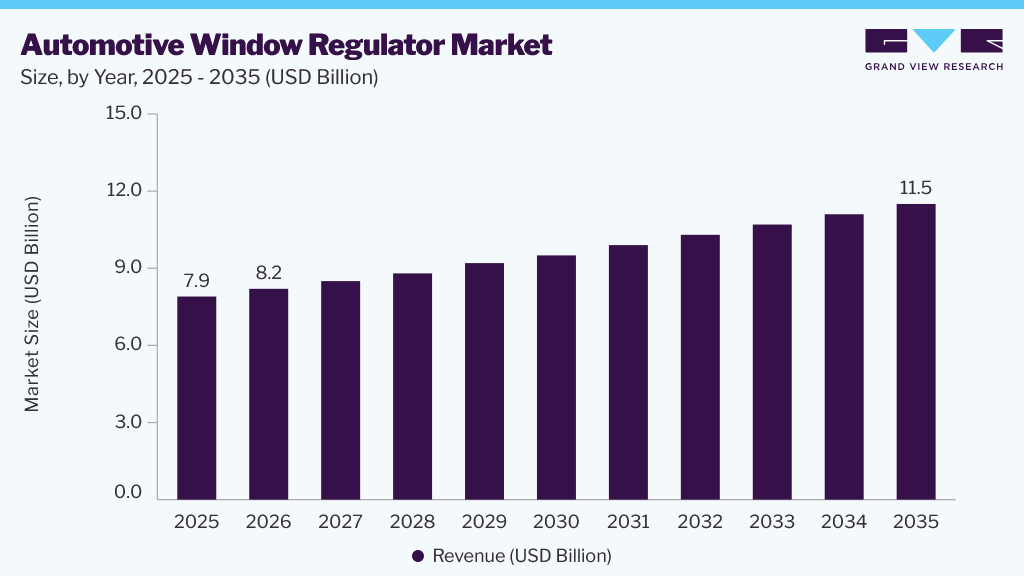
The global automotive window regulator market size was valued at USD 7.9 billion in 2025 and is projected to grow from USD 8.2 billion in 2026 to USD 11.5 billion by 2035, at a CAGR of 3.8% from 2026 to 2035. Asia Pacific dominated the market, accounting for the revenue share of 42.0% in 2025. Market growth is driven by rising vehicle production, increasing adoption of power windows, and growing demand for enhanced vehicle comfort, convenience, and safety features. Besides, the growing demand for electric and hybrid vehicles is also encouraging the demand for powered and automated window regulators.
 Source: Grand View Research, IR Documents, Primary Interviews, Paid DatabasesTo learn more about this report,
 Download Free Sample Report
 Key Market Trends & Insights
- By product: The automated segment held the largest market share of approximately 87.0% in 2025.
- By construction type: The cable type segment held the largest market share of approximately 62.0% in 2025.
- By vehicle type: The passenger vehicle segment held the largest market share of approximately 65.0% in 2025.
Regional Highlights
- Largest regional market: Asia Pacific (42.0% revenue share, 2025)
Market Size & Forecast
- Market size in 2025: USD 7.9 Billion
- Estimated market size in 2026: USD 8.2 Billion
- Projected market size by 2035: USD 11.5 Billion
- CAGR (2026-2035): 3.8%
Three ways to get this report
Buy it, customize it, or ask a question.Ask an Analyst
A direct answer, usually in 1 working day
- AccessReport author, directly
- Reply timeWithin 1 working day
- No sales callDirect answer only
- FormatEmail reply
- CostFree, no cost
Get the Full Report
What the study covers
- FormatsPDF · Excel · Dashboard
- Timeline2026–2035 annual, 2025 base
- Coverage20+ countries, 5 regions
- Companies10+ key players profiled
Customize the Report
20% free customization
- IncludeCountries, segments, points
- TailorTo your product definition
- ExtendDeeper competitor detail
- OrA fully bespoke study
- Turnaround5–10 working days
The automotive window regulator industry is driven by rising global vehicle production, increasing adoption of power windows, and growing demand for enhanced comfort, convenience, and safety features. The transition toward electric and connected vehicles further supports the demand for electronically controlled window regulators, as automakers increasingly integrate advanced door electronics and remote-controlled functionalities. The adoption of safety and convenience features, including anti-pinch protection and one-touch operation, is also contributing to the use of advanced window regulator systems. In addition, rising vehicle ownership and expanding automotive fleets in emerging economies are supporting market growth.Fluctuations in raw material prices, supply chain disruptions, and the rising cost of electronic components may constrain market growth, particularly in cost-sensitive regions. However, rising electric-vehicle production, lightweight vehicle designs, and advancements in window-regulator technology are creating significant growth opportunities. Automakers and suppliers are focusing on developing compact, lightweight, durable, and energy-efficient regulators to reduce vehicle weight and improve overall vehicle efficiency. Furthermore, the expansion of the automotive aftermarket in developing economies is increasing demand for replacement window regulators as the global vehicle parc continues to grow. The integration of window regulators with smart door systems and other electronically controlled vehicle functions is expected to further support market expansion during the forecast period.
Analyst Perspective
The automotive window regulator market is expected to witness steady growth as vehicle manufacturers continue to prioritize comfort, safety, and intelligent vehicle features. The expansion of electric and connected vehicles is driving the integration of electronically controlled window regulators with advanced door electronics and vehicle control systems. Manufacturers are increasingly focusing on lightweight materials, compact designs, improved operating efficiency, and enhanced durability to meet evolving vehicle design requirements. At the same time, rising vehicle production and replacement demand in emerging economies are creating new opportunities for OEMs and aftermarket suppliers. Strategic investments in product innovation, advanced manufacturing capabilities, and regional production expansion are expected to strengthen competitive positioning. Companies offering reliable, cost-effective, and technologically advanced window regulator solutions while meeting evolving automotive safety and quality standards are likely to gain a competitive advantage over the forecast period.
Product Insights
The automated segment led the market with the largest revenue share of approximately 87.0% in 2025, and is expected to grow at the fastest CAGR over the forecast period. Automated window regulators are increasingly adopted across modern vehicles due to rising consumer demand for convenience, comfort, and advanced vehicle functionalities. Features such as one-touch operation, anti-pinch systems, intelligent control, and integration with vehicle electronic systems have accelerated their penetration across passenger vehicles. The growing production of electric and connected vehicles is further supporting the expansion of the segment, as these vehicles are equipped with smart and energy-efficient components. In April 2025, Brose showcased its 48V system solutions at Auto Shanghai 2025, with its 48V window-regulator motor entering mass production for new-energy vehicles, demonstrating the development of advanced window-regulator technologies for electrified vehicles.
The manual segment is expected to grow at a steady CAGR during the forecast period, supported by continued demand in entry-level vehicles and cost-sensitive markets, particularly in developing economies. Manual window regulators remain relevant due to their simple design, lower cost, and ease of maintenance, making them suitable for budget-oriented vehicle models. However, the segment is expected to experience slower growth than automated systems, as increasing vehicle electrification, rising consumer expectations for convenience features, and the growing standardization of power windows continue to shift preferences toward automated solutions.
Construction Type Insights
The cable type segment led the market with the largest revenue share of approximately 62.0% in 2025 and is expected to grow at the fastest CAGR during the forecast period. Cable-type window regulators are widely adopted in modern vehicles because of their compact architecture, lightweight construction, cost-effectiveness, and packaging flexibility within the door unit. Their design allows manufacturers to efficiently integrate window-lifting mechanisms within vehicle doors while accommodating increasingly compact door architectures. The continued production of passenger cars, electric vehicles, and compact models supports the widespread adoption of cable-type regulators. In addition, their compatibility with automated window systems, efficient operation, and flexibility across different vehicle designs are strengthening their market position.
The arm type segment is expected to grow at a significant CAGR over the forecast period. Arm-type regulators remain relevant in applications requiring mechanical strength, durability, and stable window movement. Their robust construction supports reliable operation under demanding conditions, supporting adoption in SUVs, commercial vehicles, and vehicles with enhanced load-bearing capability. Furthermore, the increasing demand for durable, high-performance window mechanisms, along with ongoing advancements in automotive door systems, is expected to create growth opportunities for arm-type window regulators during the forecast period.
Vehicle Type Insights
The passenger vehicle segment led the market with the largest revenue share of approximately 65.0% in 2025. The segment's dominance is attributed to the high global production volume of passenger vehicles and widespread adoption of power-window systems across vehicle models. Increasing consumer preference for comfort, convenience, and advanced vehicle functionalities, along with the rising adoption of electric passenger vehicles, is driving the integration of automated window regulators in this segment. Furthermore, automakers are focusing on lightweight and intelligent door systems to enhance vehicle efficiency and user experience, supporting continued demand for window regulator solutions in passenger vehicles.
The light commercial vehicle (LCV) segment is expected to grow at the fastest CAGR over the forecast period. The segment’s growth is driven by the expansion of e-commerce, logistics, and commercial fleet operations, supporting the increasing demand for commercial vans and utility vehicles worldwide. Rising fleet modernization, increasing electrification of commercial vehicles, and greater adoption of power-window and convenience features are supporting the use of automated window regulator systems in LCVs. As commercial vehicle manufacturers increasingly focus on driver comfort, operational efficiency, and electronically controlled vehicle systems, demand for advanced window regulator solutions in LCV applications is expected to increase during the forecast period.
Regional Insights
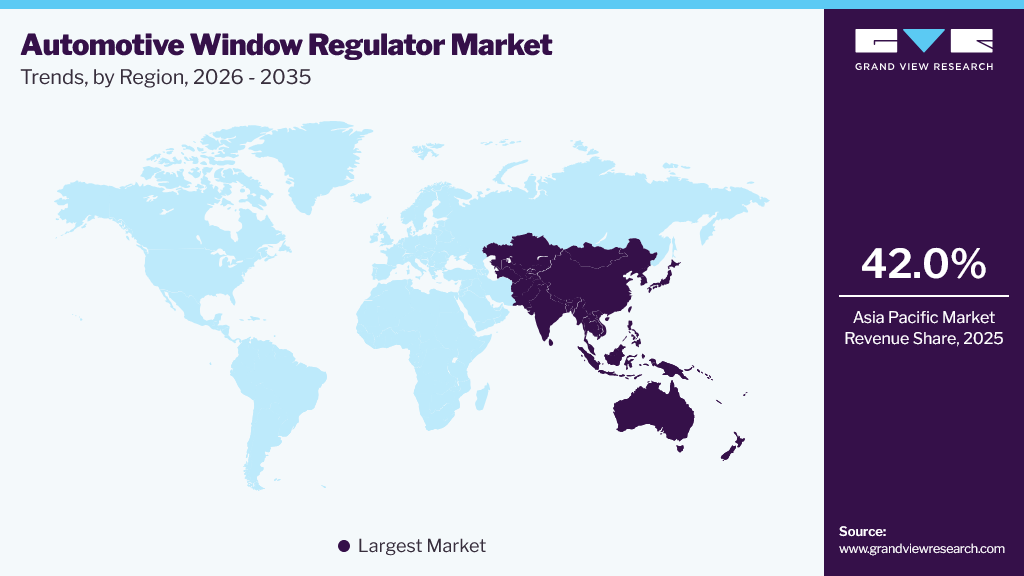
The Asia Pacific automotive window regulator market held the largest revenue share of approximately 42.0% in 2025, and is expected to grow at the fastest CAGR over the forecast period. The region's leadership is attributed to its strong automotive manufacturing ecosystem, high vehicle production capacity, and increasing presence of global automotive component suppliers. Countries including China, India, Thailand, Japan, and South Korea are witnessing significant growth in passenger vehicle production, electric vehicle adoption, and the integration of advanced comfort and convenience technologies. Increasing adoption of electric vehicles and electronically controlled comfort and convenience features is also supporting demand for advanced window regulator systems.
 To learn more about this report, Download Free Sample Report
 The expansion of automotive manufacturing facilities and investments in advanced vehicle technologies across emerging economies are further supporting regional growth. The continuous shift toward lightweight, efficient, and electronically controlled vehicle components is expected to strengthen Asia Pacific's position as the leading regional market throughout the forecast period.
North America Automotive Window Regulator Market
The automotive window regulator market in North America is expected to grow at a significant CAGR during the forecast period, supported by continued investments in automotive manufacturing, rising adoption of electric and connected vehicles, and growing demand for advanced vehicle comfort features. The region benefits from a mature automotive industry, a strong presence of global vehicle manufacturers, and an increasing focus on localizing automotive supply chains to improve production resilience. Automakers and component suppliers are increasingly investing in advanced mechatronic systems, lightweight components, and intelligent vehicle technologies, creating opportunities for automotive window regulator solutions.
For instance, in January 2025, Hi-Lex Controls initiated operations at its new manufacturing facility in Coahuila, Mexico, thereby boosting its North American window-regulator production capacity and strengthening its regional manufacturing footprint. Furthermore, the continued production of SUVs, light commercial vehicles, and electric vehicles in the region is expected to bolster demand for durable, automated window regulator systems. Ongoing technological advancements and increasing emphasis on vehicle personalization and convenience features are likely to contribute to steady market growth across North America.
Key Automotive Window Regulator Company Insights
The automotive window regulator industry is competitive, with established manufacturers competing through product innovation, technological advancements, manufacturing expansion, and strategic partnerships with global automotive manufacturers. Key players are focusing on developing lightweight, energy-efficient, and intelligent window-regulator systems to support the growing adoption of electric and connected vehicles, as well as advanced vehicle comfort features. Companies are investing in mechatronic technologies and integrated door systems to improve regulator performance, reduce component weight, and enable advanced functions such as anti-pinch protection and one-touch operation.
Furthermore, expansion of production facilities in high-growth automotive regions and collaborations with OEMs are enabling manufacturers to strengthen their global presence. Players with strong engineering capabilities, extensive supplier networks, and advanced manufacturing expertise are expected to maintain a competitive advantage in the automotive window regulator market.
Key Automotive Window Regulator Companies
The following key companies have been profiled for this study on the global automotive window regulator market:
-
Brose Fahrzeugteile SE & Co. KG
-
Inteva Products
-
HI-LEX Corporation
-
Magna International Inc.
-
AISIN CORPORATION
-
Dorman Products
-
Mitsui Kinzoku Co., Ltd.
-
VALEO
-
Continental AG
-
Johnson Electric Holdings Limited
Recent Developments
-
In April 2026, ZF Aftermarket expanded its Lemförder window regulator portfolio to over 1,600 part numbers to meet replacement demand across the European vehicle parc. This expansion focuses on older vehicle models for which original manufacturers may no longer supply electric-window spare parts, highlighting the growing importance of aftermarket window-regulator availability.
-
In November 2025, Inteva Products expanded its India operations by establishing a second manufacturing facility in Pune and launching advanced automotive solutions, including frameless window regulators and SLIM window regulator motors, to support the growing demand for lightweight and electrified vehicle systems.
-
In November 2025, Han Yale showcased its latest smart motor and window regulator solutions at AAPEX 2025, featuring IATF 16949-certified technologies designed for passenger vehicles, commercial vehicles, and electric mobility applications. The solutions highlight advancements in durable, customizable, and intelligent window regulator and motor technologies.
Automotive Window Regulator Market Report Scope
Report Attribute
Details
Market size in 2025
USD 7.9 billion
Estimated market size in 2026
USD 8.2 billion
Projected market size by 2035
USD 11.5 billion
Growth rate
CAGR of 3.8% from 2026 to 2035
Base year for estimation
2025
Historical data
2021 - 2024
Forecast period
2026 - 2035
Quantitative units
Revenue in USD billion, and CAGR from 2026 to 2035
Report coverage
Revenue forecast, company ranking, competitive landscape, growth factors, and trends
Segments covered
Product, construction type, vehicle type, region
Regional scope
North America; Europe; Asia Pacific; Latin America; Middle East & Africa
Country Scope
U.S.; Canada; Mexico; UK; Germany; France; Italy; Spain; China; Japan; India; Australia; South Korea; Brazil; Argentina; South Africa; Saudi Arabia; UAE
Key companies profiled
Brose Fahrzeugteile SE & Co. KG; Inteva Products; HI-LEX Corporation; Magna International Inc.; AISIN CORPORATION; Dorman Products; Mitsui Kinzoku Co., Ltd.; VALEO; Continental AG; Johnson Electric Holdings Limited
Customization scope
Free report customization (equivalent to 8 analyst working days) with purchase. Addition or alteration to country, regional & segment scope.
Pricing and purchase options
Avail of customized purchase options to meet your exact research needs. Explore purchase options
Global Automotive Window Regulator Market Report Segmentation
This report forecasts revenue growth at the global, regional, and country levels and provides an analysis of the latest industry trends and opportunities across each sub-segment from 2021 to 2035. For this study, Grand View Research has segmented the global automotive window regulator market report based on Product, construction type, vehicle type, and region:
-
Product Outlook (Revenue, USD Billion, 2021 - 2035)
-
Manual
-
Automated
-
-
Construction Type Outlook (Revenue, USD Billion, 2021 - 2035)
-
Cable Type
-
Arm Type
-
-
Vehicle Type Outlook (Revenue, USD Billion, 2021 - 2035)
-
Passenger Vehicle
-
Light Commercial Vehicle (LCV)
-
Heavy Commercial Vehicle (HCV)
-
-
Regional Outlook (Revenue, USD Billion, 2021 - 2035)
-
North America
-
U.S.
-
Canada
-
Mexico
-
-
Europe
-
UK
-
Germany
-
France
-
Italy
-
Spain
-
-
Asia Pacific
-
China
-
Japan
-
India
-
Australia
-
South Korea
-
-
Latin America
-
Brazil
-
Argentina
-
-
Middle East and Africa (MEA)
-
South Africa
-
Saudi Arabia
-
UAE
-
-
About the Author(s)
Automotive & Transportation Research Team
Technology · Automotive & TransportationThis report was authored by the automotive & transportation research team at Grand View Research - comprising two research analysts, one senior research analyst, and one industry expert - with specialized expertise in the automotive & transportation segment of the technology industry. All findings are based on proprietary technology databases, executive interviews, and regulatory analysis, subject to internal peer review prior to publication.
Last Updated:
Speak to Analyst

Customize this report to your needs - add regions, segments, or data points, with 20% free customization.
Or view our licence options:


ISO 9001:2015 & 27001:2022 Certified
We are GDPR and CCPA compliant! Your transaction & personal information is safe and secure. For more details, please read our privacy policy.


