
- Home
- »
- Beauty & Personal Care
- »
-
Bar Soap Market Size, Share & Growth Report, 2026-2033GVR Report cover
![Bar Soap Market (2026 - 2033)Report]()
Bar Soap Market (2026 - 2033)
Size, Share & Trends Analysis Report By Type (Organic, Synthetic), By Application (Hair Care, Body/Skin Care, Facial Care, Specialized), By Distribution Channel, By Region, And Segment Forecasts
Market Size, 2025
$34.2BMarket Estimate, 2026
$35.7BMarket Forecast, 2033
$50.2BCAGR, 2026–2033
5.0%Bar Soap Market Summary
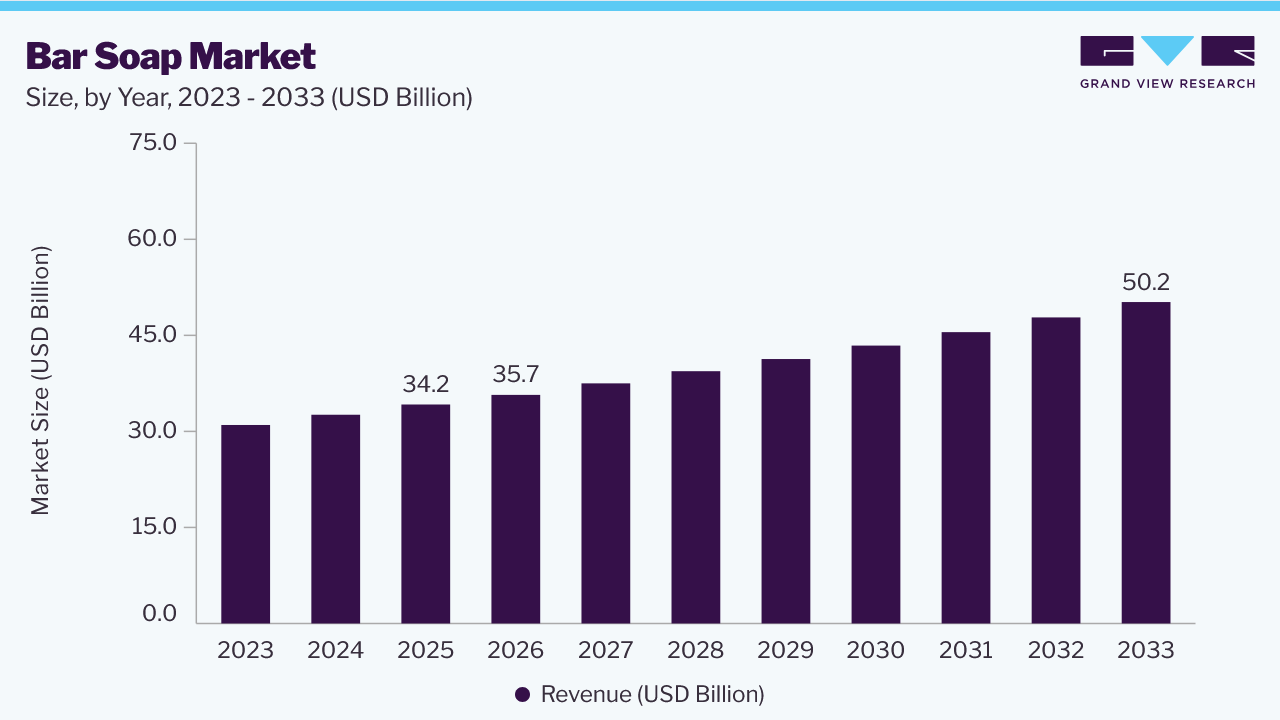
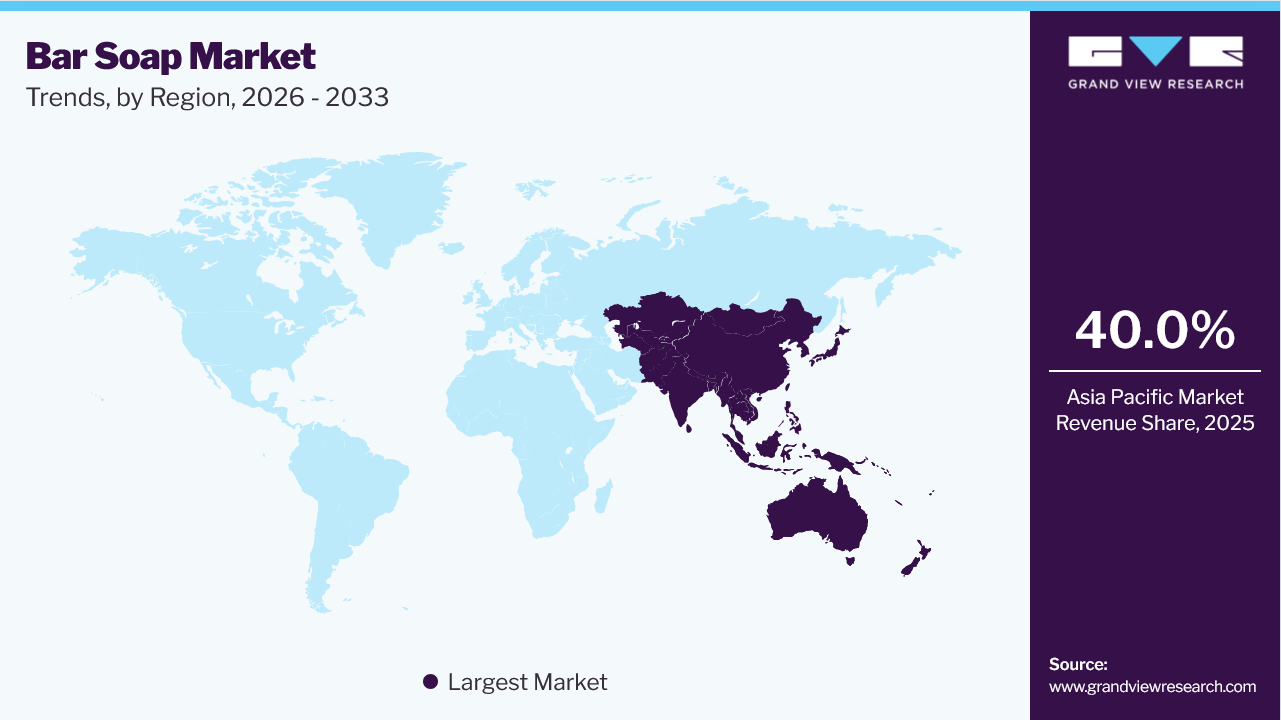
The global bar soap market size was valued at USD 34.2 billion in 2025 and is projected to grow from USD 35.7 billion in 2026 to USD 50.2 billion in 2033, at a CAGR of 5.0% from 2026 to 2033. Asia Pacific dominated the global market, accounting for the largest revenue share of 40.0% in 2025. Rising consumer awareness of personal hygiene and cleanliness is a major driver of the bar soap market.
Key Market Trends & Insights
- By type: The synthetic bar soap segment held a market revenue share of over 90% in 2025.
- By application: The skin/body care bar soaps segment led the market and accounted for around 55% share of the global revenue in 2025.
- By distribution channel: The supermarkets and hypermarkets channel segment dominated the market and accounted for over 30% of the revenue share in 2025.
Regional Highlights
- Largest regional market: Asia Pacific (over 40% revenue share, 2025)
Market Size & Forecast
- Market size in 2025: USD 34.2 Billion
- Estimated market size in 2026: USD 35.7 Billion
- Projected market size by 2033: USD 50.2 Billion
- CAGR (2026-2033): 5.0%
The personal care market has witnessed significant growth in value sales, primarily driven by the ease of access to these products through various channels, including specialty stores, pharmacies, and beauty salons. Moreover, the market is expected to expand further as male consumers increasingly prioritize skincare and grooming to enhance their physical appearance and overall skin health. Additionally, the market is positively influenced by increased R&D investments, leading to the introduction of new, effective products that cater to diverse consumer demands and preferences.Consumers are increasingly demanding vegan, natural, organic, clean, reef-friendly, GMO-free, gluten-free, soy-free, transparently sourced, and recyclable products. Manufacturers in the market are focusing on sustainability and introducing innovative products that fulfill consumer demands. For instance, Vibey Soap Co.'s eco-friendly and plant-based soaps are available in a wide range of colors and fragrances. All the soaps, from ‘Cucumber & Melon’ to ‘Almond Mahogany’, are vegan and packaged in plastic-free clamshells.
Consumers value skincare routines as a positive part of their daily rituals, helping them maintain personal hygiene and self-care. According to an article in the March 2019 issue of Global Cosmetic Industry, a significant percentage of people follow multi-step routines, washing their faces and applying moisturizer at least twice daily. The growing emphasis on facial cleansing is driving the global demand for bar soap. Bar soap is a convenient and effective way to maintain personal hygiene. In commercial establishments or public places, using bar soap can offer individuals a sense of hygiene.
In addition, bar soaps are typically less expensive than toiletries in individual bottles or dispensers. They last longer and use less soap at once, enabling hotels to reduce costs. According to a survey conducted by the Boston University School of Hospitality Administration in March 2019, it was found that soaps were the most widely used amenity at hotel chains in the U.S. Around 86% of guests who stay at a hotel for 1-2 nights utilize the provided soap, surpassing the usage rates of other popular amenities such as the in-room TV (84%), hair dryer (36%), and valet parking (28%).
Market Dynamics
Steady growth in the bar soap market is primarily driven by consumers' changing preferences for natural, organic, and eco-friendly personal care products. Today's consumers are well aware of the ingredients and look for products that are free of harsh chemicals, synthetic ingredients, and artificial fragrance. Hence, the demand for bar soaps containing vegetable oils, herbal extracts, essential oils, and moisturizing agents increased. In addition, growing awareness of environmental benefits and waste reduction encouraged the use of bar soaps instead of liquid soaps, reducing the need for packaging and plastic waste. To fulfill consumer demand, manufacturers have launched products such as vegan bar soap, organic bar soap, biodegradable bar soap, and plastic-free bar soap.
The rise of liquid soap, body washes, and shower gels is impacting the bar soap market. Consumers are increasingly preferring liquid cleansing products, as they are believed to be more hygienic and convenient for modern skincare needs. Body washes contain moisturizers and skin actives, and come in easy-to-use bottles, making them a functional product. Growth in the body care premium segment led to increased consumption of cleansing agents and skincare products, diminishing reliance on bar soaps. Generation Z prefers liquid formats because of their usability, mobility, and hygiene factor. Bar soaps are favored for their affordability and eco-friendliness. However, the shift towards liquid body washes poses a major restraint on the sustained growth of the market.
Analyst’s Perspective
The bar soap market remains highly competitive, but long-term growth is increasingly influenced by brand positioning, product differentiation, and consumer trust rather than basic cleansing functionality. As purchasing decisions become increasingly tied to ingredients, sustainability claims, and personal care preferences, established brands with strong distribution networks and brand loyalty are likely to maintain an advantage. Products will continue to compete on price, but premium and specialized products are expected to capture a larger share of the market. Innovation in formulation and branding is expected to have more weightage than product commoditization.
Type Insights
The synthetic bar soap segment accounted for over 90% of market revenue in 2025. One of the primary factors driving the market for synthetic bar soap is its cost-effectiveness. Synthetic soap brands have also evolved significantly over the years due to modern production techniques and scientific advancements, offering compelling reasons for consumers to consider these products. For instance, in January 2026, a consumer value report by “Go For Zero” identified bar soaps as highly economical compared to liquid alternatives due to their hyper-concentration and endurance, lasting 5 to 6 times as long. This means the customer isn't overpaying for watered-down products and plastic.
The organic soap demand is anticipated to expand at the fastest CAGR of 6.8% over the forecast period from 2026 to 2033. Many bar soap companies are meeting customer needs by introducing environmentally friendly products through sustainable manufacturing processes. For instance, in June 2025, Aaranyam, an organic producer of personal care products, reported a fundamental change in its operational plan, leading to the adoption of cold-process soap manufacturing. The cold process method uses a completely from-scratch formula with all-natural oils and lye to meet buyer demand for environmentally friendly goods.
Application Insights
The skin/body care bar soap segment led the market, accounting for over 55% of global revenue in 2025. Bar soaps infused with moisturizing ingredients such as shea butter, cocoa butter, coconut oil, and essential oils are in high demand. These soaps not only cleanse the skin but also hydrate and nourish it, leaving it feeling soft and supple. For instance, in June 2026, Dove showcased their “Shea Butter Beauty Bar” as the remedy to skin-stripping problems. The company says the bar is designed to deliver high levels of fatty acids and vitamins, which intensely nourish and moisturize the skin's surface, leaving it feeling soft, supple, and glowing post-use.
The specialized bar soap segment is anticipated to expand at the fastest CAGR from 2026 to 2033. Specialty bar soaps include products that treat specific skin issues or are used for exfoliation and other specific functions. These soap bars differ from traditional cleansing bars in their formulations, ingredients, and intended purposes. For instance, in September 2023, 111MedCo announced its 6% Sulfur Skin Cleansing Soap Bar, developed in collaboration with dermatologists. The specialized cleansing is designed primarily for medical skin problems, enhancing sebum depletion and providing significant antimicrobial benefits.
Distribution Channel Insights
The supermarkets and hypermarkets channel segment dominated the market, accounting for over 30% of revenue in 2025. Consumers prefer shopping in offline stores as they can physically assess the product quality and compare it with other products. In addition, supermarkets often run promotions and discounts on bar soaps, making them a cost-effective choice for consumers. Buying soap bars from supermarkets offers convenience, variety, and potential cost savings for consumers. For instance, in January 2023, Spencer entered the hypermarket format, announcing that it had around 185 stores catering to the mid- to premium segments.
The online retailer channel segment is anticipated to account for a significant share of the global bar soap market, advancing at a robust CAGR over the forecast period. Online platforms foster competition, encouraging soap bar sellers to offer competitive pricing. Promotional deals and discounts on e-commerce sites can further entice consumers to make online purchases. For example, during seasonal sale events such as Black Friday, online retailers may offer attractive discounts on soap bars, attracting customers to stock up on their favorite brands. According to Shopify, 80% of clean skin-care brands dominated the Black Friday and Cyber Monday beauty trends.
Regional Insights
The Asia Pacific bar soap market accounted for the largest revenue share, over 40%, in 2025. The region’s rapidly growing population is driving increased demand for personal care products, such as bar soaps. Bar soaps remain a preferred choice for personal hygiene and bathing in many households across regions due to their familiarity. In Asia, consumers prefer local, handmade bar soaps for genuine, distinctive skincare and haircare experiences. These products, made by small-scale manufacturers, often incorporate ingredients from the region's rich and varied traditional botanical heritage. For instance, in May 2026, market data tracking the global consumer market reported that the Asia Pacific region dominated the global soap market.
Middle East & Africa Bar Soap Market Trends
The Middle East & Africa region is expected to advance at a strong CAGR of 5.4% from 2026 to 2033. Bar soaps are favored in this region due to their cost-effectiveness and wide availability. They are a practical choice for personal hygiene needs, with a more affordable price point than liquid soaps. Regional companies have been coming to the forefront by capitalizing on local market insights, meeting cultural preferences, and offering competitive pricing, thereby gaining prominence and competing effectively with global brands. For instance, in November 2025, Bidco Africa announced increased production as it expanded its Thika detergent facility to drive growth.
Key Bar Soap Company Insights
The market includes both international and domestic participants. Key market players focus on strategies such as innovation and new product launches in retail to enhance their portfolios.
-
In July 2023, Lush Retail Ltd. launched its partnership with Eat Takeaway.com to provide products by Lush to German consumers. With this partnership, Eat Takeaway.com can explore the potential of non-food categories along with new delivery opportunities
-
In June 2023, The Body Shop established a new kiosk in Lucknow, India. Located at Lulu Mall, this branded stall offers a variety of The Body Shop's skincare, makeup, and body care products. This kiosk enables the company to connect with shoppers in Lucknow with a smaller investment compared to launching an exclusive brand outlet
-
In May 2023, Lush announced the successful establishment of its Green Hub in Dorset, UK. The company is actively working to create circular economies, aiming to close the loop on water waste. Six core teams at the Green Hub will focus on discovering innovative ways to reuse, repurpose, repair, and recycle materials throughout its business operations
Key Bar Soap Companies:
The following key companies have been profiled for this study on the bar soap market
-
Lush Retail Ltd.
-
Ethique, Inc.
-
Unilever
-
Chagrin Valley Soap & Salve Co.
-
Galderma S.A.
-
The Body Shop
-
Johnson & Johnson
-
KIRK’S NATURAL LLC
-
Tom's of Maine
-
Dr. Bronner's
Bar Soap Market Report Scope
Report Attribute
Details
Market size in 2025
USD 34.2 billion
Estimated market size in 2026
USD 35.7 billion
Projected market size by 2033
USD 50.2 billion
Growth rate
CAGR of 5.0% from 2026 to 2033
Base year for estimation
2025
Historical data
2021 - 2024
Forecast period
2026 - 2033
Quantitative units
Revenue in USD billion, and CAGR from 2026 to 2033
Report coverage
Revenue forecast, company ranking, competitive landscape, growth factors, and trends
Segments covered
Type, application, distribution channel, region
Regional Scope
North America; Europe; Asia Pacific; Latin America; Middle East & Africa
Key companies profiled
Lush Retail Ltd.; Ethique, Inc.; Unilever; Chagrin Valley Soap & Salve Co.; Galderma S.A.; The Body Shop; Johnson & Johnson; KIRK’S NATURAL LLC; Tom's of Maine; Dr. Bronner's
Customization scope
Free report customization (equivalent up to 8 analysts working days) with purchase. Addition or alteration to country, regional & segment scope.
Pricing and purchase options
Avail of customized purchase options to meet your exact research needs. Explore purchase options
Global Bar Soap Market Report Segmentation
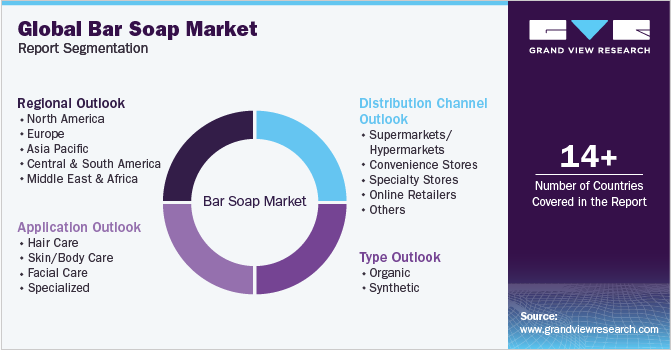
This report forecasts revenue growth at the global, regional, and country levels and provides an analysis on the latest industry trends and opportunities in each of the sub-segments from 2021 to 2033. For the purpose of this study, Grand View Research has segmented the global bar soap market report based on type, application, distribution channel type, and region:
-
Type Outlook (Revenue, USD Million, 2021 - 2033)
-
Organic
-
Synthetic
-
-
Application Outlook (Revenue, USD Million, 2021 - 2033)
-
Hair Care
-
Skin/Body Care
-
Facial Care
-
Specialized
-
-
Distribution Channel Outlook (Revenue, USD Million, 2021 - 2033)
-
Online
-
Offline
-
-
Regional Outlook (Revenue, USD Million, 2021 - 2033)
-
North America
-
U.S.
-
Canada
-
Mexico
-
-
Europe
-
Germany
-
France
-
UK
-
Italy
-
Spain
-
-
Asia Pacific
-
China
-
India
-
Japan
-
South Korea
-
Australia
-
-
Latin America
-
Brazil
-
Argentina
-
-
Middle East & Africa
-
Saudi Arabia
-
UAE
-
South Africa
-
-
Frequently Asked Questions About This Report
The global bar soap market size was valued at USD 34.2 billion in 2025 and is estimated at USD 35.7 billion in 2026.
The global bar soap market is expected to grow at a CAGR of 5.0% from 2026 to 2033, reaching USD 50.2 billion by 2033.
Asia Pacific dominated with a revenue share of 40.0% in 2025.
Some of the key players operating in the bar soap market include Lush Retail Ltd. (Brand Turnover); Ethique, Inc.; Unilever; Chagrin Valley Soap & Salve Co.; and Galderma S.A.; The Body Shop; Johnson & Johnson; KIRK’S NATURAL LLC; Tom's of Maine; Dr. Bronner's among others.
The synthetic bar soap segment held the highest market share of 90.0% in 2025.
About the Author(s)
Beauty & Personal Care Research Team
Consumer Goods · Beauty & Personal CareThis report was authored by the beauty & personal care research team at Grand View Research - comprising two research analysts, one senior research analyst, and one industry expert - with specialized expertise in the beauty & personal care segment of the consumer goods industry. All findings are based on proprietary consumer goods databases, executive interviews, and regulatory analysis, subject to internal peer review prior to publication.
Last Updated:
Speak to Analyst


Customize this report to your needs — add regions, segments, or data points, with 20% free customization.
Or view our licence options:


ISO 9001:2015 & 27001:2022 Certified
We are GDPR and CCPA compliant! Your transaction & personal information is safe and secure. For more details, please read our privacy policy.


