
- Home
- »
- Beauty & Personal Care
- »
-
Shea Butter Market Size, Share & Trends Report, 2026-2033GVR Report cover

Shea Butter Market (2026 - 2033)
Size, Share & Trends Analysis Report By Product (Raw/Unrefined, Refined), By Application (Cosmetics & Personal Care, Food, Others), By Region(North America, Europe, Asia Pacific, Latin America, MEA), And Segment Forecasts
Market Size, 2025
$2.6BMarket Estimate, 2026
$2.7BMarket Forecast, 2033
$5.0BCAGR, 2026–2033
9.2%Shea Butter Market Summary
The global shea butter market size was valued at USD 2.6 billion in 2025 and is projected to grow from USD 2.7 billion in 2026 to USD 5.0 billion by 2033, at a CAGR of 9.2% from 2026 to 2033. Europe dominated the market, accounting for a revenue share of 30.7% in 2025. This growth is largely driven by rising demand for natural and organic skincare products, with shea butter recognized for its moisturizing, anti-inflammatory, and antioxidant properties.
 Source: Grand View Research, IR Documents, Primary Interviews, Paid DatabasesTo learn more about this report,
 Download Free Sample Report
 Key Market Trends & Insights
- By product: Raw/unrefined segment led the market with the largest revenue share of 62.8% in 2025 and is expected to grow at the fastest CAGR over the forecast period.
- By application: cosmetics & personal care segment led the market with the largest revenue share of 80.8% in 2025.
Regional Highlights
- Largest regional market: Europe (30.7% revenue share, 2025)
- By country: The Germany held the largest market share in 2025.
Market Size & Forecast
- Market size in 2025: USD 2.6 Billion
- Estimated market size in 2026: USD 2.7 Billion
- Projected market size by 2033: USD 5.0 Billion
- CAGR (2026-2033): 9.2%
Three ways to get this report
Buy it, customize it, or ask a question.Ask an Analyst
A direct answer, usually in 1 working day
- AccessReport author, directly
- Reply timeWithin 1 working day
- No sales callDirect answer only
- FormatEmail reply
- CostFree, no cost
Get the Full Report
What the study covers
- FormatsPDF · Excel · Dashboard
- Timeline2026–2033 annual, 2025 base
- Coverage20+ countries, 5 regions
- Companies10+ key players profiled
Customize the Report
20% free customization
- IncludeCountries, segments, points
- TailorTo your product definition
- ExtendDeeper competitor detail
- OrA fully bespoke study
- Turnaround5–10 working days
The beauty and personal care sector, in particular, is a key consumer, spurred by consumer preferences for eco-friendly, sustainable ingredients. In addition, the market is benefiting from increased production capabilities in regions like West Africa, where shea butter is sourced, and ongoing initiatives to improve sustainability in the supply chain.The growth of the market is closely linked to regulatory frameworks and international partnerships aimed at boosting product quality, safety, and sustainability. In the U.S., shea butter products are governed by strict FDA and USDA regulations, ensuring consumer safety, preventing adulteration, and guaranteeing truthful labeling. These regulations play a significant role in maintaining market confidence, particularly in preventing the adulteration of shea butter, which is a major concern in the U.S. market. The American Shea Butter Institute categorizes imported shea butter into different classes, emphasizing the importance of using high-quality, pure shea butter for its efficacy.
 To learn more about this report, Download Free Sample Report
 Moreover, strategic collaborations between U.S. entities and African organizations are fostering both economic empowerment and sustainable practices in shea butter production. Notably, the "Shea Gets Greener!" initiative, a partnership with The Savannah Fruits Company, Sundial Brands, and USAID, is set to empower 21,000 women in Ghana, Cote d'Ivoire, and Mali. This collaboration, with an investment of USD 9.3 million, not only enhances production efficiency but also promotes eco-friendly methods. Such initiatives help expand the market by ensuring a steady supply of quality, sustainably produced shea butter, meeting the growing global demand for ethical and natural beauty ingredients.
The approval of shea butter as a novel food ingredient in China in 2017 marked a significant development for the market, expanding its usage beyond cosmetics to food products such as chocolates, ice cream, and bakery items. This shift not only introduces new culinary experiences but also drives market growth as Chinese consumers become more open to incorporating diverse ingredients. However, safety regulations prevent its inclusion in baby food. This broader acceptance of shea butter in food applications is expected to contribute to the market's growth in China as it taps into a new consumer base interested in international and unique food ingredients.
There has been a notable shift towards shea butter, driven by increased demand in the personal care and cosmetics sector in India. Shea butter's moisturizing and nourishing properties make it a popular choice for skincare and haircare products, enhancing its appeal among Indian manufacturers. The country's acceptance of shea butter as a food ingredient by the Food Safety and Standards Authority of India (FSSAI) in 2021 has further boosted imports, particularly from West African countries like Ghana. This regulatory approval has opened up new avenues for the use of shea butter in food products, such as chocolates, contributing to the growth of the market.
Market Dynamics
Shea butter is witnessing increasing demand across the personal care, cosmetics, food, and pharmaceutical industries owing to its multifunctional properties, including moisturizing, emollient, and antioxidant benefits. The growing consumer preference for natural, plant-based, and sustainably sourced ingredients is encouraging manufacturers to incorporate shea butter into a wide range of products, from skincare formulations and hair care solutions to confectionery and specialty food applications.
Beyond cosmetics, shea butter is gaining traction as a multifunctional ingredient within the food industry due to its favorable fatty acid composition, texture-enhancing properties, and compatibility with plant-based formulations. Food manufacturers are increasingly utilizing shea derivatives as alternatives to conventional vegetable fats in confectionery, bakery products, and specialty food applications. Growing demand for vegan, plant-based, and clean-label food products is further supporting the adoption of shea butter as a sustainable ingredient option.
In May 2026, AAK launched ILLEXAO EN 10, a new cocoa butter equivalent (CBE) designed specifically for enrobed chocolate applications. The ingredient utilizes specialty vegetable fats, including shea-based fractions, to help confectionery manufacturers address cocoa price volatility while maintaining product quality, gloss, texture, and processing efficiency. The launch reflects the growing use of shea-derived ingredients in chocolate and confectionery formulations as manufacturers seek cost-effective, sustainable, and high-performance alternatives to conventional cocoa butter. The development highlights how shea butter is increasingly moving beyond personal care applications and gaining strategic importance within the global food ingredients industry.
The shea butter market is restrained by regulatory interventions and export controls in major shea-producing countries, which can affect the international availability of raw shea nuts and related derivatives. Governments across West Africa are increasingly promoting domestic processing and value-addition initiatives to strengthen local industries and capture greater economic value from shea resources. While these policies support regional industrial development, they may limit raw material exports, disrupt established procurement channels, and contribute to supply shortages and price volatility for global manufacturers. The temporary suspension of shea nut exports by Burkina Faso in 2024 highlights the potential impact of trade-related measures on the global shea value chain, creating uncertainty for ingredient suppliers and end-use industries reliant on stable sourcing.
In February 2026, the Nigerian government extended its ban on raw shea nut exports until February 2027 to promote domestic processing and increase value addition within the country. The policy also removed export waivers and introduced stricter controls on surplus shea nut exports. While supporting local industrial development, the measure may reduce raw material availability for international buyers. As a result, export restrictions in major producing countries can create supply chain uncertainties and contribute to price volatility in the global shea butter market.
The limited commercialization of Nilotica shea butter presents a significant opportunity for manufacturers to develop differentiated premium skincare formulations. Its superior absorption characteristics, softer consistency, and high oleic acid content make it particularly suitable for luxury skincare, baby care, and sensitive-skin applications, enabling brands to capture higher-margin market segments.
In 2026, Korean beauty brand NILONICA introduced a dedicated skincare portfolio featuring certified organic East African Nilotica shea butter, including the Shea 10 Body Butter, Shea 25 Daily Face Cream, and Shea 50 Care Balm. The products were specifically developed to leverage Nilotica shea butter's superior absorption, non-greasy texture, and suitability for sensitive skin. The launch highlights growing industry interest in utilizing Nilotica shea butter as a premium alternative to conventional West African shea butter in high-end skincare formulations.
Analyst Perspective
The shea butter market is approaching a pivotal transition where access to raw materials may become a greater competitive differentiator than product innovation itself. With major producing nations such as Nigeria and Burkina Faso increasingly prioritizing local value addition through export controls and processing incentives, global manufacturers could face tighter access to raw shea resources despite rising end-market demand. As a result, companies that establish vertically integrated sourcing models, local processing partnerships, and direct relationships with producer cooperatives are likely to gain a structural advantage, potentially reshaping the industry's competitive hierarchy over the coming years.
Product Insights
Based on product, the raw/unrefined segment led the market with the largest revenue share of 62.8% in 2025 and is expected to grow at the fastest CAGR over the forecast period. The demand for unrefined shea butter in skincare products is increasing, driven by consumers' growing preference for natural and organic ingredients. Companies like Isivuno Naturals and FirstSeed Organics in South Africa are catering to this demand by offering unrefined shea butter for skincare formulations. The rise of the self-care movement, along with greater consumer awareness about ingredient purity, has led to the popularity of products made with unrefined shea butter. Just Shea Butter, a South African company founded by Wandisa Nkosi, has tapped into this market by sourcing organic-certified shea butter from Ghana, focusing on providing pure, unadulterated products. Their successful marketing efforts via social media have contributed to the growth of the market for unrefined shea butter.
Refined shea butter sales are projected to grow at a CAGR of 7.6% from 2025 to 2030. Companies such as All Organic Treasures GmbH, a Germany-based provider, offer organic shea butter, with its refined version being a nearly odorless and tasteless white solid fat rich in oleic and stearic acid. The refined shea butter is certified as both organic and kosher, making it suitable for food applications, and has a shelf life of at least 18 months. The company collaborates with the Shea Savannah Fruit Company (SFC) to ensure compliance with food-grade certifications, including DE-ÖKO-007 and Kosher. This growing demand for refined shea butter, particularly in food products, reflects the increasing interest in high-quality, certified ingredients that meet both health and regulatory standards in markets like Europe, where ethical sourcing and natural ingredients are highly valued.
Application Insights
Based on application, the cosmetics & personal care segment led the market with the largest revenue share of 80.8% in 2025. This is attributed to its use in cosmetics and personal care products, driven by its growing popularity for its natural, moisturizing, and skin-nourishing properties. Shea butter is rich in essential fatty acids like oleic acid and stearic acid, which are known to hydrate and protect the skin. This makes it a key ingredient in formulations for lotions, creams, lip balms, and hair care products. Brands like L'Occitane, The Body Shop, and Dr Organic have capitalized on the increasing demand for organic, natural beauty products by incorporating shea butter into their ranges. In addition, consumer preference for sustainable and ethically sourced ingredients has further fueled demand, with companies sourcing shea butter from West Africa and ensuring fair trade practices. This shift toward clean beauty and sustainable ingredients has reinforced shea butter’s dominant role in the global cosmetics market.
 To learn more about this report, Download Free Sample Report
 Shea butter sales in the food industry are projected to grow at a CAGR of 8.5% from 2025 to 2030, driven by its increasing acceptance as a versatile, natural fat used in a variety of food products. Its benefits in enhancing texture, improving shelf life, and contributing to healthier fats have led to its incorporation in products like chocolates, bakery goods, ice creams, and frying oils. For instance, the approval of shea butter as a novel food ingredient in China in 2017 opened up new avenues for its use in food, aligning with rising consumer demand for diverse and healthier food ingredients. Furthermore, shea butter is gaining traction in the vegan food market due to its plant-based origins, which align with the growing trend for plant-based and ethical food alternatives.
Regional Insights
The North America shea butter market accounted for a share of 28.93% of the global market revenue in 2024. Major American brands like The Body Shop and L'Occitane, which focus on natural ingredients, are expanding their product lines with shea butter-based offerings. Furthermore, the approval of shea butter as a food ingredient in regions like the U.S. has spurred growth in its use in edible products such as chocolates and baked goods.
U.S. Shea Butter Market Trends:
The U.S. shea butter market is expected to grow at a CAGR of 8.2% from 2025 to 2030. The U.S. market is shaped by a combination of regulatory oversight and growing demand for natural ingredients in skincare, cosmetics, and food. Shea butter is widely recognized for its versatility, used for skin conditions like eczema, sunburn relief, and wrinkle reduction. However, the market faces challenges, particularly regarding adulteration, as some producers modify shea butter to enhance its fragrance or texture, undermining its therapeutic properties. The American Shea Butter Institute highlights the issue of product delays, with some shea butter reaching consumers after two to three years, causing a loss of potency. To combat this, the Institute advises consumers to check for certifications such as the American Shea Butter Institute's seal.
Europe Shea Butter Market Trends
Europe dominated the shea butter market with the largest revenue share of 30.7% in 2025. The shea butter market in Europe is experiencing significant growth, driven by the rising demand for eco-friendly, ethically sourced ingredients, particularly in the cosmetics and food industries. European consumers are increasingly prioritizing sustainability and natural products, with the majority of shea butter consumption being directed towards the food industry, while the cosmetics sector holds a smaller but growing share, according to the Global Shea Alliance. This trend is reinforced by stringent regulatory frameworks such as the Cosmetic Regulation (EC 1223/2009) and REACH, ensuring the safety and quality of imported shea butter.
 To learn more about this report, Download Free Sample Report
 Germany Shea Butter Market Trends
The shea butter market in the Germany held the largest share in the Europe region in 2025.
Asia Pacific Shea Butter Market Trends
The Asia Pacific shea butter market is expected to grow at a CAGR of 8.7% from 2025 to 2030. The growth of the market in the Asia Pacific region is being significantly influenced by efforts from various associations, notably the Global Shea Alliance (GSA). As of December 2022, the GSA, a key non-profit organization representing over 600 members globally, launched initiatives to expand shea butter's presence in the Asia Pacific cosmetics and health sectors. With strong roots in Europe and the U.S., the GSA is now focusing on connecting cosmetic brands in Japan, South Korea, and China with rural shea butter producers, primarily women cooperatives. This initiative is expected to empower local producers, promote the use of shea butter in cosmetics, and drive market growth in the region.
Key Shea Butter Company Insights
The shea butter industry is fragmented, with the presence of many developed global players and many developing key market entrants. These players are engaging in major acquisition and promotional activities to increase their customer base and brand loyalty. Prominent companies include The Savannah Fruits Company (SFC), Bunge Loders Croklaan, and Olam International, which are key suppliers of raw shea butter, mainly sourced from Africa. These companies have a strong focus on sustainable sourcing and empowerment of women in West Africa, which aligns with the growing consumer demand for ethically sourced ingredients.
Key Shea Butter Companies
The following key companies have been profiled for this study on theshea butter market.
- BASF SE
- Olvea Group
- Sophim S.A.
- Cargill, Inc.
- Suru Chemicals
- Ghana Nuts Company Ltd.
- Croda International Plc
- Agrobotanicals, LLC
- Clariant AG
- AAK AB
Competitive Benchmarking
Category
Operating Strategies
Competitive Edge
Weakness
Established Players (Cargill, Inc., BASF SE, AAK AB)
- Diversify portfolios across cosmetics, food ingredients, and specialty fats while strengthening vertically integrated sourcing networks in West Africa.
- Benefit from established processing infrastructure, long-term supplier relationships, and global distribution capabilities that ensure supply security and product consistency.
- Exposure to export regulations, climate-related supply disruptions, and increasing competition for shea feedstock from multiple end-use industries.
Emerging Players (Sophim S.A., Suru Chemicals, Agrobotanicals, LLC)
- Focus on niche segments such as organic, fair-trade, traceable, and Nilotica shea butter products to build market differentiation.
- Greater flexibility in addressing premium consumer trends through sustainable sourcing and innovative product positioning.
- Limited sourcing scale and processing capacity, resulting in higher procurement costs and supply chain vulnerabilities.
Recent Developments
-
In June 2021, the Fuji Oil Group established the Responsible Shea Kernels Sourcing Policy, aiming to exercise sustainable development in the shea butter supply chain. Its approach involves planting 6,000 shea tree saplings annually with an objective to empower women in the shea kernel industry, enhance the production capacity of cooperatives, generate local employment opportunities, and offer training on operational skills and product quality.
-
The Ghana Shea Landscape Emission Reductions Project (GLSERP), launched in early 2024 with an investment of USD 54.5 million, aims to enhance sustainability in Shea farming. This initiative focuses on preventing deforestation, supporting local communities, and boosting the Shea butter value chain.
-
In September 2021, Shea Radiance launched six new body care products in 520 Whole Foods Stores in Virginia, U.S.
Shea Butter Market Report Scope
Report Attribute
Details
Market size in 2025
USD 2.6 billion
Estimated market size in 2026
USD 2.7 billion
Projected market size by 2033
USD 5.0 billion
Growth rate
CAGR of 9.2% from 2026 to 2033
Base year for estimation
2025
Historical data
2021 - 2024
Forecast period
2026 - 2033
Quantitative units
Revenue in USD million/billion and CAGR from 2026 to 2033
Report coverage
Revenue forecast, company ranking, competitive landscape, growth factors, and trends
Segments covered
Product, application, region
Regional scope
North America; Europe; Asia Pacific; Central & South America; MEA
Country scope
U.S.; Canada; Mexico; Germany; UK; France; Italy; Spain; China; Japan; India; Malaysia; Australia; Brazil; South Africa
Key companies profiled
BASF SE, Olvea Group, Sophim S.A., Cargill, Inc., Suru Chemicals, Ghana Nuts Company Ltd., Croda International Plc, Agrobotanicals, LLC, Clariant AG, AAK AB
Customization scope
Free report customization (equivalent up to 8 analysts' working days) with purchase. Addition or alteration to country, regional & segment scope.
Pricing and purchase options
Avail customized purchase options to meet your exact research needs. Explore purchase options
Global Shea Butter Market Report Segmentation
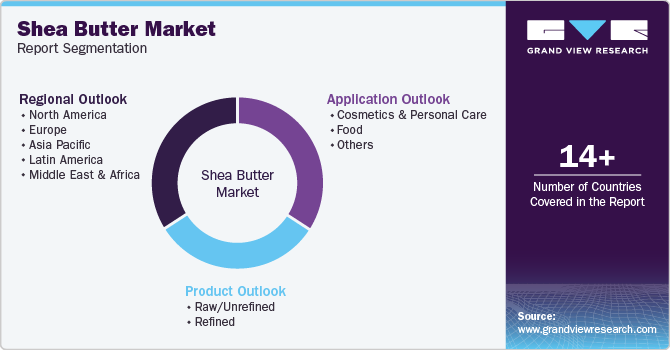
This report forecasts revenue growth at the global, regional, and country levels and provides an analysis of the latest industry trends and opportunities in each of the sub-segments from 2021 to 2033. For this study, Grand View Research has segmented the global shea butter market report based on product, application, and region.
 To learn more about this report, Download Free Sample Report
 -
Product Outlook (Revenue, USD Million, 2021 - 2033)
-
Raw/Unrefined
-
Refined
-
-
Application Outlook (Revenue, USD Million, 2021 - 2033)
-
Cosmetics & Personal Care
-
Food
-
Others
-
-
Regional Outlook (Revenue, USD Million, 2021 - 2033)
-
North America
-
U.S.
-
Canada
-
Mexico
-
-
Europe
-
Germany
-
UK
-
France
-
Italy
-
Spain
-
-
Asia Pacific
-
China
-
India
-
Japan
-
Malaysia
-
Australia
-
-
Latin America
-
Brazil
-
-
Middle East & Africa
-
South Africa
-
-
Research Methodology
The shea butter market figures in this report are based on a proven research process that combines executive interviews with secondary research from proprietary databases, company filings, and recognized regulatory and institutional sources. Market size is built through value-chain sizing - reconciling supply-side and demand-side estimates - and triangulated with bottom-up and top-down approaches. Every estimate passes multiple levels of expert validation before publication, with each shea butter segment quantified using the revenue-capture definitions in the table below.
Segment Definition
Segment - Product
Revenue capture definition
Raw/Unrefined
This segment includes the sales of shea butter that undergoes minimal processing and retains its natural color, aroma, vitamins, and fatty acids. Revenue is generated from its use in natural skincare, haircare, cosmetics, and personal care products where consumers prefer organic and minimally processed ingredients.
Refined
This segment includes the sales of shea butter that has been processed to remove impurities, color, and odor, resulting in a neutral and consistent ingredient. Revenue is generated from its widespread use in cosmetics, personal care formulations, pharmaceuticals, food products, and industrial applications requiring standardized quality and extended shelf life.
Segment - Application
Revenue capture definition
Cosmetics & Personal Care
This segment includes the sales of shea butter used in skincare, haircare, cosmetics, and personal hygiene products. Revenue is generated from its incorporation into moisturizers, lotions, creams, lip balms, soaps, shampoos, and other beauty formulations due to its moisturizing and skin-conditioning properties.
Food
This segment includes the sales of shea butter and shea-derived fractions used in food and confectionery applications. Revenue is generated from its use as a cocoa butter alternative, specialty fat, and functional ingredient in chocolates, bakery products, spreads, and other processed food products.
Others
This segment includes the sales of shea butter used in pharmaceutical, nutraceutical, and industrial applications. Revenue is generated from its incorporation into medicinal ointments, therapeutic products, and specialty formulations requiring emollient and functional properties.
Estimation Model
Raw Material Availability Layer
Processing & Supply Layer End-Use Demand Layer Revenue Realization Layer How much shea feedstock is available?
How much shea butter reaches the market? Where is shea butter consumed? How much revenue is generated? Assess shea nut production across major producing countries such as Nigeria, Ghana, Burkina Faso, Mali, and Côte d'Ivoire. Evaluate harvest volumes, climate conditions, export policies, and collection efficiency to determine the total addressable raw material base for shea butter production.
Apply processing yields, domestic consumption levels, local value-addition requirements, and export volumes to estimate the commercially available supply of raw, refined, and specialty shea butter entering global trade channels. Analyze demand across cosmetics & personal care, food & confectionery, pharmaceuticals, and other industrial applications. Segment consumption by region and application to identify the addressable market for shea butter-derived products. Estimate market revenue by applying average selling prices across product grades, application segments, and geographic markets, with organic, fair-trade, traceable, and specialty variants such as Nilotica shea butter to derive total market value. Delivered Customizations
This report has been delivered with the following In-depth customizations
Client Request
Customization Delivered
Value Adds
Growth Potential of Shea Butter in Food and Confectionery Applications
Conducted a detailed assessment of shea butter utilization in confectionery, bakery, chocolate, and specialty fats applications, including the adoption of shea-based cocoa butter equivalents (CBEs), emerging food-grade innovations, and demand trends across key consuming regions.
Helps stakeholders identify high-growth application areas, evaluate diversification opportunities beyond cosmetics, and assess the long-term revenue potential of shea-derived ingredients in the food industry.
Impact of Export Restrictions and Domestic Processing Policies on Global Shea Butter Supply
Evaluated the implications of export bans, levies, licensing requirements, and local value-addition initiatives in major shea-producing countries, including supply chain disruptions, procurement challenges, and trade flow shifts affecting global manufacturers.
Provides strategic insights into sourcing risks, supply security, and procurement planning while supporting informed investment and partnership decisions across the shea butter value chain.
Market Impact of Climate Change on Shea Nut Production and Availability
Assessed the influence of changing rainfall patterns, drought conditions, land-use changes, and biodiversity challenges on shea tree productivity, raw material availability, and long-term supply sustainability across West African producing regions.
Enables stakeholders to anticipate supply-side risks, develop climate-resilient sourcing strategies, and identify sustainable procurement opportunities to ensure long-term business continuity.
Frequently Asked Questions About This Report
Prominent companies include The Savannah Fruits Company (SFC), Bunge Loders Croklaan, and Olam International, which are key suppliers of raw shea butter, mainly sourced from Africa.
Market growth is largely driven by rising demand for natural and organic skincare products, with shea butter recognized for its moisturizing, anti-inflammatory, and antioxidant properties. The beauty and personal care sector, in particular, is a key consumer, spurred by consumer preferences for eco-friendly, sustainable ingredients.
Europe dominated with a revenue share of 30.7% in 2025.
Asia Pacific is the fastest growing region over the forecast period.
In cosmetics and personal care, the use of shea butter accounted for the largest share of 80.8% in 2025.
The global shea butter market size was valued at USD 2.6 billion in 2025 and is expected to reach USD 2.7 billion in 2026.
The global shea butter market is expected to grow at a compound annual growth rate of 9.2% from 2026 to 2033 to reach USD 5.0 million by 2033.
Raw/unrefined product segment dominated the shea butter market with a share of more than 62.8% in 2025.
About the Author(s)
Beauty & Personal Care Research Team
Consumer Goods · Beauty & Personal CareThis report was authored by the beauty & personal care research team at Grand View Research - comprising two research analysts, one senior research analyst, and one industry expert - with specialized expertise in the beauty & personal care segment of the consumer goods industry. All findings are based on proprietary consumer goods databases, executive interviews, and regulatory analysis, subject to internal peer review prior to publication.
Last Updated:
Speak to Analyst

Customize this report to your needs - add regions, segments, or data points, with 20% free customization.
Or view our licence options:


ISO 9001:2015 & 27001:2022 Certified
We are GDPR and CCPA compliant! Your transaction & personal information is safe and secure. For more details, please read our privacy policy.


