
- Home
- »
- Next Generation Technologies
- »
-
Battery-free Sensors Market Size, Industry Report, 2033GVR Report cover

Battery-free Sensors Market (2025 - 2033) Size, Share & Trends Analysis Report By Sensor Type, By Frequency (Low frequency, High frequency, Ultra-high frequency), By End Use, By Region, And Segment Forecasts
Market Size, 2024
$44.0MMarket Estimate, 2026
$49.7MMarket Forecast, 2033
$369.5MCAGR, 2025–2033
28.5%Battery-free Sensors Market Summary
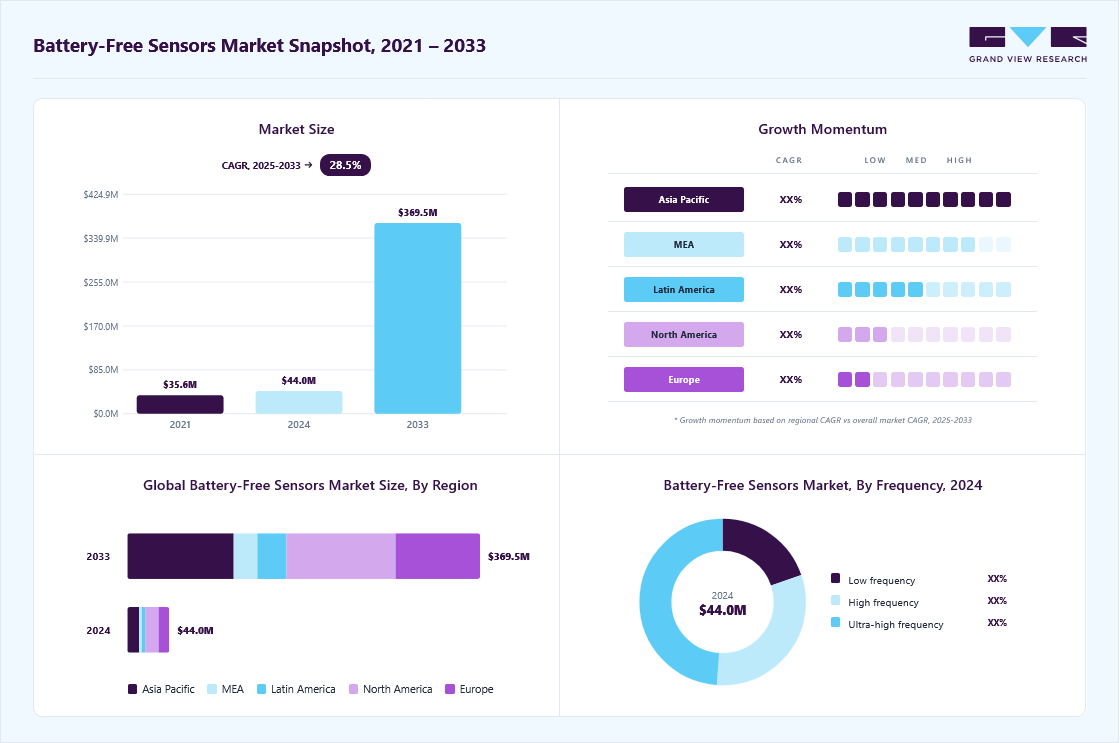
The global battery-free sensors market size was estimated at USD 44.0 million in 2024, and is projected to reach USD 369.5 million by 2033, growing at a CAGR of 28.5% from 2025 to 2033. The battery-free sensors market is gaining significant momentum driven by the global surge in demand for energy-efficient and maintenance-free sensing solutions.
 Source: Grand View Research, IR Documents, Primary Interviews, Paid DatabasesTo learn more about this report,
 Download Free Sample Report
 Key Market Trends & Insights
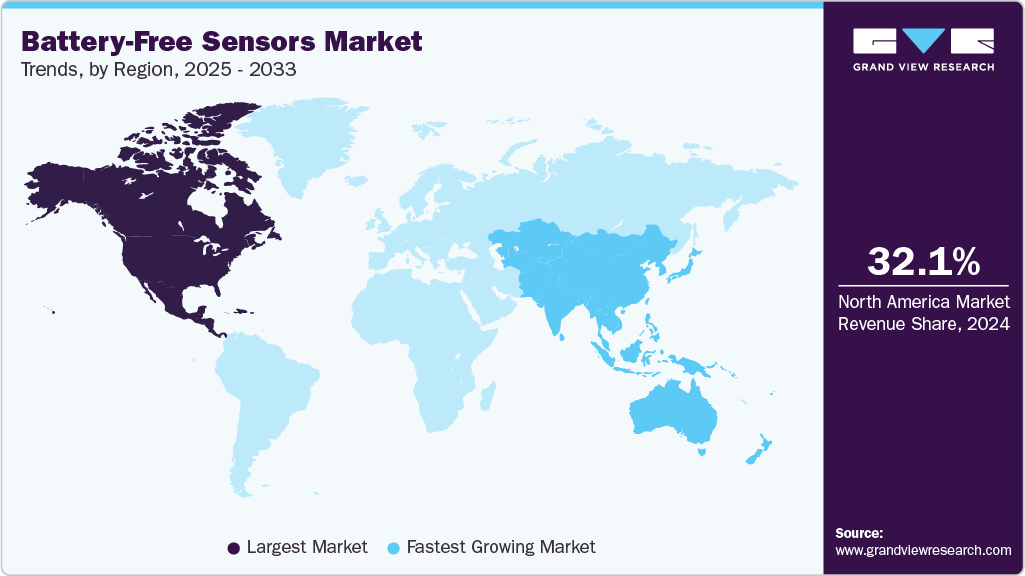
- North America battery-free sensors market accounted for a 32.1% share of the overall market in 2024.
- The battery-free sensors industry in the U.S. held a dominant position in 2024.
- By sensor type, the temperature sensors segment accounted for the largest share of 25.1% in 2024.
- By frequency, the ultra-high frequency segment held the largest market share of 49.0% in 2024
- By end use, the industrial segment dominated the market in 2024.
Market Size & Forecast
- 2024 Market Size: USD 44.0 Million
- 2033 Projected Market Size: USD 369.5 Million
- CAGR (2025-2033): 28.5%
- North America: Largest market in 2024
- Asia Pacific: Fastest market
Three ways to get this report
Buy it, customize it, or ask a question.Ask an Analyst
Analyst response in 1 business day
- AccessReport author, directly
- Reply timeWithin 1 working day
- No sales callDirect answer only
- FormatEmail reply
- CostFree, no cost
Get the Full Report
What the study covers
- FormatsPDF · Excel · Dashboard
- Timeline2025–2033 annual, 2024 base
- Coverage20+ countries, 5 regions
- Companies10+ key players profiled
Customize the Report
20% free customization
- IncludeCountries, segments, points
- TailorTo your product definition
- ExtendDeeper competitor detail
- OrA fully bespoke study
- Turnaround5–10 working days
The proliferation of the Internet of Things (IoT), especially in sectors such as industrial automation, logistics, healthcare, and smart agriculture, is creating a strong need for sensors that can operate without battery replacements. Technological advancements are playing a crucial role in shaping the growth of the market. Innovations in energy harvesting techniques, including radio frequency (RF), thermoelectric, piezoelectric, and photovoltaic methods, are enabling sensors to draw ambient power from their surroundings. At the same time, ultra-low-power electronics and improved wireless communication protocols (such as UHF RFID, NFC, and LoRa) are enhancing the range, accuracy, and data transfer capabilities of battery-free sensors. The integration of these sensors with edge computing and artificial intelligence (AI) is further extending their utility in real-time monitoring and decision-making applications.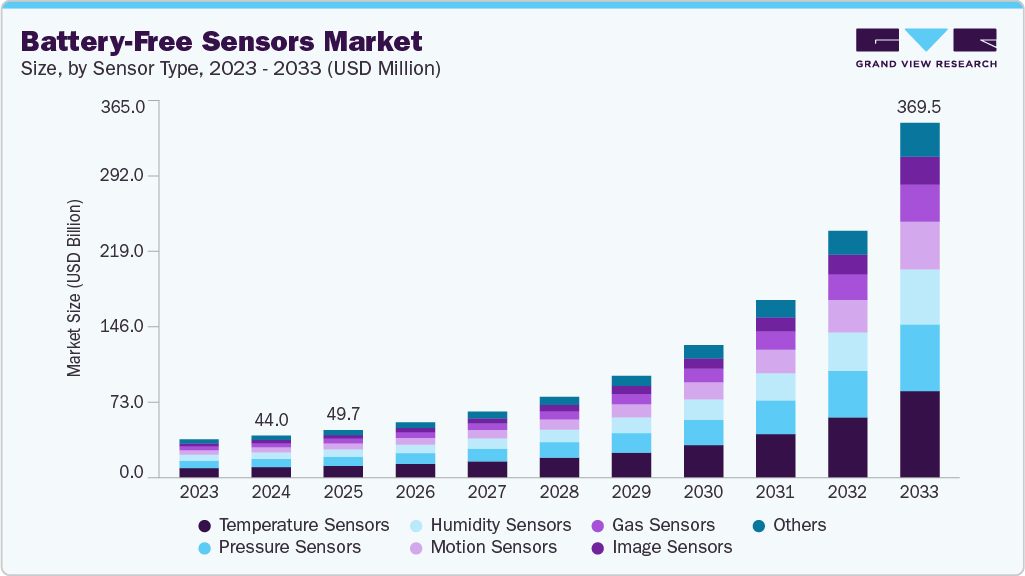 To learn more about this report, Download Free Sample Report
 Investments in the battery-free sensors market are increasing steadily, driven by both public and private sector interest in green technology and next-generation sensing solutions. Leading sensor manufacturers, RFID solution providers, and IoT startups are collaborating to accelerate product development and commercial deployment. Companies such as Everactive, Powercast, and Wiliot are attracting venture capital and strategic partnerships to expand their offerings. Government-backed initiatives promoting smart cities, digital farming, and industrial automation are also providing funding and infrastructure support, particularly in regions such as North America, Europe, and Asia Pacific.
The regulatory landscape is also evolving to support the adoption of battery-free sensor technologies. Regulations encouraging electronic waste reduction, energy efficiency, and environmentally sustainable solutions are creating favorable conditions for market growth. In sectors such as healthcare and food logistics, compliance with safety and quality standards is encouraging the use of sensors that offer continuous and reliable data without the risk of power loss. In addition, RAIN RFID and ISO standards for wireless sensor interoperability are helping ensure consistency and scalability in deployments across industries.
Despite strong growth potential, the battery-free sensors market faces a few challenges. One of the key restraints is the limited energy availability, which can constrain the performance of sensors in data-intensive or long-range applications. The upfront cost of integrating energy harvesting components and the complexity of designing reliable passive sensing systems for harsh environments may deter adoption in cost-sensitive sectors.
Sensor Type Insights
The temperature sensors segment accounted for the largest share of 25.1% in 2024. The rising adoption of IoT-based monitoring systems, particularly in sectors such as healthcare, cold chain logistics, and industrial automation, fuels the growth of the segment. Temperature is a critical parameter in applications ranging from vaccine storage and food safety to process control in manufacturing. Battery-free temperature sensors offer continuous and reliable monitoring without the need for battery replacement or maintenance, making them ideal for deployment in remote or hard-to-access locations.
The motion sensors segment is expected to grow at the fastest CAGR during the forecast period. The growing adoption of smart home technologies is driving the growth of battery-free motion sensors. These sensors are essential for automating lighting, HVAC, and security systems based on occupancy and movement. Unlike traditional battery-powered sensors, battery-free alternatives offer a maintenance-free solution, eliminating the need for periodic battery replacement. This is especially important in hard-to-reach locations such as ceilings or outdoor areas. This improves both energy efficiency and user convenience, making them attractive for large-scale smart building projects.
Frequency Insights
The ultra-high frequency segment held the largest market share of 49.0% in 2024. The high demand in supply chain and logistics fuels growth of the segment. These sensors, often embedded in UHF RFID tags, enable real-time tracking and monitoring of goods over long distances without the need for batteries. They are crucial for inventory management, cold chain monitoring, and asset tracking, offering businesses enhanced visibility, reduced loss, and improved operational efficiency. Their ability to perform in dense, metal-heavy environments further strengthens their appeal in logistics.
The high-frequency segment is expected to grow at a significant CAGR during the forecast period. The ubiquity of NFC-enabled smartphones and tablets, which can both power and read high-frequency (HF) battery-free sensors, fuels growth of the segment. This compatibility makes HF sensors ideal for consumer-centric applications such as smart packaging, digital health monitoring, contactless payments, and retail product authentication. The ability to interact with sensors using everyday mobile devices removes the need for specialized readers, accelerating adoption in industries seeking user-friendly solutions.
End Use Insights
The industrial segment dominated the market in 2024. Rising demand for predictive maintenance and asset monitoring fuels growth of the market. Battery-free sensors enable real-time monitoring of equipment parameters such as temperature, vibration, strain, and pressure without the burden of battery maintenance. This allows factories to continuously assess machine health and schedule proactive repairs, reducing unplanned downtime and extending the life of expensive machinery. The elimination of batteries is especially advantageous in difficult-to-access or hazardous areas where regular maintenance is impractical.
 To learn more about this report, Download Free Sample Report
 The healthcare segment is projected to grow at the fastest CAGR of 29.7% over the forecast period. The pharmaceutical industry is adopting battery-free sensors to improve supply chain transparency and drug safety. Temperature-sensitive medicines and vaccines require strict cold chain compliance, and battery-free RFID/NFC sensors embedded in packaging allow for real-time temperature tracking during transport and storage. These sensors reduce costs and eliminate the maintenance challenges of battery-powered data loggers, making them ideal for mass deployment in vaccine distribution and biologics tracking.
Regional Insights
The North America battery-free sensors market held a significant share in 2024. The growth in the region is driven by the rapid adoption of IoT and industrial automation across sectors such as healthcare, manufacturing, logistics, and smart infrastructure. The region benefits from advanced R&D capabilities, strong investment in energy harvesting technologies, and a high level of awareness regarding sustainable sensing solutions.
 To learn more about this report, Download Free Sample Report
 U.S. Battery-free Sensors Market Trends
The U.S. battery-free sensors market held a dominant position in 2024 due to the widespread adoption of battery-free RFID and NFC-based sensors in healthcare, retail, and supply chain operations. Federal initiatives promoting smart infrastructure and sustainability, along with a regulatory emphasis on reducing electronic waste, are supporting broader deployment.
Europe Battery-free Sensors Market Trends
The Europe battery-free sensors industry was identified as a lucrative region in 2024. The European Union's stringent environmental regulations and sustainability directives are pushing companies to replace battery-dependent devices with low-maintenance, energy-efficient alternatives. Investments in smart grid and Industry 4.0 initiatives are also creating a favorable environment for battery-free sensor deployment.
The UK battery-free sensors market is expected to grow rapidly in the coming years. In the UK, the battery-free sensors market is gaining momentum, particularly in sectors like healthcare, retail, and transportation. The country's focus on digital health transformation and NHS-backed initiatives is driving the use of wearable and disposable battery-free sensors for patient monitoring.
The Germany battery-free sensors industry held a substantial market share in 2024. The country's emphasis on smart manufacturing and predictive maintenance is encouraging the deployment of passive sensors in machinery, production lines, and asset-tracking systems. Energy harvesting technologies are being integrated into sensor networks to align with Germany's strong sustainability goals.
Asia Pacific Battery-free Sensors Market Trends
The Asia Pacific battery-free sensors market is anticipated to grow at a CAGR of 29.6% during the forecast period. The Asia Pacific region is emerging as a high-growth market for battery-free sensors, driven by large-scale industrialization, smart city projects, and expanding IoT adoption. Rapid technological advancements, combined with strong government support for digital infrastructure, are facilitating the integration of battery-less sensors in manufacturing, healthcare, and logistics.
The Japan battery-free sensors industry is expected to grow rapidly in the coming years due to increasing adoption in healthcare, precision agriculture, and automotive applications. Japan's leadership in sensor innovation and energy-efficient technologies supports the development of compact, reliable, battery-free sensing systems.
The China battery-free sensors market held a substantial market share in 2024. The growth in the country is supported by large-scale investment in smart cities, logistics automation, and digital healthcare infrastructure. The government's push for green technology and sustainable manufacturing practices aligns well with the adoption of battery-free sensing systems.
Key Battery-free Sensors Company Insights
Some of the key companies in the battery-free sensors market include Texas Instruments, STMicroelectronics, Infineon Technologies AG, Axzon, and others. Organizations are focusing on increasing customer base to gain a competitive edge in the industry. Therefore, key players are taking several strategic initiatives, such as mergers and acquisitions, and partnerships with other major companies.
-
Texas Instruments (TI) is a semiconductor company that develops advanced sensing and power management technologies enabling battery-free sensor solutions for diverse applications. TI’s ultra-low-power integrated circuits, such as the bq25570 and bq25505 power management ICs, efficiently harvest microwatts to milliwatts of energy from ambient sources like light, heat, or mechanical motion. TI has developed battery-less wireless temperature and humidity sensors powered solely by RF energy, demonstrating its expertise in enabling fully self-sustaining sensor systems.
-
Axzon Inc. is a patent holder in RFID battery-free wireless sensor technology, specializing in Smart Passive Sensing solutions that monitor temperature, moisture, pressure, and proximity without the need for external power sources. These battery-free sensors harvest energy from RFID readers to wirelessly transmit critical data, making them ideal for diverse industrial applications, including automotive manufacturing, data centers, cold chain logistics, electric utilities, and predictive maintenance.
Key Battery-free Sensors Companies:
The following are the leading companies in the battery-free sensors market. These companies collectively hold the largest market share and dictate industry trends.
- Texas Instruments
- Semiconductor Components Industries, LLC
- STMicroelectronics
- Infineon Technologies AG
- Kliskatek S.L.
- Powercast
- Axzon
- EnOcean GmbH
- Everactive
- Advantech Co., Ltd.
Recent Developments
-
In May 2025, Dracula Technologies launched the E-zeroBatteryZone, an innovative battery-free IoT sensor node platform powered entirely by indoor ambient light using their proprietary LAYER organic photovoltaic (OPV) modules. This breakthrough enables sustainable, scalable, and maintenance-free IoT deployments by harvesting energy from indoor lighting, even in low illumination conditions, eliminating the need for conventional batteries and thereby reducing environmental impact and operational costs.
-
In June 2024, Identiv, Inc., in partnership with French sensor and IC specialist Asygn, launched the battery-free metal sensor IoT devices, Sensory Tag on Metal (TOM) labels. These advanced on-metal sensor solutions leverage Asygn’s next-generation AS321X ultra-high frequency (UHF) RFID chip platform to monitor temperature and strain in proximity to metallic surfaces without relying on batteries. Fully compatible with RAIN RFID standards, the AS321X chips support both integrated and external sensors, enabling the detection of temperature, strain, ambient conditions, light, humidity, magnetic fields, motion, and pressure. This battery-free sensing technology is particularly well-suited for industrial, logistics, and supply chain environments that require reliable condition monitoring without the maintenance and costs associated with battery-powered systems.
Battery-free Sensors Market Report Scope
Report Attribute
Details
Market size value in 2025
USD 49.7 million
Revenue forecast in 2033
USD 369.5 million
Growth rate
CAGR of 28.5% from 2025 to 2033
Base year for estimation
2024
Historical data
2021 - 2023
Forecast period
2025 - 2033
Quantitative units
Revenue in USD million/billion and CAGR from 2025 to 2033
Report frequency
Revenue forecast, company ranking, competitive landscape, growth factors, and trends
Segments covered
Sensor type, frequency, end use, region
Regional scope
North America; Europe; Asia Pacific; Latin America; MEA
Country scope
U.S.; Canada; Mexico; Germany; UK; France; China; Japan; India; South Korea; Australia; Brazil; KSA; UAE; South Africa
Key companies profiled
Texas Instruments; Semiconductor Components Industries, LLC; STMicroelectronics; Infineon Technologies AG; Kliskatek S.L.; Powercast; Axzon; EnOcean GmbH; Everactive; Advantech Co., Ltd.
Customization scope
Free report customization (equivalent up to 8 analysts working days) with purchase. Addition or alteration to country, regional & segment scope.
Pricing and purchase options
Avail customized purchase options to meet your exact research needs. Explore purchase options
Global Battery-free Sensors Market Report Segmentation
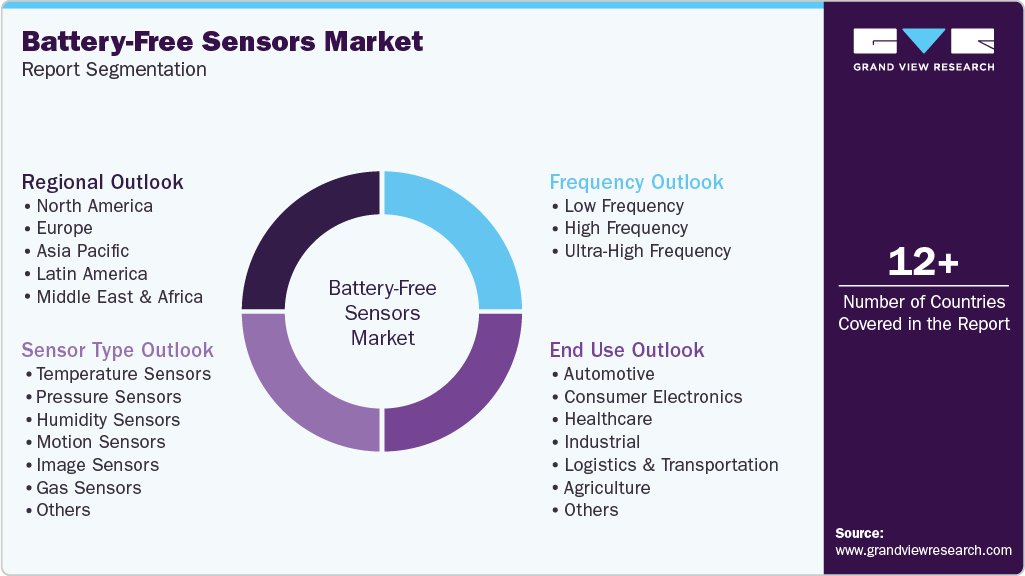
This report forecasts revenue growth at global, regional, and country levels and provides an analysis of the latest industry trends in each of the sub-segments from 2021 to 2033. For this study, Grand View Research has segmented the global battery-free sensors market report based on sensor type, frequency, end use, and region:
 To learn more about this report, Download Free Sample Report
 -
Sensor Type Outlook (Revenue, USD Million, 2021 - 2033)
-
Temperature Sensors
-
Pressure Sensors
-
Humidity Sensors
-
Motion Sensors
-
Image Sensors
-
Gas Sensors
-
Others
-
-
Frequency Outlook (Revenue, USD Million, 2021 - 2033)
-
Low Frequency
-
High Frequency
-
Ultra-High Frequency
-
-
End Use Outlook (Revenue, USD Million, 2021 - 2033)
-
Automotive
-
Consumer Electronics
-
Healthcare
-
Industrial
-
Logistics & Transportation
-
Agriculture
-
Aerospace & Defense
-
Others
-
-
Regional Outlook (Revenue, USD Million, 2021 - 2033)
-
North America
-
U.S.
-
Canada
-
Mexico
-
-
Europe
-
Germany
-
UK
-
France
-
-
Asia Pacific
-
China
-
Japan
-
India
-
South Korea
-
Australia
-
-
Latin America
-
Brazil
-
-
Middle East and Africa (MEA)
-
KSA
-
UAE
-
South Africa
-
-
Frequently Asked Questions About This Report
The global battery-free sensors market size was estimated at USD 44.0 million in 2024 and is expected to reach USD 49.7 million in 2025.
The global battery-free sensors market is expected to grow at a compound annual growth rate of 28.5% from 2025 to 2033 to reach USD 369.5 million by 2033.
North America dominated the battery-free sensors market with a share of 32.1% in 2024. The growth in the region is driven by rapid adoption of IoT and industrial automation across various sectors.
Some key players operating in the battery-free sensors market include battery-free Texas Instruments; Semiconductor Component Industries, LLC; STMicroelectronics; Infineon Technologies AG; Kliskatek S.L.; Powercast and others.
The batter-free sensors market is gaining significant momentum driven by the global surge in demand for energy-efficient and maintenance free sensing solutions.
About the Author(s)
Next Generation Technologies Research Team
Technology · Next Generation TechnologiesThis report was authored by the next generation technologies research team at Grand View Research - comprising two research analysts, one senior research analyst, and one industry expert - with specialized expertise in the next generation technologies segment of the technology industry. All findings are based on proprietary technology databases, executive interviews, and regulatory analysis, subject to internal peer review prior to publication.
Last Updated:
Speak to Analyst

Customize this report to your needs - add regions, segments, or data points, with 20% free customization.
Or view our licence options:


ISO 9001:2015 & 27001:2022 Certified
We are GDPR and CCPA compliant! Your transaction & personal information is safe and secure. For more details, please read our privacy policy.


