
- Home
- »
- Advanced Interior Materials
- »
-
Battery Grade Graphite Market Share Analysis, Industry Report, 2026-2033GVR Report cover
![Battery Grade Graphite Market (2026 - 2033)Report]()
Battery Grade Graphite Market (2026 - 2033)
Size, Share & Trend Analysis Report By Product Form (Spherical Graphite, Coated Graphite, Granular Graphite), By Application (Electric Vehicles, Energy Storage Systems, Consumer Electronics, Power Tools), By Region, And Segment Forecasts
Market Size, 2025
$2.3BMarket Estimate, 2026
$2.4BMarket Forecast, 2033
$4.2BCAGR, 2026–2033
8.2%Battery Grade Graphite Market Summary
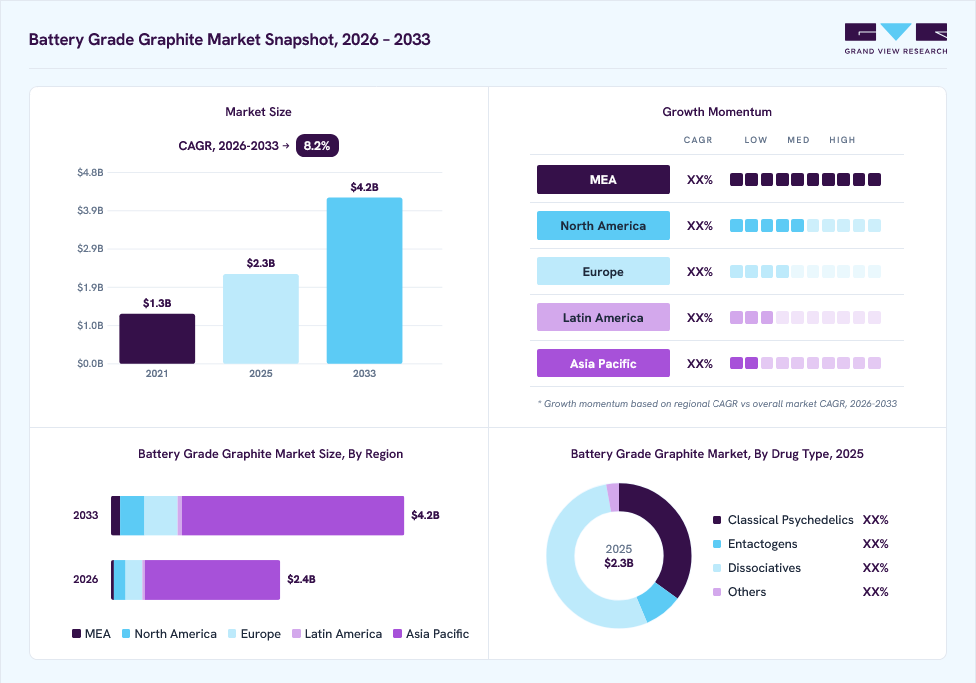
The global battery grade graphite market size was valued at USD 2.3 billion in 2025 and is projected to grow from USD 2.4 billion in 2026 to USD 4.2 billion by 2033, at a CAGR of 8.2% during the forecast period. Asia Pacific dominated the market, accounting for the largest revenue share of 80.6% in 2025. The increasing adoption of lithium-ion batteries in electric vehicles, energy storage systems, consumer electronics, power tools, and other battery-powered applications primarily drives market growth.
Key Market Trends & Insights
- By product form: Spherical graphite segment accounted for the largest market revenue share of 43.4% in 2025.
- By application: Electric vehicles segment held the largest market share of 32.2%% in 2025.
Regional Highlights:
- Largest regional market: Asia Pacific (80.6% revenue share, 2025)
- Fastest-growing regional market: Middle East & Africa (highest CAGR, 2026-2033)
- By country: China held the largest market share in 2025
Market Size & Forecast
- Market size in 2025: USD 2.3 Billion
- Estimated market size in 2026: USD 2.4 Billion
- Projected market size by 2033: USD 4.2 Billion
- CAGR (2026-2033): 8.2%
Rising global battery production, increasing EV penetration, and investments in localized battery and anode-material supply chains are further supporting demand. The graphite industry is increasingly focusing on reducing the environmental footprint associated with mining, purification, and graphitization.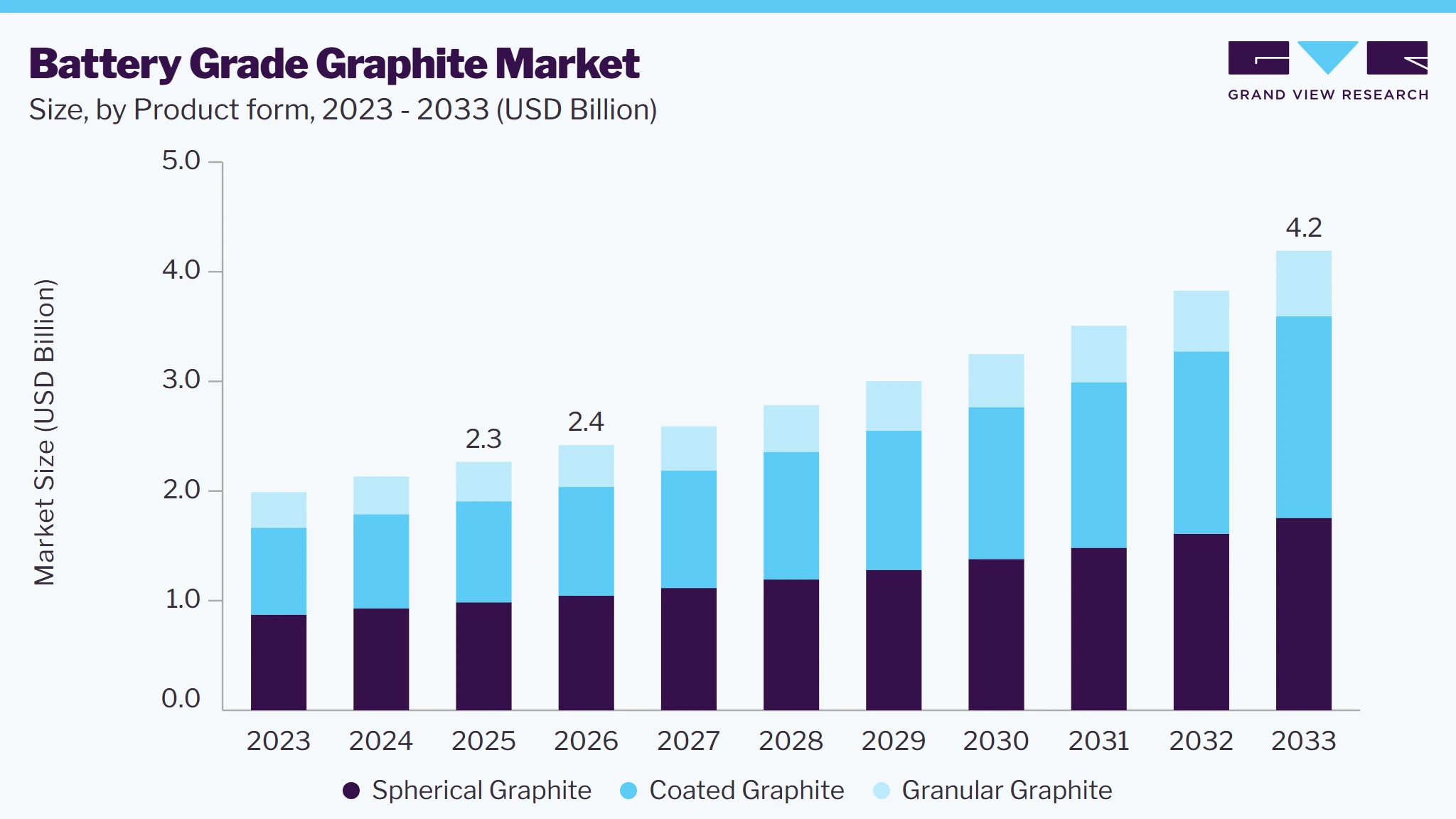
Manufacturers are investing in energy-efficient processing, renewable electricity, water recycling, responsible sourcing, and recycling of graphite from end-of-life batteries. Greater emphasis on localized supply chains and recycled graphite is also supporting the development of more sustainable anode-material production while reducing dependence on virgin raw materials and lowering the carbon intensity of battery manufacturing.
Market Dynamics:
The rapid adoption of electric vehicles (EVs) and the expansion of lithium-ion battery manufacturing are major factors supporting demand. Graphite is widely used as an anode material because of its favorable electrochemical properties and ability to support high energy density and cycle stability. Increasing EV sales, investments in gigafactories, and expansion of battery production capacity across Asia Pacific, Europe, and North America are therefore increasing the consumption of natural and synthetic graphite.
The increasing installation of grid-scale, commercial, and residential energy storage systems is creating additional demand. The expansion of renewable power generation, growing requirements for grid stabilization, and increasing adoption of battery energy storage systems are driving lithium-ion battery deployment beyond automotive applications. This trend is expected to support sustained consumption across both established and emerging energy-storage markets.
Producing high-quality material requires multiple processing stages, including purification, spheroidization, classification, coating, and graphitization, depending on the feedstock and required specifications. These processes require specialized equipment, stringent quality control, and substantial energy consumption, increasing production costs. Synthetic production is particularly energy-intensive because graphitization requires extremely high temperatures.
In addition, fluctuations in natural graphite concentrate, petroleum coke, needle coke, energy, and transportation costs can affect production economics. The concentration of processing and anode-material capacity in a limited number of countries also creates supply-chain risks, while establishing new facilities requires significant capital investment and access to advanced processing technologies.
Governments and battery manufacturers are increasingly seeking to diversify graphite and anode-material supply chains, creating opportunities for producers in North America, Europe, India, Australia, and other emerging markets. Investments in graphite mining, purification, spheroidization, coating, and anode-material facilities can reduce reliance on concentrated overseas supply chains and support the development of integrated domestic production networks.
The need for higher energy density, longer cycle life, faster charging, and improved battery performance is encouraging the adoption of engineered and coated graphite materials. Advances in particle-size control, purification, surface coating, and material engineering are enabling manufacturers to improve electrochemical performance. Increasing demand for high-performance batteries in EVs and energy-storage applications is expected to create further opportunities for coated spherical purified graphite and other advanced anode materials.
Analyst Perspective
The market for battery-grade graphite is expected to witness strong growth over the forecast period. Rising production of lithium-ion batteries for electric vehicles and energy storage systems is driving demand for graphite-based anode materials. Increasing adoption of EVs, expansion of battery gigafactories, and growing deployment of stationary energy storage are further supporting consumption. Advancements in coated graphite, high-performance anode materials, and graphite-silicon blends are improving battery energy density, charging performance, and cycle life, while investments in localized graphite processing and supply chains are creating additional growth opportunities.
Product Form Insights
Spherical graphite accounted for the largest share of the market, representing 43.4% in 2025. Its leading position is attributed to its widespread use as an anode material in lithium-ion batteries, where its spherical particle morphology provides favorable packing density, electrochemical performance, and lithium-ion diffusion characteristics. Increasing production of EV batteries and consumer electronics continues to support demand for spherical graphite.
Coated graphite is expected to register the fastest CAGR of 9.2% during the forecast period. Growth is being supported by increasing demand for high-performance anode materials with improved cycle life, energy density, charging capability, and thermal stability. Surface coating helps improve graphite's electrochemical performance and reduce undesirable reactions at the electrode-electrolyte interface, making coated materials increasingly attractive for advanced lithium-ion batteries.
Application Insights
The electric vehicles segment represented the largest application segment, accounting for 32.2% of the market in 2025. The segment's leading position is supported by increasing global EV sales and the rapid expansion of lithium-ion battery manufacturing capacity. Automakers and battery manufacturers are also investing in higher-energy-density battery technologies, increasing demand for high-quality graphite anode materials.
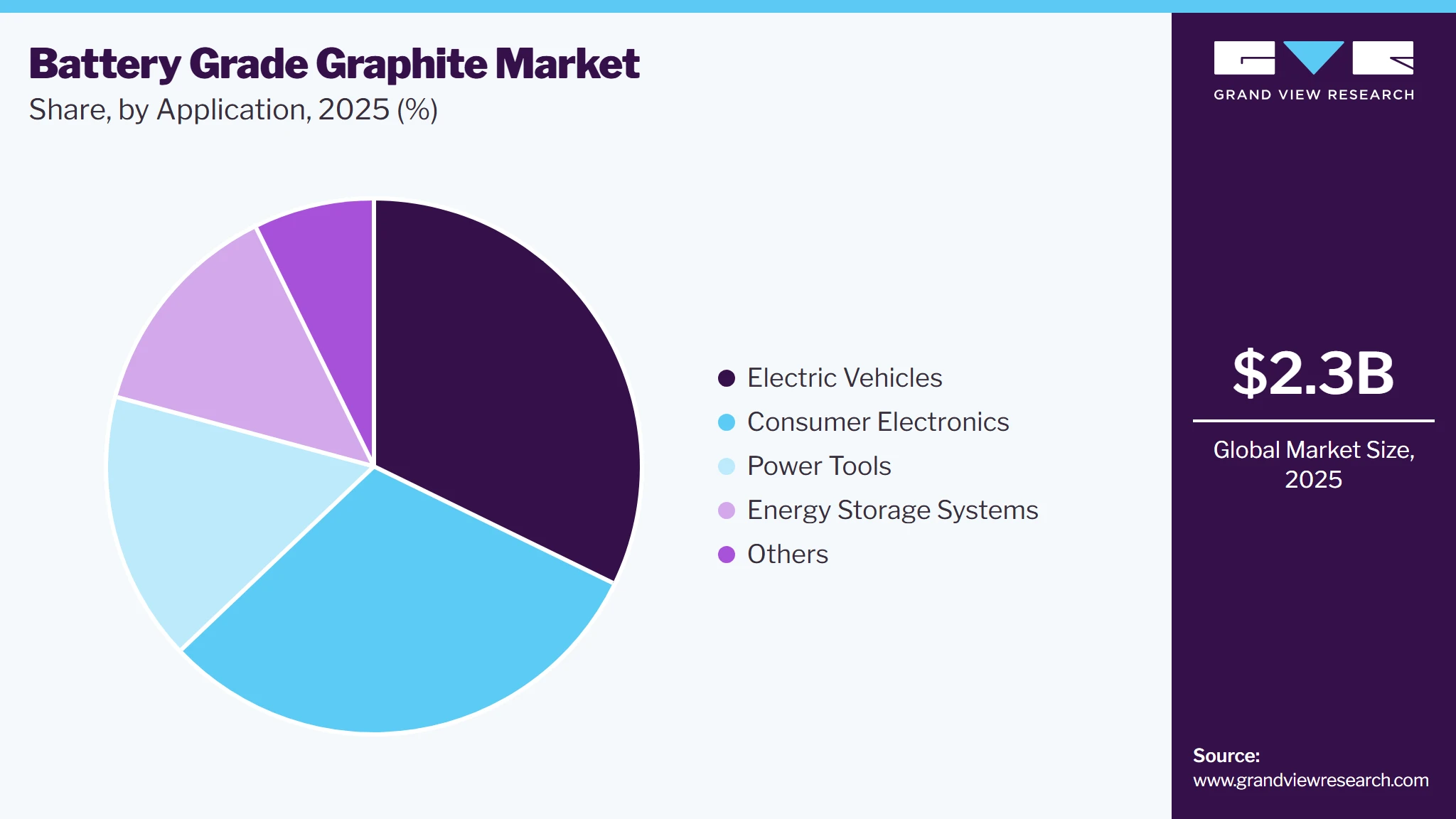
The energy storage systems are projected to record the highest CAGR of 9.3% during the forecast period. Increasing integration of renewable energy, grid modernization, and the need for reliable electricity storage are driving the deployment of lithium-ion-based stationary storage systems. Growing installations of utility-scale, commercial, and residential battery storage are therefore expected to create significant incremental demand for graphite-based anode materials.
Regional Insights
Asia Pacific Battery Grade Graphite Market Trends
Asia Pacific dominated the battery grade graphite market with the largest revenue share of 80.6% in 2025 and is expected to remain the leading regional market, supported by its large battery manufacturing base, high EV production, and established graphite processing capabilities. China, Japan, South Korea, and India are major contributors, while increasing battery investments and EV adoption across Southeast Asia and other emerging economies are further strengthening regional demand.

China battery grade graphite industry dominates the global supply chain due to its large-scale graphite processing, purification, coating, and anode material manufacturing capacity. Strong domestic lithium-ion battery production, extensive EV manufacturing, and growing energy-storage deployment continue to support consumption, while the country's established processing ecosystem provides manufacturers with significant economies of scale.
Europe Battery Grade Graphite Market Trends
Europe battery grade graphite industry is experiencing increasing demand, supported by the expansion of EV manufacturing, battery gigafactories, and renewable-energy storage infrastructure. Efforts to establish a more resilient domestic battery supply chain, reduce dependence on imported anode materials, and meet sustainability targets are encouraging investments in graphite processing and battery-material production across the region.
North America Battery Grade Graphite Market Trends
North America battery grade graphite industry is expected to witness steady growth, supported by rising electric vehicle adoption, expansion of lithium-ion battery manufacturing, and increasing investments in domestic anode-material supply chains. Government incentives for critical minerals and battery manufacturing are encouraging the development of local graphite mining, purification, and processing capacity, reducing dependence on imports and supporting regional demand.
U.S. Battery Grade Graphite Market Trends
The U.S. battery grade graphite industry represents a significant market, driven by increasing EV production, expansion of battery gigafactories, and growing deployment of energy storage systems. Investments in domestic graphite mining and anode-material processing, supported by policies aimed at strengthening critical-mineral supply chains, are expected to increase local production capacity and create opportunities for suppliers.
Latin America Battery Grade Graphite Market Trends
Latin America battery grade graphite industry is expected to experience gradual growth as EV adoption, renewable energy deployment, and battery storage investments increase across major economies. Brazil, Argentina, and Chile offer additional opportunities through their growing electric-mobility markets and broader battery-materials potential. At the same time, the region's natural-resource base could support future graphite supply-chain development.
Middle East & Africa Battery Grade Graphite Market Trends
The Middle East and Africa battery grade graphite industry is expected to witness emerging opportunities driven by renewable-energy projects, energy-storage deployment, electric-mobility initiatives, and development of critical-mineral resources. Countries such as Mozambique, Madagascar, and South Africa are particularly relevant because of their graphite resources and mining potential, while investments in battery and energy infrastructure could gradually increase regional consumption.
Key Battery Grade Graphite Company Insights
Some of the key players operating in the market include BTR New Material Group Co., Ltd., POSCO Future M Co., Ltd., and others.
-
BTR New Material Group Co., Ltd., established in 2000, is a China-based manufacturer specializing in cathode and anode materials for lithium-ion batteries. The company manufactures natural, artificial, and silicon-based anode materials designed for electric vehicles, consumer electronics, power tools, and energy storage systems. BTR operates an integrated anode-material supply chain, with manufacturing bases covering natural material purification, artificial material production, spheroidization, graphitization, and anode-material processing.
-
POSCO Future M Co., Ltd., established in 1963, is a South Korea-based advanced battery-material manufacturer producing natural and artificial anode materials for lithium-ion batteries. Its portfolio includes natural material, low-expansion grades, coated artificial material, and uncoated artificial material, serving applications including electric vehicles and energy storage systems. The company operates natural anode-material production in Sejong and is expanding artificial material production in Pohang while continuing to develop next-generation anode technologies.
-
Resonac Holdings Corporation, headquartered in Japan, is a diversified chemical and advanced materials manufacturer with a dedicated business in artificial anode materials for lithium-ion batteries. Its materials are engineered with controlled particle characteristics and internal pore structures to support lithium-ion intercalation, high capacity, and high-rate battery performance. The company's battery-material activities form part of its broader carbon and advanced-materials portfolio serving mobility and other high-performance applications.
Key Battery Grade Graphite Companies:
The following key companies have been profiled for this study on the battery grade graphite market.
-
BTR New Material Group Co., Ltd.
-
Dongguan Kaijin New Energy Technology Co., Ltd.
-
Epsilon Advanced Materials
-
Hunan Zhongke Shinzoom Technology Co., Ltd.
-
Jiangxi Zichen Technology Co., Ltd. (Putailai)
-
NOVONIX Limited
-
POSCO Future M Co., Ltd.
-
Resonac Holdings Corporation
-
Shanshan Technology
-
Shijiazhuang Shangtai Technology Co., Ltd.
Competitive Benchmarking
Category
Operating Strategies
Competitive Edge
Weakness
Established Players (e.g., BTR New Material Group Co., Ltd., Dongguan Kaijin New Energy Technology Co., Ltd., Hunan Zhongke Shinzoom Technology Co., Ltd., Jiangxi Zichen Technology Co., Ltd. (Putailai), POSCO Future M Co., Ltd., Resonac Holdings Corporation, Shanshan Technology)
- Develop high-performance natural and synthetic graphite anode materials for EVs, energy storage systems, consumer electronics, and power tools.
- Invest in advanced purification, spheroidization, coating, graphitization, and particle-engineering technologies.
- Strengthen long-term relationships with battery manufacturers and cell producers through customized grades, technical support, and large-scale supply agreements.
- Large-scale production capabilities and established processing technologies enable consistent quality, competitive costs, and high-volume supply.
- Integrated manufacturing capabilities across graphite processing and anode-material production provide greater control over product quality and costs.
- Strong relationships with major battery and automotive manufacturers support recurring demand and long-term contracts.
- High capital requirements for purification, graphitization, coating, and other processing stages increase investment and operating costs.
- Significant exposure to the highly concentrated Chinese graphite and anode-material supply chain can increase geopolitical and trade-related risks.
- Large production footprints can create capacity-utilization risks during periods of weak battery demand or graphite oversupply.
Emerging & Regional Players (e.g., Epsilon Advanced Materials, NOVONIX Limited, Shijiazhuang Shangtai Technology Co., Ltd.)
- Focus on developing high-performance synthetic and natural graphite anode materials for EV and energy-storage batteries.
- Establish localized manufacturing facilities in North America, India, and other emerging battery markets to address regional supply-chain requirements.
- Develop differentiated products targeting fast charging, high energy density, improved cycle life, and lower-carbon production.
- Ability to establish localized supply chains and serve customers seeking alternatives to highly concentrated graphite processing networks.
- Greater flexibility in developing application-specific graphite grades and adapting production to emerging battery technologies.
- Lower organizational complexity can support faster technology development, customer engagement, and commercialization of specialized products.
- Limited production scale and operating history compared with established global anode-material manufacturers can restrict participation in large-volume supply contracts.
- High upfront capital requirements for commercial-scale graphite processing and qualification facilities can create funding and execution risks.
- Dependence on successful customer qualification and ramp-up of battery manufacturing capacity can delay revenue realization.
Recent Developments
-
In May 2025, BTR New Material Group showcased new graphite and advanced anode technologies at CIBF 2025, including its “Flexible Newborn” technology for anode-material renewal and the new R graphite product. The company also presented closed-loop recycling solutions for anode materials, alongside fast-charging and next-generation battery-material technologies.
-
In March 2026, POSCO Future M signed an MOU with U.S.-based Molten to jointly develop natural graphite anode-material feedstock using methane gas. Molten plans to produce graphite through methane pyrolysis, after which POSCO Future M intends to process the material into spherical graphite and subsequently natural graphite anode material. The initiative is intended to diversify feedstock supply, reduce purification requirements, and improve cost competitiveness.
-
In March 2026, POSCO Future M secured a KRW 1.0149 trillion long-term order for artificial graphite anode material from a global automaker. The five-year agreement covers 2027-2032, and the company plans to establish a new plant in Vietnam to fulfill the order, with phased capacity expansion planned to support additional demand.
Battery Grade Graphite Market Report Scope
Report Attribute
Details
Market Definition
The market size represents the revenue generated from the sale of battery grade graphite used across electric vehicles, energy storage systems, consumer electronics, power tools, and other applications globally.
Market size value in 2025
USD 2.3 billion
Estimated market size in 2026
USD 2.4 billion
Projected market size by 2033
USD 4.2 billion
Growth rate
CAGR of 8.2% from 2026 to 2033
Base year for estimation
2025
Historical data
2021 - 2024
Forecast period
2026-2033
Quantitative Units
Revenue in USD million/billion, Volume in Kilotons, and CAGR from 2026 to 2033
Report coverage
Revenue forecast, volume forecast, competitive landscape, growth factors, and trends
Segments covered
Product form, application, and region
Regional scope
North America; Europe; Asia Pacific; Latin America; Middle East & Africa
Country scope
U.S.; Canada; Mexico; Germany; UK; France; Italy; China; South Korea; Japan; India; Brazil
Key companies profiled
BTR New Material Group Co., Ltd.; Dongguan Kaijin New Energy Technology Co., Ltd.; Epsilon Advanced Materials; Hunan Zhongke Shinzoom Technology Co., Ltd.; Jiangxi Zichen Technology Co., Ltd. (Putailai); NOVONIX Limited; POSCO Future M Co., Ltd.; Resonac Holdings Corporation; Shanshan Technology; Shijiazhuang Shangtai Technology Co., Ltd.
Customization scope
Free report customization (equivalent up to 8 analysts working days) with purchase. Addition or alteration to country, regional & segment scope.
Pricing and purchase options
Avail customized purchase options to meet your exact research needs. Explore purchase options
Global Battery Grade Graphite Market Report Segmentation
This report forecasts revenue and volume growth at global, regional, and country levels and provides an analysis of the latest industry trends in each of the sub-segments from 2021 to 2033. For this study, Grand View Research has segmented the global battery grade graphite market report based on product form, application, and region.
-
Product Form Outlook (Volume, Kilotons; Revenue, USD Billion, 2021-2033)
-
Spherical Graphite
-
Coated Graphite
-
Granular Graphite
-
-
Application Outlook (Volume, Kilotons; Revenue, USD Billion, 2021-2033)
-
Electric Vehicles
-
Energy Storage Systems
-
Consumer Electronics
-
Power Tools
-
Others
-
-
Regional Outlook (Volume, Kilotons; Revenue, USD Billion, 2021-2033)
-
North America
-
U.S.
-
Canada
-
Mexico
-
-
Europe
-
Germany
-
UK
-
France
-
Italy
-
-
Asia Pacific
-
China
-
South Korea
-
Japan
-
India
-
-
Latin America
-
Brazil
-
-
Middle East & Africa
Research Methodology
The battery grade graphite market figures in this report are based on a proven research process that combines executive interviews with secondary research from proprietary databases, company filings, and recognized regulatory and institutional sources. Market size is built through value-chain sizing—reconciling supply-side and demand-side estimates—and triangulated with bottom-up and top-down approaches. Every estimate passes multiple levels of expert validation before publication, with each battery grade graphite segment quantified using the revenue-capture definitions in the table below.
Segment Definition
Product Form
Revenue Capture Definition
Spherical Graphite
Revenue is generated from spherical graphite processed from natural graphite and used as an anode material in lithium-ion batteries. Its spherical morphology and high packing density make it suitable for batteries used in electric vehicles, consumer electronics, energy storage systems, and power tools.
Coated Graphite
Revenue is derived from coated graphite, including coated spherical purified graphite, used as a high-performance anode material in lithium-ion batteries. Surface coating improves electrochemical stability, cycle life, rate capability, and charging performance, supporting applications in electric vehicles, energy storage systems, and advanced consumer electronics.
Granular Graphite
Revenue is generated from granular graphite used as anode material or intermediate graphite feedstock in lithium-ion battery manufacturing. Demand is supported by battery applications requiring controlled particle size, conductivity, and electrochemical performance, including electric vehicles, energy storage systems, consumer electronics, and power tools.
Application
Revenue Capture Definition
Electric Vehicles
Revenue is generated from battery-grade graphite used as anode material in lithium-ion batteries powering battery electric vehicles, plug-in hybrid vehicles, and other electrified vehicles. Increasing EV production, demand for higher energy density, and expansion of fast-charging battery technologies support graphite consumption in this application.
Energy Storage Systems
Revenue is derived from graphite anode materials used in lithium-ion batteries for utility-scale, commercial, and residential energy storage systems. Increasing renewable energy integration, grid stabilization requirements, peak-load management, and backup power demand are supporting the deployment of battery-based storage systems.
Consumer Electronics
Revenue is generated from battery-grade graphite used in lithium-ion batteries for smartphones, tablets, laptops, smartwatches, wireless earbuds, cameras, and other portable electronic devices. Demand is supported by increasing device penetration, battery capacity requirements, miniaturization, and the need for improved charging and cycle performance.
Power Tools
Revenue is captured from graphite anode materials used in lithium-ion batteries powering cordless drills, saws, grinders, impact drivers, lawn equipment, and other portable power tools. Increasing replacement of corded equipment with cordless alternatives and demand for lightweight, high-energy-density batteries support graphite consumption in this segment.
Others
Includes revenue from battery-grade graphite used in other lithium-ion battery applications, including electric two-wheelers and three-wheelers, industrial equipment, portable power stations, aerospace and defense equipment, marine applications, and other battery-powered systems.
Estimation Model
Layer No.
Layer Name
Key Question
Description
01
End-Use Industry Demand Base Layer
What forms the demand base?
Identify demand across major battery end-use applications, including electric vehicles, energy storage systems, consumer electronics, power tools, and other battery-powered applications. Assess lithium-ion battery production, battery capacity additions, EV production, energy-storage deployments, and production of major electronic devices to establish the total addressable demand for battery-grade graphite.
02
Application Penetration Layer
Where are battery grade graphite utilized?
Estimate the penetration of battery-grade graphite within lithium-ion battery anodes across major applications. Analyze the adoption of graphite-based anode materials in EV batteries, stationary energy storage batteries, consumer electronics batteries, cordless power-tool batteries, and other lithium-ion battery applications across key countries and regions.
03
Consumption Intensity Layer
How much battery grade graphite is consumed?
Evaluate graphite consumption intensity based on battery capacity (kWh/GWh), graphite loading per kWh, anode composition, battery chemistry, cell design, and graphite-to-active-material ratios. Consumption varies according to battery energy density, anode formulation, fast-charging requirements, silicon-graphite blending, cell architecture, and technological developments in lithium-ion batteries.
04
Revenue Layer
How is market revenue generated?
Market revenue is generated through the sale of battery-grade spherical graphite, coated graphite, and other anode-grade graphite materials to battery and anode-material manufacturers. Revenue growth is influenced by lithium-ion battery production, graphite consumption per battery, product specifications, processing requirements, and average selling prices across different grades and regions.
Delivered Customizations
This report has been delivered with the following In-depth customizations
Client Request
Customization Delivered
Value Adds
Manufacturing Cost Structure Analysis
Comprehensive assessment of the manufacturing cost structure for battery-grade graphite, including natural graphite concentrate, synthetic graphite feedstock, purification, spheroidization, classification, graphitization, coating, energy consumption, labor, consumables, packaging, logistics, and quality control. The analysis evaluates cost variations by natural vs. synthetic graphite, product form, production scale, processing route, and region.
Identified major cost drivers and cost-reduction opportunities across the processing chain. Supported pricing strategy, plant economics, investment planning, process optimization, and margin improvement.
Trade & Manufacturing Capacity Assessment
In-depth assessment of global graphite mining, battery-grade graphite processing, anode-material manufacturing capacity, production footprints, imports and exports, trade flows, and capacity expansion projects. The study covers major production hubs, natural graphite concentrate sourcing, synthetic graphite feedstock availability, purification and coating capacity, regional production versus consumption, and country-level import dependencies.
Identified supply-demand gaps, regional capacity opportunities, sourcing risks, trade dependencies, and supply-chain concentration. Supported strategic sourcing, capacity planning, geographic expansion, and supply-chain diversification.
Pricing Analysis
Comprehensive analysis of pricing for natural spherical graphite, coated spherical purified graphite (CSPG), synthetic graphite, and other battery-grade graphite products. The analysis covers historical and forecast prices, feedstock costs, purification and graphitization costs, energy prices, freight costs, supply-demand conditions, product specifications, and regional price differentials.
Supported procurement and pricing strategies by identifying key cost drivers, regional price variations, product-level price premiums, and expected pricing trends. Enabled supplier benchmarking, contract negotiations, cost optimization, and margin planning.
Frequently Asked Questions About This Report
The global battery grade graphite market size was estimated at USD 2.3 billion in 2025 and is expected to reach USD 2.4 billion in 2026.
The global battery grade graphite market is expected to grow at a compound annual growth rate of 8.2% from 2026 to 2033 to reach USD 4.2 billion by 2033.
By product form, spherical graphite accounted for the largest market revenue share of 43.3% in 2025.
Asia Pacific dominated the battery grade graphite market with the largest revenue share of 80.6% in 2025.
The key factor driving the growth of the global battery-grade graphite market is the rapid expansion of lithium-ion battery production, fueled by rising electric vehicle adoption and increasing demand for energy storage systems.
Some of the key players of the global battery grade graphite market are BTR New Material Group Co., Ltd.; Dongguan Kaijin New Energy Technology Co., Ltd.; Epsilon Advanced Materials; Hunan Zhongke Shinzoom Technology Co., Ltd.; Jiangxi Zichen Technology Co., Ltd.; NOVONIX Limited; POSCO Future M Co., Ltd.; Resonac Holdings Corporation; Shanshan Technology; Shijiazhuang Shangtai Technology Co., Ltd., and others.
The battery grade graphite market in China held the largest share in the Asia Pacific region in 2025.
By application, the energy storage system segment is anticipated to register the fastest CAGR of 9.3% from 2026 to 2033.
The coated graphite segment is expected to register the highest growth rate during the forecast period, driven by increasing demand for high-performance anode materials that enhance lithium-ion battery energy density, cycle life, and charging efficiency.
About the Author(s)
Advanced Interior Materials Research Team
Advanced Materials · Advanced Interior MaterialsThis report was authored by the advanced interior materials research team at Grand View Research - comprising two research analysts, one senior research analyst, and one industry expert - with specialized expertise in the advanced interior materials segment of the advanced materials industry. All findings are based on proprietary advanced materials databases, executive interviews, and regulatory analysis, subject to internal peer review prior to publication.
Last Updated:
Speak to Analyst


Customize this report to your needs — add regions, segments, or data points, with 20% free customization.
Or view our licence options:


ISO 9001:2015 & 27001:2022 Certified
We are GDPR and CCPA compliant! Your transaction & personal information is safe and secure. For more details, please read our privacy policy.


