
- Home
- »
- Advanced Interior Materials
- »
-
Battery Manufacturing Equipment Market Size Report, 2033GVR Report cover
![Battery Manufacturing Equipment Market Size, Share & Trends Report]()
Battery Manufacturing Equipment Market (2025 - 2033) Size, Share & Trends Analysis Report By Machine Type, By Battery Type (Lead-Acid Batteries, Lithium-Ion Batteries, Nickel-Metal Hydride, Nickel-Cadmium), By Application (Automotive, Renewable Energy, Industrial, Consumer Electronics), By Region, And Segment Forecasts
- Report ID: GVR-4-68040-831-3
- Number of Report Pages: 100
- Format: PDF
- Historical Range: 2021 - 2023
- Forecast Period: 2025 - 2033
- Industry: Advanced Materials
- Report Summary
- Table of Contents
- Segmentation
- Methodology
- Download FREE Sample
-
 Download Sample Report
Battery Manufacturing Equipment Market Summary
The global battery manufacturing equipment market size was valued at USD 13,092.0 million in 2024 and is projected to reach USD 67,746.1 million by 2033, growing at a CAGR of 20.6% from 2025 to 2033. The market is primarily driven by the rapid global expansion of electric vehicle (EV) production, which requires large-scale, high-precision equipment for electrode preparation, cell assembly, and formation testing.
Key Market Trends & Insights
- Asia Pacific dominated the battery manufacturing equipment market with the largest revenue share of 54.5% in 2024.
- By machine type, the formation & testing machines segment is expected to grow at a considerable CAGR of 21.1% from 2025 to 2033 in terms of revenue.
- By battery type, the lithium-ion batteries segment is held the largest market share accounting for 45.8% from 2025 to 2033 in terms of revenue.
- By end use, the renewable energy segment is expected to grow at a rapid CAGR of 22.4% from 2025 to 2033 in terms of revenue.
Market Size & Forecast
- 2024 Market Size: USD 13,092.0 Million
- 2033 Projected Market Size: USD 67,746.1 Million
- CAGR (2025-2033): 20.6%
- Asia Pacific: Largest market in 2024
Automakers and cell producers are investing heavily in new gigafactories and upgrading existing lines, boosting demand for mixing, coating, calendaring, slitting, stacking, and assembly machinery capable of achieving high throughput and consistent quality. As lithium-ion batteries dominate next-generation mobility, manufacturers continue to scale their production capacity, directly stimulating equipment procurement.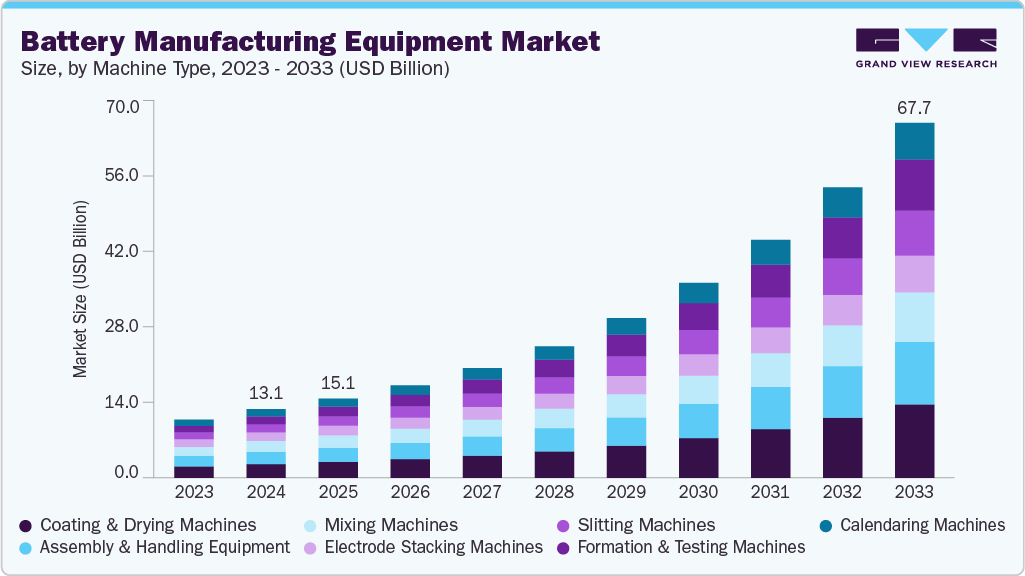
Consumer electronics remains another significant driving factor, with continuous production of smartphones, laptops, wearables, and portable devices driving the need for compact cell formats and highly automated assembly processes. As manufacturers pursue higher energy density, improved safety, and faster production cycles, they increasingly adopt advanced machinery designed for precision, uniformity, and minimal material waste.
Drivers, Opportunities & Restraints
Rising deployment of renewable energy systems contributes to market growth, as utility-scale solar and wind projects increasingly rely on battery energy storage systems (BESS) for grid stabilization and peak-shaving applications. This expansion requires large volumes of advanced lithium-ion and emerging chemistries, prompting energy storage companies to invest in automated production lines and sophisticated testing and formation equipment. Demand from industrial applications, telecom infrastructure, and backup power systems also supports steady growth in both lithium-ion and lead-acid battery equipment.
Opportunities arise from accelerating global electrification, expanding renewable energy storage needs, and the emergence of next-generation battery chemistries. Growing investments in EV gigafactories, BESS installations, and consumer electronics production are creating strong demand for high-speed, automated equipment. Advances in solid-state and high-silicon batteries also open new avenues for specialized machinery, offering manufacturers the chance to capture value in upcoming production lines while improving efficiency and reducing material losses.
The battery manufacturing equipment market faces restraints related to high capital requirements, complex production processes, and the steep learning curve associated with scaling advanced chemistries like lithium-ion. Many manufacturers struggle with the cost of setting up gigafactories, securing stable raw material supply, and maintaining stringent quality and safety standards. Additionally, technological obsolescence is rapid, forcing continuous upgrades in machinery and limiting the ability of smaller players to compete effectively.
Machine Type Insights
The coating & drying machines segment held the dominant share in the market and accounted for a share of 20.1% in 2024, driven by the increasing need for high-precision electrode manufacturing as lithium-ion battery production scales globally. These machines enable uniform slurry application and controlled drying, both of which are critical for energy density, cycle life, and overall cell performance. As EV and energy-storage producers demand tighter tolerances and faster throughput, manufacturers are investing in advanced, continuous coating lines with improved thermal management and automation features. Rising adoption of high-nickel, silicon-rich, and next-generation electrode materials further strengthens demand for equipment capable of handling complex chemistries.
The formation & testing machines segment is expected to grow at a rapid CAGR of 23.3% from 2025 to 2033 in terms of revenue. Formation and testing equipment is expanding rapidly due to its indispensable role in validating battery performance, safety, and consistency before cells enter final assembly. The shift toward large-scale EV and BESS production requires high-capacity formation systems with precise current control, thermal management, and advanced diagnostic capabilities. As manufacturers prioritize yield improvement, defect detection, and lifetime prediction, demand for intelligent testing platforms and data-driven formation processes continues to accelerate.
Battery Type Insights
The lithium-ion batteries segment continues led the market and accounted for a share of 45.8% in 2024. Increasing investments in gigafactories and advanced production lines are driving demand for high-precision equipment capable of supporting fast throughput, tighter quality control, and complex electrode designs. As manufacturers shift to high-nickel, LFP, and emerging solid-state chemistries, equipment requirements continue to evolve, fueling sustained upgrades and new machinery purchases across the value chain.
The lead-acid batteries segment is expected to grow at a fast-paced CAGR of 21.2% from 2025 to 2033 in terms of revenue. Demand for lead-acid battery manufacturing equipment remains steady, supported by its continued use in automotive starter batteries, backup power systems, industrial equipment, and uninterruptible power supply (UPS) applications. Although growth is slower compared to lithium-ion, the segment benefits from ongoing replacements, infrastructure expansions in developing regions, and the technology’s cost-effectiveness and recyclability. Manufacturers continue to invest in modernizing production lines for greater automation, improved safety, and reduced environmental impact, keeping equipment demand stable.
End Use Insights
The automotive segment dominates the battery manufacturing equipment market and accounted for a share of 34.7% in 2024. The automotive segment drives significant demand for battery manufacturing equipment as global automakers expand EV production capacity and build new gigafactories. Precision machinery for electrode preparation, cell assembly, and formation is essential to meet performance, safety, and volume requirements for electric cars, two-wheelers, and commercial vehicles. Increasing adoption of high-energy-density chemistries and fast-charging designs further accelerates investment in advanced, automated equipment that supports consistent quality and high throughput.
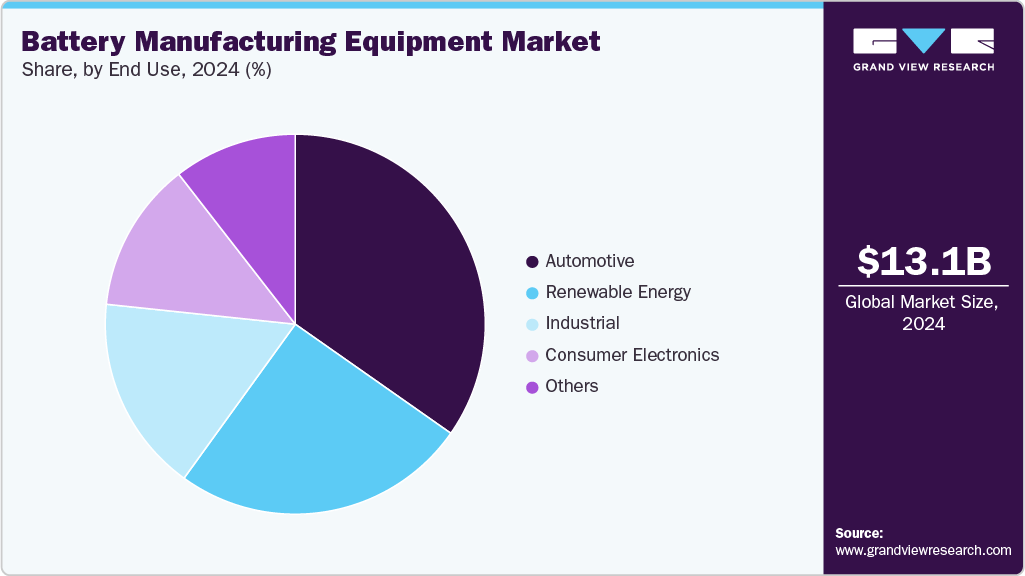
The renewable energy segment is expected to grow at a fast-paced CAGR of 22.4% from 2025 to 2033 in terms of automotive revenue. The renewable energy segment is growing rapidly as utility-scale solar and wind projects rely increasingly on battery energy storage systems (BESS) to improve grid stability and manage intermittency. This shift drives demand for large-format cell manufacturing equipment capable of producing high-capacity, long-cycle-life batteries tailored for stationary storage. As governments and energy providers invest heavily in storage infrastructure, manufacturers are scaling production lines and adopting sophisticated testing and formation technologies to meet rising performance and safety requirements in this sector.
Regional Insights
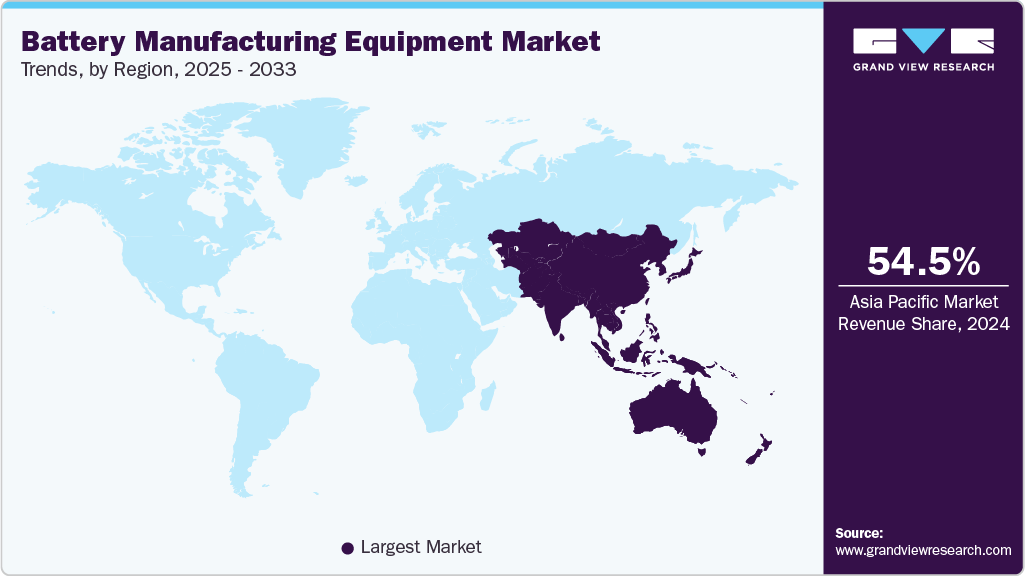
Asia Pacific is a dominant market and accounted for the 54.5% share, supported by strong growth in electric mobility, large-scale consumer electronics production, and increasing deployment of battery energy storage systems. China, South Korea, Japan, and emerging economies like India and Southeast Asia continue to invest heavily in gigafactories and capacity expansion, driving high demand for automated coating, stacking, assembly, and formation equipment. The region’s established supply chain, competitive manufacturing base, and government-backed electrification programs ensure sustained momentum.
China Battery Manufacturing Equipment Market Trends
The China battery manufacturing equipment marketremains the global leader in battery manufacturing equipment demand, fueled by its dominant EV industry, extensive energy-storage buildout, and the world’s largest concentration of gigafactories. Major cell producers continue to expand capacity and upgrade production lines, boosting demand for high-precision electrode manufacturing and formation systems. Government incentives and strong domestic supply chains further accelerate investments in advanced, automated machinery that supports high-volume, cost-efficient production.
The India battery manufacturing equipment market is growing quickly as the government pushes domestic battery production through incentives, localization mandates, and major EV adoption targets. Multiple gigafactory projects and alliances between automakers and battery producers are driving demand for essential equipment across mixing, coating, calendaring, and formation processes. Rising investments in renewable energy storage, grid modernization, and consumer electronics manufacturing further support steady growth in advanced, high-throughput battery production machinery.
North America Battery Manufacturing Equipment Market Trends
The North America battery manufacturing equipment market is expanding steadily, driven by strong investment in electric vehicle production, energy storage deployment, and domestic cell manufacturing capacity. Federal incentives, supply-chain reshoring efforts, and large-scale gigafactory announcements from automakers and battery producers are accelerating demand for advanced coating, calendaring, stacking, and formation equipment. Growth is further supported by rising renewable energy storage needs and continued modernization of industrial production facilities across the region.
The U.S. battery manufacturing equipment market leads regional growth as the Inflation Reduction Act (IRA) and other federal programs stimulate unprecedented investment in EV batteries, BESS projects, and local cell manufacturing. Major automakers and dedicated battery firms are rapidly expanding or constructing gigafactories, driving high demand for automated, high-throughput production equipment. The push to localize the battery supply chain combined with growing installations of grid-scale storage continues to strengthen the outlook for formation, testing, and electrode-processing machinery in the country.
Europe Battery Manufacturing Equipment Market Trends
Europe’s battery manufacturing equipment market is growing strongly as the region accelerates its transition to electric mobility and large-scale renewable energy storage. Ambitious climate targets, generous subsidies, and coordinated industrial policy are driving investments in gigafactories across Germany, France, Sweden, and other EU nations. This expansion fuels demand for advanced electrode processing, assembly, and formation equipment, with manufacturers prioritizing automation, energy efficiency, and high-quality output to meet stringent performance and safety standards.
The Germany battery manufacturing equipment market remains one of Europe’s most important markets, supported by its strong automotive industry, significant EV production commitments, and ongoing development of domestic battery cell manufacturing. Major automakers and technology firms are investing in new production lines, boosting demand for precision coating, calendaring, stacking, and formation equipment. The country’s focus on high-performance, high-quality battery technologies drives adoption of sophisticated machinery capable of meeting strict reliability and efficiency requirements.
The France battery manufacturing equipment market is expanding rapidly in battery manufacturing as part of its national strategy to strengthen industrial sovereignty and support the growing EV sector. The establishment of new gigafactories and alliances between automotive and battery cell producers is driving demand for automated, high-throughput equipment across the full production process. Strong government support, combined with increasing investment in energy storage applications, continues to create a favorable environment for advanced coating, assembly, and testing machinery in the French market.
Middle East & Africa Battery Manufacturing Equipment Market Trends
The MEA battery manufacturing equipment market is gradually expanding, supported by growing interest in electric mobility, renewable energy storage, and industrial diversification initiatives. Governments across the region are increasing investments in solar and wind projects, creating rising demand for battery energy storage systems and, in turn, the equipment required to manufacture large-format cells. While the market is still emerging, new industrial policies and partnerships with global battery producers are encouraging the development of localized production capacity, driving steady demand for coating, stacking, assembly, and formation machinery.
The Saudi Arabia battery manufacturing equipment market is expanding its capacity for battery manufacturing as part of its Vision 2030 industrial transformation strategy. The country’s push to localize EV production, expand renewable energy capacity, and develop large-scale energy storage systems is creating growing demand for advanced battery manufacturing equipment. Strategic partnerships with global technology firms and planned gigafactory projects are accelerating the need for automated electrode processing, assembly, and formation systems. Although early-stage, Saudi Arabia’s strong policy support and large industrial investment base make it one of the most promising markets in the MEA region.
Latin America Battery Manufacturing Equipment Market Trends
The Latin American battery manufacturing equipment market is developing steadily, supported by growing interest in electric mobility, renewable energy storage, and industrial modernization across countries such as Brazil and Chile. Rising deployment of solar and wind power is driving demand for battery energy storage systems, which in turn encourages investment in localized cell production and assembly capabilities. Although the region remains in the early stages of establishing large-scale manufacturing, supportive government policies and partnerships with global battery producers are gradually increasing demand for coating, assembly, and formation equipment.
The Brazil battery manufacturing equipment market is expected to grow considerably as it advances its EV transition, strengthens domestic electronics manufacturing, and expands renewable energy storage capacity. Increasing interest in localized battery production supported by government incentives and collaboration with international technology providers is boosting demand for essential manufacturing equipment across electrode preparation, stacking, and testing processes. Growth in grid-scale storage projects and industrial electrification further reinforces Brazil’s need for advanced, automated battery production machinery, positioning the country as a key emerging market in Latin America.
Key Battery Manufacturing Equipment Company Insights
Some of the key players operating in the market include Hitachi Ltd and Durr AG.
-
Hitachi, Ltd. is a diversified global technology and engineering company headquartered in Japan, with strong capabilities across industrial automation, electronics, energy systems, and advanced manufacturing solutions. In the battery manufacturing equipment space, Hitachi leverages its expertise in precision machinery, robotics, and digital control systems to supply production technologies that support high-quality, high-volume cell manufacturing.
-
Dürr AG is a prominent German engineering and industrial automation company focusing on offering high-performance production, coating, and environmental technology solutions. Within the battery manufacturing equipment market, Dürr has become a significant market plyer through its advanced electrode-coating, dry-coating, and automation systems designed for gigafactory-scale lithium-ion cell production. The company focuses on energy efficiency, digital monitoring, and scalable manufacturing platforms.
Key Battery Manufacturing Equipment Companies:
The following are the leading companies in the battery manufacturing equipment market. These companies collectively hold the largest Market share and dictate industry trends.
- Hitachi, Ltd
- Dürr Aktiengesellschaft
- Lead Intelligent Equipment Co., Ltd
- ANDRIT
- Bühler Group
- Lyric
- Nordson Corporation
- ROSENDAHL NEXTROM
- CKD Corporation
- DAIICHI JITSUGYO CO., LTD.
- HIRANO TECSEED Co.,Ltd
- Nagano Automation
- Targray
- Semco Infratech
- Delta ModTech
Recent Developments
-
In October 2025, Dürr AG introduced a new dry-coating technology under the X.Cellify DC system that produces a free-standing film of active battery material, which can be laminated onto the collector foil without using solvents or drying ovens. This method dramatically cuts energy use by up to 70% and reduces required production space by as much as 65%, while also allowing full recycling of excess material minimizing waste and lowering the environmental footprint of electrode manufacturing.
-
In May 2025, Lead Intelligent Equipment Co., Ltd. officially introduced a mass-production dry-coating system for lithium-ion battery electrodes, enabling solvent-free electrode manufacturing at industrial scale. The line supports electrode widths up to 1,000 mm and achieves high throughput up to 80 m/min for anode coating and 60 m/min for cathodes aligning with the production demands of large gigafactories.
Battery Manufacturing Equipment Market Report Scope
Report Attribute
Details
Market size value in 2025
USD 15,141.5 million
Revenue forecast in 2033
USD 67,746.1 million
Growth Rate
CAGR of 20.6% from 2025 to 2033
Historical data
2021 - 2023
Forecast period
2025 - 2033
Quantitative units
Revenue in USD million and CAGR from 2025 to 2033
Report coverage
Revenue forecast, company ranking, competitive landscape, growth factors, and trends
Segments covered
Machine Type, battery type, end use, region.
Regional scope
North America; Europe; Asia Pacific; Latin America; Middle East & Africa
Country scope
U.S.; Canada; Mexico; UK; Germany; France; Spain; Italy; China; Japan; India; Australia; South Korea; Brazil; Argentina; Saudi Arabia; South Africa; UAE
Key companies profiled
Hitachi, Ltd; Dürr Aktiengesellschaft; Lead Intelligent Equipment Co., Ltd; ANDRITZ; Bühler Group; Lyric; Nordson Corporation; ROSENDAHL NEXTROM; CKD Corporation; DAIICHI JITSUGYO CO., LTD.; HIRANO TECSEED Co., Ltd; Nagano Automation; Targray; Semco Infratech; Delta ModTech
Customization scope
Free report customization (equivalent up to 8 analysts working days) with purchase. Addition or alteration to country, regional & segment scope.
Pricing and purchase options
Avail customized purchase options to meet your exact research needs. Explore purchase options
Global Battery Manufacturing Equipment Market Report Segmentation
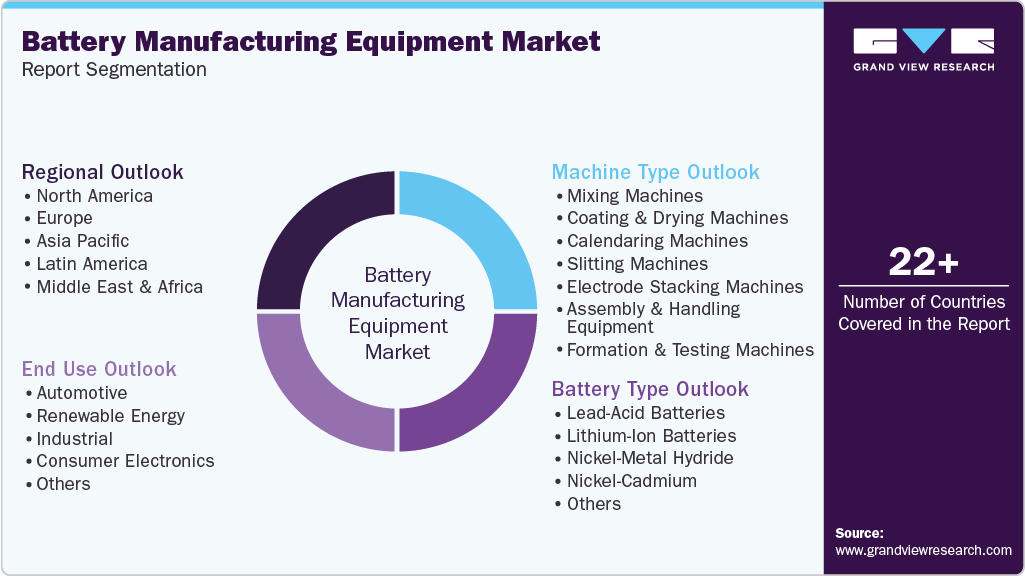
This report forecasts revenue growth at global, regional, and country levels and provides an analysis of the latest industry trends in each of the sub-segments from 2021 to 2033. For this study, Grand View Research has segmented the global battery manufacturing equipment market report based on battery type, machine type, end use, and region.
-
Battery Type Outlook (Revenue, USD Million, 2021 - 2033)
-
Lead-Acid Batteries
-
Lithium-Ion Batteries
-
Nickel-Metal Hydride
-
Nickel-Cadmium
-
Others
-
-
Machine Type Outlook (Revenue, USD Million, 2021 - 2033)
-
Mixing Machines
-
Coating & Drying Machines
-
Calendaring Machines
-
Slitting Machines
-
Electrode Stacking Machines
-
Assembly & Handling Equipment
-
Formation & Testing Machines
-
-
End Use Outlook (Revenue, USD Million, 2021 - 2033)
-
Automotive
-
Renewable Energy
-
Industrial
-
Consumer Electronics
-
Others
-
-
Regional Outlook (Revenue, USD Million, 2021 - 2033)
-
North America
-
U.S.
-
Canada
-
Mexico
-
-
Europe
-
Germany
-
France
-
Italy
-
Spain
-
UK
-
-
Asia Pacific
-
China
-
India
-
Japan
-
South Korea
-
Australia
-
-
Latin America
-
Brazil
-
Argentina
-
-
Middle East and Africa
-
Saudi Arabia
-
UAE
-
South Africa
-
-
Frequently Asked Questions About This Report
b. The global battery manufacturing equipment market size was estimated at USD 13,092.0 million in 2024 and is expected to be USD 15,141.5 million in 2025.
b. The global battery manufacturing equipment market, in terms of revenue, is expected to grow at a compound annual growth rate of 20.6% from 2025 to 2033 to reach USD 67,746.1 million by 2033.
b. The Asia Pacific market hold the dominant share in the market and accounted for a share of 54.5% in 2024, driven by large-scale investments in gigafactories, expanding EV production, and rapidly growing demand for energy-storage systems. China, South Korea, Japan, and India continue to scale lithium-ion cell manufacturing, fueling high demand for advanced coating, stacking, assembly, and formation equipment across the region.
b. Some of the key players operating in the global battery manufacturing equipment market include Hitachi, Ltd, Dürr Aktiengesellschaft, Lead Intelligent Equipment Co., Ltd, ANDRITZ, Bühler Group, Lyric, Nordson Corporation, ROSENDAHL NEXTROM, CKD Corporation, DAIICHI JITSUGYO CO., LTD., HIRANO TECSEED Co., Ltd, Nagano Automation, Targray, Semco Infratech, and Delta ModTech.
b. Rapid expansion of electric vehicle production and energy-storage deployment is fueling demand for battery manufacturing equipment worldwide. Meanwhile, advances in automation, coating technologies, and stricter quality and environmental standards push adoption of high-precision, high-throughput production machinery.


Share this report with your colleague or friend.
Need a Tailored Report?
Customize this report to your needs — add regions, segments, or data points, with 20% free customization.


ISO 9001:2015 & 27001:2022 Certified
We are GDPR and CCPA compliant! Your transaction & personal information is safe and secure. For more details, please read our privacy policy.
Trusted market insights - try a free sample
See how our reports are structured and why industry leaders rely on Grand View Research. Get a free sample or ask us to tailor this report to your needs.













