
- Home
- »
- IT Services & Applications
- »
-
Battery Simulation Software Market Size, Share Report, 2033GVR Report cover

Battery Simulation Software Market (2026 - 2033)
Size, Share, & Trend Analysis Report By Simulation Type (Electrochemical Simulation, Thermal Simulation, Structural & Mechanical Simulation, Electrical & Circuit Simulation), By Battery Type, By End Use, By Region, And Segment Forecasts
Market Size, 2025
$2.3BMarket Estimate, 2026
$2.6BMarket Forecast, 2033
$5.8BCAGR, 2026–2033
12.3%Battery Simulation Software Market Summary
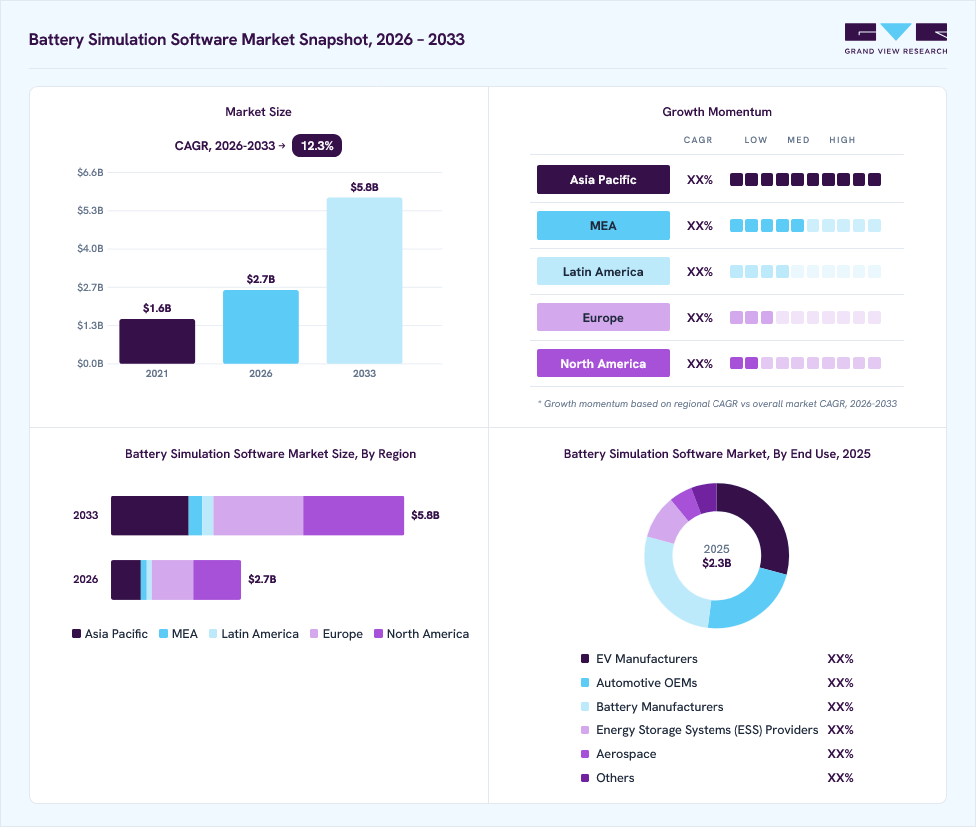
The global battery simulation software market size was valued at USD 2.3 billion in 2025 and is projected to grow from USD 2.6 billion in 2026 to USD 5.8 billion in 2033, at a CAGR of 12.3% from 2026 to 2033. North America dominated the market, accounting for a revenue share of 37.1% in 2025. The market is experiencing strong growth due to rising electric vehicle production, increasing investments in battery gigafactories, and robust research in next-generation battery technologies.
 Source: Grand View Research, IR Documents, Primary Interviews, Paid DatabasesTo learn more about this report,
 Download Free Sample Report
 Key Market Trends & Insights
- By simulation type: Electrochemical simulation segment dominated the market, with a revenue share of 32.4% in 2025
- By battery type: Lithium-ion batteries segment held the largest market share of 70.1% in 2025
- By end use: EV Manufacturers held the largest revenue share of 25.9% in 2025
Regional Highlights
- Largest regional market: North America (37.1% revenue share, 2025)
- Fastest-growing regional market: Asia Pacific (highest CAGR, 2026-2033)
- By country: The U.S. held the largest market share in 2025.
Market Size & Forecast
- Market size in 2025: USD 2.3 Billion
- Estimated market size in 2026: USD 2.6 Billion
- Projected market size by 2033: USD 5.8 Billion
- CAGR (2026-2033): 12.3%
Three ways to get this report
Buy it, customize it, or ask a question.Ask an Analyst
A direct answer, usually in 1 working day
- AccessReport author, directly
- Reply timeWithin 1 working day
- No sales callDirect answer only
- FormatEmail reply
- CostFree, no cost
Get the Full Report
What the study covers
- FormatsPDF · Excel · Dashboard
- Timeline2026–2033 annual, 2025 base
- Coverage20+ countries, 5 regions
- Companies10+ key players profiled
Customize the Report
20% free customization
- IncludeCountries, segments, points
- TailorTo your product definition
- ExtendDeeper competitor detail
- OrA fully bespoke study
- Turnaround5–10 working days
Rising investments in next-generation battery technologies are significantly driving the adoption of battery simulation software. Governments, automotive OEMs, battery manufacturers, and research institutions are investing heavily in advanced chemistries such as solid-state, sodium-ion, lithium-sulfur, and silicon-anode batteries to improve energy density, charging speed, safety, and lifecycle performance. Battery simulation platforms enable engineers to model electrochemical reactions, thermal behavior, material properties, and cell architectures in a virtual environment before physical prototyping.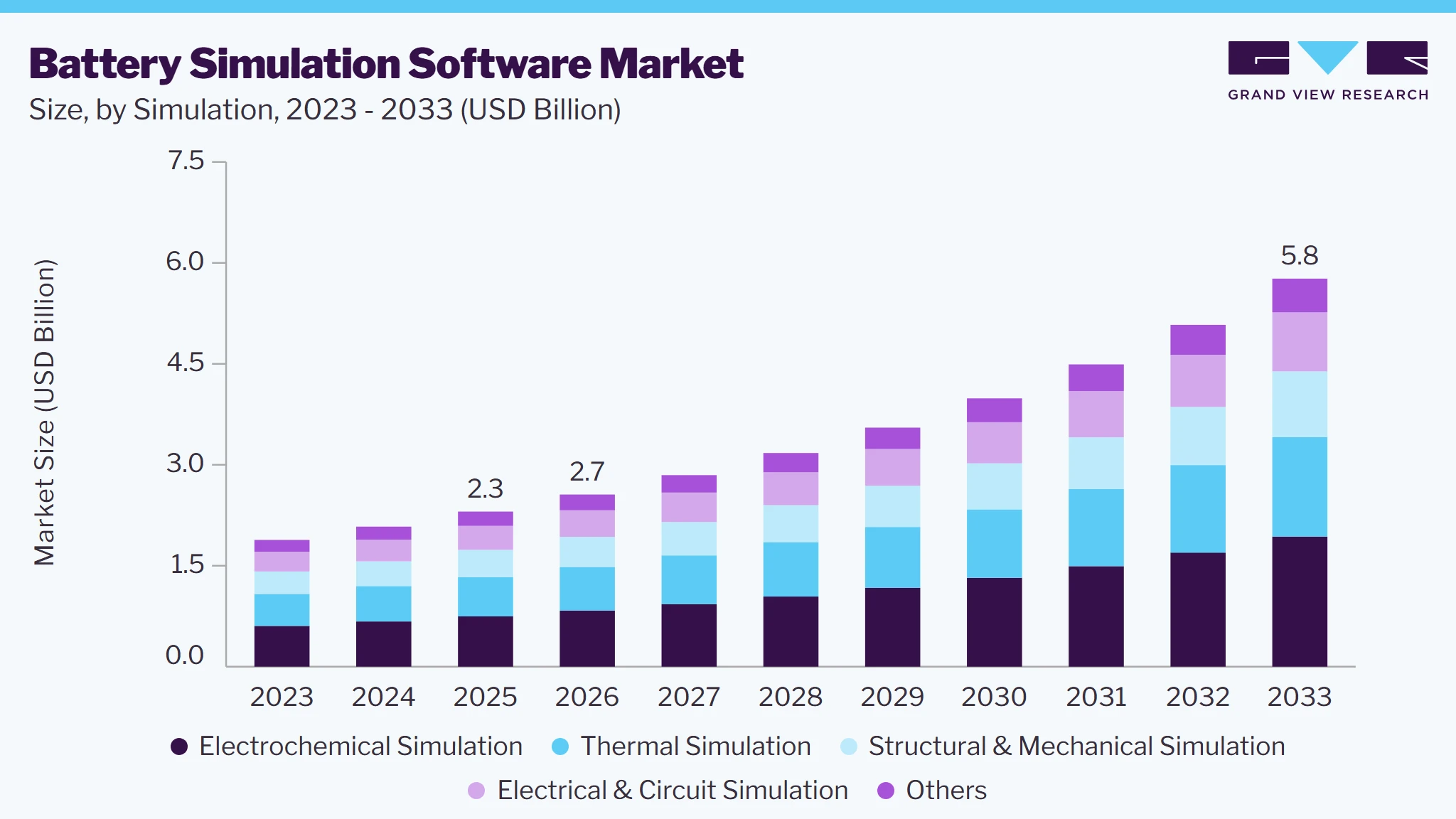 To learn more about this report, Download Free Sample Report
 This accelerates research and development, reduces dependence on expensive laboratory testing, lowers material waste, and shortens product development cycles. As innovation in battery materials intensifies, simulation software is becoming an essential tool for developing safer, more efficient, and commercially viable energy storage solutions.
Market Dynamics
The battery simulation software market is witnessing robust growth as automotive manufacturers, battery developers, and energy storage companies increasingly adopt digital engineering tools to accelerate battery innovation and reduce development costs. The rapid expansion of electric vehicles (EVs), battery energy storage systems (BESS), consumer electronics, and aerospace electrification is driving demand for advanced simulation platforms capable of modeling battery electrochemistry, thermal behavior, electrical performance, mechanical integrity, and degradation across the product lifecycle. Growing investments in next-generation battery technologies, including solid-state, sodium-ion, lithium-sulfur, and silicon-anode batteries, are increasing the need for sophisticated multiphysics simulation tools that enable virtual validation before physical prototyping. In addition, strategic investments by automotive OEMs, battery manufacturers, software vendors, research institutions, and governments in battery gigafactories, domestic battery production, and clean energy initiatives are accelerating software adoption across the battery value chain.
The rapid growth of electric vehicle (EV) production and investments in next-generation battery technologies are major drivers of the battery simulation software market. Automotive OEMs, battery manufacturers, and research institutions are increasingly adopting simulation platforms to optimize battery chemistry, cell architecture, thermal management, charging performance, and safety before physical prototyping. The growing development of solid-state, sodium-ion, and lithium-sulfur batteries is further increasing demand for advanced electrochemical and multiphysics simulation tools. These solutions help reduce development time, lower engineering costs, improve battery reliability, and accelerate the commercialization of high-performance batteries across automotive, energy storage, and consumer electronics applications.
The high implementation cost of advanced battery simulation software and the complexity of accurately modeling battery behavior remain key restraints to market growth. Sophisticated simulation platforms require significant investments in software licenses, high-performance computing (HPC) infrastructure, and skilled engineers with expertise in electrochemistry, thermal analysis, and multiphysics modeling. Moreover, accurately predicting battery degradation, thermal runaway, and long-term performance under diverse operating conditions requires extensive validation using experimental data. These technical and financial barriers can limit adoption among small and mid-sized battery developers and research organizations.
The growing adoption of artificial intelligence (AI), machine learning, and digital twin technologies presents significant opportunities for the battery simulation software market. AI-powered simulation platforms enable rapid material discovery, battery parameter optimization, and predictive performance analysis, reducing research cycles and accelerating innovation. Meanwhile, digital twins allow manufacturers to monitor battery health, predict degradation, optimize charging strategies, and improve lifecycle management using real-time operational data. Increasing investments in battery gigafactories, grid-scale energy storage systems, and next-generation battery chemistries are further expanding the demand for integrated simulation platforms that support battery design, manufacturing optimization, and performance validation across the entire battery lifecycle.
Analyst Perspective
The battery simulation software market is expanding rapidly as investments in electric vehicles and energy storage drive the need for next-generation battery innovation. Surging complexity across emerging chemistries-such as solid-state and sodium-ion-is fueling demand for tools that accurately model electrochemical, thermal, and mechanical behavior. To shorten development cycles and cut physical prototyping costs, manufacturers are increasingly adopting multiphysics tools, digital twins, and AI-driven platforms. Consequently, the strongest competitive advantage lies with software vendors capable of offering unified, scalable platforms powered by artificial intelligence and high-performance computing. Ultimately, providers delivering integrated, predictive simulation solutions remain best positioned to capture long-term growth in the global market.
Simulation Type Insights
The electrochemical simulation segment dominated the market and accounted for the revenue share of 32.4% in 2025. The growing emphasis on improving battery performance and extending operational lifespan is driving demand for electrochemical simulation software. Manufacturers use electrochemical models to predict battery aging, capacity fade, internal resistance growth, and degradation under diverse charging, discharging, and environmental conditions. These insights enable engineers to optimize battery chemistry, charging protocols, and battery management system (BMS) algorithms, enhancing energy efficiency, reliability, and safety. By accurately forecasting long-term battery behavior, simulation software reduces maintenance costs, supports predictive lifecycle management, and improves the durability of batteries used in electric vehicles, grid-scale energy storage systems, and consumer electronics.
The thermal simulation segment is anticipated to grow at a significant CAGR during the forecast period. The growing adoption of ultra-fast charging technologies is increasing demand for thermal simulation software. Fast charging generates significant heat within battery cells, making thermal management critical. Thermal simulation helps engineers optimize cooling systems, reduce temperature hotspots, minimize battery degradation, enhance charging efficiency, and ensure safe, reliable battery operation throughout its lifecycle.
Battery Type Insights
The Lithium-ion batteries segment dominated the market and accounted for the largest revenue share of 70.1% in 2025. The rapid expansion of battery energy storage systems (BESS), driven by increasing renewable energy adoption, is boosting demand for lithium-ion battery simulation software. Utilities and energy developers use simulation tools to optimize battery performance, thermal management, charge-discharge efficiency, and cycle life under diverse operating conditions. These platforms help improve system reliability, extend battery lifespan, reduce maintenance costs, and support the efficient integration of renewable energy into modern power grids.
The solid-state batteries segment is expected to grow at a significant CAGR during the forecast period. Increasing investments in solid-state battery research are driving demand for battery simulation software. Governments, automotive OEMs, and battery manufacturers use simulation tools to evaluate solid electrolytes, electrode materials, and cell designs virtually. This reduces development costs, minimizes physical prototyping, accelerates innovation, and speeds the commercialization of safer, high-energy-density batteries.
End Use Insights
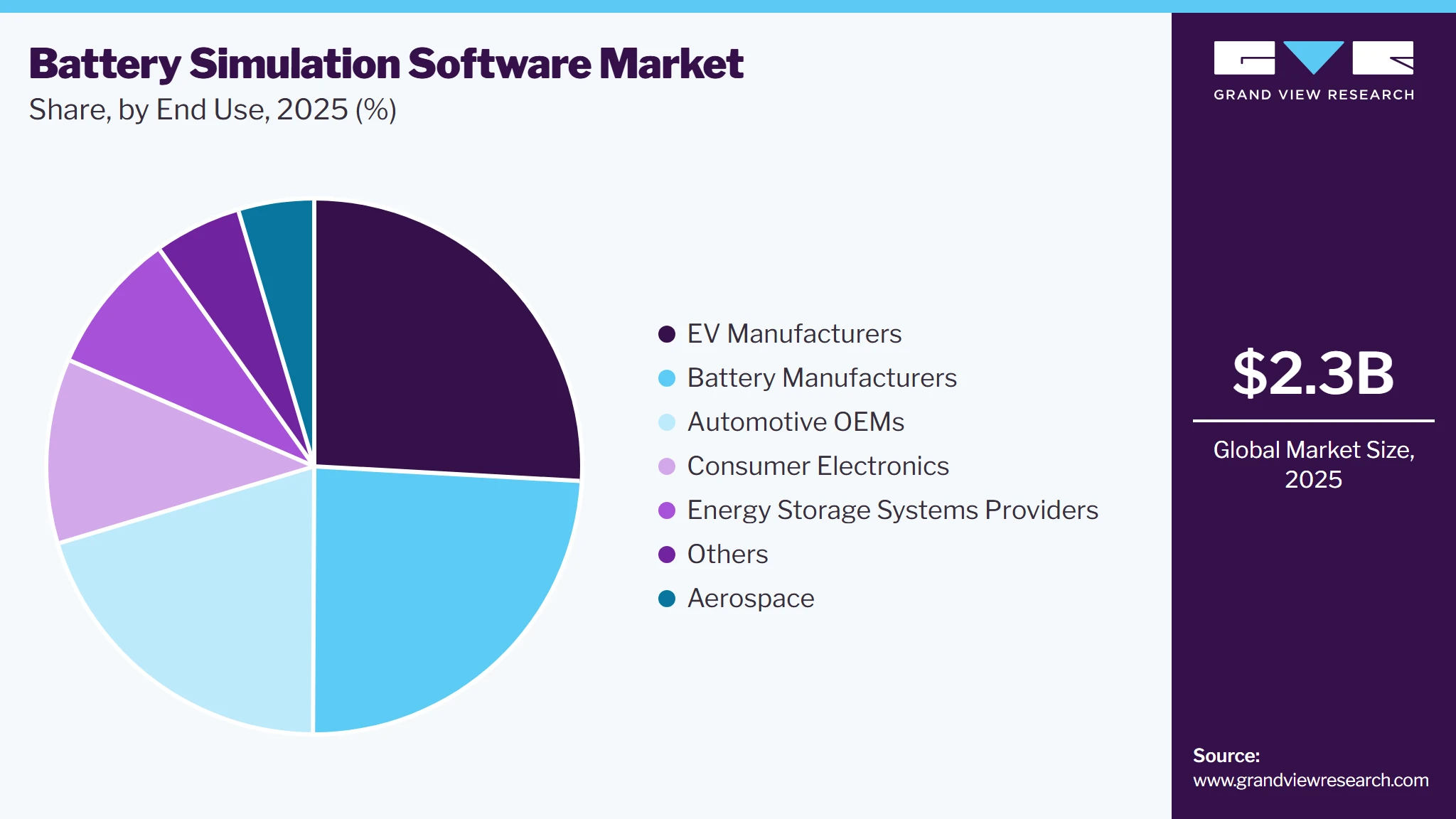
The EV manufacturers segment dominated the market and accounted for the largest revenue share of 25.9% in 2025. The growing adoption of fast and ultra-fast charging technologies is driving demand for battery simulation software among EV manufacturers. High charging rates generate significant heat and increase the risk of lithium plating, battery degradation, and reduced cycle life. Simulation software enables engineers to model electrochemical reactions, thermal behavior, and charging dynamics under various operating conditions, helping optimize battery design and charging protocols. These insights improve charging efficiency, minimize performance degradation, enhance battery safety, and extend operational lifespan. As charging infrastructure expands globally, simulation tools are becoming essential for developing reliable, high-performance batteries that support faster charging without compromising safety or durability.
 To learn more about this report, Download Free Sample Report
 The energy storage systems (ESS) providers segment is expected to grow at a significant CAGR during the forecast period. The rapid deployment of grid-scale battery energy storage systems is driving demand for battery simulation software. ESS providers use these tools to optimize battery performance, thermal management, charge-discharge efficiency, and system reliability before deployment. Simulation reduces engineering risks, improves operational efficiency, and supports reliable integration of renewable energy into power grids.
Regional Insights
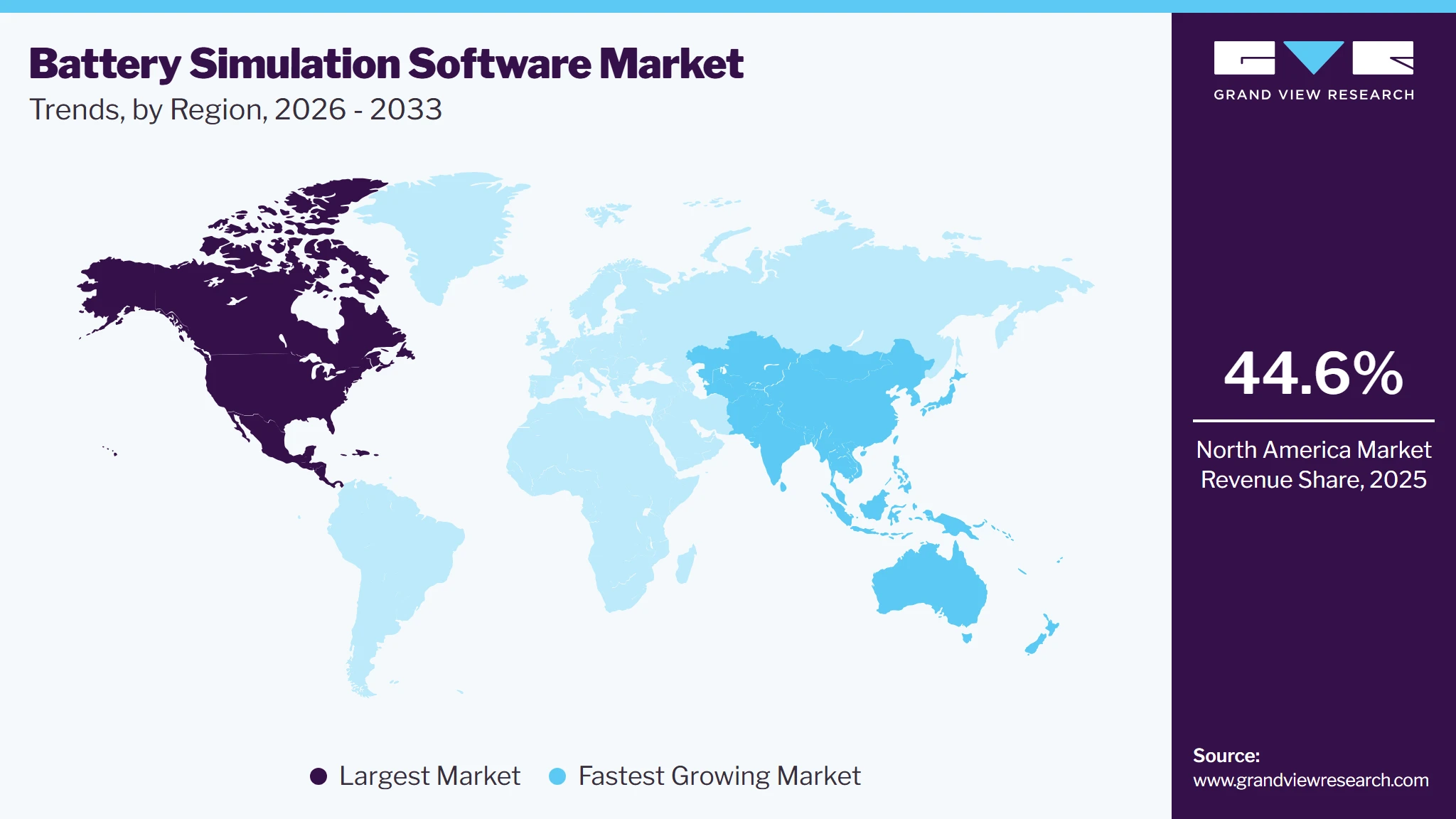
North America dominated the global market with the largest revenue share of 37.1% in 2025. Growing investments in battery gigafactories across the U.S. and Canada are driving demand for battery simulation software. As manufacturers expand large-scale battery production, simulation tools are increasingly used to optimize cell design, manufacturing processes, thermal performance, and quality control. These platforms help reduce production defects, improve operational efficiency, accelerate product validation, and shorten time-to-market for advanced lithium-ion and next-generation batteries. Consequently, battery simulation software is becoming an essential component of modern gigafactory operations and battery innovation.
 To learn more about this report, Download Free Sample Report
 U.S. Battery Simulation Software Market Trends
The battery simulation software market in the U.S. is expected to grow significantly at a CAGR of 14.2% from 2026 to 2033, due to the robust growth in EV production, led by major automotive OEMs and battery manufacturers. Increasing investments in electric mobility are driving demand for battery simulation software to optimize battery design, thermal management, charging performance, and safety while reducing development costs.
Europe Battery Simulation Software Market Trends
The battery simulation software market in Europe is anticipated to register considerable growth from 2026 to 2033. Europe's ambitious decarbonization goals, stringent vehicle emission standards, and battery sustainability regulations are accelerating the adoption of battery simulation software. Automotive OEMs and battery manufacturers use simulation tools to optimize battery performance, safety, and lifecycle while ensuring compliance with evolving EU regulatory requirements.
The UK battery simulation software market is expected to grow rapidly in the coming years. The growing use of artificial intelligence (AI), digital twins, and model-based engineering is enhancing battery development across the UK These technologies improve simulation accuracy, accelerate battery optimization, enable predictive lifecycle analysis, and reduce overall product development time.
The Germany battery simulation software market held a substantial market share in 2025. Germany is home to leading automotive OEMs and battery manufacturers that are rapidly expanding electric vehicle production. Battery simulation software is widely adopted to optimize battery cell design, thermal management, charging performance, and battery management systems (BMS), enabling faster development of high-performance EV batteries while reducing prototyping costs.
Asia Pacific Battery Simulation Software Market Trends
Asia Pacific battery simulation software market is expected to grow at the fastest CAGR during the forecast period. The region is witnessing significant investments in lithium-ion battery manufacturing facilities and gigafactories. Battery simulation software supports cell design, manufacturing optimization, quality assurance, and process validation, enabling manufacturers to improve production efficiency and accelerate commercialization.
The Japan battery simulation software market is expected to grow rapidly in the coming years. Japan is home to leading automotive OEMs that are accelerating the development of electric and hybrid vehicles. Battery simulation software is widely used to optimize battery chemistry, thermal management, charging performance, and battery management systems (BMS), enabling manufacturers to improve battery efficiency, safety, and vehicle range while reducing development time.
The China battery simulation software market held a substantial market share in 2025. China is the world's largest producer and consumer of electric vehicles, driving significant demand for battery simulation software. Automotive OEMs and battery manufacturers use simulation platforms to optimize battery chemistry, thermal management, charging performance, and battery management systems (BMS), reducing development time and improving battery safety and efficiency.
Key Battery Simulation Software Company Insights
Key players operating in the battery simulation software industry are Ansys, Inc., Siemens Digital Industries Software, Dassault Systèmes, COMSOL AB, Altair Engineering Inc., MathWorks, Inc., Cadence Design Systems, Inc., Ionworks Technologies Inc., Gamma Technologies, LLC, Hexagon AB, ESI Group, Synopsys, Inc., Keysight Technologies, Inc., Maplesoft (MapleSim), and PTC Inc. The companies are focusing on various strategic initiatives, including new product development, partnerships & collaborations, and agreements to gain a competitive advantage over their rivals. The following are some instances of such initiatives.
-
In February 2026, Ionworks Technologies Inc. announced a collaboration with NOVONIX to integrate high-quality experimental battery testing data with advanced electrochemical simulation models. The partnership combines NOVONIX's battery characterization expertise with Ionworks' physics-based simulation platform to improve battery model accuracy, accelerate cell development, reduce physical testing requirements, and optimize battery performance, safety, and lifetime. This collaboration enables faster commercialization of next-generation lithium-ion battery technologies for electric vehicles and energy storage applications.
-
In November 2024, Hexagon AB unveiled an advanced battery cell design simulation platform by integrating Fraunhofer ITWM's Battery and Electrochemistry Simulation Tool (BEST) into its Digital Materials suite. The platform enables virtual modeling of battery materials, electrode microstructures, electrochemical performance, and manufacturing processes within a unified multiphysics environment. This reduces dependence on physical prototypes, accelerates battery R&D, improves cell performance and safety, and shortens time-to-market for next-generation battery technologies.
Key Battery Simulation Software Companies
The following key companies have been profiled for this study on the battery simulation software market
-
Altair Engineering Inc.
-
Ansys, Inc.
-
Cadence Design Systems, Inc.
-
COMSOL AB
-
Dassault Systèmes
-
ESI Group
-
Gamma Technologies, LLC
-
Hexagon AB
-
Ionworks Technologies Inc.
-
Keysight Technologies, Inc.
-
Maplesoft (MapleSim)
-
MathWorks, Inc.
-
PTC Inc.
-
Siemens Digital Industries Software
-
Synopsys, Inc.
Competitive Benchmarking
Category
Operating Strategies
Competitive Edge
Weakness
Established Players (Ansys, Siemens Digital Industries Software, Dassault Systèmes, COMSOL, Altair Engineering, MathWorks, AVL List, Hexagon)
Established vendors focus on delivering comprehensive multiphysics simulation platforms that integrate electrochemical, thermal, structural, electrical, and system-level battery modeling. Their strategies emphasize continuous R&D, AI-enabled simulation, digital twins, cloud-based engineering, battery management system (BMS) validation, and partnerships with automotive OEMs, battery manufacturers, research institutions, and energy storage providers to accelerate battery development and commercialization.
These companies benefit from extensive simulation expertise, strong global customer bases, broad software portfolios, advanced multiphysics capabilities, and long-standing relationships with automotive, aerospace, electronics, and industrial manufacturers. Their integrated engineering platforms, technical support, global partner networks, and ability to model complete battery development workflows provide a strong competitive advantage and high customer retention.
Established vendors face challenges including high software licensing and implementation costs, complex deployment and integration requirements, lengthy enterprise sales cycles, and increasing competition from specialized battery simulation providers. They must continuously invest in AI, cloud computing, digital engineering, and next-generation battery modeling capabilities while addressing interoperability, evolving battery chemistries, and rapidly changing customer requirements.
Emerging Players (Ionworks, About:Energy, Eatron Technologies)
Emerging companies primarily focus on physics-based battery modeling, AI-driven simulation, cloud-native simulation platforms, digital twins, and battery analytics. Their strategies emphasize rapid innovation, flexible SaaS delivery, customized simulation workflows, integration with battery testing data, and collaborations with battery manufacturers, EV startups, universities, and research organizations to accelerate next-generation battery development.
Emerging vendors offer highly specialized battery simulation capabilities, faster software innovation cycles, AI-powered predictive modeling, cloud accessibility, and flexible deployment models. Their focus on battery-specific applications enables improved simulation accuracy, shorter development cycles, lower prototyping costs, and quicker adoption of emerging battery chemistries such as solid-state and sodium-ion batteries.
Emerging companies typically have limited global market presence, smaller customer bases, fewer financial resources, and lower brand recognition than established engineering software vendors. They also face challenges in scaling commercial operations, expanding international sales channels, building comprehensive software ecosystems, integrating with existing engineering platforms, and competing with established vendors offering end-to-end multiphysics simulation solutions.
Battery Simulation Software Market Report Scope
Report Attribute
Details
Market size in 2025
USD 2.3 Billion
Estimated market size in 2026
USD 2.6 Billion
Projected Market size by 2033
USD 5.8 Billion
Growth rate
CAGR of 12.3% from 2026 to 2033
Base year for estimation
2025
Historical data
2021 - 2024
Forecast period
2026 - 2033
Quantitative units
Revenue in USD billion and CAGR from 2026 to 2033
Report coverage
Revenue forecast, company ranking, competitive landscape, growth factors, and trends
Segments covered
Simulation type; battery type; end use; region
Regional scope
North America; Europe; Asia Pacific; Latin America; MEA
Country scope
U.S.; Canada; Mexico; Germany; UK; France; China; Japan; India; South Korea; Australia; Brazil; Saudi Arabia; South Africa; UAE
Key companies profiled
Altair Engineering Inc., Ansys, Inc., Cadence Design Systems, Inc., COMSOL AB, Dassault Systèmes, ESI Group, Gamma Technologies, LLC, Hexagon AB, Ionworks Technologies Inc., Keysight Technologies, Inc., Maplesoft (MapleSim), MathWorks, Inc., PTC Inc., Siemens Digital Industries Software, Synopsys, Inc.
Customization scope
Free report customization (equivalent up to 8 analysts' working days) with purchase. Addition or alteration to country, regional & segment scope.
Pricing and purchase options
Avail customized purchase options to meet your exact research needs. Explore purchase options
Global Battery Simulation Software Market Report Segmentation
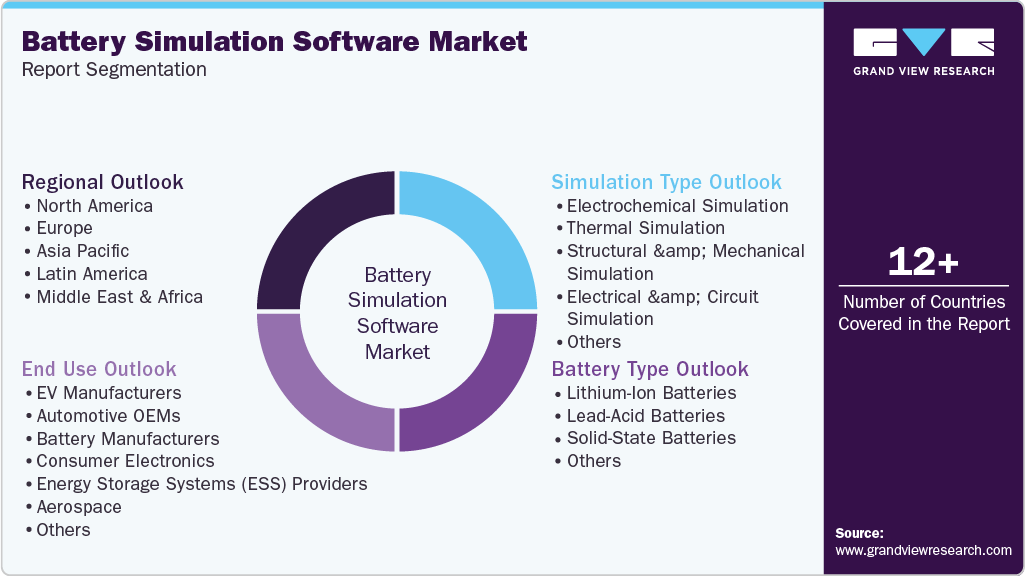
This report forecasts revenue growth at the global, regional, and country levels and provides an analysis of the latest industry trends in each of the sub-segments from 2021 to 2033. For this study, Grand View Research has segmented the battery simulation software market report based on simulation type, battery type, end use and region.
 To learn more about this report, Download Free Sample Report
 -
Simulation Type Outlook (Revenue, USD Billion, 2021 - 2033)
-
Electrochemical Simulation
-
Thermal Simulation
-
Structural & Mechanical Simulation
-
Electrical & Circuit Simulation
-
Others
-
-
Battery Type Outlook (Revenue, USD Billion, 2021 - 2033)
-
Lithium-Ion Batteries
-
Lead-Acid Batteries
-
Solid-State Batteries
-
Others
-
-
End Use Outlook (Revenue, USD Billion, 2021 - 2033)
-
EV Manufacturers
-
Automotive OEMs
-
Battery Manufacturers
-
Consumer Electronics
-
Energy Storage Systems (ESS) Providers
-
Aerospace
-
Others
-
-
Regional Outlook (Revenue, USD Billion, 2021 - 2033)
-
North America
-
U.S.
-
Canada
-
Mexico
-
-
Europe
-
UK
-
Germany
-
France
-
-
Asia Pacific
-
China
-
India
-
Japan
-
South Korea
-
Australia
-
-
Latin America
-
Brazil
-
-
Middle East & Africa
-
UAE
-
Saudi Arabia
-
South Africa
-
-
Research Methodology
The battery simulation software market figures in this report are based on a proven research process that combines executive interviews with secondary research from proprietary databases, company filings, and recognized regulatory and institutional sources. Market size is built through value-chain sizing-reconciling supply-side and demand-side estimates-and triangulated with bottom-up and top-down approaches. Every estimate passes multiple levels of expert validation before publication, with each battery simulation software segment quantified using the revenue-capture definitions in the table below.
Segment Definition
Segment - Simulation Type
Revenue capture definition
Electrochemical Simulation
Electrochemical simulation models the internal chemical and electrochemical processes occurring within a battery, including ion transport, electrode reactions, charge-discharge behavior, aging, and degradation. It helps optimize battery chemistry, improve performance, and predict battery lifespan.
Thermal Simulation
Thermal simulation analyzes heat generation, temperature distribution, and cooling performance within battery cells, modules, and packs. It helps prevent overheating, optimize thermal management systems, and improve battery safety, efficiency, and durability.
Structural & Mechanical Simulation
Structural and mechanical simulation evaluates the physical integrity of battery components under mechanical loads, vibration, shock, compression, and thermal expansion. It supports battery pack design, crashworthiness, durability, and reliability.
Electrical & Circuit Simulation
Electrical and circuit simulation models battery electrical behavior, including voltage, current, power flow, impedance, and Battery Management System (BMS) performance. It helps optimize battery control strategies, charging systems, and electrical integration.
Others
This segment includes multiphysics, manufacturing process, CFD, digital twin, and system-level simulations that combine multiple physical domains to optimize battery design, production, and operational performance.
Segment - Battery Type
Revenue capture definition
Lithium-Ion Batteries
Lithium-ion batteries are rechargeable batteries that use lithium ions as charge carriers. They offer high energy density, long cycle life, and fast charging capabilities, making them the dominant battery technology for electric vehicles, consumer electronics, and energy storage systems.
Lead-Acid Batteries
Lead-acid batteries are rechargeable batteries that use lead electrodes and sulfuric acid electrolyte. They are widely used in automotive starter batteries, backup power systems, and industrial applications due to their low cost and mature technology.
Solid-State Batteries
Solid-state batteries replace liquid electrolytes with solid electrolytes, offering improved safety, higher energy density, faster charging potential, and longer operational life. They are considered a next-generation battery technology for electric mobility and energy storage.
Others
This category includes sodium-ion, lithium-sulfur, nickel-metal hydride (NiMH), zinc-based, flow batteries, and other emerging battery chemistries used in specialized applications.
Segment - End Use
Revenue capture definition
EV Manufacturers
EV manufacturers use battery simulation software to design, optimize, and validate battery cells, modules, and packs, improving vehicle range, charging performance, thermal management, and safety.
Automotive OEMs
Automotive OEMs integrate battery simulation into vehicle development to optimize battery systems, Battery Management Systems (BMS), vehicle performance, and compliance with safety and regulatory standards.
Battery Manufacturers
Battery manufacturers use simulation software for battery material research, cell design, manufacturing optimization, quality control, and validation of battery performance before commercial production.
Consumer Electronics
Manufacturers of smartphones, laptops, wearable devices, tablets, and portable electronics use battery simulation software to improve battery life, charging efficiency, thermal performance, and product safety.
Energy Storage Systems (ESS) Providers
ESS providers utilize battery simulation software to optimize battery energy storage systems for grid-scale, commercial, and residential applications by improving lifecycle performance, reliability, thermal management, and energy efficiency.
Aerospace
The aerospace sector uses battery simulation software to develop lightweight, high-reliability batteries for aircraft, satellites, drones, and defense systems while ensuring performance under demanding environmental and operating conditions.
Others
This segment includes industrial equipment manufacturers, marine, rail, medical devices, robotics, telecommunications, research institutions, and defense organizations that use battery simulation software for specialized battery development and optimization.
Estimation Model
Layer
Question
Analysis
Battery R&D & Digital Engineering Demand Layer
Who drives demand for Battery Simulation Software?
Identify organizations investing in battery development, including EV manufacturers, battery manufacturers, automotive OEMs, consumer electronics companies, ESS providers, aerospace companies, universities, and research institutes. Assess investments in battery R&D, digital engineering, AI-driven simulation, and next-generation battery technologies to estimate the Total Addressable Market (TAM).
Battery Manufacturing & Production Layer
Where is Battery Simulation Software deployed?
Evaluate deployment across battery cell development, module and pack design, manufacturing process optimization, battery testing, Battery Management System (BMS) development, and quality assurance. Assess adoption across lithium-ion, solid-state, lead-acid, and emerging battery technologies.
Technology Adoption Layer
Who adopts Battery Simulation Software?
Assess adoption among automotive OEMs, EV manufacturers, battery manufacturers, consumer electronics companies, utilities, ESS providers, aerospace & defense organizations, research laboratories, and engineering service providers. Analyze adoption of electrochemical, thermal, structural, electrical, multiphysics simulation, AI, digital twins, and cloud-based simulation platforms.
Revenue Generation Layer
How is revenue generated?
Assess revenues from perpetual software licenses, subscription/SaaS platforms, cloud simulation services, consulting, implementation, technical support, maintenance, digital twin solutions, engineering services, and training. Analyze pricing models, enterprise contracts, deployment type, and software upgrades to estimate market revenue.
Delivered Customizations
This report has been delivered with the following In-depth customizations
CLIENT REQUEST
CUSTOMIZATION DELIVERED
VALUE ADDS
Battery Simulation Software Vendor Competitive Benchmarking
Assessed leading battery simulation software vendors based on simulation capabilities (electrochemical, thermal, structural, electrical, multiphysics), AI integration, digital twin capabilities, cloud deployment, battery chemistry support, software interoperability, pricing models, partnerships, geographic presence, innovation roadmap, and market positioning.
Enables stakeholders to benchmark competitors, identify technology leaders, evaluate product differentiation, and formulate competitive product development, partnership, and go-to-market strategies.
Regulatory & Standards Assessment
Analyzed the impact of battery safety regulations, sustainability initiatives, battery passport requirements, and automotive certification standards on simulation software adoption.
Supports compliance planning, product roadmap development, and strategic investment decisions in regulated markets.
End-use Industry Assessment
Analyzed software adoption across EV manufacturers, battery manufacturers, automotive OEMs, consumer electronics, ESS providers, aerospace & defense, industrial equipment, and research institutions.
Enables stakeholders to identify the highest-growth customer segments, tailor sales strategies, and expand into new application markets.
Frequently Asked Questions About This Report
The global battery simulation software market is expected to grow at a compound annual growth rate of 12.3% from 2026 to 2033 to reach USD 5.8 billion by 2033.
Key factors include rising investments in next-generation battery technologies are significantly driving the adoption of battery simulation software. Governments, automotive OEMs, battery manufacturers, and research institutions are investing heavily in advanced chemistries such as solid-state, sodium-ion, lithium-sulfur, and silicon-anode batteries to improve energy density, charging speed, safety, and lifecycle performance.
North America dominated with 37.1% revenue share in 2025.
Asia Pacific is the fastest-growing region over the forecast period.
The electrochemical simulation segment led with a 32.4% revenue share in 2025, while thermal simulation segment is the fastest-growing segment.
The lithium-ion batteries segment led with a 70.1% revenue share in 2025, while solid-state batteries segment is the fastest-growing segment.
The EV manufacturers segment held the largest share (over 25.0%) in 2025, while energy storage systems (ESS) providers segment is the fastest-growing segment.
Key players operating in the battery simulation software industry are Ansys, Inc., Siemens Digital Industries Software, Dassault Systèmes, COMSOL AB, Altair Engineering Inc., MathWorks, Inc., Cadence Design Systems, Inc., Ionworks Technologies Inc., Gamma Technologies, LLC, Hexagon AB, ESI Group, Synopsys, Inc., Keysight Technologies, Inc., Maplesoft (MapleSim), and PTC Inc.
The global battery simulation software market size was estimated at USD 2.3 billion in 2025 and is expected to reach USD 2.6 billion in 2026.
About the Author(s)
IT Services & Applications Research Team
Technology · IT Services & ApplicationsThis report was authored by the it services & applications research team at Grand View Research - comprising two research analysts, one senior research analyst, and one industry expert - with specialized expertise in the it services & applications segment of the technology industry. All findings are based on proprietary technology databases, executive interviews, and regulatory analysis, subject to internal peer review prior to publication.
Last Updated:
Speak to Analyst

Customize this report to your needs - add regions, segments, or data points, with 20% free customization.
Or view our licence options:


ISO 9001:2015 & 27001:2022 Certified
We are GDPR and CCPA compliant! Your transaction & personal information is safe and secure. For more details, please read our privacy policy.


