
- Home
- »
- Next Generation Technologies
- »
-
Beauty Tech Market Size, Share & Growth Report, 2025-2030GVR Report cover

Beauty Tech Market (2025 - 2030)
Size, Share & Trends Analysis Report By Technology (Artificial Intelligence (AI), Augmented Reality (AR)), By Product Category (Skincare Devices, Cosmetics), By End User, By Region, And Segment Forecasts
Market Size, 2024
$66.2BMarket Estimate, 2026
$87.1BMarket Forecast, 2030
$172.9BCAGR, 2025–2030
17.9%Beauty Tech Market Summary
The global beauty tech market size was valued at USD 66.2 billion in 2024 and is projected to grow from USD 87.1 billion in 2026 to USD 172.9 billion by 2030, at a CAGR of 17.9% from 2025 to 2030. North America dominated the market, accounting for a revenue share of 38.0% in 2024.Growth of the beauty tech industry is driven by technological advancements, shifting consumer preferences, and the increasing demand for personalized beauty solutions.
 Source: Grand View Research, IR Documents, Primary Interviews, Paid DatabasesTo learn more about this report,
 Download Free Sample Report
 Key Market Trends & Insights
- The beauty tech industry in the U.S. is expected to grow significantly at a CAGR of 16.0% from 2025 to 2030.
- By product category, the skincare devices segment dominated the market and accounted for a revenue share of over 38.0% in 2024.
- By technology, artificial intelligence is the most lucrative technology segment registering the fastest growth during the forecast period.
Market Size & Forecast
- 2024 Market Size: USD 66.2 Billion
- 2030 Projected Market Size: USD 172.9 Billion
- CAGR (2025-2030): 17.9%
- North America: Largest market in 2024
Three ways to get this report
Buy it, customize it, or ask a question.Ask an Analyst
Analyst response in 1 business day
- AccessReport author, directly
- Reply timeWithin 1 working day
- No sales callDirect answer only
- FormatEmail reply
- CostFree, no cost
Get the Full Report
What the study covers
- FormatsPDF · Excel · Dashboard
- Timeline2025–2030 annual, 2024 base
- Coverage20+ countries, 5 regions
- Companies10+ key players profiled
Customize the Report
20% free customization
- IncludeCountries, segments, points
- TailorTo your product definition
- ExtendDeeper competitor detail
- OrA fully bespoke study
- Turnaround5–10 working days
As beauty brands integrate AI, AR, and IoT into their offerings, the market is evolving rapidly, providing enhanced user experiences and innovative product developments.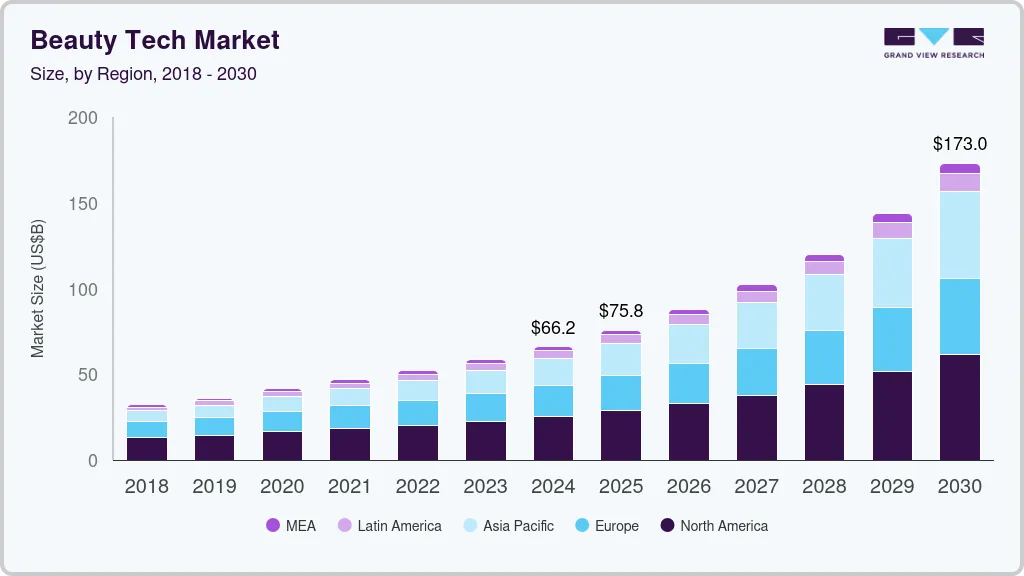 To learn more about this report, Download Free Sample Report
 Another major factor propelling market growth is the rise of smart beauty devices. IoT-enabled skincare and haircare tools provide real-time tracking and personalized recommendations. Devices such as smart facial cleansers, at-home LED therapy masks, and connected hair dryers are integrating AI to optimize skincare routines. Brands like Foreo, Dyson, and NuFace have introduced smart gadgets that monitor users' skin conditions and adjust treatments accordingly, creating a new era of intelligent beauty solutions.
The growing emphasis on sustainability and clean beauty is also a significant growth driver of the beauty tech industry. Consumers are becoming increasingly aware of ethical and environmental concerns, pushing beauty brands to adopt technology-driven sustainable practices. AI-based ingredient analysis ensures safer formulations, while smart refillable packaging minimizes waste. Companies are also using blockchain and digital transparency tools to verify ethical sourcing, further boosting consumer trust in clean beauty brands.
The rapid growth of e-commerce and digital transformation is accelerating beauty tech adoption. AI-powered virtual consultations, chatbots, and recommendation engines provide customers with highly tailored product suggestions. Beauty brands are leveraging big data and machine learning to enhance online shopping experiences, improving conversion rates and customer retention. Digital beauty platforms are also expanding into social commerce, where influencers and AI-generated content drive engagement and purchases.
The integration of biotechnology in beauty is enabling the development of more effective and customized skincare solutions. AI-powered analysis of genetic data, microbiome research, and biomimetic ingredients are allowing brands to create skincare products tailored to individual needs. Companies are now leveraging biotech to develop lab-grown ingredients, cruelty-free alternatives, and enhanced anti-aging formulations, driving demand for high-performance skincare.
Market Dynamics
The rising demand for personalized beauty solutions is a major driver of the global beauty tech market, as consumers increasingly seek tailored skincare, haircare, and cosmetic experiences that align with their unique needs and preferences. The integration of artificial intelligence (AI), augmented reality (AR), and IoT-enabled devices is enabling beauty brands to deliver hyper-personalized recommendations, virtual try-ons, and real-time skin and hair diagnostics. AI-powered tools analyze user data, including skin type, concerns, lifestyle, and preferences, to suggest the most suitable products, significantly enhancing customer satisfaction, engagement, and conversion rates.
This shift toward personalization is particularly strong among millennials and Gen Z consumers, who prefer tech-driven, data-backed beauty solutions and immersive digital experiences. Smart beauty devices such as AI-enabled skincare scanners, LED therapy masks, smart cleansing tools, and connected hair care devices are gaining widespread adoption, allowing users to monitor skin conditions and optimize routines from home. Leading players such as L'Oréal, Estée Lauder, and Sephora are investing heavily in AI-powered skin analysis tools, AR-based virtual try-on platforms, and biotech-driven custom skincare formulations, further accelerating the demand for personalized beauty technology and supporting strong long-term market expansion.
Data privacy concerns and high implementation costs remain significant restraints on the global beauty tech market. Personalized beauty technologies rely heavily on collecting and analyzing sensitive consumer data, including facial scans, skin imaging, biometric information, and behavioral preferences. As AI-powered diagnostics, AR-based virtual try-ons, and connected beauty devices continue to gain traction, concerns around data security, consent management, and compliance with regulations such as GDPR and CCPA are intensifying. Any data breaches, misuse, or lack of transparency in how consumer information is processed can erode user trust and limit broader adoption of beauty tech platforms, particularly in privacy-conscious markets.
In addition, the high cost of developing, deploying, and maintaining advanced beauty tech solutions presents a substantial barrier, especially for small and mid-sized beauty brands. Investments in AI infrastructure, AR development, biotech research, IoT-enabled devices, and continuous algorithm training require considerable financial and technical resources. Smaller players often lack the in-house expertise and capital needed to compete with established global brands, slowing innovation and limiting market accessibility. Furthermore, integrating beauty tech tools across e-commerce platforms, retail stores, and mobile applications adds operational complexity and ongoing maintenance costs, which can constrain market scalability and slow the pace of widespread adoption.
Market Concentration & Characteristics
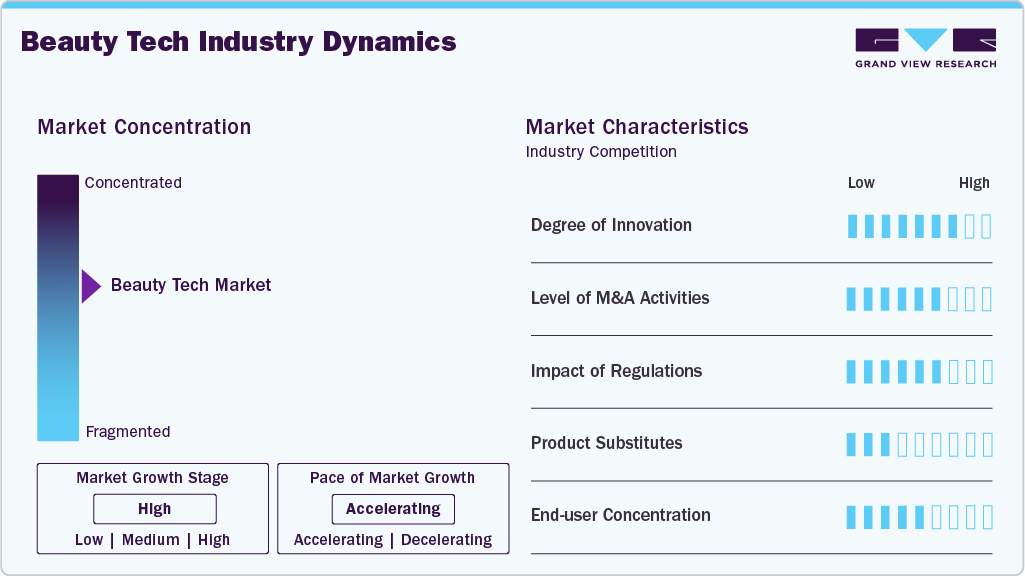
The beauty tech market is highly concentrated, with established global beauty brands, consumer electronics companies, and emerging technology-driven startups shaping the competitive landscape. Large multinational players hold a significant share of the market due to their strong brand recognition, extensive distribution networks, advanced research capabilities, and ability to invest heavily in product innovation. These companies offer a wide range of technology-enabled beauty solutions, including skin analysis devices, personalized skincare systems, smart beauty tools, virtual try-on platforms, and connected wellness products. The presence of proprietary technologies, consumer trust, patent portfolios, and access to large customer databases creates moderate entry barriers for new participants. However, the market also offers space for niche innovators focused on AI-based personalization, digital diagnostics, and direct-to-consumer beauty platforms.
 To learn more about this report, Download Free Sample Report
 In terms of market characteristics, the beauty tech industry is highly innovation-driven, with strong emphasis on artificial intelligence, augmented reality, IoT-enabled beauty devices, data analytics, and personalized product recommendations. Consumer demand is being driven by increasing awareness of skin health, rising adoption of digital beauty consultations, growing preference for customized beauty solutions, and the expansion of e-commerce and mobile applications. The market is also experiencing rising collaboration between cosmetic companies and technology providers to develop more accurate diagnostic tools and immersive digital experiences. Regulatory compliance related to consumer safety, data privacy, product claims, and connected device standards is increasingly important, particularly in developed markets.
Technology Insights
The artificial intelligence (AI) dominated the market and accounted for a revenue share of over 34.0% in 2024 owing to personalization, virtual try-ons, and advancements in AI-powered skin analysis. Consumers are increasingly seeking tailored beauty solutions, and AI-driven personalization plays a crucial role in offering customized skincare and makeup recommendations. By analyzing data from user inputs, such as skin type, concerns, and preferences, AI algorithms can suggest the most suitable products, enhancing customer satisfaction and engagement. This level of customization is particularly appealing to millennials and Gen Z consumers, who prefer tech-driven and data-backed beauty solutions.
The augmented reality (AR) segment is anticipated to grow at a CAGR of 19.9% during the forecast period, driven by increasing consumer demand for interactive and immersive shopping experiences. Beauty brands are leveraging AR technology to allow consumers to test makeup products, such as lipsticks, eyeshadows, and foundations, in real time using their smartphones, tablets, or smart mirrors. This enhances the online shopping experience by reducing uncertainty in product selection, increasing consumer confidence, and ultimately driving higher conversion rates for beauty brands.
Product Category Insights
The skincare devices segment dominated the market and accounted for a revenue share of over 38.0% in 2024, driven by increasing consumer demand for high-tech, at-home skincare solutions. One of the primary growth drivers is the rising awareness of skin health and personalized skincare routines. Consumers are looking for advanced tools that provide professional-grade skincare treatments at home, reducing their dependence on salons and dermatologists. The skincare devices segment is further segmented into acne devices, cleansing, rejuvenation, anti-aging devices, and others.
The cosmetics segment is expected to grow at a significant CAGR over the forecast period. Voice-enabled and AI-powered beauty assistants are enhancing the cosmetics shopping experience, both online and in physical stores. Virtual assistants can analyze customer preferences, recommend makeup routines, and provide step-by-step tutorials through smart devices, making beauty routines more interactive and engaging. The skincare devices segment is further segmented into smart makeup tools, virtual makeup try-ons, and others.
End User Insights
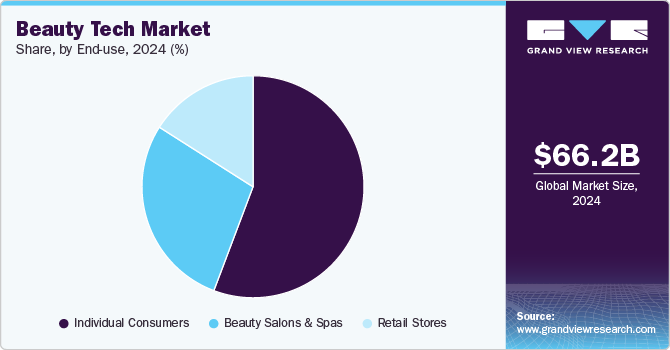
The individual consumers segment dominated the market and accounted for a revenue share of nearly 56.0% in 2024. The growing popularity of at-home beauty tech devices is also contributing to market expansion. With the rise of self-care and wellness trends, consumers are investing in AI-powered skincare tools, LED therapy masks, microcurrent devices, and smart cleansing brushes to achieve salon-quality results at home. These innovations cater to the increasing demand for convenient, cost-effective, and high-tech beauty treatments without the need for professional appointments.
 To learn more about this report, Download Free Sample Report
 The beauty salons and spas segment is expected to grow at a significant CAGR over the forecast period. The growing impact of beauty influencers and digital content creators is accelerating the adoption of beauty tech innovations. Many salons and spas are investing in AI-powered content creation tools, AR beauty filters, and interactive virtual consultation platforms to engage customers on social media and attract a tech-savvy audience.
Regional Insights
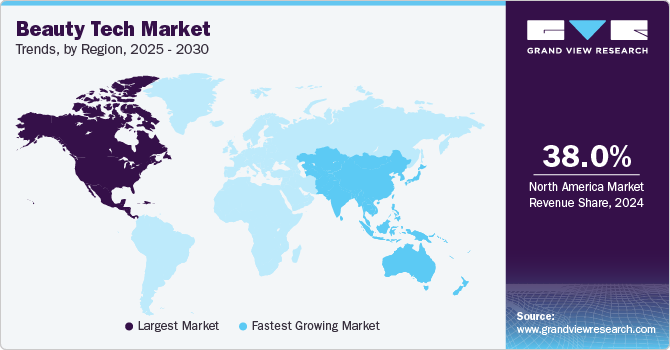
The beauty tech industry in North America held the largest revenue share of over 38.0% in 2024 due to the increasing adoption of AI and AR technologies by major beauty brands. Companies such as L’Oréal, Estée Lauder, and Sephora have invested heavily in AI-powered skin analysis tools and AR-based virtual try-on applications. These technologies enhance customer engagement by allowing users to try products virtually before making a purchase, thereby reducing return rates and increasing customer confidence.
 To learn more about this report, Download Free Sample Report
 U.S. Beauty Tech Market Trends
The beauty tech industry in the U.S. is expected to grow significantly at a CAGR of 16.0% from 2025 to 2030. The rise of social commerce and influencer marketing is driving digital beauty adoption as brands use data analytics to track trends and consumer behavior. The increasing emphasis on clean beauty and sustainability is also pushing companies to adopt AI-driven ingredient transparency tools. Moreover, the growth of e-commerce and direct-to-consumer (DTC) brands is accelerating the adoption of personalized beauty solutions.
Europe Beauty Tech Market Trends
The Europe beauty tech industry is anticipated to register considerable CAGR from 2025 to 2030.Europe’s market is witnessing growth due to the increasing adoption of AR and AI for virtual consultations and personalized product recommendations. The region's strong presence of luxury beauty brands and heightened consumer interest in premium beauty experiences further drive the market. Sustainability initiatives and regulations promoting eco-friendly beauty technologies are also fostering growth.
The UK beauty tech market is expected to grow rapidly in the coming years. In the UK, the beauty tech market is supported by the growing popularity of online beauty retail and e-commerce platforms offering AI-powered personalized experiences. The integration of AR for virtual try-ons and digital beauty consultations is enhancing customer engagement. Moreover, collaborations between beauty brands and tech startups are contributing to market expansion.
The beauty tech market in Germany held a substantial market share in 2024. The country’s robust research and development (R&D) landscape supports innovations in cosmetic technology, leading to the introduction of advanced at-home beauty devices. Additionally, the emphasis on sustainability and clean beauty products, often integrated with tech-enabled transparency solutions, further propels market growth.
Asia Pacific Beauty Tech Market Trends
Asia Pacific beauty tech industry is expected to register the fastest CAGR of 21.8% from 2025 to 2030. The proliferation of smartphone apps for virtual beauty experiences, coupled with the integration of AI and big data analytics for hyper-personalization, is propelling the market. Additionally, the increasing adoption of wearable skincare and haircare devices is a significant growth factor.
The Japan beauty tech market is expected to grow rapidly in the coming years. In Japan, the market is fueled by the country's advanced technological landscape and consumer preference for high-quality skincare solutions. The use of AI-powered beauty diagnostics and smart skincare devices is prevalent. Japanese beauty brands are also leveraging robotics and sensor technologies for personalized beauty treatments, driving market growth.
The beauty tech market in China held a substantial market share in 2024, driven by the booming e-commerce sector and the widespread use of social media platforms for beauty product marketing. AI-powered virtual try-on tools and live-streaming shopping experiences are increasingly popular. Additionally, the growing demand for smart skincare devices and customized beauty solutions is supporting market expansion, particularly among tech-savvy younger consumers.
Key Beauty Tech Company Insights
Key players operating in the beauty tech industry are L'Oreal S.A.; Estée Lauder Companies Inc.; Unilever PLC; Procter & Gamble Co.; and Shiseido. The companies are focusing on various strategic initiatives, including new product development, partnerships & collaborations, and agreements to gain a competitive advantage over their rivals. The following are some instances of such initiatives.
-
In January 2025, Estée Lauder Companies Inc. announced a partnership with Exuud Inc. a U.S.-based platform specializing in fragrance technology, to create a smart fragrance expression platform, set to redefine olfactive innovation. As part of the agreement, ELC has invested in Exuud, recognizing the potential of its patented Soliqaire technology. This advanced fragrance delivery system allows users to customize their scent experience by adjusting intensity, duration, and frequency for a more consistent and personalized application. By blending technological innovation with luxury craftsmanship, the collaboration aims to revolutionize how consumers engage with fragrances.
-
In May 2024, L’Oréal S.A., made advancements in beauty tech with a series of innovations, including bioprinted skin technology and a GenAI-powered content lab to enhance creativity. The company introduced AI-driven skin and hair diagnostics, a personal beauty assistant powered by generative AI, and CREAITECH, a specialized lab focused on transforming beauty content creation. Additionally, L’Oréal unveiled an infrared light-based hair dryer, a micro-resurfacing skincare device for enhanced performance, and an ultra-realistic human skin technology platform for scientific research and product testing, reinforcing its commitment to tech-driven beauty advancements.
Key Beauty Tech Companies:
The following are the leading companies in the beauty tech market. These companies collectively hold the largest market share and dictate industry trends.
- Amorepacific Corporation
- Avon Products, Inc.
- Dyson
- Johnson & Johnson
- Kao Corporation
- L'Oreal S.A.
- Mary Kay Inc.
- Oriflame Holding AG
- Panasonic
- Procter & Gamble Co.
- Revlon, Inc.
- Sephora (LVMH subsidiary)
- The Estee Lauder Companies Inc.
- Shiseido
- Unilever PLC
Competitive Benchmarking
Operating Strategies
Competitive Edge
Weakness
Mature Players: Johnson & Johnson; Kao Corporation; L'Oreal S.A.; Panasonic; Procter & Gamble Co.; The Estee Lauder Companies Inc.; Shiseido; Unilever PLC
- A core operational strategy is the integration of digital beauty ecosystems into product delivery and customer engagement.
- Mature players also operate with a strong focus on omnichannel integration, ensuring seamless coordination between online platforms, physical retail stores, dermatology clinics, and professional beauty partners.
- Mature players in the beauty tech market compete primarily through advanced product innovation, brand equity, and deep integration of science-driven beauty solutions.
- Another key competitive strategy is ecosystem development through personalization and digital engagement platforms.
- Mature players also face challenges related to organizational complexity and legacy systems. Many of these companies were originally built as traditional beauty or cosmetics manufacturers and have gradually evolved into tech-enabled enterprises.
- Another weakness lies in the high dependency on brand perception and premium positioning, which can limit flexibility in pricing and product experimentation.
Emerging Players: Mary Kay Inc.; Oriflame Holding AG; Revlon, Inc.; Sephora
- Emerging players in the beauty tech market operate with lean, digitally driven strategies that prioritize speed, flexibility, and direct consumer engagement.
- A central operational strategy for these players is digital-first execution across the entire value chain.
- Emerging players in the beauty tech market compete primarily by positioning themselves as agile, innovation-led disruptors that focus on personalization, digital-native experiences, and niche problem-solving.
- Another important competitive strategy is leveraging digital-first distribution and marketing models.
- Emerging players in the beauty tech market face a fundamental weakness in limited financial capacity, which restricts their ability to invest in advanced research, proprietary technologies, and large-scale commercialization.
- Another weakness lies in their limited ability to navigate complex regulatory and compliance frameworks.
Beauty Tech Market Report Scope
Report Attribute
Details
Market size in 2024
USD 66.2 billion
Estimated market size in 2026
USD 87.1 billion
Projected market size by 2030
USD 172.9 billion
Growth rate
CAGR of 17.9% from 2025 to 2030
Actual data
2018 - 2023
Base year for estimation
2024
Forecast period
2025 - 2030
Quantitative units
Revenue in USD billion and CAGR from 2025 to 2030
Report services
Revenue forecast, company share, competitive landscape, growth factors, and trends
Segments covered
Technology, product category, end user, region
Regional scope
North America; Europe; Asia Pacific; Latin America; MEA
Country scope
U.S.; Canada; Mexico; UK; Germany; France; China; India; Japan; Australia; South Korea; Brazil; UAE; Kingdom of Saudi Arabia; South Africa
Key companies profiled
Amorepacific Corporation; Avon Products, Inc.; Dyson; Johnson & Johnson; Kao Corporation; L'Oreal S.A.; Mary Kay Inc.; Oriflame Holding AG; Panasonic; Procter & Gamble Co.; Revlon, Inc.; Sephora (LVMH subsidiary); The Estee Lauder Companies Inc.; Shiseido; Unilever PLC
Customization scope
Free report customization (equivalent up to 8 analysts working days) with purchase. Addition or alteration to country, regional & segment scope.
Pricing and purchase options
Avail customized purchase options to meet your exact research needs. Explore purchase options
Global Beauty Tech Market Report Segmentation
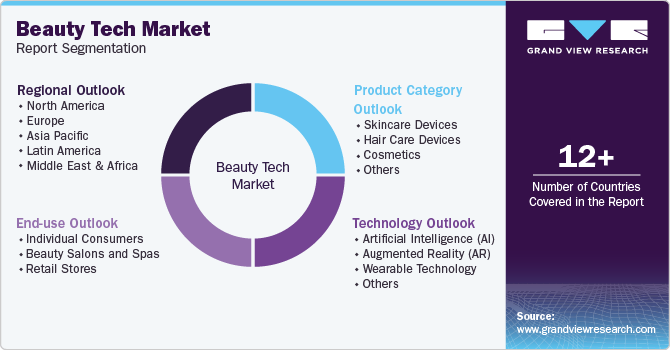
This report forecasts revenue growth at global, regional, and country levels and provides an analysis of the latest industry trends in each of the sub-segments from 2018 to 2030. For this study, Grand View Research has segmented the beauty tech market report based on technology, product category, end user, and region:
 To learn more about this report, Download Free Sample Report
 -
Technology Outlook (Revenue, USD Billion, 2018 - 2030)
-
Artificial Intelligence (AI)
-
Augmented Reality (AR)
-
Wearable Technology
-
Others
-
-
Product Category Outlook (Revenue, USD Billion, 2018 - 2030)
-
Skincare Devices
-
Acne Devices
-
Cleansing
-
Rejuvenation
-
Anti-Aging Devices
-
Others
-
-
Hair Care Devices
-
Hair growth
-
Hair removal
-
Smart Hair Dryers
-
LED Hair Treatment Devices
-
-
Cosmetics
-
Smart Makeup Tools
-
Virtual Makeup Try-On
-
Others
-
-
Others
-
-
End User Outlook (Revenue, USD Billion, 2018 - 2030)
-
Individual Consumers
-
Beauty Salons and Spas
-
Retail Stores
-
-
Regional Outlook (Revenue, USD Billion, 2018 - 2030)
-
North America
-
U.S.
-
Canada
-
Mexico
-
-
Europe
-
UK
-
Germany
-
France
-
-
Asia Pacific
-
China
-
India
-
Japan
-
South Korea
-
Australia
-
-
Latin America
-
Brazil
-
-
Middle East & Africa
-
UAE
-
Saudi Arabia
-
South Africa
-
-
Delivered Customizations
This report has been delivered with the following In-depth customizations
Client Request
Customization Delivered
Value Adds
Global Beauty Tech Market Entry Strategy for a Skincare & Devices Manufacturer
Assessment of the beauty tech ecosystem, including skincare devices, AR/VR beauty platforms, and AI personalization tools
Benchmarking of digital-first beauty brands and D2C adoption trends
Identified high-growth demand for AI-driven skincare personalization tools
Supported omnichannel digital-first market entry strategy
AI-Powered Personalized Beauty & Skin Analysis Market Study
Analysis of AI-based skin diagnostics tools and mobile beauty apps
Evaluation of consumer adoption of virtual skin analysis and recommendation engines
Analysis of dermatology-backed beauty tech platforms
Identified a strong consumer shift toward hyper-personalized skincare routines
Highlighted monetization potential through subscription-based beauty apps
Supported the development of AI-based product recommendation engines
AR Virtual Try-On & Smart Cosmetics Adoption Analysis
Assessment of AR-based makeup try-on tools across e-commerce platforms
Adoption of smart mirrors and in-store digital beauty experiences
Analysis of consumer engagement impact on purchase conversion rates
Demonstrated a significant increase in online conversion rates via AR try-on tools
Identified retail transformation opportunities for omnichannel beauty brands
Supported investment in immersive digital shopping experiences
Frequently Asked Questions About This Report
The global beauty tech market size was valued at USD 66.2 billion in 2024 and is estimated at USD 87.1 billion for 2026.
The global beauty tech market is expected to grow at a CAGR of 17.9% from 2025 to 2030, reaching USD 172.9 billion by 2030.
The beauty tech market in North America held the largest share of over 38.0% in 2024 due to the increasing adoption of AI and AR technologies by major beauty brands. Companies such as L’Oréal, Estée Lauder, and Sephora have invested heavily in AI-powered skin analysis tools and AR-based virtual try-on applications.
Some key players operating in the beauty tech market include Amorepacific Corporation, Avon Products, Inc., Dyson, Johnson & Johnson, Kao Corporation, L'Oreal S.A., Mary Kay Inc., Oriflame Holding AG, Panasonic, Procter & Gamble Co., Revlon, Inc., Sephora (LVMH subsidiary), The Estee Lauder Companies Inc., Shiseido, Unilever PLC
The beauty tech market is driven by technological advancements, shifting consumer preferences, and the increasing demand for personalized beauty solutions. As beauty brands integrate AI, AR, and IoT into their offerings, the market is evolving rapidly, providing enhanced user experiences and innovative product developments.
About the Author(s)
Next Generation Technologies Research Team
Technology · Next Generation TechnologiesThis report was authored by the next generation technologies research team at Grand View Research - comprising two research analysts, one senior research analyst, and one industry expert - with specialized expertise in the next generation technologies segment of the technology industry. All findings are based on proprietary technology databases, executive interviews, and regulatory analysis, subject to internal peer review prior to publication.
Last Updated:
Speak to Analyst

Customize this report to your needs - add regions, segments, or data points, with 20% free customization.
Or view our licence options:


ISO 9001:2015 & 27001:2022 Certified
We are GDPR and CCPA compliant! Your transaction & personal information is safe and secure. For more details, please read our privacy policy.


