
- Home
- »
- Homecare & Decor
- »
-
Bike Market Size, Share & Trends, Industry Report, 2033GVR Report cover

Bike Market (2026 - 2033) Size, Share & Trends Analysis Report By Type (Conventional, Electric), By Product (Cargo Bikes, Road Bikes), By Price Range, By End User (Men, Women), By Application (Personal/Individual, Commercial), By Region, And Segment Forecasts
Market Size, 2025
$84.6BMarket Estimate, 2026
$88.9BMarket Forecast, 2033
$140.8BCAGR, 2026–2033
6.8%Bike Market Report Summary
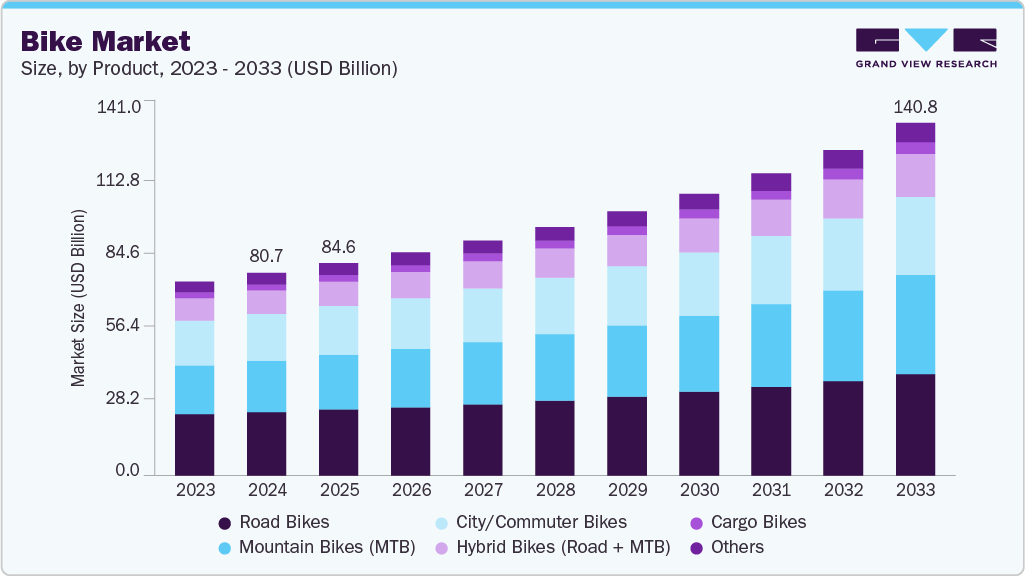
The global bike market size was valued at USD 84.6 billion in 2025 and is projected to grow from USD 88.9 billion in 2026 to USD 140.8 billion by 2033, at a CAGR of 6.8% from 2026 to 2033. The Asia Pacific bike market held the largest share of 38.3% of the global market in 2025. The global bike market is undergoing a structural transformation, driven by electrification, premiumization, and its expanding role in sustainable mobility.
 Source: Grand View Research, IR Documents, Primary Interviews, Paid DatabasesTo learn more about this report,
 Download Free Sample Report
 Key Market Trends & Insights
- By product: Road bikes led the bike market and accounted for a share of 31.0% in 2025.
- By type: Conventional bikes led the bike market and accounted for a share of 72.9% in 2025.
- By end-use: Men led the bike market and accounted for a share of 77.2% in 2025.
- By application, Personal/ individual use led the bike market and accounted for a share of 85.8% in 2025.
Regional Highlights
- Largest regional market: Asia Pacific (38.3% revenue share, 2025)
- By country: The bike market in China is anticipated to witness a CAGR of 7.1% from 2026 to 2033.
Market Size & Forecast
- Market size in 2025: USD 84.6 billion
- Estimated market size in 2026: USD 88.9 Billion
- Projected market size by 2033: USD 140.8 billion
- CAGR (2026-2033): 6.8%
Three ways to get this report
Buy it, customize it, or ask a question.Ask an Analyst
Analyst response in 1 business day
- AccessReport author, directly
- Reply timeWithin 1 working day
- No sales callDirect answer only
- FormatEmail reply
- CostFree, no cost
Get the Full Report
What the study covers
- FormatsPDF · Excel · Dashboard
- Timeline2026–2033 annual, 2025 base
- Coverage20+ countries, 5 regions
- Companies10+ key players profiled
Customize the Report
20% free customization
- IncludeCountries, segments, points
- TailorTo your product definition
- ExtendDeeper competitor detail
- OrA fully bespoke study
- Turnaround5–10 working days
Electrically assisted bicycles (e-bikes) have become the principal revenue growth engine, supported by government incentives across Europe and parts of Asia, as well as urban policies promoting low-emission transport. In markets such as Germany and the Netherlands, e-bikes now account for a significant share of total bicycle sales value, reflecting strong commuter adoption. Simultaneously, large cities, including Paris, have expanded cycling infrastructure and restricted inner-city car usage, further reinforcing two-wheel mobility. This policy-led ecosystem is repositioning bicycles from recreational products to core components of urban transportation networks.
 To learn more about this report, Download Free Sample Report
 While e-bikes dominate value growth, traditional pedal bicycles continue to anchor global unit volumes, particularly in emerging economies where affordability and basic mobility remain primary drivers. Entry-level road, hybrid, and commuter bikes maintain relevance across price-sensitive segments, ensuring broad-based participation. However, even in non-electric categories, manufacturers are integrating lightweight frames, improved gearing systems, and enhanced safety components to elevate consumer appeal. Leisure cycling, gravel riding, and endurance sports have also contributed to demand for higher-specification mechanical bikes, especially in North America and Western Europe. The market, therefore, reflects a dual structure: high-volume mechanical sales complemented by high-margin electrified platforms.
Various organizations and governments across many countries are focusing on reducing vehicular emissions, which has accelerated the growth of the e-bike market. Several governments have implemented strict emission control regulations, encouraging automobile manufacturers to introduce electric bicycles as sustainable mobility solutions. The development and adoption of e-bikes are growing significantly, driven by strong government support through incentives, subsidies, and favorable policies that are fueling global e-bike market expansion. Such initiatives are expected to increase consumer adoption of electric bikes for urban commuting and last-mile connectivity. For instance, the Government of Japan provides subsidies and tax rebates for e-bikes under the Clean Energy Vehicles Introduction Project, further strengthening growth opportunities in the electric bike market. Several countries in Europe provide grants and subsidies for e-bikes, which are mentioned below:
-
Austria provides a subsidy of around USD 572.50 for the purchase of an e-bike.
-
Sweden provides a 25% subsidy for the purchase of e-bikes.
-
Portugal provides a subsidy of up to USD 286.25 for the purchase of an e-bike.
-
The Government of France announced the provision of a subsidy of up to USD 572.5 for the purchase of e-bikes after 2020.
Manufacturers are increasingly integrating smart technology into products across the bicycle market, including app-connected speedometers, built-in lighting systems, anti-theft GPS tracking, and biometric sensors for performance monitoring. Lightweight frame materials such as carbon fiber and titanium are becoming standard in professional and premium lifestyle bicycles, improving efficiency, durability, and rider comfort. Meanwhile, the e-bike segment within the bicycle market continues to drive innovation, with foldable electric bicycles, long-range commuter models, and cargo bicycles designed for family and commercial use, leading to strong product differentiation and expanding opportunities in the global bicycle market.
Ownership preferences are rapidly evolving in the bike market, as many urban consumers shift from traditional one-time purchases toward bicycle subscription services that include maintenance, upgrades, and theft protection. In cities such as Amsterdam, Copenhagen, and Bengaluru, bike-sharing and micro-leasing platforms have become integral components of urban mobility ecosystems, strengthening growth opportunities in the bike market. These service-based mobility models reduce entry barriers, encourage flexible usage, and provide affordable access to high-quality bicycles, particularly among students, freelancers, and daily commuters, thereby supporting sustained expansion of the bike industry.
Bicycle sports events include amateur and professional races that are generally held in Europe, the US, and the Asia Pacific region. Sports events related to cycling are governed by each country's cycling federation and the Union Cycliste Internationale (UCI), a Switzerland-based governing body for sports cycling that oversees international competitive cycling events. Amateur races are held for both women and men in national, regional, and local competitions by age group, ranging from 12 to 13 years. However, in the World Championships for men, amateurs are not differentiated from professionals. Some of the famous bicycle sports events include:
-
Tour de France: It is one of the most famous multi-stage races in the world and one of the three European Grand Tours. The race is held annually and consists of new routes where riders have to cover 2,174.80 miles (3,500 km) over 23 days.
-
Giro d'Italia: It is a European multi-staged race that is held annually and does not have any fixed route. It is usually held in late May or early June over a period of 23 days.
-
Vuelta a España: This multi-stage bicycle race, primarily held in Spain, is part of the European Grand Tour. It consists of 21 stages over a 23-day period that includes two rest days.
-
Olympic Games: The road cycling sports event is a part of the Olympics. The games consist of road, track, and BMX events for both men and women.
Most of these events are held every year, which can lead to an increase in bike demand. Hence, the increasing number of bicycle sports events organized worldwide will positively impact the growth of the global bike market during the forecast period.
Market Dynamics
The global bike market is being strongly supported by increasing government investments in cycling infrastructure and policy-led promotion of active mobility. Public authorities across key regions are prioritizing bicycles as a sustainable transport alternative to reduce urban congestion, emissions, and fuel dependency. For instance, India’s Ministry of Road Transport & Highways (MoRTH) and Smart Cities Mission have incorporated non-motorized transport (NMT) corridors, dedicated cycle tracks, and last-mile connectivity solutions in urban planning frameworks.
In Europe, the European Commission reports that cycling already accounts for around 8% of total trips across the EU, with several countries targeting significant increases through national cycling strategies. Similarly, the U.S. Department of Transportation has allocated funding under programs such as the Bipartisan Infrastructure Law, which includes billions of dollars for bike lanes, pedestrian pathways, and safe streets initiatives. These initiatives are directly driving bicycle adoption across commuting, recreational, and fitness use cases. Additionally, public bike-sharing programs supported by municipal governments are expanding access and normalizing cycling in urban centers, thereby supporting sustained demand growth in the bike market.
A major restraint for the bike market is the persistent issue of road safety and uneven infrastructure development, particularly in emerging economies. According to India’s MoRTH, road accidents remain a critical concern, with over 150,000 fatalities annually, where vulnerable road users—including cyclists and pedestrians—account for a significant share. Limited availability of dedicated cycling lanes, poor road conditions, and mixed traffic discourage widespread bicycle commuting. In many developing markets, cycling is still perceived as unsafe due to high exposure to motorized traffic and a lack of enforcement of traffic regulations. Even in developed markets, safety concerns remain a barrier; for example, the U.S. National Highway Traffic Safety Administration (NHTSA) reports thousands of cyclist injuries and fatalities each year, highlighting ongoing risks despite infrastructure improvements. These factors not only limit new user adoption but also restrict the frequency of usage among existing cyclists. As a result, safety concerns and infrastructure gaps continue to constrain the full growth potential of the global bike market.
Consumer Insights
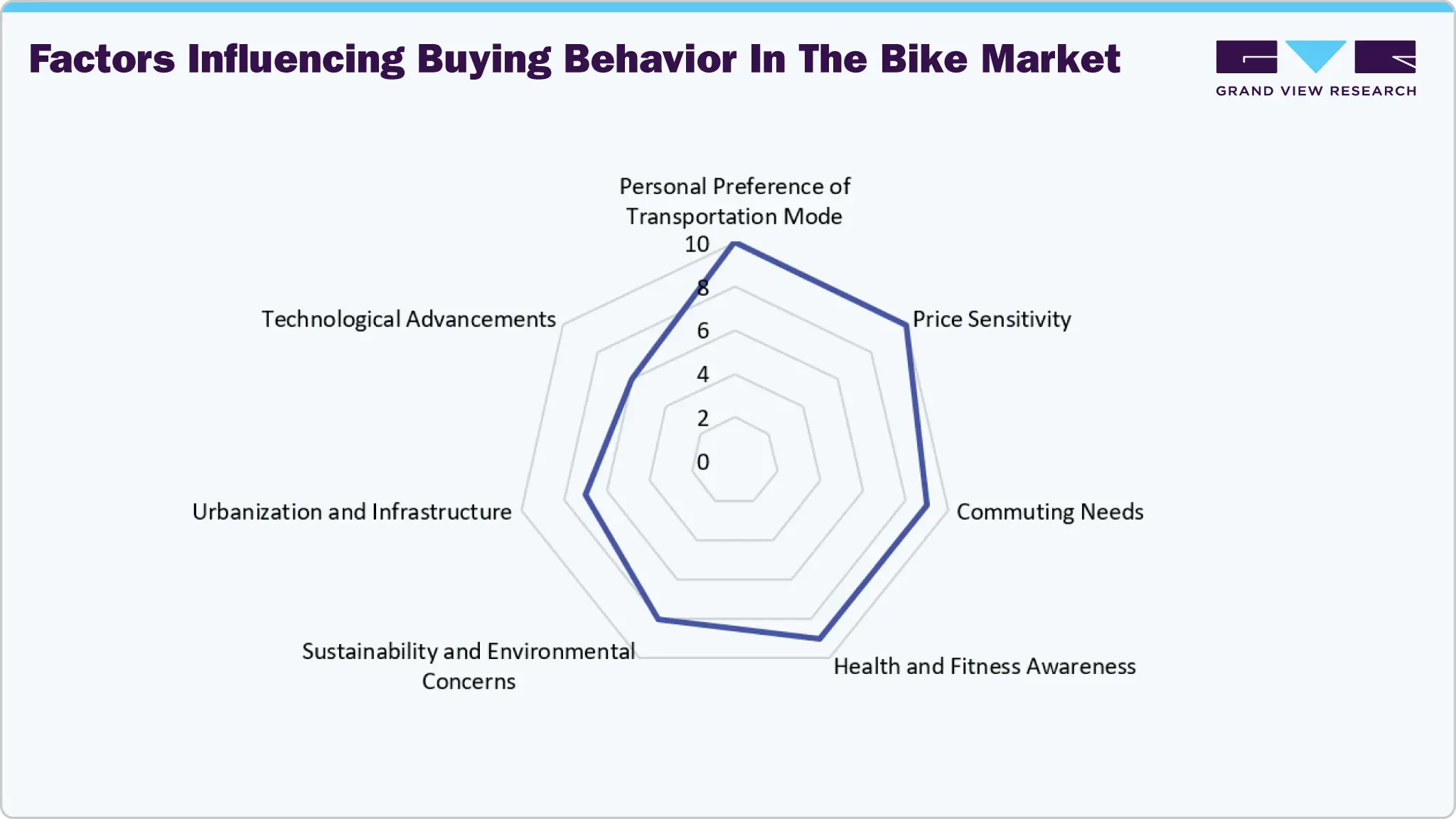
Individual lifestyle choices and mobility preferences shape demand in the bike market. For some consumers, the decision to cycle stems from values around independence, freedom of movement, and convenience, while others prioritize comfort, speed, or social image tied to transport modes like cars. Bikes appeal particularly to those who value flexibility, fitness, and environmentally conscious choices.
 To learn more about this report, Download Free Sample Report
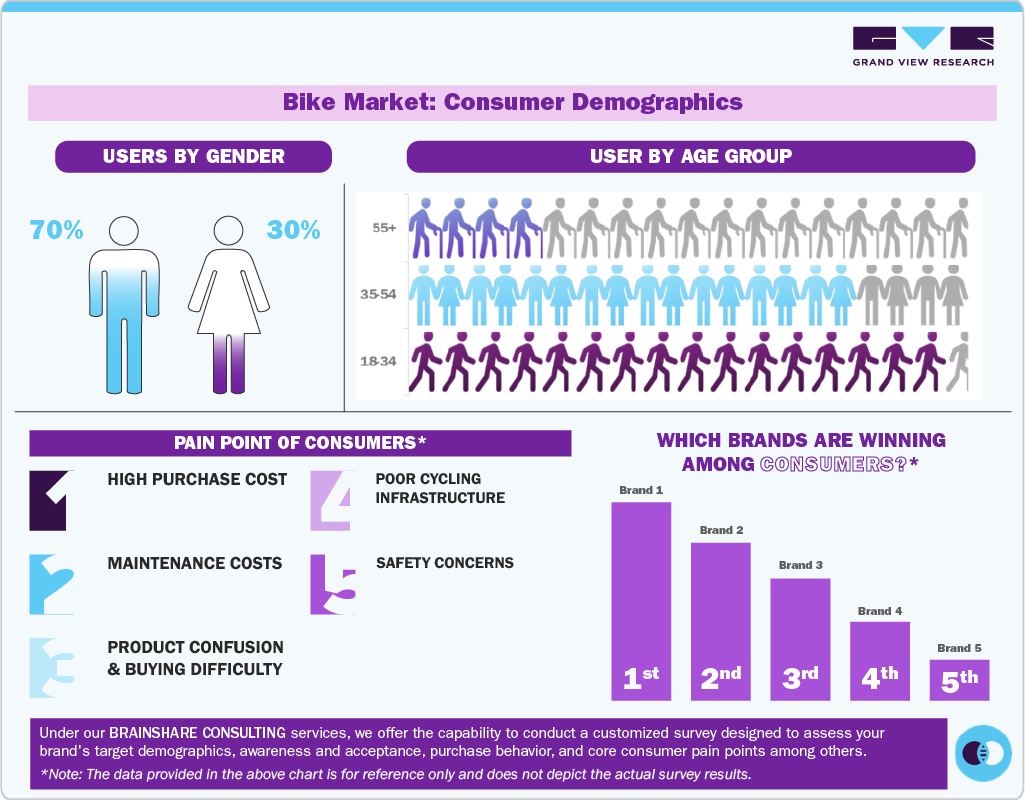
 Price remains one of the most influential factors shaping consumer purchasing decisions in the global bike market. For many consumers, affordability determines whether they opt for traditional bicycles, entry-level e-bikes, or premium performance models. Rising production costs, inflation, and currency fluctuations can also impact consumer willingness to invest. While higher-income groups may view premium bikes as lifestyle or status products, middle- and lower-income consumers often prioritize cost-effectiveness. This dynamic makes pricing strategies critical, as competitive pricing can expand adoption in emerging markets, while premium pricing can reinforce brand positioning in developed economies.
 To learn more about this report, Download Free Sample Report
 Type Insights
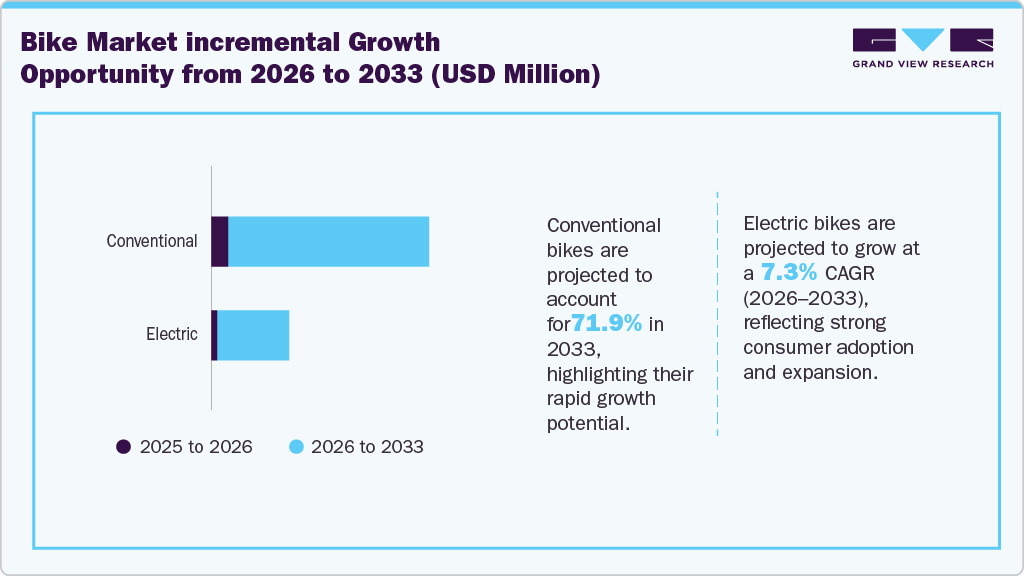
Conventional bikes held the largest revenue share of the bike industry in 2025, accounting for a share of 72.9%, due to their affordability, widespread availability, and strong consumer preference across both developed and developing regions. These bicycles remain the go-to choice for everyday commuting, fitness, and recreational use, especially in countries where cycling is a key mode of transportation. Their simple mechanical structure, ease of repair, and low ownership costs make them especially appealing to cost-conscious and practical users. In addition, rising awareness of health, sustainability, and eco-friendly mobility has further reinforced demand for traditional bicycles.
 To learn more about this report, Download Free Sample Report
 Electric bikes are anticipated to witness a CAGR of 7.3% from 2026 to 2033. With rising urban congestion and growing environmental concerns, electric bicycles offer a sustainable alternative to traditional vehicles, especially for short to medium-distance travel. Technological advancements in battery performance, lightweight materials, and smart features have enhanced their appeal among commuters and recreational riders alike. Government incentives, infrastructure development, and a shift toward low-emission transportation are further accelerating adoption. As a result, electric bicycles are becoming a preferred choice for modern urban mobility across diverse age groups.
Product Insights
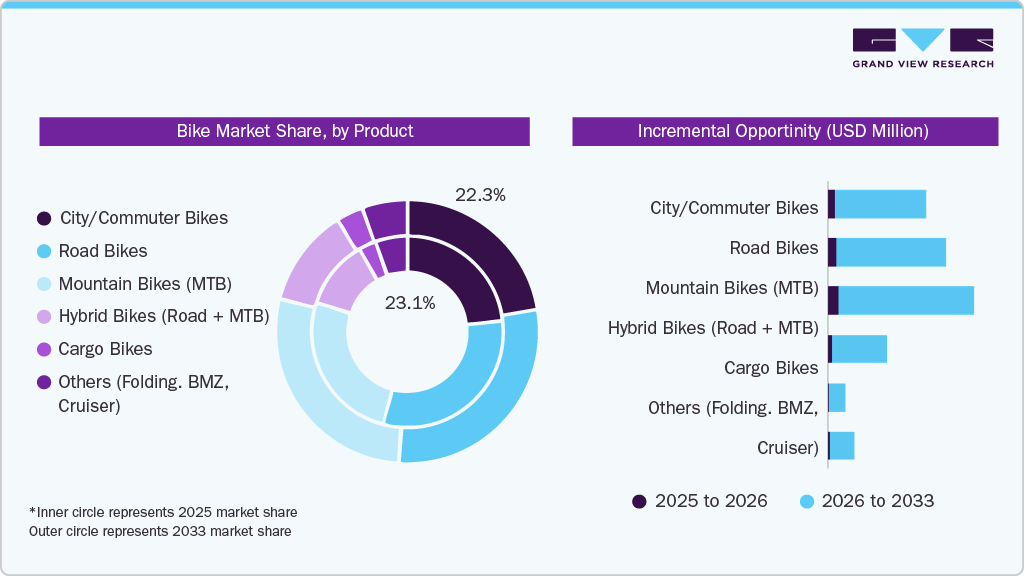
Road bikes held the largest revenue share of the bike industry in 2025, accounting for a share of 31.0%. Lightweight frames, aerodynamic design, and efficiency on paved surfaces make them ideal for high-speed and endurance riding. The price range for road bicycles varies significantly, catering to different consumer segments. Low-range models such as the Schwinn Volare 1400 start around USD 500, mid-range options such as the Specialized Allez or Trek Domane AL 2 fall between USD 1,000 to USD 2,000, while high-end models such as the Cervélo R5 or Pinarello Dogma F can exceed USD 10,000. This wide pricing spectrum enables road bicycles to appeal to both casual riders and professional athletes, contributing to their substantial market share.
 To learn more about this report, Download Free Sample Report
 Cargo bikes are anticipated to witness a CAGR of 8.2% from 2026 to 2033, driven by the rise of sustainable urban logistics solutions. In recent years, U.S. cities such as New York, Portland, and Chicago have encouraged the adoption of eco-friendly delivery modes to reduce congestion and carbon emissions caused by traditional vans and trucks. Cargo bikes offer a cost-efficient, zero-emission alternative for last-mile delivery, which is increasingly valued as e-commerce volumes continue to grow. Companies like UPS and Amazon have piloted cargo bike fleets in dense urban areas, demonstrating their practicality in navigating traffic-congested zones while aligning with corporate sustainability commitments.
End User Insights
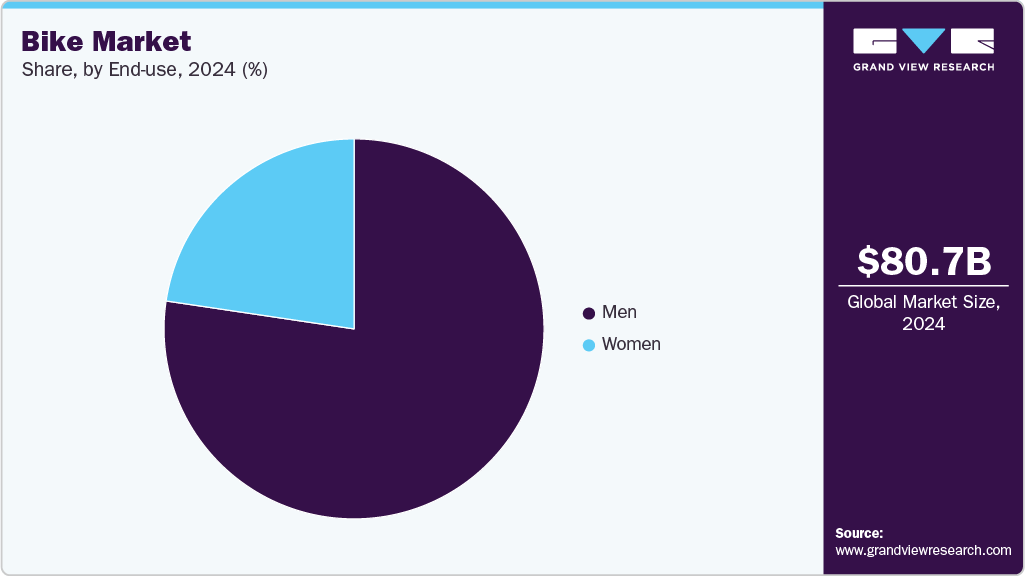
Men held the largest revenue share of the bike industry in 2025, accounting for a share of 77.2%. Traditionally, male consumers have shown a strong inclination toward performance-oriented bicycle categories such as road bikes and mountain bikes, which typically command higher price points and drive greater revenue. In addition, men are more likely to invest in premium models and cycling accessories, further boosting overall sales.
 To learn more about this report, Download Free Sample Report
 Women are anticipated to witness a CAGR of 7.4% from 2026 to 2033, driven by increasing health awareness, rising interest in outdoor activities, and the growing availability of women-specific bicycle designs. As more cities invest in cycling infrastructure and promote safe, inclusive commuting, women are adopting bicycles not only for fitness but also for daily travel and leisure. The industry has responded with ergonomically designed frames, lightweight builds, and enhanced comfort features tailored to female riders, which is encouraging greater participation. In addition, social fitness trends and community riding events have further contributed to the growing appeal of bicycling among women, boosting market growth in this segment.
Application Insights
Personal/individual applications for bikes held the largest revenue share of the bike industry in 2025, accounting for a share of 85.8%. With increasing awareness of health and sustainability, more individuals are turning to cycling as a cost-effective, eco-friendly, and convenient mode of transport. The widespread availability of various bike types, such as road, mountain, hybrid, and city bicycles, caters to diverse riding needs and personal preferences. In addition, the growing influence of social fitness trends, cycling communities, and wellness-focused lifestyles has encouraged more people to incorporate biking into their daily routines.
Commercial applications of bikes are anticipated to witness a CAGR of 6.1% from 2026 to 2033, driven by their expanding role across various industries such as logistics, tourism, public bike-sharing, food delivery, and corporate mobility programs. Businesses are increasingly using bicycles for last-mile delivery in congested urban areas, while electric cargo bikes are gaining traction among courier and postal services for their ability to carry heavy loads efficiently. In the tourism sector, guided city bike tours and rental services are becoming popular, especially in eco-conscious travel destinations. In addition, many organizations are introducing bicycles into their workplace wellness or green commuting initiatives. These diverse and growing applications are making bikes an essential tool in commercial operations, fueling strong market growth.
Regional Insights
The bike market in North America is anticipated to witness a CAGR of 6.6% from 2026 to 2033. Increased investment in cycling lanes, bike-sharing programs, and sustainable urban transport initiatives across major cities has encouraged more people to adopt cycling. In addition, rising health consciousness, the popularity of outdoor activities, and a surge in e-bike adoption have further fueled sales across various segments. The presence of established brands, wide product availability, and strong retail networks also contributed to the region’s substantial market share.
U.S. Bike Market Trends
The bike market in the U.S. is anticipated to witness a CAGR of 6.1% from 2026 to 2033. Urban development projects promoting alternative transportation have led to increased bicycle usage for commuting and leisure. The rise in popularity of electric bicycles, coupled with demand for performance-oriented models like mountain and road bikes, has further boosted sales. Moreover, strong distribution channels, brand presence, and a shift toward eco-conscious travel have made bicycles a preferred choice among a wide demographic, driving the electric bike market within the region.
Europe Bike Market Trends
The bike market in Europe held the revenue share of the bike industry in 2025, accounting for a share of 25.7%, supported by the region's strong cycling culture, government-backed green mobility initiatives, and advanced urban infrastructure. Many European cities have integrated bicycle-friendly policies, including dedicated cycling lanes, subsidies for e-bike purchases, and restrictions on car usage in city centers, all of which have encouraged more people to adopt cycling for daily commutes and leisure. The popularity of both traditional and electric bicycles continues to rise, driven by environmental awareness and a growing preference for sustainable transportation.
The bike market in Germany is anticipated to witness a CAGR of 5.7% from 2026 to 2033. Technological innovation is playing a transformative role in the sports bike market, as manufacturers increasingly integrate advanced engineering, smart connectivity, and performance-enhancing components to enhance the rider experience and improve efficiency. Modern sports bicycles feature lightweight carbon-fiber frames, aerodynamic designs, electronic gear shifting systems, and integrated GPS-enabled performance tracking, allowing riders to monitor speed, endurance, and training metrics in real time. In addition, innovations such as power meters, disc braking systems, and improved suspension technologies are enhancing safety, control, and competitive performance. The growing adoption of smart and high-performance cycling technologies is strengthening premiumization trends and driving sustained growth in the global sports bike market.
The bike market in the UK is anticipated to witness a CAGR of 7.3% from 2026 to 2033. The rapid growth of urban micromobility and bike-sharing services is reshaping transportation patterns across cities, supporting expansion in the bicycle market. Shared bicycles and e-bikes provide affordable, flexible, and environmentally friendly last-mile connectivity, particularly for daily commuters, students, and tourists. Increasing investments in smart mobility infrastructure and app-based rental platforms are further accelerating adoption, making bike-sharing an integral part of modern urban mobility ecosystems.
Rising awareness of rider safety and increased participation in cycling and outdoor recreational activities are significantly driving growth in the bicycle helmet market. Governments and safety organizations across many countries are promoting the use of protective gear through awareness campaigns and safety regulations, encouraging both commuters and sports cyclists to adopt helmets as essential riding equipment. The growing popularity of e-bikes, sports cycling, and urban commuting is further strengthening demand within the global bicycle helmet market.
Asia Pacific Market Trends
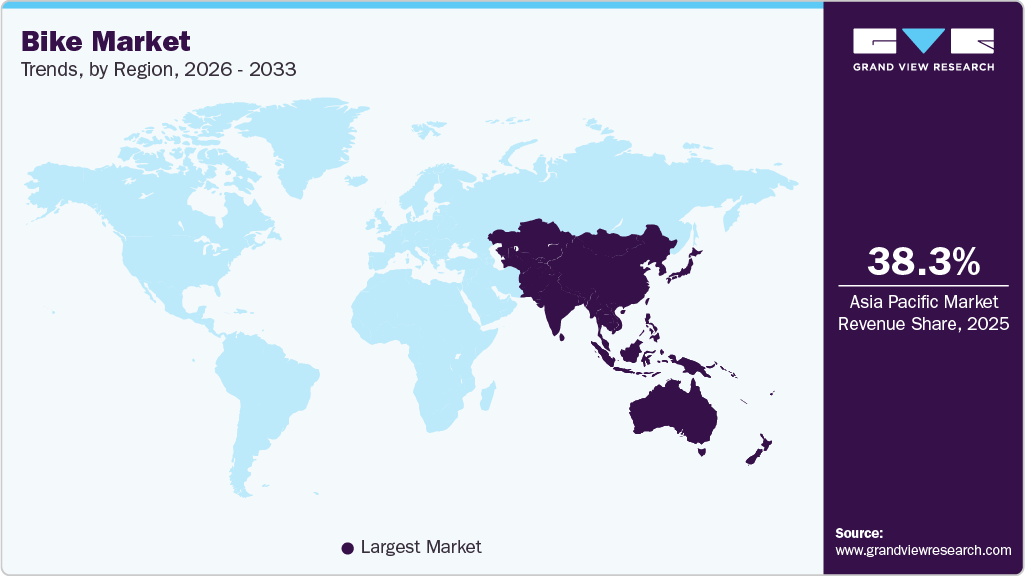
The bike market in Asia Pacific held the largest revenue share of the bike industry in 2025, accounting for a share of 38.3%, driven by rapid urbanization, rising population, and increasing demand for affordable, efficient transportation. Many countries in the region, such as China, India, and Indonesia, are witnessing a surge in bicycle usage for both commuting and recreational purposes due to traffic congestion and rising fuel costs. Government initiatives promoting eco-friendly mobility, along with infrastructure improvements such as dedicated cycling lanes, are further supporting market growth. In addition, the rising popularity of electric bicycles and the expansion of domestic manufacturing capabilities are making bikes more accessible to a broader population, fueling sustained industry expansion across the Asia Pacific.
 To learn more about this report, Download Free Sample Report
 The bike market in China is anticipated to witness a CAGR of 7.1% from 2026 to 2033. Increasing traffic congestion and rising commuting costs encourage consumers to shift toward bicycles and e-bikes for efficient last-mile transportation. Government investments in cycling infrastructure, smart parking systems, and app-based mobility platforms are further integrating bicycles into urban transport networks, strengthening their role in sustainable city mobility.
The bike market in India is anticipated to witness a CAGR of 9.6% from 2026 to 2033. Growing awareness of preventive healthcare, increasing participation in outdoor fitness activities, and the popularity of cycling communities and endurance events are encouraging demand for bicycles across urban and semi-urban areas. This shift toward wellness-focused living is transforming bicycles from basic transportation tools into fitness and recreational products, supporting the sustained expansion of the Indian bike market.
Central & South America Bike Market Trends
The bike market in Central and South America is anticipated to witness a CAGR of 5.0% from 2026 to 2033. Rapid urbanization, traffic congestion, and rising fuel costs are encouraging consumers to adopt bicycles as economical and eco-friendly transportation solutions. Governments and city planners are promoting cycling infrastructure and car-free initiatives, boosting everyday bicycle usage.
Middle East & Africa Bike Market Trends
The bike market in the Middle East and Africa held the revenue share of the bike industry in 2025, accounting for a share of 4.0%. Fitness awareness and outdoor recreation trends are strengthening bicycle adoption, particularly in Gulf countries and emerging African urban centers. International cycling events and investments in sports infrastructure are helping build cycling culture and encouraging participation among younger consumers.
Key Bike Company Insights
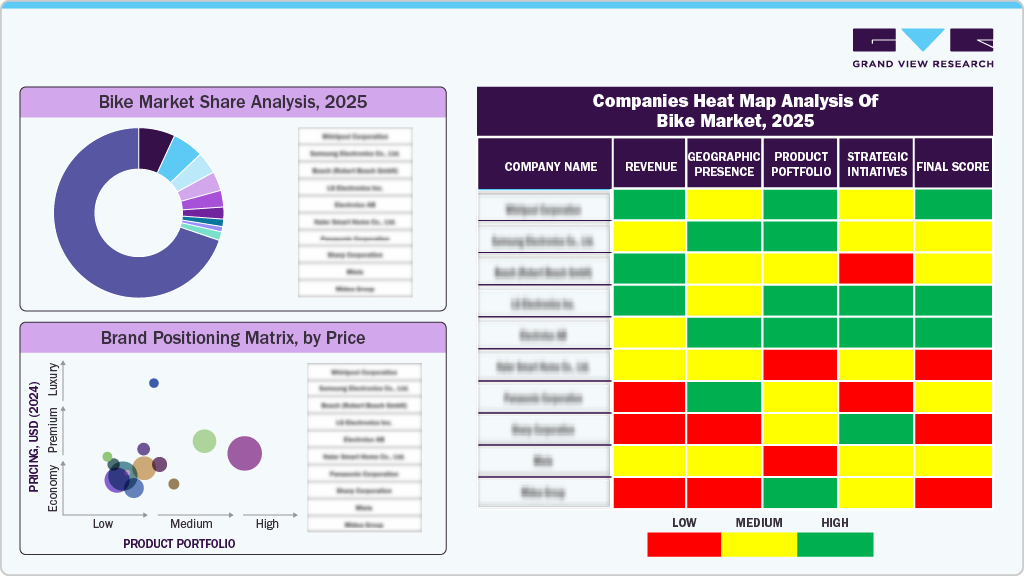
The global bike market features a combination of well-established manufacturers and emerging brands that continue to innovate in design, performance, and sustainability to meet evolving consumer demands. Leading companies prioritize quality, durability, and rider comfort while integrating advanced materials and technology to enhance cycling experience. By partnering with large-scale retailers, sporting goods stores, and mobility service providers, and strengthening their presence on e-commerce platforms, these players ensure wide accessibility and market penetration. Furthermore, strategic collaborations and agile manufacturing capabilities allow key industry participants to develop specialized bicycles, such as electric, folding, or cargo bikes, and effectively cater to niche segments and emerging urban mobility markets across the globe.
 To learn more about this report, Download Free Sample Report
 Key Bike Companies:
The following key companies have been profiled for this study on the bike market.
- Giant Manufacturing Co. Ltd.
- Trek Bicycle Corporation
- Merida Industry Co., Ltd.
- Specialized Bicycle Components
- Accell Group N.V.
- Hero Cycles Ltd.
- Pon Holdings (Pon.Bike)
- Scott Sports SA
- Cube Bikes (Cube GmbH)
- Avon Cycles Ltd.
Recent Developments
-
In September 2025, Samsung ventured into the electric mobility sector with its Samsung Electric Cycle, offering advanced technology and eco-friendly design. The cycle features a brushless DC motor delivering speeds up to 25 km/h and a range of 50-80 km per charge, depending on the model. Weighing between 15-18 kg, it incorporates a lithium-ion battery with a 3-4-hour charging time. While Samsung has not officially launched this product under its brand, it has previously collaborated with companies like Trek Bicycle and Energica Motor Company to enhance cycling experiences.
-
In August 2025, J-Star Holding launched QO Bikes, a premium cycling components brand co-founded with industry veterans Pablo Carrasco and Ignacio Estellés. The brand's initial product line features three carbon fiber crankset models designed for road, gravel, and mountain bikes. These cranksets are engineered to be lightweight and strong, reflecting QO's commitment to innovation in the cycling industry.
-
In August 2025, Sklar Bikes introduced the PBJ (Performance Basket Jammer), a fully rigid steel mountain bike designed for versatility and fun. The PBJ features a modern geometry that blends elements from mountain and gravel bike designs, offering stability on descents and efficiency during long rides. It supports both geared and single-speed setups, with adjustable dropouts allowing for 100-120mm of front suspension or a rigid fork.
-
In August 2025, Spanish performance bike brand BH Bikes re-entered the UK and Irish markets by partnering with cycling sales agency Spoken Vélo. Notable models include the RS1 aero road bike and the Ultralight performance bike, featuring a monocoque frame weighing under 740g. The electric bike lineup includes models powered by Bosch, Shimano, and Brose systems, as well as BH’s proprietary motors developed in collaboration with SEG.
-
In July 2025, DJI entered the U.S. e-bike market through its subsidiary, Amflow, launching two high-performance models: the Amflow PL Carbon and PL Carbon Pro. Both are full-suspension electric mountain bikes featuring DJI’s proprietary Avinox mid-drive motor, delivering 105 Nm of torque and up to 850 watts of peak power in a compact 2.5 kg unit. The bikes boast a lightweight carbon fiber frame, 160 mm front and 150 mm rear suspension, and a mullet wheel setup (29” front, 27.5” rear) for optimal agility and rollover capability.
Bike Market Report Scope
Report Attribute
Details
Market size in 2025
USD 84.6 billion
Estimated market size in 2026
USD 88.9 billion
Projected market size by 2033
USD 140.8 billion
Growth rate
CAGR of 6.8% from 2026 to 2033
Actuals
2021 - 2025
Forecast period
2026 - 2033
Quantitative units
Revenue in USD million/billion and CAGR from 2026 to 2033
Report coverage
Revenue forecast, company ranking, competitive landscape, growth factors, and trends
Segments covered
Type, product, product x price range, end user, application, and region
Regional scope
North America; Europe; Asia Pacific; Central & South America; the Middle East & Africa
Country scope
U.S.; Canada; Mexico; UK; Germany; France; Italy; Spain; China; India; Japan; Australia; South Korea; Brazil; South Africa
Key companies profiled
Giant Manufacturing Co. Ltd.; Trek Bicycle Corporation; Merida Industry Co., Ltd.; Specialized Bicycle Components; Accell Group N.V.; Hero Cycles Ltd.; Pon Holdings (Pon.Bike); Scott Sports SA; Cube Bikes (Cube GmbH); Avon Cycles Ltd.
Customization scope
Free report customization (equivalent up to 8 analysts working days) with purchase. Addition or alteration to country, regional & segment scope
Pricing and purchase options
Avail customized purchase options to meet your exact research needs. Explore purchase options
Global Bike Market Report Segmentation
This report forecasts revenue growth at global, regional & country levels and provides an analysis of the latest trends and opportunities in each of the sub-segments from 2021 to 2033. For this study, Grand View Research has segmented the bike market on the basis of type, product, price range, end use, application, and region:
-
Type Outlook (Volume, Thousand Units; Revenue, USD Billion, 2021 - 2033)
-
Conventional
-
Electric
-
-
Product Outlook (Volume, Thousand Units; Revenue, USD Billion, 2021 - 2033)
-
City/Commuter Bikes
-
Road Bikes
-
Mountain Bikes (MTB)
-
Hybrid Bikes
-
Cargo Bikes
-
Others
-
-
Product x Price Range Outlook (Volume, Thousand Units; Revenue, USD Billion, 2021 - 2033)
-
City/Commuter Bikes
-
Low (USD 200 to 500)
-
Mid-Range (USD 500 to USD 1,000)
-
High End (Above USD 1,000)
-
-
Road Bikes
-
Low (USD 400 to 1,000)
-
Mid-Range (USD 1,000 to USD 2,500)
-
High End (Above USD 2,500)
-
-
Mountain Bikes (MTB)
-
Low (USD 300 to 7,00)
-
Mid-Range (USD 700 to USD 1,800)
-
High End (Above USD 1,800)
-
-
Hybrid Bikes (Road & MTB)
-
Low (USD 300 to 700)
-
Mid-Range (USD 700 to USD 1,500)
-
High End (Above USD 1,500)
-
-
Cargo Bikes
-
Low (USD 500 to 2,500)
-
Mid-Range (USD 2,500 to USD 4,500)
-
High End (Above USD 4,500)
-
-
Others
-
Low (USD 200 to 800)
-
Mid-Range (USD 800 to USD 1,200)
-
High End (Above USD 1,200)
-
-
-
End-use Outlook (Volume, Thousand Units; Revenue, USD Billion, 2021 - 2033)
-
Men
-
Women
-
-
Application Outlook (Volume, Thousand Units; Revenue, USD Billion, 2021 - 2033)
-
Personal/Individual
-
Commercial
-
-
Regional Outlook (Volume, Thousand Units; Revenue, USD Billion, 2021 - 2033)
-
North America
-
U.S.
-
Canada
-
Mexico
-
-
Europe
-
UK
-
Germany
-
France
-
Italy
-
Spain
-
-
Asia Pacific
-
China
-
India
-
Japan
-
Australia
-
South Korea
-
-
Central & South America
-
Brazil
-
-
Middle East & Africa (MEA)
-
South Africa
-
-
Delivered Customizations
This report has been delivered with the following In-depth customizations
Client Request
Customization Delivered
Value Adds
Product by Price Range Cross-Segmentation Analysis
A tailored product-by-price-range cross-segmentation was structured for the bike market, aligning client-defined price bands with key product categories (conventional and electric) and regional pricing dynamics, while integrating brand positioning, feature differentiation, and consumer usage patterns within each price tier for precise, comparable benchmarking.
This enables the client to identify and prioritize high-growth and premium segments for targeted investments, optimize pricing strategies by understanding price-volume trade-offs, uncover white space opportunities for new product launches, refine product portfolio positioning against competitors, and align channel strategies by focusing on the most profitable price segments across online and offline platforms.
Case Study Analysis for Major Manufacturers
Developed a tailored case study framework for major bike manufacturers, analyzing their product portfolio across price segments, pricing strategies, innovation focus (e.g., e-bikes, materials), and channel approaches, aligned to client-specific scope and benchmarking requirements.
This enables the client to benchmark competitor strategies, identify best practices in pricing and product positioning, uncover gaps and white-space opportunities in their own portfolio, and refine market-entry, expansion, and competitive-positioning strategies with actionable insights.
Country-Wise Opportunity Assessment
Developed a country-wise opportunity assessment framework, mapping bike market potential across key geographies by integrating demand size, growth rates, pricing dynamics, consumer preferences, and regulatory environment, tailored to client-priority markets and strategic focus segments.
This enables the client to prioritize high-potential countries for expansion, optimize market entry strategies based on local demand and pricing structures, identify country-specific growth drivers and risks, and allocate resources effectively to maximize returns across target markets.
Frequently Asked Questions About This Report
The global bike market size was valued at USD 84.6 billion in 2025 and is estimated at USD 88.9 billion for 2026.
Asia Pacific dominated with a 38.3% revenue share in 2025.
The conventional bikes segment led with a 72.9% revenue share in 2025.
Men segment held the largest share (over 77.0%) in 2025.
Personal/individual led the market and accounted for a share of 85.8% in 2025
Key players include Giant Manufacturing Co. Ltd.; Trek Bicycle Corporation; Merida Industry Co., Ltd.; Specialized Bicycle Components; Accell Group N.V.; Hero Cycles Ltd.; Pon Holdings (Pon.Bike); Scott Sports SA; Cube Bikes (Cube GmbH); Avon Cycles Ltd.
Key factors driving the bike market growth include a sustained transition toward electrified and higher-value product segments. It is being positioned as a strategic component of urban mobility, last-mile logistics, and leisure demand.
The global bike market is expected to grow at a CAGR of 6.8% from 2026 to 2033, reaching USD 140.8 billion.
Road bikes held the largest revenue share of 31.0% in 2025. Lightweight frame, aerodynamic design, and efficiency on paved surfaces make them ideal for high-speed and endurance riding.
About the Author(s)
Homecare & Decor Research Team
Consumer Goods · Homecare & DecorThis report was authored by the homecare & decor research team at Grand View Research - comprising two research analysts, one senior research analyst, and one industry expert - with specialized expertise in the homecare & decor segment of the consumer goods industry. All findings are based on proprietary consumer goods databases, executive interviews, and regulatory analysis, subject to internal peer review prior to publication.
Last Updated:
Speak to Analyst

Customize this report to your needs - add regions, segments, or data points, with 20% free customization.
Or view our licence options:


ISO 9001:2015 & 27001:2022 Certified
We are GDPR and CCPA compliant! Your transaction & personal information is safe and secure. For more details, please read our privacy policy.


