
- Home
- »
- Plastics, Polymers & Resins
- »
-
Bio-based Polyvinyl Chloride Market Size Report, 2023-2030GVR Report cover

Bio-based Polyvinyl Chloride Market (2023 - 2030)
Size, Share & Trends Analysis Report By Product (Rigid, Flexible), By Application (Films & Sheets, Wires & Cables, Pipes & Fittings), By Region, And Segment Forecasts
Market Size, 2022
$640.8MMarket Estimate, 2026
$1,208.5MMarket Forecast, 2030
$2,544.7MCAGR, 2023–2030
19.3%Report Overview
The global bio-based polyvinyl chloride market size was valued at USD 640.8 million in 2022 and is projected to grow from USD 1,208.5 million in 2026 to USD 2,544.7 million by 2030, at a CAGR of 19.3% from 2023 to 2030. Asia Pacific dominated the market, accounting for a revenue share of 43.0% in 2022. The increasing demand for sustainable and eco-friendly materials in various industries has emerged as a significant driving factor for bio-based polyvinyl chloride (PVC). Traditional PVC, which relies on petroleum-based feedstocks, has faced criticism due to its environmental impact, including the release of toxic chlorine gas during production and slow decomposition in landfills. Bio-based PVC, on the other hand, is manufactured using renewable resources, such as biomass-derived ethanol or plant-based plasticizers. This not only reduces the carbon footprint but also helps in mitigating the dependency on fossil fuels.
 Source: Grand View Research, IR Documents, Primary Interviews, Paid DatabasesTo learn more about this report,
 Download Free Sample Report
  To learn more about this report, Download Free Sample Report
 As governments and consumers worldwide become more conscious of environmental concerns, the adoption of bio-based PVC has gained traction, fostering innovation and investment in the development of greener alternatives. Furthermore, regulatory initiatives and policies aimed at promoting sustainable materials and reducing greenhouse gas emissions have bolstered the growth in demand for bio-based PVC. Many countries have introduced incentives, tax benefits, and stricter regulations on conventional plastics, pushing industries to explore and adopt bio-based alternatives.
The shift towards bio-based PVC aligns with global efforts to combat climate change and reduce plastic pollution, making it a compelling choice for industries seeking sustainable solutions while meeting stringent environmental standards. In this context, bio-based PVC has not only emerged as a sustainable material but also as a key driver for a more eco-conscious and responsible approach in various manufacturing sectors.
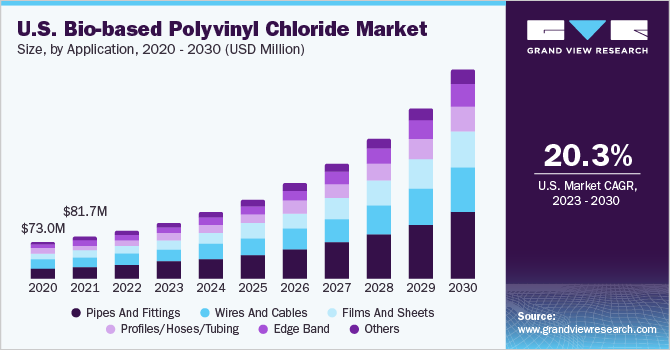
The bio-based polyvinyl chloride market in the United States has experienced remarkable growth in recent years, primarily driven by increasing environmental consciousness and the need for sustainable alternatives to traditional PVC. Consumers and industries alike are becoming more inclined to adopt bio-based PVC due to its reduced carbon footprint and reliance on renewable resources. This trend aligns with the U.S. government's focus on sustainability and the promotion of green technologies.
As a result, the bio-based PVC market has seen investments and research initiatives aimed at developing innovative production processes and expanding its applications in various sectors, such as construction, automotive, and packaging. Government regulations and initiatives have played a pivotal role in shaping the bio-based PVC market in the U.S. Environmental policies aimed at reducing plastic waste and supporting the transition to bio-based materials have encouraged businesses to explore and invest in bio-based PVC production.
In addition to its sustainability benefits, bio-based PVC aligns with circular economy principles, making it an attractive option for businesses looking to meet evolving environmental standards. With growing consumer demand for eco-friendly products and favorable regulatory support, the bio-based PVC market in the United States is expected to continue its expansion and contribute to a more sustainable and environmentally conscious industrial landscape.
Application Insights
The pipes & fittings segment was the dominating application area in the global bio-based polyvinyl chloride market and accounted for over 31.0% share of the overall revenue in 2022. Bio-based PVC's durability, chemical resistance, and low maintenance properties make it ideal for constructing pipes and fittings. These qualities ensure that the pipes can endure the rigors of transporting various fluids, including water and chemicals while maintaining structural integrity over an extended period. This durability reduces replacement and maintenance costs, making bio-based PVC pipes and fittings a cost-effective choice for infrastructure projects.
Additionally, the increasing emphasis on sustainability in the construction and water management sectors has driven the adoption of bio-based PVC in pipes and fittings. As industries strive to reduce their carbon footprint and dependence on non-renewable resources, bio-based PVC provides a greener alternative to conventional PVC. Its production from renewable resources aligns with environmental goals, making it an attractive choice for both governments and businesses looking to meet eco-friendly regulations and consumer preferences. With the ongoing focus on sustainable infrastructure development and water management solutions, pipes and fittings made from bio-based PVC are poised to maintain their dominant position in the global market.
Product Insights
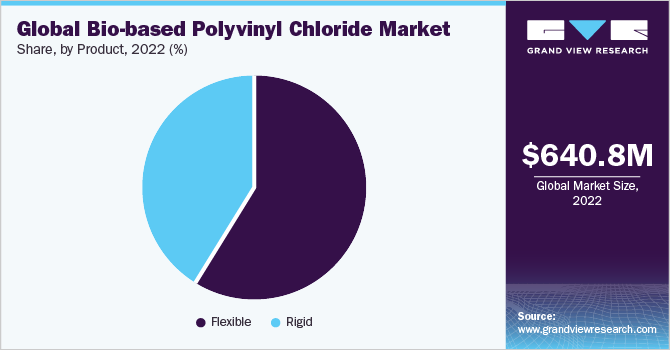
Rigid PVC is a substantial contributor to the global bio-based polyvinyl chloride (PVC) market and accounted for over 41.0% share of the overall revenue in 2022. Rigid PVC offers exceptional durability and strength, making it a preferred choice for a wide range of applications, including construction, automotive components, and pipes. Its ability to withstand harsh environmental conditions and resist corrosion makes it invaluable in these sectors, driving significant demand. Moreover, the increased emphasis on sustainability and eco-friendliness has boosted the adoption of bio-based rigid PVC.
 To learn more about this report, Download Free Sample Report
 As a bio-based alternative to conventional rigid PVC, it aligns with the growing environmental consciousness among consumers and industries. By utilizing renewable resources and reducing reliance on fossil fuels, bio-based rigid PVC addresses concerns about the environmental impact associated with traditional PVC production, making it an attractive choice for companies aiming to meet sustainability goals and comply with stringent regulations. These factors combined have contributed to the strong position of rigid PVC in the global bio-based PVC market, with its versatility and eco-friendly attributes playing a pivotal role in its market share growth.
Regional Insights
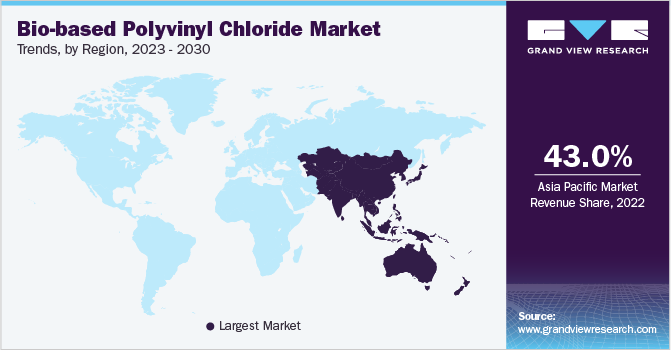
Asia Pacific was the dominating region in the global market for bio-based PVC and accounted for more than 43.0% share of the overall revenue in 2022. Asia Pacific's robust industrial and construction sectors have generated significant demand for PVC products, including bio-based PVC, as it offers durability and versatility. The rapid urbanization and infrastructure development in countries like China and India have driven the use of PVC in applications ranging from pipes and fittings to automotive components and consumer goods. This sustained growth in industrial and construction activities has propelled the Asia Pacific region to the forefront of the bio-based PVC market.
 To learn more about this report, Download Free Sample Report
 Asia Pacific has been a hub for the production of bio-based PVC due to its abundant availability of raw materials, including biomass feedstocks and agricultural resources. This has facilitated the cost-effective manufacturing of bio-based PVC in the region, making it a preferred choice for both domestic consumption and export markets. The region's commitment to sustainability and environmental initiatives has encouraged the adoption of bio-based PVC as a greener alternative to conventional PVC, further boosting its market share. As sustainability continues to be a priority in the Asia Pacific, the demand for bio-based PVC in applications is expected to expand in the coming years.
Key Companies & Market Share Insights
The global market has been characterized by the presence of key players along with a few medium- and small-sized regional players. Major players are continuously working on developing polymers for the production of bio-based polyvinyl chloride (PVC), owing to the rising demand for bio-based polyvinyl chloride (PVC) components from end-use industries.
The global market for bio-based PVC is highly competitive due to the presence of major industries worldwide, with companies being comparatively concentrated and fiercely competitive, utilizing strategies such as product launches, acquisitions, mergers, and collaborations. For instance, in February 2021, Vinnolit, a subsidiary of Westlake Chemical Corporation, launched a bio-attributed polyvinyl chloride (PVC) with the brand name GreenVin, a lower-carbon alternative PVC that is widely utilized across the medical, automotive, and construction industries. Some prominent players in the global bio-based polyvinyl chloride (PVC) market include:
-
VinyLoop
-
INEOS Group
-
Braskem
-
Kaneka Corporation
-
BIO-TEC ENVIRONMENTAL
-
Westlake Vinnolit GmbH & Co. KG
-
Vynova Group
-
Solvay Indupa
-
Dow Mitsui & Co. Ltd.
Bio-based Polyvinyl Chloride Market Report Scope
Report Attribute
Details
Market size in 2022
USD 640.8 million
Estimated market size in 2026
USD 1,208.5 million
Projected market size by 2030
USD 2,544.7 million
Growth rate
CAGR of 19.3% from 2023 to 2030
Base year for estimation
2022
Historical data
2018 - 2021
Forecast period
2023 - 2030
Quantitative units
Volume in kilotons, revenue in USD million, and CAGR from 2023 to 2030
Report coverage
Revenue forecast, company ranking, competitive landscape, growth factors, and trends
Segments covered
Product, application, region
Regional scope
North America; Europe; Asia Pacific; Central & South America; MEA
Country scope
U.S.; Canada; Mexico; Germany; UK; France; Italy; Spain; The Netherlands; China; India; Japan; South Korea; Australia; Thailand; Malaysia; Indonesia; Vietnam; Brazil; Argentina; Saudi Arabia; UAE; South Africa
Key companies profiled
VinyLoop; INEOS Group; Braskem; Kaneka Corporation; BIO-TEC ENVIRONMENTAL; Westlake Vinnolit GmbH & Co. KG; Vynova Group; Solvay Indupa; Dow Mitsui & Co. Ltd.
Customization scope
Free report customization (equivalent up to 8 analyst’s working days) with purchase. Addition or alteration to country, regional & segment scope.
Pricing and purchase options
Avail customized purchase options to meet your exact research needs. Explore purchase options
Global Bio-based Polyvinyl Chloride Market Report Segmentation
This report forecasts revenue and volume growth at the global, regional & country levels and provides an analysis of the latest industry trends in each of the sub-segments from 2018 to 2030. For the purpose of this study, Grand View Research has segmented the global bio-based polyvinyl chloride market report on the basis of product, application, and region:
 To learn more about this report, Download Free Sample Report
 -
Product Outlook (Volume, Kilotons; Revenue, USD Million, 2018 - 2030)
-
Rigid
-
Flexible
-
-
Application Outlook (Volume, Kilotons; Revenue, USD Million, 2018 - 2030)
-
Films and Sheets
-
Wires and Cables
-
Pipes and Fittings
-
Profiles/Hoses/Tubing
-
Edge Band
-
Others
-
-
Regional Outlook (Volume, Kilotons; Revenue, USD Million, 2018 - 2030)
-
North America
-
U.S.
-
Canada
-
Mexico
-
-
Europe
-
Germany
-
UK
-
France
-
Italy
-
Spain
-
The Netherlands
-
-
Asia Pacific
-
China
-
India
-
Japan
-
South Korea
-
Australia
-
Thailand
-
Malaysia
-
Indonesia
-
Vietnam
-
-
Central & South America
-
Brazil
-
Argentina
-
-
Middle East & Africa
-
Saudi Arabia
-
UAE
-
South Africa
-
-
About the Author(s)
Plastics, Polymers & Resins Research Team
Bulk Chemicals · Plastics, Polymers & ResinsThis report was authored by the plastics, polymers & resins research team at Grand View Research - comprising two research analysts, one senior research analyst, and one industry expert - with specialized expertise in the plastics, polymers & resins segment of the bulk chemicals industry. All findings are based on proprietary bulk chemicals databases, executive interviews, and regulatory analysis, subject to internal peer review prior to publication.
Last Updated:
Speak to Analyst -

Customize this report to your needs - add regions, segments, or data points, with 20% free customization.
Or view our licence options:


ISO 9001:2015 & 27001:2022 Certified
We are GDPR and CCPA compliant! Your transaction & personal information is safe and secure. For more details, please read our privacy policy.


