
- Home
- »
- Advanced Interior Materials
- »
-
Bio-based Textiles Market Size & Share Report, 2026-2033GVR Report cover

Bio-based Textiles Market (2026 - 2033)
Size, Share & Trends Analysis Report By Source Material (Plant-Based, Animal-Based, Microbial/Bioengineered), By Application (Apparel, Home Textiles, Industrial Textiles), By Region, And Segment Forecasts
Market Size, 2025
$54.1BMarket Estimate, 2026
$58.7BMarket Forecast, 2033
$100.4BCAGR, 2026–2033
8.0%Bio-based Textiles Market Summary
The global bio-based textiles market size was valued at USD 54.1 billion in 2025 and is projected to grow from USD 58.7 billion in 2026 to USD 100.4 billion by 2033, at a CAGR of 8.0% from 2026 to 2033. The market in Asia Pacific dominated with a revenue share of 43.9% in 2025. Consumers increasingly seek sustainable alternatives as awareness of the fashion industry's environmental impact increases.
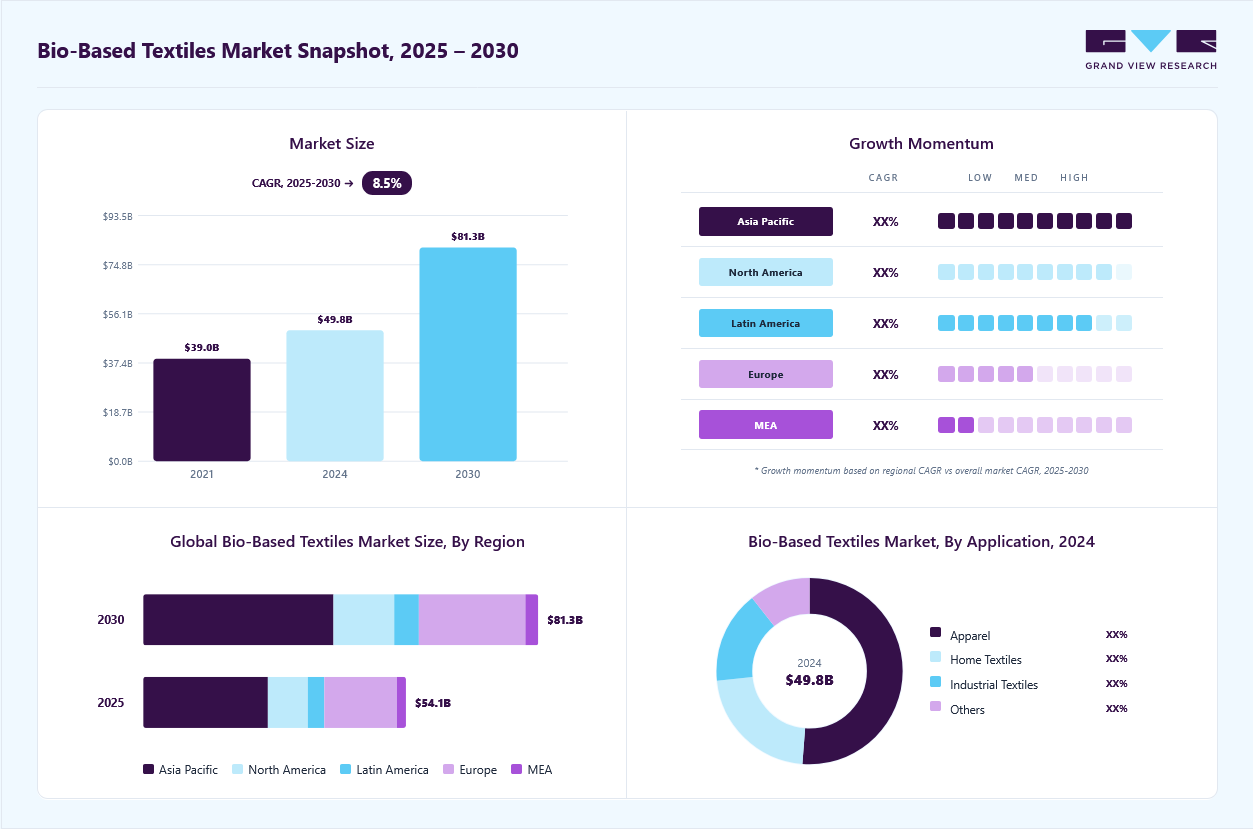 Source: Grand View Research, IR Documents, Primary Interviews, Paid DatabasesTo learn more about this report,
 Download Free Sample Report
 Key Market Trends & Insights
- By source material: Plant-based segment held the largest market share of 63.9% in 2025.
- By application: Apparel segment held the largest market share of 51.0% in 2025.
Regional Highlights
- Largest regional market: Asia Pacific (43.9% revenue share, 2025)
- By country: China held the largest market share in 2025
Market Size & Forecast
- Market size in 2025: USD 54.1 Billion
- Estimated market size in 2026: USD 58.7 Billion
- Projected market size by 2033: USD 100.4 Billion
- CAGR (2026-2033): 8.0%
Three ways to get this report
Buy it, customize it, or ask a question.Ask an Analyst
Analyst response in 1 business day
- AccessReport author, directly
- Reply timeWithin 1 working day
- No sales callDirect answer only
- FormatEmail reply
- CostFree, no cost
Get the Full Report
What the study covers
- FormatsPDF · Excel · Dashboard
- Timeline2026–2033 annual, 2025 base
- Coverage20+ countries, 5 regions
- Companies10+ key players profiled
Customize the Report
20% free customization
- IncludeCountries, segments, points
- TailorTo your product definition
- ExtendDeeper competitor detail
- OrA fully bespoke study
- Turnaround5–10 working days
Bio-based textiles, derived from renewable resources like plants, fungi, and agricultural byproducts, offer a promising solution. These materials reduce reliance on fossil fuels and contribute to lower carbon emissions and water usage compared to conventional textiles. Several key drivers are propelling the demand for bio-based textiles. Regulatory pressures, such as the European Union's Circular Economy Action Plan, are encouraging brands to adopt sustainable practices, including the use of biodegradable materials and closed-loop systems. In addition, advancements in biotechnology have led to the development of innovative materials like mycelium-based fabrics and microbial cellulose, which are biodegradable and can be produced with minimal environmental impact. Consumer preference for transparency and ethical production further accelerates the shift towards bio-based textiles. To learn more about this report, Download Free Sample Report
 Innovation plays a crucial role in the evolution of bio-based textiles. Companies are integrating smart technologies into fabrics, enabling features like real-time health monitoring and adaptive responses to environmental conditions. Moreover, advancements in material processing techniques, such as nanofiber production and bio-based coatings, are enhancing the performance and durability of bio-based textiles. The convergence of sustainability, technology, and consumer demand positions bio-based textiles at the forefront of the fashion industry's transformation towards a more sustainable future.
Market Dynamics
The bio-based textiles market is witnessing robust growth driven by increasing sustainability concerns, stringent environmental regulations, rising consumer preference for eco-friendly products, and growing adoption of renewable raw materials across the textile value chain. The market is benefiting from investments in circular economy initiatives, advancements in bio-based fiber technologies, and commitments by global apparel brands to reduce carbon emissions and dependence on petroleum-derived fibers. Additionally, government support for sustainable manufacturing and increasing awareness regarding textile waste reduction are accelerating the commercialization of bio-based textile solutions across apparel, home furnishing, industrial, and technical textile applications.
The increasing environmental footprint of conventional synthetic fibers has become a major concern for governments, manufacturers, and consumers worldwide. Traditional textile materials such as polyester and nylon rely heavily on fossil fuel-based feedstocks and contribute significantly to greenhouse gas emissions, microplastic pollution, and landfill waste. As sustainability becomes a key purchasing criterion, consumers are increasingly favoring apparel and textile products manufactured using renewable, biodegradable, and low-carbon materials. This shift in consumer behavior is encouraging textile manufacturers and fashion brands to integrate bio-based fibers into their product portfolios.
Furthermore, leading apparel companies are implementing ambitious sustainability targets focused on reducing carbon emissions and improving supply chain transparency. Growing adoption of circular economy principles, sustainable sourcing programs, and eco-label certifications is creating favorable conditions for bio-based textile manufacturers. The expansion of sustainable fashion trends, coupled with increasing investments in renewable fiber development, continues to strengthen market demand across both developed and emerging economies.
Despite significant environmental advantages, bio-based textiles continue to face challenges associated with higher production costs compared to conventional synthetic fibers. The use of specialized feedstocks, advanced processing technologies, and limited production capacities increases manufacturing expenses, making bio-based materials less competitive in price-sensitive textile applications. In addition, supply chain limitations, inconsistent feedstock availability, and the need for substantial capital investment in production facilities restrict large-scale commercialization. These factors continue to hinder widespread adoption, particularly in mass-market textile segments where cost remains a critical purchasing factor.
Emerging innovations in biotechnology, microbial fermentation, algae-based materials, and cellulose engineering are creating substantial growth opportunities for the bio-based textiles market. Advanced bioengineered fibers offer enhanced performance characteristics such as durability, moisture management, biodegradability, and improved recyclability, enabling their use across a wider range of textile applications. Simultaneously, growing investments in textile recycling technologies, closed-loop manufacturing systems, and circular economy initiatives are supporting the development of sustainable textile ecosystems. As technology matures and production efficiencies improve, bio-based textiles are expected to achieve broader commercial acceptance and unlock significant long-term growth opportunities for industry participants.
Market Concentration & Characteristics
The bio-based textiles industry is moderately concentrated, with several key players dominating the landscape alongside numerous emerging startups. Leading companies are investing heavily in research and development to innovate sustainable fibers and scalable production processes. However, the market also sees significant participation from smaller, niche brands specializing in unique bio-based materials such as mushroom leather, algae-based fabrics, and plant-derived fibers. This combination of established players and agile innovators fosters competitive dynamics, encouraging continuous improvement in product quality, sustainability credentials, and cost-efficiency.
 To learn more about this report, Download Free Sample Report
 Despite the growing popularity of bio-based textiles, product substitutes remain a significant factor influencing market dynamics. Conventional synthetic fibers like polyester and nylon, derived from petroleum, continue to dominate due to their low cost and established manufacturing infrastructure. In addition, traditional natural fibers such as cotton and wool serve as alternatives but face sustainability concerns related to water usage and land impact. Emerging alternatives like recycled textiles and blended fabrics combining bio-based and synthetic fibers also compete by balancing performance with environmental benefits. This diversity of substitutes pushes bio-based textile producers to innovate and differentiate their products by emphasizing biodegradability, reduced carbon footprint, and unique material properties.
Analyst Perspective
The bio-based textiles market is evolving from a niche sustainable textile segment into a technology-driven market centered on carbon footprint reduction, renewable feedstock utilization, circular fashion integration, biodegradable fiber innovation, and next-generation sustainable textile solutions. The strongest growth opportunities are emerging from apparel, home textiles, industrial textiles, technical textiles, and performance wear applications where brands and manufacturers are increasingly seeking low-impact alternatives to conventional petroleum-based fibers. Rising environmental regulations, sustainable sourcing requirements, corporate ESG commitments, and growing consumer demand for eco-friendly clothing and textile products are accelerating the adoption of bio-based fibers across global textile value chains.
Source Material Insights
Based on source material, the plant-based segment led the market with the largest revenue share of 63.9% in 2025 and is expected to grow at a CAGR of 7.9% over the forecast period. Fibers such as cotton, linen (from flax), hemp, and bamboo are widely recognized for their sustainability benefits, including biodegradability and lower environmental impact compared to synthetic alternatives. These plant-based textiles are favored by many fashion and home textile brands for their natural feel, breathability, and versatility, making them a staple in the sustainable fabric landscape. In addition, advances in agricultural practices and processing technologies have improved the quality and availability of plant-based fibers, further cementing their dominant market position.
The microbial/bioengineered textiles segment is expected to grow at the fastest CAGR during the forecast period, due to their ability to address sustainability challenges in the fashion and textile industry. These textiles are produced using microorganisms such as bacteria, yeast, and algae, which can biosynthesize fibers like bacterial cellulose or bioengineered proteins (e.g., spider silk) under controlled conditions. The process significantly reduces water, land, and chemical use compared to conventional natural fibers like cotton. In addition, microbial textiles are biodegradable and can be designed to have specific properties such as strength, flexibility, or moisture-wicking, making them highly versatile for various applications. As consumers and brands increasingly seek eco-friendly and ethically sourced alternatives, bioengineered textiles stand out as a scalable, innovative solution that aligns with circular economy goals, driving their position as the fastest-growing segment in the bio-based textile industry.
Application Insights
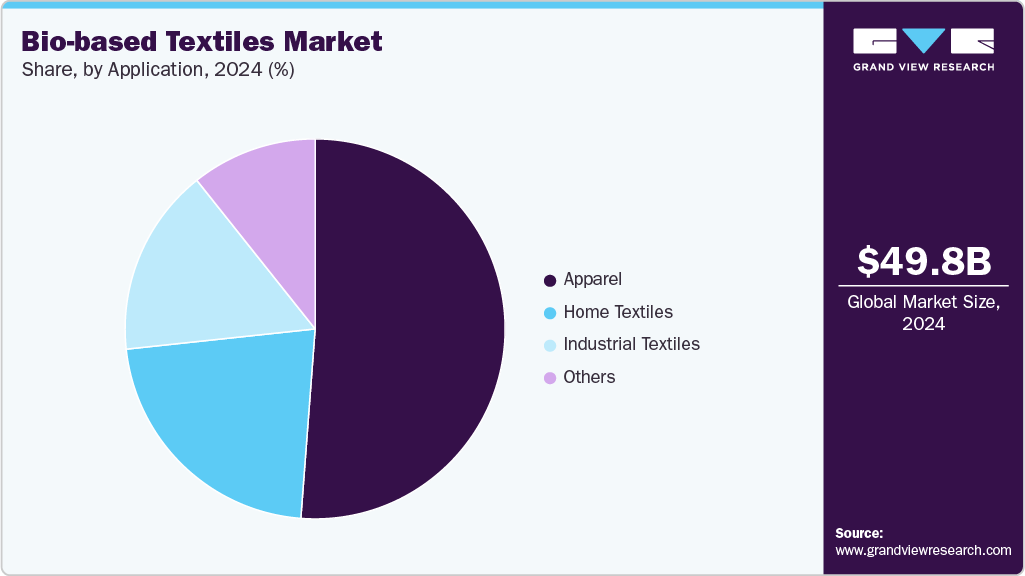
Based on application, the apparel segment led the market with the largest revenue share of 51.0% in 2025 and is expected to grow at a CAGR of 7.6% over the forecast period, due to rising consumer awareness of sustainable fashion and increasing demand for eco-friendly clothing. Major fashion brands incorporate bio-based materials such as organic cotton, hemp, and bamboo into their collections to align with environmental and ethical standards. Consumers, particularly in urban and developed markets, are increasingly prioritizing sustainability in their wardrobe choices, pushing both high-end and mass-market apparel brands to adopt plant- and animal-based bio-textiles. The segment also benefits from a well-established global supply chain and marketing strategies that highlight the environmental benefits of bio-based clothing.
 To learn more about this report, Download Free Sample Report
 The home textiles segment is anticipated to grow at a significant CAGR during the forecast period. Demand for sustainable home products such as bed linens, curtains, upholstery, and towels is rising rapidly as consumers seek eco-conscious alternatives for their living spaces. Interior designers and furniture manufacturers are also adopting bio-based fabrics to meet green building certifications and customer preferences for non-toxic, biodegradable materials. In addition, as awareness of indoor environmental quality and health grows, home buyers are opting for textiles made from renewable sources that reduce allergens and chemical exposure. This trend is being supported by increasing product innovation, affordability, and expanding retail availability in the home décor sector.
Regional Insights
The bio-based textiles market in North America is a key market for bio-based textiles, characterized by high consumer awareness, supportive regulations, and a strong culture of sustainability. The region has seen significant adoption of eco-friendly fabrics across fashion, sportswear, and home furnishings. Leading brands are actively investing in bio-based innovations and sustainable sourcing practices. In addition, government incentives and environmental regulations, particularly in the U.S. and Canada, are encouraging the shift towards biodegradable and renewable textiles.
U.S. Bio-based Textiles Market Trends
The bio-based textiles market in the U.S. accounted for the largest market revenue share in North America in 2025, driven by a mature fashion industry and high consumer demand for sustainable products. U.S.-based brands are at the forefront of incorporating bio-based materials into their collections, and consumer preference for ethical and transparent supply chains continues to grow. There’s also a rise in local startups focused on developing novel bio-fibers and eco-friendly alternatives to traditional textiles. Research institutions and funding initiatives are further accelerating innovation in the sector.
Asia Pacific Bio-based Textiles Market Trends
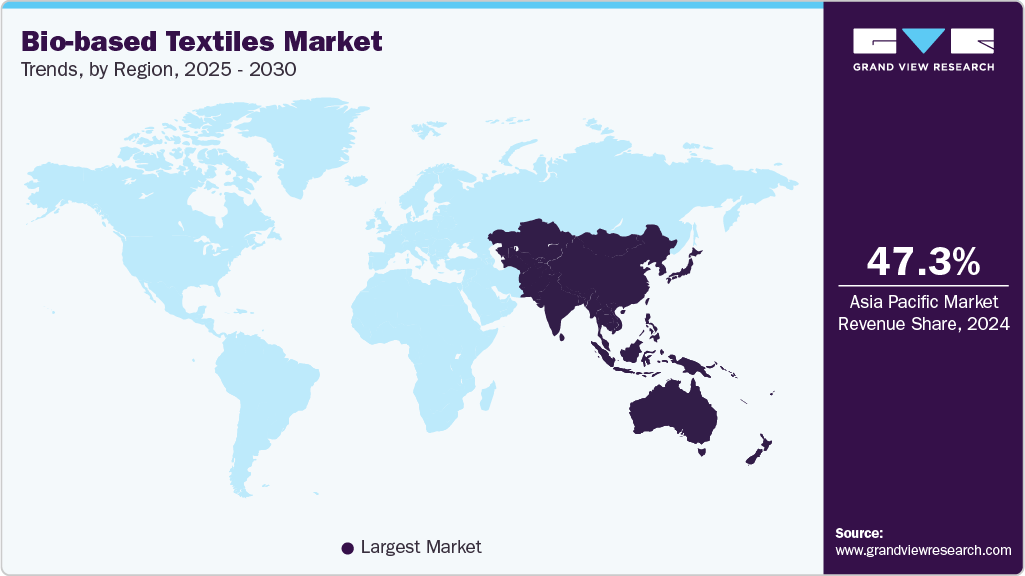
Asia Pacific dominated the bio-based textiles market with the largest revenue share of 43.9% in 2025, driven by the region's massive textile manufacturing base, abundant agricultural resources, and increasing focus on sustainability. Countries like India, China, and Japan are at the forefront of bio-based textile production, supported by government initiatives and growing demand from eco-conscious consumers. The region benefits from cost-effective labor and raw material availability, enabling large-scale production of plant-based fibers like organic cotton and bamboo. In addition, Asia Pacific is experiencing a surge in innovation and partnerships between startups and established manufacturers, further solidifying its leadership in the global market.
 To learn more about this report, Download Free Sample Report
 The bio-based textiles market in China held the largest share in the Asia Pacific region in 2025, due to its status as the world’s largest textile producer and exporter. The country is rapidly integrating bio-based materials into its textile supply chains, fueled by domestic environmental regulations and international demand for sustainable products. Chinese companies are investing in advanced technologies to produce biodegradable fabrics and reduce reliance on synthetic fibers. Moreover, China’s growing middle class is increasingly embracing eco-friendly fashion, contributing to rising domestic demand for bio-based textiles.
Europe Bio-based Textiles Market Trends
The bio-based textiles market in Europe is a strong and environmentally progressive market for bio-based textiles, with stringent regulations and widespread consumer support for sustainable living. The EU’s Green Deal and Circular Economy Action Plan are pushing textile producers to adopt bio-based materials and reduce environmental impacts. European fashion brands, known for quality and sustainability, are rapidly transitioning to organic and biodegradable fabrics. The region also leads in circular fashion initiatives, encouraging reuse, recycling, and sustainable sourcing.
The Germany bio-based textiles market is in stands out within the European market for its technological innovation and strong emphasis on environmental responsibility. German manufacturers and research institutions are investing heavily in bio-fiber R&D, including advanced processing of flax, hemp, and biodegradable synthetics. The country’s industrial expertise, combined with a high level of environmental awareness among consumers, is accelerating the adoption of bio-based textiles across both fashion and technical applications.
Central & South America Bio-based Textiles Market Trends
The bio-based textiles market in Central & South America are emerging markets for bio-based textiles, with increasing attention on sustainable agriculture and eco-friendly manufacturing. Countries like Brazil and Peru, rich in natural fibers such as organic cotton and alpaca wool, are beginning to leverage their resources to produce bio-based textiles. While the market is still developing, supportive government policies and rising global demand for sustainable exports are creating growth opportunities in the region.
Middle East & Africa Bio-based Textiles Market Trends
The bio-based textiles market in Middle East & Africa is in the early stages of adopting bio-based textiles, but it holds strong potential due to its growing population, expanding fashion sector, and increasing focus on sustainability. Countries like South Africa and the UAE are beginning to explore sustainable fashion and textile innovations. Although infrastructure and awareness are currently limited compared to other regions, investments in green technologies and rising environmental concerns are expected to drive gradual market growth in the coming years.
Key Bio-based Textiles Companies Insights
Some of the key players operating in the market include NatureWorks LLC and BASF SE
-
NatureWorks LLC, a joint venture between Cargill and PTT Global Chemical, is a leading producer of bioplastics derived from plant resources. Their flagship product, Ingeo, is a polylactic acid (PLA) polymer made from renewable sources like corn starch. Ingeo is utilized in various applications, including textiles, offering a sustainable alternative to petroleum-based materials.
-
BASF SE, a global chemical company, has made significant strides in sustainable textiles through innovations like Loopamid, a polyamide 6 (nylon 6) entirely derived from textile waste. In collaboration with Inditex, BASF launched a jacket made solely from Loopamid, demonstrating the potential for circular fashion solutions. In addition, BASF's Ultramid, Ccycled, and Ultramid BMB products incorporate recycled and biowaste feedstocks, respectively, further promoting sustainability in the textile industry.
MycoWorks, and Bolt Threads, are some of the emerging market participants in the bio-based textiles industry.
-
MycoWorks is a biotechnology company specializing in mycelium-based materials. Their proprietary Fine Mycelium technology produces Reishi, a sustainable leather alternative that mimics the qualities of animal leather. MycoWorks has partnered with luxury brands like Hermès and has opened a large-scale manufacturing facility in South Carolina to meet growing demand.
-
Bolt Threads is known for developing innovative biomaterials inspired by nature. Their products include Mylo, a mycelium-based leather alternative, and Microsilk , a synthetic spider silk fiber. Bolt Threads has collaborated with brands such as Stella McCartney and Adidas to incorporate these sustainable materials into fashion products.
Key Bio-based Textiles Companies:
The following key companies have been profiled for this study on the bio-based textiles market.
-
NatureWorks LLC
-
BASF SE
-
MycoWorks
-
Bolt Threads
-
Lenzing AG
-
Teijin Limited.
-
Von Holzhausen.
-
Toray Industries, Inc.
-
Spinnova
-
Ecofibre Limited
Competitive Benchmarking
Category
Operating Strategies
Competitive Edge
Weakness
Established Players (BASF SE, Lenzing AG, Teijin Limited, Toray Industries, Inc., NatureWorks LLC)
- Expand global production capacity for bio-based fibers and fabrics.
- Establish long-term partnerships with apparel brands, retailers, and textile manufacturers.
- Invest in sustainable sourcing, certifications, and circular textile initiatives.
- Strong manufacturing scale and established global distribution networks.
- Diversified product portfolios serving multiple textile applications.
- Significant R&D capabilities and strong brand recognition among end users.
- Slower adoption of disruptive technologies due to large operational structures.
- Exposure to feedstock price fluctuations and regulatory compliance costs.
- High capital expenditure requirements for production upgrades and expansion.
Emerging Players (MycoWorks, Bolt Threads, Spinnova, Ecofibre Limited, Von Holzhausen)
- Focus on the commercialization of innovative bio-based fiber technologies.
- Collaborate with fashion brands and research institutions for product validation.
- Raise capital and form strategic partnerships to scale manufacturing operations.
- Proprietary technologies in biofabrication, mycelium materials, and engineered fibers.
- Superior sustainability credentials with lower environmental footprints.
- Greater flexibility and agility in developing customized textile solutions.
- Limited commercial-scale production capacity and market reach.
- Higher production costs compared to conventional textile manufacturers.
- Dependence on external funding and challenges associated with large-scale commercialization.
Recent Developments
-
In January 2024, BASF, in collaboration with Inditex, introduced Loopamid, a recycled polyamide 6 (nylon) made entirely from textile waste. This innovation supports circularity in the fashion industry by enabling the recycling of mixed textile waste into new garments.
-
In September 2023, MycoWorks opened the world's first commercial-scale Fine Mycelium production plant in Union, South Carolina, aiming to supply millions of square feet of Reishi annually.
Bio-based Textiles Market Report Scope
Report Attribute
Details
Market size in 2025
USD 54.1 billion
Estimated market size in 2026
USD 58.7 billion
Projected market size by 2033
USD 100.4 billion
Growth rate
CAGR of 8.0% from 2026 to 2033
Base year for estimation
2025
Historical data
2021 - 2024
Forecast period
2026 - 2033
Quantitative units
Revenue in USD million/billion and CAGR from 2026 to 2033
Report coverage
Revenue forecast, company ranking, competitive landscape, growth factors, and trends
Segments covered
Source material, application, region
Regional scope
North America; Europe; Asia Pacific; Central & South America; Middle East & Africa
Country scope
U.S.; Canada; Mexico; UK; Germany; France; Italy; Spain; China; India; Japan; South Korea
Key companies profiled
NatureWorks LLC; BASF SE; Mycoworks; Bolt Threads; Lenzing AG; Teijin Limited; Von Holzhausen; Toray Industries, Inc.; Ecofibre Limited and Spinnova
Customization scope
Free report customization (equivalent up to 8 analysts' working days) with purchase. Addition or alteration to country, regional & segment scope.
Pricing and purchase options
Avail customized purchase options to meet your exact research needs. Explore purchase options
Global Bio-based Textiles Market Report Segmentation
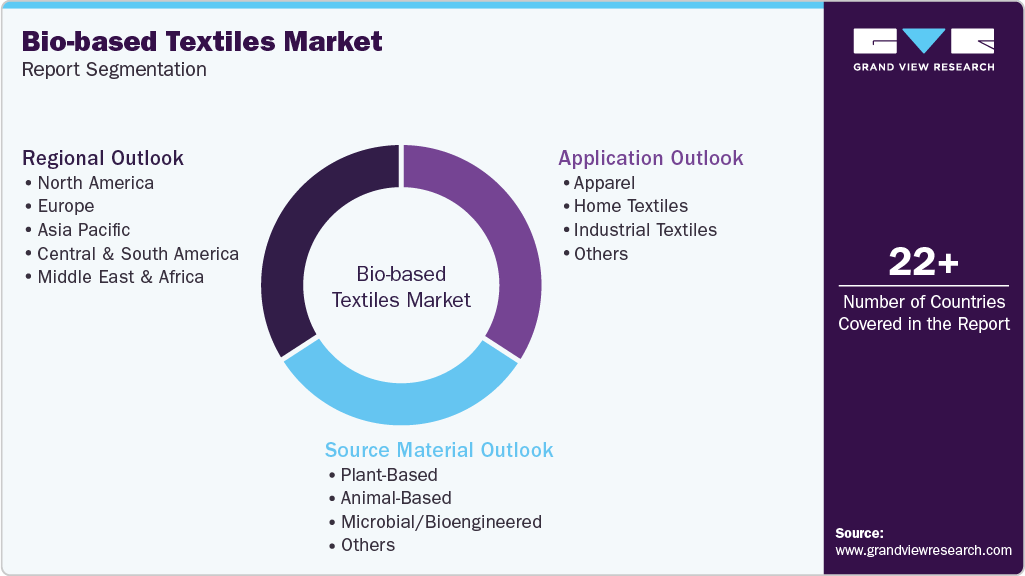
This report forecasts revenue growth at the global, regional, and country levels and provides an analysis of the latest industry trends in each of the sub-segments from 2021 to 2033. For this study, Grand View Research has segmented the global bio-based textiles market report based on source material, application, and region.
 To learn more about this report, Download Free Sample Report
 -
Source Material Outlook (Revenue, USD Million, 2021 - 2033)
-
Plant-Based
-
Animal-Based
-
Microbial/Bioengineered
-
Others
-
-
Application Outlook (Revenue, USD Million, 2021 - 2033)
-
Apparel
-
Home Textiles
-
Industrial Textiles
-
Others
-
-
Regional Outlook (Revenue, USD Million, 2021 - 2033)
-
North America
-
U.S.
-
Canada
-
Mexico
-
-
Europe
-
Germany
-
UK
-
France
-
Italy
-
Spain
-
-
Asia Pacific
-
China
-
Japan
-
India
-
South Korea
-
-
Central & South America
-
Middle East & Africa
-
Research Methodology
The bio-based textiles market figures in this report are based on a proven research process that combines executive interviews with secondary research from proprietary databases, company filings, and recognized regulatory and institutional sources. Market size is built through value-chain sizing - reconciling supply-side and demand-side estimates - and triangulated with bottom-up and top-down approaches. Every estimate passes multiple levels of expert validation before publication, with each bio-based textiles segment quantified using the revenue-capture definitions in the table below.
Segment Definition
Segment - Source Material
Revenue capture definition
Plant-Based
Revenue generated from bio-based textile materials derived from renewable plant sources such as cotton, hemp, flax, bamboo, jute, ramie, banana fiber, and other botanical feedstocks. This segment includes revenues from the production and sale of fibers, yarns, fabrics, and textile products manufactured using plant-derived raw materials for apparel, home textiles, industrial textiles, and other end-use applications.
Animal-Based
Revenue generated from textile materials sourced from animals, including wool, silk, alpaca fiber, cashmere, mohair, and other naturally renewable animal-derived fibers. The segment captures revenues from fiber processing, yarn production, fabric manufacturing, and finished textile products utilized across clothing, furnishing, luxury textiles, and specialty industrial applications.
Microbial/Bioengineered
Revenue generated from advanced textile materials produced through biotechnology processes such as microbial fermentation, bacterial cellulose production, biofabrication, protein-based fibers, mycelium-derived materials, and genetically engineered biofibers. This segment includes revenues from innovative sustainable textile solutions designed to offer enhanced performance, biodegradability, and reduced environmental impact compared to conventional synthetic textiles.
Others
Revenue generated from other renewable and bio-based textile materials not classified under plant-based, animal-based, or microbial/bioengineered categories. This includes emerging feedstocks, agricultural residue-derived fibers, algae-based textiles, composite biofibers, and novel sustainable textile materials developed for commercial and industrial textile applications.
Segment - Application
Revenue capture definition
Apparel
Revenue generated from bio-based textiles utilized in clothing and fashion applications, including casual wear, sportswear, activewear, formal wear, luxury apparel, workwear, and accessories. This segment captures revenues from manufacturers supplying sustainable fibers, fabrics, and finished garments designed to meet growing consumer demand for environmentally responsible fashion products.
Home Textiles
Revenue generated from bio-based textile materials used in residential and commercial furnishing applications such as bedding, curtains, upholstery, carpets, rugs, towels, blankets, cushions, and decorative textiles. The segment includes revenues from sustainable textile products designed to enhance comfort, aesthetics, and environmental performance within indoor spaces.
Industrial Textiles
Revenue generated from bio-based textiles used in industrial, technical, and functional applications including automotive textiles, filtration materials, geotextiles, agricultural textiles, medical textiles, packaging textiles, protective clothing, and reinforcement materials. This segment captures revenues from specialized bio-based textile solutions engineered to meet performance, durability, and sustainability requirements across industrial sectors.
Others
Revenue generated from bio-based textiles utilized in applications beyond apparel, home textiles, and industrial textiles. This includes textiles used in consumer goods, footwear components, personal care products, recreational products, specialty applications, and emerging end-use sectors adopting renewable textile materials.
Estimation Model
Layer Name
Key Question
Description
Global Textile Market
What is the total value of the global textile industry?
The estimation begins with the overall global textile market, encompassing natural fibers, synthetic fibers, fabrics, apparel textiles, home textiles, and industrial textiles. This layer establishes the total addressable market from which bio-based textile revenues are derived.
Sustainable & Eco-Friendly Textiles Market
What portion of the textile market is shifting toward sustainable materials?
This layer narrows the analysis to textiles produced using environmentally friendly materials and processes, including organic fibers, recycled fibers, low-impact textiles, and renewable fiber-based products. Growing sustainability initiatives and regulatory pressures drive demand within this segment.
Bio-based Textiles Market
What share of sustainable textiles is derived from renewable biological feedstocks?
This layer focuses specifically on textiles manufactured from bio-based raw materials such as plant-derived fibers, animal-derived fibers, microbial/bioengineered fibers, and other renewable feedstocks. It excludes recycled synthetic textiles and conventional petroleum-based fibers.
Application-Level Revenue Analysis
How is bio-based textile revenue distributed across end-use applications?
The final layer allocates market revenues across key applications including apparel, home textiles, industrial textiles, and other end-use sectors. Revenue is validated through analysis of bio-based fiber consumption, production volumes, adoption rates, and average selling prices across each application segment and region.
Delivered Customizations
This report has been delivered with the following In-depth customizations
CLIENT REQUEST
CUSTOMIZATION DELIVERED
VALUE ADDS
Competitive Landscape Assessment
Comprehensive benchmarking of leading bio-based textile manufacturers, fiber producers, biotechnology innovators, and emerging material developers. The analysis includes company positioning, product portfolios, production capacities, geographic presence, strategic initiatives, partnerships, sustainability strategies, funding activities, mergers & acquisitions, and recent product developments across the bio-based textiles ecosystem.
Enables clients to identify market leaders, assess competitive intensity, evaluate strategic positioning, uncover white-space opportunities, benchmark business performance, and identify potential collaboration, investment, or acquisition targets within the bio-based textiles value chain.
Technology and Innovation Mapping
Detailed assessment of current and emerging technologies shaping the bio-based textiles industry, including plant-based fibers, microbial fermentation processes, bioengineered fibers, bacterial cellulose, mycelium-based materials, biofabrication technologies, circular textile systems, fiber recycling innovations, and next-generation sustainable material platforms. The study also evaluates technology maturity, commercialization potential, investment trends, and innovation pipelines.
Helps stakeholders understand future technology directions, identify disruptive innovations, prioritize R&D investments, evaluate commercialization opportunities, mitigate technology risks, and develop long-term product development and market-entry strategies.
Value Chain Analysis
Comprehensive evaluation of the bio-based textiles value chain covering feedstock cultivation and sourcing, fiber production, yarn manufacturing, fabric processing, textile finishing, apparel and product manufacturing, distribution networks, retail channels, and end-use consumption. The analysis assesses key stakeholders at each stage, value addition mechanisms, cost structures, margin distribution, supply-demand dynamics, integration levels, and sustainability considerations across the ecosystem.
Enables stakeholders to identify profit pools, optimize operational efficiencies, strengthen supplier relationships, improve sourcing strategies, mitigate supply chain risks, evaluate vertical integration opportunities, and enhance overall competitiveness within the bio-based textiles market.
Frequently Asked Questions About This Report
The global bio-based textiles market size was valued at USD 54.1 billion in 2025 and is estimated at USD 58.7 billion for 2026.
The global bio-based textiles market is expected to grow at a CAGR of 8.0% from 2026 to 2033, reaching USD 100.4 billion by 2033.
Some of the key players operating in the bio-based textiles market include NatureWorks LLC, BASF SE, MycoWorks, Bolt Threads, Lenzing AG, Teijin Limited., Von Holzhausen, Toray Industries, Inc., Spinnova, and Ecofibre Limited.
Asia Pacific held the highest revenue market share of 43.9% in 2025.
Microbial/Bioengineered is the fastest growing source material segment in the bio-based textiles market.
Industrial textiles is the fastest growing application segment in the bio-based textiles market.
The apparel segment held the largest revenue share of 51.0% in 2025, driven by increasing consumer demand for sustainable fashion, the growing adoption of eco-friendly fibers by global apparel brands, and rising emphasis on reducing the environmental impact of textile production.
The plant-based segment held the highest revenue market share of 63.9% in 2025, owing to its abundant raw material availability, established processing infrastructure, cost-effectiveness, and widespread adoption across apparel, home textile, and industrial textile applications.
Key factors driving the bio-based textiles market include increasing demand for sustainable fashion, stringent environmental regulations, rising adoption of circular economy practices, growing consumer preference for eco-friendly products, and advancements in bio-based fiber technologies.
About the Author(s)
Advanced Interior Materials Research Team
Advanced Materials · Advanced Interior MaterialsThis report was authored by the advanced interior materials research team at Grand View Research - comprising two research analysts, one senior research analyst, and one industry expert - with specialized expertise in the advanced interior materials segment of the advanced materials industry. All findings are based on proprietary advanced materials databases, executive interviews, and regulatory analysis, subject to internal peer review prior to publication.
Last Updated:
Speak to Analyst

Customize this report to your needs - add regions, segments, or data points, with 20% free customization.
Or view our licence options:


ISO 9001:2015 & 27001:2022 Certified
We are GDPR and CCPA compliant! Your transaction & personal information is safe and secure. For more details, please read our privacy policy.


