
- Home
- »
- Homecare & Decor
- »
-
Biodegradable Cutlery Market Size, Industry Report, 2033GVR Report cover

Biodegradable Cutlery Market (2026 - 2033) Size, Share & Trends Analysis Report By Raw Material (Wood, Husk, Paper, Plastic), By Region (North America, Europe, Asia Pacific, Latin America, Middle East & Africa), And Segment Forecasts
Market Size, 2025
$46.8MMarket Estimate, 2026
$50.1MMarket Forecast, 2033
$87.6MCAGR, 2026–2033
8.3%Biodegradable Cutlery Market Summary
The global biodegradable cutlery market size was valued at USD 46.8 million in 2025 and is projected to grow from USD 50.1 million in 2026 to USD 87.6 million by 2033, at a CAGR of 8.3% from 2026 to 2033. The market in Europe dominated with a revenue share of 36.6% in 2025. Rising environmental awareness is a major growth driver, as consumers increasingly recognize the long-term damage caused by plastic waste, landfill accumulation, and marine pollution, leading them to prefer compostable and naturally degradable alternatives that do not generate microplastics.
 Source: Grand View Research, IR Documents, Primary Interviews, Paid DatabasesTo learn more about this report,
 Download Free Sample Report
 Key Market Trends & Insights
- By raw material: Biodegradable plastic led the market, accounting for a share of 26.8% in 2025.
- By raw material: Paper cutlery is anticipated to witness a CAGR of 8.6% from 2026 to 2033.
Regional Highlights
- Largest regional market: Europe (36.6% revenue share, 2025)
- Fastest-growing regional market: North America (highest CAGR, 2026-2033)
- By country: The biodegradable cutlery industry in the Germany held the largest revenue share in 2025.
Market Size & Forecast
- Market size in 2025: USD 46.8 Million
- Estimated market size in 2026: USD 50.1 Million
- Projected market size by 2033: USD 87.6 Million
- CAGR (2026-2033): 8.3%
Three ways to get this report
Buy it, customize it, or ask a question.Ask an Analyst
Analyst response in 1 business day
- AccessReport author, directly
- Reply timeWithin 1 working day
- No sales callDirect answer only
- FormatEmail reply
- CostFree, no cost
Get the Full Report
What the study covers
- FormatsPDF · Excel · Dashboard
- Timeline2026–2033 annual, 2025 base
- Coverage20+ countries, 5 regions
- Companies10+ key players profiled
Customize the Report
20% free customization
- IncludeCountries, segments, points
- TailorTo your product definition
- ExtendDeeper competitor detail
- OrA fully bespoke study
- Turnaround5–10 working days
At the same time, government policies and plastic bans across many countries are accelerating the shift away from single-use plastics by enforcing strict regulations, restrictions, and penalties, compelling foodservice providers and retailers to adopt biodegradable options.Companies are increasingly integrating eco-friendly cutlery into their corporate social responsibility (CSR) strategies to demonstrate environmental commitment and reduce their operational footprint. Businesses in the hospitality, foodservice, and retail sectors are replacing conventional plastic utensils with biodegradable alternatives, particularly from the growing bamboo cutlery market, which offers durable, natural, and compostable solutions to align with sustainability goals, comply with green standards, and appeal to environmentally conscious consumers. This shift not only helps minimize waste but also strengthens brand reputation, builds customer trust, and differentiates companies in a competitive, sustainability-focused market.
 To learn more about this report, Download Free Sample Report
 Innovation and product diversity are playing a key role in the growth of the biodegradable cutlery industry, with manufacturers introducing new formats such as edible cutlery, compostable plant-based materials, and enhanced bamboo or fiber-based variants to improve durability, functionality, and sustainability. These advancements not only reduce environmental impact but also cater to evolving consumer preferences for convenient, waste-free dining solutions, helping brands differentiate their offerings while supporting the broader shift toward sustainable and eco-friendly foodservice practices.
In India, several companies are making edible, eco-friendly cutlery mainstream as part of this trend, blending sustainability with local enterprise and social impact. For example, Kerala-based Thoosan produces edible tableware from wheat bran that can either be eaten or biodegraded without harm, reducing single-use plastic waste and providing additional income to farmers. Likewise, Bangalore-based Gajamukha Foods’ EdiblePRO offers over 80 natural, zero-waste cutlery variants made from grains and pulses, supporting rural employment while promoting sustainable consumption habits. These initiatives highlight how innovative, consumable cutlery products are gaining traction and contributing to broader sustainable dining and environmental goals.
Compostable cutlery and tableware are the best alternatives to non-biodegradable plastics and are one of the emerging green businesses. The rising awareness of the adverse effects of non-biodegradable plastic includes severe consequences for aquatic animals. This is one of the major drivers of market growth. For instance, according to the data provided by the U.S., more than 8 million tons of plastic is dumped into the ocean every year globally. Another global report suggests there may already be more than 5.25 trillion micro- and macroplastic particles in the ocean. These adverse effects drive the usage of biodegradable materials.
Market Dynamics
The market for biodegradable cutlery is being strongly supported by the rising scale of plastic waste generation and increasing regulatory pressure to reduce environmental impact. According to government-backed and institutional estimates, India generated over 10.8 million tonnes of plastic waste in 2023, with nearly 70% classified as mismanaged waste, highlighting the urgent need for sustainable alternatives. In addition, India alone contributes around 5.5 million tonnes of single-use plastic waste annually, ranking among the top global contributors. In response, governments have introduced targeted bans on disposable plastic products, including cutlery, and strengthened waste management frameworks such as Plastic Waste Management Rules and Extended Producer Responsibility (EPR) policies. These regulatory and environmental pressures are accelerating the transition toward biodegradable cutlery across foodservice, institutional catering, and retail applications, particularly as businesses align with sustainability mandates and compliance requirements.
A key restraint for the market for biodegradable cutlery is the limited availability of cost-effective and scalable alternatives compared to conventional plastic products. Government and policy analyses highlight that one of the major challenges in phasing out single-use plastics is the lack of widely accessible, affordable, and performance-efficient substitutes, especially for mass consumption segments. Biodegradable materials often face issues related to durability, heat resistance, and shelf life, making them less suitable for certain foodservice applications. In addition, production costs remain relatively higher due to raw material sourcing and processing constraints, which impacts adoption in price-sensitive markets. These challenges create a gap between regulatory intent and practical implementation, thereby limiting large-scale substitution of plastic cutlery with biodegradable options.
Consumer Insights
Consumer surveys indicate that sustainability is becoming a key purchase criterion, with a significant portion of buyers willing to pay extra for environmentally responsible products. For instance, in 2025, 47% of consumers reported a willingness to spend 5–10% more on sustainable alternatives, reflecting growing acceptance of higher-priced eco-friendly options. This willingness to pay a premium directly benefits the biodegradable cutlery market, where plant-based, compostable, or bamboo products often cost more than conventional plastic utensils. As consumers increasingly prioritize reducing plastic waste and supporting sustainable brands, they are more likely to choose biodegradable cutlery despite the price difference, encouraging foodservice providers and retailers to adopt greener solutions.
 To learn more about this report, Download Free Sample Report
 Raw Material Insights
Biodegradable plastic cutlery led the biodegradable cutlery industry in 2025, accounting for a revenue share of 26.8%. It offers the same convenience and functionality as conventional plastic while addressing environmental concerns. Materials such as PLA and other plant-based bioplastics offer similar strength, flexibility, and heat resistance, enabling businesses to switch from traditional plastics without compromising performance or customer experience. At the same time, increasing plastic bans, stricter regulations, and sustainability goals are pushing foodservice operators, retailers, and event organizers to adopt compostable alternatives that reduce landfill waste and carbon footprints.
 To learn more about this report, Download Free Sample Report
 Paper cutlery is anticipated to witness a CAGR of 8.6% from 2026 to 2033. Paper cutlery has emerged as the most widely adopted alternative to plastic because it offers a practical balance between sustainability, affordability, and convenience. It is made from renewable resources, biodegradable, and compostable, which appeals to environmentally conscious consumers and helps businesses comply with single-use plastic bans. At the same time, paper utensils are cost-effective and easy to mass-produce using existing paper manufacturing infrastructure, making them cheaper than alternatives such as bamboo or edible cutlery.
Regional Insights
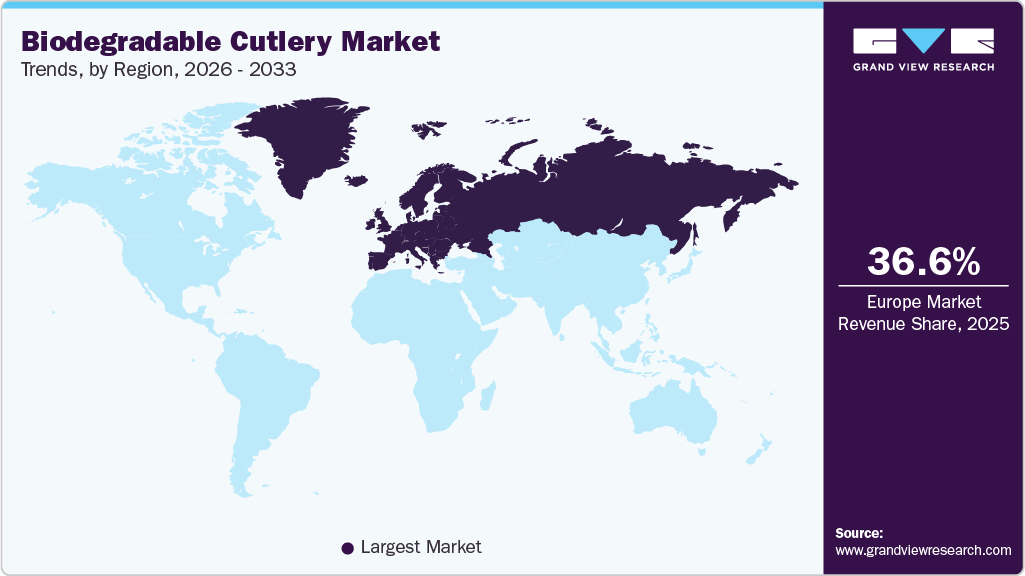
The Europe biodegradable cutlery industry held a global revenue share of 36.6% in 2025. Many startup companies, as well as major manufacturers of biodegradable utensils, are focused on new product development and innovation in raw materials. For instance, Leaf Republic GmbH, a Germany-based Startup, introduced an entire set of Leaf tableware. The product is manufactured from leaves and leaf-made paper, with no synthetic additives, colorants, or glue. These products are biodegradable within 28 days after use. This innovative product launch is anticipated to fuel the market over the forecast period.
 To learn more about this report, Download Free Sample Report
 UK Biodegradable Cutlery Market Trends
The biodegradable cutlery market in the UK was valued at 3.81 million in 2025. Regulatory measures in the UK are a major driver of biodegradable cutlery adoption, as the government implemented bans on several single-use plastic items, including plastic cutlery, to curb waste and environmental pollution. These restrictions compelled restaurants, cafés, takeaway outlets, and catering services to replace conventional plastic utensils with certified biodegradable and compostable alternatives, thereby significantly boosting demand for bamboo cutlery. Bamboo cutlery gained strong popularity due to its natural, renewable, and sturdy properties, making it a practical and eco-friendly alternative to plastic. As a result, businesses actively sought compliant, sustainable solutions. They invested in innovative disposables, accelerating the overall shift toward greener materials and supporting steady growth across the bamboo cutlery market.
The Germany biodegradable cutlery market is expected to grow at a CAGR of 8.6% from 2026 to 2033. Germany is one of the leading contributors to Europe’s growth, driven by vigorous regulatory enforcement, high environmental awareness, and widespread consumer preference for sustainable alternatives. The country accounts for a significant share of regional demand as restaurants, catering services, and retailers actively replace plastic utensils with compostable, plant-based options. At the same time, manufacturers are focusing on innovation and product development, enhancing durability, heat resistance, and natural aesthetics through improved molding and design, to ensure biodegradable cutlery meets both functional foodservice requirements and consumer expectations for high-quality, eco-friendly products.
North America Biodegradable Cutlery Market Trends
The North America biodegradable cutlery industry is anticipated to witness a CAGR of 8.5% from 2026 to 2033. The rapid expansion of quick-service restaurants, food delivery platforms, and institutional foodservice providers across North America is significantly driving the adoption of biodegradable cutlery, as these segments rely heavily on disposable utensils for convenience and large-scale operations. To meet rising consumer expectations for sustainability and comply with local environmental regulations, operators are increasingly replacing traditional plastic cutlery with compostable and plant-based alternatives. This shift allows businesses to maintain practicality while reducing plastic waste, aligning their services with broader sustainable dining trends, and strengthening their eco-friendly brand positioning.
The biodegradable cutlery industry in the U.S. is expected to grow at a CAGR of 8.6% from 2026 to 2033. Rising environmental consciousness among U.S. consumers is a key factor driving demand for biodegradable cutlery, as individuals and businesses increasingly recognize the negative impact of single-use plastics on landfills, oceans, and overall ecosystem health. Shoppers are actively choosing eco-friendly products that align with their sustainability values, while restaurants, catering services, and corporate cafeterias are adopting compostable and plant-based utensils to strengthen their green image and meet customer expectations.
Asia Pacific Biodegradable Cutlery Market Trends
The Asia Pacific biodegradable cutlery market held a market share of 19.2% of the global revenue in 2025. Material and product innovation is shaping the market, with traditional plastic biopolymers such as PLA still accounting for a significant share due to affordability and scalability, while wood, bamboo, bagasse, and other plant-based materials are gaining faster traction for their natural appeal and superior compostability. Manufacturers are focusing on improving strength, heat resistance, and aesthetic quality to better match conventional plastic performance, making these alternatives more suitable for foodservice and takeaway applications. At the same time, wider distribution through e-commerce platforms and retail stores is increasing product accessibility, helping brands reach environmentally conscious consumers and institutional buyers more effectively.
The biodegradable cutlery market in China was valued at USD 2.83 million in 2025. Regulatory measures aimed at reducing single-use plastics, including phased bans on conventional plastic cutlery, are driving the adoption of compostable utensils, and growing consumer preference for eco-friendly products is supporting broader market penetration. As online and offline distribution channels expand, more sustainable cutlery options are reaching institutional buyers and individual consumers alike, further accelerating market development in China’s biodegradable cutlery segment.
Latin America Biodegradable Cutlery Market Trends
The biodegradable cutlery industry in Latin America is expected to grow at a CAGR of 7.5% from 2026 to 2033. Growth in the region is supported by rising environmental concerns, government efforts to curb single-use plastics, and stronger consumer preference for eco-friendly products, especially among urban and young demographics. Although infrastructure and cost challenges remain, expanding e-commerce and retail availability is helping biodegradable cutlery reach a broader base of institutional buyers and individual consumers.
Middle East & Africa Biodegradable Cutlery Market Trends
The market growth is driven by shifting consumer preferences toward eco-friendly options and by greater environmental awareness among millennials and Gen Z in urban markets across the Gulf Cooperation Council (GCC). Growth is supported by rising demand within foodservice sectors and by the hospitality and events industries seeking to reduce single-use plastic waste.
Key Biodegradable Cutlery Company Insights
Leading players in the biodegradable cutlery market include Huhtamäki Oyj, Biotrem, and Vegware. Companies are increasingly focusing on material innovation, certified compostable products, and performance-enhanced designs, such as sturdy plant-based forks, heat-resistant spoons, and durable knives, to meet the evolving needs of environmentally conscious consumers and commercial buyers. In addition, brands are introducing premium sustainable options made from wood, bamboo, bagasse, and bioplastics, along with customizable and bulk solutions for restaurants, catering services, and events, helping differentiate offerings while aligning with global sustainability and plastic-reduction goals.
 To learn more about this report, Download Free Sample Report
 Key Biodegradable Cutlery Companies:
The following key companies have been profiled for this study on the biodegradable cutlery market.
- Huhtamäki Oyj
- Biotrem
- BIOPAK; BETTER EARTH LLC
- Vegware
- Pactiv LLC
- Eco Guardian
- Genpak, LLC
- Bionatic GmbH & Co. KG
- GreenGood USA
Recent Developments
-
In June 2025, designers and startups in Bengaluru turned agricultural waste such as rice husk and wheat straw into biodegradable tableware and cutlery as alternatives to single-use plastics ahead of World Environment Day 2025. They used these materials to make durable, eco-friendly plates, cups, and utensils that could decompose naturally and reduce plastic pollution.
-
In October 2025, researchers at the Indian Institute of Technology Roorkee’s INNOPAP Lab developed eco-friendly tableware from wheat straw, an agricultural residue that was often burned, causing air pollution. They converted the wheat straw into durable, heat-resistant, biodegradable, and compostable tableware that was food-safe, offering an alternative to single-use plastics and helping reduce both plastic waste and crop residue burning.
Biodegradable Cutlery Market Report Scope
Report Attribute
Details
Market size in 2025
USD 46.8 million
Estimated market size in 2026
USD 50.1 million
Projected market size by 2033
USD 87.6 million
Growth rate
CAGR of 8.3% from 2026 to 2033
Actuals
2021 - 2025
Forecast period
2026 - 2033
Quantitative units
Revenue in USD million and CAGR from 2026 to 2033
Report coverage
Revenue forecast, company ranking, competitive landscape, growth factors, and trends
Segments covered
Raw material, region
Region covered
North America; Europe; Asia Pacific; Central & South America; Middle East & Africa
Country covered
U.S.; Canada; Mexico; UK; Germany; France; Spain; Italy; China; Japan; India ; South Korea; Australia & New Zealand; Brazil; South Africa
Key companies profiled
Huhtamäki Oyj; Biotrem; BIOPAK; BETTER EARTH LLC; Vegware; Pactiv LLC; Eco Guardian; Genpak, LLC; Bionatic GmbH & Co. KG; GreenGood USA
Customization scope
Free report customization (equivalent up to 8 analysts’ working days) with purchase. Addition or alteration to country, regional & segment scope.
Pricing and purchase options
Avail customized purchase options to meet your exact research needs. Explore purchase options
Global Biodegradable Cutlery Market Report Segmentation
This report forecasts revenue growth at the global, regional & country levels and provides an analysis of the latest trends and opportunities in each sub-segment from 2021 to 2033. For this study, Grand View Research has segmented the biodegradable cutlery market report based on raw material and region:
 To learn more about this report, Download Free Sample Report
 -
Raw Material Outlook (Revenue, USD Million, 2021 - 2033)
-
Wood
-
Husk
-
Paper
-
Plastic
-
Others
-
-
Regional Outlook (Revenue, USD Million, 2021 - 2033)
-
North America
-
U.S.
-
Canada
-
Mexico
-
-
Europe
-
UK
-
Germany
-
France
-
Spain
-
Italy
-
-
Asia Pacific
-
China
-
Japan
-
India
-
South Korea
-
Australia & New Zealand
-
-
Latin America
-
Brazil
-
-
Middle East and Africa (MEA)
-
South Africa
-
-
Delivered Customizations
This report has been delivered with the following In-depth customizations
Client Request
Customization Delivered
Value Adds
Raw Material Segmentation Analysis
Developed a detailed segmentation of the biodegradable cutlery market based on raw materials such as wood, husk, paper, plastic, and other bio-based polymers, aligned with client-specific categorization and regional availability dynamics.
This enables the client to identify cost-efficient and sustainable material options, optimize sourcing strategies, and align product development with evolving regulatory and consumer preferences toward eco-friendly materials.
Vendor Landscape
Mapped the competitive landscape by profiling key manufacturers across regions, analyzing their product portfolios, pricing strategies, production capabilities, and distribution networks within the biodegradable cutlery market.
This helps the client benchmark against competitors, identify potential partners or acquisition targets, understand competitive positioning, and refine differentiation strategies to strengthen market presence.
Country Wise Opportunity Assessment
Conducted a country-level analysis evaluating market size, growth potential, regulatory frameworks (plastic bans), consumer adoption, and pricing trends across key regions relevant to biodegradable cutlery demand.
This enables the client to prioritize high-growth markets, tailor market entry strategies based on local regulations and demand drivers, and allocate investments effectively to maximize returns across geographies.
Frequently Asked Questions About This Report
Key players include Huhtamäki Oyj; Biotrem; BIOPAK; BETTER EARTH LLC; Vegware; Pactiv LLC; Eco Guardian; Genpak, LLC; Bionatic GmbH & Co. KG; GreenGood USA.
Key factors that are driving the market growth include increasing consumer awareness regarding ill effects of non-biodegradable plastic, and mushrooming growth of restaurants, fast food joints, and cafeterias worldwide.
North America is the fastest-growing region over the forecast period.
The plastic segment accounted for the largest revenue share of 26.8% in 2025.
The global biodegradable cutlery market size was valued at USD 46.8 million in 2025 and is estimated at USD 50.1 million for 2026.
The global biodegradable cutlery market is expected to grow at a CAGR of 8.3% from 2026 to 2033, reaching USD 87.6 million.
Europe dominated with a 36.6% revenue share in 2025. This is attributable to rising instances of product innovation and launches by prominent market participants within the region.
About the Author(s)
Homecare & Decor Research Team
Consumer Goods · Homecare & DecorThis report was authored by the homecare & decor research team at Grand View Research - comprising two research analysts, one senior research analyst, and one industry expert - with specialized expertise in the homecare & decor segment of the consumer goods industry. All findings are based on proprietary consumer goods databases, executive interviews, and regulatory analysis, subject to internal peer review prior to publication.
Last Updated:
Speak to Analyst

Customize this report to your needs - add regions, segments, or data points, with 20% free customization.
Or view our licence options:


ISO 9001:2015 & 27001:2022 Certified
We are GDPR and CCPA compliant! Your transaction & personal information is safe and secure. For more details, please read our privacy policy.


