
- Home
- »
- Biotechnology
- »
-
Bioinformatics Market Size, Share, Trends Report, 2026-2033GVR Report cover

Bioinformatics Market (2026 - 2033)
Size, Share & Trends Analysis Report By Product (Platforms, Services), By Application (Genomics, Cheminformatics, Metabolomics, Proteomics, Transcriptomics, Cheminformatics and Drug Designing), By Region, And Segment Forecasts
Market Size, 2025
$20.1BMarket Estimate, 2026
$23.5BMarket Forecast, 2033
$63.7BCAGR, 2026–2033
15.3%Bioinformatics Market Summary
The global bioinformatics market size was valued at USD 20.1 billion in 2025 and is projected to grow from USD 23.5 billion in 2026 to USD 63.7 billion in 2033, at a CAGR of 15.3% from 2026 to 2033. North America dominated the market, accounting for a revenue share of 42.5% in 2025. Growing clinical development of biopharmaceuticals and increasing need for three-dimensional drug designing technology are expected to drive the market growth over the forecast period.
Key Market Trends & Insights
- By product: The bio-content management segment led the market with a revenue share of around 38.0% in 2025.
- By application: The genomics segment accounted for a significant revenue share in 2025.
Regional Highlights
- Largest regional market: North America (42.5% revenue share, 2025)
- Fastest-growing regional market: Asia Pacific (highest CAGR, 2026-2033)
Market Size & Forecast
- Market size in 2025: USD 20.1 Billion
- Estimated market size in 2026: USD 23.5 Billion
- Projected market size by 2033: USD 63.7 Billion
- CAGR (2026-2033): 15.3%
Three ways to get this report
Buy it, customize it, or ask a question.Ask an Analyst
Analyst response in 1 business day
- AccessReport author, directly
- Reply timeWithin 1 working day
- No sales callDirect answer only
- FormatEmail reply
- CostFree, no cost
Get the Full Report
What the study covers
- FormatsPDF · Excel · Dashboard
- Timeline2026–2033 annual, 2025 base
- Coverage20+ countries, 5 regions
- Companies10+ key players profiled
Customize the Report
20% free customization
- IncludeCountries, segments, points
- TailorTo your product definition
- ExtendDeeper competitor detail
- OrA fully bespoke study
- Turnaround5–10 working days
The introduction of user-friendly and readily available bioinformatics software such as RasMol, AUTODOCK, BALL, and Bioclipse, and growing market usage of these tools for the accurate and effective analysis of biomarker discovery programs that assist in toxicity detection during the initial stage of the drug development process are expected to drive industry growth over the forecast period.
Bioinformatics software and tools are being used as integrated solutions that provide algorithms and statistical methodologies for data analysis and help integrate data management and analysis for applications such as next-generation sequencing, genomic and proteomic structuring, modeling, and three-dimensional drug designing. Increasing R&D initiatives in the proteomics and genomics market, including other related ‘-omics’ fields, are further expected to support market growth to meet data storage and analysis demands.
 Source: Grand View Research, IR Documents, Primary Interviews, Paid DatabasesTo learn more about this report,
 Download Free Sample Report
 The increasing adoption of bioinformatics tools is driven by their ability to provide integrated solutions for genome and proteome analysis, as well as for biological data interpretation, storage, and management. These platforms leverage computational techniques, statistical models, algorithms, and data visualization tools across key applications, including next-generation sequencing, biomarker discovery, drug development, molecular modeling, and personalized medicine. As pharmaceutical companies, research institutions, and healthcare providers generate increasingly complex biological datasets, the need for efficient data analysis and predictive insights continues to grow. In addition, the rising importance of genomics research, precision medicine, and targeted therapies is expected to accelerate demand for bioinformatics solutions over the forecast period.
Market Dynamics
The growing use of genomics and precision medicine is a major factor driving the market. The increasing reliance on next-generation sequencing (NGS), biomarker discovery, molecular diagnostics, and personalized medicine is creating large, complex biological datasets. These datasets need effective computational tools for interpretation. Bioinformatics platforms are essential for processing, storing, and analyzing genomics, proteomics, and multi-omics data. This work supports applications in disease diagnosis, drug discovery, and therapeutic development. The integration of AI-driven analytics and multi-omics workflows improves the ability to gather useful biological insights. This boosts adoption in research and clinical settings. In addition, the increasing need for quick genomic data interpretation, variant analysis, and biomarker identification in clinical and drug development pipelines is speeding up market growth. For instance, in October 2025, Broad Clinical Labs, working with Roche Sequencing Solutions and Boston Children’s Hospital, set a Guinness World Record. They completed whole-genome sequencing and analysis in under 4 hours using an integrated sequencing and bioinformatics workflow. This achievement highlights the rising need for fast, end-to-end genomic analysis solutions.
High data complexity and a shortage of skilled professionals are key restraints limiting market growth. The increasing generation of large-scale genomic, proteomic, transcriptomic, and clinical datasets requires advanced computational infrastructure, sophisticated algorithms, and specialized expertise to ensure accurate data interpretation. However, challenges related to multi-omics integration, database interoperability, and the reproducibility of analytical outcomes continue to hinder efficient workflow execution. In addition, the market faces a significant shortage of trained bioinformatics professionals, including computational biologists and data scientists, which increases operational costs and slows adoption of advanced platforms. Concerns related to data privacy, cybersecurity risks, and evolving regulatory frameworks governing genomic and patient data further complicate implementation, thereby restraining market expansion over the forecast period.
The expansion of artificial intelligence (AI), machine learning, and cloud-based bioinformatics platforms presents a significant market growth opportunity. The growing volume of genomic, proteomic, transcriptomic, and multi-omics datasets generated by next-generation sequencing (NGS) and precision medicine initiatives is driving demand for scalable, intelligent bioinformatics solutions. Cloud-based bioinformatics platforms offer advantages such as enhanced computational power, remote accessibility, secure data storage, and seamless research collaboration, enabling pharmaceutical companies, biotechnology firms, healthcare organizations, and research institutions to analyze large biological datasets more efficiently.
AI-enabled bioinformatics tools are improving the speed and accuracy of sequence analysis, biomarker discovery, target identification, and predictive modeling, reducing analytical complexity and accelerating biological research. Furthermore, the growing integration of artificial intelligence, machine learning, and cloud computing technologies into bioinformatics workflows enables real-time data processing, advanced predictive analytics, and enhanced collaboration across research organizations. These advancements are improving the efficiency of biological data interpretation and supporting the development of precision medicine, thereby creating significant growth opportunities for the market.
Analyst Perspective
The market is supported by strong long-term growth drivers, including the rapid expansion of genomics research, increasing adoption of next-generation sequencing technologies, and growing demand for precision medicine and personalized healthcare solutions. The market is highly influenced by the ongoing rise in biological data generated by genomics, proteomics, and multi-omics studies, which is driving the need for advanced computational tools to store, process, and analyze complex datasets.
Demand from pharmaceutical companies, biotechnology firms, and research institutions is steadily increasing, especially for cloud-based bioinformatics platforms, AI-driven analytics tools, and integrated data management systems that support faster drug discovery and clinical decision-making.
Product Insights
The bio-content management segment led the market, accounting for around 38.0% of revenue in 2025, driven by the growing need to store, organize, integrate, and manage large volumes of biological and genomic data generated by research and clinical activities. The growing adoption of bioinformatics platforms for efficient data sharing, database management, and collaborative research has further supported segment growth. In addition, rising investments in genomics, proteomics, and precision medicine initiatives are driving demand for advanced data management solutions that enable researchers to access, analyze, and interpret complex biological datasets more effectively.
The bioinformatics services segment is expected to grow at the fastest CAGR of around 16.0% during the forecast period. This growth is driven by the rising use of next-generation sequencing (NGS), genomics research, precision medicine, and multi-omics applications. As biological data becomes more complex and voluminous, pharmaceutical companies, biotechnology firms, healthcare organizations, and research institutions are turning to specialized service providers for data analysis, interpretation, computational modeling, and workflow improvement. The increasing need for affordable expertise, scalable computing infrastructure, and better analytics is speeding up the outsourcing of bioinformatics services. Furthermore, increased investment in drug discovery, biomarker identification, and multi-omics research is fueling the expansion of this segment. Reflecting this trend, in October 2025, Illumina launched BioInsight, a business dedicated to providing deeper biological insights by integrating sequencing, data analysis, software, and artificial intelligence. This initiative aims to assist researchers and pharmaceutical companies in interpreting large-scale multi-omics datasets, identifying drug targets, uncovering disease mechanisms, and advancing next-generation biological research.
Application Insights
The genomics application segment accounted for a significant share of revenue in 2025. The segment's growth is driven by the rising popularity of next-generation sequencing, whole-genome sequencing, pharmacogenomics, gene expression studies, and molecular diagnostics. Genomics is an application field in which bioinformatics solutions are widely applied to sequence mapping, genome annotation, variation analysis, biomarker identification, and disease prediction. Increasing demand for the development of pharmacogenomics-based drugs, rising expenditure on precision medicine, and technological advancements to handle large genomic datasets will support segment growth. In addition, the growing use of genomics in cancer, rare diseases, and personalized healthcare is driving demand in the segment.
The cheminformatics and drug design segment is expected to witness significant growth during the forecast period, driven by increasing demand for biomarker discovery, drug target identification, and cost-efficient drug development. The combination of bioinformatics and cheminformatics enables researchers to analyze and interpret vast amounts of data on chemicals and biology to model molecules, conduct virtual screening, optimize leads, predict toxicity, and perform structure-based drug design. With shorter development timelines and lower costs, coupled with increased spending on research and development by pharmaceutical and biotechnology companies, the demand for this segment is expected to continue growing at an accelerated pace. In addition, the rising number of novel molecular entities (NMEs) approved by regulatory authorities and the increased adoption of computer-assisted drug discovery systems will drive growth in this segment.
Regional Insights
North America dominated the market, accounting for around 42.5% of revenue in 2025. This dominance is due to the strong presence of leading biotechnology and pharmaceutical companies, academic research institutes, genomics organizations, and bioinformatics technology providers across the U.S. and Canada. The region benefits from rising investments in genomics, precision medicine, computational biology, and next-generation sequencing (NGS). In addition, investment in molecular biology and drug discovery is increasing. The growing need for innovative technologies to manage large volumes of data in genomics, proteomics, and multi-omics studies is also driving regional market growth. For instance, in April 2026, 10x Genomics, based in California, launched Atera, an in situ spatial biology platform aimed at providing whole-transcriptome spatial analysis at single-cell resolution at scale.
 To learn more about this report, Download Free Sample Report
 Asia Pacific Bioinformatics Market Trends
The bioinformatics market in the Asia Pacific is expected to grow at a CAGR of around 17.5% during the forecast period, driven by rapid advances in genomics research and increased investment in biotechnology and precision medicine. The increase in biopharmaceutical development, the use of next-generation sequencing technologies, molecular diagnostics, and computational biology will also drive market growth in this region. In addition, greater investments in life sciences research, improvements in biopharmaceutical development, and increased demand for bioinformatics solutions capable of analyzing vast amounts of genomics, proteomics, and other omics data contribute to market growth. The presence of expanding biotechnology ecosystems, rising digitalization in healthcare, and increasing collaborations among research institutes, healthcare organizations, and technology providers are expected to further support regional market expansion during the forecast period.
Key Bioinformatics Company Insights
The market is highly fragmented, with biotechnology companies, bioinformatics software providers, sequencing technology firms, cloud computing providers, and life sciences analytics companies competing for market share. Competition is primarily driven by the development of advanced data analysis platforms, scalable computing infrastructure, AI-enabled bioinformatics tools, and cloud-based solutions supporting genomics, proteomics, drug discovery, and precision medicine applications. Key players are increasingly focusing on integrating artificial intelligence, machine learning, and high-performance computing capabilities into their platforms to enhance data processing efficiency and analytical accuracy.
-
In January 2026, Illumina, Inc. launched Illumina Connected Multiomics, a cloud-based research platform that helps users analyze and visualize large biological datasets. This platform combines data from different areas, including genomics, transcriptomics, proteomics, and epigenetics, into a single environment. This setup allows researchers to simplify data interpretation and improve efficiency in their analyses. By cutting down the time, cost, and complexity involved in multiomic data analysis, the platform aims to speed up scientific discovery and support the progress of precision medicine efforts.
-
In January 2024, DNAnexus, Inc. partnered with Intelliseq to enhance its Precision Health Data Cloud by integrating automated genomic variant interpretation and clinical reporting tools, streamlining next-generation sequencing (NGS) workflows for cancer and rare disease research applications.
Key Bioinformatics Companies:
The following key companies have been profiled for this study on the The following key companies have been profiled for this study on the.
-
DNAnexus Inc.
-
Seven Bridges Genomics
-
BGI
-
Partek Inc.
-
Thermo Fisher Scientific Inc.
-
QIAGEN
-
Agilent Technologies, Inc.
-
Illumina, Inc.
-
PerkinElmer
-
Roche (F. Hoffmann-La Roche Ltd.)
Bioinformatics Market Report Scope
Report Attribute
Details
Market size in 2025
USD 20.1 billion
Estimated market size in 2026
USD 23.5 billion
Projected Market size by 2033
USD 63.7 billion
Growth rate
CAGR of 15.3% from 2026 to 2033
Historical data
2021 - 2025
Forecast period
2026 - 2033
Quantitative units
Revenue in USD billion, and CAGR from 2026 to 2033
Report coverage
Revenue forecast, company ranking, competitive landscape, growth factors, and trends
Segments covered
Product, application, region
Regional Scope
North America; Europe; Asia Pacific; Latin America; MEA
Country Scope
U.S.; Canada; UK; Germany; France; Italy; Spain; Denmark; Sweden; Norway; Japan; China; India; Australia; Thailand; South Korea; Brazil; Mexico; Argentina; South Africa; Saudi Arabia; UAE; Kuwait
Key companies profiled
DNAnexus Inc.; Seven Bridges Genomics; BGI; Partek Inc.; Thermo Fisher Scientific Inc.; QIAGEN; Agilent Technologies, Inc.; Illumina, Inc.; PerkinElmer; Roche (F. Hoffmann-La Roche Ltd.)
Customization scope
Free report customization (equivalent up to 8 analysts working days) with purchase. Addition or alteration to country, regional & segment scope.
Pricing and purchase options
Avail of customized purchase options to meet your exact research needs. Explore purchase options
Global Bioinformatics Market Report Segmentation
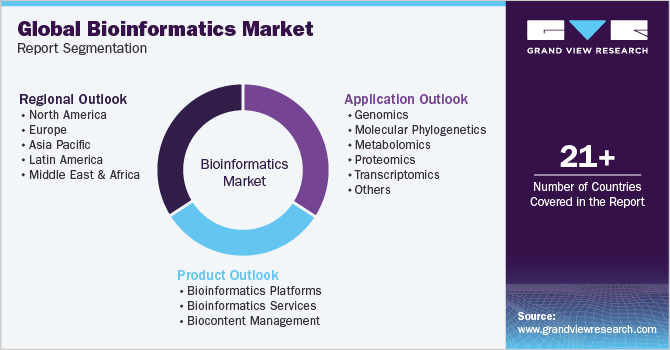
This report forecasts revenue growth at the regional and country levels and provides an analysis of the latest industry trends and opportunities in each of the sub-segments from 2021 to 2033. For this study, Grand View Research has segmented the global bioinformatics market based on product, application, and region:
 To learn more about this report, Download Free Sample Report
 -
Product Outlook (Revenue, USD Billion, 2021 - 2033)
-
Bioinformatics Platforms
-
Sequence Analysis Platforms
-
Sequence Manipulation Platforms
-
Sequence Alignment Platforms
-
Structural and Functional Analysis Platforms
-
Others
-
-
Bioinformatics Services
-
Sequencing
-
Database Management
-
Data Analysis
-
Others
-
-
Biocontent Management
-
Generalized Biocontent
-
Specialized Biocontent
-
-
-
Application Outlook (Revenue, USD Billion, 2021 - 2033)
-
Genomics
-
Molecular Phylogenetics
-
Metabolomics
-
Proteomics
-
Transcriptomics
-
Cheminformatics and Drug Designing
-
Others
-
-
Regional Outlook (Revenue, USD Billion, 2021 - 2033)
-
North America
-
U.S.
-
Canada
-
-
Europe
-
UK
-
Germany
-
France
-
Italy
-
Spain
-
Denmark
-
Sweden
-
Norway
-
-
Asia Pacific
-
Japan
-
China
-
India
-
Australia
-
South Korea
-
Thailand
-
-
Latin America
-
Brazil
-
Mexico
-
Argentina
-
-
Middle East and Africa
-
South Africa
-
Saudi Arabia
-
UAE
-
Kuwait
-
-
Frequently Asked Questions About This Report
The global bioinformatics market size was valued at USD 20.1 billion in 2025 and is estimated at USD 23.5 billion for 2026.
The global bioinformatics market is expected to grow at a CAGR of 15.3% from 2026 to 2033, reaching USD 63.7 billion
bio-content management dominated the bioinformatics market with a share of 38.0% in 2025, while bioinformatics services is the fastest-growing segment.
Some key players operating in the bioinformatics market include DNAnexus Inc.; Seven Bridges Genomics; BGI; Partek Inc.; Thermo Fisher Scientific Inc.; QIAGEN; Agilent Technologies, Inc.; Illumina, Inc.; PerkinElmer; Roche (F. Hoffmann-La Roche Ltd.)
North America dominated with a 42.5% revenue share in 2025.
About the Author(s)
Biotechnology Research Team
Healthcare · BiotechnologyThis report was authored by the biotechnology research team at Grand View Research - comprising two research analysts, one senior research analyst, and one industry expert - with specialized expertise in the biotechnology segment of the healthcare industry. All findings are based on proprietary healthcare databases, executive interviews, and regulatory analysis, subject to internal peer review prior to publication.
Last Updated:
Speak to Analyst

Customize this report to your needs - add regions, segments, or data points, with 20% free customization.
Or view our licence options:


ISO 9001:2015 & 27001:2022 Certified
We are GDPR and CCPA compliant! Your transaction & personal information is safe and secure. For more details, please read our privacy policy.


