
- Home
- »
- Paints, Coatings & Printing Inks
- »
-
Bioinks Market Size, Share & Analysis Report, 2026-2033GVR Report cover

Bioinks Market (2026 - 2033) Size, Share & Trends Analysis Report By Material (Natural Polymer-based, Synthetic Polymer-based), By Application (Drug Discovery & Toxicology Testing, Tissue Engineering, Organoids & Organ-on-Chip) By Region, And Segment Forecasts
Market Size, 2025
$196.8MMarket Estimate, 2026
$203.1MMarket Forecast, 2033
$683.6MCAGR, 2026–2033
18.9%Bioinks Market Summary
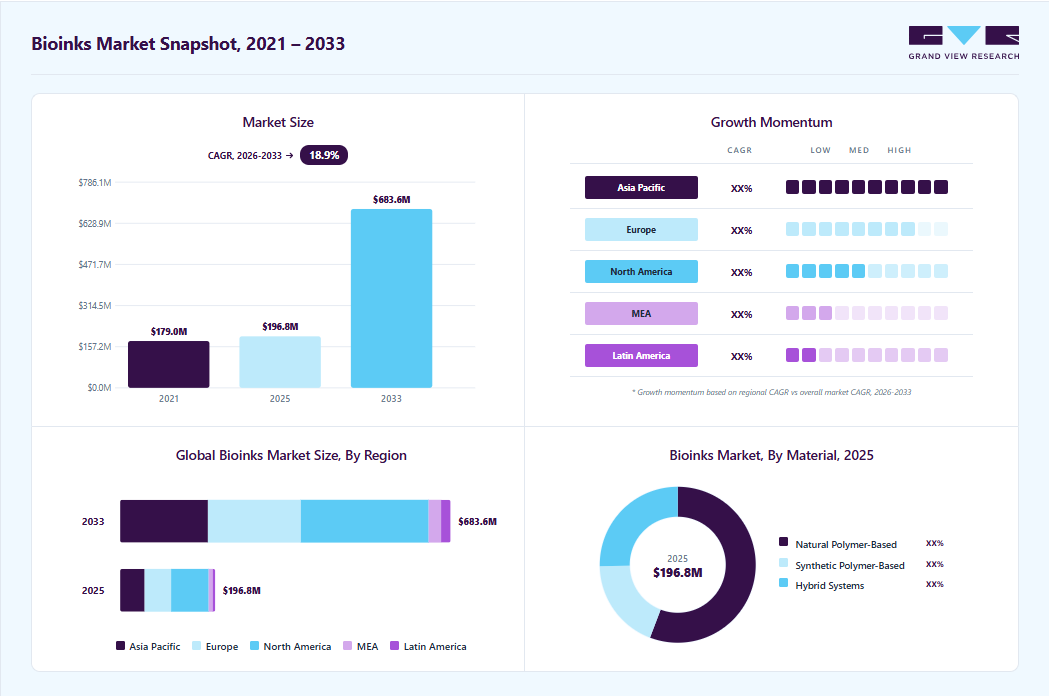
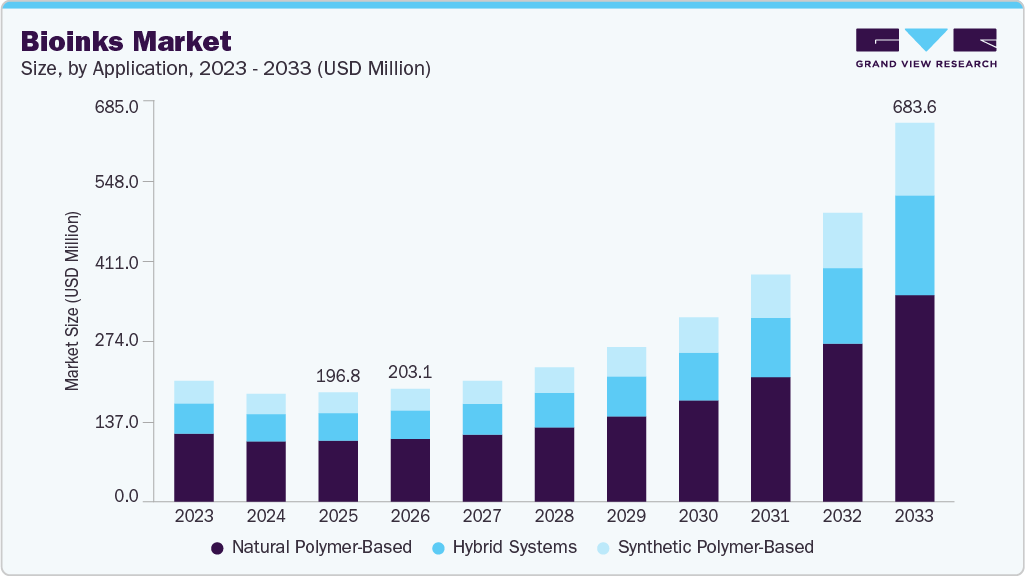
The global bioinks market size was valued at USD 196.8 million in 2025 and is projected to grow from USD 203.1 million in 2026 to USD 683.6 million by 2033, at a CAGR of 18.9% from 2026 to 2033. The market in North America dominated with a revenue share of 39.5% in 2025. The market is primarily driven by the increasing adoption of 3D bioprinting in drug discovery and tissue engineering, as pharmaceutical and biotechnology companies shift toward more predictive, human-relevant testing models.
 Source: Grand View Research, IR Documents, Primary Interviews, Paid DatabasesTo learn more about this report,
 Download Free Sample Report
 Key Market Trends & Insights
- By material: Natural polymer-based segment held the largest market share of 55.8% in 2025.
- By application: Tissue engineering segment held the largest market share of 41.1% in 2025.
Regional Highlights
- Largest regional market: North America (39.5% revenue share, 2025)
- Fastest-growing regional market: Asia Pacific (highest CAGR, 2026-2033)
- By country: The U.S. held the largest market share in 2025
Market Size & Forecast
- Market size in 2025: USD 196.8 Million
- Estimated market size in 2026: USD 203.1 Million
- Projected market size by 2033: USD 683.6 Million
- CAGR (2026-2033): 18.9%
Three ways to get this report
Buy it, customize it, or ask a question.Ask an Analyst
A direct answer, usually in 1 working day
- AccessReport author, directly
- Reply timeWithin 1 working day
- No sales callDirect answer only
- FormatEmail reply
- CostFree, no cost
Get the Full Report
What the study covers
- FormatsPDF · Excel · Dashboard
- Timeline2026–2033 annual, 2025 base
- Coverage20+ countries, 5 regions
- Companies10+ key players profiled
Customize the Report
20% free customization
- IncludeCountries, segments, points
- TailorTo your product definition
- ExtendDeeper competitor detail
- OrA fully bespoke study
- Turnaround5–10 working days
Rising investments in regenerative medicine, coupled with advancements in biomaterials and printing technologies, are accelerating the development of complex tissue constructs. The growing regulatory and ethical pressure to reduce animal testing is further supporting demand for bioink-enabled in vitro models, particularly in pharmaceutical and cosmetic applications.Significant opportunities exist in the expansion of bioinks into commercial drug discovery workflows and organ-on-chip applications, where demand for high-throughput, physiologically relevant models is rapidly increasing. The development of hybrid and functional bioinks with enhanced mechanical and biological properties presents a key avenue for differentiation and premium pricing. In the long term, the successful integration of bioinks into clinical regenerative medicine, including personalized tissue and organ fabrication, has the potential to unlock substantial market value and transform the broader healthcare landscape.
 To learn more about this report, Download Free Sample Report
 Despite strong growth potential, the market faces several structural challenges, including the lack of standardized bioink formulations and limited reproducibility across different platforms. High costs associated with bioinks and bioprinting systems continue to restrict widespread adoption, particularly in cost-sensitive research environments. Furthermore, the clinical translation of bioprinted tissues remains constrained by regulatory uncertainty and long validation timelines, while scalability issues and variability in biological materials pose additional barriers to commercialization.
Market Concentration & Characteristics
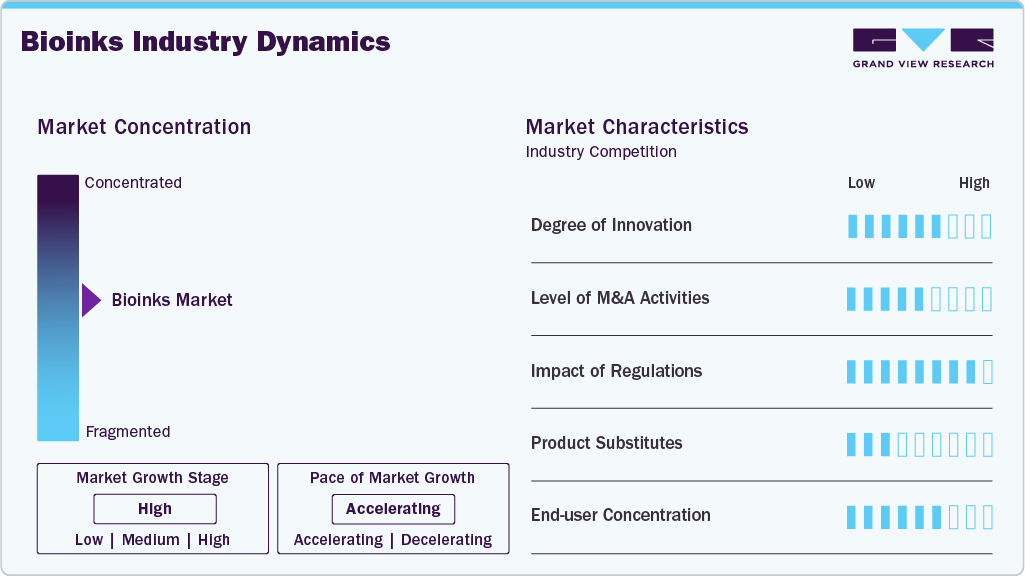
The competitive landscape of the bioinks market is characterized by a hybrid mix of integrated platform providers, biomaterial specialists, and emerging formulation innovators, reflecting the interdisciplinary nature of the industry. Companies such as CELLINK and Allevi, Inc. operate as ecosystem players, offering bioprinters, software, and bioinks, thereby creating strong customer lock-in and recurring revenue streams through consumables. Their strategies are further reinforced through acquisitions, such as the integration of Advanced BioMatrix, to expand capabilities in high-quality biomaterials and reagents, strengthening their position across the value chain.
 To learn more about this report, Download Free Sample Report
 At the same time, the market features a growing cohort of specialized biomaterial and bioink developers focused on differentiation through proprietary formulations and application-specific performance. Companies like CollPlant are advancing recombinant, animal-free bioinks with high reproducibility and scalability, targeting applications in drug discovery, organ-on-chip systems, and regenerative medicine. Other players such as BIO INX, INNOREGEN, Humabiologics, Inc, Viscofan DE GmbH, Scire Science, and large life sciences firms like Merck KGaA are competing through innovation in hybrid materials, human-derived biomaterials, and application-driven bioinks. Overall, competition is increasingly shaped by material performance, reproducibility, and alignment with high-growth applications such as drug discovery and organ-on-chip platforms, rather than scale alone.
Material Insights
Natural polymer-based bioinks dominated the market with the largest revenue share of 55.8% in 2025 due to their superior biocompatibility and inherent ability to mimic the extracellular matrix (ECM), which is critical for maintaining cell viability, proliferation, and differentiation. Materials such as collagen, gelatin, alginate, and fibrin are widely adopted across research and pre-clinical applications, particularly in tissue engineering and early-stage drug testing. Their ease of use, established validation in academic workflows, and compatibility with a wide range of cell types have positioned natural bioinks as the default choice in laboratory settings, thereby driving their significant share of overall market demand.
However, the market is gradually transitioning toward more engineered solutions, with synthetic polymer-based and hybrid systems gaining traction. Synthetic bioinks offer advantages in terms of mechanical strength, reproducibility, and tunability, making them suitable for applications requiring structural precision and scalability. Meanwhile, hybrid systems, combining natural and synthetic components, are emerging as the fastest-growing segment, as they address the limitations of standalone materials by delivering both biological functionality and mechanical performance. This shift reflects an increasing focus on application-specific optimization, particularly in advanced use cases such as organ-on-chip models and future clinical applications in regenerative medicine.
Application Insights
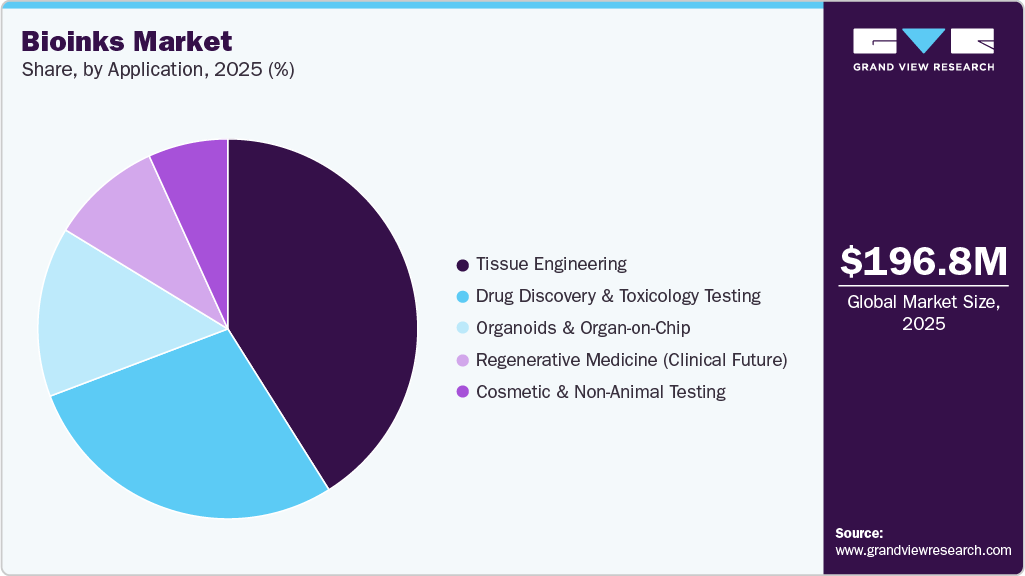
Tissue engineering dominated the bioinks market with the largest revenue share of 41.1% in 2025, primarily due to its foundational role in the development of in vitro and pre-clinical tissue constructs. Bioinks are extensively utilized in fabricating skin, cartilage, and bone models, making tissue engineering the most established and widely adopted application across academic and research institutions. The segment benefits from sustained research funding, high experimental throughput, and broad applicability across multiple therapeutic areas, positioning it as the core demand driver in the current market landscape.
 To learn more about this report, Download Free Sample Report
 The market is witnessing a gradual shift toward more commercially driven applications, particularly in drug discovery and advanced in vitro modeling. Drug discovery & toxicology testing and organoids & organ-on-chip segments are gaining traction due to their ability to provide highly predictive, human-relevant models for pharmaceutical testing, thereby improving efficiency and reducing reliance on animal studies. Meanwhile, regenerative medicine represents a high-impact, long-term opportunity, albeit constrained by regulatory and clinical validation timelines. Cosmetic & non-animal testing, while smaller in scale, continues to expand steadily, supported by evolving regulatory frameworks and industry demand for ethical testing alternatives.
Regional Insights
North America Bioinks Market Trends
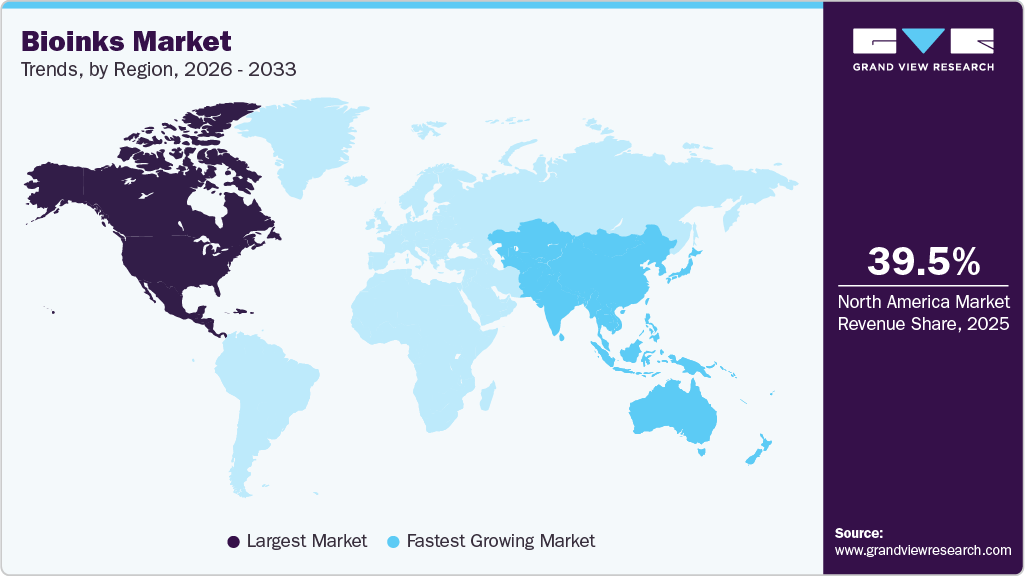
North America accounted for 39.5% of the global bioinks market in 2025, maintaining its position as the leading regional market due to its well-established biotechnology ecosystem, strong research funding, and early adoption of advanced bioprinting technologies. The region benefits from a high concentration of pharmaceutical and biotech companies, robust academic research output, and access to sophisticated laboratory infrastructure. In addition, continuous investments in regenerative medicine and 3D cell culture technologies are reinforcing North America’s leadership in both innovation and commercial adoption.
 To learn more about this report, Download Free Sample Report
 U.S. Bioinks Market Trends
The U.S. represents the dominant share within North America, driven by its leadership in biomedical research, extensive funding from federal agencies, and a strong presence of key industry players. The country serves as the global hub for innovation in bioprinting and bioinks, supported by close collaboration between academia, biotech firms, and healthcare institutions. High adoption of bioinks in drug discovery and translational research further strengthens its position as the largest single-country market globally.
Europe Bioinks Market Trends
Europe captured 27.8% of the global bioinks market in 2025, supported by a strong regulatory framework, advanced research capabilities, and significant public funding for life sciences and biomedical innovation. The region is characterized by a collaborative research environment and increasing focus on ethical testing alternatives, including non-animal models. While commercialization is relatively slower compared to North America, Europe remains a key contributor to technological advancements and standardization efforts in the bioinks space.
Germany held the largest market share in Europe, underpinned by its robust biotechnology sector, strong industrial base, and leadership in engineering and materials science. The country plays a pivotal role in advancing bioink development through academic excellence and industry collaboration, particularly in tissue engineering and biomaterials research. Government support and participation in pan-European research initiatives further enhance Germany’s position as a central innovation hub in the region.
Asia Pacific Bioinks Market Trends
Asia Pacific accounted for 25.7% of the global bioinks market in 2025 and is emerging as the fastest-growing regional market. Growth is driven by increasing government investments in biotechnology, expanding research infrastructure, and rising adoption of advanced healthcare technologies across countries such as China, Japan, and South Korea. The region is transitioning from a research-focused market to a scaling ecosystem, supported by cost advantages and growing participation from domestic players.
China is the largest contributor within the Asia Pacific market, supported by strong government backing, rapid expansion of biotechnology research, and increasing investments in regenerative medicine and 3D bioprinting. The country is positioning itself as a high-growth market, leveraging its manufacturing capabilities and focus on innovation to scale bioink production and adoption. Growing collaboration between academic institutions and industry players is further accelerating market development.
Middle East & Africa Bioinks Market Trends
Middle East & Africa region held a relatively small share of the global bioinks market but is witnessing gradual growth driven by increasing investments in healthcare infrastructure and biotechnology research. Countries such as the UAE and Saudi Arabia are focusing on building innovation ecosystems and supporting advanced medical technologies, including bioprinting. However, limited research infrastructure and funding constraints continue to moderate the pace of adoption.
Latin America Bioinks Market Trends
Latin America is an emerging market for bioinks, characterized by growing academic research activities and increasing interest in advanced biomedical technologies. Countries such as Brazil and Mexico are leading regional adoption, supported by expanding healthcare systems and gradual improvements in research capabilities. While the market remains at an early stage, rising awareness and participation in global research initiatives are expected to support steady growth over the coming years.
Key Bioinks Company Insights
Key players, such as CELLINK, Collplant, Advanced BioMatrix, Allevi, Inc. , BIO INX , and Merck KGaA are dominating the market.
CELLINK
CELLINK is a leading global provider of 3D bioprinting technologies and bioinks, operating as part of the broader BICO Group, a bioconvergence company integrating biology, engineering, and digital technologies. Founded in 2016, the company initially disrupted the market with the launch of the first universal bioink and has since evolved into an integrated platform player, offering a comprehensive portfolio of bioprinters, biomaterials, software, and services tailored for applications in drug discovery, tissue engineering, and regenerative medicine. Its solutions are widely adopted across academic, pharmaceutical, and industrial laboratories, supported by strong global distribution and a growing installed base. By focusing on accessibility, standardization, and end-to-end workflow integration, CELLINK has positioned itself as a market leader driving the commercialization and scalability of bioprinting technologies worldwide.
Key Bioinks Companies:
The following key companies have been profiled for this study on the bioinks market.
- CELLINK
- Collplant
- Advanced BioMatrix
- Allevi, Inc.
- BIO INX
- Merck KGaA
- Humabiologics, Inc
- INNOREGEN
- Viscofan DE GmbH
- Scire Science
Recent Developments
-
In March 2026, CollPlant launched BioFlex, a ready-to-print recombinant human collagen-based bioink kit for DLP bioprinting, aimed at enabling high-resolution tissue fabrication for drug discovery and regenerative applications.
-
In March 2026, Collplant expanded its North American footprint by establishing a U.S.-based logistics and distribution center, enhancing supply chain efficiency and supporting growing demand for its bioink portfolio.
Bioinks Market Report Scope
Report Attribute
Details
Market size in 2025
USD 196.8 million
Estimated market size in 2026
USD 203.1 million
Projected market size by 2033
USD 683.6 million
Growth rate
CAGR of 18.9% from 2026 to 2033
Base year for estimation
2025
Historical data
2021 - 2024
Forecast period
2026 - 2033
Quantitative units
Revenue in USD million/billion, volume in kilotons, and CAGR from 2026 to 2033
Report coverage
Revenue forecast, company ranking, competitive landscape, growth factors, and trends
Segments covered
Material, application, and region
Regional scope
North America; Europe; Asia Pacific; Middle East & Africa; Latin America
Country scope
U.S.; Canada; Mexico; Germany; UK; France; Italy; Spain; China; India; Japan; South Korea; Brazil; Argentina; South Africa; Saudi Arabia
Key companies profiled
CELLINK; Collplant; Advanced BioMatrix; Allevi, Inc.; BIO INX; Merck KGaA; Humabiologics, Inc; INNOREGEN; Viscofan DE GmbH; Scire Science
Customization scope
Free report customization (equivalent up to 8 analysts’ working days) with purchase. Addition or alteration to country, regional & segment scope.
Pricing and purchase options
Avail customized purchase options to meet your exact research needs. Explore purchase options
Global Bioinks Market Report Segmentation
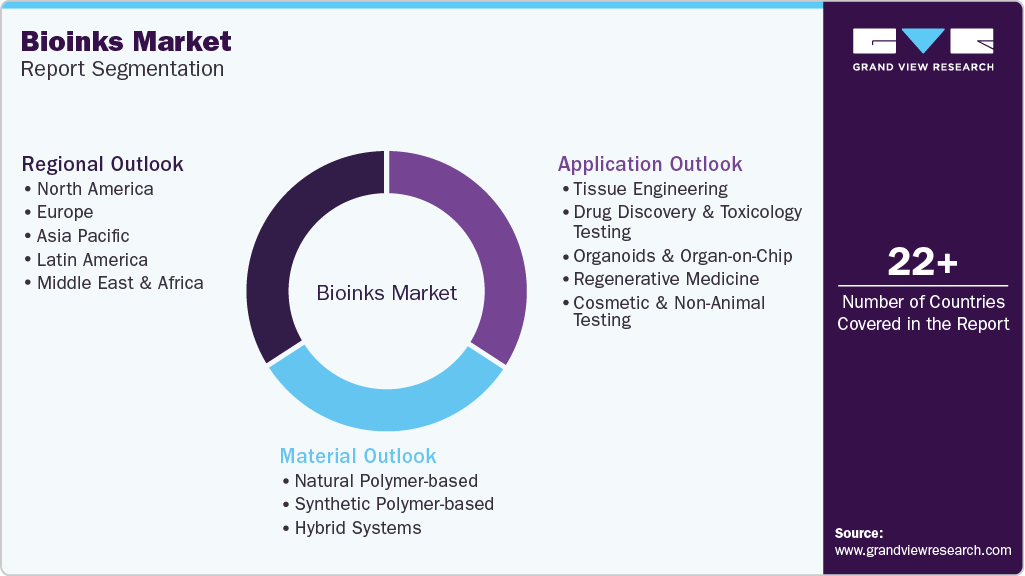
This report forecasts revenue growth at global, regional, and country levels and provides an analysis of the latest industry trends in each of the sub-segments from 2021 to 2033. For this study, Grand View Research has segmented the global bioinks market report based on material, application, and region.
 To learn more about this report, Download Free Sample Report
 -
Material Outlook (Volume, Kilotons; Revenue, USD Million, 2021 - 2033)
-
Natural Polymer-based
-
Synthetic Polymer-based
-
Hybrid Systems
-
-
Application Outlook (Volume, Kilotons; Revenue, USD Million, 2021 - 2033)
-
Tissue Engineering
-
Drug Discovery & Toxicology Testing
-
Organoids & Organ-on-Chip
-
Regenerative Medicine
-
Cosmetic & Non-Animal Testing
-
-
Regional Outlook (Volume, Kilotons; Revenue, USD Million, 2021 - 2033)
-
North America
-
U.S.
-
Canada
-
Mexico
-
-
Europe
-
Germany
-
UK
-
France
-
Italy
-
Spain
-
-
Asia Pacific
-
China
-
India
-
Japan
-
South Korea
-
-
Middle East & Africa
-
Saudi Arabia
-
South Africa
-
-
Latin America
-
Brazil
-
Argentina
-
-
Frequently Asked Questions About This Report
Asia Pacific is the fastest-growing region over the forecast period.
The natural polymer-based bioinks led the market with a 55.8% revenue share in 2025.
Tissue engineering dominated the market with a 41.1% revenue share in 2025.
The global bioinks market size was valued at USD 196.8 million in 2025 and is estimated at USD 203.1 million for 2026.
Key players include CELLINK; Collplant; Advanced BioMatrix; Allevi, Inc.; BIO INX; Merck KGaA; Humabiologics, Inc; INNOREGEN; Viscofan DE GmbH; and Scire Science.
North America dominated the bioinks market with a 39.5% revenue share in 2025.
The global bioinks market is expected to grow at a CAGR of 18.9% from 2026 to 2033, reaching USD 683.6 million.
Key factors include the increasing adoption of 3D bioprinting in drug discovery and tissue engineering, rising investments in regenerative medicine, advancements in biomaterials and printing technologies, growing demand for human-relevant testing models, and increasing regulatory and ethical pressure to reduce animal testing.
About the Author(s)
Paints, Coatings & Printing Inks Research Team
Bulk Chemicals · Paints, Coatings & Printing InksThis report was authored by the paints, coatings & printing inks research team at Grand View Research - comprising two research analysts, one senior research analyst, and one industry expert - with specialized expertise in the paints, coatings & printing inks segment of the bulk chemicals industry. All findings are based on proprietary bulk chemicals databases, executive interviews, and regulatory analysis, subject to internal peer review prior to publication.
Last Updated:
Speak to Analyst

Customize this report to your needs - add regions, segments, or data points, with 20% free customization.
Or view our licence options:


ISO 9001:2015 & 27001:2022 Certified
We are GDPR and CCPA compliant! Your transaction & personal information is safe and secure. For more details, please read our privacy policy.


