
- Home
- »
- Advanced Interior Materials
- »
-
Biomass Boilers Market Size And Share Report, 2026-2033GVR Report cover

Biomass Boilers Market (2026 - 2033)
Size, Share & Trends Analysis Report By Fuel Type (Wood Chip Boilers, Pellet Boilers, Log Boilers), By End-use (Commercial, Residential), By Application (Heating, Power Generation), By Capacity, By Region, And Segment Forecasts
Market Size, 2025
$7.8BMarket Estimate, 2026
$8.4BMarket Forecast, 2033
$15.5BCAGR, 2026–2033
9.2%Biomass Boilers Market Summary
The global biomass boilers market size was valued at USD 7.8 billion in 2025 and is projected to grow from USD 8.4 billion in 2026 to USD 15.5 billion by 2033, at a CAGR of 9.2% from 2026 to 2033. The market in Europe dominated with a revenue share of 40.0% in 2025. The growth of the biomass boilers industry is driven by the increasing emphasis on renewable energy sources and the need to reduce carbon emissions.
 Source: Grand View Research, IR Documents, Primary Interviews, Paid DatabasesTo learn more about this report,
 Download Free Sample Report
 Key Market Trends & Insights
- By fuel type: Pellet boilers segment held the largest market share of 41.0% in 2025.
- By capacity: 10kw to 20kw segment held the largest market share of 31.1% in 2025.
- By application: Heating segment held the largest market share of 54.5% in 2025.
- By end use: Residential segment held the largest market share of 43.2% in 2025.
Regional Highlights
- Largest regional market: Europe (40.0% revenue share, 2025)
- By country: Germany held the largest market share in 2025
Market Size & Forecast
- Market size in 2025: USD 7.8 Billion
- Estimated market size in 2026: USD 8.4 Billion
- Projected market size by 2033: USD 15.5 Billion
- CAGR (2026-2033): 9.2%
GVR research-powered AIAsk Prism AI about the biomass boilers marketGet cited answers from GVR research on market growth, segments, regulations and forecasts.Start with✓ Source-linked answers ✓ Market-specific context ✓ Traceable figuresExplore Prism AI ↗Governments worldwide are offering incentives, subsidies, and tax rebates to encourage the adoption of biomass boilers as part of their sustainability and energy transition goals.
 To learn more about this report, Download Free Sample Report
 These boilers provide a cleaner alternative to fossil fuel-based heating systems, aligning with global efforts to promote energy efficiency and combat climate change. Advancements in biomass boiler technology have improved their efficiency, performance, and affordability, making them more accessible to residential, commercial, and industrial users.
 To learn more about this report, Download Free Sample Report
 Market Dynamics
The biomass boilers market is driven by the growing demand for renewable heating solutions, supportive government policies for decarbonization, and increasing utilization of agricultural and forestry residues for energy production. Rising energy costs and the need to reduce dependence on fossil fuels are encouraging the adoption of biomass-based heating systems across residential, commercial, and industrial sectors. Technological advancements are improving boiler efficiency and emission performance, enhancing market competitiveness. However, high installation costs and inconsistent biomass fuel supply can limit adoption. Expanding district heating networks, industrial decarbonization initiatives, and investments in sustainable energy infrastructure are expected to create significant growth opportunities.
The increasing demand for renewable and low-carbon heating solutions is a major driver for the biomass boilers market. Governments, industries, and building owners are seeking alternatives to fossil fuel-based heating systems to reduce greenhouse gas emissions and meet sustainability targets. Biomass boilers use renewable feedstocks such as wood pellets, wood chips, agricultural residues, and forestry waste, making them an attractive option for clean heat generation.
High initial installation and infrastructure costs represent a significant restraint for the biomass boilers market. Biomass heating systems require substantial upfront investment for boiler units, fuel storage facilities, feeding systems, emission control equipment, and installation activities. In many applications, additional modifications to existing heating infrastructure are necessary, increasing project costs. Fuel handling and storage requirements can also occupy considerable space, limiting adoption in urban and space-constrained environments.
The expansion of industrial decarbonization initiatives and district heating projects presents a significant opportunity for the biomass boilers market. Industries with substantial heat requirements are increasingly replacing fossil fuel systems with renewable heating technologies to reduce carbon emissions and comply with environmental regulations. Biomass boilers can provide reliable and continuous thermal energy for manufacturing processes, food processing, pulp and paper production, and other industrial applications.
Market Concentration & Characteristics
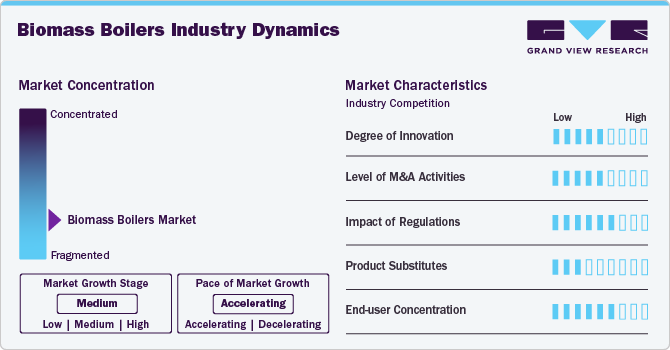
The biomass boilers industry is moderately fragmented, with a mix of large, established players and smaller, regional companies competing for market share. Leading manufacturers are focusing on offering innovative and efficient biomass heating solutions that cater to a variety of residential, commercial, and industrial applications.
As governments worldwide implement stricter environmental regulations and promote renewable energy adoption, key players in the market are increasingly investing in sustainable technologies that reduce carbon emissions and improve the efficiency of biomass boilers. Regulatory bodies, such as the European Union and various national authorities, are playing a critical role in driving market growth by setting standards for emissions, energy efficiency, and the use of renewable energy sources. Compliance with these regulations is essential for manufacturers to remain competitive and meet the growing demand for eco-friendly heating solutions.
 To learn more about this report, Download Free Sample Report
 The growing emphasis on sustainability, energy independence, and reducing reliance on fossil fuels is prompting both the public and private sectors to adopt biomass-based heating systems. As a result, manufacturers are also exploring opportunities for technological innovation, such as improving fuel flexibility and enhancing the performance of biomass boilers. Additionally, the rising awareness about climate change and the environmental impact of conventional heating methods is encouraging both consumers and businesses to transition to more sustainable alternatives like biomass boilers. With the ongoing push for cleaner energy solutions, the biomass boilers market is poised for steady growth, particularly in regions with abundant biomass resources and supportive government policies.
Analyst Perspective
The biomass boilers market is expanding as governments and industries seek practical alternatives to fossil fuel-based heating systems. Demand is being supported by decarbonization goals, rising energy security concerns, and the growing use of locally available biomass resources such as wood pellets, chips, and agricultural residues. Industrial and commercial sectors are expected to remain key adopters due to their significant heat requirements and sustainability commitments. Technological advancements in combustion efficiency, automation, and emission control are improving system performance and reliability. While high upfront costs and fuel supply logistics remain challenges, supportive policies and investments in renewable heating infrastructure are expected to strengthen long-term market prospects.
Drivers, Opportunities & Restraints
Rising energy prices and growing awareness about the environmental impact of conventional heating methods are further encouraging consumers and businesses to turn to biomass as a sustainable and cost-effective heating solution. As the construction of energy-efficient buildings and sustainable infrastructure increases, the demand for biomass boilers is expected to continue growing, particularly in regions with abundant biomass resources.
While biomass boilers offer long-term cost savings through lower fuel costs, the upfront investment in Fuel Type, installation, and maintenance can be a significant barrier for many consumers, particularly in residential applications.
As governments continue to enforce stricter emissions regulations and offer incentives for renewable energy adoption, the demand for biomass boilers is expected to rise. The growing emphasis on energy independence and reducing reliance on fossil fuels presents an opportunity for biomass boilers, particularly in rural and off-grid areas.
Fuel Type Insights
The demand for wood chip boilers is increasing due to their ability to efficiently utilize locally sourced biomass, making them an attractive option for rural areas and businesses seeking to reduce energy costs. As the focus on sustainable energy solutions grows, wood chip boilers are gaining popularity for their affordability, fuel availability, and lower carbon emissions compared to fossil fuels.
Based on fuel type, the pellet boilers segment led the market with the largest revenue share of 41.0% in 2025. Pellet boilers are seeing rising demand due to their convenience, efficiency, and ability to produce consistent heat from compressed wood pellets. With advancements in pellet technology, these systems are becoming more user-friendly and cost-effective, making them a popular choice for residential and small commercial applications looking for a reliable and eco-friendly heating solution.
End-use Insights
The adoption of biomass boilers in both industrial and residential applications is being driven by several key factors. In industrial settings, biomass boilers offer a cost-effective and sustainable alternative to conventional heating systems, helping businesses reduce energy costs and carbon emissions. With industries increasingly facing pressure to meet sustainability goals and comply with stringent environmental regulations, biomass boilers provide an eco-friendly solution by utilizing renewable biomass materials like wood chips, pellets, and agricultural waste.
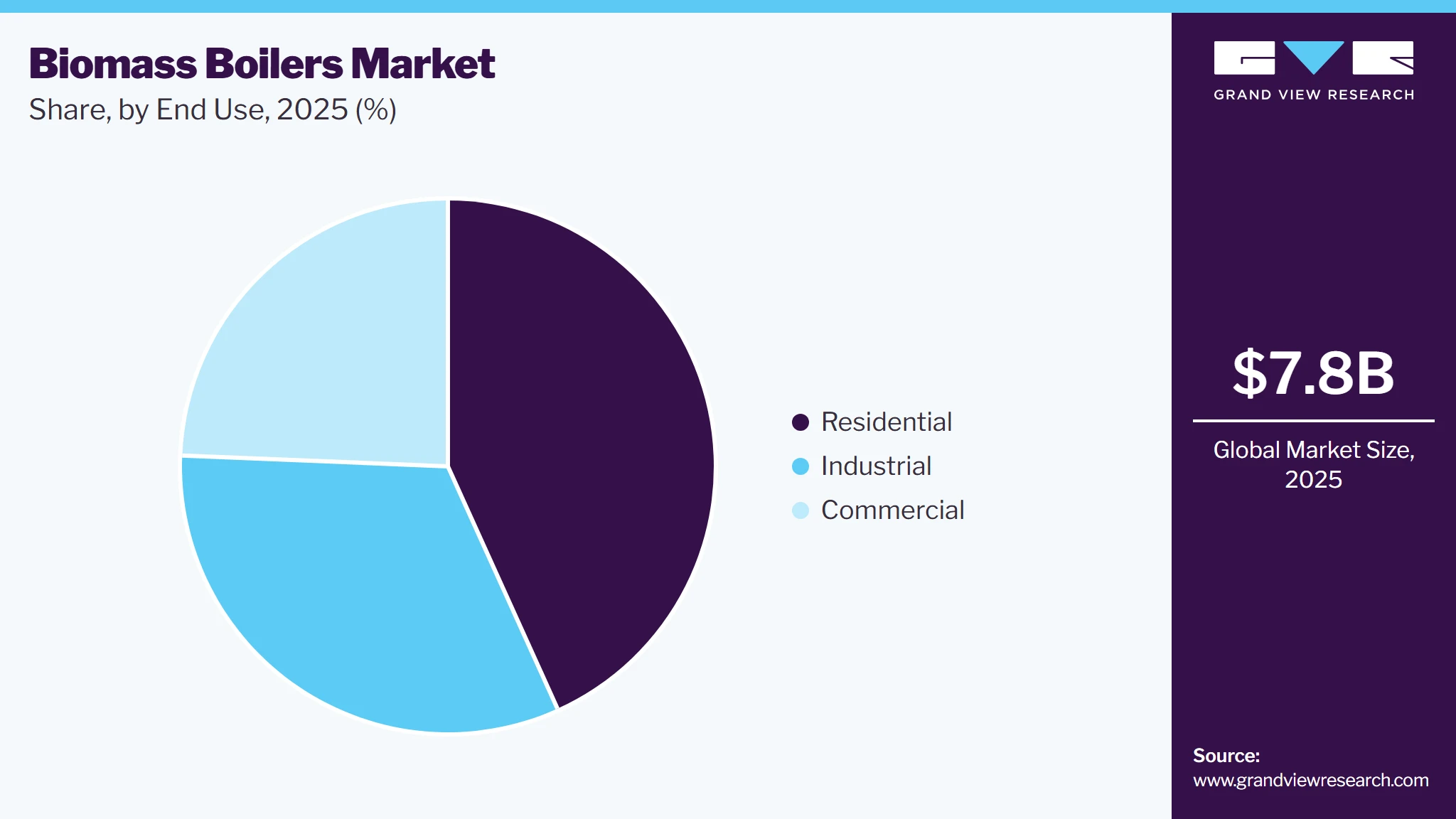
Based on end use, the residential segment led the market with the largest revenue share of 43.2% in 2025. For residential applications, the growing awareness of climate change and rising energy costs are encouraging homeowners to seek energy-efficient heating systems. Biomass boilers, which provide a consistent and renewable heat source, offer significant long-term savings by reducing reliance on expensive fossil fuels. Additionally, government incentives and subsidies for renewable energy systems are further driving the adoption of biomass boilers in residential buildings. As technology improves, biomass boilers are becoming more accessible and user-friendly, making them a viable and attractive option for homeowners looking to reduce their environmental impact.
Capacity Insights
The demand for 20 kW to 50 kW systems is increasing due to the growing focus on energy efficiency and sustainability in industries. These systems are ideal for applications that require reliable, medium-scale power generation, such as commercial buildings, industrial facilities, and renewable energy projects. Technological advancements and government incentives for green energy are also fueling this growth. Additionally, the shift toward decentralized power production is driving the adoption of such systems.
Based on capacity, the 10kW to 20kW segment led the market with the largest revenue share of 31.1% in 2025, accounting for a 31.0% market share in 2024 due to its versatility and cost-effectiveness for small to medium-scale energy needs. This range is ideal for residential, small business, and remote applications, offering a balance between power output and affordability. As energy demands increase in urban and rural areas, these systems provide an efficient solution for a wide variety of users. The availability of supportive policies and incentives for renewable energy further boosts the segment's dominance.
Application Insights
The demand for biomass boilers for generating power is driven by the shift toward renewable energy sources to reduce greenhouse gas emissions and reliance on fossil fuels. Biomass boilers offer a reliable and scalable solution for power generation, enabling the conversion of biomass into electricity while contributing to a cleaner, more sustainable energy mix. As governments implement stricter emissions regulations and offer incentives for renewable energy adoption, biomass boilers are gaining traction in the power generation sector.
 To learn more about this report, Download Free Sample Report
 Based on application, the heating segment led the market with the largest revenue share of 54.5% in 2025, driven by the growing need for energy-efficient and sustainable heating solutions. As global energy prices rise and environmental concerns intensify, biomass boilers provide a cost-effective, renewable alternative to fossil fuel-based heating systems, particularly in residential, commercial, and industrial settings. Their ability to utilize locally sourced biomass materials like wood chips and pellets helps reduce energy costs and supports energy independence.
Regional Insights
North America biomass boilers market is driven by increasing government incentives and regulations promoting renewable energy adoption. The rising emphasis on reducing carbon emissions and the need for more sustainable heating solutions, particularly in industrial and commercial sectors, are also boosting market growth. Furthermore, the region's vast agricultural and forestry resources provide a steady supply of biomass feedstocks, enhancing the feasibility and cost-effectiveness of biomass boilers.
U.S. Biomass Boilers Market Trends
The biomass boiler industry in the U.S. accounted for 72.9% of the regional market share in 2025. In the U.S., the growth of the market is driven by increasing government support for renewable energy technologies and the shift toward sustainable energy solutions. Federal and state-level incentives, such as tax credits and rebates, encourage the adoption of biomass boilers in residential, commercial, and industrial sectors.
Europe Biomass Boilers Market Trends
Europe dominated the biomass boilers market with the largest revenue share of 40.0% in 2025. The biomass boiler market in Europe is increasing due to the region’s focus on reducing its reliance on coal and decreasing air pollution. For example, the Poland government’s incentives, including subsidies for renewable energy systems, are helping to accelerate the adoption of biomass boilers, particularly in residential and district heating applications. With Poland’s abundance of agricultural residues and forestry products, biomass boilers offer an attractive solution for utilizing locally available resources while achieving energy independence and sustainability.
 To learn more about this report, Download Free Sample Report
 The biomass boilers industry in Germany held the largest share in the Europe region in 2025, accounting for 29.5% of the overall revenue share of the regional market. Germany’s biomass boiler market is being driven by the country’s aggressive renewable energy targets and its commitment to reducing greenhouse gas emissions. The country’s policies, including feed-in tariffs and other financial incentives, are encouraging widespread adoption of biomass boilers in both residential and industrial sectors. Germany’s strong commitment to sustainability, coupled with a well-established biomass feedstock supply chain, makes biomass boilers a key component of its renewable energy strategy.
Asia Pacific Biomass Boilers Market Trends
The biomass boiler market in Asia Pacific is driven by rapid urbanization and industrial growth. Countries like China, India, and Japan are focusing on reducing their carbon footprint and improving energy efficiency, which is spurring investments in renewable energy technologies like biomass boilers. Government support in the form of subsidies, regulations promoting clean energy, and the region’s large agricultural sector also contribute to the market's expansion.
India biomass boiler market is projected to expand at a CAGR of 11.0% over the forecast period. The growth of the market in the nation is driven by increasing energy demand and the need for more sustainable energy solutions in rural and industrial areas. The government’s focus on renewable energy, energy efficiency, and waste-to-energy projects is promoting the adoption of biomass boilers as a viable alternative to conventional heating and power generation systems. Biomass boilers are also gaining traction in industries like textiles and agriculture, where biomass feedstocks are abundant and cost-effective.
The biomass boilers market in China accounted for 45.9% of the regional market share in 2025 driven by rapid industrialization, urbanization, and the government’s commitment to reducing air pollution and carbon emissions are driving the demand for biomass boilers. The Chinese government has implemented policies to promote renewable energy adoption and reduce dependence on coal, creating a favorable market for biomass technologies. Additionally, China’s large agricultural sector provides a consistent supply of biomass feedstocks, making biomass boilers an attractive and sustainable energy solution for both heating and power generation.
Middle East & Africa Biomass Boilers Market Trends
The biomass boiler market in the Middle East and Africa is driven by the growing demand for renewable energy solutions to reduce dependence on fossil fuels is driving biomass boiler adoption. Countries in the Middle East are investing in sustainable energy infrastructure, with biomass systems being integrated into broader renewable energy initiatives. In Africa, the potential for off-grid biomass power generation and the availability of biomass feedstocks in agricultural regions are encouraging the adoption of biomass boilers, especially for rural energy needs and small-scale industrial applications.
Latin America Biomass Boilers Market Trends
The biomass boiler market in Latin America is fueled by the region's push for sustainable energy solutions and reliance on local biomass resources, such as agricultural residues and wood. Government incentives aimed at reducing carbon emissions and increasing the share of renewable energy are creating a favorable environment for biomass adoption. Additionally, growing industrialization and increasing energy demands in the region make biomass boilers an attractive option for both heating and power generation.
Key Biomass Boilers Company Insights
Some of the key players operating in the market include Caterpillar Inc. and XCMG Group among others.
-
ANDRITZ is a global supplier of solutions to the metals, environment & energy, pulp & paper, and hydropower sectors. The company has a diverse range of sustainable products and solutions offered by operations spread across over 280 locations in over 80 countries.
-
Thermax Limited specializes in the production and sale of products related to water and waste management, specialty chemicals, and heating. The company is also involved in the design, construction, and commission of large boilers for power and steam generation, waste heat recovery systems, air pollution control projects, turnkey power plants, and industrial and municipal wastewater treatment facilities.
Key Biomass Boilers Companies:
The following key companies have been profiled for this study on the biomass boiler market.
- ANDRITZ
- Thermax Limited
- Isgec Heavy Engineering Ltd.
- HARGASSNER Ges mbH
- INNASOL GROUP LTD.
- TATANO s.n.c.
- ÖkoFEN
- Justsen Energiteknik A/S
- ATMOS
- Säätötuli Canada Enterprises inc.
- Fink Machine Inc
- Fröling Heizkessel
- Evergreen
- Heizomat Canada Inc.
- Maanya Group
Competitive Benchmarking
Category
Operating Strategies
Competitive Edge
Weakness
Established Players (e.g. ANDRITZ, Thermax Limited, Isgec Heavy Engineering Ltd., HARGASSNER Ges mbH, ÖkoFEN)
- Focus on expanding biomass boiler portfolios for residential, commercial, industrial, and district heating applications.
- Invest in high-efficiency combustion technologies, automation, and advanced emission control systems.
- Strengthen collaborations with utilities, industrial customers, EPC contractors, and renewable energy developers.
- Strong technological expertise in biomass combustion and thermal energy systems.
- Broad product portfolios with advanced engineering and integrated energy solutions.
- Established customer relationships and extensive global sales and service networks.
- High research, development, and manufacturing costs.
- Dependence on renewable energy policies and biomass fuel supply dynamics.
- Long project development and installation timelines for large-scale biomass heating systems.
Emerging & Regional Players (e.g Innasol Group Ltd., TATANO s.n.c., Justsen Energiteknik A/S, ATMOS, Fröling Heizkessel)
- Focus on specialized and application-specific biomass boiler solutions for niche heating and industrial applications.
- Expand market presence through customized product development and regional distribution partnerships.
- Emphasize flexible boiler designs compatible with diverse biomass fuel types and customer requirements.
- Competitive pricing and greater flexibility in customized boiler solutions.
- Ability to address local biomass availability and specialized heating applications.
- Agile operations enabling quicker response to changing market demands and regulatory requirements.
- Limited financial capacity for large-scale technology development and international expansion.
- Smaller global sales, installation, and after-sales service networks compared with established competitors.
- Lower participation in large industrial and district heating projects due to limited project execution capabilities.
Recent Developments
-
In October 2024, INNASOL GROUP LTD. acquired Y Pellets, a prominent UK biomass heat company, to bolster the UK's renewable energy initiatives. The acquisition, valued at USD 4.3 million, allows Innasol to enhance its offerings in the biomass sector while retaining the Y Pellets brand.
-
In September 2024, Boccard acquired Leroux & Lotz Technologies (LLT), a well-established French industrial boiler manufacturer, positioning itself as a European leader in renewable thermal energy. This merger combines Boccard's extensive experience in industrial equipment with LLT's expertise in biomass and waste recovery systems, facilitating the construction of integrated renewable thermal power plants.
Biomass Boilers Market Report Scope
Report Attribute
Details
Market size in 2025
USD 7.8 billion
Estimated market size in 2026
USD 8.4 billion
Projected market size by 2033
USD 15.5 billion
Growth rate
CAGR of 9.2% from 2026 to 2033
Base year for estimation
2025
Historical data
2021 - 2024
Forecast period
2026 - 2033
Quantitative units
Revenue in USD billion and CAGR from 2026 to 2033
Report coverage
Revenue forecast, company ranking, competitive landscape, growth factors, and trends
Segments covered
Fuel type, capacity, end use, application, region
Regional scope
North America; Europe; Asia Pacific; Latin America; Middle East & Africa
Country scope
U.S., Canada, Mexico, Poland, Austria, Germany, France, Italy, China, India, Japan, Indonesia, South Korea, Brazil, Argentina, South Africa, Saudi Arabia, UAE
Key companies profiled
ANDRITZ, Thermax Limited, Isgec Heavy Engineering Ltd., HARGASSNER Ges mbH, Innasol Group ltd., TATANO s.n.c., ÖkoFEN, Justsen Energiteknik A/S, ATMOS, Säätötuli Canada Enterprises inc., Fink Machine Inc, Fröling Heizkessel, Evergreen, Heizomat Canada Inc., Maanya Group
Customization scope
Free report customization (equivalent up to 8 analysts' working days) with purchase. Addition or alteration to country, regional & segment scope.
Pricing and purchase options
Avail customized purchase options to meet your exact research needs. Explore purchase options
Global Biomass Boilers Market Report Segmentation
This report forecasts revenue growth at global, regional & country levels and provides an analysis of the industry trends in each of the sub-segments from 2021 to 2033. For this study, Grand View Research has segmented the global biomass boilers market report on the basis of fuel type, end-use, capacity, application, and region:
-
Fuel Type Outlook (Revenue, USD Million, 2021 - 2033)
-
Wood Chip Boilers
-
Pellet Boilers
-
Log Boilers
-
Organic Waste Boilers
-
-
End-use Outlook (Revenue, USD Million, 2021 - 2033)
-
Commercial
-
Residential
-
Industrial
-
-
Capacity Outlook (Revenue, USD Million, 2021 - 2033)
-
Below 10kW
-
10kW to 20kW
-
20kW to 50kW
-
Above 50kW
-
-
Application (Revenue, USD Million, 2021 - 2033)
-
Heating
-
Power Generation
-
-
Regional Outlook (Revenue, USD Million, 2021 - 2033)
-
North America
-
U.S.
-
Canada
-
Mexico
-
-
Europe
-
Poland
-
Austria
-
France
-
Germany
-
Italy
-
-
Asia Pacific
-
China
-
India
-
Japan
-
South Korea
-
Indonesia
-
-
Latin America
-
Brazil
-
Argentina
-
-
Middle East & Africa
-
South Africa
-
Saudi Arabia
-
UAE
-
-
Research Methodology
The biomass boilers market figures in this report are based on a proven research process that combines executive interviews with secondary research from proprietary databases, company filings, and recognized regulatory and institutional sources. Market size is built through value-chain sizing - reconciling supply-side and demand-side estimates - and triangulated with bottom-up and top-down approaches. Every estimate passes multiple levels of expert validation before publication, with each biomass boilers segment quantified using the revenue-capture definitions in the table below.
Segment Definition
Segment - Fuel Type
Revenue Capture Definition
Wood Chip Boilers
Revenue is derived from the sale of biomass boilers designed to use wood chips as the primary fuel for heat generation.
Pellet Boilers
Revenue is generated through the sale of biomass boilers that operate on compressed biomass or wood pellets.
Log Boilers
Revenue is earned from the sale of biomass boilers intended to burn logs and other solid wood fuels for heating applications.
Organic Waste Boilers
Revenue is obtained from the sale of biomass boilers capable of utilizing organic waste materials as a renewable energy source.
Segment -End Use
Revenue Capture Definition
Commercial
Revenue is generated from supplying biomass boilers for heating and energy requirements in commercial establishments.
Residential
Revenue is captured through the sale of biomass boilers installed in residential buildings for space and water heating.
Industrial
Revenue is derived from the sale of biomass boilers used in industrial facilities for process heating and energy production.
Segment - Capacity
Revenue Capture Definition
Below 10kW
Revenue is generated through the sale of biomass boilers with capacities below 10kW for small-scale heating applications.
10kW to 20kW
Revenue is earned from the sale of biomass boilers with capacities ranging from 10kW to 20kW for moderate heating needs.
20kW to 50kW
Revenue is obtained from the sale of biomass boilers with capacities between 20kW and 50kW for medium-scale installations.
Above 50kW
Revenue is captured from the sale of high-capacity biomass boilers exceeding 50kW for commercial, industrial, and district heating projects.
Segment - Application
Revenue Capture Definition
Heating
Revenue is generated from the sale of biomass boilers deployed for space heating, water heating, and process heating applications.
Power Generation
Revenue is derived from the sale of biomass boilers incorporated into electricity generation and combined heat and power systems.
Estimation Model
Layer Name
Key Question
Description
Heat Demand and End-use Industry Layer
Which industries generate demand for biomass boilers?
The estimation begins by evaluating heating and energy requirements across residential, commercial, and industrial sectors. Growth in sustainable heating, industrial process heat demand, district heating networks, and renewable energy adoption establishes the base market demand.
Biomass Fuel Adoption Layer
Which fuel types drive market demand?
This layer refines demand by assessing the adoption of wood chip, pellet, log, and organic waste boilers. Fuel availability, feedstock costs, regional biomass resources, and environmental regulations influence fuel type selection.
Boiler Capacity and Application Deployment Layer
What determines biomass boiler installations?
Market demand is estimated through the adoption of biomass boilers across different capacity ranges and applications, including heating and power generation. Industrial expansions, commercial infrastructure development, residential heating projects, and equipment replacement cycles further support demand.
Revenue Layer
How is total market revenue calculated?
Revenue is estimated by aggregating biomass boiler sales across fuel types, capacities, applications, end-use sectors, and regional markets. Renewable energy investments, district heating developments, industrial decarbonization projects, replacement demand, and manufacturer revenues are incorporated to validate the total market size.
Delivered Customizations
This report has been delivered with the following In-depth customizations
Client Request
Customization Delivered
Value Adds
Regional Segmentation
Detailed regional analysis covered North America, Europe, Asia Pacific, Latin America, and the Middle East & Africa, with country-level assessment of key markets. The study evaluated biomass resource availability, renewable heating adoption, industrial and commercial heating demand, district heating developments, government incentives, and energy transition policies influencing biomass boiler demand.
Helped identify high-growth regions, country-specific opportunities, and evolving demand trends across residential, commercial, and industrial heating sectors, supporting market entry strategies, regional expansion planning, and identification of emerging renewable energy hubs.
Competitive Benchmarking
Comprehensive benchmarking assessed major participants based on product portfolio, biomass boiler technologies, engineering capabilities, manufacturing strength, automation features, regional presence, aftermarket services, and distribution networks. The study also compared established and emerging players in the biomass boilers market.
Assisted clients in evaluating competitor positioning, technological capabilities, and market gaps while supporting strategic planning, partnership opportunities, product differentiation, and investment decisions across renewable heating and industrial energy applications.
Opportunity Assessment
In-depth opportunity assessment analyzed industrial decarbonization initiatives, district heating expansions, renewable energy investments, biomass fuel supply developments, and growth in sustainable heating infrastructure. The study identified emerging opportunities in high-efficiency biomass boilers, automated fuel handling systems, and combined heat and power (CHP) applications.
Enabled clients to identify high-growth investment areas, prioritize regional expansion, and evaluate future revenue opportunities while supporting product development, technology adoption, and long-term growth strategies in the biomass boilers market.
Frequently Asked Questions About This Report
10kW to 20kW capacity segment led the market with the largest revenue share of 31.1% in 2025.
The heating segment led the market with the largest revenue share of 54.5% in 2025.
Residential segment held the largest share (over 43.0%) in 2025.
Europe accounted for largest market share of 40.0% in 2025.
The global biomass boilers market size was valued at USD 7.8 billion in 2025 and is estimated at USD 8.4 billion for 2026.
Some of the key players operating in the biomass boilers market are ANDRITZ, Thermax Limited, Isgec Heavy Engineering Ltd., HARGASSNER Ges mbH, Innasol Group ltd., TATANO s.n.c., ÖkoFEN, Justsen Energiteknik A/S, ATMOS, Säätötuli Canada Enterprises inc., Fink Machine Inc, Fröling Heizkessel, Evergreen, Heizomat Canada Inc., and Maanya Group.
The global biomass boilers market is expected to grow at a CAGR of 9.2% from 2026 to 2033, reaching USD 15.5 billion by 2033.
The pellet boilers segment led the market with the largest revenue share of 41.0% in 2025.
Key factors driving the biomass boilers market include increasing government support for renewable energy adoption and growing demand for sustainable heating solutions. Additionally, rising energy costs and the push for carbon emission reduction are encouraging businesses and homeowners to invest in biomass boilers.
About the Author(s)
Advanced Interior Materials Research Team
Advanced Materials · Advanced Interior MaterialsThis report was authored by the advanced interior materials research team at Grand View Research - comprising two research analysts, one senior research analyst, and one industry expert - with specialized expertise in the advanced interior materials segment of the advanced materials industry. All findings are based on proprietary advanced materials databases, executive interviews, and regulatory analysis, subject to internal peer review prior to publication.
Last Updated:
Speak to Analyst

Customize this report to your needs - add regions, segments, or data points, with 20% free customization.
Or view our licence options:


ISO 9001:2015 & 27001:2022 Certified
We are GDPR and CCPA compliant! Your transaction & personal information is safe and secure. For more details, please read our privacy policy.


