
- Home
- »
- Medical Devices
- »
-
Biopharmaceutical Cold Chain Third Party Logistics Market Report, 2033GVR Report cover

Biopharmaceutical Cold Chain Third Party Logistics Market (2026 - 2033)
Size, Share & Trends Analysis Report By Services (Transportation, Inventory Management, Warehousing & Storage, Packaging Solutions), By Temperature Range, By Region, And Segment Forecasts
Market Size, 2025
$33.4BMarket Estimate, 2026
$36.6BMarket Forecast, 2033
$74.5BCAGR, 2026–2033
10.7%Biopharmaceutical Cold Chain Third Party Logistics Market Summary
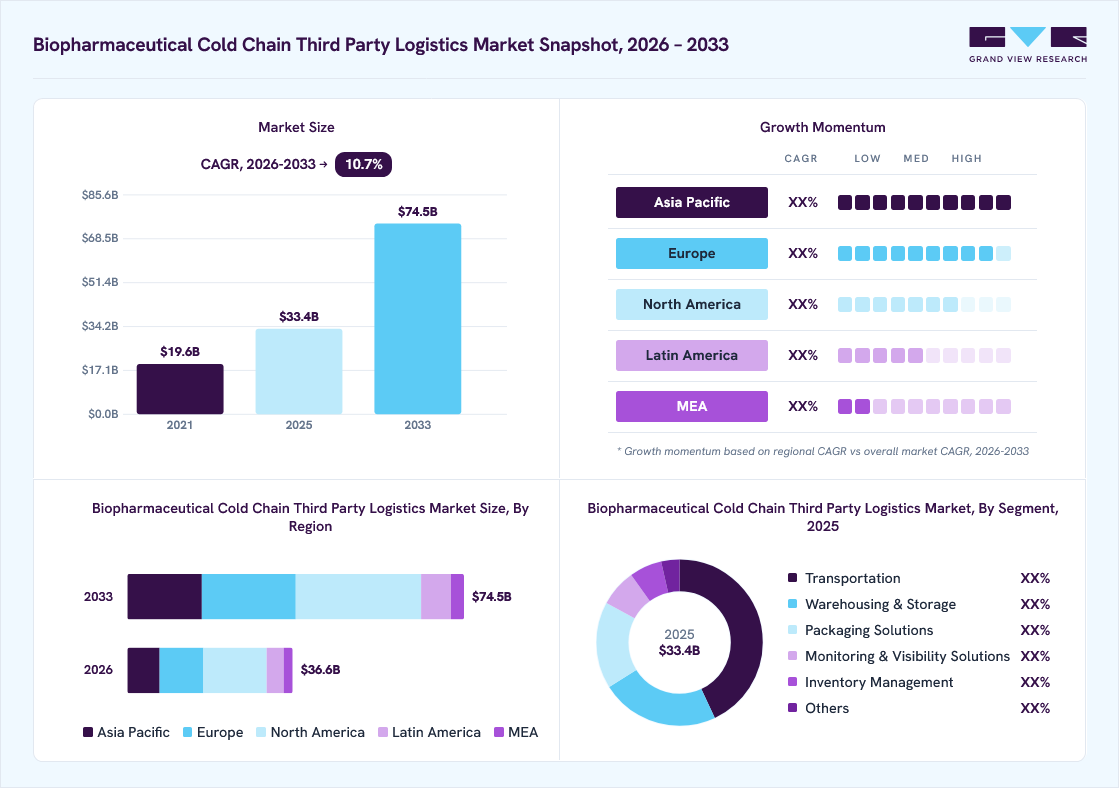
The global biopharmaceutical cold chain third party logistics market size was valued at USD 33.4 billion in 2025 and is projected to grow from USD 36.6 billion in 2026 to USD 74.5 billion by 2033, growing at a CAGR of 10.7% from 2026 to 2033. North America dominated the market, accounting for the largest global share of 38.3% in 2025. This market growth is due to the rising demand for temperature-sensitive pharmaceuticals, stringent drug storage and transportation regulatory requirements, and the global expansion of biologics and vaccine distribution.
 Source: Grand View Research, IR Documents, Primary Interviews, Paid DatabasesTo learn more about this report,
 Download Free Sample Report
Key Market Trends & Insights
- By service: Transportation segment held the largest revenue share of 43.0% in 2025.
- By temperature range: Frozen segment held the largest revenue share of 52.7% in 2025.
Regional Highlights
- Largest regional market: North America (38.3% revenue share, 2025)
- Fastest-growing regional market: Asia Pacific (highest CAGR, 2026–2033)
- By country: The U.S. held the largest share of North America in 2025.
Market Size & Forecast
- Market size in 2025: USD 33.4 Billion
- Estimated market size in 2026: USD 36.6 Billion
- Projected market size by 2033: USD 74.5 Billion
- CAGR (2026-2033): 10.7%
Three ways to get this report
Buy it, customize it, or ask a question.Ask an Analyst
Analyst response in 1 business day
- AccessReport author, directly
- Reply timeWithin 1 working day
- No sales callDirect answer only
- FormatEmail reply
- CostFree, no cost
Get the Full Report
What the study covers
- FormatsPDF · Excel · Dashboard
- Timeline2026–2033 annual, 2025 base
- Coverage20+ countries, 5 regions
- Companies10+ key players profiled
Customize the Report
20% free customization
- IncludeCountries, segments, points
- TailorTo your product definition
- ExtendDeeper competitor detail
- OrA fully bespoke study
- Turnaround5–10 working days
In addition, increasing outsourcing of logistics services by pharmaceutical companies is further driving market expansion. Furthermore, increasing demand for biologics, vaccines, and temperature-sensitive drugs has significantly expanded the need for reliable cold chain logistics solutions. Biologics, including monoclonal antibodies, gene therapies, and recombinant proteins, require stringent temperature control, typically between 2°C and 8°C, with some requiring ultra-low storage at -70°C or lower-to maintain their efficacy.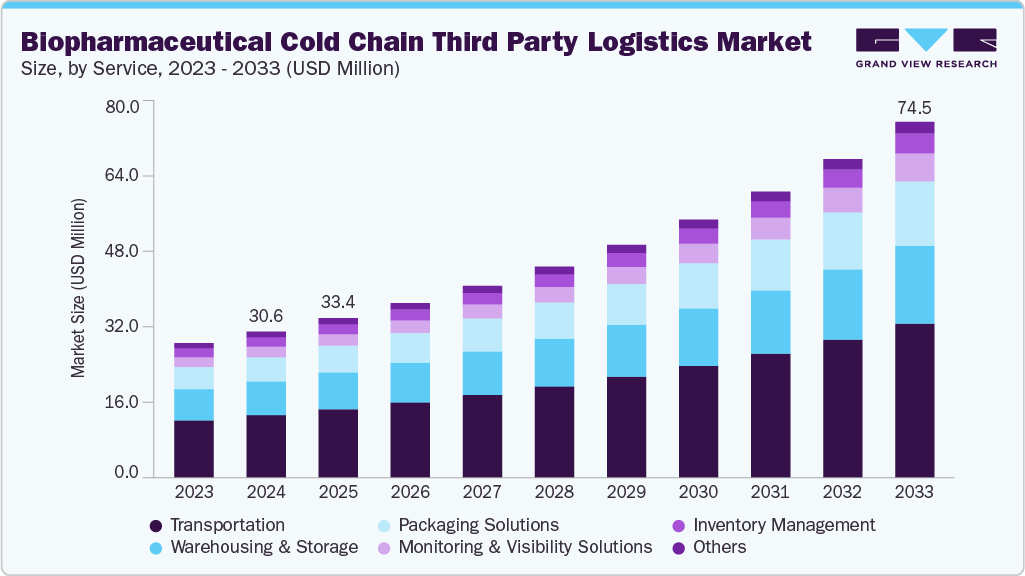 To learn more about this report, Download Free Sample Report
Moreover, the growing trend towards personalized medicine has further boosted the need for specialized logistics solutions to ensure product integrity throughout the supply chain.
Market Dynamics
The biopharmaceutical cold chain third-party logistics market is driven by the expanding production and commercialization of temperature-sensitive therapies, including biologics, biosimilars, vaccines, plasma products, specialty injectables, and cell & gene therapies. As these products require strict temperature control across storage, transportation, packaging, and distribution, demand for specialized cold chain 3PL services is increasing across clinical and commercial supply chains. The market is also benefiting from the rising adoption of advanced temperature ranges, including frozen, ultra-frozen, and cryogenic logistics, particularly for high-value biologics and personalized therapies.
Moreover, technology integration is reshaping the market dynamics, with AI-enabled visibility, real-time monitoring, GPS tracking, data loggers, automated alerts, and inventory platforms improving shipment control and compliance readiness. Besides, growing decentralized clinical trials, direct-to-patient delivery models, and global biologics distribution are further supporting demand for flexible, end-to-end logistics solutions. Sustainability is also becoming an important market theme, encouraging the use of reusable packaging, optimized shipment planning, and energy-efficient storage systems. Thus, the market is shifting towards integrated, compliant, technology-enabled, and specialized logistics models that support product integrity, faster delivery, and reliable biopharmaceutical access.
The growth in AI-enabled cold chain visibility stands out as a key driver for the biopharmaceutical cold chain third-party logistics market. This is largely due to the fact that temperature-sensitive biologics, vaccines, biosimilars, specialty drugs, and cell & gene therapies require meticulous monitoring across complex distribution networks. AI-based platforms facilitate real-time tracking of shipment location, temperature, humidity, route deviations, handling conditions, and potential excursion risks. Such monitoring plays a major role in biopharmaceutical logistics, where minor temperature deviations can significantly impact product stability, regulatory compliance, and patient safety.
Furthermore, the adoption of AI allows for predictive alerts, route optimization, automated exception management, and data-driven decision-making for logistics providers and biopharmaceutical companies alike. As clinical trials become increasingly decentralized and commercial distribution expands into global and regional markets, the demand for proactive cold chain control continues to grow. Compared to sustainable packaging, direct-to-patient (DTP) logistics, and blockchain adoption, AI-enabled visibility has a wider range of applications across transportation, warehousing, inventory management, and last-mile delivery. Thus, it serves as a core growth driver by enhancing supply chain reliability, minimizing product loss, reinforcing compliance, and ensuring comprehensive temperature integrity throughout the process.
A major restraint for the biopharmaceutical cold chain third-party logistics market is the high cost and operational complexity of maintaining validated temperature control across storage, transportation, packaging, and last-mile delivery. Biopharmaceutical products such as biologics, vaccines, plasma products, biosimilars, and cell & gene therapies require strict temperature ranges, including refrigerated, frozen, ultra-frozen, and cryogenic conditions. This increases the need for specialized warehouses, refrigerated fleets, insulated packaging, dry ice, liquid nitrogen systems, calibrated monitoring devices, trained personnel, and compliant documentation. WHO guidance emphasizes controlled storage and transport requirements for time- and temperature-sensitive pharmaceutical products, while temperature excursions can deteriorate product quality and require investigation, reporting, or product rejection.
These requirements raise service costs for 3PL providers and increase outsourcing expenses for biopharmaceutical companies. In addition, route disruptions, customs delays, infrastructure gaps, and inconsistent cold chain capabilities across emerging regions can increase excursion risk. As a result, cost pressure and execution complexity may limit adoption among small and mid-sized biopharmaceutical companies.
The biopharmaceutical cold chain third-party logistics market is gaining strong growth opportunity from the rising adoption of cell & gene therapies, specialty biologics, personalized medicines, and other high-value temperature-sensitive products. These therapies require advanced logistics capabilities beyond conventional cold chain services, including cryogenic storage, ultra-low temperature transportation, validated packaging, real-time monitoring, chain-of-custody tracking, and chain-of-identity management. As many advanced therapies are patient-specific and time-sensitive, logistics accuracy directly affects product quality, treatment scheduling, regulatory compliance, and patient outcomes.
This creates a strong need for specialized 3PL providers that can manage complex handling requirements across clinical and commercial distribution. Increasing clinical trial activity, broader commercialization of biologics, and expansion of advanced therapy pipelines are expected to raise demand for integrated cold chain solutions. The opportunity is significantly strong across cryogenic logistics, ultra-frozen storage, digital shipment visibility, temperature excursion management, and compliance documentation. Thus, cold chain 3PL providers can capture higher-value service revenue by offering reliable, end-to-end logistics support for complex biopharmaceutical products.
Analyst Perspective
The biopharmaceutical cold chain third-party logistics market is positioned for steady growth as temperature-sensitive therapies continue to represent a larger share of pharmaceutical pipelines and commercial portfolios. Demand is increasingly shaped by the need for validated storage, controlled transportation, shipment visibility, and strict temperature integrity across refrigerated, frozen, ultra-frozen, and cryogenic ranges.
The market is shifting from basic logistics support to a specialized supply chain function that directly influences product quality, regulatory compliance, patient access, and treatment continuity. Rising biologics adoption, vaccine distribution, clinical trial decentralization, and cell & gene therapy commercialization are expected to increase demand for integrated cold chain models. Technology-enabled monitoring, route optimization, risk-based packaging, and inventory visibility are becoming essential rather than optional. Going forward, market differentiation will depend on reliability, regulatory alignment, temperature excursion prevention, scalability, and the ability to support complex biopharmaceutical products across both clinical and commercial distribution channels.
Opportunity Analysis
Continuous expansion of the biopharmaceutical sector and emerging markets in Asia-Pacific, Latin America, and the Middle East are creating significant growth opportunities for cold chain logistics providers. The increasing trend of biopharmaceutical companies outsourcing their logistics operations to 3PL providers allows for cost optimization and operational efficiency. In addition, the rise of cell & gene therapies, which require ultra-cold storage, is creating new opportunities for logistics service providers.
Companies offering end-to-end cold chain solutions, from warehousing to last-mile delivery, are projected to gain a competitive advantage in this evolving landscape. For instance, in May 2023, DHL invested approximately USD 1.5 million in introducing a temperature-controlled air freight service based in Indianapolis. This service explicitly supports transporting sensitive medical and biopharmaceutical products across the U.S. and Puerto Rico, enhancing the network's robustness in handling life sciences logistics. This initiative is part of DHL's broader strategy to boost cold chain logistics infrastructure, addressing growing needs for biologics and other temperature-sensitive medicines.
Technological Advancements
The market is undergoing a transformation driven by technological innovations. IoT-enabled tracking systems, AI-driven predictive analytics, and blockchain-based supply chain management solutions enhance visibility and efficiency across logistics networks. Real-time temperature monitoring ensures compliance with regulatory standards, reducing risks associated with temperature excursions. Moreover, autonomous refrigerated vehicles and drone-based pharmaceutical deliveries are revolutionizing last-mile distribution. These advancements improve operational efficiency and minimize losses associated with spoilage and regulatory non-compliance.
Comparative Regional Matrix, by Technology
Region
Adoption of IoT & AI
Blockchain Integration
Automated Warehousing
North America
High
Moderate
High
Europe
High
High
Moderate
Asia-Pacific
Moderate
Emerging
High
Latin America
Low
Emerging
Moderate
Middle East & Africa
Moderate
Low
Emerging
North America leads in IoT-based monitoring and automated warehousing, while Europe is rapidly integrating blockchain for secure cold chain management. Asia-Pacific is emerging as a hub due to its vast geography and high demand for fast deliveries.
Pricing Analysis
The pricing structure in the market is influenced by factors such as service model, transportation mode, and storage requirements, with providers offering flexible solutions tailored to client needs. Dedicated cold storage is a high-cost model ideal for large pharmaceutical manufacturers requiring exclusive temperature-controlled warehousing. Pay-per-use warehousing provides a cost-effective, scalable option for mid-sized pharma companies and distributors, allowing them to access cold storage on demand without long-term commitments. Furthermore, integrated supply chain solutions offer end-to-end logistics, covering storage, transportation, and distribution, making them a preferred choice for companies seeking streamlined and cost-efficient operations.
Service Insights
Based on service, the transportation segment led the market with the largest revenue share of 43.0% in 2025. The growth is mainly due to the rising global trade of temperature-sensitive pharmaceuticals, including biologics and vaccines, which require stringent cold chain logistics. Furthermore, the expansion of cross-border pharmaceutical distribution, coupled with increasing outsourcing of logistics by pharmaceutical companies, is leading to growing investments in specialized refrigerated transport solutions.
The monitoring & visibility solutions segment is projected to grow at the fastest CAGR due to the increasing need for real-time tracking, compliance, and risk mitigation in cold chain logistics. Adopting advanced technologies ensures product integrity, minimizes spoilage, and enhances supply chain transparency.
Temperature Range Insights
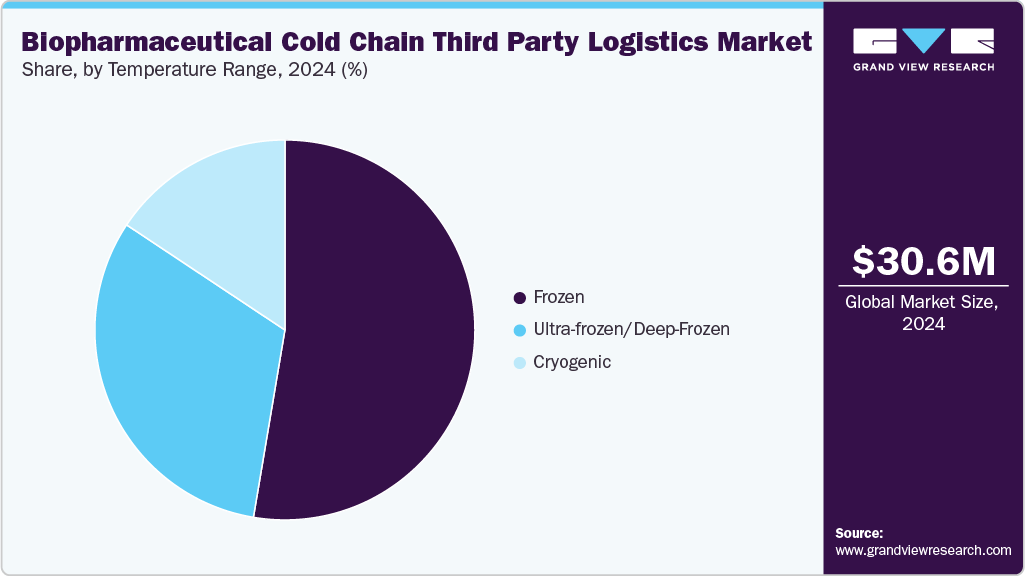
Based on temperature range, the frozen segment led the market with the largest revenue share of 52.7% in 2025. The segment’s growth is due to the high volume of biologics, vaccines, and specialty pharmaceuticals that require storage temperatures between -20°C and -80°C. The increasing adoption of frozen storage for cell-based therapies, blood plasma, and insulin has further strengthened demand for reliable cold chain solutions.
 To learn more about this report, Download Free Sample Report
The ultra-frozen/deep-frozen segment is projected to grow at the fastest CAGR during the forecast period. The growth is due to the rising demand for temperature-sensitive biopharmaceuticals, such as cell and gene therapies, vaccines, and advanced biologics, which often require storage and transport at ultra-low temperatures to maintain efficacy. In addition, the growing prevalence of chronic and rare diseases has accelerated the development of such therapies, further boosting the need for robust ultra-frozen logistics solutions.
Regional Insights
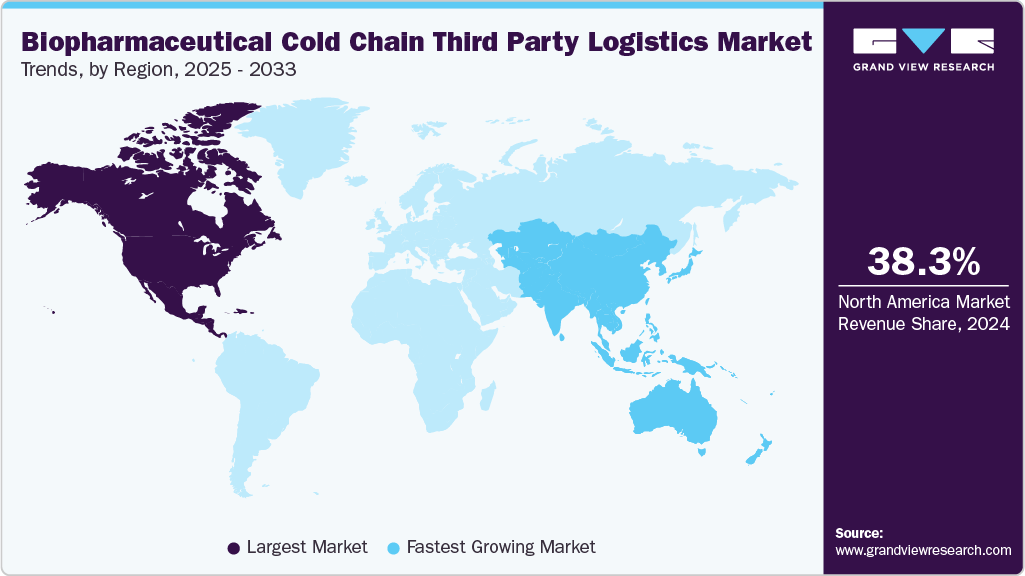
North America dominated the biopharmaceutical cold chain third party logistics market with the largest revenue share of 38.3% in 2025. due to its advanced biopharmaceutical industry and a well-regulated framework. The region has seen significant investments in temperature-controlled warehouses, IoT-enabled tracking systems, and AI-driven route optimization. The rising demand for biologics, gene therapies, and personalized medicine has further strengthened its cold chain infrastructure.
 To learn more about this report, Download Free Sample Report
U.S. Biopharmaceutical Cold Chain Third Party Logistics Market Trends
The biopharmaceutical cold chain third party logistics market in the U.S. held the largest share in the North America region in 2025. The biopharmaceutical cold chain third party logistics market in the U.S. is driven by the country’s highly developed regulatory landscape (FDA, GDP, GMP), which mandates strict cold chain compliance. In addition, rising pharmaceutical exports and increased outsourcing of logistics operations to specialized 3PL providers are further accelerating the market growth.
Europe Biopharmaceutical Cold Chain Third Party Logistics Market Trends
The biopharmaceutical cold chain third party logistics market in Europeis experiencing growth. The region has witnessed a surge in investments in GDP-compliant cold storage facilities and last-mile delivery solutions. The European Medicines Agency (EMA) enforces strict guidelines, compelling logistics providers to adopt real-time temperature monitoring and risk mitigation strategies.
The UK biopharmaceutical cold chain third party logistics market held a significant share in 2025. The country’s market growth is due to its robust pharmaceutical supply chain, with high demand for cold chain logistics due to its strong biotech and vaccine production industry. The impact of Brexit has led to increased complexities in cross-border pharmaceutical trade, making efficient cold chain management essential.
The biopharmaceutical cold chain third-party logistics market in France is driven due to the country’s growing biologics and vaccine production sector. The government’s focus on domestic pharmaceutical manufacturing and R&D investments increases the demand for specialized cold chain services.
The biopharmaceutical cold chain third party logistics market in Germany is anticipated to grow significantly over the forecast period. The country’s logistics firms are increasingly adopting automation, AI-driven supply chain analytics, and IoT-based monitoring to enhance efficiency. Sustainability is a major focus, with investments in hydrogen-powered refrigerated trucks and green warehousing solutions.
Asia Pacific Biopharmaceutical Cold Chain Third Party Logistics Market Trends
The biopharmaceutical cold chain third party logistics market in the Asia Pacific is projected to grow at the highest CAGR over the forecast period. The market's growth is due to rising pharmaceutical manufacturing, vaccine exports, and increasing demand for biologics. The region is witnessing massive investments in temperature-controlled warehouses, IoT-based tracking systems, and express cold chain transportation.
The biopharmaceutical cold chain third party logistics market in China is expected to grow over the forecast period. The country is rapidly expanding its cold storage and refrigerated transport infrastructure to meet rising demand. Government regulations on pharmaceutical cold chain compliance are becoming stricter, further driving investments in GDP-certified logistics solutions.
Japan biopharmaceutical cold chain third party logistics market is witnessing significant growth over the forecast period. The country has advanced regulatory compliance, high-tech logistics solutions, and an increasing demand for regenerative medicine. It also has one of the most sophisticated cold chain infrastructures, extensively using robotic cold storage, AI-driven logistics management, and RFID-based tracking.
The biopharmaceutical cold chain third party logistics market in India is witnessing considerable growth due to increasing government support. The government’s "Make in India" initiative is accelerating the development of domestic cold chain infrastructure. The growth of online pharmacy platforms and e-commerce-driven drug deliveries increases the need for last-mile cold chain solutions.
Key Biopharmaceutical Cold Chain Third Party Logistics Company Insights
Key players in the market are actively enhancing their service offerings to meet the growing demand for temperature-sensitive pharmaceutical products. Companies such as Cardinal Health, DHL Group, and Agility are investing in advanced technologies like IoT-enabled tracking systems, real-time temperature monitoring, and automated warehousing solutions. These innovations aim to ensure the integrity and safety of healthcare products during transit. For instance, in October 2024, UPS acquired Frigo-Trans and its sister company BPL. This strategic initiative aims to enhance UPS Healthcare's end-to-end temperature-controlled and time-critical transportation solutions, addressing the growing demands of the pharmaceutical and biotech industries.
Key Biopharmaceutical Cold Chain Third Party Logistics Companies
The following key companies have been profiled for this study on the biopharmaceutical cold chain third party logistics market.
-
Cardinal Health
-
DHL Group
-
Agility
-
SF Express
-
Kinesis Medical B.V.
-
United Parcel Service of America, Inc.
-
Barrett Distribution
-
Cencora
-
DB Schenker
-
FedEx
-
KUEHNE + NAGEL
-
Kerry Logistics Network Ltd.
-
Freight Logistics Solutions
Competitive Benchmarking
Category
Operating Strategies
Competitive Edge
Weakness
Established Players (Cardinal Health, DHL Group, Agility)
- Established players focus on expanding temperature-controlled networks, GDP-compliant infrastructure, validated packaging, real-time monitoring, and integrated transportation capabilities. They strengthen biopharmaceutical logistics through global partnerships, specialized healthcare warehouses, digital visibility platforms, and multimodal shipment models covering frozen, ultra-frozen, refrigerated, and cryogenic supply chain requirements.
- Established players hold a strong competitive edge through global route coverage, large-scale cold chain capacity, regulatory expertise, validated handling processes, and long-standing relationships with biopharmaceutical manufacturers. Their ability to offer end-to-end services, risk mitigation, shipment visibility, and reliable temperature integrity supports higher client retention and market leadership.
- Established players may face operational challenges from high infrastructure costs, complex compliance requirements, capacity constraints during demand surges, and dependence on global trade lanes. Their large operating models can reduce flexibility for customized niche requirements, while temperature excursion risks, labor shortages, and regional infrastructure gaps may affect service consistency.
Emerging Players (
Kinesis Medical B.V., Barrett Distribution, Freight Logistics Solutions)
- Emerging players focus on specialized cold chain services, regional route strength, customized packaging, flexible warehousing, and client-specific logistics support. They build capabilities through technology adoption, niche biopharmaceutical handling, faster service response, partnerships, and targeted investments in temperature-controlled storage, monitoring, and last-mile distribution.
- Emerging players offer flexibility, faster decision-making, customized service models, and focused cold chain expertise for specific biopharmaceutical requirements. Their ability to serve niche clients, regional markets, and specialized temperature-controlled shipments helps them compete against larger providers, especially where personalized support and operational agility are critical.
- Emerging players often face limitations in global network coverage, large-scale infrastructure, capital availability, regulatory depth, and multimodal logistics capacity. Their dependence on selected regions or service categories can restrict scalability, while limited brand recognition, lower bargaining power, and smaller technology investments may affect competitiveness against established providers.
Recent Developments
-
In August 2025, UPS Healthcare announced it would expand its global pharmaceutical logistics network with 20 state-of-the-art facilities and aims to open seven more by the end of the year.
-
In February 2024, DHL announced that it would invest 200 million USD in expanding its life sciences and healthcare logistics capabilities in the U.S. This strategic initiative includes constructing five new state-of-the-art warehouse facilities in Pennsylvania and North Carolina. The new state-of-the-art facilities would enhance the company’s ability to provide end-to-end temperature-controlled storage and distribution, particularly for high-growth segments like cryogenic and frozen biologics.
-
In October 2024, UPS announced that it would expand its healthcare logistics business through internal growth and strategic acquisitions to enhance profitability. The company aims to reduce reliance on volatile sectors by strengthening its presence in healthcare logistics.
Biopharmaceutical Cold Chain Third Party Logistics Market Report Scope
Report Attribute
Details
Market size value in 2025
USD 33.4 billion
Market size value in 2026
USD 36.6 billion
Revenue forecast in 2033
USD 74.5 billion
Growth rate
CAGR of 10.7% from 2026 to 2033
Historical data
2021 - 2025
Forecast period
2026 - 2033
Quantitative units
Revenue in USD million/billion, and CAGR from 2026 to 2033
Report coverage
Revenue forecast, company ranking, competitive landscape, growth factors, and trends
Segments covered
Service, temperature range, region
Regional scope
North America; Europe; Asia Pacific; Latin America; MEA
Country scope
U.S., Canada, Mexico, UK, Germany, France, Italy, Spain, Denmark, Sweden, Norway, Japan, China, India, Thailand, South Korea, Australia, Brazil, Argentina, South Africa, Saudi Arabia, UAE, Kuwait, Oman, Qatar
Key companies profiled
Cardinal Health; DHL Group, Agility; SF Express; Kinesis Medical B.V.; United Parcel Service of America, Inc.; Barrett Distribution; Cencora; DB Schenker; FedEx; KUEHNE + NAGEL; Kerry Logistics Network Ltd.; Freight Logistics Solutions
Customization scope
Free report customization (equivalent up to 8 analysts' working days) with purchase. Addition or alteration to country, regional & segment scope.
Pricing and purchase options
Avail customized purchase options to meet your exact research needs. Explore purchase options
Global Biopharmaceutical Cold Chain Third Party Logistics Market Report Segmentation
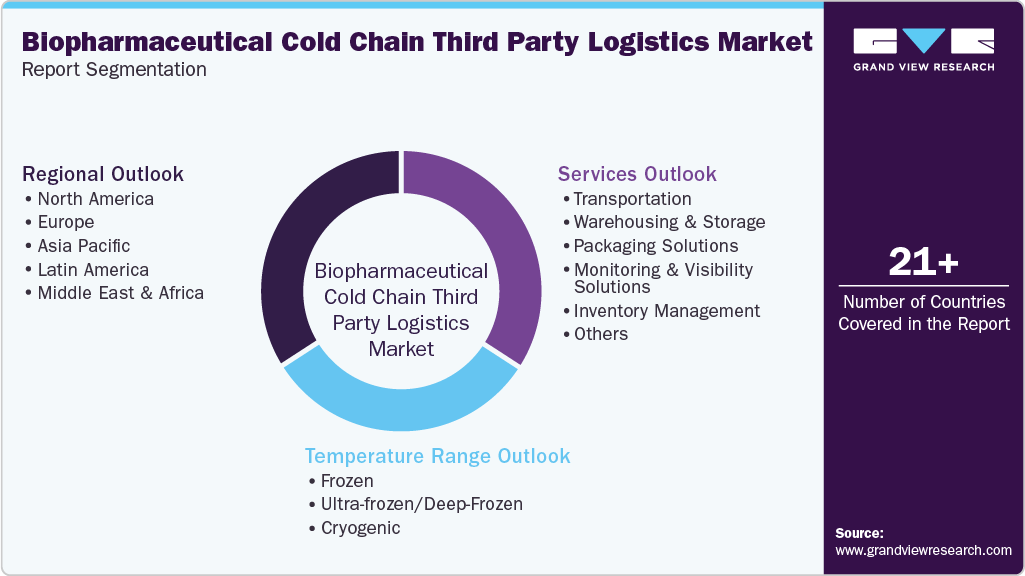
This report forecasts revenue growth and provides an analysis of the latest trends in each of the sub-segments from 2021 to 2033. For this report, Grand View Research has segmented the global biopharmaceutical cold chain third party logistics market based on service, temperature range, and region:
 To learn more about this report, Download Free Sample Report
-
Services Outlook (Revenue, USD Million, 2021 - 2033)
-
Transportation
-
Air Freight
-
Sea Freight
-
Overland
-
-
Warehousing & Storage
-
Packaging Solutions
-
Monitoring & Visibility Solutions
-
Inventory Management
-
Others
-
-
Temperature Range Outlook (Revenue, USD Million, 2021 - 2033)
-
Frozen
-
Ultra-frozen/Deep-Frozen
-
Cryogenic
-
-
Regional Outlook (Revenue, USD Million, 2021 - 2033)
-
North America
-
U.S.
-
Canada
-
Mexico
-
-
Europe
-
UK
-
Germany
-
France
-
Italy
-
Spain
-
Denmark
-
Sweden
-
Norway
-
-
Asia Pacific
-
Japan
-
China
-
India
-
South Korea
-
Australia
-
Thailand
-
-
Latin America
-
Brazil
-
Argentina
-
-
Middle East & Africa
-
South Africa
-
Saudi Arabia
-
UAE
-
Kuwait
-
Oman
-
Qatar
-
-
Research Methodology
The U.S. refractory market figures in this report are based on a proven research process that combines executive interviews with secondary research from proprietary databases, company filings, and recognized regulatory and institutional sources. Market size is built through value-chain sizing-reconciling supply-side and demand-side estimates-and triangulated with bottom-up and top-down approaches. Every estimate passes multiple levels of expert validation before publication, with each U.S. refractory segment quantified using the revenue-capture definitions in the table below.
Segment Definition
Segment - Services
Definition
Transportation
The segment captures revenue generated by providing cold chain third-party logistics services for biopharmaceutical transportation to end users. The segment includes temperature-controlled movement of vaccines, biologics, biosimilars, cell & gene therapies, plasma products, and clinical trial materials across air, sea, and overland routes.
Air Freight
The segment covers revenue generated by providing cold chain third-party logistics services for biopharmaceutical air freight transportation to end users. The segment includes rapid, temperature-controlled shipment of high-value, time-sensitive biologics, vaccines, specialty drugs, clinical trial supplies, and cell & gene therapy products using validated air cargo networks.
Sea Freight
The segment includes revenue generated by providing cold chain third-party logistics services for biopharmaceutical sea freight transportation to end users. The segment includes controlled-temperature ocean shipping, refrigerated containers, insulated shipping systems, long-distance bulk movement, and cost-efficient international transport of stable biopharmaceutical products.
Overland
The segment captures revenue generated by providing cold chain third-party logistics services for biopharmaceutical overland transportation to end users. The segment includes refrigerated trucks, vans, rail logistics, last-mile delivery, regional distribution, and controlled-temperature movement between manufacturing sites, warehouses, hospitals, pharmacies, and research centers.
Warehousing & Storage
The segment covers revenue generated by providing cold chain third-party logistics services for biopharmaceutical warehousing and storage to end users. The segment includes GMP-compliant refrigerated, frozen, cryogenic, and controlled-room-temperature storage for biologics, vaccines, specialty drugs, APIs, samples, and clinical trial materials.
Packaging Solutions
The segment includes revenue generated by providing cold chain third-party logistics services for biopharmaceutical packaging solutions to end users. The segment includes insulated shippers, reusable containers, gel packs, dry ice packaging, phase-change materials, cryogenic packaging, validated packaging design, and temperature-controlled shipment preparation.
Monitoring & Visibility Solutions
The segment captures revenue generated by providing cold chain third-party logistics services for biopharmaceutical monitoring and visibility solutions to end users. The segment includes temperature sensors, data loggers, GPS tracking, real-time shipment monitoring, route visibility, excursion alerts, compliance reporting, and digital control tower solutions.
Inventory Management
The segment covers revenue generated by providing cold chain third-party logistics services for biopharmaceutical inventory management to end users. The segment includes stock control, batch tracking, expiry management, lot-level traceability, order fulfillment, returns handling, demand planning support, and cold chain inventory optimization.
Others
The segment includes revenue generated by providing other cold chain third-party logistics services for biopharmaceutical products to end users. The segment includes customs clearance support, regulatory documentation, reverse logistics, quality assurance services, clinical trial logistics coordination, returns management, temperature excursion handling, and value-added logistics support.
Segment - Temperature Range
Definition
Frozen
The segment captures revenue generated by providing cold chain third-party logistics temperature range services for biopharmaceutical products to end users. The segment includes frozen storage and transportation, typically around -20°C, for biologics, vaccines, specialty drugs, plasma products, samples, and clinical trial materials requiring validated frozen temperature control.
Ultra-frozen/Deep-Frozen
The segment covers revenue generated by providing cold chain third-party logistics temperature range services for biopharmaceutical products to end users. The segment includes ultra-low temperature storage and transportation, typically between -70°C and -80°C, for mRNA vaccines, advanced biologics, cell-based products, specialty injectables, and temperature-sensitive clinical trial supplies.
Cryogenic
The segment includes revenue generated by providing cold chain third-party logistics temperature range services for biopharmaceutical products to end users. The segment includes cryogenic storage and transportation, typically below -150°C using liquid nitrogen or vapor-phase systems, for cell & gene therapies, stem cells, biologic samples, reproductive materials, and highly sensitive advanced therapy products.
Estimation Model
BIOPHARMACEUTICAL COLD CHAIN 3PL MARKET ESTIMATION METHODOLOGY
METHODOLOGY OVERVIEW: The market estimation for biopharmaceutical cold chain third-party logistics should be based on a triangulated methodology that combines revenue mapping, demand validation, service capacity assessment, and regional outsourcing trends. This approach supports a reliable market view by capturing both commercial supply chain requirements and specialized cold chain service adoption across biopharmaceutical end users.
01
TOP-DOWN APPROACH02
BOTTOM-UP APPROACH03
SUPPLY-SIDE ESTIMATION04
DATA TRIANGULATION APPROACHThe top-down model estimates the biopharmaceutical cold chain third-party logistics market by starting with the overall pharmaceutical logistics or healthcare cold chain logistics market and narrowing it to biopharmaceutical-specific cold chain 3PL services. The allocation is based on temperature-sensitive biologics, vaccines, specialty drugs, clinical trial materials, and outsourcing penetration across transportation, warehousing, packaging, and monitoring services.
The bottom-up model estimates the market by aggregating revenue generated by key service providers offering biopharmaceutical cold chain third-party logistics services. Company revenues are mapped across transportation, warehousing, storage, packaging, monitoring, and value-added logistics services. Adjustments are applied for regional presence, biopharma client mix, temperature range coverage, and service utilization across commercial and clinical supply chains.
The supply-side model assesses the market from the service provider perspective by analyzing logistics capacity, cold storage infrastructure, refrigerated fleet availability, packaging capabilities, monitoring platforms, and regional distribution networks. Revenue is estimated through provider service portfolios, contract volumes, facility utilization, temperature-controlled lane coverage, and pricing structures across frozen, ultra-frozen, cryogenic, refrigerated, and controlled-room-temperature logistics services.
The triangulation model validates the final market estimates by cross-checking top-down, bottom-up, demand-side, and supply-side outputs. Variations are reconciled using company disclosures, shipment trends, cold storage capacity, biologics production volumes, vaccine distribution demand, clinical trial activity, and regional outsourcing maturity. This ensures balanced, realistic, and commercially defensible market sizing for biopharmaceutical cold chain third-party logistics.
Delivered Customizations
This report has been delivered with the following In-depth customizations
Client Request
Customization Delivered
Value Adds
Cross-Segmentation Opportunity Assessment
Detailed cross-segmentation analysis can be delivered across service, therapeutic area, end use, and region, such as personal promotion for oncology drugs, remote MSL support for biopharma companies, or nurse educator demand in metabolic disorders across key countries.
Supported to identify high-growth CSO service areas, therapy-specific outsourcing demand, client-type revenue pockets, and priority segments for commercial salesforce deployment and medical engagement support.
Regional Expansion & Market Entry Assessment
Country-level market entry analysis can be delivered across North America, Europe, Asia Pacific, Latin America, and MEA based on pharma salesforce outsourcing maturity, regulatory environment, physician access, product launch activity, and local commercial infrastructure.
Supports regional prioritization, salesforce deployment planning, partner selection, market entry strategy, and expansion decisions for healthcare CSO providers targeting pharmaceutical, biopharmaceutical, and medical device clients.
Competitive Dynamics & Operating Model Benchmarking
Competitive benchmarking can be delivered across CSO providers based on service portfolio, therapeutic expertise, salesforce size, key account management capabilities, medical affairs support, digital promotion tools, remote engagement models, and geographic coverage.
Enables assessment of competitive positioning, capability gaps, differentiated service offerings, pricing models, and strategic opportunities in personal promotion, non-personal promotion, MSL support, and clinical educator services.
Volume, Productivity & Commercial Effectiveness Analysis
Volume analysis can be delivered across sales representative deployment, vacancy management demand, product launch support, HCP reach, call frequency, remote engagement volume, account coverage, and therapy-specific promotional activity by region and end use.
Provides deeper visibility into salesforce utilization, field productivity, promotional effectiveness, client demand intensity, and future investment areas across outsourced healthcare commercial and medical affairs support models.
Frequently Asked Questions About This Report
The global biopharmaceutical cold chain third-party logistics market size was estimated at USD 33.4 billion in 2025 and is expected to reach USD 36.6 billion in 2026.
The global biopharmaceutical cold chain third-party logistics market is expected to grow at a CAGR of 10.7% from 2026 to 2033, reaching USD 74.5 billion.
Some key players operating in the biopharmaceutical cold chain third-party logistics market include Cardinal Health, DHL Group, Agility, SF Express, Kinesis Medical B.V., United Parcel Service of America, Inc., Barrett Distribution, Cencora, DB Schenker, FedEx, KUEHNE + NAGEL, Kerry Logistics Network Ltd., Freight Logistics Solutions
Key factors that are driving the market growth include rising demand for temperature-sensitive pharmaceuticals, stringent regulatory requirements for drug storage and transportation, and the expansion of biologics and vaccine distribution globally.
Asia Pacific is the fastest-growing region over the forecast period.
The transportation segment led with a 43.0% revenue share in 2025, while monitoring & visibility solutions is the fastest-growing segment.
The frozen segment led with a 52.7% revenue share in 2025, while ultra-frozen/deep-frozen is the fastest-growing segment.
North America dominated with a 38.3% revenue share in 2025.
About the Author(s)
Medical Devices Research Team
Healthcare · Medical DevicesThis report was authored by the medical devices research team at Grand View Research - comprising two research analysts, one senior research analyst, and one industry expert - with specialized expertise in the medical devices segment of the healthcare industry. All findings are based on proprietary healthcare databases, executive interviews, and regulatory analysis, subject to internal peer review prior to publication.
Last Updated:
Speak to Analyst

Customize this report to your needs - add regions, segments, or data points, with 20% free customization.
Or view our licence options:


ISO 9001:2015 & 27001:2022 Certified
We are GDPR and CCPA compliant! Your transaction & personal information is safe and secure. For more details, please read our privacy policy.


